Hubbry Logo
Multipole expansionMultipole expansionMain
Open search
Multipole expansion
Community hub
Multipole expansion
logo
7 pages, 0 posts
0 subscribers
Be the first to start a discussion here.
Multipole expansion
Multipole expansion
from Wikipedia

A multipole expansion is a mathematical series representing a function that depends on angles—usually the two angles used in the spherical coordinate system (the polar and azimuthal angles) for three-dimensional Euclidean space, . Multipole expansions are useful because, similar to Taylor series, oftentimes only the first few terms are needed to provide a good approximation of the original function. The function being expanded may be real- or complex-valued and is defined either on , or less often on for some other .

Multipole expansions are used frequently in the study of electromagnetic and gravitational fields, where the fields at distant points are given in terms of sources in a small region. The multipole expansion with angles is often combined with an expansion in radius. Such a combination gives an expansion describing a function throughout three-dimensional space.[1]

The multipole expansion is expressed as a sum of terms with progressively finer angular features (moments). The first (the zeroth-order) term is called the monopole moment, the second (the first-order) term is called the dipole moment, the third (the second-order) the quadrupole moment, the fourth (third-order) term is called the octupole moment, and so on. Given the limitation of Greek numeral prefixes, terms of higher order are conventionally named by adding "-pole" to the number of poles—e.g., 32-pole (rarely dotriacontapole or triacontadipole) and 64-pole (rarely tetrahexacontapole or hexacontatetrapole).[2][3][4] A multipole moment usually involves powers (or inverse powers) of the distance to the origin, as well as some angular dependence.

In principle, a multipole expansion provides an exact description of the potential, and generally converges under two conditions: (1) if the sources (e.g. charges) are localized close to the origin and the point at which the potential is observed is far from the origin; or (2) the reverse, i.e., if the sources are located far from the origin and the potential is observed close to the origin. In the first (more common) case, the coefficients of the series expansion are called exterior multipole moments or simply multipole moments whereas, in the second case, they are called interior multipole moments.

Expansion in spherical harmonics

[edit]

Most commonly, the series is written as a sum of spherical harmonics. Thus, we might write a function as the sum where are the standard spherical harmonics, and are constant coefficients which depend on the function. The term represents the monopole; represent the dipole; and so on. Equivalently, the series is also frequently written[5] as where the represent the components of a unit vector in the direction given by the angles and , and indices are implicitly summed. Here, the term is the monopole; is a set of three numbers representing the dipole; and so on.

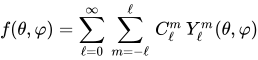
In the above expansions, the coefficients may be real or complex. If the function being expressed as a multipole expansion is real, however, the coefficients must satisfy certain properties. In the spherical harmonic expansion, we must have In the multi-vector expansion, each coefficient must be real:


While expansions of scalar functions are by far the most common application of multipole expansions, they may also be generalized to describe tensors of arbitrary rank.[6] This finds use in multipole expansions of the vector potential in electromagnetism, or the metric perturbation in the description of gravitational waves.

For describing functions of three dimensions, away from the coordinate origin, the coefficients of the multipole expansion can be written as functions of the distance to the origin, —most frequently, as a Laurent series in powers of . For example, to describe the electromagnetic potential, , from a source in a small region near the origin, the coefficients may be written as:

Applications

[edit]

Multipole expansions are widely used in problems involving gravitational fields of systems of masses, electric and magnetic fields of charge and current distributions, and the propagation of electromagnetic waves. A classic example is the calculation of the exterior multipole moments of atomic nuclei from their interaction energies with the interior multipoles of the electronic orbitals. The multipole moments of the nuclei report on the distribution of charges within the nucleus and, thus, on the shape of the nucleus. Truncation of the multipole expansion to its first non-zero term is often useful for theoretical calculations.

Multipole expansions are also useful in numerical simulations, and form the basis of the fast multipole method of Greengard and Rokhlin, a general technique for efficient computation of energies and forces in systems of interacting particles. The basic idea is to decompose the particles into groups; particles within a group interact normally (i.e., by the full potential), whereas the energies and forces between groups of particles are calculated from their multipole moments. The efficiency of the fast multipole method is generally similar to that of Ewald summation, but is superior if the particles are clustered, i.e. the system has large density fluctuations.

Multipole expansion of a potential outside an electrostatic charge distribution

[edit]

Consider a discrete charge distribution consisting of N point charges qi with position vectors ri. We assume the charges to be clustered around the origin, so that for all i: ri < rmax, where rmax has some finite value. The potential V(R), due to the charge distribution, at a point R outside the charge distribution, i.e., |R| > rmax, can be expanded in powers of 1/R. Two ways of making this expansion can be found in the literature: The first is a Taylor series in the Cartesian coordinates x, y, and z, while the second is in terms of spherical harmonics which depend on spherical polar coordinates. The Cartesian approach has the advantage that no prior knowledge of Legendre functions, spherical harmonics, etc., is required. Its disadvantage is that the derivations are fairly cumbersome (in fact a large part of it is the implicit rederivation of the Legendre expansion of 1 / |rR|, which was done once and for all by Legendre in the 1780s). Also it is difficult to give a closed expression for a general term of the multipole expansion—usually only the first few terms are given followed by an ellipsis.

Expansion in Cartesian coordinates

[edit]

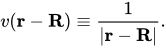
Assume v(r) = v(−r) for convenience. The Taylor expansion of v(rR) around the origin r = 0 can be written as with Taylor coefficients If v(rR) satisfies the Laplace equation, then by the above expansion we have and the expansion can be rewritten in terms of the components of a traceless Cartesian second rank tensor: where δαβ is the Kronecker delta and r2 ≡ |r|2. Removing the trace is common, because it takes the rotationally invariant r2 out of the second rank tensor.


Example

[edit]

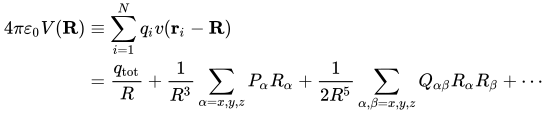
Consider now the following form of v(rR): Then by direct differentiation it follows that Define a monopole, dipole, and (traceless) quadrupole by, respectively, and we obtain finally the first few terms of the multipole expansion of the total potential, which is the sum of the Coulomb potentials of the separate charges:[7]: 137–138 
This expansion of the potential of a discrete charge distribution is very similar to the one in real solid harmonics given below. The main difference is that the present one is in terms of linearly dependent quantities, for

Note: If the charge distribution consists of two charges of opposite sign which are an infinitesimal distance d apart, so that d/R ≫ (d/R)2, it is easily shown that the dominant term in the expansion is the electric dipolar potential field.
Spherical form

[edit]

The potential V(R) at a point R outside the charge distribution, i.e. |R| > rmax, can be expanded by the Laplace expansion: where is an irregular solid harmonic (defined below as a spherical harmonic function divided by ) and is a regular solid harmonic (a spherical harmonic times r). We define the spherical multipole moment of the charge distribution as follows Note that a multipole moment is solely determined by the charge distribution (the positions and magnitudes of the N charges).

A spherical harmonic depends on the unit vector . (A unit vector is determined by two spherical polar angles.) Thus, by definition, the irregular solid harmonics can be written as so that the multipole expansion of the field V(R) at the point R outside the charge distribution is given by

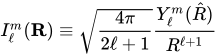
This expansion is completely general in that it gives a closed form for all terms, not just for the first few. It shows that the spherical multipole moments appear as coefficients in the 1/R expansion of the potential.

It is of interest to consider the first few terms in real form, which are the only terms commonly found in undergraduate textbooks. Since the summand of the m summation is invariant under a unitary transformation of both factors simultaneously and since transformation of complex spherical harmonics to real form is by a unitary transformation, we can simply substitute real irregular solid harmonics and real multipole moments. The = 0 term becomes This is in fact Coulomb's law again. For the = 1 term we introduce Then This term is identical to the one found in Cartesian form.

In order to write the = 2 term, we have to introduce shorthand notations for the five real components of the quadrupole moment and the real spherical harmonics. Notations of the type can be found in the literature. Clearly the real notation becomes awkward very soon, exhibiting the usefulness of the complex notation.
Interaction of two non-overlapping charge distributions

[edit]

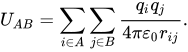
Consider two sets of point charges, one set {qi} clustered around a point A and one set {qj} clustered around a point B. Think for example of two molecules, and recall that a molecule by definition consists of electrons (negative point charges) and nuclei (positive point charges). The total electrostatic interaction energy UAB between the two distributions is This energy can be expanded in a power series in the inverse distance of A and B. This expansion is known as the multipole expansion of UAB.
In order to derive this multipole expansion, we write rXY = rYrX, which is a vector pointing from X towards Y. Note that We assume that the two distributions do not overlap: Under this condition we may apply the Laplace expansion in the following form where and are irregular and regular solid harmonics, respectively. The translation of the regular solid harmonic gives a finite expansion, where the quantity between pointed brackets is a Clebsch–Gordan coefficient. Further we used Use of the definition of spherical multipoles Qm
and covering of the summation ranges in a somewhat different order (which is only allowed for an infinite range of L) gives finally


This is the multipole expansion of the interaction energy of two non-overlapping charge distributions which are a distance RAB apart. Since this expansion is manifestly in powers of 1 / RAB. The function Yml is a normalized spherical harmonic.

Molecular moments

[edit]

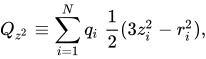
All atoms and molecules (except S-state atoms) have one or more non-vanishing permanent multipole moments. Different definitions can be found in the literature, but the following definition in spherical form has the advantage that it is contained in one general equation. Because it is in complex form it has as the further advantage that it is easier to manipulate in calculations than its real counterpart.

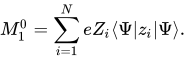
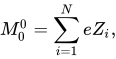
We consider a molecule consisting of N particles (electrons and nuclei) with charges eZi. (Electrons have a Z-value of −1, while for nuclei it is the atomic number). Particle i has spherical polar coordinates ri, θi, and φi and Cartesian coordinates xi, yi, and zi. The (complex) electrostatic multipole operator is where is a regular solid harmonic function in Racah's normalization (also known as Schmidt's semi-normalization). If the molecule has total normalized wave function Ψ (depending on the coordinates of electrons and nuclei), then the multipole moment of order of the molecule is given by the expectation (expected) value: If the molecule has certain point group symmetry, then this is reflected in the wave function: Ψ transforms according to a certain irreducible representation λ of the group ("Ψ has symmetry type λ"). This has the consequence that selection rules hold for the expectation value of the multipole operator, or in other words, that the expectation value may vanish because of symmetry. A well-known example of this is the fact that molecules with an inversion center do not carry a dipole (the expectation values of vanish for m = −1, 0, 1). For a molecule without symmetry, no selection rules are operative and such a molecule will have non-vanishing multipoles of any order (it will carry a dipole and simultaneously a quadrupole, octupole, hexadecapole, etc.).

The lowest explicit forms of the regular solid harmonics (with the Condon-Shortley phase) give: (the total charge of the molecule). The (complex) dipole components are:

Note that by a simple linear combination one can transform the complex multipole operators to real ones. The real multipole operators are of cosine type or sine type . A few of the lowest ones are:

Note on conventions

[edit]

The definition of the complex molecular multipole moment given above is the complex conjugate of the definition given in this article, which follows the definition of the standard textbook on classical electrodynamics by Jackson,[7]: 137  except for the normalization. Moreover, in the classical definition of Jackson the equivalent of the N-particle quantum mechanical expectation value is an integral over a one-particle charge distribution. Remember that in the case of a one-particle quantum mechanical system the expectation value is nothing but an integral over the charge distribution (modulus of wavefunction squared), so that the definition of this article is a quantum mechanical N-particle generalization of Jackson's definition.

The definition in this article agrees with, among others, the one of Fano and Racah[8] and Brink and Satchler.[9]

Examples

[edit]

There are many types of multipole moments, since there are many types of potentials and many ways of approximating a potential by a series expansion, depending on the coordinates and the symmetry of the charge distribution. The most common expansions include:

Examples of 1/R potentials include the electric potential, the magnetic potential and the gravitational potential of point sources. An example of a ln R potential is the electric potential of an infinite line charge.

General mathematical properties

[edit]

Multipole moments in mathematics and mathematical physics form an orthogonal basis for the decomposition of a function, based on the response of a field to point sources that are brought infinitely close to each other. These can be thought of as arranged in various geometrical shapes, or, in the sense of distribution theory, as directional derivatives.

Multipole expansions are related to the underlying rotational symmetry of the physical laws and their associated differential equations. Even though the source terms (such as the masses, charges, or currents) may not be symmetrical, one can expand them in terms of irreducible representations of the rotational symmetry group, which leads to spherical harmonics and related sets of orthogonal functions. One uses the technique of separation of variables to extract the corresponding solutions for the radial dependencies.

In practice, many fields can be well approximated with a finite number of multipole moments (although an infinite number may be required to reconstruct a field exactly). A typical application is to approximate the field of a localized charge distribution by its monopole and dipole terms. Problems solved once for a given order of multipole moment may be linearly combined to create a final approximate solution for a given source.

See also

[edit]

References

[edit]
Revisions and contributorsEdit on WikipediaRead on Wikipedia
from Grokipedia
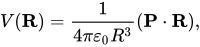
In physics, the multipole expansion is a mathematical series representation of the scalar or vector potential produced by a localized charge or current distribution, approximating the far-field behavior by decomposing it into successive terms of increasing angular order and decreasing radial dependence, starting from the monopole (ℓ=0), dipole (ℓ=1), quadrupole (ℓ=2), and higher multipoles. This expansion arises from the Taylor series development of the inverse distance in the potential integral, typically using Legendre polynomials or spherical harmonics to handle the angular dependence, allowing the potential V(R) at a distant point R from a compact source of size much smaller than R to be written as V(R) = Σ_{ℓ=0}^∞ [1/(4πε₀ R^{ℓ+1})] ∫ ρ(r') r'^ℓ P_ℓ(cosα) d³r', where ρ is the charge density and α is the angle between R and r'. The monopole term captures the net charge Q_net as V_monopole = Q_net / (4πε₀ R), vanishing for neutral systems, while the dipole term involves the dipole moment p = ∫ r' ρ(r') d³r' with V_dipole = (p · R̂) / (4πε₀ R²), and the quadrupole term uses the traceless tensor Q_{ij} = ∫ (3x_i' x_j' - r'^2 δ_{ij}) ρ(r') d³r' for V_quadrupole = [\hat{R} · Q · \hat{R}] / [2 (4πε₀ R³)]. The technique is essential in electrostatics for simplifying calculations of potentials and fields from complex distributions, such as molecules or nuclei, where direct integration is impractical, and it enables far-field approximations by truncating at the lowest non-vanishing term for desired accuracy. Beyond electrostatics, multipole expansions extend to magnetostatics via magnetic multipole moments, gravitational potentials in , and for atomic and nuclear interactions, with the expansion parameter typically being (source size / observation distance), ensuring convergence outside the source. Higher-order terms like octupoles (ℓ=3) describe finer asymmetries in the source, but their contributions diminish rapidly with distance, making the expansion a powerful tool for both analytical and numerical modeling in diverse physical contexts.

Mathematical Foundations

General Definition

The multipole expansion provides a series representation of scalar or vector potentials generated by localized source distributions at distant points, analogous to a but featuring inverse powers of the distance rr from the source origin to the field point. This method decomposes the potential into contributions from successively higher-order moments of the source, offering approximations that improve with increasing distance from the source relative to its spatial extent. It is fundamental in fields like and for analyzing far-field behaviors without solving the full source distribution explicitly. In its general one-dimensional form, applicable along a line or axis of , the ϕ(r)\phi(\mathbf{r}) due to a source ρ(r)\rho(\mathbf{r}') (with r>rr > r') is expressed as ϕ(r)=n=01rn+1(r)nPn(cosα)ρ(r)dV,\phi(\mathbf{r}) = \sum_{n=0}^{\infty} \frac{1}{r^{n+1}} \int (r')^n P_n(\cos \alpha) \rho(\mathbf{r}') \, dV', where PnP_n denotes the and α\alpha is the angle between r\mathbf{r} and r\mathbf{r}'. For full three-dimensional cases with arbitrary angular dependence, this extends to a sum over Ylm(θ,ϕ)Y_l^m(\theta, \phi), replacing the with a complete angular basis to capture all directional variations. The successive terms represent distinct multipole orders: the n=0n=0 (monopole) term captures the net source strength, such as total charge; the n=1n=1 () term accounts for the first-order asymmetry or moment of the distribution; the n=2n=2 () and higher terms describe more refined spatial variations, serving as perturbative corrections that diminish rapidly for large rr. This hierarchical structure enables truncation at low orders for practical computations while retaining accuracy far from the source. The multipole expansion originated with George Green's 1828 essay on the mathematical analysis of electricity and magnetism, where it was introduced for electrostatic potentials.

Convergence Criteria

The multipole expansion of the electrostatic potential converges absolutely when the distance rr from the expansion center to the observation point exceeds the maximum distance rmaxr'_{\max} of any source charge from the center, ensuring the observation point lies outside the smallest sphere enclosing all sources. This condition, r>rmaxr > r'_{\max}, guarantees the validity of the underlying Taylor series expansion of the reciprocal distance 1/rr1/|\mathbf{r} - \mathbf{r}'| in powers of r/rr'/r. For a localized charge distribution confined within a sphere of radius RR, the expansion holds for all r>Rr > R. The series converges, exhibiting rapid convergence as rr increases, with successive terms diminishing in magnitude for large observation distances. However, inside the source (r<rmaxr < r'_{\max}), the expansion generally diverges due to the proximity of singularities from the source charges. To quantify truncation errors, the remainder after the term of order \ell follows from the Taylor theorem applied to the generating function, bounding the error by the magnitude of the next term. For practical estimates, if the expansion is truncated after the 22^\ell-pole (order \ell), the relative error scales as O((R/r)+1)O\left( (R/r)^{\ell+1} \right), where RR is the source radius, highlighting the expansion's utility for far-field approximations. In two dimensions, the multipole expansion for the logarithmic electrostatic potential corresponds to a Laurent series in the complex plane, with convergence governed by the annulus between the expansion center and the nearest source singularity, analyzable via analytic continuation principles from complex analysis. This formulation underscores the series' geometric convergence radius and its limitations near sources.

Electrostatic Potential Expansion

Cartesian Form

The electrostatic potential ϕ(r)\phi(\mathbf{r}) due to a localized charge distribution ρ(r)\rho(\mathbf{r}') at a point r\mathbf{r} far from the origin is given by Coulomb's law in integral form: ϕ(r)=14πϵ0ρ(r)rrdV.\phi(\mathbf{r}) = \frac{1}{4\pi\epsilon_0} \int \frac{\rho(\mathbf{r}')}{|\mathbf{r} - \mathbf{r}'|} \, dV'. This expression holds for any charge distribution confined within a region much smaller than r=rr = |\mathbf{r}|. To obtain the multipole expansion in Cartesian coordinates, expand the denominator 1/rr1/|\mathbf{r} - \mathbf{r}'| using a multivariate Taylor series around r=0\mathbf{r}' = 0, treating r\mathbf{r} as fixed and r\mathbf{r}' as the small displacement. The general term in the expansion is 1rr=n=0(1)nn!rirjrknrirjrk(1r),\frac{1}{|\mathbf{r} - \mathbf{r}'|} = \sum_{n=0}^{\infty} \frac{(-1)^n}{n!} r'_i r'_j \cdots r'_k \frac{\partial^n}{\partial r_i \partial r_j \cdots \partial r_k} \left( \frac{1}{r} \right), where summation over repeated indices i,j,i, j, \ldots from 1 to 3 (corresponding to x,y,zx, y, z) is implied, and the nn-th order term involves nn factors of rlr'_l and nn partial derivatives. This series converges for r<rr' < r. Substituting into the potential integral yields the multipole series by interchanging the sum and integral, assuming the charge distribution is localized. The lowest-order term (n=0n=0) is the monopole contribution, where Q=ρ(r)dVQ = \int \rho(\mathbf{r}') \, dV' is the total charge. The first-order (n=1n=1) term gives the dipole, with components pi=riρ(r)dVp_i = \int r'_i \rho(\mathbf{r}') \, dV'. For the second-order (n=2n=2) quadrupole term, the Cartesian tensor is defined in traceless form as Qij=(3rirjδijr2)ρ(r)dV,Q_{ij} = \int (3 r'_i r'_j - \delta_{ij} r'^2) \rho(\mathbf{r}') \, dV', which is symmetric (Qij=QjiQ_{ij} = Q_{ji}) and traceless (Qii=0Q_{ii} = 0), capturing the deviation from spherical symmetry with five independent components. Higher-order terms follow similarly but grow more complex. The resulting multipole expansion of the potential, truncated at quadrupole order, is ϕ(r)14πϵ0[Qr+prr3+16Qij2rirj(1r)+],\phi(\mathbf{r}) \approx \frac{1}{4\pi\epsilon_0} \left[ \frac{Q}{r} + \frac{\mathbf{p} \cdot \mathbf{r}}{r^3} + \frac{1}{6} Q_{ij} \frac{\partial^2}{\partial r_i \partial r_j} \left( \frac{1}{r} \right) + \cdots \right], where the derivatives act on 1/r1/r, and ij(1/r)=(3rirjδijr2)/r5\partial_i \partial_j (1/r) = (3 r_i r_j - \delta_{ij} r^2)/r^5. Each term falls off as 1/rn+11/r^{n+1} for the nn-th multipole, allowing truncation based on distance and charge asymmetry. This Cartesian form is intuitive for systems with rectangular or cubic symmetry, as the tensor components align directly with coordinate axes, facilitating computation for anisotropic distributions. However, it becomes cumbersome for higher multipoles due to the increasing number of tensor components (e.g., 15 for octupole before symmetrization), often requiring irreducible representations for efficiency.

Spherical Harmonic Form

The spherical harmonic form of the multipole expansion leverages the rotational invariance of the electrostatic potential by separating the radial and angular dependencies using spherical coordinates. This approach is particularly suited for systems with spherical symmetry, providing a compact representation of the angular variations through the orthogonal basis of spherical harmonics Ylm(θ,ϕ)Y_{lm}(\theta, \phi). The expansion begins with the separation of variables for the reciprocal distance in the potential integral, which forms the foundation for expressing the potential due to a localized charge distribution. The key identity for the expansion of 1/rr1/|\mathbf{r} - \mathbf{r}'| assumes r>rr > r' (i.e., the observation point is outside the charge distribution) and is given by 1rr=l=0m=ll4π2l+1r<lr>l+1Ylm(θ,ϕ)Ylm(θ,ϕ),\frac{1}{|\mathbf{r} - \mathbf{r}'|} = \sum_{l=0}^{\infty} \sum_{m=-l}^{l} \frac{4\pi}{2l+1} \frac{r_<^l}{r_>^{l+1}} Y_{lm}^*(\theta', \phi') Y_{lm}(\theta, \phi), where r<=min(r,r)r_< = \min(r, r'), r>=max(r,r)r_> = \max(r, r'), and the satisfy the orthogonality relation Ylm(θ,ϕ)Ylm(θ,ϕ)dΩ=δllδmm\int Y_{lm}^*(\theta', \phi') Y_{l'm'}(\theta', \phi') \, d\Omega' = \delta_{ll'} \delta_{mm'}. This expansion exploits the addition theorem for , reducing the angular dependence to when m=0m=0, but generalizing to full azimuthal dependence for arbitrary mm. For the exterior electrostatic potential ϕ(r)\phi(\mathbf{r}) generated by a charge density ρ(r)\rho(\mathbf{r}') confined within a of a<ra < r, the multipole series becomes ϕ(r)=14πϵ0l=0m=ll4π2l+1qlmrl+1Ylm(θ,ϕ),\phi(\mathbf{r}) = \frac{1}{4\pi\epsilon_0} \sum_{l=0}^{\infty} \sum_{m=-l}^{l} \frac{4\pi}{2l+1} \frac{q_{lm}}{r^{l+1}} Y_{lm}(\theta, \phi), where the multipole moments are defined as qlm=rlYlm(θ,ϕ)ρ(r)dV.q_{lm} = \int r'^l Y_{lm}^*(\theta', \phi') \rho(\mathbf{r}') \, dV'. In this convention, the factor 4π2l+1\frac{4\pi}{2l+1} is included explicitly for direct correspondence with the harmonics' normalization. The l=0l=0 term represents the monopole (total charge), l=1l=1 the dipole, and higher ll higher-order multipoles, with each ll contributing 2l+12l+1 independent moments due to the azimuthal quantum number mm. This spherical form relates to the Cartesian tensor expansion through the theory of irreducible representations of the rotation group SO(3). The multipole moments qlmq_{lm} transform as irreducible spherical tensors of rank ll, corresponding to the 2l2^l-pole in the traditional nomenclature (e.g., l=2l=2 for quadrupole). Unlike the Cartesian form, which uses traceless symmetric tensors of rank ll with (2l+1)(2l+1) independent components after removing lower-order traces, the spherical harmonics provide a manifestly irreducible basis, facilitating rotationally invariant computations. The orthogonality of spherical harmonics underpins the computational efficiency of this expansion, enabling fast evaluation via series truncation and analytic translations between multipole and local expansions. This property forms the basis for fast multipole methods (FMM), which achieve O(N)O(N) complexity for N-body interactions in three dimensions by hierarchically grouping charges and using spherical harmonic rotations for far-field approximations.

Multipole Moments

Charge Moments

The monopole moment of a charge distribution ρ(r)\rho(\mathbf{r}) is defined as the total charge Q=ρ(r)dV,Q = \int \rho(\mathbf{r}) \, dV, which is independent of the origin chosen for the coordinates. This scalar quantity represents the net charge of the distribution and, when nonzero, provides the leading term in the far-field electrostatic potential, equivalent to that of a point charge at the origin. The dipole moment is a vector defined by p=rρ(r)dV,\mathbf{p} = \int \mathbf{r} \, \rho(\mathbf{r}) \, dV, which quantifies the effective separation of positive and negative charges in the distribution. Physically, it arises from the first moment of the charge density and becomes the dominant contribution to the potential when the monopole vanishes. However, p\mathbf{p} depends on the choice of origin unless Q=0Q = 0, as shifting the origin by a\mathbf{a} transforms it to p=p+Qa\mathbf{p}' = \mathbf{p} + Q \mathbf{a}. Higher-order multipole moments describe more detailed aspects of the charge distribution's asymmetry and are represented as symmetric traceless tensors of increasing rank. The quadrupole moment, for instance, is the second-order tensor Qij=(3xixjδijr2)ρ(r)dV,Q_{ij} = \int (3 x_i x_j - \delta_{ij} r^2) \, \rho(\mathbf{r}) \, dV, which captures deviations from spherical symmetry in the charge arrangement. Similarly, the octupole and subsequent moments follow analogous tensor forms for third and higher orders. These moments generally transform under translation of the origin; for example, the dipole moment vanishes at the center of charge rc=1Qrρ(r)dV\mathbf{r}_c = \frac{1}{Q} \int \mathbf{r} \, \rho(\mathbf{r}) \, dV when Q0Q \neq 0, and higher moments obey relations derived from Steiner's theorem, akin to the parallel axis theorem for inertia tensors. In terms of units and scaling, the ll-th multipole moment has dimensions of charge times length to the power ll, reflecting the integral's dependence on the spatial extent of the distribution: for a system of characteristic size LL, the moment scales as QLlQ L^l./Physical_Properties_of_Matter/Atomic_and_Molecular_Properties/Intermolecular_Forces/Multipole_Expansion) This scaling ensures that higher moments diminish in influence at large distances, justifying their use in asymptotic expansions of the potential.

Molecular Conventions

In quantum chemistry, multipole moments for molecules are derived from the total charge density ρ(r)\rho(\mathbf{r}), which combines nuclear and electronic contributions: ρ(r)=AZAδ(rRA)iψi(r)2\rho(\mathbf{r}) = \sum_A Z_A \delta(\mathbf{r} - \mathbf{R}_A) - \sum_i |\psi_i(\mathbf{r})|^2, where ZAZ_A and RA\mathbf{R}_A are the charge and position of nucleus AA, and the electronic density is obtained from the squared modulus of the molecular wavefunction ψi\psi_i for occupied orbitals (with the negative sign accounting for electron charge). This density is integrated to compute moments, with the choice of origin typically at the center of mass for neutral molecules, where the dipole moment is origin-independent (since Q=0), though higher moments generally remain origin-dependent unless all lower-order moments vanish at that point, or at a specific nuclear coordinate for ionic or asymmetric systems. Conventions for the sign and direction of multipole moments vary between traditions, notably the Buckingham convention prevalent in molecular physics and the IUPAC standard in chemical spectroscopy. Under the Buckingham convention, the dipole moment is defined as μα=AZARAαrαρel(r)dr\boldsymbol{\mu}_\alpha = \sum_A Z_A R_{A\alpha} - \int r_\alpha \rho_\mathrm{el}(\mathbf{r}) \, d\mathbf{r}, where the nuclear term is positive and the electronic integral carries a negative sign, yielding a vector pointing from negative to positive charge regions. In contrast, the IUPAC convention aligns the dipole vector direction from the negative to the positive charge center, consistent with spectroscopic measurements, though the arrow symbol in chemical diagrams often points oppositely for illustrative purposes. For higher-order moments, molecular physics employs traceless Cartesian tensors to eliminate origin dependence and simplify anisotropy descriptions. The quadrupole moment tensor QαβQ_{\alpha\beta} is rendered traceless such that Qxx+Qyy+Qzz=0Q_{xx} + Q_{yy} + Q_{zz} = 0, with the anisotropy often quantified as ΔQ=Qzz(Qxx+Qyy)/2\Delta Q = Q_{zz} - (Q_{xx} + Q_{yy})/2, particularly useful for linear molecules where off-diagonal elements vanish. Computing these moments via ab initio methods introduces challenges due to basis set dependence, where incomplete basis sets lead to systematic errors in the electronic density and thus in dipole and quadrupole values; convergence requires augmented, diffuse functions for accurate long-range properties. Experimentally, moments are determined through spectroscopic techniques like Stark effect in microwave spectroscopy for dipoles or collision-induced absorption for quadrupoles, providing benchmarks against theoretical predictions. These conventions were standardized in the 1970s through foundational work on spherical tensor formulations and molecular electrostatics, notably by , enabling consistent comparisons across quantum chemical calculations and experiments.

Interactions Between Distributions

Interaction Energy

The electrostatic interaction energy UU between two non-overlapping charge distributions ρA(r)\rho_A(\mathbf{r}) and ρB(r)\rho_B(\mathbf{r}') is given by the double integral U=14πϵ0ρA(r)ρB(r)rrdVdV,U = \frac{1}{4\pi\epsilon_0} \iint \frac{\rho_A(\mathbf{r}) \rho_B(\mathbf{r}')}{|\mathbf{r} - \mathbf{r}'|} \, dV \, dV', where ϵ0\epsilon_0 is the vacuum permittivity. This expression arises from integrating Coulomb's law over the continuous charge densities of the distributions. For well-separated distributions, where the distance RR between their centers greatly exceeds the sizes of the distributions, the denominator rr|\mathbf{r} - \mathbf{r}'| can be expanded using the multipole series. The resulting interaction energy approximates to Ula=0lb=01Rla+lb+1TlalbqlaAqlbB,U \approx \sum_{l_a=0}^\infty \sum_{l_b=0}^\infty \frac{1}{R^{l_a + l_b + 1}} T_{l_a l_b} q_{l_a}^A q_{l_b}^B, where qlaAq_{l_a}^A and qlbBq_{l_b}^B are the multipole moments of orders lal_a and lbl_b for distributions A and B, respectively, and TlalbT_{l_a l_b} is the interaction tensor that encodes the angular dependence and incorporates the factor 1/(4πϵ0)1/(4\pi\epsilon_0). This double sum captures contributions from all pairwise interactions between multipoles of the two distributions, converging rapidly for large RR. The leading term in this expansion is the monopole-monopole interaction, Umono-mono=QAQB4πϵ0RU_{\text{mono-mono}} = \frac{Q_A Q_B}{4\pi\epsilon_0 R}, where QAQ_A and QBQ_B are the total charges of the distributions; this dominates for charged systems at long range. The next term, the monopole-dipole interaction, is Umono-dip=QA4πϵ0pB(1R)U_{\text{mono-dip}} = \frac{Q_A}{4\pi\epsilon_0} \mathbf{p}_B \cdot \nabla \left( \frac{1}{R} \right), where pB\mathbf{p}_B is the dipole moment of distribution B; it arises when one distribution is charged and the other has a permanent dipole. The dipole-dipole term follows as Udip-dip=14πϵ0pA(1R)pBU_{\text{dip-dip}} = \frac{1}{4\pi\epsilon_0} \mathbf{p}_A \cdot \nabla \nabla \left( \frac{1}{R} \right) \cdot \mathbf{p}_B, which is crucial for neutral polar molecules and scales as 1/R31/R^3. Higher-order terms, such as quadrupole-quadrupole, contribute at shorter ranges or for systems lacking lower moments. The multipole expansion exhibits symmetry properties related to the parity of the interacting moments: interactions between multipoles of even total order (e.g., monopole-monopole or dipole-dipole) are even under inversion and dominate electrostatic repulsion or attraction between like-charged distributions, while odd total order terms (e.g., monopole-dipole) are odd and describe induction effects in perturbation theory. Van der Waals dispersion forces, arising from second-order perturbation theory involving correlated fluctuations, correspond to even-order terms beyond the first-order electrostatic expansion. A general framework for this interaction expansion in spherical tensors was developed by Stone in 1978, providing compact expressions for the electrostatic energy using irreducible spherical tensor representations of the multipole moments and interaction operators, which facilitate efficient computation of orientation-dependent forces and torques between molecules.

Expansion of Potential

The multipole expansion of the electrostatic potential due to a localized charge distribution A, evaluated at points within the region of another localized charge distribution B, provides an approximate representation of the potential field when the separation between the distributions greatly exceeds their individual extents. This expansion is particularly useful for distant systems, where the potential varies slowly across B relative to the separation vector R\mathbf{R} from the origin of A to the origin of B. Consider a point in the region of B at position x=R+s\mathbf{x} = \mathbf{R} + \mathbf{s}, where s\mathbf{s} is the position vector relative to B's origin and sR|\mathbf{s}| \ll |\mathbf{R}|. The potential ϕA(x)\phi_A(\mathbf{x}) generated by distribution A can then be expressed via the multivariable around R\mathbf{R}: ϕA(R+s)=n=01n!(s)nϕA(R),\phi_A(\mathbf{R} + \mathbf{s}) = \sum_{n=0}^{\infty} \frac{1}{n!} \left( \mathbf{s} \cdot \nabla \right)^n \phi_A(\mathbf{R}), with the gradient operator \nabla acting on the coordinates of the evaluation point and evaluated at R\mathbf{R}. Here, ϕA(R)\phi_A(\mathbf{R}) itself admits a in Cartesian form, expressing the potential at B's origin as a series in inverse powers of RR: ϕA(R)=14πϵ0[QAR+pA(1R)+12QijAij(1R)+],\phi_A(\mathbf{R}) = \frac{1}{4\pi \epsilon_0} \left[ \frac{Q_A}{R} + \mathbf{p}_A \cdot \nabla \left( \frac{1}{R} \right) + \frac{1}{2} Q_{ij}^A \partial_i \partial_j \left( \frac{1}{R} \right) + \cdots \right], where QAQ_A is the monopole moment (total charge), pA\mathbf{p}_A the dipole moment, and QijAQ_{ij}^A the traceless quadrupole tensor of A, with higher-order terms following analogously. Substituting this multipole series into the Taylor expansion yields ϕA(R+s)\phi_A(\mathbf{R} + \mathbf{s}) as a double expansion: the leading multipoles of A contracted with tensorial derivatives of 1/R1/R at the origin of B, further Taylor-expanded in powers of s\mathbf{s} to approximate the potential across B. This structure allows truncation at low orders for practical computations when higher multipoles contribute negligibly. For scenarios involving close or partially overlapping but non-penetrating distributions—such as atomic or molecular systems where standard spherical expansions diverge—a multipole expansion in proves effective. Bipolar coordinates (τ,σ,ϕ)(\tau, \sigma, \phi) are defined with foci at the origins of A and B, separated by distance d<Rd < R, transforming the interaction via elliptic coordinates along the axis joining the centers; the potential is then expanded as a series of bipolar harmonics, ensuring convergence in the interpenetrating region without assuming large separation. This potential expansion underpins perturbation theory in quantum mechanics, where the interaction between distant subsystems is treated as a perturbative correction to unperturbed Hamiltonians, with multipole terms providing the leading-order long-range couplings.

Applications and Examples

Physical Systems

In electrostatics, the multipole expansion provides a powerful framework for approximating the potential due to localized charge distributions at large distances, enabling the analysis of interactions between systems such as ions and atoms. For instance, the interaction energy between a point-charge ion and a neutral atom can be expanded in terms of the atom's multipole moments, starting with the monopole term for the ion's charge and including the atom's induced dipole and higher-order responses for short-range corrections. This approach is particularly useful in classical models of scattering and van der Waals forces, where the leading terms capture the dominant physics while higher multipoles account for angular dependencies and asymmetries in the charge distribution. The Earth's global electric field, arising from atmospheric charge separations, can also be approximated via multipole expansions to model regional variations, though the dominant fair-weather field is often treated as a near-uniform downward-directed component with small dipole perturbations from ionospheric sources. In gravitational physics, the Newtonian potential for planetary fields is expanded in spherical harmonics to account for deviations from spherical symmetry, with the leading correction being the quadrupole term characterized by the zonal harmonic coefficient J2J_2. For Earth, this term arises primarily from rotational oblateness, flattening the planet at the poles and bulging at the equator, yielding J21.0827×103J_2 \approx 1.0827 \times 10^{-3}, which influences satellite orbits and tidal dynamics. The full expansion takes the form Φ(r,θ)=GMr[1l=2Jl(Rr)lPl(cosθ)],\Phi(r, \theta) = -\frac{GM}{r} \left[ 1 - \sum_{l=2}^{\infty} J_l \left( \frac{R}{r} \right)^l P_l(\cos \theta) \right], where MM is the planet's mass, RR its reference radius, and PlP_l are Legendre polynomials; higher terms like J4J_4 are much smaller, on the order of 10510^{-5}. In magnetostatics, multipole expansions describe the field from current distributions, with the magnetic dipole moment defined as m=12r×J(r)dV,\mathbf{m} = \frac{1}{2} \int \mathbf{r} \times \mathbf{J}(\mathbf{r}) \, dV, where J\mathbf{J} is the current density; this moment quantifies the effective loop area and strength for localized sources like atomic currents or planetary dynamos. Far from the source, the magnetic field approximates the dipole form B(r)μ04π3(mr^)r^mr3,\mathbf{B}(\mathbf{r}) \approx \frac{\mu_0}{4\pi} \frac{3(\mathbf{m} \cdot \hat{\mathbf{r}}) \hat{\mathbf{r}} - \mathbf{m}}{r^3}, which captures the field's 1/r31/r^3 decay and angular variation, essential for modeling Earth's geomagnetic field dominated by its internal dipole. A classic example is the electrostatic potential of a uniformly charged sphere of total charge QQ and radius RR. Outside the sphere (r>Rr > R), the potential is purely monopolar, equivalent to a point charge at the center: ϕ(r)=14πϵ0Qr,\phi(r) = \frac{1}{4\pi \epsilon_0} \frac{Q}{r}, with all higher multipole moments vanishing due to spherical . Inside the sphere (r<Rr < R), the potential includes higher-order terms when expanded around the center, reflecting the quadratic variation: ϕ(r)=14πϵ0Q2R(3(rR)2),\phi(r) = \frac{1}{4\pi \epsilon_0} \frac{Q}{2R} \left( 3 - \left( \frac{r}{R} \right)^2 \right), which can be expressed as a series involving even Legendre polynomials starting from the monopole. Experimental validation of gravitational multipole expansions has been advanced since the 1960s through satellite measurements, with the GRACE mission (2002–2017) and its successor GRACE Follow-On (GRACE-FO, launched 2018 and operational as of 2025) providing high-resolution maps of Earth's gravity field variations, enabling precise determination of low-degree multipoles like J2J_2 and their temporal changes due to mass redistributions such as ice melt and groundwater depletion. These data confirm the expansion's accuracy to scales of hundreds of kilometers, with J2J_2 variations tracked at the 101110^{-11} level relative to its mean value.

Chemical and Biological Contexts

In quantum chemistry, multipole expansions play a crucial role in computing intermolecular forces through methods like symmetry-adapted perturbation theory (SAPT), where electrostatic interactions are derived from multipole moments obtained via Hartree-Fock (HF) or wavefunctions. These moments enable the decomposition of interaction energies into physically interpretable components, such as electrostatics, induction, and dispersion, providing insights into molecular associations at the quantum level. For instance, dipole-dipole terms within the multipole expansion dominate the electrostatic contribution to hydrogen bonding, accurately capturing the attraction between electronegative atoms and hydrogen in systems like water dimers. In drug design, multipole expansions enhance the modeling of protein-ligand binding energies by representing electrostatic interactions more precisely than simple point charges. The Atomic Multipole Optimized Energetics for Biomolecular Applications (AMOEBA) force field employs permanent atomic multipoles up to quadrupole order, combined with inducible dipoles, to simulate polarization effects in biomolecular complexes. This approach has demonstrated superior accuracy in predicting binding affinities for protein-ligand systems, outperforming fixed-charge models in scenarios involving charged or polar ligands. Biological applications leverage multipole expansions to elucidate electrostatic mechanisms in key processes. In ion channels, such as potassium channels, multipole moments derived from partial charge distributions inform selectivity by quantifying ion-protein electrostatic interactions at the selectivity filter, reproducing observed preferences for K⁺ over Na⁺. Similarly, for DNA base pairing, distributed multipole analyses predict stable Watson-Crick geometries through accurate electrostatic potentials between bases, highlighting the role of higher-order moments in stabilizing hydrogen-bonded pairs. Advanced methods like distributed multipole analysis (DMA), developed by Stone and Alderton in the 1980s, distribute multipoles across atomic sites to overcome limitations of centered expansions, yielding more accurate intermolecular potentials for molecular simulations. However, standard HF or DFT computations of these moments often underestimate electron correlation effects, which influence higher-order multipoles and require post-HF methods, such as coupled-cluster theory, for improved accuracy in correlated systems.

General Properties

Uniqueness and Completeness

The uniqueness of the multipole expansion for the electrostatic potential outside a charge distribution follows from the uniqueness theorem for solutions to Laplace's equation in the exterior domain. For a localized charge distribution with compact support, the potential satisfies ∇²Φ = 0 for r greater than the radius enclosing all charges, and specifying the behavior at infinity (Φ → 0 as r → ∞) uniquely determines the solution among all harmonic functions vanishing at infinity. This uniqueness extends to the multipole representation, where the coefficients (multipole moments) are uniquely fixed by the boundary values on a sphere surrounding the sources. The Kelvin inversion theorem maps interior solutions to exterior ones while preserving harmonicity. The completeness of the multipole expansion arises because the spherical harmonics {Y_{ℓm}(θ, φ)} form a complete orthonormal basis for the Hilbert space L² of square-integrable functions on the unit sphere. Any harmonic function in the exterior region can thus be uniquely expanded as a series in spherical harmonics times radial factors (1/r^{ℓ+1}), ensuring that the multipole series fully represents the potential without omission of components. The multipole expansion provides a far-field representation of the potential, valid for observation points distant from the sources, while its dual—the local expansion—offers a near-field description centered away from the sources, using positive powers of r. These dual representations are interconvertible via translation operators in the fast multipole method, allowing efficient evaluation in both regimes. Multipole moments depend on the choice of expansion origin, introducing a gauge-like ambiguity under translations, but physical observables such as interaction energies remain invariant due to compensatory changes in higher-order moments. For a charge density ρ with compact support within a sphere of radius a, the infinite multipole series exactly equals the true potential for all r > a, converging term-by-term to the solution of outside the sources.

Relation to Other Expansions

The multipole expansion bears a close mathematical resemblance to expansions, particularly in the context of far-field representations. In two dimensions, the potential generated by a localized charge distribution admits a expansion in powers of 1/z1/z, where zz is the complex position coordinate; the terms with negative powers encapsulate the multipolar contributions, providing an asymptotic description for large z|z|. In three dimensions, this concept generalizes to an expansion in inverse powers of rr modulated by , serving as the spherical analog of the 2D for capturing angular dependencies in the far field. In contrast to Fourier series or transforms, which decompose fields from periodic or extended sources into plane-wave components, multipole expansions are specifically formulated for compact, localized distributions, enabling hierarchical approximations that decay rapidly with distance. This distinction is leveraged in computational methods, such as the (FMM) developed by Greengard and Rokhlin, which accelerates the summation of interactions from NN sources and targets from O(N2)O(N^2) to O(N)O(N) complexity by translating and combining multipole expansions across levels. Multipole expansions extend beyond scalar electrostatic potentials to vector and tensor fields in broader physical theories. In , the vector potential A\mathbf{A} is expanded in a multipolar form, often involving the curl ×A\nabla \times \mathbf{A} to separate transverse components into electric and magnetic multipoles of order ll, conventionally termed 2l2^l-poles (e.g., for l=1l=1, for l=2l=2). In , similar expansions apply to the using tensor , decomposing the of isolated sources into mass (electric-type) and current (magnetic-type) multipoles that characterize curvature at large distances. In , multipole expansions describe radiative transitions in atomic and molecular spectra, where the interaction Hamiltonian couples to electromagnetic fields via multipolar operators; selection rules, derived from conservation and parity considerations, allow transitions where the change in total angular momentum satisfies |ΔJ| ≤ l ≤ J_i + J_f for 2^l-pole (with J_i + J_f ≥ 1), with parity change for electric multipoles if l is odd (no change if even) and the opposite for magnetic multipoles. A fundamental distinction from plane-wave expansions lies in the asymptotic behavior: multipole terms decay as 1/rl+11/r^{l+1} in the far field, allowing truncation for distant observations, whereas plane-wave representations maintain oscillatory propagation without inherent decay, suiting scattering or uniform wave problems.

References

Add your contribution
Related Hubs
User Avatar
No comments yet.