Hubbry Logo
Trio (music)Trio (music)Main
Open search
Trio (music)
Community hub
Trio (music)
logo
8 pages, 0 posts
0 subscribers
Be the first to start a discussion here.
Trio (music)
Trio (music)
from Wikipedia
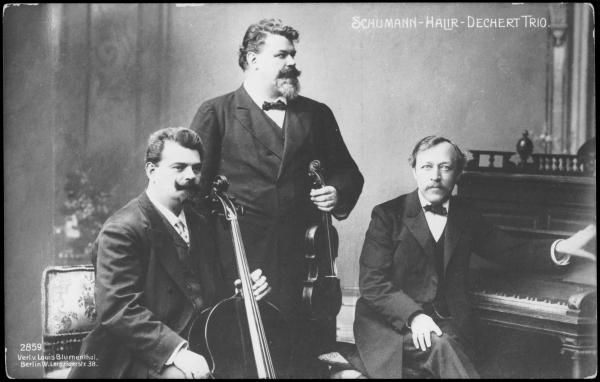
The Schumann-Halir-Dechert [de] Piano Trio (violin, cello, and piano)

In music, a trio (from the Italian) is any of the following:

  • a composition for three performers or three musical parts
  • in larger works, the middle section of a ternary form (so named because of the 17th-century practice of scoring the contrasting second or middle dance appearing between two statements of a principal dance for three instruments)
  • an ensemble of three instruments or voices performing trio compositions.

Composition

[edit]

A trio is a composition for three performers or musical parts. Works include Baroque trio sonatas, choral works for three parts, and works for three instruments such as string trios.

In the trio sonata, a popular genre of the 17th and early 18th century, two melodic instruments are accompanied by a basso continuo, making three parts in all. But because the basso continuo is usually played by two instruments (typically a cello or bass viol and a keyboard instrument such as the harpsichord), performances of trio sonatas typically involve four musicians. However there are also examples for a single performer such as Bach's Organ Sonatas or Trios, BWV 525–30 for two hands and a pair of feet, and also for two performers, such as his Violin Sonatas, Viol Sonatas and Flute Sonata, in which the harpsichordist's right hand performs a melodic part.

In vocal music with or without accompaniment, the term terzet is sometimes preferred to "trio".[1]

Form

[edit]

From the 17th century onward, trio has been used to describe a contrasting second or middle dance appearing between two statements of a principal dance, such as a minuet or bourrée. This second dance was originally called a trio because of the 17th-century practice of scoring it for three instruments, and later examples continued to be referred to as trios, even when they involved a larger number of parts.[2] The Menuet of Bach's Brandenburg Concerto No. 1 (1721) is a late nod to the original practice, with trios for two oboes and bassoon as well as two horns and a third part played by three oboes in unison.

Ensemble

[edit]

Derived from the compositions, trio often denotes a group of three solo instruments or voices.[2] The most common types of such compositions are the piano trio of typically piano, violin and cello, and the string trio of commonly violin, viola and cello.[3]

Other types of trio include [citation needed]:

References

[edit]
Revisions and contributorsEdit on WikipediaRead on Wikipedia
from Grokipedia
In music, a trio is a composition for three solo voices or instruments, or an ensemble consisting of three performers. It also denotes the contrasting middle section (B) in the ternary structure of a and trio or and trio form, typically followed by a reprise of the opening section (A). This dual usage reflects the term's origins in Italian musical , where it initially emphasized groupings of three parts or players. As an ensemble, the trio encompasses diverse instrumental combinations, with the piano trio—featuring piano, , and —emerging as one of the most prominent in during the Classical period. Composers such as , , and extensively cultivated the piano trio, producing works that balance virtuosic interplay among the instruments while highlighting their timbral contrasts. In the Baroque era, often featured the , typically for two violins and . The for , viola, and developed in the Classical period, serving as a foundational form before the rise of the in the mid-18th century. Other variants, like the , involve two instruments plus continuo, underscoring the trio's adaptability across historical styles. In formal contexts, the trio section provides textural and thematic relief within the minuet and trio structure, a compound (ABA) common as the third movement in Classical symphonies, sonatas, and string quartets. Originating from 17th-century dance practices, the is a stately piece in triple meter, while the trio is lighter, often scored for fewer instruments or voices to evoke intimacy, and typically in a related key. By the Romantic era, this form evolved into the and trio, retaining the ABA outline but with greater rhythmic vitality and humor. Notable examples include Haydn's No. 94 ("Surprise"), where the trio's simplicity contrasts the minuet's elegance.

Terminology

Definition

In music, a trio primarily denotes three interrelated concepts: a structural form within larger compositions, a piece composed for three independent parts, and a performing ensemble consisting of three musicians. These senses, while interconnected, serve distinct purposes in musical practice and analysis. The term originates from the Italian trio and French trio, both derived from the Latin tri- meaning "three," reflecting its consistent association with the number three since around 1600. As a , a trio refers to the contrasting middle section (B) in a ternary structure, such as the ABA design of a or , where the initial section (A) returns after the trio for repetition. This section typically features a lighter texture, often in a related key like the dominant or relative major, providing variety and relief from the main dance-like material; historically, it was scored for a reduced of three instruments to create contrast with the fuller ensemble of the opening section. As a composition, a trio is a work written for three separate musical parts, where each part constitutes a distinct melodic line or voice that interweaves to produce and texture. A musical part is defined as an individual line of or assigned to one performer or voice, independent yet complementary to the others in the ensemble. As an , a trio is a group of three performers who play or sing together, often realizing a composition designed for that configuration, such as a with , , and . The distinctions among these senses lie in their focus: the form emphasizes structural contrast within a movement, the composition highlights writing for three parts, and the centers on the performers themselves, though the terms frequently overlap in practice.

Etymology and Usage

The term "trio" in music derives from the Italian word trio, meaning "three," which itself stems from the Latin prefix tri- indicating the number three. It entered the via French in the early , with the first known musical usage recorded around 1724 to describe a composition for three voices or instruments. Initially, the term was applied in operatic contexts to denote ensembles featuring three performers, often singers, highlighting their interplay within a larger orchestral or dramatic framework. In , "trio" evolved to encompass settings, such as works for three instruments like , , and , emphasizing balanced dialogue among the parts. Within , it retained its focus on three vocalists, though with varying instrumental accompaniment to underscore emotional or narrative tension. By the , the term expanded into genres, particularly and , where it simply denoted bands of three members—often a "power trio" configuration of guitar, bass, and drums—allowing for amplified intensity and rhythmic drive without additional players. This shift reflected broader democratization of music-making, adapting the classical concept to electric and improvisational styles prevalent in the mid-to-late 20th and early 21st centuries.

Musical Form

In Dance Movements

In dance movements, the trio functions as the contrasting middle section within a ternary structure, most prominently in the minuet-trio-minuet form (ABA). The initial minuet (A) is typically cast in , consisting of two repeated sections that modulate to the dominant and return to the tonic, establishing a stately and graceful character in triple meter. The trio (B) follows as a self-contained binary unit, often shorter than the , and introduces variety through a shift to a , such as the relative major or dominant, before the repetition of the minuet (often without its internal repeats). This overall form, rooted in stylized court dances, provides structural balance and relief from the minuet's formality. The trio's characteristics emphasize contrast to heighten the movement's expressive range. Texturally, it shifts from the minuet's fuller, sometimes polyphonic layering to a lighter, more homophonic style, promoting clarity and simplicity. Instrumentation often changes to achieve this: in orchestral minuets, winds may be reduced or omitted in the trio, allowing strings to dominate and evoke a more intimate or mood, while the lyrical quality can introduce a playful or song-like . These alterations create a sense of repose or bucolic charm, aligning with the trio's role as a momentary diversion before the minuet's return. In Baroque suite movements, trios similarly appear in dances such as the , maintaining duple meter but with a shorter, more concise design to suit the suite's flowing sequence of stylized dances. For instance, Johann Sebastian Bach's Orchestral Suite No. 3 in , BWV 1068, features I followed by II as its trio, where the latter employs a sparser texture and rhythmic variation—replacing the first gavotte's dotted figures with even notes—for a brighter, more agile contrast while preserving the dance's moderate tempo and binary framework.

In Larger Works

The -trio- form evolved from the Classical -trio structure, with the scherzo replacing the minuet as a faster, more energetic movement while preserving the overall ABA framework. In Beethoven's symphonies, such as the Third Symphony ("Eroica"), the scherzo introduces greater rhythmic complexity through , irregular phrase lengths (e.g., alternating 8- and 10-bar phrases), and constant beat displacement via string articulations, creating a sense of propulsion and intensity absent in earlier minuets. Key changes typically occur in the trio section, often modulating to a contrasting key for relief, as in the Eroica where the trio shifts from to before returning to upon , heightening the interlude's lyrical contrast against the scherzo's vigor. Within cycles, the trio functions prominently as the third movement in symphonies and string quartets, providing a ternary interlude that balances the cycle's dramatic arc. This placement allows the trio to offer thematic contrast—often lighter in texture and melody compared to the surrounding —while adhering to binary subsections within each part (A as rounded binary, B as trio, followed by A ). The repetition reinforces structural unity, enabling composers to revisit and sometimes vary the initial material for cohesion across the multi-movement form. In the Romantic era, composers like Brahms and Mahler expanded the trio's role beyond its Classical brevity, integrating fuller and heightened emotional depth to enhance the movement's expressive range within symphonic structures. These developments often involved richer palettes and extended developmental passages in the trio, transforming it from a simple contrast into a more integral, psychologically charged episode that amplifies the overall symphony's narrative intensity.

Composition

Vocal Trios

Vocal trios are compositions designed for three solo voices, typically without in their purest form, though often supported by in operatic contexts or organ in sacred settings. These works emphasize the interplay of to convey text, , and narrative, distinguishing them from larger choral ensembles through intimate and balanced roles. Operatic trios function as ensemble scenes where three soloists interact dramatically, advancing the plot through contrasting vocal lines that reflect character conflicts or alliances. In Wolfgang Amadeus Mozart's (1791), the terzetto for the Three Boys in Act 2 exemplifies this, with the boys delivering prophetic guidance to Tamino and Pamina; their collective function heightens the mystical narrative, using synchronized entries to symbolize unity amid the opera's trials. Mozart's scoring aligns tonal shifts with the , creating dramatic tension through overlapping phrases rather than strict forms. Madrigals for three voices, common in the , adapt secular poetry into polyphonic settings, often reducing larger SSATB textures to SSA or SAT for smaller groups. Composers like Jacob Arcadelt composed early Italian madrigals in three parts, employing imitation and to evoke themes. These works prioritize contrapuntal independence, with voices weaving around a derived from the text's rhythm. Sacred motets for three voices emerged in the medieval and periods, blending liturgical texts with polyphonic elaboration to enhance devotional expression. Guillaume de Machaut's "Bone pastor, Guillerme" (c. 1360) uses three voices— with a plainchant foundation and two upper voices in French—creating a layered texture that contrasts sacred Latin with . Later, composers such as wrote motets for three voices, focusing on smooth to underscore pleas for mercy. Structurally, vocal trios alternate between homophonic textures, where voices move in rhythmic unison to clarify text, and polyphonic ones, featuring independent melodic lines for expressive depth. Text setting varies by : operatic trios favor syllabic to mimic natural , as in Mozart's terzettos where overlapping entries simulate conversation. In madrigals and motets, melismatic passages highlight key words, such as sighs or exclamations. Harmonic progressions in three parts typically rely on root-position triads (), providing stability while allowing the middle voice to add color through passing tones. In the 20th century, Benjamin Britten revived the vocal trio form in his Canticle II: Abraham and Isaac, Op. 51 (1952), scored for alto, tenor, and baritone with piano obbligato. This dramatic scena draws from the Chester Mystery Play, portraying the biblical sacrifice through tense duets escalating to trio climaxes that resolve in divine intervention, emphasizing psychological torment via dissonant harmonies and fragmented text. Britten's use of the trio underscores themes of obedience and mercy, linking back to his church parables like Curlew River (1964) in their ritualistic vocal interactions.

Instrumental Trios

Instrumental trios encompass compositions written specifically for three instruments, often in chamber settings that prioritize intimate interplay and textural balance. Among these, string trios for , viola, and form a core , where contrapuntal writing allows each instrument to contribute independently while maintaining harmonic cohesion. The 's melodic agility contrasts with the 's foundational depth and the viola's middle-range warmth, enabling composers to explore polyphonic textures without the fuller sonority of a . Wind trios, such as those scored for , , and , similarly emphasize balance through their diverse timbres: the 's airy brightness, the 's reedy expressiveness, and the 's resonant low register. Contrapuntal lines in these works demand precise dynamic control to blend the instruments' varying volumes, often featuring imitative entries that highlight their individual colors while supporting a unified sound. The piano trio—comprising violin, cello, and piano—emerged as a prominent instrumental format in the Classical era, with Joseph Haydn playing a pivotal role in its development during the 1780s and 1790s. Haydn's approximately 45 piano trios established the ensemble's standard instrumentation and elevated it from an accompanied keyboard sonata to a true chamber work, where the violin and cello engage as equals to the piano. These compositions typically unfold in three movements—a brisk sonata-allegro opener, a contemplative slow movement, and a lively finale in rondo or sonata form—though later examples occasionally incorporate a four-movement structure with an added minuet or scherzo for greater variety. Technical considerations in piano trio composition focus on idiomatic writing tailored to each instrument's capabilities, such as exploiting the 's broad range for harmonic support and virtuosic passages, while respecting the violin's upper-register and the 's and techniques. Dialogue between parts is achieved through motivic exchanges, where themes pass fluidly among the instruments, creating conversational interplay and textural variety; range considerations ensure that high lines avoid clashing with the 's treble and that the 's bass lines anchor without overpowering the . Beethoven's three s, Op. 1 (1795), exemplify these principles as pioneering works, expanding the form to four movements—typically sonata allegro, slow movement, or , and finale—while granting the unprecedented independence and dramatic agency, thereby intensifying contrapuntal depth and emotional scope.

Ensemble

Chamber Ensembles

In classical , the trio serves as an intimate performing ensemble, typically comprising three instrumentalists who engage in balanced dialogue without a conductor. Standard configurations include the piano trio, consisting of , , and , which blends the lyrical expressiveness of strings with the piano's harmonic foundation. The usually features , viola, and , emphasizing polyphonic interplay among bowed strings. trio variants often substitute the for one string instrument, such as in combinations of , , and (as in Beethoven's Op. 11 and Brahms's Op. 114) or , viola, and (as in Schumann's Märchenerzählungen, Op. 132), allowing for timbral contrasts while maintaining three-part textures. Performance practices in chamber trios highlight the demands of three-part harmony, where precise intonation is crucial due to the fixed of clashing with the strings' tendency toward , often requiring adjustments during ensemble playing to achieve consonant chords. Rehearsal dynamics involve collaborative decision-making, with musicians using full scores to align interpretations and address balance, as the frequently leads and but must yield to the strings' phrasing for egalitarian interplay. Repertoire selection prioritizes works that suit the group's technical levels and interpretive goals, fostering cohesion through repeated sectional practice before full ensemble run-throughs. In the piano trio, assumes a as support and melodic partner, providing that propels the dialogue while occasionally emerging as a quasi-solo voice. Notable 19th- and 20th-century chamber trios exemplified these practices through extensive touring and recordings that elevated the genre's visibility. The , founded in 1955 by pianist , violinist Daniel Guilet, and cellist , performed approximately 100 concerts annually worldwide, navigating early financial challenges by traveling by train and bus before achieving broader acclaim. Their recordings, spanning the complete from Haydn to Shostakovich, earned prestigious awards like the Grand Prix du Disque and influenced generations of performers by demonstrating refined intonation and ensemble precision. Active for 53 years until 2008, the ensemble set a benchmark for chamber trio artistry, emphasizing interpretive unity that resonated through live performances and preserved legacies on disc. In popular and jazz music, the trio format emphasizes rhythmic propulsion, , and close interpersonal dynamics among musicians, often diverging from the more structured interactions found in classical chamber settings. The trio, consisting of , , and , emerged as a cornerstone ensemble in the mid-20th century, where the bass typically provides a walking line—playing quarter-note patterns that outline chord progressions and maintain momentum—while the engages in comping, delivering rhythmic chord voicings and melodic fragments to support solos and drive the groove. The contributes subtle to emphatic rhythms, often using brushes or sticks to complement the bass's and the 's harmonic texture. This configuration allows for fluid interplay, enabling spontaneous conversations among players during improvisations. A seminal example is the Bill Evans Trio of 1959–1961, featuring pianist , bassist , and drummer , which revolutionized the format by elevating the bassist's role beyond mere timekeeping to equal melodic and contrapuntal participation, fostering a more democratic and interactive sound that blurred traditional hierarchies. Evans's approach to comping incorporated impressionistic harmonies and space, allowing LaFaro's bass lines to weave independently while Motian's drumming responded intuitively, creating a collective that influenced subsequent ensembles. This evolution highlighted the trio's potential for emotional depth and rhythmic vitality in performance. In rock and pop, the power trio—typically electric guitar, bass guitar, and drums—relies on high-volume amplification to generate a dense, wall-of-sound texture without additional instruments, compensating for the reduced lineup by emphasizing distortion, overdrive, and extended solos that fill harmonic and rhythmic spaces. Stage dynamics in this setup demand versatility: the guitarist often handles both lead and rhythm duties, the bassist locks into propulsive grooves to anchor the low end, and the drummer provides relentless drive, enabling high-energy live shows where each member projects prominently. The Power Station, a 1980s supergroup with guitarist Andy Taylor, bassist John Taylor, and drummer Tony Thompson (plus vocalist Robert Palmer), exemplified this format's punchy, riff-driven style, blending rock edge with funk-infused rhythms on their self-titled debut album. Blues trios trace their roots to the raw, expressive traditions of , where solo guitarists like laid foundational riffs and narratives that later inspired amplified group adaptations in the mid-20th century. These evolved into electric power trios, prioritizing gritty improvisation and shuffle rhythms drawn from Delta influences to evoke storytelling and emotional intensity. In the , trio formats have fused with electronic music, adapting to synthesizers, drum machines, and DJ controllers for genre-blending experimentation, as seen in EDM groups like —comprising DJs , , and —who layered builds with collaborative production to create anthemic tracks emphasizing drops and builds over traditional . Similarly, integrated electronics with rock aggression in a core trio setup, influencing hybrid styles that prioritize digital manipulation and live remixing for dynamic, high-impact performances.

History

Origins in Baroque Era

The concept of the trio in emerged in during the early , primarily through the development of the , a chamber featuring two upper melodic lines and a , creating a three-part texture despite often involving more than three performers. This form evolved from late instrumental pieces like the canzona, adapting polyphonic writing for violin-family instruments and providing a foundation for contrapuntal interplay among the parts. A seminal example is found in the works of (1653–1713), whose published collections, including the Twelve Church Trio Sonatas, Op. 1 (1681) and Twelve Chamber Trio Sonatas, Op. 2 (1685), exemplified the genre with two s and , emphasizing balanced dialogue and harmonic support from the continuo. Corelli's compositions standardized the trio sonata's structure, influencing subsequent generations by integrating slow-fast movement alternations and idiomatic writing. In vocal music, early trios appeared in operatic and sacred contexts, such as the ensemble sections in Claudio Monteverdi's (1567–1643) operas, where three voices often combined to heighten dramatic expression, as seen in choral interludes of (1607). These operatic trios built on Monteverdi's innovative use of multiple voices with continuo to blend and . The practice underpinned this three-part writing, serving as the foundational "third voice" by realizing harmonies over a bass line, typically on or organ with a sustaining instrument like the , which permeated composition from solo to ensemble forms. The trio concept spread from Italy to Germany in the mid-17th century, notably through Heinrich Schütz (1585–1672), who incorporated Italian styles into sacred vocal works after studying in Venice. Schütz's Symphoniae Sacrae (1629, 1647, 1650) include pieces for three voices with instruments and continuo, such as the lively trio setting of "Benedicam Dominum in omni tempore" for soprano, tenor, bass, and cornet, adapting trio textures for German Lutheran contexts and bridging vocal and instrumental traditions.

Classical and Romantic Periods

In the Classical period, and were instrumental in establishing the piano trio as a core genre, integrating to create balanced, dialogic structures. Haydn's later piano trios, composed during his 1794–1795 London visits, such as the Trio in C major, Hob. XV:27, modified traditional through deceptive cadences, hybrid themes, and remote tonal modulations, achieving symphonic complexity while accommodating amateur pianists. Mozart advanced this standardization in works like his Piano Trios K. 496 (1786) and K. 502 (1786), employing normative two-part expositions with clear medial caesuras and tonal contrasts, emphasizing instrumental equality and formal precision. Ludwig van Beethoven further expanded the genre's expressiveness in the early , elevating the to a co-protagonist alongside and through dramatic contrasts and motivic transformation. His Piano Trios Op. 1 (1795) introduced bold thematic development and emotional intensity, while the "" Trio, Op. 97 (1811), blended Classical structural rigor with proto-Romantic spontaneity, exploiting the piano's for heightened dialogue. These innovations marked a shift from accompaniment-dominated trios to fully integrated ensembles, influencing subsequent composers. In the Romantic era, infused piano trios with lyrical introspection, as in his Piano Trio No. 1 in B-flat major, D. 898 (1827), featuring wistful, song-like melodies and subtle instrumental interplays that evoked personal emotion. built on this with greater passion and virtuosity in his Piano Trio in , Op. 49 (1839), incorporating surging themes and cyclic elements that reflected early Romantic individualism. achieved structural complexity in his Piano Trio No. 2 in C major, Op. 87 (1882), through intricate thematic interconnections, expanded movements, and harmonic depth, demanding technical prowess from performers. The institutional growth of societies in and by the mid-19th century shaped trio norms, promoting professional performances and compositional standards. 's , established in 1812, hosted regular of Haydn, Mozart, and Beethoven trios, cultivating middle-class appreciation and ensemble discipline among amateurs and professionals. In , Pierre-Marie Baillot's series (1814–1840) transitioned from private salons to public halls with growing subscriber bases up to 700, inspiring virtuosic trios by composers like Onslow and Farrenc tailored to diverse audiences. This environment accelerated the Romantic shift toward expressive virtuosity, as trios evolved to suit bourgeois patrons and skilled ensembles by 1850.

References

Add your contribution
Related Hubs
User Avatar
No comments yet.