


Community hub
Recent from talks
Contribute something
Nothing was collected or created yet.
NGC 523
View on Wikipedia
| NGC 523 | |
|---|---|
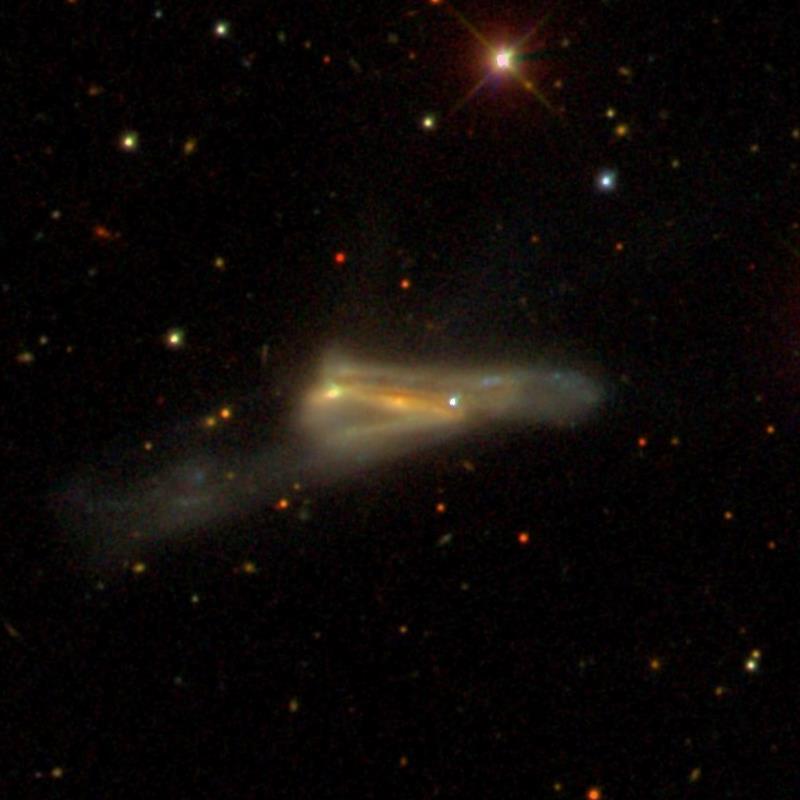
 NGC 523 imaged by SDSS | |
| Observation data (J2000[1] epoch) | |
| Constellation | Andromeda |
| Right ascension | 01h 25m 20.7140s[2] |
| Declination | +34° 01′ 30.524″[2] |
| Redshift | 0.0159[3] |
| Heliocentric radial velocity | 4,761±2 km/s[2] |
| Galactocentric velocity | 4,481±20 km/s[2] |
| Distance | 203.46 ± 6.55 Mly (62.381 ± 2.007 Mpc)[2] |
| Group or cluster | NGC 507 Group (LGG 26) |
| Apparent magnitude (V) | 12.7[3] |
| Apparent magnitude (B) | 13.5[1] |
| Characteristics | |
| Type | SBc/Pec[3] |
| Size | ~189,400 ly (58.07 kpc) (estimated)[2] |
| Apparent size (V) | 2.5′ × 0.7′[3] |
| Other designations | |
| IRAS 01225+3345, NGC 537, Arp 158, UGC 979, MCG +06-04-018, PGC 5268, CGCG 521-022, VV 783[2][3] | |
NGC 523, also known as Arp 158 from the ARP catalog, is a spiral galaxy located in the constellation Andromeda.[1] It was discovered by German-British astronomer William Herschel on 13 September 1784. Heinrich d'Arrest rediscovered it on 13 August 1862 and listed it as NGC 523, whereas Herschel's original discovery was listed as NGC 537.[4] John Dreyer noted in the New General Catalogue that NGC 523 is a double nebula.[1]
Supernova
[edit]One supernova has been observed in NGC 523: SN 2001en (type Ia, mag. 17.5) was discovered by LOTOSS (Lick Observatory and Tenagra Observatory Supernova Searches) on 26 September 2001.[5][6][7]
NGC 507 Group
[edit]NGC 523 is part of the NGC 507 group (also known as LGG 26). This large group includes at least 42 galaxies, of which 21 are in the New General Catalogue and 5 in the Index Catalog. Four members of this group are also Markarian galaxies. The brightest of these galaxies is NGC 507 and the largest is NGC 536.[8]

See also
[edit]References
[edit]- ^ a b c d Frommert, Hartmut. "NGC 523". spider.seds.org.
- ^ a b c d e f g "Results for object NGC 0523". NASA/IPAC Extragalactic Database. NASA and Caltech. Retrieved 18 May 2025.
- ^ a b c d e Rojas, Sebastián García. "Galaxy NGC 523 · Deep Sky Objects Browser". DSO Browser.[permanent dead link]
- ^ "New General Catalog Objects: NGC 500 – 549". cseligman.com.
- ^ Hutchings, D.; Li, W. D. (2001). "Supernova 2001en in NGC 523". International Astronomical Union Circular (7724): 1. Bibcode:2001IAUC.7724....1H.
- ^ "SN 2001en". Transient Name Server. IAU. Retrieved 18 May 2025.
- ^ Bishop, David. "Supernova 2001en in NGC 523". Rochester Astronomy.org. Retrieved 21 October 2018.
- ^ Garcia, A. M. (1993). "General study of group membership. II. Determination of nearby groups". Astronomy and Astrophysics Supplement Series. 100: 47. Bibcode:1993A&AS..100...47G.
External links
[edit] Media related to NGC 523 at Wikimedia Commons
- NGC 523 on WikiSky: DSS2, SDSS, GALEX, IRAS, Hydrogen α, X-Ray, Astrophoto, Sky Map, Articles and images
- SEDS

| Stars |
| ||||||||||||
|---|---|---|---|---|---|---|---|---|---|---|---|---|---|
| |||||||||||||
| Star clusters |
| ||||||||||||
| Nebulae |
| ||||||||||||
| Galaxies |
| ||||||||||||
| |||||||||||||
| |||||||||||||

 | This spiral galaxy article is a stub. You can help Wikipedia by expanding it. |