Hubbry Logo
NHL 99NHL 99Main
Open search
NHL 99
Community hub
NHL 99
logo
7 pages, 0 posts
0 subscribers
Be the first to start a discussion here.
NHL 99
NHL 99
from Wikipedia
NHL 99
Cover art featuring Eric Lindros
DevelopersEA Canada (PS/PC)
MBL Research (N64)[3]
PublisherEA Sports
ProducerKen Sayler
SeriesNHL
EngineVirtual Stadium
PlatformsPlayStation, Windows, Nintendo 64
ReleasePlayStation, Windows
Nintendo 64
  • NA: October 1, 1998[2]
  • EU: November 30, 1998
GenreSports (ice hockey)
ModesSingle-player, multiplayer

NHL 99 is an ice hockey video game developed by Electronic Arts Canada. It was released in September 1998 and was the successor to NHL 98.

Gameplay

[edit]

Starting with NHL 99 up to NHL 2001, there were very few large improvements to the game. NHL 99 for the PlayStation boasted higher-resolution graphics than NHL 98, but the framerate and unresponsive controls (especially in 2+ player modes) hindered its playability. Online leagues of the game also became more organized. Daryl Reaugh left the series as color commentator following NHL 99. In the Nintendo 64 version of NHL 99, the official NHL and NHLPA license with all teams and players are represented, including the Nashville Predators expansion team. It has a medium-high resolution at 30 FP, rumble-pack support, and four player mode.[3] The commentary is done by ESPN's Bill Clement.[3]

Reception

[edit]

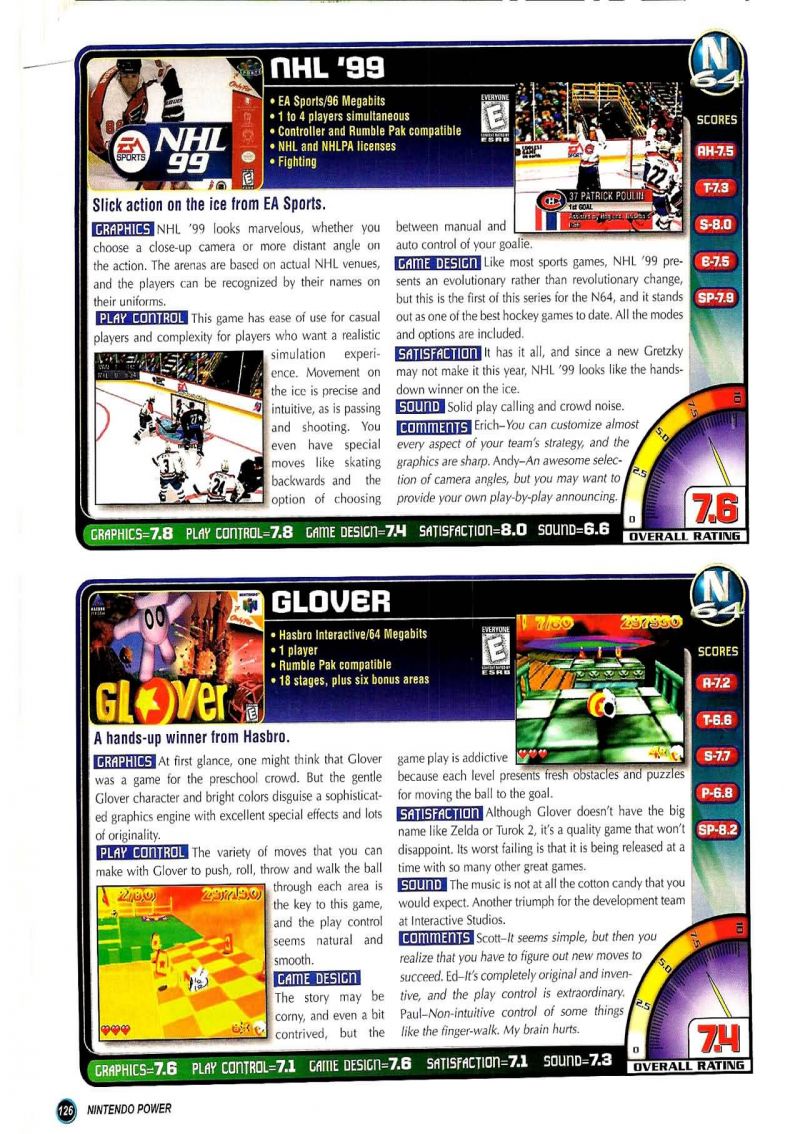
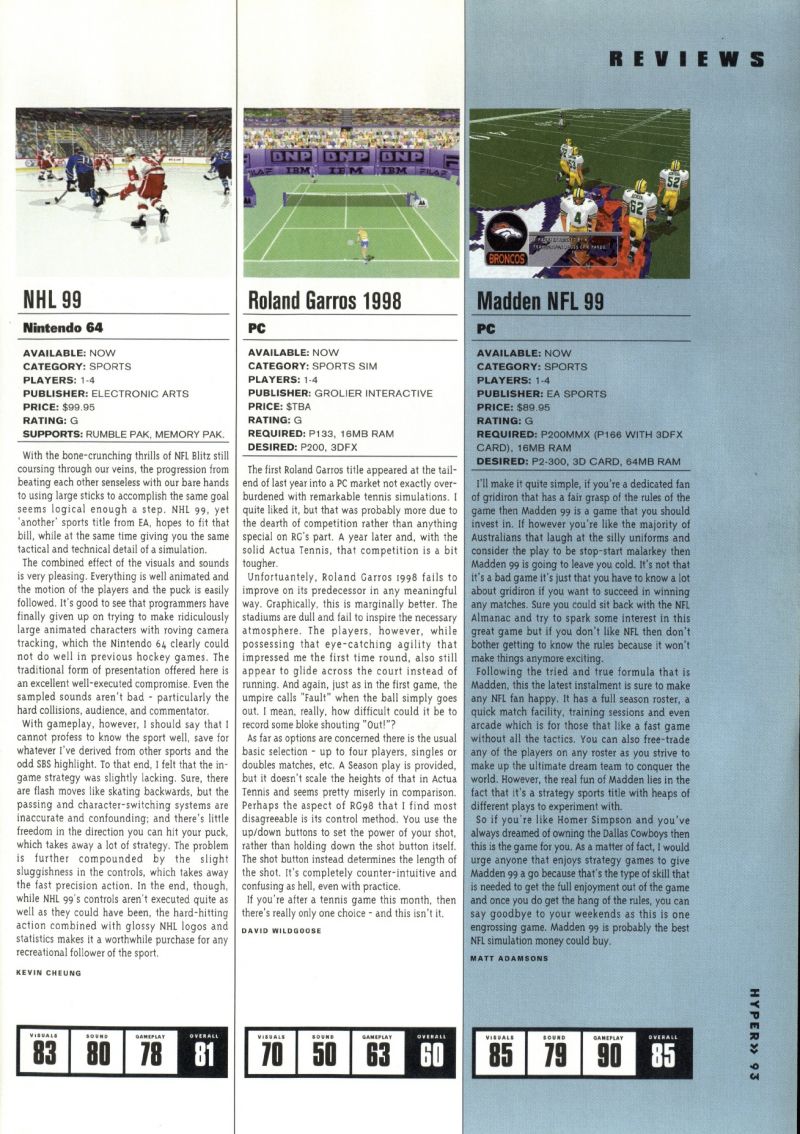
The game received "favorable" reviews on all platforms according to the review aggregation website GameRankings.[4][5][6] AllGame gave the PlayStation version four stars out of five, saying that it "isn't a Stanley Cup winner yet, but there is still an undeniable amount of fun to be had if you're willing to except [sic] a few flaws."[34] Likewise, Official UK PlayStation Magazine gave it a similar score of eight out of ten, saying that the game "manages to succeed in bettering its predecessor. But, be warned, you have to really play it to get the most out of it. Patience is key."[35] Hyper gave the Nintendo 64 version 81%, saying, "while NHL 99's controls aren't executed quite as well as they could have been, the hard-hitting action combined with glossy NHL logos and statistics makes it a worthwhile purchase for any recreational follower of the sport."[36] N64 Magazine gave the same console version 74%, saying that it was "by no means dire."[28] Jeff Lackey of Computer Games Strategy Plus gave the Windows version three stars out of five, saying, "By making the goalies behave in the way they do, a player has two choices when playing NHL 99: play at Rookie level and quickly learn to win every game by a wide margin, or play at Pro level and accept the inability of your players to score standard NHL style goals against computer super-goalies. Perhaps the great graphics and sounds will be enough for some to overcome this deficiency; however, it's unlikely this will be the case for anyone who actually follows the NHL and wants a real hockey simulation."[37]

Next Generation said of the PlayStation version in its January 1999 issue, "What EA has given us this year is more of an attempt at a purist hockey game rather than the intense hockey experience they have delivered before. While a purist hockey game is certainly not a bad thing, it's just not that much fun to play, and that's the bottom line."[27] One issue later, however, the magazine changed its tune and called the Windows version "the best-looking hockey game on the PC."[26] In the same issue, the magazine listed the same Windows version as well as the N64 version at #40 on its list of the Fifty Best Games of All Time, saying, "The control is fantastic and the company has managed to balance the gameplay perfectly between arcade and simulation. It feels real, but it is never tedious, as realistic simulations tend to be."[38]

The Electric Playground nominated the Windows version for their 1998 "Best Computer Game" award, which ultimately went to Half-Life.[39] The game won the "Best Hockey Game" award as well;[40] the Official Broadcast Overlays and Up To The Minute Stats were nominated for "Best Easter Eggs or Extras", which ultimately went to the Batmobile from Need for Speed 3.[41] It was also nominated for PC PowerPlay's "Best Sports" award, which went to FIFA 99,[42] and for the "Best Sports Game of the Year" award at IGN's Best of 1998 Awards, which ultimately went to NFL Blitz.[43]

Notes

[edit]

References

[edit]
[edit]
Revisions and contributorsEdit on WikipediaRead on Wikipedia
from Grokipedia
NHL 99 is an developed by Canada and published by under the label . Released on September 30, 1998, for Microsoft Windows, PlayStation, and , it serves as the successor to the previous year's and introduces significant enhancements in graphics, animations, and to deliver a more realistic hockey experience. The game features all 27 NHL teams from the 1998–99 season, including the expansion , alongside 18 international teams for expanded multiplayer options. Key gameplay improvements include motion-captured animations derived from actual NHL athletes, refined shooting mechanics with new dekes and spin-o-ramas, and smarter AI for opponents and goaltenders. New additions encompass a Beginner difficulty mode for , an International mode adhering to IIHF rules with adjustable rink sizes, and a revamped Season mode that incorporates player hot and cold streaks, injuries, and a fantasy . Arenas are rendered in 3D with details like banners, retired jerseys, and luxury boxes, while commentary is provided by and . The game supports up to eight players via Multi-Tap on PlayStation and includes coaching drills and on-the-fly play calling. NHL 99 received widespread critical acclaim for its polished presentation and immersive simulation, earning an average score of 87% from 45 reviews and accolades such as Best Sports Game of from PC Player magazine and runner-up in the same category from Computer Gaming World. It was praised for advancing the NHL series' reputation as a benchmark in sports gaming, with enhanced polygon counts, ice reflections, and video goal judge features contributing to its realism. The title holds the official NHL seal of approval and updated rosters reflecting the league's current standings.

Development

Production team

NHL 99 was primarily developed by Electronic Arts Canada, the studio responsible for the PlayStation and PC versions of the game. The Nintendo 64 port was outsourced to MBL Research, an external developer tasked with adapting the core title to the console's hardware. Ken Sayler served as the lead producer, overseeing the overall project direction and coordination across platforms. Under his leadership, the team emphasized refinements to gameplay and content drawn from the evolving NHL landscape. Additional key contributors included executive producer Bruce E. McMillan and development director Warren Wall, who handled high-level production and technical oversight. As the direct successor to , the production incorporated updated rosters reflecting the 1998-99 NHL season, including the expansion as a playable team with a dedicated draft mode. This integration marked a key update to align the game with the league's expansion to 27 teams. The development timeline spanned much of 1998, building on lessons from the previous year's release to introduce iterative enhancements such as improved player attributes and season simulation features, all leading to the game's launch in September 1998. Previews and hands-on sessions in mid-1998 highlighted the team's focus on maintaining the series' fast-paced hockey simulation while expanding accessibility across platforms.

Technological advancements

NHL 99 utilized an updated iteration of ' proprietary engine, which delivered refined simulation mechanics and visual rendering for more immersive experiences on the rink. This engine incorporated dynamic lighting, rink reflections, , and support for high resolutions up to 1024x768 on PC, enhancing the overall graphical depth and realism in player movements and environmental interactions. On the PlayStation platform, the game marked significant graphical upgrades over , including higher resolution textures that resulted in more detailed player models with smoother animations for actions like skating, checking, and puck handling. These enhancements provided greater visual fidelity, allowing for better distinction of individual player features and more fluid on-ice dynamics, though they occasionally led to minor framerate dips during intense plays. The port optimized performance for the hardware, achieving a consistent 30 frames per second with medium-to-high resolution visuals that maintained smooth gameplay without load times between periods. It also integrated rumble pack support to deliver haptic feedback for collisions and shots, alongside tailored controls leveraging the N64 controller's for precise movement and C-buttons for quick player switching, making multi-player sessions up to four participants more responsive. Across platforms, particularly on PC, NHL 99 introduced enhanced connectivity options for league play, including support via EA Online and modem-to-modem functionality, enabling more structured remote competitions with features like season tracking and team organization for multiplayer leagues.

Release

Platforms and dates

NHL 99 was released on three primary platforms: the PlayStation, Windows, and 64. The game was published by across all versions. It was developed by EA for the PlayStation and PC versions. The PlayStation and Windows versions launched in September 1998 in . The version followed on October 1, 1998, in , with a European release on November 30, 1998. The PlayStation and PC served as the lead platforms, while the version was a port developed by MBL Research. This port included unique features such as support for up to four players simultaneously.

Marketing and promotion

The marketing campaign for NHL 99 capitalized on its alignment with the ongoing 1998-99 NHL season, positioning the game as an essential companion for fans with updated rosters that included the newly expanded and reflected recent player trades and signings. Released in late September and early October 1998, just as the real NHL season commenced on , the promotion emphasized timely authenticity to draw in hockey enthusiasts eager to simulate current league action at home. EA Sports heavily promoted the game's official licenses from the National Hockey League (NHL) and NHL Players' Association (NHLPA), which enabled accurate team uniforms, player likenesses, and arena details in advertisements. Print ads and TV commercials highlighted these elements to underscore the game's realism, showcasing fluid on-ice action, precise puck physics, and authentic rule implementations derived from professional play. Multiplayer features, including support for up to four players on compatible platforms, were also a key focus in promotional materials, marketed as ideal for group sessions mimicking real NHL rivalries and fostering among gamers. Promotional videos and packaging spotlighted the game's introductory cinematic, a first for the series in featuring licensed music from David Bowie's "Heroes," which accompanied highlights of NHL and dramatic gameplay moments to evoke the excitement of professional hockey. This innovative use of popular rock tracks aimed to broaden appeal beyond traditional sports fans, blending cultural cool with athletic intensity. EA announced the version's launch via a on October 1, 1998, confirming immediate availability in stores and touting the title as a flagship entry in their sports lineup.

Gameplay

Core mechanics

NHL 99 features that provides players with comprehensive control over fundamental actions, including skating via the for directional movement, passing by holding the pass while aiming with the stick, shooting through a dedicated with directional aiming for accuracy, and checking using body check or poke check inputs to disrupt opponents. These mechanics emphasize strategic positioning and timing, with features like speed bursts for quick acceleration and spin-o-rama moves for evasive puck protection, allowing for fluid transitions between offense and defense. The game includes updated rosters reflecting the 1998 NHL season, modeling every player with accurate attributes such as speed, shooting accuracy, and checking strength derived from real-world performance data. This attention to detail enables of authentic team dynamics, where player ratings influence outcomes in passing success and defensive positioning. Compared to , NHL 99 introduces physics improvements, particularly in puck handling for more realistic bounces and deflections, enhanced that results in dynamic body checks capable of shattering glass, and refined goalie interactions where netminders exhibit smarter positioning and reaction times to shots. These upgrades contribute to a more immersive , reducing unrealistic puck clipping and improving the flow of play during scrambles. On the PlayStation version, control responsiveness suffers from framerate drops, which can make the game feel sluggish during intense sequences and hinder precise inputs for skating and checking. Despite graphical enhancements like detailed player animations, these performance issues occasionally disrupt the otherwise tight mechanics.

Game modes

NHL 99 provides a variety of single-player modes centered around simulating professional hockey experiences. Exhibition mode allows players to select any two teams for a single game, including all 27 NHL teams from the 1998-99 , such as the expansion , as well as All-Star squads, international clubs, and custom-created teams. mode enables simulation of a full NHL campaign, with configurable lengths of a shortened 26-game , in which each team plays every other team once, or a full 82-game , culminating in playoff contention based on standings. Playoff mode focuses on postseason tournaments, allowing users to simulate or play through bracket-style eliminations leading to the Stanley Cup finals. International mode lets players simulate global tournaments such as the Olympics or , using IIHF rules and featuring adjustable rink sizes for different national styles. Coaching Drills mode offers practice sessions to hone individual skills like shooting, passing, and checking through structured exercises. Multiplayer options emphasize local , supporting up to four players on the version through connected controllers for simultaneous play in exhibition or other modes. On the PC platform, the game facilitated early organized online leagues, enabling community-driven multiplayer sessions for league-style play. Customization features enhance depth, particularly in season mode, where users can edit team rosters, adjust lines and strategies, execute player trades (with options to enable or disable the trade deadline), conduct expansion drafts, or release free agents, and create individual players. These tools allow for personalized management, with saved custom rosters applicable across modes like .

Presentation

Graphics and controls

NHL 99 showcased notable improvements in visual fidelity across platforms, building on the foundation of its predecessor. The PlayStation version delivered higher-resolution graphics compared to , featuring enhanced arena rendering with detailed ice surfaces and more lifelike player models, including recognizable facial features. Skating and body-checking animations were refined for greater realism, contributing to a more immersive on-ice experience. These upgrades were powered by an evolved iteration of the Virtual Stadium engine, emphasizing dynamic environmental details like puck physics and player interactions. On the , the game maintained a consistently smooth 30 frames per second, rendering crisp 3D graphics without significant animation drops, which reviewers praised for its fluidity during high-speed action. The version supported feedback, providing haptic responses to hits and goals that enhanced control immersion. However, the N64 port occasionally exhibited texture pop-in, a common limitation of the hardware that affected distant arena elements like crowds. The emphasized with dedicated menus for roster management, enabling players to customize teams, edit lineups, and view detailed player statistics such as goals, assists, and penalties. In-game heads-up display (HUD) elements were straightforward, overlaying essential information like shot counts, period time, and penalty indicators to keep focus on gameplay without clutter. Controls were intuitive, relying on a core three-button setup for shooting, passing, and checking, augmented by precision for skating direction on compatible controllers. While generally responsive, the PlayStation version experienced occasional framerate hitches during intense multi-player sessions, potentially affecting timing in fast breaks and dekes. Reviewers noted that these minor slowdowns could disrupt control precision, though single-player modes ran smoothly overall.

Audio and music

The audio in NHL 99 featured play-by-play commentary by and color commentary by , who reprised their roles from on the PC and PlayStation versions. On the version, ESPN broadcaster Bill Clement provided the commentary, delivering generic lines that focused on general game action without specific player names. Reaugh departed the series after NHL 99, with Bill Clement taking over color commentary duties starting in . Sound effects emphasized realism through the game's Virtual Stadium engine, which simulated immersive arena atmospheres with dynamic crowd cheers that varied by team and venue, the scrape of skates on ice, sharp impacts, and bone-jarring body checks. These elements were rendered in stereo on PC and PlayStation, enhancing the sense of a live NHL game, while the N64 version offered solid but more compressed audio due to hardware limitations. NHL 99 marked a milestone for the EA NHL series by incorporating a soundtrack with licensed rock and electronic tracks, including David Bowie's "Heroes" in the intro video and Garbage's "Push It" during menus. Additional pieces like ' "Guilty (Juno Reactor Remix)" and original compositions by blended high-energy guitar riffs and electronic beats to build excitement between periods. Platform-specific audio depth varied, with the PC and PlayStation versions supporting full stereo and Pro-Logic surround for richer crowd and effect immersion, while the N64 edition prioritized cartridge constraints, resulting in slightly flatter but retaining core commentary and effects integrity.

Reception

Critical reviews

NHL 99 received generally favorable reviews from critics, with an average score of 87% based on 45 professional reviews compiled by . The PlayStation version earned scores such as 8.9/10 from , which lauded its strong realism and multiplayer features, describing it as a "fine playing hockey game with good controls, a load of features and an addictive four-player mode." awarded the same platform 8.4/10, praising the "stunning reflections on the ice and clearly recognizable faces on every player" along with crisp graphics and smooth animations that heightened the intensity of on-ice action. Critics highlighted the game's undeniable amount of fun, particularly in its core gameplay loop, though some noted areas for improvement. On the version, scored it 8.8/10, commending the "extremely crisp, fantastically smooth 3D graphics" with no drops in animation, and specifically praising the accessible four-player mode for enhancing multiplayer experiences. Common criticisms included technical issues and design choices. The PlayStation port faced complaints about framerate dips during intense plays and occasional control responsiveness problems, as noted in contemporary analyses. pointed out the game's "convoluted layout" in its interface menus and the absence of dedicated buttons for wrist shots or poke checks, which limited tactical depth compared to competitors like NHL PowerPlay '98. The edition, despite its multiplayer strengths, drew minor flak for less refined AI in defensive positioning compared to the PlayStation counterpart. Overall, these reviews positioned NHL 99 as a strong entry in the series, building on its predecessor with enhanced realism while revealing platform-specific trade-offs.

Awards

NHL 99 won the "Best Hockey Game" award at the Electric Playground's 1998 Blister Awards. The Windows version was nominated for "Best Computer Game" at the same awards, ultimately losing to . The game also received "Best Sports Game" from PC Player magazine in 1998, runner-up for Best Sports Game from Computer Gaming World, and Best Play-by-Play for the PlayStation version from . Although no official sales figures for NHL 99 have been publicly released by EA Sports, estimates suggest it sold around 1.5 million units worldwide.

Legacy

Rankings

NHL 99 received notable recognition in contemporary gaming publications shortly after its release. In 1999, Next Generation magazine ranked it #40 on its list of the "Fifty Best Games of All Time," specifically highlighting the PC and Nintendo 64 versions for their exceptional balance of arcade action and simulation realism, and fantastic controls. In modern retrospectives, NHL 99 continues to be praised for its enduring quality, particularly on the Nintendo 64. A 2024 review on NTNDO64.com described it as "certainly the best traditional hockey title on the N64," commending its fast, heavy, and hard-hitting gameplay that evokes the excitement of classic early '90s NHL titles while maintaining simple yet consistent controls. Within the broader NHL series history, NHL 99 stands out as a for incorporating licensed music tracks, such as David Bowie's "Heroes" in its introductory sequence, which enhanced the game's atmospheric presentation alongside original compositions. The title also advanced organized online play on PC, allowing multiplayer matches through EA's services, a feature that built on prior entries and solidified the series' reputation for connectivity in sports gaming. Regarding modern playability, the PC version of NHL 99 faces installer compatibility issues on contemporary Windows systems due to its 1998 origins, often requiring community patches or compatibility modes to run. However, it remains accessible via emulation on original hardware or through fan-maintained fixes, preserving its legacy for enthusiasts.

Series influence

NHL 99 marked a pivotal expansion in the use of licensed music within the NHL series, featuring David Bowie's "Heroes" in its introductory video and a small selection of four tracks that set the tone for future soundtracks. This approach established licensed music as a standard element, transitioning from sporadic inclusions in earlier titles like to more integrated audio experiences that enhanced the game's atmosphere and cultural appeal. Subsequent entries, such as and beyond, built on this foundation by gradually increasing the number of licensed songs and introducing EA Trax, evolving into full-fledged soundtracks that became a hallmark of the franchise's presentation. The game's commentary team, consisting of on play-by-play and as color analyst, represented the culmination of early voice work in the series before a significant shift occurred. Reaugh's departure after NHL 99 prompted EA to replace him with Bill Clement starting in , altering the dynamic of broadcasts and influencing the selection of commentators in later games to emphasize varied personalities and expertise. This change contributed to a more diverse and engaging audio commentary style that persisted through the era and beyond, adapting to technological advancements in voice integration. NHL 99 advanced multiplayer capabilities by introducing enhanced support for remote leagues, allowing up to 30 players to participate in a full 120-game season via TCP/IP connections, which facilitated organized online play despite the era's technical limitations like lag. These features built on prior online experiments in the series, such as those in NHL 97, and paved the way for more robust community-driven competitions in future titles, including during the competitive NHL 2K era when online leagues became central to player engagement. As a key transitional title, NHL 99 served as a bridge from the series' earlier 2D roots to fully realized 3D simulations, refining player models, animations, and on-ice realism introduced in NHL 97 to create smoother, more immersive . This in graphics and physics directly impacted the realism in competitor titles like the NHL FaceOff series and subsequent EA iterations, establishing benchmarks for authentic hockey that influenced genre-wide standards for visual fidelity and player movement.

References

Add your contribution
Related Hubs
User Avatar
No comments yet.