


Community hub
Recent from talks
Contribute something
Nothing was collected or created yet.
NSU Prinz
View on Wikipedia

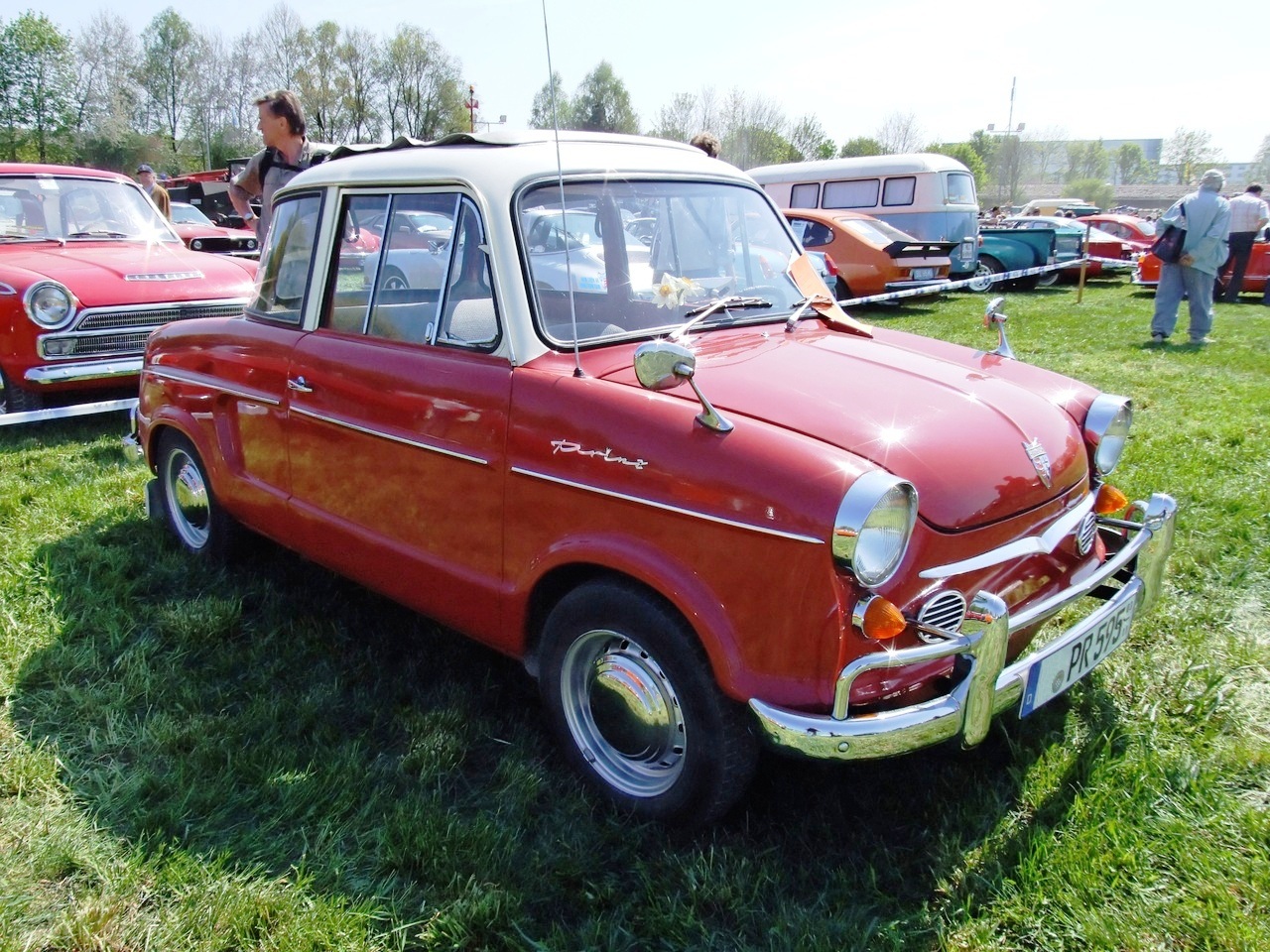
The NSU Prinz is an automobile which was produced from 1958 to 1973 in West Germany by the NSU Motorenwerke AG which in the mid 1950s had been the biggest motorcycle producer in the world. The production of German motorcycles declined sharply as customers needed weather protection for daily driving, with demand shifting first towards microcars and then towards affordable cars.
NSU Prinz I, II, and III
[edit]| NSU Prinz I, II, and III | |
|---|---|
 NSU Prinz I | |
| Overview | |
| Production | 1958–1962 |
| Assembly |
|
| Body and chassis | |
| Body style | 2-door saloon[2] |
| Layout | Rear engine, rear-wheel drive |
| Related |
|
| Powertrain | |
| Engine | 583 cc (35.6 cu in) I2[2] rear-mounted air-cooled |
| Transmission | 4-speed manual 4-speed manual all-synchromesh[2] |
| Dimensions | |
| Wheelbase | 78.7 in (2,000 mm) |
| Length | 124 in (3,150 mm)[2] |
| Width | 56 in (1,422 mm)[2] |
| Height | 53 in (1,346 mm)[2] |
NSU's first post-war car, the Prinz I, was launched at the Frankfurt Motor Show in September 1957 with the advertising slogan "Fahre Prinz und Du bist König" ("Drive a Prince and you're a king").[4] After a pilot run of 150 preproduction cars, volume production began in March 1958.[5]
The Prinz I was available as a two-door saloon[6] featuring an upright roof line and seating for four people. The doors opened wide enough to permit reasonable access even to the rear seats, although leg room was severely restricted if attempting to accommodate four full sized adults.[2] In addition to a luggage compartment accessed via a hatch at the front of the car and shared with the spare wheel and fuel filler, there was a narrow but deep full width space behind the rear seat sufficient to accommodate a holiday suitcase.
The Prinz was exported to the United States, but did not sell well and was dropped after 1960.[7] The Prinz was also famously used by an US astronaut. While others chose Chevrolet Corvettes that were offered to them by GM, Mercury astronaut John Glenn used the Chevrolet connection to lease a station wagon to haul his kids around in, while using an NSU Prinz 1 as daily driver. The Prinz got better fuel mileage than the Chevrolet, and as Glenn had a longer commute than his fellow astronauts, the more economical Prinz allowed him to save for his children’s college fund.[2]
The noisy[2] two-cylinder 600 cc 20 PS (14.7 kW; 19.7 hp) air-cooled engine was located at the back where it drove the rear wheels, initially via a "crash" gearbox. Later versions gained a four-speed all-synchromesh gearbox. Contemporaries were impressed by the brevity of the maintenance schedule, with the engine, gear box and final drive operating as a single chamber and all lubricated by means of oil, added through a filler in the rocker box cover.[2] There were just two grease nipples requiring attention, positioned on the steering kingpins.[2] The engine was also commended in contemporary reports for its fuel economy and longevity.[2] Although noisy, the engine offered impressive flexibility, recalling NSU's strengths as a motorcycle manufacturer.[2]
The Prinz II was a more 'luxurious' version[8] released in 1959, with better trim and an all-synchromesh gearbox.[9] A 30E export version was equipped with a 30 PS (22.1 kW; 29.6 hp) engine.[9] The Prinz III was launched in October 1960[10] featuring a new stabilizer bar and the 30 hp motor.[9]
NSU received government approval to build the Prinz in Brazil in the late 1950s, but nothing came of the project.[11]
-
 NSU Prinz 30E
 -
 1960 NSU Prinz II
 -
 1961 NSU Prinz III


.jpg)
NSU Sport Prinz
[edit]| NSU Sport Prinz | |
|---|---|
 1964 NSU Sport Prinz | |
| Overview | |
| Production | 1958–1968 [12] 20,831 produced [12] |
| Assembly |
|
| Body and chassis | |
| Body style | 2-door coupé |
| Layout | Rear engine, rear-wheel drive |
| Related | NSU Spider |
| Powertrain | |
| Engine | 583 cc I2 [12] 598 cc I2 [12] |
| Chronology | |
| Successor | Audi TT |
The Sport Prinz was a 2-seater sports coupe variant.[12] It was designed by Franco Scaglione at Bertone studios in Turin. 20,831 were manufactured between 1958 and 1968.[12] The first 250 bodies were built by Bertone in Turin. The rest were built in Heilbronn at Karrosseriewerke Drauz which was later bought by NSU.
The Sport Prinz was initially powered by the 583 cc (35.6 cu in) Prinz 50 straight-twin engine but a maximum speed of 160 km/h (99 mph) was nevertheless claimed. From late 1962 a 598 cc (36.5 cu in) engine was fitted.[12]
The NSU Spider was a Wankel rotary powered two-seater roadster based on the Sport Prinz platform.[12]

NSU Prinz 4
[edit]| NSU Prinz 4 | |
|---|---|
 | |
| Overview | |
| Also called | Ramses II (Egypt) NSU P-1000 (Uruguay, 1963–1964) |
| Production | 1961–1973 |
| Body and chassis | |
| Body style | 2-door saloon[13] |
| Layout | Rear engine, rear-wheel drive |
| Related | NSU P6 (Uruguay, 1963–1967) |
| Powertrain | |
| Engine | 598 cc air-cooled OHV I2[13] |
| Transmission | 4-speed manual all-synchromesh[13] |
| Dimensions | |
| Wheelbase | 2,040 mm (80.3 in)[14] |
| Length | 3,440 mm (135 in)[14] |
| Width | 1,490 mm (58.7 in)[14] |
| Height | 1,360 mm (53.5 in)[14] |
| Chronology | |
| Successor | Audi 50 |
One of the revelations of the Frankfurt Motor Show in September 1961,[15][16] the Prinz 4 replaced the original Prinz. Its new body closely resembled the then fashionable Chevrolet Corvair, but was of course much smaller. Like the original Prinz, it was powered by a two-cylinder air-cooled engine in the rear. The Prinz 4 was much improved and continued to be a well-engineered car, like its predecessors. The engine carried on the NSU tradition of an eccentric rod-driven camshaft inherited from their motorcycle engines, and had a dynastart (combined starter/generator) built into the crankcase. The dynastart also works as a flywheel of the engine. Later, four-cylinder engines adopted the more conventional (pre-engaged) separate starter motor and alternator.
In 1968, Britain's Autocar road tested a Super Prinz. They had tested a Prinz 4 in 1962, and in commenting on how little the car had changed in the intervening six years quipped some of their road testers appeared to have gained more weight than the commendably light-weight Prinz in that period.[13] The test car achieved a top speed of 70 mph (113 km/h) and accelerated to 60 mph (97 km/h) in 35.7 seconds.[13] The home grown Mini 850 reached 60 mph in 29.5 seconds in an equivalent contemporary test and also managed to beat the NSU's top speed, albeit only by about 3%.[13] At this time, the UK car market was heavily protected by tariffs, and the Prinz's UK manufacturer's recommended retail price was £597, which was more than the (possibly below cost)[citation needed] £561 asked for the 850 cc Mini, but certainly not completely out of touch with it.[13] The testers concluded their report that the car was competitively priced in its class and performed adequately.[13] They opined, cautiously, it offered 'no more than the rest' but neither did it 'lack anything important'.

NSU Prinz 1000, TT
[edit]| NSU Prinz 1000/1000 C/TT/TTS | |
|---|---|
 NSU 1000 C | |
| Overview | |
| Production | 1963–1972 |
| Body and chassis | |
| Body style | 2-door saloon |
| Layout | Rear engine, rear-wheel drive |
| Related | NSU P10 (Uruguay, 1970–1971) |
| Powertrain | |
| Engine | |
| Transmission | 4-speed manual all-synchromesh |
| Dimensions | |
| Wheelbase | 2,250 mm (88.6 in)[14] |
| Length |
|
| Width | 1,490 mm (58.7 in)[14] |
| Height | 1,364 mm (53.7 in)[14] |
The NSU Prinz evolved into the somewhat larger bodied NSU Prinz 1000 (Typ 67a), introduced at the 1963 Frankfurt Motor Show.[17][18] A sporting NSU 1000 TT (with a 1.1 litre engine) also appeared, which was later developed into the NSU (1200) TT[19] and NSU TTS[20] models. All had the same body with inline-four air-cooled OHC engines and were frequently driven as sports cars, but also as economical family cars as well. The mostly alloy engines were very lively, and highly reliable. The OHC arrangement was quite advanced for the time on a small family car as most home-grown cars were still using less efficient pushrod engines. The Prinz 1000 lost the "Prinz" part of the name in January 1967, becoming simply the NSU 1000 or 1000 C depending on the equipment. It has 40 PS (29 kW) DIN, while the 1200 TT has 65 PS DIN (48 kW) and the most potent TTS version has 70 PS DIN (51 kW) from only one litre.[14] The 1000 received large oval headlights, while the sportier TT versions have twin round headlights mounted within the same frame. The first 1000 TT has 55 PS (40 kW) DIN and uses the engine first introduced in the larger NSU Typ 110.

The NSU Prinz 1000 TT was built in 14,292 examples between 1965 and 1967, when it was replaced by the bigger engined TT. This, with a 1.2-liter engine, was built until July 1972 for a total of 49,327 examples. The TT can be recognized by its broad black stripe between its headlights. The TTS was built especially for competition, being successful in both hillclimbs and circuit racing. It has a front-mounted oil cooler and was built in 2,402 examples from February 1967 until July 1971. It was briefly referred to as the "Prinz 1000 TTS" when first introduced. There was also a competition model of the TTS available for sale, with 83 PS DIN (61 kW).[17] Production of the Typ 67a (NSU 1000) came to a halt in December 1972.
In 1965, an even larger model was added, initially called Typ 110, and from 1967 on NSU 1200. It offered more space, so it was a better family car, but was not as sporty as the smaller models. Therefore, the NSU 1200TT used the 1200 cc engine of the 1200 in the smaller body of the NSU 1000.

End of production
[edit]NSU was acquired by Volkswagen in 1969 due to financial difficulties at NSU and merged with Auto Union AG. Auto Union had been taken over by VW in 1964 and was producing mid-sized cars under the revived Audi marque. The name of the new company was Audi NSU Auto Union AG. The small, rear-engined NSUs were phased out in 1973, as production capacity was needed for larger and more profitable Audis. Audi's contender in the Prinz' market segment was the front-wheel drive Audi 50, later rebadged as the Volkswagen Polo.
Related models
[edit]The Prinz was manufactured under license in Sarajevo, Yugoslavia (now in Bosnia-Herzegovina), by PRETIS (Preduzeće Tito Sarajevo). Around 15,000 vehicles were made.[21]
The Prinz was also manufactured in Argentina by Autoar, making mainly models Prinz II and Prinz III / 30. A total of 2,432 units were built between 1959 and 1963. It is said[who?] that only 40-45 Sportprinz and fewer than ten Prinz IV were imported.[citation needed]
The Ramses was the first car produced in Egypt, and was the result of a co-operation between the new Egyptian car firm Egyptian Light Transport Manufacturing Company, and NSU. The factory was located right next to the Great Pyramids. Plans were to produce around 10,000 cars a year, most of the work being manual labor.[22]
The Prinz 4-cylinder air-cooled engine was also famously adopted by Friedl Münch in 1966 for the hand-built Münch Mammut motorcycle, at the time the fastest and most expensive motorcycle in production.
In Uruguay, the Prinz 4 was built by Nordex S.A., and a new model, the P6, combined the engine and mechanics of the NSU model with a separate body completely redesigned by Carlos Sotomayor. From 1970, the P10 was built as the successor model to the NSU P6. This had the larger engine of the NSU Prince 1000 and a 21 cm extended wheelbase.[23]

References
[edit]Notes
[edit]- ^ NSU Prinz sedan, 1960 Retrieved on 19 March 2012
- ^ a b c d e f g h i j k l m "Knowing Your NSU Prinz 30". Practical Motorist. 7 (79): 709–710. March 1961.
- ^ Die Chronik des Automobils, Chronik Verlag / Bertelsmann-Lexikon Verlag / Weltbild Verlag GmbH ISBN 3-86047-137-6, p. 347
- ^ "Not und Spiele: Die 50er Jahre...". Auto Motor u. Sport. No. 13. 14 June 1996. pp. 58–65.
- ^ Deutsche Autos, Band 4, 2001, p. 392.
- ^ Michael Sedgwick and Mark Gillies, A-Z of Cars 1945-1970, page 145
- ^ Lentinello, Richard (19 August 2020). "Rarely seen on American soil, the NSU Prinz gave Americans a taste of hypermiling in the Fifties". hemmings.com. Retrieved 21 October 2025.
- ^ "NSU Prinz II automobile, 1959". Audi AG. 11 December 2014. Archived from the original on 29 December 2016. Retrieved 21 October 2025.
- ^ a b c "1960 NSU Prinz III". microcarmuseum.com. 25 February 2015.
- ^ "NSU Prinz III automobile, 1960". Audi AG. 11 December 2014. Archived from the original on 29 December 2016. Retrieved 21 October 2025.
- ^ Shapiro, Helen (Winter 1991). "Determinants of Firm Entry into the Brazilian Automobile Manufacturing Industry, 1956-1968". The Business History Review. 65 (4, The Automobile Industry): 897. doi:10.2307/3117267. JSTOR 3117267. S2CID 153363903.
- ^ a b c d e f g h Michael Sedgwick and Mark Gillies, A-Z of Cars 1945-1970, page 146
- ^ a b c d e f g h "Autotest: NSU Super Prinz". Autocar. Vol. 129, no. 3785. 29 August 1968. pp. 18–22.
- ^ a b c d e f g h Logoz, Arthur, ed. (1971), Auto-Universum 1971 (in German), vol. XIV, Zürich, Switzerland: Verlag Internationale Automobil-Parade AG, p. 140
- ^ "Automobilia". Toutes les voitures françaises 1962 (Salon Paris oct 1961). 19. Paris: Histoire & collections: 74. 2001.
- ^ "NSU Prinz 4, 1962". Audi AG. 11 December 2014. Archived from the original on 29 December 2016. Retrieved 21 October 2025.
- ^ a b Braunschweig, Robert; et al., eds. (9 March 1967), Automobil Revue Modelle 1967/Revue Automobile modèles 1967 (in German and French), vol. 62, Berne, Switzerland: Hallwag AG, p. 366
- ^ "NSU Prinz 1000, 1964". Audi AG. 11 December 2014. Archived from the original on 29 December 2016. Retrieved 21 October 2025.
- ^ "NSU TT, 1967". Audi AG. 11 December 2014. Archived from the original on 29 December 2016. Retrieved 21 October 2025.
- ^ "NSU TTS, 1967". Audi AG. 11 December 2014. Archived from the original on 29 December 2016. Retrieved 21 October 2025.
- ^ "SFRJ četvorotočkaši: Šta su pravili i vozili Jugosloveni?". ba.n1info.com. 23 December 2015.
- ^ Kasumba, Jonathan (3 April 2009). "The Ramses". aada-african-car.blogspot.com.
- ^ Weber, Wolfgang (20 February 2024). "Automotive History: NSU Prinz – The 4 Cylinder Models, Part 1: Grocery Getters with Pizzaz". curbsideclassic.com.
Bibliography
[edit]General
[edit]- Arth, Klaus (2015). NSU-Automobile: Typen, Technik, Modelle [NSU Automobiles: Types, Technology, Models]. Edition Audi Tradition (in German) (2nd ed.). Bielefeld, Germany: Delius Klasing. ISBN 9783667103499.
- ————— (2016). NSU: Alle Automobile von 1905 bis 1977 [NSU: All Automobiles from 1905 to 1977]. Typenkunde Classic (in German). Bielefeld, Germany: Delius Klasing. ISBN 9783667106902.
- Bruse, Volker; Storz, Alexander Franco (2010). NSU Fotoalbum 1906–1977: Auto [NSU Photo Album 1906–1977: Car]. Motorrad - Auto series, no. 11 (in German). Lemgo, Germany: Johann Kleine Vennekate Verlag. ISBN 9783935517539.
- Geiling, Gerhard (2009). NSU: Fahrzeuge, Prototypen und Eigenbauten [NSU: Vehicles, Prototypes and Modifieds] (in German). Eschborn, Germany: Christian Rieck Verlag. ISBN 9783924043377.
- Lintelmann, Reinhard (1987). NSU Personenwagen: Eine Chronik [NSU Passenger Vehicles: A Chronicle]. Markenreihe series (in German). Brilon, Germany: Podszun Verlag. ISBN 3923448368.
- Oswald, Werner [in German] (2001). Deutsche Autos [German Cars] (in German). Vol. Band [Volume] 4: 1945–1990 Audi, BMW, Mercedes, Porsche und andere [and others]. Stuttgart: Motorbuch Verlag. ISBN 3613021315.
- Schneider, Peter (1988). NSU 1873-1984: Vom Hochrad zum Automobil – Geschichte, Typen und Modelle [NSU 1873-1984: From Penny-Farthing to Automobile – History, Types and Models] (in German) (2nd ed.). Stuttgart: Motorbuch Verlag. ISBN 3613010860.
- ———————— (2008). NSU: Automobile 1905–1977 [NSU: Automobile 1905–1977]. Typenkompass series (in German). Stuttgart: Motorbuch Verlag. ISBN 9783613028678.
- ———————— (2011). NSU Autos und Motorräder 1900–1977 [NSU Cars and Motorcycles 1900–1977]. Schrader-Motor-Chronik series (in German) (2nd ed.). Stuttgart: Motorbuch Verlag. ISBN 9783613032774.
- ———————— (2012). Die NSU-Story [The NSU Story] (in German) (3rd ed.). Stuttgart: Motorbuch Verlag. ISBN 9783613033979.
- Steidl, Franz-Georg (2009). NSU Personenwagen: Eine Chronik [NSU Passenger Vehicles: A Chronicle]. Markenreihe series (in German). Brilon, Germany: Podszun Verlag. ISBN 9783861334422.
- Thyssen-Bornemissza, Hanns-Peter von [in German] (1998). NSU Prinz: Prinzen-Garde [NSU Prinz: Prince Guard] (in German). Stuttgart: Motorbuch Verlag. ISBN 3613871793.
- Walker, Mick (2009). NSU: The Complete Story. Crowood AutoClassic Series. Ramsbury, Marlborough, UK: The Crowood Press. ISBN 9781847971487.
- Westrup, Arthur (1995). Fahre Prinz und du bist König: Geschichten aus der NSU-Geschichte [Drive a Prinz and you are the King: Stories from NSU History] (in German). Bielefeld, Germany: Delius Klasing. ISBN 3768808904.
Workshop manuals
[edit]- Korp, Dieter (1966). NSU: 1000/C, 110/1200/C, TT/TTS. Jetzt helfe ich mir selbst series, Band 13 (in German). Stuttgart: Motorbuch Verlag. ISBN 3879430527.
- Korp, Dieter (1971). NSU: Prinz 4, Sport-Prinz, Prinz I bis III. Jetzt helfe ich mir selbst series, Band 6 (in German) (6th ed.). Stuttgart: Motorbuch Verlag. ISBN 3879430454.
- NSU: Prinz 1000/1000L/1000S/1000/1000C/110/110S/SC/1200/1200C/TT/TTS. Reparaturanleitung series, Band 148 (in German). Zug, Switzerland: Verlag Bucheli. 2013. ISBN 978-3716812136.
- NSU: Prinz I/II/III/Sportprinz/Prinz 4. Reparaturanleitung series, Band 61 (in German) (reprint of the original 1973 ed.). Zug, Switzerland: Verlag Bucheli. 2017. ISBN 9783716822463.
- NSU 1000 Owners Workshop Manual 1963-1972. Cobham, Surrey, UK: Brooklands Books. 1979. ISBN 1783181230.
External links
[edit]
- "NSU 1200 C, 1967". Audi AG. 11 December 2014. Archived from the original on 29 December 2016. Retrieved 21 October 2025.
- http://www.nsu-ig.de/
- https://web.archive.org/web/20170315082748/http://www.nsuprinz.com/
- Restored NSU Sport Prinz in Israel