


Community hub
Recent from talks
Contribute something
Nothing was collected or created yet.
Negaunee, Michigan
View on Wikipedia
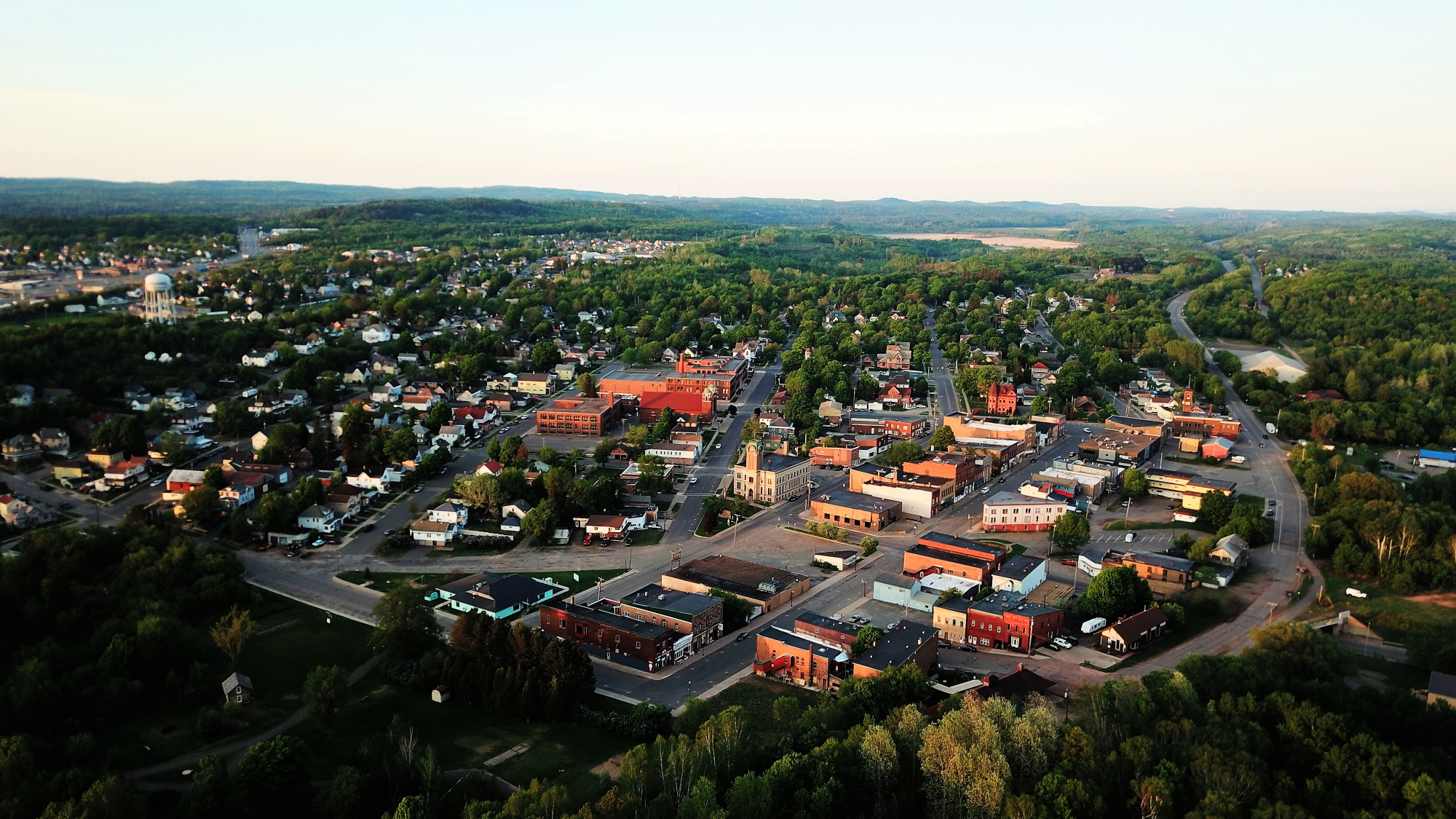
Negaunee (/nəˈɡɔːni/ nə-GAW-nee or locally /ˈnəˈɡɒni/ nə-GON-ee) is a city in Marquette County in the U.S. state of Michigan. The population was 4,627 at the 2020 census.[2] The city is located at the southwest corner of Negaunee Township, which is administratively separate, in the Upper Peninsula. The city is home to a luge track. The name "Negaunee" comes from an Anishinabemowin (Ojibwe) word nigani, meaning "foremost, in advance, leading," which was determined to be the closest Ojibwe translation for "pioneer". Within the city limits is Teal Lake.
Key Information


History
[edit]The city was built after the discovery of the Marquette Iron Range during the early 19th century. The Jackson Mine was established in 1845 to mine the ore for shipment to iron forges; the first such forge to operate in the Lake Superior basin was set up in Negaunee during this period.[5] In 1858, the community was given a post office. In 1865, Negaunee was incorporated as a village and reincorporated as a city in 1873.[6] As mining operations expanded, many immigrants helped settle the area, bringing with them rich traditions that remain today. Due to extensive underground mining, roughly half the city was abandoned in the early 20th century due to risk of cave-in. The city closed its trolley system in 1927. The Jackson Mine ceased all operations within the city limits in the 1940s.
On January 16, 1952, Negaunee became the smallest city to ever host an NBA game. The Milwaukee Hawks beat the Baltimore Bullets 77–71. Baltimore's Don Barksdale led all scorers with 24 points. Negaunee is still the smallest city to ever host any of the four major North American professional sports.[7]
Geography
[edit]Negaunee is in central Marquette County and is bordered to the west by the city of Ishpeming. Marquette, the county seat, is 10 miles (16 km) to the east. Negaunee sits on the eastern shore of Teal Lake, all of which is within the city borders. According to the United States Census Bureau, the city has a total area of 14.34 square miles (37.14 km2), of which 13.44 square miles (34.81 km2) are land and 0.89 square miles (2.31 km2), or 6.24%, are water.[1]
Attractions
[edit]
The Michigan Iron Industry Museum is located near the Carp River on the outskirts of Negaunee. Negaunee is home to Pioneer Days, a festival held every year the week following July 4.
Negaunee is the home of the only full-length natural-track luge course in the United States,[8] maintained by the Upper Peninsula Luge Club.[9] A section near the finish line is open to public sliding in the wintertime, using club equipment.[10] The original track layout was over 800 meters (0.50 mi) in length,[11] featuring 29 curves along its 88-meter (289 ft) vertical drop.[12]
Negaunee is also the home of Suicide Hill Ski Jump, a ski jump training facility where the Ishpeming Ski Club prepares skiers for classic cross country skiing, Nordic combined, and ski jumping competitions.
The county's Heritage Trails pass through Negaunee where visitors can stroll, hike, bike, and snowmobile through Old Town Negaunee and around various collapsed underground mines from last century. The Negaunee portion of the trail also includes a new disc golf course.
Transportation
[edit]Highways
[edit] US 41 passes through the northern portion of Negaunee, running westerly and northerly toward Houghton, easterly toward Marquette and thence southeast to Escanaba.
 M-28 travels concurrently with US 41 through the city, running westerly toward Wakefield and east to Marquette.
 Bus. M-28 serves the downtowns of both Negaunee and Ishpeming.
 M-35, passing east of the city limits, provides an alternate route to the Escanaba area and access to Marquette Sawyer Regional Airport.


Bus
[edit]- Indian Trails bus lines operates daily intercity bus service between Hancock and Milwaukee, Wisconsin, with a stop in Negaunee.[13]
Demographics
[edit]| Census | Pop. | Note | %± |
|---|---|---|---|
| 1870 | 2,559 | — | |
| 1880 | 3,931 | 53.6% | |
| 1890 | 6,078 | 54.6% | |
| 1900 | 6,935 | 14.1% | |
| 1910 | 8,460 | 22.0% | |
| 1920 | 7,419 | −12.3% | |
| 1930 | 6,552 | −11.7% | |
| 1940 | 6,813 | 4.0% | |
| 1950 | 6,472 | −5.0% | |
| 1960 | 6,126 | −5.3% | |
| 1970 | 5,248 | −14.3% | |
| 1980 | 5,189 | −1.1% | |
| 1990 | 4,741 | −8.6% | |
| 2000 | 4,576 | −3.5% | |
| 2010 | 4,568 | −0.2% | |
| 2020 | 4,627 | 1.3% | |
| U.S. Decennial Census[14] | |||
2010 census
[edit]As of the census[15] of 2010, there were 4,568 people, 1,940 households, and 1,219 families residing in the city. The population density was 336.9 inhabitants per square mile (130.1/km2). There were 2,119 housing units at an average density of 156.3 per square mile (60.3/km2). The racial makeup of the city was 96.6% White, 0.1% African American, 1.1% Native American, 0.3% Asian, 0.2% from other races, and 1.7% from two or more races. Hispanic or Latino of any race were 1.1% of the population.
There were 1,940 households, of which 30.6% had children under the age of 18 living with them, 47.1% were married couples living together, 10.9% had a female householder with no husband present, 4.8% had a male householder with no wife present, and 37.2% were non-families. 31.7% of all households were made up of individuals, and 13.8% had someone living alone who was 65 years of age or older. The average household size was 2.30 and the average family size was 2.90.
The median age in the city was 39.7 years. 23.9% of residents were under the age of 18; 8% were between the ages of 18 and 24; 24.4% were from 25 to 44; 27.2% were from 45 to 64; and 16.7% were 65 years of age or older. The gender makeup of the city was 47.4% male and 52.6% female.
2000 census
[edit]As of the census[3] of 2000, there were 4,576 people, 1,946 households, and 1,218 families residing in the city. The population density was 332.1 inhabitants per square mile (128.2/km2). There were 2,088 housing units at an average density of 151.5 per square mile (58.5/km2). The racial makeup of the city was 96.63% White, 0.28% African American, 1.29% Native American, 0.22% Asian, 0.13% from other races, and 1.44% from two or more races. Hispanic or Latino of any race were 0.44% of the population. 28.8% were of Finnish, 14.5% Italian, 14.0% English, 9.3% German, 8.9% Swedish and 5.8% French ancestry according to Census 2000. 95.7% spoke English, 1.7% Spanish and 1.5% Finnish as their first language.
There were 1,946 households, out of which 27.4% had children under the age of 18 living with them, 49.4% were married couples living together, 9.0% had a female householder with no husband present, and 37.4% were non-families. 33.0% of all households were made up of individuals, and 16.6% had someone living alone who was 65 years of age or older. The average household size was 2.30 and the average family size was 2.93.
In the city, the population was spread out, with 22.3% under the age of 18, 9.1% from 18 to 24, 25.9% from 25 to 44, 23.8% from 45 to 64, and 18.8% who were 65 years of age or older. The median age was 40 years. For every 100 females, there were 92.0 males. For every 100 females age 18 and over, there were 89.7 males.
The median income for a household in the city was $33,117, and the median income for a family was $39,750. Males had a median income of $36,026 versus $22,380 for females. The per capita income for the city was $16,889. About 6.3% of families and 9.4% of the population were below the poverty line, including 11.7% of those under age 18 and 5.6% of those age 65 or over.
Education
[edit]
The Negaunee school system, Negaunee Public Schools, ranked in the top 20% of schools for the State of Michigan in 2008.[16] It has since slightly decreased in rank in 2023.[17]
Negaunee Public Schools consists of three main buildings: Lakeview Elementary, which has K-4th grades; Negaunee Middle School, which has 5th through 8th grade; and Negaunee High School, which has 9th through 12th grade. Negaunee athletics have large, healthy rivalries with the Westwood Patriots (Ishpeming Township, Michigan) and Ishpeming Hematites. Other relevant rivalries exist with the Calumet Copper Kings and Iron Mountain Mountaineers.
St. Paul's Catholic School was formerly in Negaunee. Closure was proposed in 1974.[18]
Climate
[edit]This climatic region is typified by large seasonal temperature differences, with warm to hot (and often humid) summers and cold (sometimes severely cold) winters. According to the Köppen Climate Classification system, Negaunee has a humid continental climate, abbreviated "Dfb" on climate maps.[19] The normal monthly mean temperature ranges from 13.6 °F (−10.2 °C) in January to 65.5 °F (18.6 °C) in July.[20] From 1981 to 2010, on average, there were only 3.6 days annually with a maximum of 90 °F (32 °C) or higher, 97 days with a maximum remaining at or below freezing (including most days from December thru February), and 31 days with a minimum reaching 0 °F (−18 °C) or below.[20] The average window for freezing temperatures is September 23 thru May 26, allowing a growing season of 120 days.[20] Negaunee is the location of the National Weather Service forecast office that serves Marquette and surrounding areas.[21]
Precipitation is moderate, averaging 35.7 inches (910 millimeters) annually, with September and October being the wettest months, and the meteorological winter months of December thru February being the driest in terms of normal total precipitation.[20] Snowfall is extremely heavy due to the location in the lake effect snow belt of Lake Superior, averaging 203 in (5.16 m) per season, with the snowiest months of December and January each producing around 43 in (1.1 m) of snow.[20] On average, measurable (0.1 inches or 0.25 centimeters) snow occurs between October 14 and April 28, with accumulating snow in May occurring around half of the time; accumulating snow in September is much rarer, occurring on average once per decade.[20]
| Climate data for NWS Marquette WFO (1981–2010 normals, extremes 1959–present) | |||||||||||||
|---|---|---|---|---|---|---|---|---|---|---|---|---|---|
| Month | Jan | Feb | Mar | Apr | May | Jun | Jul | Aug | Sep | Oct | Nov | Dec | Year |
| Record high °F (°C) | 53 (12) |
61 (16) |
81 (27) |
92 (33) |
95 (35) |
99 (37) |
99 (37) |
96 (36) |
93 (34) |
87 (31) |
73 (23) |
59 (15) |
99 (37) |
| Mean maximum °F (°C) | 39.0 (3.9) |
45.4 (7.4) |
57.4 (14.1) |
73.8 (23.2) |
84.1 (28.9) |
88.4 (31.3) |
89.4 (31.9) |
88.2 (31.2) |
83.7 (28.7) |
74.3 (23.5) |
56.2 (13.4) |
42.4 (5.8) |
91.9 (33.3) |
| Mean daily maximum °F (°C) | 21.9 (−5.6) |
25.6 (−3.6) |
34.7 (1.5) |
47.8 (8.8) |
61.8 (16.6) |
71.7 (22.1) |
76.4 (24.7) |
74.3 (23.5) |
65.8 (18.8) |
52.1 (11.2) |
37.6 (3.1) |
25.9 (−3.4) |
49.8 (9.9) |
| Mean daily minimum °F (°C) | 5.2 (−14.9) |
5.3 (−14.8) |
13.8 (−10.1) |
28.0 (−2.2) |
39.9 (4.4) |
49.4 (9.7) |
54.6 (12.6) |
53.1 (11.7) |
45.8 (7.7) |
34.2 (1.2) |
23.0 (−5.0) |
11.2 (−11.6) |
30.4 (−0.9) |
| Mean minimum °F (°C) | −14.8 (−26.0) |
−16.0 (−26.7) |
−11.7 (−24.3) |
10.0 (−12.2) |
25.2 (−3.8) |
34.7 (1.5) |
41.1 (5.1) |
39.0 (3.9) |
30.2 (−1.0) |
22.0 (−5.6) |
5.9 (−14.5) |
−9.8 (−23.2) |
−20.4 (−29.1) |
| Record low °F (°C) | −32 (−36) |
−34 (−37) |
−30 (−34) |
−9 (−23) |
17 (−8) |
25 (−4) |
34 (1) |
31 (−1) |
21 (−6) |
9 (−13) |
−13 (−25) |
−28 (−33) |
−34 (−37) |
| Average precipitation inches (mm) | 2.41 (61) |
2.14 (54) |
3.03 (77) |
3.01 (76) |
3.05 (77) |
2.84 (72) |
2.84 (72) |
3.05 (77) |
3.72 (94) |
3.84 (98) |
3.18 (81) |
2.57 (65) |
35.68 (906) |
| Average snowfall inches (cm) | 43.2 (110) |
35.9 (91) |
34.9 (89) |
14.5 (37) |
1.5 (3.8) |
0 (0) |
0 (0) |
0 (0) |
0.1 (0.25) |
6.0 (15) |
24.4 (62) |
42.8 (109) |
203.3 (516) |
| Average precipitation days (≥ 0.01 in) | 17.3 | 13.1 | 14.5 | 12.2 | 11.5 | 12.2 | 11.6 | 10.7 | 13.4 | 15.2 | 15.2 | 17.1 | 164.0 |
| Average snowy days (≥ 0.1 in) | 19.6 | 14.7 | 13.0 | 6.5 | 0.9 | 0 | 0 | 0 | 0.1 | 4.1 | 12.4 | 18.3 | 89.6 |
| Source: NOAA[20][22] | |||||||||||||
Notable people
[edit]- Mark Ayotte (born 1964), National Basketball Association referee
- Edward Breitung (1831–1887), Michigan State House of Representatives member
- Bob Chase (1926–2016), sports commentator
- Dominic Jacobetti (1920–1994), Michigan State House of Representatives member
- Joan LeQuia (1937-2022), All-American Girls Professional Baseball League player
- Sarah York, became penpal of Manuel Noriega at age 10
References
[edit]- ^ a b "2022 U.S. Gazetteer Files: Michigan". United States Census Bureau. Retrieved August 16, 2023.
- ^ a b "P1. Race – Negaunee city, Michigan: 2020 DEC Redistricting Data (PL 94-171)". U.S. Census Bureau. Retrieved August 16, 2023.
- ^ a b "U.S. Census website". United States Census Bureau. Retrieved January 31, 2008.
- ^ "US Board on Geographic Names". United States Geological Survey. October 25, 2007. Retrieved January 31, 2008.
- ^ Reynolds, Terry S.; Dawson, Virginia P. (2011). Iron Will: Cleveland Cliffs and the Mining of Iron Ore, 1847–2006. Detroit: Wayne State University Press. pp. 14–18. ISBN 978-0-8143-3511-6.
- ^ Romig, Walter (1986). Michigan Place Names: The History of the Founding and Naming of More than Five Thousand Past and Present Michigan Communities. Great Lakes Books. Detroit: Wayne State University Press. p. 390. ISBN 978-0-8143-1838-6. OCLC 756403524.
- ^ "The Smallest City to ever Host an NBA Game".
- ^ Meyer, Zlati (February 23, 2014). "You Haven't Lived Here Until... You Slide Down the Naturbahn Luge Track in Negaunee". Detroit Free Press. Retrieved March 3, 2015.
- ^ Vachon, Paul (2015). Moon Michigan's Upper Peninsula. Avalon Travel Publishing. p. 367. ISBN 978-1-61238-987-5.
- ^ "Upper Peninsula Luge Club". Upper Peninsula Luge Club. Retrieved October 14, 2021.
- ^ Bowers, Lisa (May 24, 2016). "World Cup Luge Event at Negaunee's Lucy Hill Canceled". The Mining Journal. Marquette, MI. Retrieved December 30, 2016.
- ^ "The Luge Course". Upper Peninsula Luge Club. Retrieved December 30, 2016.
- ^ "Hancock–Marquette–Green Bay–Milwaukee" (PDF). Indian Trails. January 12, 2012. Archived from the original (PDF) on February 22, 2014. Retrieved February 27, 2013.
- ^ "Census of Population and Housing". Census.gov. Retrieved June 4, 2015.
- ^ "U.S. Census website". United States Census Bureau. Retrieved November 25, 2012.
- ^ "Michigan Public School Rankings". psk12.com. Archived from the original on October 26, 2008. Retrieved July 17, 2008.
- ^ "Explore Negaunee Public Schools". Niche. Retrieved March 28, 2023.
- ^ "School may close". Green Bay Press-Gazette. November 17, 1974. p. D10 – via Newspapers.com.
- ^ "Climate Summary for Negaunee, Michigan". WeatherBase.
- ^ a b c d e f g "NOWData: NOAA Online Weather Data". National Oceanic and Atmospheric Administration. Retrieved September 24, 2019.
Scroll down and select 'Marquette WFO, MI'.
- ^ "NWS Forecast Office Marquette, MI". National Weather Service. Retrieved December 30, 2025.
- ^ "Station Name: MI MARQUETTE WFO". National Oceanic and Atmospheric Administration (FTP). Retrieved September 24, 2019.[dead ftp link] (To view documents see Help:FTP)
External links
[edit]Municipalities and communities of Marquette County, Michigan, United States | ||
|---|---|---|
| Cities |  | |
| Charter townships | ||
| Civil townships | ||
| CDPs | ||
| Other communities | ||
| Indian reservations | ||
| Footnotes | ‡This populated place also has portions in an adjacent county or counties | |
| International | |
|---|---|
| National | |
| Geographic | |
| Other | |

Negaunee, Michigan
View on GrokipediaHistory
Founding and Incorporation
The discovery of iron ore in the area that would become Negaunee occurred on September 19, 1844, when a U.S. government surveying party led by William A. Burt, guided by Native American locals familiar with the terrain, identified significant deposits near Teal Lake on the Marquette Iron Range. These guides, from the Ojibwe (Chippewa) people who had long inhabited the region, directed the explorers to the prominent outcropping at what is now the site of the Jackson Mine, marking the first documented recognition of the area's rich mineral resources by non-Native settlers. This event sparked interest in the Upper Peninsula's potential for iron extraction, laying the groundwork for settlement in a previously sparsely populated wilderness.[3][8] Negaunee was officially founded in 1846 as a mining camp by the Jackson Iron Company, which organized operations around the newly discovered ore body. The name "Negaunee" derives from the Ojibwe word niigaaniinh, meaning "pioneer" or "leading ahead," reflecting the site's role as the forefront of Michigan's emerging iron industry and honoring the Indigenous heritage of the area. Initial development was rudimentary, consisting of log cabins and basic infrastructure to support miners and surveyors, with the camp serving as a hub for early extraction efforts beginning in 1845.[3][9] The community formalized its status through incorporation as a village in 1865, amid growing economic activity that attracted workers and merchants to the region. By 1873, with continued expansion driven by mining, Negaunee was reincorporated as a city, establishing its own local government; key early figures included Edward Breitung, a mining entrepreneur and politician who arrived in 1859 and later served as mayor, contributing to the area's administrative and economic foundations. Population growth was rapid during this period, rising from approximately 124 residents in the nascent settlement of 1850 to 2,559 by the 1870 U.S. Census, fueled by an influx of laborers seeking opportunities in the burgeoning iron sector.[10])Mining Industry Development
The mining industry in Negaunee began with the establishment of the Jackson Mine in 1845, marking the first operational iron mine in the Lake Superior district. Organized by the Jackson Iron Company, this open-pit operation extracted high-grade hematite ore from the Marquette Iron Range, initially using basic tools like picks and bars to pry ore from surface exposures up to 150 feet high. The mine's development spurred rapid industrial growth, transforming the area from wilderness into a bustling mining center by the late 1840s.[3][11] Negaunee emerged as a key hub in the Marquette Iron Range, which has historically produced approximately 300 million tons of direct-shipping iron ore since mining commenced in 1848. This output contributed significantly to the broader Lake Superior iron district's total production exceeding 4 billion tons, fueling the U.S. steel industry during the 19th century. The range's rich deposits of 52-54% Fe ores drove economic expansion, with Negaunee's mines playing a pivotal role in early shipments that reached over one million tons annually by 1873.[12][13] Essential infrastructure supported this growth, including the Carp River Forge, constructed in 1848 by the Jackson Iron Company as the first iron smelting operation in the Lake Superior region. Operating until 1855, the forge processed local ore into small quantities of wrought iron using charcoal from nearby timber before shifting focus to direct ore shipment. Railroads were critical for transport; the Marquette, Houghton & Ontonagon Railroad, completed in 1857 from Negaunee to Marquette, became the Upper Peninsula's first common carrier line, initially horse-powered and later steam-driven to haul ore to Lake Superior ports. Subsequent lines, such as the Peninsula Railroad's Escanaba-Negaunee route finished in 1864, enhanced connectivity and enabled efficient ore export via Great Lakes vessels.[14][15] Mining peaked in the late 1800s, with the Marquette Range outputting over five million tons annually by the 1890s, employing thousands in underground and open-pit operations. This boom attracted multicultural immigration, drawing workers from Cornwall, Finland, Italy, Sweden, and other European regions through chain migration networks, who brought specialized mining skills and diversified the local workforce to meet labor demands.[13][16][17]20th Century and Modern Era
The mining industry in Negaunee, which had driven the city's growth in the 19th century, began a prolonged decline in the early 20th century due to the depletion of high-grade iron ores and persistent safety hazards from underground operations. By the 1920s, several mines faced closures amid increasing cave-ins, with the eastern sections of the city declared unsafe as subsidence threatened structures above the extensive tunnel networks. Resource exhaustion intensified this trend; by the 1940s, viable underground deposits were largely spent, prompting a shift toward lower-grade ore processing that reduced employment and economic reliance on mining.[18][19] This downturn culminated in significant urban disruption during the mid-20th century, as cave-ins forced the partial abandonment of the city's original west end neighborhood, known as Old Town. In the 1950s, mining companies warned of imminent collapses, leading to the relocation of roughly half the population eastward and the demolition or dismantling of homes and buildings to mitigate risks. By the 1960s, much of this area stood condemned and vacant, leaving behind remnants like isolated staircases leading to empty lots, symbolizing the mining era's toll on the community. The last major underground operation, the Mather B Mine, closed in 1979 as the regional industry transitioned to open-pit taconite processing elsewhere.[20][21][22] Amid these challenges, Negaunee hosted a notable cultural event in 1952 that briefly spotlighted the city nationally. On January 16, the Milwaukee Hawks defeated the Baltimore Bullets 73-60 in an NBA regular-season game at Negaunee High School's gymnasium, a venue with a capacity of about 1,800 seats. With the city's population around 6,400 at the time, this remains the smallest municipality to host a professional basketball game, arranged as a neutral-site matchup to boost league attendance during a period of financial strain.[23] Post-mining recovery efforts emphasized heritage preservation and economic diversification starting in the late 20th century. The Michigan Iron Industry Museum opened in 1987 on a 40-acre site overlooking the historic Carp River Forge—the first iron manufactory in the region, operational from 1848 to 1855—and incorporating former mining lands deeded to the state in 1979-1980. This state-funded facility, costing $1.5 million, educates visitors on the Marquette Iron Range's legacy while supporting tourism on reclaimed industrial grounds.[14] In recent years, Negaunee has pursued revitalization through strategic planning and community initiatives. The city's "Forge Your Adventure" economic development strategy, released in November 2024, outlines a five-year focus on expanding housing options to attract residents and workers, alongside enhancing outdoor recreation amenities like trails and parks to leverage the area's natural assets. These efforts contributed to Negaunee receiving the Michigan Municipal League's 2025 Community Excellence Award for its Downtown Enhancement Project, which upgraded infrastructure, added pedestrian-friendly features such as Iron Town Plaza, and transformed a blighted commercial district into a vibrant hub.[4][24][25]Geography
Location and Physical Features
Negaunee is situated in Marquette County in Michigan's Upper Peninsula, approximately 10 miles southwest of the city of Marquette and adjacent to Ishpeming.[2][26] The city encompasses a land area of 13.4 square miles according to the U.S. Census Bureau.[1] Its water features include Teal Lake, a 466-acre body covering about 0.73 square miles and reaching a maximum depth of 32 feet.[27] The local topography has been shaped by the Marquette Iron Range, a major iron ore formation consisting of sedimentary layers in a synclinal structure that features rocky hills and surrounding forests.[28][13] Negaunee lies approximately 12 miles northwest of Lake Superior's shoreline, with elevations ranging from 1,200 to 1,500 feet above sea level; the urban core is aligned along U.S. Route 41.[29][30]Climate
Negaunee experiences a humid continental climate classified as Dfb under the Köppen system, characterized by cold, snowy winters and mild summers.[31] Winters are prolonged and severe, with average daily high temperatures in January reaching only 22°F and lows around 7°F, often dipping below 20°F overall for the month.[32] The cold season spans from late November to mid-March, during which snowfall predominates, contributing to an annual average of 203 inches (1981-2010 normals)—among the highest in the Upper Peninsula.[33] Precipitation totals approximately 30 inches yearly, with most falling as snow from November through April due to lake-effect influences from nearby Lake Superior.[34] Summers are relatively mild, with July marking the warmest month at an average high of 76°F and low of 55°F.[32] The warm season lasts from late May to mid-September, featuring comfortable temperatures moderated by Lake Superior, which keeps extremes in check and supports even distribution of rainfall during these months.[32] Overall, the lake's proximity tempers both summer heat and winter cold, preventing more severe continental swings while enhancing snowfall through moisture-laden winds.[32] Extreme weather records underscore the climate's variability, as recorded at the National Weather Service office in Negaunee Township. The lowest recorded temperature was -36°F on January 17, 1977, reflecting intense Arctic outbreaks common to the Upper Peninsula.[35] The highest reached 105°F on August 9, 1936, during a historic North American heat wave.[35] These records highlight the range from subzero winters to occasional summer peaks, influenced by the region's position near Lake Superior.[35]Demographics
Population History
Negaunee's population grew rapidly in the mid-19th century, fueled by immigration drawn to the burgeoning iron ore mining industry. The settlement, which began as a small outpost, recorded just 124 residents in 1850, but expanded dramatically to 6,078 by 1890 as workers and their families arrived from Europe and other parts of the United States to support mining operations.[10][36] This growth continued into the early 20th century, with the population reaching 6,935 in 1900, before the exhaustion of accessible ore deposits and the relocation of mining activities led to a prolonged decline. By 2000, the number of residents had fallen to 4,601, reflecting the economic impacts of mine closures and out-migration from the region.[36][37] In the decades following, Negaunee's population stabilized at around 4,600 to 4,700, with the 2020 census recording 4,627 residents amid a general trend of slow depopulation in the Upper Peninsula. Key factors in this stabilization include economic shifts away from mining, such as the 2016 indefinite idling of the Empire Mine that eliminated approximately 200 jobs, as well as net migration influenced by the city's close proximity to Marquette, which facilitates commuting and regional economic ties.[10][38] As of 2023, the estimated population is 4,641, reflecting continued modest stability.[39]| Year | Population |
|---|---|
| 1850 | 124 |
| 1890 | 6,078 |
| 1900 | 6,935 |
| 2000 | 4,601 |
| 2020 | 4,627 |
| 2023 (est.) | 4,641 |
2020 Census Details
According to the 2020 United States Census, the population of Negaunee was 4,627, representing a slight increase of 1.3% from the 4,568 residents recorded in the 2010 Census. This figure reflects the city's stable resident base in the Upper Peninsula.[1] The racial and ethnic composition of Negaunee in 2020 was predominantly White alone at 91.9%, followed by individuals identifying with two or more races at 3.3%, American Indian and Alaska Native alone at 1.9%, and Asian alone at 0.7%; Black or African American alone accounted for 0.4%, and 1.8% of the population identified as Hispanic or Latino of any race. These demographics highlight the city's largely homogeneous character, with limited diversity across racial and ethnic groups.[40] Household metrics from the 2020 Census indicate 1,945 households with an average size of 2.38 persons per household. The median age was 36.9 years (2018-2022 ACS), and the population was 50.1% female. These statistics underscore a middle-aged community with moderately sized families.[41][42] Housing data showed 2,067 total units, of which 94.1% were occupied. The median home value was $147,800 (2018-2022 ACS), reflecting affordable housing options typical of small Midwestern cities.[41][43]| Demographic Category | 2020 Value | Source |
|---|---|---|
| Total Population | 4,627 | 2020 Decennial Census |
| 2010 Population | 4,568 | 2010 Decennial Census |
| White alone | 91.9% | 2020 Decennial Census |
| American Indian and Alaska Native alone | 1.9% | 2020 Decennial Census |
| Two or More Races | 3.3% | 2020 Decennial Census |
| Asian alone | 0.7% | 2020 Decennial Census |
| Black or African American alone | 0.4% | 2020 Decennial Census |
| Hispanic or Latino | 1.8% | 2020 Decennial Census |
| Households | 1,945 | 2020 Decennial Census |
| Average Household Size | 2.38 | 2020 Decennial Census |
| Median Age | 36.9 years | 2018-2022 ACS |
| Female Population | 50.1% | 2020 Decennial Census |
| Total Housing Units | 2,067 | 2020 Decennial Census |
| Occupied Units | 94.1% | 2020 Decennial Census |
| Median Home Value | $147,800 | 2018-2022 ACS |