Hubbry Logo
NetherdaleNetherdaleMain
Open search
Netherdale
Community hub
Netherdale
logo
8 pages, 0 posts
0 subscribers
Be the first to start a discussion here.
Netherdale
Netherdale
from Wikipedia

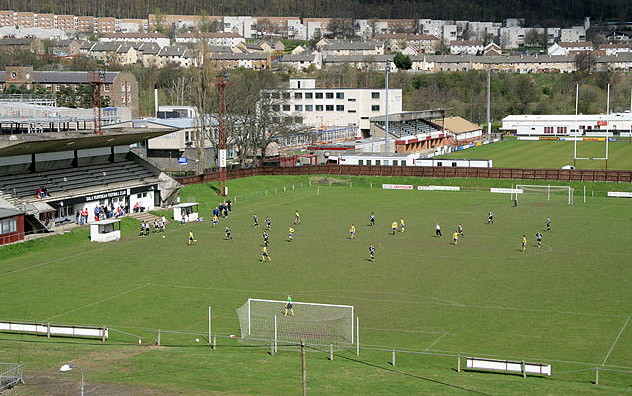
Netherdale is a sports complex in Galashiels, Scottish Borders, consisting of two adjacent stadiums used for rugby union and football. The rugby ground is the home of Gala RFC and was formerly used by the professional Border Reivers team. It hosted one match of the 1999 Rugby World Cup. It has also occasionally been used for rugby league matches. The football ground is home to Gala Fairydean Rovers and has a Category A listed grandstand.

Key Information

Overview

[edit]

The Netherdale complex is located on Nether Road towards the east end of Galashiels, near the River Tweed. The Gala rugby ground is in the north-west corner of the site, with the Gala Fairydean Rovers football ground in the south-west; the two grounds are joined end-to-end. The rest of the site is taken up by a number of undeveloped rugby and football fields known as the back pitches. Gala RFC moved to the area in 1912 from their previous ground at Mossilee, initially playing on what is now the football ground before the construction of their present ground – "New Netherdale" – in 1961–62.

Gala Fairydean F.C. arrived at Netherdale in 1929, initially playing on an undeveloped pitch called Raid Stane Park, before taking over the old rugby ground. Local amateur club Gala Rovers F.C. also played at the Netherdale complex before the two clubs merged to form Gala Fairydean Rovers in 2013. Since the installation of a 3G pitch in 2011, the Fairydean ground is officially known as the 3G Arena Netherdale and is also used as a community football and rugby facility.

Football ground

[edit]
The main stand of Netherdale football stadium is a Category A listed building

Gala RFC had previously played at the Public Park and Mossilee before moving to Netherdale in 1912, where their new ground incorporating a pavilion and grandstand was built at a cost of £1,150.[1] The first rugby match took place in September 1912, against local rivals Hawick.[2] The rugby club continued to play on this part of the ground until the construction of the adjacent "New Netherdale" in 1961–62.

The football stadium has a capacity of around 2,000. The ground's most striking feature is the main stand, which was opened in 1964.[3] With a capacity of 500 it is the largest stand in the Scottish Borders.[3] Designed by the renowned British architect Peter Womersley in the brutalist style, the concrete structure is sometimes sarcastically dubbed as "the San Siro of the Borders". It was awarded a 'B' category listing by Historic Scotland in December 2006, which means the "character and setting" of the building must be preserved for "future generations".[3][4][5]

Historic Scotland upgraded its listing to 'A' category in December 2013, stating that the stand is "a significant work of late modernist architecture in Scotland".[6][7][5] The stand was closed during the 2018–19 season, pending works needed to repair water damage to the concrete.[8] Works to the stand were completed in October 2022.[9]

Rugby ground

[edit]
Netherdale rugby stadium, home of Gala RFC

The rugby stadium has a large grandstand which overlooks the pitch and the nearby Eildon Hills. While the professional Border Reivers club played, a second fully seated stand was installed, increasing the capacity to around 4,000 from the previous 2,000. New pitch protection systems were installed, which the Scottish Rugby Union continued to pay the maintenance costs for even after the Border Reivers club was closed.[10]

The stadium hosted the 1999 Rugby World Cup Pool A match between Uruguay and Spain.[11][12]

Netherdale has also hosted rugby league international matches, firstly the match between Scotland and France on 31 October 2014 as part of the 2014 European Cup. France won that match 38–22.[13] As part of the 2015 European Cup, Netherdale hosted the match between Scotland and Ireland on 23 October.

See also

[edit]

References

[edit]
[edit]
Revisions and contributorsEdit on WikipediaRead on Wikipedia
from Grokipedia
Netherdale is a sports complex located in Galashiels, Scottish Borders, Scotland, featuring two adjacent stadiums dedicated to rugby union and association football, serving as a central hub for local sports since the early 20th century. The complex includes the rugby ground, home to Gala Rugby Football Club (Gala RFC) since 1912 when the club relocated from Mossilee and constructed a new pavilion and grandstand for £1,150, with a capacity of approximately 4,000 spectators. Gala RFC, founded in 1875, has a storied history in Scottish rugby, including multiple Premiership runner-up finishes. Adjacent to it is the football stadium, known as the 3G Arena Netherdale, which accommodates Gala Fairydean Rovers F.C. of the Scottish Lowland Football League and features a full-sized 3G artificial turf pitch, a five-a-side area, floodlighting, changing facilities, and parking; the club holds a record attendance of 2,500 from a 1922 match against Berwick Rangers. A defining feature of Netherdale is its Category A-listed spectator stand, a brutalist concrete structure designed by architect Peter Womersley and completed in 1964 as part of the Gala Stadium development, comprising five modular cantilevered sections that evoke "concrete origami" through their sharp angles and lightweight monumentality. The stand, with 800 seats, turnstiles, changing rooms, and a club room, primarily serves the but contributes to the complex's shared . Closed in 2018 due to safety issues, it underwent a £1.45 million restoration funded by Council, reopening in October 2022 with repairs to the upper levels while preserving its architectural integrity; a second phase for the ground floor is planned. In 2024, the project earned national acclaim, including shortlistings for and awards, underscoring Netherdale's role as a preserved example of mid-20th-century Scottish integrated with community sport. The ground has also hosted international rugby league matches, such as Scotland versus in 2014.

Overview and Location

Site Description

Netherdale is a sports complex situated in , , , comprising two adjacent stadiums dedicated to and . The northern stadium serves as the home ground for Gala Rugby Football Club, featuring a natural grass rugby pitch equipped with , while the southern stadium, known as the 3G Arena Netherdale, hosts Gala Fairydean Rovers Football Club on an artificial surface certified for both football and rugby use. The overall layout positions the rugby pitch to the north and the to the south, with shared facilities including parking areas, changing rooms, clubrooms, and a fitness suite that support operations across both venues. The complex is located adjacent to the Scottish Borders Campus, between the Gala Water and , approximately 1.25 miles southeast of town center. Capacity estimates for the combined site reach up to 6,000 spectators as of 2024, though typical attendances are lower; the northern rugby stadium holds 4,000, the southern Arena accommodates 2,000, and the main grandstand provides seating for 500. Netherdale functions as a vital hub for the Borders region, facilitating amateur and through flexible bookings for matches, training, and events across various age groups and abilities.

Accessibility and Surroundings

Netherdale is situated at approximately 55°36′28″N 2°47′00″W, on the eastern outskirts of in the , positioned near the Gala Water, a tributary of the River Tweed. This location places the complex between the river and nearby urban developments, facilitating its role as a regional . Access to Netherdale is convenient via the A7 road, which runs adjacent to the site and connects it directly to major routes. Visitors from can reach by bus services or a drive of about one hour covering roughly 33 miles, while the nearest railway station is Tweedbank on the , located 1.2 miles away, offering connections from Waverley in around 50 minutes followed by a short walk or local bus. On-site parking is limited to approximately 200 free spaces, with additional options available in nearby areas like the Gala Water . The surrounding environment blends industrial and residential elements, with Netherdale directly adjacent to the Netherdale Industrial Estate, which hosts various businesses and supports the local economy. The site provides scenic views toward the Eildon Hills to the southeast, enhancing its appeal as an integrated part of the Borders landscape. Netherdale contributes to the community through regular usage by local schools, sports clubs, and groups for training, matches, and events, managed in part by Live Borders to promote recreational access. This engagement underscores its role as a vital local hub, drawing participants and spectators from the Galashiels area and beyond for diverse activities.

Historical Development

Origins and Construction

The area now known as Netherdale in Galashiels, Scottish Borders, has roots in local sports dating back to the late 19th century, when informal fields served community activities. Gala Rugby Football Club (Gala RFC), established in 1875 as one of Scotland's oldest rugby unions, initially played at the Public Park before relocating to Mossilee around 1881; by 1912, the club had shifted to Netherdale, developing a basic ground there complete with a pavilion and grandstand at a cost of £1,150 to accommodate growing participation in organized rugby. Similarly, Gala Fairydean Rovers F.C., founded in 1894, utilized adjacent or overlapping spaces in the Netherdale vicinity for football matches, reflecting the site's early role as a shared, ad-hoc venue for both codes amid rising post-industrial demand for recreational facilities in the textile town. The primary phase of formal construction at Netherdale occurred between 1963 and 1965, transforming the site into a dedicated with separate pitches for rugby and football to address the limitations of earlier informal setups. This development, centered on the erection of a modernist , was spearheaded by local club initiatives and fundraising efforts, particularly from Gala Fairydean Rovers, which sought enhanced infrastructure to support ambitions for league progression. The project created structured enclosures replacing scattered fields, funded through club-generated revenues from competitions and community contributions rather than large-scale external grants at the time. Key milestones included the official opening of the football stand on 21 November 1964, officiated by A. Wilson Strachan, chairman of Heart of Midlothian F.C. and Scottish Football Association treasurer, during a match against East Fife that drew significant local attendance. By 1965, the full complex was operational, with initial rugby viewing areas supporting around 4,000 spectators and football facilities accommodating approximately 2,000, establishing Netherdale as a central hub for Borders sports. These early capacities underscored the venue's scale for regional matches, while its Brutalist concrete design elements provided a stark, functional aesthetic.

Renovations and Modern Upgrades

In the 2010s, Netherdale underwent significant modernization to enhance its facilities for both and , particularly through the installation of a pitch. Construction began in August 2011 on the site of the existing grass pitch at Gala Fairydean Rovers' ground, transforming it into a full-size surface compliant with and International Rugby Board standards, alongside a smaller synthetic training pitch. The project, costing approximately £750,000, was funded through a partnership including Scottish FA grants, Council contributions, and support from the Football Foundation and Hayward Group. This upgrade enabled year-round play, reducing weather-related cancellations and increasing usage by local clubs and community groups, with the pitch officially opening in February 2012 after delays due to adverse weather during infill application. By the early 2020s, the surfaces required renewal due to wear from high utilization—averaging thousands of hours annually across football and rugby activities—leading to a £425,000 replacement project completed in August 2022. The work, funded by Council, Live Borders, and the Hayward Trust, involved resurfacing the main pitch and five-a-side area, along with installation of a new LED floodlight system to improve energy efficiency and visibility for evening events. These enhancements maintained Netherdale's role as a multi-sport hub while addressing maintenance needs from the original 2011 installation. A major focus of recent upgrades has been the conservation and repair of the iconic Category A-listed spectator stand, originally designed by Peter Womersley in 1964, which closed in 2018 due to safety concerns from , including spalling caused by decades of and prior alterations. A £1.45 million repair project commenced in February 2022 and culminated in the stand's reopening on 29 October 2022, with finishing works completed by November. Led by Reiach and Hall Architects in collaboration with David Narro Associates (engineers) and Morham and Brotchie (quantity surveyors), the project included comprehensive concrete restoration, drainage system improvements to prevent water ingress, installation of a new liquid membrane roof, ventilation upgrades, and reinstatement of original features, all while respecting heritage constraints to preserve the brutalist structure's architectural integrity. Funding was secured from a consortium comprising Council, , the Fallago Environmental Fund, Live Borders, Gala Fairydean Rovers, and community trusts. Overall, post-2000 investments in Netherdale, encompassing the initial pitch development, its 2022 renewal, and refurbishment, have exceeded £2 million, drawn from a blend of local authority ( Council), national sports bodies (Scottish FA), and private/club sources to ensure sustainable, accessible facilities amid heritage preservation requirements.

Architecture and Heritage

Design and Architectural Features

The Netherdale grandstand, designed by architect Peter Womersley and constructed between 1963 and 1965, exemplifies Scottish brutalism through its emphasis on raw materials, geometric massing, and functional form. Womersley, a prominent figure in post-war Scottish modernism influenced by Le Corbusier's techniques, prioritized exposed concrete as both structural and aesthetic element, creating a structure that integrates stark functionality with visual impact. The grandstand comprises five modular precast concrete units, forming a cantilevered that shelters spectators while projecting a sense of precarious lightness against the heavy mass below. This design features an austere raw finish, with bold angular forms and sharp edges that evoke "," highlighting brutalist principles of honesty in materials and sculptural expression without decorative excess. The cantilevered , supported by slender elements, not only provides weather protection but also enhances the structure's dramatic silhouette, drawing on modernist ideals of as . Structurally, its modular composition allowed for efficient and assembly while accommodating the site's dual-sport layout. Positioned to overlook both the and pitches, it integrates with contrasting terracing arrangements: banked earth mounds on the rugby side for elevated viewing and flat standing areas on the football side for direct pitch access. This thoughtful site integration underscores Womersley's approach to contextual functionality, where the grandstand acts as a unifying element in the sports complex without compromising the distinct requirements of each sport.

Listing and Preservation

Netherdale's main stand, known as the Gala Fairydean Football Stadium, was designated as a by on November 14, 2006, with the listing upgraded to on November 22, 2013, recognizing it as a structure of national or international importance. This designation places it among a select few sports venues in to receive such protection, highlighting its exceptional architectural and historical value. The listing criteria emphasize the stand's role as an outstanding example of late-modernist in , characterized by its innovative sculptural form and departure from traditional functionalism toward aesthetic expression. It is noted for the rarity of its intact design, featuring board-marked concrete elements and a cantilevered canopy supported by V-sectioned fins, which together form a "geometrical composition of unusual interest and subtlety." This recognition underscores its cultural significance as a rare surviving mid-20th-century football stand, designed by architect Peter Womersley in collaboration with engineers . Preservation efforts have addressed significant challenges posed by the structure's exposure to Scotland's harsh weather, particularly the weathering and deterioration of its components over decades of use. In 2022, following planning approval in 2021, a £1.45 million repair project overseen by Council and engineering firm Narro Associates focused on stabilizing the stand through protection, repairs, and restoration of original features like timber-graining patterns, all while adhering to Category A guidelines to avoid altering its appearance. Ongoing preservation involves regular monitoring by Council in partnership with to ensure the structure's long-term integrity. In , the restoration project received national recognition, including shortlistings for the ' Structural Awards and the Scottish Design Awards, underscoring the stand's preserved architectural significance. Future plans include potential enhancements such as on-site interpretation boards to better educate visitors about the stand's architectural heritage, supporting its role as an attraction for enthusiasts and students.

Rugby Union Facilities

Gala RFC Usage

Gala Rugby Football Club, established in 1875, has utilized Netherdale as its primary home ground since relocating there in from the previous Mossilee site. The club competes in the Men's National League Division 1, where Netherdale serves as the central venue for its home matches in this competitive tier of Scottish club rugby. Over the decades, the ground has become synonymous with Gala's participation in regional and national competitions, fostering a strong connection to the local Borders rugby tradition. The facilities at Netherdale support Gala RFC's rugby operations through a natural grass pitch, the iconic main stand for spectator viewing—which is shared with the adjacent football stadium—and dedicated alongside a clubhouse for team preparations and social gatherings. These amenities enable efficient matchday logistics, including player access and supporter accommodations, while the clubhouse often hosts post-game events and club functions. Matchday operations at Netherdale typically feature enthusiastic local crowds, with border rivalries such as those against drawing heightened interest and atmosphere due to the intense historical competition between the clubs. These fixtures highlight the ground's role in sustaining community engagement through rugby. Netherdale also hosts Gala RFC's community programs, including youth academies, coaching sessions, and summer camps aimed at developing young players from minis to under-18 levels, contributing to the club's grassroots efforts in the .

Pitch Specifications and Capacity

The rugby pitch at Netherdale features a natural grass surface measuring 100 meters in length by 70 meters in width, in line with standards, along with in-goal areas ranging from 10 to 22 meters deep and regulation goalposts positioned at each end. The field is equipped with an system to maintain playability during colder months. Gala RFC oversees the pitch's annual maintenance, which incorporates to alleviate , promote root growth, and enhance drainage, ensuring the surface withstands the demands of competitive . The accommodates up to 4,000 spectators for rugby fixtures, comprising approximately 650 seats in the main stand and standing room on terracing for the balance. Netherdale has served as a venue for significant rugby events, including multiple Border League finals, such as the 2023 showdown between Melrose and Selkirk. During the 1970s, it emerged as a leading host for tournaments, surpassing even Murrayfield in prominence for the spring circuit. The ground has also welcomed South of Scotland select team matches, underscoring its role in regional club-level internationals.

Association Football Facilities

Gala Fairydean Rovers Usage

Gala Fairydean Rovers Football Club, based in , , traces its origins to 1894 when it was first established as a senior team in the region. The club underwent a significant in 2013 through a merger between the historic Gala Fairydean and Gala Rovers entities, adopting the unified name Gala Fairydean Rovers and transitioning to the Scottish Lowland Football League from the . Since the mid-1960s, the club has utilized the south pitch at Netherdale as its primary home venue for senior matches, establishing a longstanding presence in the facility originally developed to support local football. The club's operational routines at Netherdale center on hosting home fixtures in the Lowland League, alongside regular training sessions for the senior squad. This extends to the women's team, which competes in regional leagues and conducts weekly training and matches on site, and the youth academy, which supports development programs for players from age upward, including boys and girls sections that utilize the grounds for skill-building and competitive play. These activities reflect steady local interest in the club's performances. Netherdale provides dedicated facilities tailored to the club's needs, including multiple changing rooms for home and away teams, a separate officials' room for referees and match officials, and a trainer's room to support on-site preparations. These amenities integrate seamlessly with the adjacent pitch, enabling efficient multi-use scheduling for training and fixtures across the club's various teams. Beyond competitive play, Gala Fairydean Rovers plays a vital role through its dedicated Community Trust, which fosters partnerships with local schools to deliver football programs for primary and secondary pupils. The club also organizes annual events such as youth festivals and development clinics at Netherdale, promoting grassroots participation and strengthening ties with the area.

3G Pitch and Events

The at Netherdale features a full-size synthetic turf pitch installed in 2011, marking the first such facility in the . The surface is 2-star rated and certified by the International Rugby Board for competitive play in both football and , with overall dimensions of 116 meters by 72 meters to accommodate standard match requirements including run-off areas. Floodlighting enables year-round usage, supporting evening fixtures and training. The pitch underwent renewal in 2022, funded by Council, to maintain its quality for ongoing community and competitive events. For football matches, the venue accommodates up to 2,000 spectators, primarily via the shared main stand with open terracing at the ends. This setup supports intimate yet vibrant atmospheres for Lowland League games and cup ties. The pitch regularly hosts notable events, including Scottish Lowland Football League fixtures and Scottish Cup qualifiers, such as Gala Fairydean Rovers' first-round exit to Linlithgow Rose in 2025. It has also served as a venue for community tournaments like the annual Festival of Football, which draws over 120 youth teams. A highlight was the 2018 Scottish Cup second-round match against East Stirlingshire, contributing to the ground's role in regional football development. Annually, the pitch supports more than 100 bookings, encompassing league matches, amateur competitions, and training sessions for local clubs and schools, promoting accessible football in the Borders region.

References

Add your contribution
Related Hubs
User Avatar
No comments yet.