


Community hub
Recent from talks
Contribute something
Nothing was collected or created yet.
Newton-second
View on Wikipedia| newton-second | |
|---|---|
 | |
| General information | |
| Unit system | SI |
| Unit of | impulse and momentum |
| Symbol | N⋅s |
| Named after | Isaac Newton |
| In SI base units: | kg⋅m/s |
The newton-second (also newton second; symbol: N⋅s or N s)[1] is the unit of impulse in the International System of Units (SI). It is dimensionally equivalent to the momentum unit kilogram-metre per second (kg⋅m/s). One newton-second corresponds to a one-newton force applied for one second.
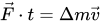
It can be used to identify the resultant velocity of a mass if a force accelerates the mass for a specific time interval.
Definition
[edit]Momentum is given by the formula:

- is the momentum in newton-seconds (N⋅s) or "kilogram-metres per second" (kg⋅m/s)
- is the mass in kilograms (kg)
- is the velocity in metres per second (m/s)


Examples
[edit]This table gives the magnitudes of some momenta for various masses and speeds.
| Mass (kg) |
Speed (m/s) |
Momentum (N⋅s) |
Explanation |
|---|---|---|---|
| 0.42 | 2.4 | 1 | A 420-gram (15 oz) football (FIFA specified weight for outdoor size 5) kicked to a speed of 8.6 km/h (5.3 mph). |
| 0.42 | 38 | 16 | The momentum of the famous football kick of the Brazilian player Roberto Carlos in the match against France in 1997. The football had a speed of 137 km/h (85 mph), making it one of the hardest kicks measured. |
| 1300 | 10 | 13000 | A four-door car weighing 1300 kg (2900 lb) crashing at 36 km/h (22 mph). |
| 2000 | 10 | 20000 | A mid-size SUV weighing 2000 kg (4400 lb) crashing at 36 km/h (22 mph). |
| 6 | 1 | 6 | The total impulse of a class C model rocket engine, which can be found in amateur fireworks. |
| 10 | 2 | 20 | The total impulse of a class D model rocket engine, which also can be found in amateur fireworks. |
| 132500 | 8050 | 1.07×10⁹ | Space Shuttle launched from Earth to orbit[a] |
| 45702 | 10834 | 4.95×10⁸ | Apollo 11 launched from Earth to orbit |
| 0.0075 | 350 | 2.6 | A 7.5-gram (0.26 oz) handgun bullet (e.g. 9mm Parabellum) fired at 350 m/s (1100 ft/s). |
| 0.004 | 945 | 3.8 | A 4-gram (0.14 oz) rifle bullet (e.g. 5.56×45mm NATO) fired at 945 m/s (3100 ft/s). |
| 0.05 | 860 | 43 | A 50-gram (1.8 oz) anti-material bullet (e.g. .50 BMG) fired at 860 m/s (2800 ft/s). |
- ^ Space Shuttle weight here includes the heaviest possible payload (27500 kg), empty external tank (30000 kg), and the shuttle itself (75000 kg) all in a low Earth orbit (8.05 km/s). As the Space Shuttle uses staging, not all launched components reach all the way to orbit (e.g. the boosters). The total impulse gained by all stages together during the launch is 5.7×10⁹ Ns.
See also
[edit]- Power factor
- Newton-metre – SI unit of torque
- Orders of magnitude (momentum) – examples of momenta
References
[edit]- ^ International Bureau of Weights and Measures (2006), The International System of Units (SI) (PDF) (8th ed.), ISBN 92-822-2213-6, archived (PDF) from the original on 2021-06-04, retrieved 2021-12-16

 | This classical mechanics–related article is a stub. You can help Wikipedia by expanding it. |
 | This unit of measurement related article is a stub. You can help Wikipedia by expanding it. |
Newton-second
View on GrokipediaDefinition and Properties
Formal Definition
The newton-second (symbol: N⋅s) is the derived SI unit of impulse and momentum, defined as the impulse resulting from a force of one newton acting over a duration of one second.[2] This unit arises as the product of the SI unit of force, the newton (N), and the SI unit of time, the second (s).[7] In terms of base SI units, the newton-second is expressed as (kilogram-meter per second), reflecting its coherence within the International System of Units, where no numerical factors other than unity are involved in its formation.[2] The International Bureau of Weights and Measures (BIPM) classifies it as a coherent derived unit without a special name or prefix, ensuring consistency across physical measurements.[2] The International Union of Pure and Applied Physics (IUPAP) endorses this definition, recommending its use for quantities such as linear momentum and mechanical impulse in physical equations.[8] Notation conventions specify the symbol as N s (with a space indicating multiplication) or N⋅s (with a middle dot), printed in upright roman font; the unspaced form Ns is avoided to prevent ambiguity with other units like the nanosiemens.[7][8]Dimensional Analysis
The newton-second (N⋅s) possesses the dimensional formula , where denotes mass, length, and time. This derives from the dimension of force in the newton, , multiplied by time , yielding the overall dimensions of mass times velocity.[9] In the International System of Units (SI), the newton-second is dimensionally equivalent to the unit of momentum, kilogram meter per second (kg⋅m/s), such that . This equivalence holds without numerical conversion factors, as both express the product of mass and velocity in coherent SI base units. Additionally, it corresponds to , reflecting the relation between energy (joule, J = N⋅m) and the unit's structure, though the primary focus remains on kg⋅m/s for momentum-related contexts.[9] Comparisons to non-SI units illustrate cross-system conversions; for instance, (pound-force second) in the imperial system.[10] The newton-second's coherency within the SI system ensures seamless integration in impulse and momentum calculations, requiring no scaling factors when combining with other SI derived units like force or velocity. This property facilitates precise, factor-free computations in scientific and engineering applications adhering to SI standards.[11]Physical Significance
Relation to Impulse
The newton-second (N⋅s) serves as the SI unit for impulse, a vector quantity in physics defined as the integral of force over time, expressed mathematically as , where is force and is an infinitesimal time interval.[12] This formulation arises from integrating Newton's second law, , over a finite time period, yielding the total impulse as the change in momentum, though the focus here is on the force-time product.[13] The unit N⋅s reflects the dimensional combination of force in newtons (kg⋅m/s²) and time in seconds, resulting in kg⋅m/s.[14] For a constant force applied over a discrete time interval , the impulse simplifies to , directly linking the magnitude of the force to the duration of its application.[14] This equation underscores the newton-second's role in quantifying sustained force effects, such as in propulsion or impact scenarios. Impulse in N⋅s measures the overall "push" delivered by the force, independent of instantaneous variations if averaged appropriately.[15] Physically, impulse represents the cumulative impact of a force acting over time, enabling the assessment of how prolonged or intense forces alter an object's motion.[16] The average force during the interval can be derived as , illustrating that a given impulse in newton-seconds can result from a large force over short time or a small force over longer time, scaling the unit's utility in dynamic systems.[14] Notably, the newton-second is dimensionally equivalent to the unit of momentum, kg⋅m/s.[12]Relation to Momentum
The newton-second (N⋅s) serves as the SI derived unit for linear momentum, a vector quantity defined as the product of an object's mass and its velocity. Mathematically, linear momentum is given by , where is the mass in kilograms (kg) and is the velocity in meters per second (m/s). This yields the unit kg⋅m/s, which is dimensionally equivalent to N⋅s since 1 N = 1 kg⋅m/s², and thus 1 N⋅s = 1 kg⋅m/s.[12][17] In isolated systems—those free from external forces—the total linear momentum is conserved, meaning the vector sum of the momenta of all objects remains constant over time. This conservation law, a direct consequence of Newton's third law, implies that the total quantity in N⋅s for the system does not change during interactions such as collisions. For example, in a perfectly elastic collision between two objects, the post-collision momenta adjust such that their sum equals the pre-collision sum, preserving the overall N⋅s value.[18][12] It is important to distinguish linear momentum from angular momentum, which involves rotational motion and has units of N⋅m⋅s (or kg⋅m²/s) rather than N⋅s. While linear momentum quantifies straight-line motion, angular momentum accounts for rotation about an axis, and the two are not interchangeable in this context.[19][20] In special relativity, the formula for linear momentum modifies to , where is the Lorentz factor and is the speed of light; however, the SI unit remains N⋅s (or kg⋅m/s), as is dimensionless. This adjustment becomes significant at velocities approaching , but the unit equivalence holds across both classical and relativistic regimes.[21]Applications and Examples
In Classical Mechanics
In classical mechanics, the newton-second serves as a practical unit for quantifying impulse and changes in momentum during interactions like collisions and launches. Consider a ballistic collision scenario where an impulse of 10 N⋅s is applied to a 2 kg object initially at rest; this impulse alters its velocity by Δv = J / m = 10 / 2 = 5 m/s, illustrating the direct relationship between impulse and momentum change as per the impulse-momentum theorem.[22][23] Conservation of momentum, expressed in newton-seconds, is fundamental in analyzing inelastic collisions where objects stick together post-impact. For instance, a 2 kg mass moving at 3 m/s collides inelastically with a stationary 3 kg mass, yielding an initial total momentum of (2 kg)(3 m/s) + (3 kg)(0 m/s) = 6 N⋅s; after collision, the combined 5 kg system moves at 1.2 m/s, conserving the total momentum at 6 N⋅s.[24][25] In projectile motion, the newton-second quantifies the initial impulse imparted during launch, determining takeoff momentum. A simplified case involves launching a 1 kg projectile vertically with an impulse of 20 N⋅s from rest, resulting in an initial velocity of 20 m/s and momentum of 20 N⋅s; the maximum height reached can then be derived from energy considerations, but the impulse sets the foundational momentum scale.[12] Air resistance impulses are often neglected in idealized projectile analyses to simplify trajectories, assuming constant horizontal momentum in newton-seconds. However, when included, the drag force integrated over flight time yields a net impulse that opposes motion, exponentially decaying the horizontal velocity component and reducing overall range.[26][27]In Engineering and Technology
In rocket propulsion, the newton-second quantifies total impulse as the time integral of thrust, representing the overall momentum change imparted to the vehicle. This measure is crucial for calculating delta-v, the change in velocity, using the Tsiolkovsky rocket equation: , where is specific impulse in seconds, is standard gravity, and , are initial and final masses; total impulse in N⋅s relates directly to propellant mass times exhaust velocity, enabling mission trajectory designs.[28][29] In automotive safety systems, airbag deployment delivers an impulse on the order of 20–80 N⋅s to occupants during collisions, extending the stopping time from milliseconds to tens of milliseconds and thereby reducing peak forces to below injury thresholds (e.g., limiting chest deceleration to under 60 g for a Hybrid III dummy). This impulse management leverages momentum conservation in the crash, distributing the required change in occupant momentum over a longer duration without altering the total impulse.[30] Structural engineering employs the newton-second in seismic design to model earthquake ground motions as impulsive inputs, such as double impulses approximating near-fault fling-step effects, where each impulse corresponds to a velocity change and total momentum transfer in N⋅s for single-degree-of-freedom systems. These models facilitate energy balance assessments, ensuring buildings withstand maximum deformations by optimizing stiffness and damping to dissipate the input kinetic energy .[31] Measurement tools like impulse hammers and dynamometers are calibrated to quantify impacts in newton-seconds for vibration testing, applying Newton's second law () to a known mass and accelerometer to verify force-time integrals, enabling precise modal analysis of structures under dynamic loads.[32]Historical Development
Origins in Newtonian Mechanics
The conceptual foundation of the newton-second as a unit of impulse traces back to Isaac Newton's formulation of his second law of motion in the Philosophiæ Naturalis Principia Mathematica (1687), where he described the change in a body's "quantity of motion" as proportional to the "motive force" impressed upon it and occurring in the direction of that force. Newton defined "quantity of motion" as arising conjointly from the body's mass and velocity, equivalent to what is now termed linear momentum (), and the impressed force as an external action altering this quantity.[33] This implies that the time-integrated effect of force, or impulse, equals the change in momentum: , establishing a force-time product as the measure for such changes, though Newton expressed it geometrically without modern algebraic notation.[34] Newton's "quantity of motion" built on earlier ideas like Galileo's concept of impetus but shifted emphasis to external forces causing acceleration, resolving ambiguities in pre-Principia views where motion was attributed to innate forces.[34] In the 18th century, Leonhard Euler and others further developed the analytic treatment of these concepts in works like Euler's Mechanica sive Motus Scientia Analytice Exposita (1736), clarifying quantity of motion as a vector quantity conserved in isolated systems and altered by impulses. Euler's work extended Newton's principles to rigid bodies, solidifying the impulse-momentum relation as central to dynamics.[35] Prior to the coherence of the modern SI system, the foot-pound-second (FPS) framework emerged in the early 19th century among British and American engineers, measuring impulse in pound-force seconds (lbf⋅s) to quantify changes in momentum for practical applications like ballistics and machinery.[36] This non-absolute system treated the pound ambiguously as both mass and force, leading to inconsistencies resolved by adopting the absolute FPS variant, where the poundal (a coherent force unit equal to one pound-mass accelerated at one foot per second squared) yielded the poundal-second as an impulse measure.[37] The poundal's formal introduction in 1877 by the British Association for the Advancement of Science marked a key 19th-century step in British engineering toward consistent units linking force, time, and momentum, predating metric unification efforts.[38]Standardization in the SI System
The newton-second (N⋅s) was formally established as a derived unit within the International System of Units (SI) by the 11th General Conference on Weights and Measures (CGPM) in 1960, through Resolution 12, which defined the SI based on the metre-kilogram-second (MKS) system and specified coherent derived units including those for force and its time integral.[39] As a product of the newton (kg⋅m⋅s⁻²) and the second (s), the newton-second equates to kg⋅m⋅s⁻¹ and serves as the coherent SI unit for quantities such as impulse and momentum, ensuring dimensional consistency across mechanical derivations without requiring additional base units.[2] The 2019 redefinition of the SI, adopted by the 26th CGPM and effective from May 20, 2019, fixed the values of fundamental constants such as the Planck constant (h = 6.626 070 15 × 10⁻³⁴ J⋅s) to redefine base units including the kilogram, metre, and second, thereby enhancing the long-term stability of derived units like the newton-second.[2] Although this revision indirectly influences the newton-second through its dependence on these base units, the unit itself underwent no structural change, maintaining its expression as N⋅s or kg⋅m⋅s⁻¹ to preserve continuity with pre-2019 measurements. Unlike certain derived units such as the joule (J = N⋅m) for energy, the newton-second has no special name in the SI to distinguish it clearly as the unit for impulse while sharing the same dimensions with momentum, as specified in the ISO 80000-4 standard on quantities and units in mechanics. This convention avoids potential ambiguity in nomenclature, with the unit consistently denoted as N⋅s in international standards for classical mechanical quantities.[2] Following the 1960 establishment of the SI and accelerated metrication efforts in the 1970s, the newton-second saw widespread international adoption in scientific literature and engineering practices, supplanting the dyne-second (from the centimetre-gram-second system) as the preferred unit for impulse and related quantities.[2] This transition aligned global measurements under a unified framework, with organizations like the International Organization for Standardization endorsing the SI-derived form to facilitate interoperability in research and technology.References
- https://openstax.org/books/university-physics-volume-1/pages/9-2-impulse-and-collisions