Hubbry Logo
Space Shuttle orbiterSpace Shuttle orbiterMain
Open search
Space Shuttle orbiter
Community hub
Space Shuttle orbiter
logo
8 pages, 0 posts
0 subscribers
Be the first to start a discussion here.
Contribute something
Space Shuttle orbiter
from Wikipedia

Space Shuttle orbiter
ManufacturerRockwell International (North American Aircraft Operations)
Country of originUnited States
OperatorNASA
ApplicationsCrew and cargo spaceplane
Specifications
Spacecraft typeCrewed, reusable
Launch mass110,000 kg (240,000 lb)
Dry mass78,000 kg (172,000 lb)
RegimeLow Earth orbit
Dimensions
Length37.237 m (122.17 ft)
Height17.86 m (58.6 ft)
Wingspan23.79 m (78.1 ft)
Capacity
Payload to Low Earth orbit
Mass24,310 kg (53,590 lb)
Production
StatusRetired
Built6
Launched5 orbiters
135 missions
Lost2 orbiters
Maiden launchSpace Shuttle Columbia
STS-1
(April 12, 1981)
Last launchSpace Shuttle Atlantis
STS-135
(July 8, 2011)
Last retirementSpace Shuttle Atlantis
STS-135
(July 21, 2011)

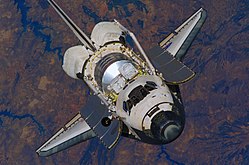
The Space Shuttle orbiter is the spaceplane component of the Space Shuttle, a partially reusable orbital spacecraft system that was part of the discontinued Space Shuttle program. Operated from 1981 to 2011 by NASA,[1] the U.S. space agency, this vehicle could carry astronauts and payloads into low Earth orbit, perform in-space operations, then re-enter the atmosphere and land as a glider, returning its crew and any on-board payload to the Earth.

Six orbiters were built for flight: Enterprise, Columbia, Challenger, Discovery, Atlantis, and Endeavour. All were built in Palmdale, California, by the Pittsburgh, Pennsylvania-based Rockwell International company's North American Aircraft Operations branch. The first orbiter, Enterprise, made its maiden flight in 1977. An unpowered glider, it was carried by a modified Boeing 747 airliner called the Shuttle Carrier Aircraft and released for a series of atmospheric test flights and landings. Enterprise was partially disassembled and retired after completion of critical testing. The remaining orbiters were fully operational spacecraft, and were launched vertically as part of the Space Shuttle stack.

Columbia was the first space-worthy orbiter; it made its inaugural flight in 1981. Challenger, Discovery, and Atlantis followed in 1983, 1984, and 1985, respectively. In 1986, Challenger was destroyed in a disaster shortly after its 10th launch, killing all seven crew members. Endeavour was built as Challenger's successor, and was first launched in 1992. In 2003, Columbia was destroyed during re-entry, leaving just three remaining orbiters. Discovery completed its final flight on March 9, 2011, and Endeavour completed its final flight on June 1, 2011. Atlantis completed the final Shuttle flight, STS-135, on July 21, 2011.

In addition to their crews and payloads, the reusable orbiter carried most of the Space Shuttle's liquid-propellant rocket system, but both the liquid hydrogen fuel and the liquid oxygen oxidizer for its three main rocket engines were fed from an external cryogenic propellant tank. Additionally, two reusable solid rocket boosters (SRBs) provided additional thrust for approximately the first two minutes of launch. The orbiters themselves did carry hypergolic propellants for their Reaction Control System (RCS) thrusters and Orbital Maneuvering System (OMS) engines.

Description

[edit]

About the size of a McDonnell Douglas DC-9,[2] the Space Shuttle orbiter resembled an airplane in its design, with a standard-looking fuselage and two double delta wings, both swept wings at an angle of 81 degrees at their inner leading edges and 45 degrees at their outer leading edges. The vertical stabilizer of the orbiter had a leading edge that was swept back at a 45-degree angle. There were four elevons mounted at the trailing edges of the delta wings, and the combination rudder and speed brake was attached at the trailing edge of the vertical stabilizer. These, along with a movable body flap located underneath the main engines, controlled the orbiter during later stages of reentry.

The prime contractor for the orbiter was Rockwell International, which built the pressurized cabin, thermal protection, forward attitude control system, and forward and aft fuselage in its Downey, California factory, the payload bay doors in its Tulsa, Oklahoma factory, and the body flap in its Columbus, Ohio factory. Subcontractors included Convair in San Diego for the midsection, Fairchild Aircraft in Farmingdale, New York for the vertical stabilizer, Grumman in Bethpage, New York for the wings,[3][4] Marquardt Corporation in Van Nuys, California for the attitude control propulsion,[5] Aerojet in Rancho Cordova, California for the orbital insertion and deorbit propulsion, McDonnell Douglas for the surrounding pods, and Rocketdyne in Canoga Park, Los Angeles for the launch and ascent propulsion.[4][6] 12,000 Rockwell workers were assigned to orbiter construction at the program's peak in the Downey plant.[7] Final assembly was carried out at United States Air Force Plant 42 near Palmdale, California.[3]

Attitude control system

[edit]
Discovery's forward reaction control thrusters

The Reaction Control System (RCS) was composed of 44 small liquid-fueled rocket thrusters and their very sophisticated fly-by-wire flight control system, which utilized computationally intensive digital Kalman filtering. This control system carried out the usual attitude control along the pitch, roll, and yaw axes during all of the flight phases of launching, orbiting, and re-entry. This system also executed any needed orbital maneuvers, including all changes in the orbit's altitude, orbital plane, and eccentricity. These were all operations that required more thrust and impulse than mere attitude control.

The forward rockets of the Reaction Control System, located near the nose of the Space Shuttle orbiter, included 14 primary and two vernier RCS rockets. The aft RCS engines were located in the two Orbital Maneuvering System (OMS) pods at the rear of the orbiter, and these included 12 primary (PRCS) and two vernier (VRCS) engines in each pod. The PRCS system provided the pointing control of the Orbiter, and the VRCS was used for fine maneuvering during the rendezvous, docking, and undocking maneuvers with the International Space Station, or formerly with the Russian Mir space station. The RCS also controlled the attitude of the orbiter during most of its re-entry into the Earth's atmosphere – until the air became dense enough that the rudder, elevons and body flap became effective.[8]

The orbiter's OMS and RCS fuel is monomethyl hydrazine (CH3NHNH2), and the oxidizer is dinitrogen tetroxide (N2O4). This particular propellant combination is extremely reactive and spontaneously ignites on contact (hypergolic) with each other. This chemical reaction (4CH3NHNH2 + 5N2O4 → 9N2 + 4CO2 + 12H2O) occurs within the engine's combustion chamber. The reaction products are then expanded and accelerated in the engine bell to provide thrust. Due to their hypergolic characteristics these two chemicals are easily started and restarted without an ignition source, which makes them ideal for spacecraft maneuvering systems.

During the early design process of the orbiter, the forward RCS thrusters were to be hidden underneath retractable doors, which would open once the orbiter reached space. These were omitted in favor of flush-mounted thrusters for fear that the RCS doors would remain stuck open and endanger the crew and orbiter during re-entry.[9]

Pressurized cabin

[edit]
Space Shuttle glass cockpit (simulated, composite image)
A window on Endeavour's aft flight deck

The orbiter's flight deck or cockpit originally had 2,214 controls and displays, about three times as many as the Apollo command module.[2] The crew cabin consisted of the flight deck, the mid-deck, and the utility area. The uppermost of these was the flight deck, in which sat the Space Shuttle's commander and pilot in permanently fixed seats with up to two mission specialists seated behind them in stowable seats.[10] The mission specialist in seat four (located behind and between commander and pilot) served as the flight engineer during ascent and landing, tracking information from CAPCOM and calling out milestones.

The mid-deck, which was below the flight deck, was normally equipped with up to three additional stowable seats, depending on the crew requirements of the mission.[11] One mission carried four seats (STS-61-A) and NASA drew up plans that were never used to carry up to seven seats in the case of an emergency rescue (STS-400).

The galley, toilet, sleep locations, storage lockers, and the side hatch for entering and exiting the orbiter were also located on the mid-deck, as well as the airlock. The airlock had an additional hatch into the payload bay. This airlock allowed two or three astronauts, wearing their Extravehicular Mobility Unit (EMU) space suits, to depressurize before a walk in space (EVA), and also to repressurize and re-enter the orbiter at the conclusion of the EVA.

The utility area was located under the floor of the mid-deck and contained air and water tanks in addition to the carbon dioxide scrubbing system.

Propulsion

[edit]
Atlantis's main engines during launch

Three Space Shuttle Main Engines (SSMEs) were mounted on the orbiter's aft fuselage in the pattern of an equilateral triangle. These three liquid-fueled engines could be swiveled 10.5 degrees vertically and 8.5 degrees horizontally during the rocket-powered ascent of the orbiter in order to change the direction of their thrust. Hence, they steered the entire Space Shuttle, as well as providing rocket thrust towards orbit. The aft fuselage also housed three auxiliary power units (APU). The APUs chemically converted hydrazine fuel from a liquid state to a gas state, powering a hydraulic pump which supplied pressure for all of the hydraulic system, including the hydraulic sub-system that pointed the three main liquid-fueled rocket engines, under computerized flight control. The hydraulic pressure generated was also used to control all of the orbiter's flight control surfaces (the elevons, rudder, speed brake, etc.), to deploy the landing gear of the orbiter, and to retract the umbilical hose connection doors located near the rear landing gear, which supplied the orbiter's SSMEs with liquid hydrogen and oxygen from the external tank.

Two Orbital Maneuvering System (OMS) thrusters were mounted in two separate removable pods on the orbiter's aft fuselage, located between the SSMEs and the vertical stabilizer. The OMS engines provided significant thrust for course orbital maneuvers, including insertion, circularization, transfer, rendezvous, deorbit, abort to orbit, and to abort once around.[12] At lift-off, two solid rocket boosters (SRBs) were used to take the vehicle to an altitude of roughly 140,000 feet.[13]

Electrical power

[edit]

Electric power for the orbiter's subsystems was provided by a set of three hydrogen-oxygen fuel cells which produced 28 volt DC power and was also converted into 115 volt 400 Hz AC three-phase electric power (for systems that used AC power).[14] These provided power to the entire Shuttle stack (including the SRBs and ET) from T-minus 3m30s up through the end of the mission. The hydrogen and oxygen for the fuel cells was kept in pairs of cryogenic storage tanks in the mid-fuselage underneath the payload bay liner, and a variable number of such tank sets could be installed (up to five pairs) depending on the requirements of the mission. The three fuel cells were capable of generating 21 kilowatts of power continuously (or a 15-minute peak of 36 kilowatts) with the orbiter consuming an average of about 14 kilowatts of that power (leaving 7 kilowatts for the payload).

Additionally, the fuel cells provided potable water for the crew during the mission.

Computer systems

[edit]

The orbiter's computer system consisted of five identical IBM AP-101 avionics computers, which redundantly controlled the vehicle's on-board systems. The specialized HAL/S programming language was used for orbiter systems.[15][16]

Thermal protection

[edit]
Discovery's ventral thermal protection system

The orbiters were protected by Thermal Protection System (TPS) materials (developed by Rockwell Space Systems) inside and out, from the orbiter's outer surface to the payload bay.[17][18] The TPS protected it from the cold soak of −121 °C (−186 °F) in space to the 1,649 °C (3,000 °F) heat of re-entry. The tile materials comprising much of the orbiter's outermost layer were mostly air held within near-pure silica fibers, which made it efficient at refractory insulation that absorbed and redirected heat back out into the air, and covered in silicon borides and borosilicate glass, with blacker tiles covering the lower surface, and whiter tiles covering the tail, parts of the upper wing and crew cabin surfaces, and the outsides of the payload bay doors. The nose cap, nose landing gear doors, and leading edges were made of reinforced carbon–carbon, which is rayon impregnated with graphite-filled resins and coated in silicon carbide.[19] The upper, white materials that were not in tiles were mostly made of either Nomex felt coated in silicon-rich elastomer or beta cloth, woven silica fibers covered in Teflon. This was especially true in the interior of the payload bay.[20][21][22][18]

Structure

[edit]

The orbiter's structure was made primarily from aluminum alloy, although the engine thrust structure was made from titanium alloy. The later orbiters (Discovery, Atlantis and Endeavour) substituted graphite epoxy for aluminum in some structural elements in order to reduce weight. The windows were made of aluminum silicate glass and fused silica glass, and comprised an internal pressure pane, a 1.3-inch-thick (33 mm) optical pane, and an external thermal pane.[23] The windows were tinted with the same ink used to make American banknotes.[24]

Landing gear

[edit]
Atlantis's landing gear are deployed following STS-122.

The Space Shuttle orbiter had three sets of landing gear which emerged downwards through doors in the heat shield. As a weight-saving measure, the gear could not be retracted once deployed. Since any premature extension of the landing gear would very likely have been catastrophic (as it opened through the heat shield layers), the landing gear could only be lowered by manual controls, and not by any automatic system.

Similarly, since the Shuttle landed at high speed and could not abort its landing attempt, the gear had to deploy reliably on the first try every time. The gear were unlocked and deployed by triple redundant hydraulics, with the gear doors actuated by mechanical linkages to the gear strut. If all three hydraulic systems failed to release the landing gear uplocks within one second of the release command, pyrotechnic charges automatically cut the lock hooks and a set of springs deployed the gear.

During landing, the Shuttle nose wheel could be steered with the rudder pedals in the cockpit. During the construction of Space Shuttle Endeavour, an improved nose wheel steering system was developed which allowed easier and more effective nose wheel steering. After Endeavour's roll-out, the system was installed on the other shuttles during their overhauls in the early 1990s.

Lack of navigational lights

[edit]

The Space Shuttle orbiter did not carry anti-collision lights, navigational lights, or landing lights, because the orbiter always landed in areas that had been specially cleared by both the Federal Aviation Administration (FAA) and the U.S. Air Force. The orbiter always landed at either Edwards Air Force Base, California or at the Kennedy Space Center Shuttle Landing Facility, Florida, except STS-3 at the White Sands Space Harbor in New Mexico. Similar special clearances (no-fly zones) were also in effect at potential emergency landing sites, such as in Spain and in West Africa during all launches.

When an orbiter landing was carried out at night, the runway was always strongly illuminated with light from floodlights and spotlights on the ground, making landing lights on the orbiter unnecessary and also an unneeded spaceflight weight load. A total of 26 landings took place at night, the first being STS-8 in September 1983.[25]

Markings and insignia

[edit]
The Space Shuttle orbiter ranks second among the world's first spaceplanes, preceded only by the North American X-15 and followed by the Buran, SpaceShipOne, and the Boeing X-37.
Enterprise displaying the orbiter markings.

The typeface used on the Space Shuttle orbiter was Helvetica.[26]

The prototype orbiter Enterprise originally had a flag of the United States on the upper surface of the left wing and the letters "USA" in black on the right wing. The name "Enterprise" in black was painted on the payload bay doors just above the forwardmost hinge and behind the crew module; on the aft end of the payload bay doors was the NASA "worm" logotype in gray. Underneath the rear of the payload bay doors on the side of the fuselage just above the wing was the text "United States" in black with a flag of the United States ahead of it.

The first operational orbiter, Columbia, originally had the same markings as Enterprise, although the letters "USA" on the right wing were slightly larger and spaced farther apart. Columbia also had black tiles which Enterprise lacked on its forward RCS module, around the cockpit windows, and on its vertical stabilizer. Columbia also had distinctive black chines on the forward part of its upper wing surfaces, which none of the other orbiters had.

Gray NASA "worm" logotype used on the orbiters from 1982 to 1998.

Challenger established a modified marking scheme for the shuttle fleet that would be matched by Discovery, Atlantis and Endeavour. The letters "USA" in black above an American flag were displayed on the left wing, with the NASA "worm" logotype in gray centered above the name of the orbiter in black on the right wing. Also, the name of the orbiter was inscribed not on the payload bay doors, but on the forward fuselage just below and behind the cockpit windows. This would make the name visible when the orbiter was photographed in orbit with the doors open. Challenger also had black tiles on the tip of its vertical stabilizer much like Columbia, which the other orbiters lacked.

In 1983, Enterprise had its wing markings changed to match Challenger, and the NASA "worm" logotype on the aft end of the payload bay doors was changed from gray to black. Some black markings were added to the nose, cockpit windows and vertical tail to more closely resemble the flight vehicles, but the name "Enterprise" remained on the payload bay doors as there was never any need to open them. Columbia had its name moved to the forward fuselage to match the other flight vehicles after STS-61-C, during the 1986–1988 hiatus when the shuttle fleet was grounded following the loss of Challenger, but retained its original wing markings until its last overhaul (after STS-93), and its unique black chines for the remainder of its operational life.

NASA "meatball" insignia used on the operational Space Shuttle orbiters after 1998.

Beginning in STS-95 (1998), the flight vehicles' markings were modified to incorporate the NASA "meatball" insignia. The "worm" logotype, which the agency had phased out, was removed from the payload bay doors and the "meatball" insignia was added aft of the "United States" text on the lower aft fuselage. The "meatball" insignia was also displayed on the left wing, with the American flag above the orbiter's name, left-justified rather than centered, on the right wing. The three surviving flight vehicles, Discovery, Atlantis and Endeavour, still bear these markings as museum displays. Enterprise became the property of the Smithsonian Institution in 1985 and was no longer under NASA's control when these changes were made, hence the prototype orbiter still has its 1983 markings and still has its name on the payload bay doors.

Retirement

[edit]

With the end of the Shuttle program, plans were made to place the three remaining Space Shuttle orbiters on permanent display. NASA Administrator Charles F. Bolden Jr. announced the disposition location of the orbiters on April 12, 2011, the 50th anniversary of the first human space flight and the 30th anniversary of the first flight of Columbia.

Discovery went to the Smithsonian's Steven F. Udvar-Hazy Center, replacing Enterprise which was moved to the Intrepid Museum in New York City. Endeavour went to the California Science Center in Los Angeles arriving on October 14, 2012. Atlantis went to the Kennedy Space Center Visitor Complex in Merritt Island on November 2, 2012. Hundreds of other shuttle artifacts were put on display at various other museums and educational institutions around the U.S.[27]

One of the Crew Compartment Trainer Flight and mid-deck training hardware is on display at the National Museum of the U.S. Air Force,[28] while the other is on display at the JSC.[29] The Full Fuselage Trainer, which includes the payload bay and aft section but no wings, is on display at the Museum of Flight in Seattle, Washington.[30] The Mission Simulation and Training Facility's Shuttle Mission Simulator Fixed Base Simulator originally went to the Adler Planetarium in Chicago, Illinois[31] but was later transferred to the Stafford Air & Space Museum in Weatherford, Oklahoma.[32] The Motion Base Simulator was transferred to the Texas A&M Aerospace Engineering Department in College Station, Texas,[33] and the Guidance and Navigation Simulator went to the Wings of Dreams Aviation Museum in Starke, Florida.[34] NASA also made approximately 7,000 TPS tiles available to schools and universities.[35]

Shuttle Orbiter Specifications (OV-105)

[edit]

Data from [36]

General characteristics

  • Crew: 2 (commander and pilot)
  • Capacity: 6 passengers (up to three mission and up to three payload specialists) or 25,060 kg (55,250 lb)
  • Length: 122 ft 2.0 in (37.237 m)
  • Wingspan: 78 ft 1 in (23.79 m)
  • Height: 58 ft 7 in (17.86 m)
  • Wing area: 2,690 sq ft (249.9 m2) [37]
  • Empty weight: 171,961 lb (78,000 kg)
  • Max takeoff weight: 242,508 lb (110,000 kg)
  • Payload to LEO: 24,310 kg (53,590 lb)

Performance

  • Maximum speed: 17,320 mph (27,870 km/h, 15,050 kn)
  • Range: 120–600 mi (190–960 km, 100–520 nmi)
  • Service ceiling: 607,000–2,110,000 ft (185,000–643,000 m)
  • Maximum glide ratio: Variable with speed, 1:1 at hypersonic speed - 2:1 at supersonic speed - 4.5:1 at subsonic speed[38]

The cargo bay is 60 ft (18 m) by 15 ft (4.6 m),[39] and could transport 24,400 kg (53,800 lb) to 204 km (127 mi), or 12,500 kg (27,600 lb) to the ISS at 407 km (253 mi).[40] The most massive payload launched by the Space Shuttle was the Chandra X-ray Observatory in 1999 at 50,162 lb (22,753 kg), including its Inertial Upper Stage (IUS) and support equipment.[41] The Shuttle was capable of returning approximately 16,000 kg (35,000 lb) of cargo to Earth.[42]

The orbiter's maximum glide ratio / lift-to-drag ratio varied considerably with speed, ranging from 1:1 at hypersonic speeds, 2:1 at supersonic speeds, and reaching 4.5:1 at subsonic speeds during approach and landing.[38]

Fleet

[edit]
Shuttle launch profiles. From left to right: Columbia, Challenger, Discovery, Atlantis, and Endeavour.

Individual Space Shuttle orbiters were named in honor of antique sailing ships of the navies of the world (though the test orbiter Enterprise, originally to be named "Constitution", had its name changed after the Star Trek starship, itself named after a series of US Navy ships), and they were also numbered using the NASA Orbiter Vehicle designation system. Three of the names had also been given to Apollo spacecraft between 1969 and 1972: Apollo 11 Command Module Columbia, Apollo 15 Command Module Endeavour, and Apollo 17 Lunar Module Challenger.

While all of the orbiters were externally practically identical, they had minor differences in their interiors. New equipment for the Orbiters was installed in the same order that they underwent maintenance work, and the newer orbiters were constructed by Rockwell International, under NASA supervision, with some more advanced, lighter in weight, structural elements. Thus, the newer orbiters (Discovery, Atlantis and Endeavour) had slightly more cargo capacity than Columbia or Challenger.

The Space Shuttle orbiters were assembled at Rockwell's assembly facility in Palmdale, California,[4] at the federally owned Plant 42 complex.

Orbiter Vehicle Designation

[edit]

Each NASA Space Shuttle designation was composed of a prefix and suffix separated by a dash. The prefix for operational shuttles is OV, for Orbiter Vehicle. The suffix is composed of two parts: the series and the vehicle number; "0" was used for non-flight ready orbiters, and "1" was used for flight-ready orbiters. The vehicle number is sequentially assigned within the series, beginning with 1. Therefore, there can never be an OV-100 as it would read "Orbiter Vehicle Series 1 Vehicle 0". Many proposals to build a second generation of orbiters, externally compatible with the current system but internally new, refer to them as "OV-200" or "OV-2xx" in order to differentiate them from the "first generation", the OV-100s. This terminology is informal, and it is unlikely that any Shuttle-derived vehicle built will be given such designation. Challenger was originally intended to be used as a Structural Test Article (STA), rather than a flight-capable orbiter; as such, the numbering was changed when it was rebuilt. Enterprise, on the other hand, was intended to be rebuilt into a flight-capable orbiter; it was found to be cheaper to rebuild STA-099 than OV-101, so it remained unflown. The designations were not altered, despite these changes in plans. An "OV-106" designation was given to the set of structural components manufactured to replace those used in the construction of Endeavour; however, the contract for these was canceled shortly afterwards, and they were never completed.[43] The "096" and "097" designators were given to structural test articles that were canceled, but while they exist in some NASA records, the NASA History Office has no official record of STA-096 and STA-097.[44]

Orbiter vehicles Test articles
Designation Vehicle Designation Vehicle
OV-099[a] Challenger OV-095 Shuttle Avionics Integration Laboratory (SAIL) mockup
OV-101 Enterprise STA-096 ECLSS Structural Test Article
OV-102 Columbia STA-097 Vibro Acoustic Structural Test Article
OV-103 Discovery OV-098[b] Pathfinder
OV-104 Atlantis MPTA-098 Main Propulsion Test Article
OV-105 Endeavour
  1. ^ Formerly known as STA-099.
  2. ^ Retroactive honorary designation

Operational orbiters

[edit]
Operational Orbiters
Name Picture OVD First flight Number of flights Last flight Status [45] Ref.
Atlantis OV-104 STS-51-J
October 3–7, 1985
33 STS-135
July 8–21, 2011
Retired.
Displayed at Kennedy Space Center Visitor Complex in Florida.
[46]
Challenger OV-099 STS-6
April 4–9, 1983
10 STS-51-L
January 28, 1986
Destroyed.
Disintegrated due to faulty solid rocket booster on January 28, 1986. Debris buried at Cape Canaveral LC-31.
[47]
Columbia OV-102 STS-1
April 12–14, 1981
28 STS-107
January 16 – February 1, 2003
Destroyed.
Broke up on reentry due to wing damage during launch on February 1, 2003. Remains of orbiter stored at Vehicle Assembly Building.
Discovery OV-103 STS-41-D
August 30, 1984
39 STS-133
February 24, 2011
Retired.
Displayed at the Steven F. Udvar-Hazy Center in Chantilly, Virginia.
[48]
Endeavour OV-105 STS-49
May 7, 1992
25 STS-134
May 16, 2011
Retired.
Displayed at California Science Center in Los Angeles, California.
[49]
  • Challenger was first launched on April 4, 1983. On January 28, 1986, it disintegrated 73 seconds after launch on its 10th mission.
  • Atlantis was first launched on October 3, 1985. It flew 33 spaceflights including the final Space Shuttle mission, STS-135, in July 2011.
  • Endeavour was first launched on May 7, 1992. It flew 25 spaceflights, the final being STS-134, launched May 16, 2011.

Test articles

[edit]
Test Articles
Picture OVD Name Notes
OV-095 - Simulator for actual flight hardware and software system testing and training located in the Shuttle Avionics Integration Laboratory
OV-098[a] Pathfinder Orbiter simulator for moving and handling tests. Currently on display at the U.S. Space & Rocket Center.
MPTA-098 Testbed for propulsion and fuel delivery systems
STA-099 Structural test article used for stress and thermal testing, later became Challenger
OV-101 Enterprise First atmospheric free flight August 12, 1977. Used for approach and landing tests, not suitable for spaceflight. Formerly located at the Steven F. Udvar-Hazy Center, the orbiter is currently located on the flight deck of the USS Intrepid (CV-11) at the Intrepid Sea, Air & Space Museum in New York City.[27]

Mockups

[edit]

In addition to the operational orbiters and test articles produced for use in the Shuttle program, there are also various mockup replicas on display throughout the United States:

Mockups
Name Picture Replicates Location Status
Adventure Forward fuselage Space Center Houston Removed
America Most except right-wing Six Flags Great America Removed
Independence Full Space Center Houston On Display
Inspiration (California)[50] Most except left-wing, vertical stabilizer, and payload bay doors Columbia Memorial Space Center In storage
Inspiration (Florida)[51] Full Shuttle Landing Facility On Display
Resolution![52] Forward fuselage Columbia Memorial Space Center Abandoned

Flight statistics

[edit]
Key
 Test vehicle
 Lost
Shuttle Designation Flights Flight time Orbits Longest flight First flight Last flight Mir
dockings
ISS dockings Sources
Flight Date Flight Date
Enterprise OV-101 5 00d 00h 19m N/a 00d 00h 05m ALT-12 12 August 1977 ALT-16 26 October 1977 N/a N/a [53][54][55][56]
Columbia OV-102 28 300d 17h 47m 15s 4,808 17d 15h 53m 18s STS-1 12 April 1981 STS-107 16 January 2003 0 0 [53][54][57][58][59]
Challenger OV-099 10 62d 07h 56m 15s 995 08d 05h 23m 33s STS-6 4 April 1983 STS-51-L 28 January 1986 0 0 [53][54][60][61]
Discovery OV-103 39 364d 22h 39m 29s 5,830 15d 02h 48m 08s STS-41-D 30 August 1984 STS-133 24 February 2011 1 13 [53][54][62][63]
Atlantis OV-104 33 306d 14h 12m 43s 4,848 13d 20h 12m 44s STS-51-J 3 October 1985 STS-135 8 July 2011 7 12 [53][54][64][65]
Endeavour OV-105 25 296d 03h 34m 02s 4,677 16d 15h 08m 48s STS-49 7 May 1992 STS-134 16 May 2011 1 12 [53][54][66][67]
Total 135 1,330d 18h 9m 44s 21,158 9 37


Flight history timeline

[edit]

See also

[edit]

Notes

[edit]

References

[edit]
[edit]
Revisions and contributorsEdit on WikipediaRead on Wikipedia
from Grokipedia
The Space Shuttle orbiter was the reusable, winged spacecraft that served as the core vehicle of NASA's Space Transportation System (STS), designed to transport crews of up to seven astronauts and significant payloads to low Earth orbit while enabling a gliding atmospheric reentry and runway landing for reuse. Approximately the size of a DC-9 commercial airliner, each orbiter measured 122 feet (37 meters) in length, had a wingspan of 78 feet (24 meters), and weighed about 150,000 pounds (68,000 kilograms) when empty. Its distinctive double-delta wing configuration and thermal protection system of over 24,000 heat-resistant tiles allowed it to withstand reentry temperatures exceeding 3,000 degrees Fahrenheit (1,650 degrees Celsius). Equipped with three space shuttle main engines (SSMEs) in the aft section for launch ascent, (OMS) engines for in-space adjustments, and a payload bay measuring 60 feet (18 meters) long by 15 feet (4.6 meters) in diameter, the orbiter could deploy, service, or retrieve satellites and other cargo weighing up to 65,000 pounds (29,500 kilograms) depending on mission parameters. As the only fully reusable element of the STS—unlike the expendable solid rocket boosters and external tank—the orbiter was engineered for up to 100 flights, with a typical turnaround time of several months between missions. The forward fuselage housed the crew compartment with living quarters, flight controls, and , while the mid-fuselage accommodated the cargo bay and remote manipulator system () for payload handling. NASA built six orbiters in total: Enterprise, used solely for atmospheric test flights in 1977; Columbia, the first to fly in space on STS-1 in 1981; Challenger, lost in the 1986 disaster; Discovery, Atlantis, and Endeavour, which completed the operational fleet. Over 30 years of operation from April 12, 1981, to July 21, 2011, the five flightworthy orbiters conducted 135 missions, cumulatively logging 542 million miles (872 million kilometers) in space. These flights supported pivotal achievements, including the deployment of the , construction of the , and numerous scientific experiments, while demonstrating partial reusability in and inspiring advancements in .

Overview

History and development

The development of the Space Shuttle orbiter originated in the late as part of 's post-Apollo planning for reusable space transportation systems. Following the success of the Apollo lunar missions, initiated Phase A studies in October 1968 to explore integrated launch and reentry vehicles, with early concepts emphasizing fully reusable designs to reduce costs for orbital operations. In July 1969, awarded $2.9 million study contracts to North American Rockwell and McDonnell Douglas to develop proposals for a 12-person and associated reusable ferry vehicles, focusing on modular systems that could support ongoing space activities beyond Apollo. These efforts built on prior experimental programs, incorporating lessons from high-speed aircraft to address the technical feasibility of horizontal landings for crewed . By 1971, NASA refined these concepts through Phase B studies, evaluating various configurations including lifting bodies and winged vehicles, ultimately selecting a delta-winged orbiter design in March 1972. This choice was heavily influenced by data from the X-15 hypersonic research program and the lifting body flight tests conducted in the 1960s, which demonstrated the viability of unpowered gliding reentries and runway landings for space vehicles. The winged design prioritized aerodynamic stability during atmospheric reentry and horizontal landing capabilities, marking a shift from ballistic capsules to aircraft-like orbiters. In July 1972, NASA awarded the prime development contract to North American Rockwell (later Rockwell International) for the orbiter, initiating construction of the first test vehicle, OV-101, designated as the Space Shuttle Orbiter Test Vehicle. The first orbiter, named Enterprise, rolled out from Rockwell's facility on September 17, 1976, after four years of design and fabrication. To validate the orbiter's aerodynamic and landing performance, conducted the (ALT) from February to October 1977 at the Dryden Flight Research Center (now ), where Enterprise was released from a modified carrier aircraft for free-flight glides and powered approaches. These tests confirmed the orbiter's handling qualities, paving the way for orbital operations. The first operational orbiter, Columbia (OV-102), achieved the program's inaugural orbital flight, , on April 12, 1981, launched from and landing at after two days in space. Engineering challenges significantly shaped the orbiter's development, particularly the thermal protection system and main propulsion integration. The high-speed carbon-carbon composite tiles for reentry heat shielding required extensive iteration to achieve durability and attachment reliability, with manufacturing issues delaying full implementation until the late 1970s. Similarly, integrating the three Space Shuttle Main Engines (SSMEs), high-performance liquid hydrogen/oxygen turbopumps, posed formidable design hurdles, including achieving reusable throttle control and thermal management during multiple firings. Throughout the 1970s, the program faced substantial budget constraints and congressional scrutiny, with funding cuts reducing the planned orbiter fleet and extending timelines; for instance, annual appropriations fluctuated amid post-Apollo fiscal austerity, forcing design simplifications to meet cost targets. These pressures, combined with technical refinements, delayed full operational capability but ensured the orbiter's role as a cornerstone of U.S. space access.

Role in the Space Shuttle program

The Space Shuttle orbiter served as the crewed, reusable component of the overall system, designed to transport astronauts, scientific experiments, and payloads into (LEO) while enabling a range of orbital operations. It functioned as the primary crew compartment and control center, typically accommodating up to seven astronauts (with capacity for up to eight on select missions) who conducted missions lasting from several days to over two weeks. After achieving , the orbiter performed tasks such as deploying satellites, assembling space structures, and conducting in-space before reentering Earth's atmosphere and landing horizontally on a like a conventional , a capability that distinguished it from earlier expendable . Integrated with the expendable External Tank and partially reusable Solid Rocket Boosters for launch, the orbiter formed a partially reusable launch system aimed at reducing the cost of space access compared to fully expendable rockets. The program's goal was to achieve frequent, low-cost flights through orbiter reusability, with each vehicle designed for up to 100 missions, though in practice, the five operational orbiters flew a total of 135 missions across the program from 1981 to 2011. This partial reusability—where the orbiter and boosters were refurbished for multiple uses but the External Tank was discarded after each launch—lowered per-mission costs relative to contemporary alternatives but fell short of initial projections due to refurbishment complexities and safety requirements. The orbiter's primary roles encompassed satellite deployment, such as the in 1990, which expanded astronomical observations; construction of the (ISS) through 36 assembly flights delivering modules like the node; scientific experimentation via the laboratory module on 16 missions, enabling microgravity research in fields like life sciences and materials processing; and classified missions for the U.S. Department of Defense, including payload deployments for national security. Despite these strengths, the orbiter faced limitations inherent to its design, such as a maximum capacity of approximately 25,000 kg to LEO, which constrained the size and mass of compared to later heavy-lift . The full launch stack's partial expendability, particularly the single-use External Tank, increased overall program costs and turnaround times, limiting flight rates to an average of about four per year. These factors underscored the orbiter's role as a transitional system bridging early and more efficient future architectures.

Design and Structure

Airframe and materials

The Space Shuttle orbiter employed a delta-wing configuration optimized for hypersonic reentry and atmospheric gliding, measuring 122 feet in length, 78 feet in wingspan, and standing 57 feet tall when positioned on the runway. Its empty weight, including installed main engines, was approximately 171,000 pounds, balancing reusability with payload capacity. This design prioritized aerodynamic stability, with the double-delta wings enabling a cross-range capability of up to 1,100 nautical miles during unpowered descent. The primary airframe structure consisted of high-strength aluminum alloys, selected for their favorable strength-to-weight ratio and proven manufacturability in aerospace applications. The fuselage was built using welded aluminum frames and skin panels, divided into forward, mid-, and aft sections to manage distributed loads efficiently. Specifically, the mid-fuselage incorporated a wing carry-through structure—a robust torque box assembly—that transferred aerodynamic forces from the wings to the main body, ensuring structural integrity under flight stresses. Wings and the vertical tail assembly featured aluminum spar and rib construction reinforced with composite elements, such as graphite-epoxy for select panels to reduce weight while maintaining rigidity. The payload bay doors, critical for mission operations, were fabricated from lightweight graphite-epoxy composites to minimize mass without compromising the 60-foot-long, 15-foot-diameter payload enclosure's strength. Structural reinforcements addressed extreme operational environments, including launch accelerations up to 3 g's and reentry aero-thermal loads exceeding 3,000°F on leading surfaces. The wing carry-through and longerons were oversized in key areas to handle these dynamic forces, with employed in high-stress zones like the aft for enhanced durability. These features allowed the to support up to 100 reuses, far exceeding initial expectations. Development evolved from the OV-101 Enterprise, a proof-of-concept primarily of aluminum without flight hardware or thermal protection, to production orbiters like Columbia (OV-102), which incorporated refined aluminum alloys and composite integrations for improved fatigue resistance and weight savings. Later vehicles, such as Discovery and , benefited from iterative enhancements, including stronger mid-fuselage reinforcements to mitigate corrosion and vibration issues identified in early flights. This progression reduced overall empty weight by several thousand pounds across the fleet while enhancing longevity. The underlying aluminum skeleton integrated seamlessly with the thermal protection system, maintaining structural temperatures below 350°F during peak heating.

Thermal protection system

The thermal protection system (TPS) of the Space Shuttle orbiter consisted primarily of over 24,000 ceramic tiles made from reusable surface insulation (RSI), reinforced carbon-carbon (RCC) panels, and felt reusable surface insulation (FRSI) blankets, designed to shield the underlying aluminum from the extreme of atmospheric reentry. The RSI tiles, numbering approximately 24,300, covered the majority of the orbiter's exterior where temperatures reached up to 1,650°C (3,000°F), while RCC panels—totaling 44 on the nose cap and wing leading edges—protected areas experiencing the highest thermal loads exceeding 1,650°C. FRSI blankets, made from flexible silica or felt, were applied to lower-temperature regions such as the upper and doors, where fluxes were below 650°C (1,200°F), providing lightweight insulation without the rigidity of tiles. These materials were selected for their low thermal conductivity and reusability, enabling the orbiter to endure multiple missions with minimal degradation. The tile system utilized silica fiber material, composed of 100% SiO₂ in a low-density (9 lb/ft³) porous structure that offered exceptional by minimizing heat conduction to the orbiter's structure. High-temperature reusable surface insulation (HRSI) black-coated tiles protected undersides and areas up to 1,260°C (2,300°F), while low-temperature reusable surface insulation (LRSI) white-coated tiles safeguarded upper surfaces up to 650°C (1,200°F) with higher reflectivity to reduce radiative heating. To accommodate the orbiter's structural vibrations and without cracking the brittle tiles, each was bonded to a strain isolation pad (SIP)—a felt layer—that isolated it from the aluminum skin or graphite-epoxy structure beneath. This attachment method, involving room-temperature-vulcanizing (RTV) silicone adhesive, ensured the tiles could flex independently during launch, orbit, and reentry stresses. Reinforced carbon-carbon (RCC) panels were engineered as an oxidation-resistant composite for the orbiter's most vulnerable high-heat zones, including the and wing leading edges, where hypersonic airflow generated peak temperatures and pressures. Composed of carbon fiber reinforced with a carbon matrix and coated with for enhanced durability against oxidation, the RCC withstood repeated thermal cycles with limited mass loss. Following the 2003 Columbia accident, where foam debris breached an RCC panel on the left wing leading edge, causing catastrophic reentry failure, replaced the RCC components on the remaining orbiters with a new generation featuring an improved, tougher conversion coating to better resist impacts and oxidation. This upgrade, implemented starting with Discovery's return-to-flight modifications, included enhanced nondestructive inspection techniques like and to detect microcracks or delaminations. Maintenance of the TPS posed significant challenges due to the fragility of the tiles and the risk of shedding or damage from during launch, necessitating extensive inspections per orbiter turnaround between flights to verify integrity. Technicians visually and tactilely examined each tile for cracks, gaps, or coating erosion, often repairing or replacing up to hundreds of tiles per mission using RTV adhesives and custom-molded spares, a process that consumed thousands of man-hours in the . Post-Columbia protocols added on-orbit inspections using the Orbiter Boom Sensor System with cameras and imagers to scan for impacts, further mitigating risks identified in earlier flights where tile loss had caused localized hotspots. During hypersonic reentry, the TPS effectively managed frictional heating from atmospheric compression, maintaining underlying structure temperatures below 175°C (350°F) while exhibiting minimal thanks to the non-sacrificial, reusable design of the silica-based materials. The system's performance across 135 missions demonstrated its ability to protect the during reentry, underscoring the trade-offs for cost-effective reusability.

Propulsion systems

The Space Shuttle orbiter was equipped with three Space Shuttle Main Engines (SSMEs), designated , mounted in a triangular cluster at the aft end of the vehicle. These cryogenic engines utilized (LH2) as fuel and (LOX) as oxidizer in a staged-combustion cycle, powered by high-pressure turbopumps that delivered propellants at rates exceeding 1,000 gallons per second per engine. Each SSME generated up to 512,000 pounds of vacuum at full power, contributing to a combined output of approximately 1.5 million pounds during ascent, with throttling capability from 65% to 109% of rated power level to optimize performance across varying mission phases. During launch, the SSMEs were fed propellants from the External Tank, enabling the orbiter to achieve orbital velocity after separation from the Solid Rocket Boosters. For orbital operations, the orbiter relied on the (OMS), consisting of two AJ10-190 engines housed in external pods attached to the aft fuselage. These pressure-fed engines burned hypergolic propellants—nitrogen tetroxide (N2O4) as oxidizer and (MMH) as fuel—producing 6,000 pounds of vacuum thrust per engine for precise orbit insertion, circularization, and adjustments. The OMS provided a total delta-V capability of about 1,000 feet per second, essential for reaching operational orbits and performing rendezvous maneuvers. Attitude control and fine maneuvering in space were handled by the (RCS), which included 44 thrusters distributed across forward and aft modules: 38 primary thrusters rated at 870 pounds of thrust each and 6 vernier thrusters at 25 pounds for subtle adjustments. Like the OMS, the RCS used the same N2O4/MMH hypergolic propellants, ignited on contact for reliable, instantaneous response without igniters. These thrusters enabled three-axis control, translation, and orientation changes during orbital flight, with the primary set providing high-authority torques and the vernier set ensuring precision. Propellants for the OMS and RCS were stored in insulated, pressurized tanks within the two OMS pods and dedicated RCS modules, with the combined system holding approximately 25,000 pounds of usable hypergolics to support multiple burns over a mission duration of up to two weeks. The SSMEs drew from the External Tank during ascent, while OMS/RCS tanks were loaded pre-launch and isolated post-separation to prevent contamination. All propulsion components emphasized reusability, with SSMEs undergoing rigorous post-flight inspections, refurbishment, and testing at facilities like NASA's before reuse; individual engines were certified for up to 55 missions but flew up to 19 times in practice due to program constraints and upgrades. The OMS engines and RCS thrusters were similarly refurbished after each flight, contributing to the orbiter's cost-effective operational tempo across 135 missions.

Avionics and Internal Systems

Flight computers and avionics

The Space Shuttle orbiter's flight computers were centered around five General Purpose Computers (GPCs), each an AP-101S unit designed for real-time applications. These computers operated at approximately 400,000 and ran the programming language, a high-level, real-time language developed specifically for flight software. The GPCs provided redundant processing through a fault-tolerant , where four computers executed the primary system (PASS) in a synchronized, majority-voting mode to ensure consensus on critical commands, while the fifth served as a hot standby capable of within milliseconds if discrepancies arose. The avionics suite integrated with the GPCs included three Inertial Measurement Units (IMUs) for primary navigation, providing acceleration and angular rate data to compute vehicle position and velocity. Two Star Trackers supplemented attitude determination by optically tracking stars to align the IMUs and refine orientation during orbital operations. For rendezvous and proximity operations, the Ku-band radar system supplied range, range-rate, and angular measurements to external targets, such as the International Space Station, enabling precise docking maneuvers. These components interfaced via a multiplexed data bus network, allowing the GPCs to process sensor inputs for guidance, navigation, and control throughout the mission. The Data Processing System (DPS), comprising the GPCs and associated hardware, managed all flight phases including ascent, on-orbit operations, and by executing modular software for trajectory calculations, systems monitoring, and control surface actuation. A key feature was the Backup Flight Software (BFS), loaded on the fifth GPC, which provided an independent, simplified control capability for abort scenarios such as Return to Launch Site or Transoceanic Abort Landing, ensuring safe recovery without reliance on the primary system. Post-Challenger accident in 1986, redundancies were enhanced through procedural changes, including mandatory BFS activation during launch countdown and improved cross-checking of sensor data to mitigate single-point failures. Avionics upgrades over the program's lifespan addressed obsolescence in supporting subsystems, evolving from early 8086-based processors in mass memory units to PowerPC architectures in later display and systems for improved performance and reliability. The orbiter featured over 4,000 sensors distributed across the , monitoring parameters such as temperatures in the thermal protection system, pressures in lines, and vibrations in structural components to provide real-time health data to the DPS. These sensors fed into the GPCs via processors, enabling continuous and automated responses during flight.

Electrical power and distribution

The Space Shuttle orbiter's primary electrical power was generated by three fuel cell power plants located in the forward fuselage beneath the payload bay floor. These units electrochemically converted cryogenic (LH2) and (LOX) reactants into (DC) electricity, while producing pure water as a for drinking and hygiene needs. Each was rated for a continuous output of 7 kW and a peak output of 12 kW for up to 15 minutes, operating at 28 V DC with a regulated range of 27.5 to 32.5 V. The system as a whole delivered up to 21 kW continuously and 36 kW at peak, meeting the demands of , environmental controls, and payloads without supplementary generation sources. The fuel cells achieved high efficiency through near-complete reactant utilization, requiring periodic purging roughly twice daily to maintain performance. They were designed for extended missions, supporting operations up to 30 days, and were reusable for approximately 2,000 hours of service life before refurbishment. Backup power was provided by silver-zinc batteries, which supplied essential electrical needs during launch ascent, orbital insertion, and reentry/landing phases when fuel cells were inactive due to or environmental constraints. These primary batteries ensured reliability for critical intervals, typically up to 30 minutes of operation. The electrical distribution network featured redundant DC buses—designated A, B, and C—to isolate faults and maintain power to vital subsystems, preventing single-point failures from compromising orbiter operations. Power was routed through six dedicated distribution subsystems, incorporating circuit breakers for overcurrent protection and remote power controllers for automated load shedding and management. This architecture supported flexible allocation between orbiter needs and payloads while prioritizing flight-critical functions.

Environmental control and life support

The Environmental Control and Life Support System (ECLSS) of the Space Shuttle orbiter maintained habitable conditions within the crew compartment by regulating atmospheric composition, pressure, temperature, humidity, and waste, while also providing and suppression capabilities. This system consisted of several integrated subsystems designed for reliability during missions lasting up to 17 days, supporting crews of up to eight astronauts. The ECLSS drew power from the orbiter's electrical systems to operate pumps and valves, ensuring continuous environmental monitoring and control. Atmosphere control was achieved through the supply of oxygen from two liquid oxygen tanks and nitrogen from two liquid nitrogen tanks, located in the forward fuselage section, which are vaporized to replenish metabolic consumption and maintain the desired partial pressures. Cabin pressure was regulated at 14.7 pounds per square inch (psi), equivalent to sea-level conditions, using a combination of oxygen addition and controlled venting to manage the inert nitrogen component from the initial pre-launch atmosphere. Carbon dioxide removal relied on lithium hydroxide (LiOH) canisters, which chemically absorbed CO2 exhaled by the crew; typically, six to twelve canisters were carried per mission, each effective for approximately 96 man-hours (4 crewmember-days) of operation before replacement. Temperature and humidity control utilized a water-based cooling loop that circulated chilled water through heat exchangers to condition cabin air, with excess heat rejected via from external sublimator panels during orbital operations; on the ground or during reentry, ground-supplied cooling or internal loops supplemented the system. This maintained cabin temperatures between 65°F and 75°F and relative humidity at 50-65%, preventing and ensuring comfort. Waste management involved vacuum toilets for collecting and , with urine separated and processed for partial recovery, while potable water was primarily recycled from the electrochemical reaction in the fuel cells, yielding up to 10 gallons per day per member for drinking, rehydration, and needs. Fire safety was addressed by an integrated suppression system using Halon 1301 gas stored in a pressurized tank, distributed through multiple nozzles upon detection by strategically placed smoke detectors in the cabin and avionics bays; the system could discharge in under 10 seconds to smother flames without depleting oxygen levels. Emergency oxygen masks provided immediate portable supply during potential depressurization or fire events. For missions involving pressurized payloads like , the ECLSS included umbilical connections and control interfaces to extend capabilities, allowing shared atmosphere revitalization and thermal conditioning between the orbiter and module.

Operational Features

Attitude control and navigation

The Space Shuttle orbiter's attitude control relied primarily on the (RCS) thrusters to achieve three-axis in roll, pitch, and yaw during orbital operations. The RCS, consisting of 38 primary thrusters distributed across the orbiter's forward and aft modules, provided precise for orientation changes in the vacuum of , with each thruster delivering up to 3,900 N of force using hypergolic propellants. This system was integrated with the Digital Flight Control System (DFCS), a set of five general-purpose computers running primary and backup flight software that commanded thruster firings based on inputs. Attitude rates were measured by four Rate Gyro Assemblies (RGAs), each containing three single-axis gyros for redundancy, enabling the DFCS to maintain stability with accuracies better than 0.1 degrees per second. Navigation for the orbiter combined onboard inertial systems with external references to determine position and velocity in . Inertial Measurement Units (), consisting of three strapdown gyroscopes and accelerometers, provided continuous attitude and trajectory data propagated from launch, with periodic updates to correct drift. Following upgrades in the 1990s, the (GPS) receiver was integrated as the primary aid, offering real-time position fixes with horizontal accuracy of approximately 100 meters when four or more satellites were visible. This was supplemented by ground-based tracking through the Tracking and Data Relay Satellite System (TDRSS) and radar stations, which uplinked state vector corrections to refine and achieve overall errors under 200 meters. The DFCS supported multiple software modes for attitude management, including automatic attitude hold, where the system autonomously fired RCS thrusters to maintain a commanded orientation relative to an inertial frame, compensating for environmental torques like gravity gradients or atmospheric drag at low altitudes. Crew intervention was possible through manual overrides using the rotational hand controller (RHC) in the , which allowed pilots to input rate commands directly to the DFCS for fine adjustments, with the system blending automatic and manual inputs to prevent overcontrol. These modes ensured stable pointing for operations, such as deploying satellites or aligning antennas, while conserving by minimizing unnecessary firings. Rendezvous operations with satellites or the (ISS) employed a coelliptic sequence to gradually match , beginning with ground-targeted burns to establish a phasing orbit slightly offset in altitude from the target. This sequence typically involved three mid-course corrections and a terminal phase initiation burn, reducing to near zero over several hours, followed by proximity operations using RCS for station-keeping at distances under 100 meters. For ISS dockings, the tuned coelliptic variant optimized propellant use by adjusting apogee and perigee heights, enabling precise alignment with the station's docking port. A key limitation of the orbiter's attitude control was its complete reliance on RCS thrusters in the vacuum environment, as no aerodynamic surfaces like air vanes were available for torque generation outside the atmosphere. This dependence required careful management, with the designed for up to 1,000 hours of orbital operations but limited by the 3,300 kg of usable RCS , necessitating efficient pulsing strategies to avoid depletion during extended missions. The RCS hardware, including modular thruster clusters, was optimized for redundancy but could not be serviced in flight, underscoring the need for robust fault-tolerant software in the DFCS.

Crew compartment and payload bay

The crew compartment of the Space Shuttle orbiter was divided into the forward flight deck and the middeck, providing a pressurized environment for crew operations and habitation. The flight deck, located at the front, featured seven seats arranged for optimal control and observation: two forward-facing seats for the commander and pilot, two side-facing seats for flight engineers or mission specialists, and three additional jump seats that could be stowed when not in use. The middeck, positioned below the flight deck, served as the primary living quarters, equipped with modular sleeping berths that attached to the walls for zero-gravity use, a compact galley for food and beverage preparation, and storage lockers for personal items and equipment. An integrated airlock in the middeck allowed access for extravehicular activities (EVAs), where crew members donned Extravehicular Mobility Unit (EMU) suits before depressurizing and exiting through the external hatch. The pressurized volume of the crew compartment totaled 71.5 cubic meters (2,525 cubic feet), with the dedicated to instrumentation and navigation controls and the middeck optimized for daily activities such as eating, sleeping, and experiment handling. This design supported a nominal of up to seven astronauts, enabling efficient during missions while maintaining features like emergency oxygen masks and restraint systems. The middeck also housed access to the payload bay via a hatch, facilitating interaction with without compromising pressurization. Aft of the crew compartment lay the unpressurized payload bay, a cylindrical cargo hold measuring 15 feet in diameter by 60 feet in length, capable of accommodating satellites, experiments, and large equipment up to 65,000 pounds. Payload deployment and retrieval were managed using the Remote Manipulator System (RMS), commonly called the Canadarm, a 50-foot articulated robotic arm mounted on the starboard sill of the payload bay; it enabled precise grappling and maneuvering of objects in orbit. The bay's twin doors, which hinged upward when opened, were lined with multilayer insulation thermal blankets to shield contents from solar radiation and extreme temperature fluctuations during operations. To support extended missions, the Extended Duration Orbiter (EDO) package incorporated pallets in the payload bay holding additional cryogenic tanks of and oxygen for the orbiter's fuel cells, along with enhanced and water storage systems. These modifications extended mission durations from the baseline 7-10 days to up to 18 days, as demonstrated in flights like STS-80. The EDO pallets occupied minimal bay space, preserving capacity for primary payloads while integrating seamlessly with the orbiter's power and infrastructure.

Landing gear and procedures

The Space Shuttle orbiter was equipped with a landing gear configuration consisting of two main s and one nose . Each main featured a four-wheel assembly, providing eight wheels total for the mains, while the nose gear had a dual-wheel setup that was steerable for and rollout control. The system incorporated lightweight carbon composite brake linings paired with heat sinks on each main gear wheel to manage high-energy deceleration, along with an anti-skid system to prevent wheel lockup and optimize braking performance during rollout. The landing gears were deployed during the terminal phase of approach on an altitude-based schedule, typically around 600 feet above ground level, with crew confirmation via gear lights at approximately 300 feet, ensuring safe extension at subsonic speeds below Mach 0.5. The reentry profile began with a deorbit burn using the engines, targeting an elliptical with a perigee of about 50 nautical miles (93 km) and apogee of 80-120 nautical miles (148-222 km), depending on mission inclination and duration. This maneuver reduced orbital velocity from approximately 17,500 mph (28,200 km/h) to initiate atmospheric interface at around 400,000 feet (122 km). During hypersonic descent, the orbiter maintained a high of 40 degrees to maximize drag and protect against stresses, executing a series of S-turns to further decelerate to subsonic speeds by about 80,000 feet (24 km), transitioning to a steeper glide path while managing energy to align with the landing site. By the time the vehicle reached Mach 1 at roughly 50,000 feet (15 km), it had slowed to around 760 mph (1,224 km/h), with continued banking maneuvers dissipating remaining kinetic energy until reaching 10,000 feet (3 km) at approximately 300 knots (345 mph). Primary landing operations occurred at the (KSC) in , utilizing a 15,000-foot (4,572 m) designed specifically for orbiter touchdowns, with its length accommodating the vehicle's high landing weight of up to 230,000 pounds (104,000 kg). Alternative sites included in , offering longer up to 36,000 feet (11,000 m) for contingencies like or system issues, and in as a backup desert landing strip. These sites were selected for their ability to handle the orbiter's unpowered glider-like descent, with KSC preferred for post-landing processing efficiency. Landing procedures were divided into the Terminal Area Energy Management (TAEM) phase and the subsequent approach and landing phase. In TAEM, initiated at about 85,000 feet (26 km) and Mach 2.5, the autopilot guided the orbiter through energy-dissipating turns to the heading alignment cone (HAC) at 10,000 feet (3 km) and 213-250 knots (245-288 mph), positioning it for final approach. Control then transitioned to the approach and landing guidance system, with autopilot maintaining a 1.5-degree glideslope until 2,000 feet (610 m), after which the commander assumed manual control for the pre-flare segment down to 300-500 feet (91-152 m). The manual flare maneuver raised the nose to achieve main gear touchdown at 213-220 knots (245-253 mph) and a 1-2 degree pitch attitude, followed by nose gear lowering and rollout braking to a stop, typically within 7,000 to 11,000 feet (2,134 to 3,353 m) depending on weight and conditions. Crosswind limits for were established at 15 knots (17 mph) to ensure safe control and performance, though demonstrations confirmed capability up to 20 knots (23 mph) on surfaces like those at Edwards AFB; at KSC, limits were sometimes conservatively reduced to 12 knots during night operations or for heavier vehicles due to wear concerns on the grooved runway.

Fleet and Variants

Orbiter designations

The Space Shuttle orbiters were formally designated by using the prefix "OV-" followed by a three-digit number, where "OV" stands for Orbiter , to identify each vehicle in the fleet. This numbering system was established as part of the program's development, with the first orbiter, OV-101, rolled out in 1976. The suffix combined a series identifier (typically "1" for flight-capable orbiters) and a sequential vehicle number, skipping OV-100 to avoid implying a "zero" vehicle and starting operational flight orbiters at OV-102. NASA adhered to a naming tradition inspired by historical exploration vessels for most orbiters, selecting names that evoked maritime discovery to symbolize the program's pioneering spirit in space. Columbia (OV-102), Challenger (OV-099), Discovery (OV-103), Atlantis (OV-104), and Endeavour (OV-105) were named after renowned ships from American and British naval history, such as the sloop Columbia that circumnavigated the globe in 1790 and Captain James Cook's HMS Endeavour. Enterprise (OV-101), however, broke this pattern, receiving its name through a public campaign led by fans of the science fiction series Star Trek, who successfully petitioned NASA to rename the originally planned Constitution in 1976. The name Endeavour was uniquely chosen via a national competition among elementary and secondary school students in 1989, continuing the historical theme while engaging the public. External identification included prominent markings on the and wings for visibility and national representation. The featured the orbiter's name in large black lettering, along with the OV designation, while the upper surfaces of both wings displayed mission patches for completed flights. International and agency identifiers consisted of the (the "meatball" logo) on the payload bay doors and forward , and an American flag decal on the starboard wing, emphasizing the U.S. government's role in the program. These elements, along with "United States of America" lettering on the , complied with federal standards for government aircraft. Structural differences among the designations reflected their intended roles and program evolution. OV-101 Enterprise was built solely as a test vehicle for atmospheric flight and ground handling, lacking main engines, thermal protection tiles, and orbital systems necessary for . OV-099 Challenger, the second operational orbiter, was lost during the mission on January 28, 1986, due to a structural failure in its . In response, authorized OV-105 Endeavour in 1987 as a direct replacement, incorporating design improvements like lighter weight and enhanced while utilizing spare parts originally intended for earlier vehicles.

Operational orbiters

The operational orbiters of the consisted of five operational orbiters designed for orbital flight (with atmospheric reentry) and one test vehicle designed for atmospheric flight tests, with the five operational orbiters achieving . These orbiters, constructed primarily by at facilities in , underwent rigorous testing and modifications to support NASA's diverse mission requirements, including deployment, construction, and scientific . Each orbiter's service life was marked by unique contributions, though two were lost in accidents that profoundly impacted the program. Enterprise (OV-101) was the first orbiter built, with construction beginning on June 4, 1974, and its rollout occurring on September 17, 1976. Lacking main engines and a functional thermal protection system, it was dedicated exclusively to the conducted at from February to October 1977, validating the orbiter's aerodynamic design through five free flights released from a modified carrier aircraft. Enterprise never reached orbit but proved essential for crew training and ferry flight demonstrations. Following its test program, it supported fit checks at launch sites and was retired in 1985, later transferred to the before moving to the Intrepid Sea, Air & Space Museum in in 2012, where it remains on public display. Columbia (OV-102), the first orbiter to achieve , rolled out in and was delivered to in March 1979 after completing vibration and thermal tests. Named after the sloop Columbia and sharing its name with the command module, it pioneered the Shuttle program with its maiden flight, , on April 12, 1981, commanded by John Young and piloted by , marking the first winged spacecraft to reach . Over its 22-year career, Columbia completed 28 missions, accumulating over 300 days in space and traveling more than 125 million statute miles, supporting payloads like the module and the . Tragically, it disintegrated during reentry on February 1, 2003, during due to damage from foam debris impacting its left wing during launch, resulting in the loss of all seven crew members; debris recovery efforts followed at , with remnants preserved for investigation. Challenger (OV-099) entered service as the second operational orbiter, with assembly starting in 1978 using structural spares and completing ground vibration tests by 1982. It launched on its first mission, STS-6, on April 4, 1983, deploying the and conducting the first U.S. spacewalk. Challenger flew 10 missions in total, including the deployment of the Hubble Space Telescope's initial instruments and the teacher-in-space flight featuring . On January 28, 1986, 73 seconds after liftoff, it exploded due to a failure in the right O-ring seals exacerbated by cold weather, killing all seven crew members and grounding the fleet for 32 months; the remains were recovered from the Atlantic Ocean off , with the crew compartment impacting the seabed. Discovery (OV-103), rolled out in 1981 and first flown on STS-41-D in August 1984, became the most extensively used orbiter, completing 39 missions over 27 years and logging 365 days in space while traveling nearly 150 million miles. It deployed the during on April 24, 1990, from an altitude of 380 miles, enabling groundbreaking astronomical observations despite the telescope's initial . Discovery also carried the Ulysses solar probe, conducted the first shuttle-Mir docking on , and flew the "Return to Flight" mission in 2005 after the Columbia accident; its final flight, in 2011, delivered the Leonardo Permanent Multipurpose Module to the . Retired on March 9, 2011, it is displayed at the of the in . Atlantis (OV-104), the fourth orbiter to fly, began construction in 1983 and launched on in October 1985, its first of 33 missions spanning 26 years, during which it spent 307 days in orbit and orbited Earth 4,848 times. Specializing in (ISS) assembly, it delivered the module on STS-104 in July 2001, enabling spacewalks from the station, and installed key truss segments on missions like STS-115 and STS-129. Atlantis flew the final shuttle mission, , on July 8, 2011, resupplying the ISS with the Raffaello before retiring; it is now exhibited at the in . Endeavour (OV-105) was authorized by in August 1987 as a replacement for Challenger, utilizing existing structural spares to accelerate production, with rollout in April 1991 and first flight on in May 1992. It completed 25 missions, including the first servicing on in December 1993, which corrected the primary mirror's flaw using corrective optics, and ISS assembly flights like , adding the S5 truss segment. Endeavour's final mission, in May 2011, delivered the Alpha Magnetic Spectrometer particle detector to the ISS; retired shortly after, it was transported to the in in 2012 for vertical display in the Samuel Oschin Air and Space Center.

Test articles and mockups

The utilized several non-flight test articles and s to validate ground operations, structural integrity, and crew procedures prior to the development of operational orbiters. These vehicles, lacking systems or orbital capabilities, were essential for simulating handling, fit checks, and without risking flight hardware. One prominent example was Pathfinder, designated STA-098, a full-scale constructed primarily from and wood to replicate the dimensions, weight, and center of gravity of an operational orbiter. Built at 's in 1977, Pathfinder was transported to (KSC) for ground handling simulations, including roadway clearance verifications and payload integration fit checks within the . It underwent lift tests to ensure compatibility with cranes and transport equipment, confirming that the orbiter could be safely mated to external tanks and solid rocket boosters on the ground. Structural test articles provided critical data on the orbiter's durability under extreme loads. The initial fuselage assembly for OV-099, later converted into the operational orbiter Challenger and designated STA-099, served as a high-fidelity structural test article delivered to for static load evaluations. This component underwent rigorous vibration and thermal stress testing at facilities like the to verify the design's ability to withstand launch, reentry, and landing forces, informing modifications before full orbiter assembly. These tests established baseline performance metrics, such as load limits exceeding 150 percent of expected flight stresses, ensuring safety margins for the fleet. Training mockups focused on crew familiarization and procedural rehearsals. At NASA's (JSC), middeck simulators replicated the orbiter's lower crew compartment for hands-on practice of ingress/egress, procedures, and operations. These partial-scale trainers, developed in the mid-1970s, allowed astronauts to simulate zero-gravity tasks and equipment malfunctions in a controlled environment. Full-scale mockups, such as those at educational facilities like the U.S. Space & Rocket Center's Space Camp in , extended this to public outreach, providing immersive experiences in orbiter layout and mission simulations using repurposed hardware. An ALT pathfinder mockup supported the 1970s (ALT) phase alongside the prototype Enterprise (OV-101), aiding ground-based evaluations of landing gear deployment and taxi operations at . This simulator helped refine taxi, takeoff, and landing protocols by mimicking aerodynamic behaviors during captive and free-flight trials. Most test articles and mockups were eventually scrapped, repurposed for display, or integrated into operational vehicles, as they possessed no orbital flight systems. For instance, Pathfinder was refurbished multiple times and placed on static exhibit atop a mock stack at the U.S. Space & Rocket Center, while STA-099's fuselage was upgraded into Challenger for . These ground-only assets directly informed the design of the operational fleet without ever attempting orbit.

Missions and Performance

Mission profile and statistics

The typical mission profile of the Space Shuttle orbiter encompassed launch, on-orbit operations, reentry, and landing phases. The launch phase lasted approximately 8.5 minutes, during which the orbiter, mounted atop the external tank and twin solid rocket boosters, accelerated from the pad to orbital insertion using its three main engines and the boosters' thrust. On-orbit operations followed, lasting from 5 to 16 days depending on mission objectives such as payload deployment, satellite servicing, or assembly, during which the crew conducted scientific experiments, extravehicular activities, and rendezvous maneuvers. Reentry began with a deorbit burn from the engines, initiating a roughly 1-hour descent through the atmosphere, where the orbiter's thermal protection system withstood temperatures exceeding 1,650°C (3,000°F) as it slowed from orbital velocity. The landing phase concluded the mission in about 20 minutes, with the orbiter autonomously unpowered to a touchdown at speeds around 215 mph (346 km/h), utilizing its and aerodynamic design for a precise horizontal similar to an . Over its operational history from April 12, 1981, to July 21, 2011, the completed 135 missions, accumulating a total of 1,323 days in space and carrying 355 unique astronauts from 16 nations. Of these missions, 133 were successful, yielding a 98.5% success rate, marred by the losses of Challenger in 1986 and Columbia in 2003. The orbiters deployed approximately 1.6 million kg of payloads to , including satellites, space probes, and major components for the . Crewed extravehicular activities (EVAs) totaled 159 across the program, enabling tasks such as Hubble Space Telescope repairs and station construction, with a cumulative EVA duration exceeding 1,000 hours. The longest mission duration was 17 days, 15 hours, and 53 minutes on STS-80 aboard Columbia in 1996, while the highest apogee achieved was 386 miles (621 km) during STS-31 on Discovery in 1990 to deploy the Hubble Space Telescope. The average operational cost per launch was approximately $450 million in 2011 dollars.

Notable achievements and records

The Space Shuttle orbiters achieved several milestones in astronomical observation through their missions to service the . On in April 1990, the crew of Discovery deployed the Hubble into orbit from , marking the first major astronomical observatory launched by a crewed . Subsequent repair missions extended its operational life and enhanced its capabilities; in December 1993 aboard Endeavour installed the Corrective Optics Space Telescope Axial Replacement (COSTAR) to fix the primary mirror's , restoring Hubble's imaging precision. The third servicing mission, on Discovery in December 1999, replaced the aging gyroscopes and installed the Advanced Camera for Surveys, significantly boosting Hubble's scientific output for years to come. A cornerstone of the orbiter fleet's legacy was its role in assembling the (ISS), with shuttle missions delivering critical modules and components over more than a decade. The inaugural ISS assembly flight, in December 1998, saw Endeavour's crew connect the U.S.-built Unity connecting module to the Russian Zarya module, forming the station's foundational structure. In total, 37 shuttle missions contributed to ISS construction and outfitting, transporting over 355,000 kilograms of hardware and enabling the station's expansion into a permanent orbital laboratory. The orbiters also pioneered diversity in human spaceflight. in July 1999 marked a historic first when commanded Columbia, becoming the first woman to lead a mission during the deployment of the . Another milestone, though tragically unrealized, was the planned inclusion of as the first teacher in space on Challenger's mission in January 1986, which aimed to demonstrate educational experiments in microgravity before the vehicle's loss. In terms of operational records, Discovery holds the distinction of completing the most flights of any orbiter, with 39 missions spanning 1984 to 2011, including key Hubble and ISS contributions. The longest single mission was on Columbia in November 1996, lasting 17 days, 15 hours, and 53 minutes, during which the crew conducted extended microgravity experiments with the Wake Shield Facility and the Spartan astronomy satellite. Scientifically, the orbiters facilitated groundbreaking microgravity research via modules, flown on 36 missions from 1983 to 1998, yielding insights into fluid physics, , and biological processes in low gravity; for instance, the International Microgravity Laboratory-2 on in 1994 tested protein crystal growth and behavior, advancing pharmaceutical and applications. Additionally, classified Department of Defense missions, such as STS-53 on Discovery in 1992, demonstrated advanced imaging capabilities for and , though payload details remain restricted.

Retirement and Legacy

Decommissioning

The Space Shuttle program reached its conclusion with the final mission, , aboard , which launched on July 8, 2011, and landed safely at on July 21, 2011, marking the end of 135 missions over 30 years. 's flight delivered supplies to the and carried the Raffaello, symbolizing the program's shift from operational flights to legacy preservation. The retirement was driven by persistent safety concerns, escalating budgetary pressures, and NASA's strategic pivot toward the —intended to replace the Shuttle with new exploration vehicles, though it was later restructured into the initiative. The decommissioning process began immediately after each orbiter's final flight, focusing on safeing operations to render the vehicles inert for long-term storage. At Kennedy Space Center's , teams drained residual cryogenic reactants from the tanks and units, inerted systems with gaseous or , and removed hazardous materials such as hypergolic propellants from the . Preparation for museum display included meticulous inspections and selective removal of damaged thermal protection system tiles, ensuring structural integrity while eliminating risks from residual fluids or volatile components; this phase typically took several months per orbiter. Discovery, Endeavour, and underwent these procedures sequentially after their respective final missions ( in March 2011, in May 2011, and in July 2011). The Challenger disaster on January 28, 1986, and the Columbia tragedy on February 1, 2003, profoundly influenced the timeline for retirement by exposing systemic safety vulnerabilities. The Rogers Commission investigation into Challenger highlighted flaws in decision-making and engineering oversight, leading to a 32-month grounding and design overhauls that increased operational complexity. Similarly, the Columbia Accident Investigation Board (CAIB) report identified foam debris risks and organizational cultural issues, recommending in R9.2-1 that, prior to operating the Shuttle beyond 2010, NASA develop and conduct a vehicle recertification at the material, component, subsystem, and system levels to prioritize safer, more sustainable systems. These findings, combined with the CAIB's broader call for transitioning to next-generation vehicles, accelerated the program's end beyond initial projections. Economic considerations further justified decommissioning, as the Shuttle program's high operational costs, averaging approximately $1.5 billion per mission due to extensive refurbishment including labor-intensive tile repairs, subsystem overhauls, and integration testing after each flight, strained 's budget amid competing priorities like the completion. These expenses, averaging $450 million per mission for processing alone, strained 's budget amid competing priorities like the completion. In parallel, facilitated the transition by transferring Shuttle-era assets, including launch infrastructure at and propulsion technologies, to commercial partners such as , enabling the development of cost-effective alternatives like the for cargo and crew transport.

Preservation and current status

Following the retirement of the Space Shuttle program in 2011, the four surviving orbiters were allocated to museums for public display and preservation. Space Shuttle Enterprise, the prototype test vehicle, is exhibited at the Intrepid Sea, Air & Space Museum in , suspended in a simulated launch configuration. Discovery, the most flown orbiter, is currently housed at the of the Smithsonian in . Atlantis resides at the in , positioned horizontally with payload bay doors open to showcase its interior. Endeavour is displayed at the in , where it was fully stacked in a vertical "ready for launch" configuration in early 2024, complete with an external tank and solid rocket boosters, marking the world's only such authentic setup. Preservation efforts emphasize long-term structural integrity and historical authenticity, with each orbiter housed in climate-controlled environments to mitigate and material degradation from decades of service. Museums conduct ongoing , including tile inspections and repainting to replicate the orbiters' post-flight appearance, while removing hazardous components like hypergolic fuels prior to display. Public access is facilitated through guided tours and interactive exhibits, allowing visitors to explore the vehicles up close without compromising their condition. As of November 2025, a major development involves Discovery's proposed relocation to in , authorized by congressional signed into law in July 2025 as part of a broader spending package. The $85 million allocated in the legislation has been criticized as insufficient, with Smithsonian and estimates ranging from $120 million to over $300 million, including potential partial disassembly and new display construction. The move has sparked controversy, with Smithsonian officials warning of potential structural risks requiring partial disassembly of the 78-ton orbiter for transport, alongside debates over ownership and historical value. The relocation remains unexecuted, as the Office of Management and Budget directed and the Smithsonian in October 2025 to prepare within 18 months, but resistance from museum curators and senators continues. The orbiters contribute to legacy programs focused on educational outreach and STEM inspiration, with museums hosting workshops, virtual reality experiences, and school programs that highlight the engineering feats of the Shuttle era. Select components, such as engines and segments, have been repurposed for NASA's program's , extending the hardware's utility in modern deep-space missions. However, the vehicles face ongoing challenges from age-related fragility, including brittle thermal tiles and cryogenic system vulnerabilities, with no plans for reactivation or further flights.

References

Add your contribution
Related Hubs
Contribute something
User Avatar
No comments yet.