Hubbry Logo
NgabenNgabenMain
Open search
Ngaben
Community hub
Ngaben
logo
8 pages, 0 posts
0 subscribers
Be the first to start a discussion here.
Ngaben
Ngaben
from Wikipedia
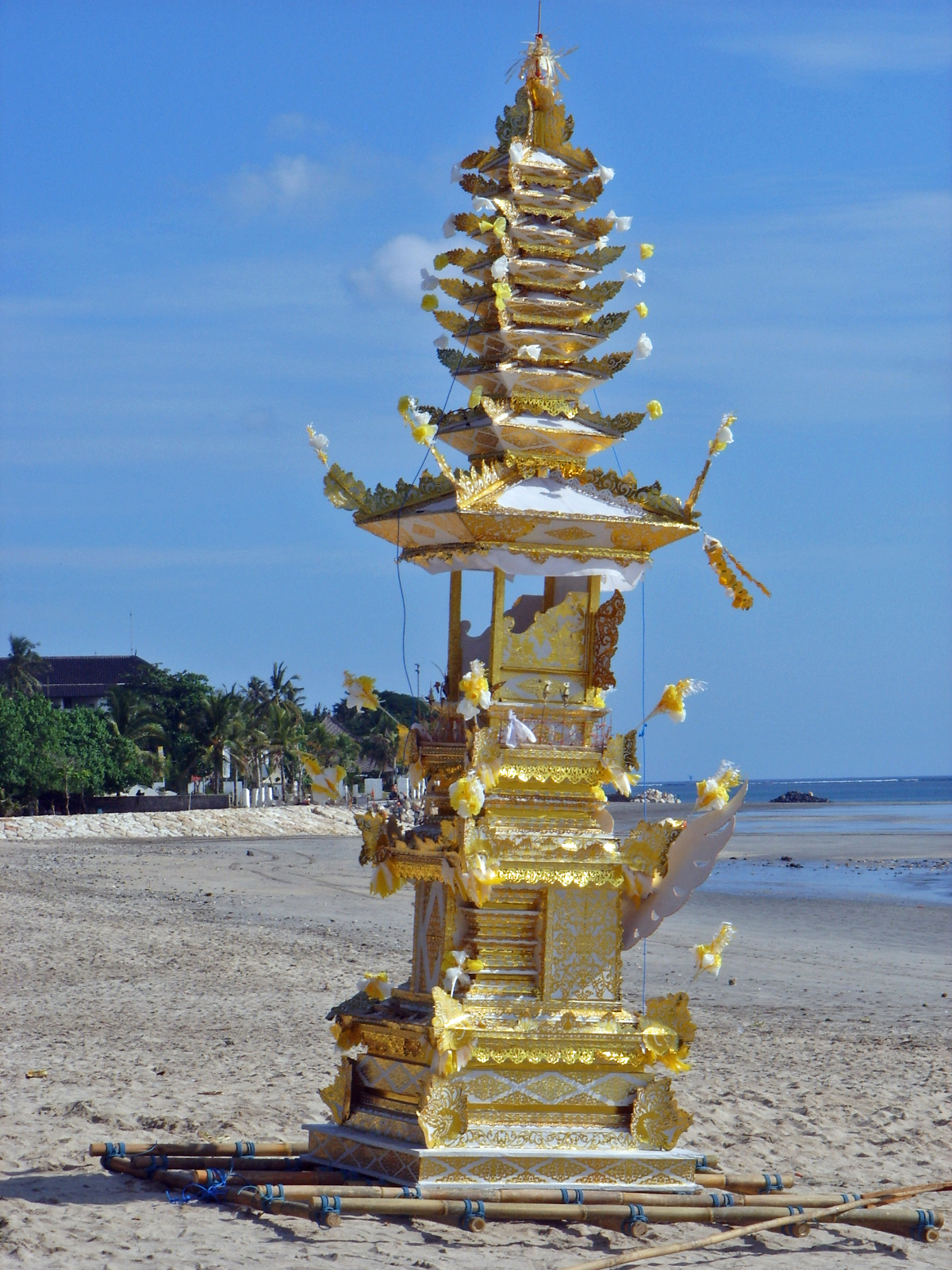
Left: A wadah cremation tower for Ngaben; Right: A lembu cremation bull.[1][2]

Ngaben, also known as Pitra Yadnya, Pelebon or cremation ceremony, is the Hindu funeral ritual of Bali, Indonesia.[3][4][5] A Ngaben is performed to release the soul of a dead person so that it can enter the upper realm where it can wait for it to be reborn or become liberated from the cycles of rebirths.[1][6] The Balinese Hindu theology holds that there is a competition between evil residents of the lower realm to capture this soul, and a proper cremation enhances the chance that it may reach the upper realm.[1]

Ngaben cremation
Cremation parade in Bedulu, Bali, Indonesia.

A quick Ngaben is preferred, but usually too expensive.[1][7] In Balinese culture, people go through an interim state where they bury the dead for a while usually near Pura Prajapati, pool funds and cremate many recently dead on the same day in an elaborate community-based Ngaben ceremony.[1][8][9] Once the families are financially ready, they select an auspicious day, make bade (coffins) to carry the dead, and announce the event in the village. The families also make a patulangan to cremate the body in,[7] which is either a lembu (bull or mythical animal-shaped bamboo-wood-paper coffin) to burn with the dead, or a wooden wadah (temple-like structure).[3][1] Once the corpse is ready for the cremation ground, it is washed, dressed in Balinese attire, family and friends pay their last goodbye with prayers and the mourners take it for cremation. They carry the corpses with rites, dressed in traditional attire, accompanied with gamelan music and singing, to the kuburan (cremation grounds).[1] If the path passes through major road crossings, the coffin is rotated three times to confuse the evil residents of the lower realm.[1][3]

Funeral music during Ngaben, Bali

At the cremation ground, the corpse is placed into the bull-shaped lembu or temple-shaped wadah, final hymns are recited and the cremation pyre lit.[2] While the corpse burns, the Balinese music team plays the beleganjur music, a battle song symbolizing the soul's fight with evil underworld to reach the worry-free upper realm.[1][10] Twelve days after the cremation, the families collect the ashes, fill it inside coconut shell, carry it to nearby ocean or sea to return the remains back to the elements.[1]

See also

[edit]

References

[edit]
[edit]
Revisions and contributorsEdit on WikipediaRead on Wikipedia
from Grokipedia
Ngaben, also known as Pelebon or Pitra Yadnya, is a traditional cremation ceremony that ritually releases the of the deceased from its earthly body, allowing it to return to the and prepare for or union with the divine. This elaborate ritual, deeply rooted in —a syncretic blend of ancient Indian Hindu traditions, local , and ancestral beliefs introduced to around the —emphasizes the purification of the five elemental components of the body (, , , air, and ether) through , symbolizing the 's liberation from worldly attachments and its journey toward spiritual fulfillment. Performed predominantly in , , where constitute approximately 86.91% of the population, Ngaben serves as both a religious obligation to honor ancestors and a communal event fostering social harmony and cultural identity. The ceremony's origins trace back to ancient Indian cremation practices around 400 BCE, adapted in Bali to align with local cosmology and the Hindu concept of karma phala (the fruits of karma), where timely cremation ensures the soul's peaceful ascent to heaven rather than lingering in suffering. Historically, before the Majapahit era (14th century), Balinese disposed of bodies in forests, but cremation became standardized with Hindu influences; by the early 20th century, practices evolved, with widow immolation (sati) abolished in 1903 under Dutch colonial rule. Today, Ngaben varies by social status and economic means: high-caste or royal ceremonies feature grander scales, while commoners may use effigies or delay the event for years to pool resources, costing $2,000–$3,000 on average, often shared communally. In recent decades, modern alternatives like crematorium-based Ngaben have emerged for efficiency and accessibility, accommodating all economic strata while preserving core rituals, with 78.09% of Balinese Hindus viewing them as practical innovations. The ritual unfolds in multiple stages, beginning with preparation that can span days to years. Immediately after death, the body is washed (nyiramin or ngemandusin), shrouded in cloth (ngajum ), and temporarily buried if full cremation is not immediate, a practice known as ngebet. An auspicious date is selected by using the Balinese lunar-solar , followed by exhumation and placement of remains into a symbolic tower (bade)—often 20–30 feet tall and adorned with intricate carvings representing mythical creatures like bulls, lions, or fish—carried in a chaotic, joyous (mamagas) with music, dances, and offerings to confuse malevolent spirits. At the cremation ground, the body is transferred to a , anointed with , and ignited amid prayers and flames fanned by , reducing it to ashes that are then collected, pulverized, and dispersed into the via rivers within 12 days to complete purification. Beyond its spiritual role in repaying the debt to ancestors (Pitra Rna) and aligning with the Balinese philosophy of Tri Hita Karana (harmony among humans, nature, and the divine), Ngaben reinforces community bonds through collective labor and celebration, transforming grief into a vibrant affirmation of life's cycle. Anthropologically, it exemplifies Bali's artistic expression, with towering bade and processional chaos serving as cosmological interventions to protect the soul, as noted in studies of Balinese ritual music and symbolism. While increasingly a tourist spectacle, the ceremony remains a cornerstone of Balinese identity, with variations like mass cremations for multiple families underscoring its adaptability to contemporary needs.

Religious and Cultural Context

Balinese Hinduism

, known locally as Agama Hindu , represents a distinctive form of the religion that has evolved on the island of , , blending ancient Indian influences with indigenous traditions. arrived in around the 8th century CE through Javanese intermediaries, particularly during the period of the Empire, when Hindu-Buddhist kingdoms from extended their cultural and religious influence to the island, gradually supplanting or integrating with pre-existing animistic beliefs among the . This historical migration led to 's dominance in by the 14th century, establishing it as the primary faith while allowing local spiritual practices to persist in a syncretic framework. At the core of Balinese Hinduism lies the philosophy of , which emphasizes achieving harmony among three fundamental realms: (the relationship between humans and the divine), pawongan (interpersonal harmony among humans), and palemahan (harmony between humans and nature). This triadic principle serves as the ethical and spiritual foundation for Balinese life, guiding moral conduct and community practices to foster balance and prosperity. Additionally, the caste system, adapted from Indian Hinduism's varna structure, organizes Balinese society into four main groups—Brahmana (priests), (nobles and warriors), Wesya (merchants and farmers), and Sudra (commoners)—though it functions more as a hereditary naming convention and ritual status marker rather than a rigid socioeconomic divider, with inter-caste marriages and interactions being relatively fluid compared to mainland . Balinese Hinduism exhibits unique syncretic elements, incorporating pre-Hindu , ancestor veneration, and Buddhist influences into its practices, creating a localized version distinct from Indian orthodoxy. Indigenous animistic beliefs in spirits inhabiting natural features, such as mountains and seas, are woven into Hindu rituals, where deities are often associated with these elemental forces to ensure communal well-being. worship plays a central role, with the deceased regarded as protective spirits integrated into family and village life cycles, reflecting a continuity of Balinese cosmological views that predate Hindu arrival. Buddhist elements, introduced alongside via , manifest in tantric practices and the veneration of figures like as an avatar of , enriching the pantheon without forming a separate tradition. Temples, known as pura, form the spiritual heart of Balinese communities, serving as sacred enclosures where offerings and ceremonies maintain cosmic order and connect the material world to the divine. Each village typically has several pura dedicated to specific deities or ancestors, with the grandest, like Pura Besakih, acting as the island's "mother temple" on the slopes of , symbolizing the in Balinese cosmology. Daily offerings, particularly —small woven palm-leaf baskets filled with flowers, betel nut, and — are meticulously prepared by women and placed at household shrines, temples, and public spaces to express gratitude to Sang Hyang Widhi Wasa (the supreme universal spirit) and to appease lower spirits, embodying the principle of reciprocity central to Balinese devotion. These practices underscore the religion's emphasis on ritual purity and balance, which in turn underpin key life-cycle rites such as cremations in Balinese tradition.

Significance in Balinese Society

Ngaben serves as a pivotal life-cycle rite, or samskara, in , signifying the deceased's transition from the physical realm to the and facilitating the soul's journey toward . This engages the entire banjar, the foundational village community unit, which collectively organizes and participates to ensure the ritual's success, reinforcing social bonds and communal harmony. Through this involvement, Ngaben transcends individual mourning, becoming a shared societal event that upholds Balinese values of mutual support. Economically, Ngaben imposes significant obligations on families and communities, with costs often ranging from $2,000 to $3,000 or more, depending on scale and materials. To manage these expenses, the principle of gotong royong—communal —plays a central role, as banjar members contribute labor, resources, and funds without expectation of repayment, alleviating the financial burden on the bereaved family. This collective effort not only distributes the economic load but also strengthens social ties, though families may delay the ceremony for years to accumulate resources. The ceremony's elaboration carries profound status implications within Balinese society, where opulent Ngaben for higher castes or affluent families enhances prestige through displays of and , often resembling political theater. In contrast, lower castes or economically constrained families opt for simpler versions or participate in Ngaben events, which allow multiple cremations in one gathering to reduce costs for the underprivileged. Performed for all deceased Balinese , Ngaben occurs with varying frequency, from immediate individual rites for the wealthy to communal ceremonies that promote equity and accessibility across social strata.

Preparation for the Ceremony

Determining the Auspicious Date

In , selecting the auspicious date for the Ngaben ceremony is a meticulous process guided by consultation with high priests known as pedanda, who interpret traditional calendrical systems to ensure cosmic harmony and facilitate the 's smooth journey to the . The primary tools are the Pawukon calendar, a 210-day cycle derived from overlapping weeks that reflect agricultural and spiritual rhythms, and the calendar, a lunar-based Hindu system adapted to Balinese contexts. These calendars help identify "" (hari baik) by aligning the ceremony with favorable planetary and cyclical positions, avoiding disruptions that could trap the in limbo. Key factors influencing the date include the deceased's birth date, which is cross-referenced against the calendars to prevent inauspicious alignments, as well as economic means and , where higher status ceremonies feature grander scales but timing is primarily determined by family resources and community support for costs. The pedanda evaluates combinations within the Pawukon system, such as the Sapta Wara (seven-day week), to pinpoint days that promote spiritual release without hindrance from malevolent forces. Delays are common if no suitable date aligns soon after or if resources need pooling, leading families to temporarily inter the body in a pre-Ngaben until timing and funds converge, sometimes extending months or even years, with an ideal limit of three years to avoid prolonged spiritual unrest. Omens play a crucial role in validation, as a poorly chosen date might invite illness, misfortune, or village-wide harm, prompting further consultation with spirit mediums if signs of distress appear. To seek divine approval, families perform offerings during preliminary rituals, notably appealing to —the deity of destruction and transformation—at the Pura Dalem temple through the Ngulapin rite, where gifts and prayers request permission for the ceremony's progression. Daily offerings of food at the temporary grave sustain the spirit in the interim, ensuring its peace until the auspicious moment arrives. This divinatory approach underscores the Balinese belief in time as a sacred force that must synchronize with the for the ritual's efficacy.

Pre-Cremation Rituals

The pre-cremation rituals of Ngaben begin with the careful preparation of the deceased's body to purify it and sever its earthly attachments. Immediately following , or upon exhumation if the body was temporarily buried (a common practice due to costs, requiring additional purification steps for exhumed remains), the ritual of nyiramin (also known as ngemandusin or corpse washing) is performed by close family members using called tirta. This water is sourced from sacred sites such as village temples, the priest's residence, and natural wellsprings, collected in ceremonial processions to ensure spiritual potency. The washing symbolizes the initial cleansing of the atman (soul) from physical impurities, transforming personal grief into a communal act of transition. Following the washing, the body is dressed in white cloth, signifying purity and detachment from worldly life, and sometimes adorned with personal items or symbolic objects like coins for prosperity in the afterlife. It is then shrouded in additional layers of cloth (ngajum kajang), which serves as a protective wrapping until the main ceremony. This step further prepares the body for release by representing the shedding of material bonds. Family members conduct rituals to honor ancestors and seek peace for the soul, including the preparation and offering of banten—elaborate trays of food, flowers, and symbolic items such as rice, fruits, and betel nut. These offerings are presented at a temporary shelter (bale pavilion) near the home or grave, accompanied by prayers and mantras recited by a Hindu priest to guide the atman toward liberation. A symbolic meal is shared among the family and the deceased's effigy or wrapped body, reinforcing communal bonds and invoking blessings for the soul's journey, often evoking shared mourning and emotional release. In parallel, the community prepares the ceremonial structures, with family and banjar (village council) members constructing the cremation tower (bade)—a multi-tiered edifice up to 30 feet tall, adorned with colorful fabrics, flowers, and motifs representing the path to the —or a bull-shaped (lembu), depending on the deceased's status. These are crafted by local artisans using natural materials, symbolizing the elevation of the and often featuring intricate carvings of mythical creatures. The setup occurs at the family compound or temple grounds, fostering collective participation. These rituals typically span 1 to 3 days of intensive and purification for immediate cases, though exhumations and resource gathering can extend preparations up to weeks. This period emphasizes the Balinese Hindu belief in reuniting the with divine elements, preventing it from lingering in .

The Ceremony Process

Procession and Placement

The procession in the Ngaben ceremony begins after the body, prepared in earlier rituals, is placed within a towering structure known as the bade, a multi-tiered tower resembling a temple that symbolizes the deceased's ascent to the spiritual realm. This communal parade typically starts from the family home or a local temple such as Pura Dalem and proceeds through the village streets to the cremation grounds or a designated field, creating a festive yet solemn journey that involves the entire community. Accompanied by the rhythmic sounds of beleganjur ensembles, traditional dances, and drumming, the procession aims to guide the soul while warding off malevolent spirits, emphasizing joy over mourning to facilitate the spirit's smooth transition. Family members lead the event, with the community joining in a display of collective support, while women often scatter flowers like along the path to invoke purity and blessings. The bade, which can reach up to 30 feet in height and contains the , is borne on poles by young men or male pallbearers from the family and village, who perform symbolic inversions by twisting, spinning, and sometimes inverting the structure during the march. These deliberate disorienting movements serve to confuse the , preventing it from lingering or returning to the material world and instead directing it toward detachment and . A separate group of men may carry a ahead, such as a bull-shaped lembu or other animal form, while the positions himself on the highest tier of the bade to oversee the spiritual guidance. This participatory role underscores the communal responsibility in , where the inversion and spinning also symbolize breaking ties to earthly attachments for the deceased's liberation. Upon arrival at the cremation site, the body is carefully removed from the bade and positioned within the lembu or directly on the , adorned with offerings such as flowers, glass shards, and symbolic leaves to restore spiritual wholeness. Final prayers and hymns are recited by the and family, accompanied by additional offerings to purify the soul before the ignition of the , marking the transition from to the core rite. This placement phase reinforces the ceremony's philosophical aim of reuniting the soul's elements with the , ensuring its readiness for the journey.

Cremation

The central act of the Ngaben ceremony is the , where the deceased's remains are placed within a atop a and burned to facilitate the soul's release. The , known as a lembu (typically shaped like a ) or sometimes integrated with the bade tower, is constructed from wood and , often elaborately decorated to represent the deceased's status. At the cremation site, usually a temple ground or open field, the performs final rituals, including sprinkling , before igniting the with a sacred fire using a blessed torch. This sacred fire, drawn from temple sources, ensures the purification through , with the structure designed to burn completely using the wood as primary fuel. As the flames rise, the lembu or bade structure gradually collapses into the , allowing the remains to be fully consumed. The burning process typically lasts several hours, often extending up to a full day depending on the size of the structure and materials, during which priests and family members chant prayers and make offerings to guide the spiritual transition. Family members observe the from a safe distance, monitoring the fire's progress to ensure it remains steady; if needed, additional wood may be added to maintain , though this is managed by attendants. Traditionally performed in open-air settings without restrictions, the cremation generates substantial smoke from the wood pyre, contributing to air pollution concerns in densely populated areas of Bali. In response, modern practices incorporate environmental regulations, such as promoting the use of crematoriums with controlled emissions to reduce smoke and particulate output, while preserving the ritual's core elements.

Post-Cremation Rites

Following the cremation, family members collect the remaining ashes and bone fragments from the , often separating them into sections such as the head, , and legs before grinding them into a fine powder using tools like sticks performed by a close relative, such as a or . These pulverized remains are then typically placed in a or mixed with or clay to facilitate handling and symbolic preparation for dispersal. Larger bones, if not fully incinerated, may be set aside and stored temporarily, such as in a shelter, for incorporation into subsequent ceremonies to ensure complete purification of the physical form. The ashes are subsequently scattered in a ritual known as pada ngleyang, where they are dispersed into the sea, a river, or a temple pond to symbolize the deceased's return to the five elemental forces (panca maha bhuta) and the universe, aiding the soul's detachment from the material world, typically 12 days after the . This dispersal often occurs within days of the cremation, accompanied by offerings and prayers led by a , emphasizing the cyclical harmony of life and nature in Balinese cosmology. In some cases, the process is delayed for communal or logistical reasons but remains essential for liberating the atman (soul). These ceremonies, sometimes including purification rites like ngeroras, invoke divine intervention to protect and elevate the spirit, preventing it from lingering in the intermediate realm. This time includes purification baths with (tirtha) administered by a to cleanse the family of any residual impurities associated with .

Symbolism and Beliefs

Philosophical Foundations

The philosophical foundations of Ngaben are deeply rooted in Balinese Hinduism's adaptation of Hindu metaphysics, emphasizing the liberation of the soul from the material world to facilitate its spiritual progression. Central to this belief is the concept that the eternal soul, known as atman, is temporarily bound to the physical body, referred to as the gross body (sthula sharira), which is composed of the five great elements (panca maha bhuta: earth, water, fire, air, and ether). The ritual serves to sever this bond, returning the elements to their cosmic origins and freeing the atman from its earthly attachments, thereby enabling either ultimate liberation () or continued reincarnation through the cycle of samsara. This process is seen as essential for the soul's purification and ascent, aligning with the broader Hindu principle of detachment (), where the body is viewed as transient and illusory. Balinese cosmology, influenced by Hindu scriptures, structures the universe into the tri loka—three realms (Bhūloka, Bhuvarloka, and Svarloka) that guide the 's post-death journey. The atman originates in Bhūloka, the earthly realm, and through proper rites, transitions toward Svarloka, the heavenly realm of divine union. Without these rituals, the risks lingering in an intermediate state of unrest, where it may suffer or be hindered in its path to higher realms. This layered worldview underscores Ngaben's role in ensuring a smooth cosmic transit, preventing the from becoming trapped between worlds and allowing it to reunite with the divine essence, Ida Sang Hyang Widhi Wasa. It also integrates animistic elements, such as offerings to ancestral spirits and protection from malevolent forces like bhuta kala, reflecting Bali's syncretic beliefs. The quality of the Ngaben ceremony is profoundly shaped by the principles of karma, where the accumulated actions (karma wasana) of the deceased determine the soul's trajectory. A meticulously performed rite, honoring ancestral duties through pitra yadnya, propels the atman toward favorable rebirth or liberation, reflecting the karmic balance achieved in life. Conversely, incomplete or delayed ceremonies can result in the soul wandering as a bhuta (malevolent ghost or bhuta cuil), causing misfortune to the family or community, such as illness or spiritual imbalance, until remedial rites are conducted. This karmic dimension highlights Ngaben not merely as a but as a moral and cosmic imperative to resolve earthly debts. These beliefs draw from Balinese interpretations of key , particularly the , which elucidates the eternity of the atman and the impermanence of the body (e.g., Chapter VII, verses 4–10), promoting as a path to transcend material bonds. In Balinese tradition, such scriptures are localized through palm-leaf manuscripts (lontar), like the Wrhaspati Tattwa and , which adapt Vedic ideas to emphasize communal rituals for soul elevation, integrating animistic elements unique to Bali while preserving the core Hindu emphasis on cosmic harmony and ethical living.

Symbolic Elements

The bade tower, a towering structure carried in the procession, symbolizes , the sacred cosmic axis in that connects the earthly and divine realms. Its multi-tiered design, often adorned with intricate carvings and fabrics, represents the hierarchical levels of spiritual existence, from the base symbolizing the human world to the summit evoking heavenly domains, thereby guiding the deceased's soul upward. The deliberate collapse of the bade during the embodies the principle of impermanence (anitya), illustrating the fleeting nature of material form and encouraging reflection on life's transience. The lembu sarcophagus, typically crafted in the form of a , draws on the imagery of Nandi, the mythical mount of , signifying divine guidance and protection for the soul's passage beyond death. This bovine shape evokes Shiva's role as the and , facilitating the soul's safe navigation through the liminal space between worlds. Fire serves as a purifying force in the ceremony, incinerating the physical remains to cleanse accumulated karma and liberate the atman from earthly bonds. This elemental transformation neutralizes negative influences, enabling the soul's elevation. Complementing , is employed in the dispersal of into the or rivers, symbolizing the reintegration of the soul's into , the ultimate universal consciousness, and marking a return to cosmic unity. Procession elements incorporate inversions, such as participants walking backward while carrying the bade, to symbolize detachment from maya, the illusory attachments of the material world. These deliberate disorientations confuse and sever the soul's ties to worldly illusions, preventing it from returning and ensuring its progression toward spiritual realms.

Variations and Modern Practices

Traditional vs. Mass Cremations

Traditional individual Ngaben ceremonies are highly elaborate affairs reserved primarily for affluent Balinese families, involving intricate preparations such as constructing ornate sarcophagi shaped like animals or mythical creatures and mobilizing the entire village community for processions. These rituals, which can cost upwards of $20,000 due to the expenses of materials, labor, and offerings, are typically held soon after to promptly release the soul (atma) from the physical body. The scale emphasizes personalization, with the deceased's body or remains carried in a custom tower (bade) by dozens of participants, reflecting the family's status and devotion. In contrast, mass Ngaben represents a practical adaptation where 10 to 50 bodies—often from temporary burials—are cremated together in a communal event organized by the banjar (village council), significantly reducing costs to around $300–$650 per family through shared resources. These ceremonies feature larger-scale processions and multiple sarcophagi, fostering community solidarity while maintaining the core ritual elements. They are commonly timed to coincide with auspicious periods like the (Purnama) or the festival, allowing families unable to afford immediate individual rites to participate without prolonged delays. The historical shift toward mass Ngaben gained prominence in the 20th century, particularly in the post-colonial era, as economic pressures made individual ceremonies unsustainable for many households, leading to widespread temporary burials followed by collective events every few years. This adaptation eased the financial burden while preserving the ceremony's spiritual purpose of soul purification. Notable examples include the 2013 mass cremation in , which honored over 60 deceased, and similar large-scale gatherings in , where communities unite for these shared rites.

Contemporary Adaptations

In response to growing environmental concerns, particularly from traditional open pyres, Balinese authorities have introduced regulations promoting the use of crematoriums for Ngaben ceremonies since the . These facilities allow for controlled , reducing emissions and compared to open-air burning, while aligning with broader Indonesian laws on and . For instance, modern crematoriums enable efficient, low-cost cremations that minimize environmental impact without fully abandoning elements. Recent advancements as of 2025 include greater adoption of gas-fired crematoriums, which further reduce through cleaner . Tourism has significantly influenced Ngaben practices, leading to established guidelines for observers to ensure respect during ceremonies. Visitors are advised to dress modestly in sarongs and sashes, maintain a distance from intimate family moments, and seek permission before photographing, with flash photography strictly prohibited to avoid disrupting the sacred atmosphere. In tourist-heavy areas like Ubud, some communities schedule processions on auspicious days visible to outsiders, fostering cultural exchange while preserving sanctity, though core rituals remain private. Economic pressures on low-income families have prompted adaptations, including NGO and scholarly support for simplified Ngaben versions. Organizations and Hindu leaders offer financial aid or free participation in mass cremations, where costs are reduced to as low as Rp 5 million (as of 2013) or waived entirely for the needy, often using pre-made sarcophagi and shared facilities. These measures, such as utilizing public crematoriums, allow underprivileged households to fulfill obligations without prohibitive expenses. Efforts to preserve Ngaben as include advocacy for recognition, though it remains uninscribed, with local institutions focusing on documentation, education, and funding to sustain the practice amid modernization. In Balinese communities, such as those in , adaptations incorporate local regulations, like same-day cremations at municipal facilities costing around 15 million rupiah, blending Vedic principles with urban multiculturalism through inter-Hindu . These global variations emphasize gotong royong (communal ) to maintain spiritual essence in diverse settings.

References

Add your contribution
Related Hubs
User Avatar
No comments yet.