


Community hub
Recent from talks
Contribute something
Nothing was collected or created yet.

| Part of a series on |
| Planes of existence |
|---|
 |
| Theosophy |
| Rosicrucianism |
| Thelema |
| Hermeticism |
| Surat Shabd Yoga |
| Jainism |
| Sufism |
| Hinduism |
| Buddhism |
| Gnosticism |
| Kabbalah |
| Fourth Way |
| Subtle bodies |
| Related |
| In fiction |
Loka (Sanskrit: लोक) is a concept in Hinduism and other Indian religions, that may be translated as a planet, the universe, a plane, or a realm of existence. In some philosophies, it may also be interpreted as a mental state that one can experience.[1] A primary concept in several Indian religions is the idea that different lokas are home to various divine beings, and one takes birth in such realms based on their karma.[2]
Hinduism
[edit]Three lokas
[edit]
The most common classification of lokas in Hinduism is the Trailokya, or the three worlds.[3]
The concept of the three worlds has a number of different interpretations in Hindu cosmology.
In Hindu literature, the three worlds refer to either the earth (Bhuloka), heaven (Svarga), and hell (Naraka),[4] or the earth (Bhuloka), heaven (Svarga), and the netherworld (Patala).[5]
Bhuloka
[edit]In the Narada Purana, Bhuloka is identified with the planet Earth, the world of human beings. It is described to be split up into seven regions, referred to as dvipas (islands). These regions are known as Jambudvipa, Plakshadvipa, Shalmaladvipa, Kushadvipa, Kraunchadvipa, Shakadvipa, and Pushkaradvipa. Of special significance is the Indian subcontinent, referred to as Bharatavarsha, which is a land where the fruits of one's actions allows one passage into either Svarga or Naraka. Bhuloka also has seven oceans, namely, Lavana, Ikshu, Sura, Sarpih, Dadhi, Dughdha, and Jala.[6]
Svarga
[edit]Generally translated as heaven, Svarga is identified with the realm of Indra and the devas in contemporary Hinduism. The Vedas offer the reward of Svarga as one's destination for the proper practice of sacrificial rituals on earth.[7] In Vedic mythology, Svarga is filled with the nectar of immortality, amrita, with lakes containing lotuses, pools of wine, milk, and ghee, as well as streams that are replete with honey. It is abundant with food and refreshments, and equal opportunity is offered to all of its denizens.[8] It is described to be an infinite, complete, as well as an immortal realm, offering pleasure to those rare few who are able to ascend to it. It is sometimes associated with Pitṛloka, the realm of one's ancestors, but this association is not present in all literature.[9]
Naraka
[edit]Naraka is generally translated as hell, and refers to the loka that humans are sent to, to be punished for their sins. Ruled by Yama, sinners are offered appropriate punishments for their sins on earth, and after a period of time, reborn on earth with bad vipāka, which is the effect of bad karma.[10] The Bhagavata Purana enumerates the following 28 Narakas: Tamisra, Andhatamisra, Raurava, Maharaurava, Kumbhipaka, Kalasutra, Asipatravana, Sukaramukha, Andhakupa, Krimibhojana, Samdamsa, Taptasurmi, Vajrakantaka-salmali, Vaitarani, Puyoda, Pranarodha, Visasana, Lalabhaksa, Sarameyadana, Avichi, Ayahpana, Ksharakardama, Raksogana-bhojana, Sulaprota, Dandasuka, Avata-nirodhana, Paryavartana, and Suchimukha.[11]
The Brahmanda Purana conceives them to be Bhūta (past), Bhavya (future), and Bhavat (present)[12]
The scholar Deborah Soifer describes the development of the concept of lokas as follows:
The concept of a loka or lokas develops in the Vedic literature. Influenced by the special connotations that a word for space might have for a nomadic people, loka in the Veda did not simply mean place or world, but had a positive valuation: it was a place or position of religious or psychological interest with a special value or function of its own. Hence, inherent in the 'loka' concept in the earliest literature was a double aspect; that is, coexistent with spatiality was a religious or soteriological meaning, which could exist independent of a spatial notion, an 'immaterial' significance. The most common cosmological conception of lokas in the Veda was that of the trailokya or triple world: three worlds consisting of earth, atmosphere or sky, and heaven, making up the universe."[13]
Fourteen lokas
[edit]In the Puranas and in the Atharvaveda, there are 14 worlds, seven higher ones (Vyahrtis) and seven lower ones (Pātālas), viz. bhu, bhuvas, svar, mahas, janas, tapas, and satya above and atala, vitala, sutala, rasātala, talātala, mahātala, pātāla and naraka at the bottom.[citation needed][original research?] [unreliable source?] The higher lokas (1-7) are described as the heavens, populated by higher gods, and full of truth. The lower lokas (8-14) constitute the different "hells".[2] In each of these realms are different deities and beings 'living out their karmic trajectories". Those beings in the higher realms have attained a temporary spiritual liberation due to their positive merits for having strengthened their detachment to the mind, ego and sense objects.[2] However, ultimate liberation (moksha) is regarded as the highest goal in human life, in which one achieves ultimate union with God.[14] Moksha, in turn, requires total liberation/detachment from worldly objects and desires.[15]
-
 Higher seven Lokas
 -
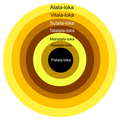 The lower seven Lokas


Lokas:
- Satya-loka (Brahma-loka)
- Tapa-loka
- Jana-loka
- Mahar-loka
- Svar-loka (Svarga-loka)
- Bhuvar-loka
- Bhu-loka
- Atala-loka
- Vitala-loka
- Sutala-loka
- Talatala-loka
- Mahatala-loka
- Rasatala-loka
- Patala-loka
Another lineup of the fourteen lokas is stated as follows:[16]
- Bhur-loka
- Bhuvar-loka
- Suvar-loka
- Mahar-loka
- Janar-loka
- Tapar-loka
- Satya-loka
- Brahma-loka
- Pitri-loka
- Soma-loka
- Indra-loka
- Gandharva-loka
- Rakshasa-loka
- Yaksha-loka
Gallery
[edit]-

-
 Map 2: Intermediate neighbourhood of the Earth according to one Hindu cosmology.
 -
 Map 3: Local neighbourhood of the Earth according to one Hindu cosmology.


Buddhism
[edit]Six lokas
[edit]In the Tibetan and Tantric schools, "Six Lokas" refers to a Bönpo and Nyingmapa spiritual practice or discipline that works with chakras and the six dimensions or classes of beings in the Bhavachakra. In Buddhist cosmology, Kama-Loka, Rupa-Loka, Arupa-Loka are the realms that are inhabited by various beings.[17][clarification needed] Additionally, those who inhabit these realms will identify with the characteristics of that realm. For example, a being that resides in Kama-loka experiences predominantly sensual desires, whereas a being in Rupa-loka will experience deep meditation.[1] Various early suttas also suggest that there is a close relationship between psychology and cosmology, equating to different levels of existence in the cosmos, which can be interpreted as the afformentioned lokas.[1]
Three lokas
[edit]There is a cosmological view in Buddhism called Trailokya.[18] In early Buddhism, based upon the Pali Canon and related Agamas, there are three distinct realms: First the Kama Loka, or the world of sensuality, in which humans, animals, and some devas reside, the second is Rupadhatu Loka, or the world of material existence, in which certain beings mastering specific meditative attainments reside, and the third is Arupadhatu Loka, or the immaterial, formless world, in which formless spirits reside. Arahants, who have attained the highest goal of Nirvana have unbound themselves from individual existence in any form, in any realm, and cannot be found here, there, or in between, i.e., they are found in no loka whatsoever.[citation needed] The early suttas also contain information regarding another important domain known as the supramundane realm, (lokottara/lokuttara 出世間, “beyond the world”), which is described as being experienced by awakened noble beings.[1]
Jainism
[edit]
In Jain texts, the universe is referred to as loka. Although loka originally means "open space," Jain teachers preferred to derive it from the verbal root lok, which means to see. They explain loka as "that which is seen by the omniscient ones."[19]
Jain cosmology postulates an eternal and ever-existing loka which works on universal natural laws, there being no creator and destroyer deity.[20] According to the Jain cosmology, the universe is divided into three parts:[21]
- Urdhva Loka - the realms of the gods or heavens
- Madhya Loka – the realms of the humans, animals and plants
- Adho Loka – the realms of the hellish beings or the infernal regions
Jain cosmology uses the terms loka and aloka to describe the inhabitable and uninhabitable spaces in the universe. The philosophy describes how inhabitable space (loka) will never penetrate into the uninhabitable space (aloka) and vice versa, both of which are a subdivision of space (ākāśa).[22] In the aloka, there is nothing except strong winds.[19] In Jain cosmology, on achieving moksha, the soul becomes free of the wordly realm once the fruits of all good and bad karmas have been received.[23]
Theosophy
[edit]The concept of lokas was adopted by Theosophy, and can be found in the writings of Blavatsky and G. de Purucker. One of Blavatsky's three worlds are kamaloka (world of desires), which is like a temporary after-life state or an astral plane, according to the teachings of Blavatsky, Leadbeater, and Steiner.
References
[edit]- ^ a b c d Lin, Qian (2022). On the Early Buddhist Attitude Toward Metaphysics. Dordrecht: Springer Netherlands. pp. 143–162.
{{cite book}}: CS1 maint: publisher location (link) - ^ a b c Haag, James W (2012). HINDU COSMOGONY/ COSMOLOGY. Routledge, 2 Park Square, Milton Park, Abingdon, Oxon, OX14 4RN. pp. 503–504.
- ^ "Loka" in the Encyclopedia Britannica
- ^ www.wisdomlib.org (2017-11-18). "Trailokya: 21 definitions". www.wisdomlib.org. Retrieved 2022-10-24.
- ^ Maruvada, Surya N. (2020-03-02). Who is Who in Hindu Mythology - VOL 2: A Comprehensive Collection of Stories from the Pur??as. Notion Press. ISBN 978-1-64805-686-4.
- ^ www.wisdomlib.org (2013-05-25). "Geography". www.wisdomlib.org. Retrieved 2022-10-24.
- ^ Cush, Denise; Robinson, Catherine A.; York, Michael (2008). Encyclopedia of Hinduism. Psychology Press. p. 844. ISBN 978-0-7007-1267-0.
- ^ Singh, Nagendra Kr (1997). Vedic Mythology. APH Publishing. p. 101. ISBN 978-81-7024-867-5.
- ^ Craig, Edward (1998). Routledge Encyclopedia of Philosophy: Index. Taylor & Francis. p. 254. ISBN 978-0-415-07310-3.
- ^ www.wisdomlib.org (2009-03-29). "Naraka, Nāraka: 33 definitions". www.wisdomlib.org. Retrieved 2022-10-24.
- ^ "Srimad Bhagavatam Canto 5 Chapter 26". 2012-11-13. Archived from the original on 2012-11-13. Retrieved 2022-10-24.
- ^ www.wisdomlib.org (2019-06-20). "Vaivasvata Manvantara: the Mārīca creation [Chapter 38]". www.wisdomlib.org. Retrieved 2022-10-24.
- ^ Soiver, Deborah A., The Myths of Narasimha and Vamana: Two Avatars in Cosmological Perspective State University of New York Press (Nov 1991), ISBN 978-0-7914-0799-8 p. 51 [1]
- ^ Mishra, R.C (2013). Moksha and the Hindu Worldview. New Delhi, India: SAGE Publications. p. 28.
- ^ Mishra, R.C (2013). Moksha and the Hindu Worldview. New Delhi, India: SAGE Publications. p. 37.
- ^ www.wisdomlib.org (2008-06-21). "Loka: 45 definitions". www.wisdomlib.org. Retrieved 2022-10-24.
- ^ Desired Realms (Rupa Loka, Arupa Loka, Kama Loka)
- ^ "triloka". Oxford Reference. Retrieved 2021-10-09.
- ^ a b Dundas, Paul (2002). The Jains. Library of religious beliefs and practices (2nd ed.). London; New York: Routledge. p. 90. ISBN 978-0-415-26605-5.
- ^ Jain cosmology
- ^ Shah, Natubhai (1998). p. 25
- ^ Balcerowicz, Piotr (2021). Beginnings of Jaina Ontology and Its Models. Dordrecht: Springer Netherlands. pp. 657–697.
{{cite book}}: CS1 maint: publisher location (link) - ^ Mishra, R.C (2013). Moksha and the Hindu Worldview. Sage Publications. p. 28.
Hindu deities and texts | ||
|---|---|---|
| Gods |  | |
| Goddesses | ||
| Deity groups | ||
| Texts (list) | ||
Terminology
Etymology
The term loka derives from the Sanskrit verbal root loc (लोच्), meaning "to see," "to perceive," or "to behold," as listed in traditional Sanskrit grammatical texts such as the Dhātupāṭha. In the Dhātupāṭha, √loc belongs to the first verbal class (bhvādi gaṇa), denoting perception.[3] This root, connected etymologically to verbs denoting visibility or observation, evolved in usage to signify "open space," "free realm," or "world," implying a domain that is perceptible or accessible to perception.[4] The noun form loka (लोक) thus carries connotations of a visible or experiential expanse, distinguishing it from more abstract notions of existence. In early Vedic literature, particularly the Rigveda, loka appears frequently to describe cosmic regions or visible worlds, often in contrast to hidden or divine realms, emphasizing spatial openness and the observable universe. For instance, it denotes the "wide world" or "people" in plural forms, reflecting both physical and social dimensions of perceivable reality across hymns dedicated to creation and order (e.g., RV 10.129).[5][5] Related compounds include trailokya (त्रैलोक्य), formed from tri ("three") and loka, referring collectively to the three primary worlds or spheres of existence.[6] Loka is further distinguished from bhuvana (भुवन), which derives from the root bhū ("to become" or "to exist") and emphasizes abodes, regions of manifestation, or inhabited places, whereas loka prioritizes the perceptual or spatial aspect.[7] Across Indo-European languages, loka exhibits phonetic and semantic variations, with cognates such as Latin lūcus ("sacred grove") and Lithuanian laũkas ("field"), tracing back to a Proto-Indo-European root *lowk-ós denoting "open space," from *lewk- ("to shine, see").[8]Conceptual Overview
In Indian philosophies, the concept of loka denotes multidimensional planes of existence that form the structure of the cosmos, profoundly influenced by karma (actions and their consequences), dharma (cosmic order and moral duty), and the prevailing mental states of sentient beings. These planes encompass realms where consciousness manifests in varied forms, determining the quality and nature of experience for inhabitants reborn within them. Derived from the Sanskrit root loc meaning "to see," loka fundamentally refers to perceptible worlds or domains of reality.[9][10] While varying across traditions, a common theme in Hinduism, Buddhism, and Jainism involves lokas as realms influenced by karma and samsara-like cycles, serving as stages for rebirth and paths to liberation, with specific hierarchies detailed in each philosophy. Beings navigate these realms based on their karmic merits or demerits, with lower planes marked by suffering and attachment, and higher ones by increasing purity and insight. The soteriological goal remains liberation: moksha in Hinduism and Jainism, or nirvana in Buddhism, achieved by dissolving karmic bonds to escape the wheel of existence.[11][12] Lokas are broadly categorized into physical (gross material domains tied to sensory perception), subtle (astral or psychic levels involving refined energies and emotions), and spiritual (transcendent spheres of pure consciousness aligned with ultimate reality). This tripartite distinction underscores their role not as isolated physical locations or planets, but as interconnected perceptual realities that mirror the evolving states of awareness and spiritual maturation of the soul.[11][13]In Hinduism
The Three Lokas (Trailokya)
In Hindu cosmology, the concept of Trailokya, or the three worlds, represents the foundational tripartite division of existence, encompassing the realms inhabited by beings according to their karmic merits and demerits.[1] This model, articulated in texts like the Vishnu Purana, structures reality into interconnected spheres where souls experience temporary abodes influenced by actions in previous lives, ultimately guiding the cycle of reincarnation toward potential liberation.[1] The three lokas—Bhūloka, Bhuvarloka, and Svarloka—serve as moral and karmic geographies, with Naraka representing additional hellish realms below Bhūloka for sinners, emphasizing the impermanence of worldly existence.[14] Bhūloka, the earthly realm, forms the foundational plane of human and mortal existence, extending across vast continental divisions illuminated by the sun and moon.[1] Central to this loka is Jambudvīpa, a prominent continent shaped like a lotus leaf, centered around the golden Mount Meru rising 16,000 yojanas high, surrounded by subsidiary mountains and sacred rivers.[15] Jambudvīpa encompasses nine varṣas (regions), including Bharata-varṣa (the known world of humans), separated by mountain ranges like Himavān and Hemakūṭa, and is one of seven concentric dvīpas (continents)—Plakṣa, Śālmali, Kuśa, Krauñca, Śāka, and Puṣkara—encircled by successively larger oceans of saltwater, sugarcane juice, liquor, ghee, curd, fresh water, and milk.[15] These divisions symbolize the diverse terrestrial habitats where karma unfolds through human endeavors, births, and deaths.[15] Svarloka, the heavenly realm, lies above Bhūloka as the abode of the devas, ruled by Indra, the king of gods, who wields the thunderbolt and oversees celestial order. This loka, spanning from the sun to the polar star Dhruva and measuring 1,400,000 yojanas in extent, is characterized by eternal pleasures, divine music, and the nectar of immortality known as amṛta, which sustains the devas and grants prolonged bliss to virtuous souls.[1] Inhabitants here, including gods and elevated beings, enjoy rewards for pious karma, such as heroic deeds or Vedic sacrifices, in opulent cities like Amarāvatī, yet this paradise remains transient, as even devas face rebirth upon exhaustion of merits. The infernal realm, termed Naraka, constitutes the punitive sphere beneath Bhūloka, governed by Yama, the lord of death and justice, who resides in the southern direction and judges souls via his messengers, the Yamadūtas.[14] Positioned in the intermediate space below the earthly plane and above the Garbhodaka Ocean, Naraka comprises 28 hells as detailed in the Bhagavata Purana, where sinners endure tailored torments mirroring their misdeeds—such as immersion in boiling oil for arson or assault by ravenous creatures for violence—administered under the modes of material nature.[14] Key hells include Tāmīsra for thieves and adulterers, Andhatāmīsra for betrayers, and Raurava for killers, serving as corrective measures to purify karma before reincarnation.[14] Within Hindu soteriology, the Trailokya functions as a karmic framework where all three lokas are impermanent stations: souls ascend to Svarloka for good deeds, descend to Naraka for sins, or navigate Bhūloka for balanced actions, with the ultimate goal of transcending these realms through accumulated merit leading to mokṣa, or liberation from rebirth.[14] This basic tripartite model expands in later texts into a more elaborate hierarchy of fourteen lokas, incorporating additional subtle and causal planes.[1]The Fourteen Lokas
In Hindu cosmology, the fourteen lokas represent a hierarchical structure of fourteen worlds or planes of existence, extending from the highest spiritual realms to the deepest subterranean domains, as detailed in ancient Puranic texts. This model expands upon the foundational three-lokya framework by delineating seven upper lokas (ūrdhva-lokas or vyāhṛtis), which ascend from the subtlest divine abodes to the gross earthly plane, and seven lower lokas (adho-lokas or pātālas), which descend into increasingly material and infernal regions. These lokas are envisioned as concentric spheres encircling Mount Meru, the cosmic axis, and are integral to understanding the soul's journey through saṃsāra toward liberation.[1] The seven upper lokas, described in ascending order from the subtlest to the grosser manifestations, are realms of progressively increasing density and association with material elements and deities:- Satya-loka: The highest abode, also known as Brahma-loka, situated 120 million leagues above the polar star Dhruva; it is the sphere of truth and eternal wisdom, where Brahma resides, and its inhabitants are immune to death, embodying pure sattva (goodness).[1]
- Tapa-loka: Located 40 million leagues above Dhruva, this is the realm of intense austerity, inhabited by the unconsumable deities called Vaibhrājas, who perform severe penances; it is associated with the element of fire and the principle of tapas (spiritual heat).[1]
- Jana-loka: Positioned 20 million leagues above Dhruva, home to the mind-born sons of Brahma such as Sanaka and Sanandana, who are embodiments of knowledge and devotion; linked to the ether element and intellectual purity.[1]
- Mahar-loka: Extending 10 million leagues above Dhruva, occupied by great saints and ascetics who endure for an entire kalpa (cosmic age); it bridges the transitory and durable realms, associated with the air element and partial detachment.[1]
- Svar-loka: The heavenly realm from the sun to Dhruva, spanning 1.4 million leagues, abode of the devas including Indra, and linked to the light element; it is a place of divine enjoyment and governance.[1]
- Bhuvar-loka: The intermediate atmospheric plane between earth and the sun, inhabited by siddhas (perfected beings) and ancestral spirits (pitṛs); connected to the water element and subtle vital forces (prāṇa).[1]
- Bhur-loka: The earthly realm, illuminated by the sun and moon, encompassing continents, oceans, mountains, and human habitation; tied to the gross earth element and the domain of mortals and lower deities.[1]
- Atala: The uppermost lower realm, created from a demon's yawn, featuring enchanting women and boundless sense pleasures; ruled by demoniac beings who revel in illusion.[16]
- Vitala: Abode of Lord Śiva and Pārvatī (Gaurī), where gold is produced from ant-hills; populated by ghosts, goblins, and demons engaged in ritualistic enjoyments.[16]
- Sutala: Luxurious domain of the pious demon king Bali, granted by Vishnu in his Vāmana avatar; its residents experience unalloyed happiness and devotion.[16]
- Talātala: Ruled by the architect-demon Maya Dānava, favored by Śiva; inhabitants pursue architectural and magical arts amid material comforts.[16]
- Mahātala: Dwelling of multi-hooded nāgas like Kuhaka and Takṣaka, who live fearfully yet familially; associated with serpentine power and hidden treasures.[16]
- Rasātala: Home to the demoniac offspring of Diti and Danu, such as the Paṇis and Nivāta-kavacas, who dwell in cavernous holes like serpents, embodying envy and conflict.[16]
- Patala: The deepest realm, inhabited by the serpent king Vasuki and other nāgas like Śaṅkha and Kulika; characterized by fierce, jewel-adorned serpents guarding the underworld's core.[16]
In Buddhism
The Six Lokas of Rebirth
In Buddhist cosmology, the six lokas of rebirth represent the possible destinations for sentient beings within the cycle of samsara, specifically confined to the desire realm (kama-dhatu) of the three dhatus. These realms illustrate the pervasive nature of suffering (dukkha) and impermanence (anicca), where rebirth is driven by karma and conditioned by ignorance, craving, and aversion. No realm offers permanent escape from the cycle; even the most pleasurable existences end in decline and further rebirth, underscoring the urgency of pursuing enlightenment to transcend samsara.[18] The deva-loka, or realm of the gods, is characterized by long lifespans and exquisite sensual pleasures, arising from virtuous karma. Inhabitants enjoy divine abodes with no experience of aging or disease during their tenure, yet this bliss is impermanent; upon exhaustion of merit, devas face acute suffering from the foreknowledge of rebirth in lower realms.[19] The asura-loka, realm of the demigods or titans, features beings of great power but perpetual jealousy toward the devas, leading to constant warfare and internal strife. Their existence highlights how attachment to status and rivalry perpetuates suffering, despite physical might and relative longevity.[20] The manusya-loka, or human realm, provides a balanced state of experience, with equal potential for pleasure and pain, making it uniquely suited for practicing the Dharma and achieving liberation. Humans endure birth, aging, illness, and death, but this very exposure to dukkha fosters insight into impermanence, unlike the oblivious bliss of higher realms or the overwhelming torment of lower ones.[19] In contrast, the tiryag-loka, realm of animals, is dominated by instinctual survival, predation, and ignorance, resulting in pervasive fear and exploitation without opportunity for ethical reflection or spiritual progress.[20] The preta-loka, or hungry ghost realm, torments its inhabitants with insatiable cravings for food, drink, and sensory satisfaction, often blocked by karmic obstructions like narrow throats or repulsive forms. This state exemplifies the suffering of unfulfilled desire, where past greed leads to endless frustration despite proximity to worldly abundances.[19] Finally, the naraka-loka, hell realms, impose extreme agonies such as scorching heat, freezing cold, or mutilation, tailored to the severity of negative karma like hatred or violence. These torments are temporary, ceasing when retributive karma is exhausted, but they represent the nadir of suffering within samsara.[20] These six lokas are vividly depicted in the bhavachakra, or Wheel of Life, a traditional mandala illustrating samsara's dynamics, with Yama (lord of death) grasping the wheel and the realms segmented around its periphery to emphasize karmic causation. The wheel's hub features the three poisons—ignorance, attachment, and aversion—driving rebirth, while the outer rim portrays the Twelve Nidanas, the links of dependent origination (from ignorance to aging and death), showing how these processes condition existence across the realms and perpetuate cyclic suffering until broken by wisdom.[19][20]The Three Lokas (Dhatus)
In Buddhist cosmology, the three lokas, also known as dhātus or realms, represent hierarchical spheres of existence differentiated by levels of consciousness, attachment, and meditative attainment. These realms—Kāma-dhātu (desire realm), Rūpa-dhātu (form realm), and Ārūpya-dhātu (formless realm)—encompass all conditioned states of rebirth and meditation within saṃsāra, transcending the mere cycles of suffering by emphasizing progressive refinement of mind through jhāna (meditative absorption). This framework, elaborated in Abhidharma texts, ties existence to the subtlety of perception and form, with higher realms accessible only via advanced meditation that diminishes sensory and material bonds.[21] The Kāma-dhātu, or desire realm, is the coarsest sphere, characterized by attachment to sensory pleasures such as food, sex, and comfort, which dominate consciousness and perpetuate rebirth. It encompasses the six realms of rebirth—hells, hungry ghosts, animals, humans, and lower gods—where beings experience a spectrum of suffering and satisfaction driven by craving (kāma). Unlike higher realms, meditative absorption (jhāna) is not inherent here; instead, consciousness remains tethered to the five senses and mental objects, supporting defiled states that hinder liberation. Entry into Kāma-dhātu occurs through karma rooted in desire, and while beings can temporarily access jhāna to ascend temporarily, the realm's 20 divisions (including eight hells and six heavenly abodes) reflect ongoing saṃsāric bondage.[21][22] The Rūpa-dhātu, or form realm, marks a transcendence of sensory desire, attained through the first four jhānas, where consciousness shifts to subtle materiality free from gross attachments. Comprising 17 levels (sometimes enumerated as 16 or 18, excluding or including intermediary states like the dhyāna-antarikas or asaṃjñi-sattvas), it is divided into four meditative tiers: the first jhāna yields three abodes (e.g., Brahmakāyika gods), the second three (e.g., Ābhāsvara), the third three (e.g., Śubhakṛtsna), and the fourth eight (e.g., Akanisṭha, the highest). Beings here, reborn via meditative karma, possess luminous forms without need for food or sensory indulgence, experiencing joy from absorption alone; their consciousness, refined by samādhi, supports pure mental states but remains conditioned by subtle form. This realm facilitates deeper insight, as defilements are progressively abandoned through meditation, though full liberation requires surpassing it.[21][22] The Ārūpya-dhātu, or formless realm, represents the pinnacle of conditioned existence, where consciousness operates in pure mental states devoid of any materiality, achieved via the four formless jhānas (arūpya-samāpatti). It consists of four levels: the sphere of infinite space (ākāśānantyāyatana), infinite consciousness (vijñānānantyāyatana), nothingness (ākiṃcanyāyatana), and neither perception nor non-perception (naivasaṃjñānāsaṃjñāyatana, or bhavāgra, the "summit of existence"). Without physical location or form, beings here sustain a mental continuum supported by vital faculties, with lifespans extending from 20,000 to 84,000 kalpas; consciousness is wholly introspective, transcending perceptual objects and fostering equanimity. These states, accessed by relinquishing form concepts in meditation, abandon deeper defilements but still bind to saṃsāra, serving as a gateway to unconditioned freedom.[21][22] Beyond these three dhātus lies the supramundane realm of nirvāṇa, the unconditioned state transcending all lokas, where consciousness ceases saṃsāric flux through complete eradication of defilements via the noble path. In Abhidharma analysis, nirvāṇa is neither a realm nor a rebirth plane but the ultimate liberation, realized from any dhātu (most accessibly from the human sphere in Kāma-dhātu) and independent of jhānas, though meditative proficiency aids its attainment. It represents freedom from the three realms' conditioned aggregates, embodying peace beyond birth, aging, and death.[21]In Jainism
Structure of the Loka
In Jain cosmology, the loka represents the eternal and uncreated inhabitable universe, existing without beginning or end in a cyclical pattern of transformation governed by natural laws rather than divine intervention.[23][24] This universe is visualized as resembling the form of a cosmic man, known as loka-purusha, with a symmetrical structure that is narrow at the top and bottom, widest in the equatorial middle region, and tapering toward the poles to form an hourglass-like silhouette.[23][25] The loka is distinct from aloka, the infinite void space surrounding it, which lacks any substances or life forms and serves as an empty expanse beyond the bounded cosmos.[23][26] Composed of six fundamental eternal substances, or dravyas, according to Jain metaphysics, the loka includes jīva (souls), pudgala (matter), dharma (principle of motion), adharma (principle of rest), ākāśa (space), and kāla (time); these interpenetrate to form the dynamic framework of existence.[27][28] Horizontally, the loka's structure expands to its broadest extent in the middle world, encompassing vast continents and oceans, while vertically it divides into upper, middle, and lower regions that reflect its tapering form.[23] This configuration is detailed in foundational texts such as the Tattvartha Sūtra, which outlines the loka's tripartite nature and eternal qualities in verses like 4.2 ("The loka is eternal with all substances, their qualities, and modifications") and 4.3 ("The loka is of three kinds").[24] Within this structure, the loka plays a central role in the Jain doctrine of karma and liberation, as souls (jīva) bound by karmic particles migrate through its realms based on their ethical actions, with ultimate freedom achieved by ascending to the liberated state beyond the upper regions.[23][29]Divisions: Upper, Middle, and Lower
In Jain cosmology, the loka is divided into three primary regions known as the upper world (Urdhva-loka), middle world (Madhya-loka), and lower world (Adho-loka), which serve as karmic destinations for souls based on their accumulated merits and demerits, within an eternal and uncreated universe.[30] These divisions constitute the populated areas of the vyavahara-loka, the conventional or perceived world inhabited by jivas (souls) in various forms, excluding the uninhabited aloka-akasa (empty space).[31] The Urdhva-loka, or upper world, encompasses the celestial realms where benevolent souls reborn as devas (heavenly beings) enjoy pleasures proportionate to their positive karma, though these beings are not eternal gods and must eventually reincarnate.[32] It consists of 16 principal heavens, referred to as kalpas or graded empyreans, arranged in ascending order from Saudharma (the lowest, nearest the middle world) to Vijaya (the highest), with additional intermediary realms like the nine graiveyakas, nine Anudiśa, and five anuttara heavens above them.[33][34] Devas in these kalpas possess subtle bodies with five senses including hearing, and their lifespans increase progressively as one ascends, with durations vastly longer than human scales—ranging from over one palyopama (approximately 10^12 years) in lower kalpas to up to 33 sagaropamas (about 10^14 years each, or roughly 8.48 × 10^17 years total) in the highest anuttara—reflecting intensified bliss and finite existence that encourages eventual pursuit of liberation.[35] These realms house vaimanika devas (peripatetic celestial beings), distinct from other types like bhavanavasi (mansion-dwelling) devas who reside in the middle world.[36] The Madhya-loka, or middle world, forms the central habitable zone where human and animal souls predominate, serving as the unique locus for spiritual progress toward moksha (liberation) through the teachings of tirthankaras (ford-makers like Mahavira). This expansive, disk-shaped region spans multiple continents and oceans, with Jambudvipa at its core as the primary site of human civilization, encompassing seven zones from Bharata-ksetra (where historical events unfold) to Airavata, flanked by oceans and further dvipas like Lavana and Kaloda. Inhabitants include humans (manusya-gati) with rational faculties capable of ethical conduct, animals (tiryyak-gati) varying from one- to five-sensed forms, and subordinate celestial beings such as jyotisika devas (luminous bodies like the sun and moon) and vyantara devas (wandering spirits).[30] Tirthankaras manifest exclusively here to guide souls, emphasizing non-violence and asceticism amid the karmic flux of birth, death, and rebirth.[31] The Adho-loka, or lower world, comprises the infernal realms designated for souls burdened by intense negative karma such as violence and possessiveness, where suffering escalates with depth and no redemption occurs until the karmic term ends. It features seven progressively darker and more torment-filled hells (narakas), named Ratna-prabha (first and mildest, with jewel-like soil and minimal torture), Sharkara-prabha (gravelly, increasing pain from mutual aggression), Valuka-prabha (sandy, with scorching heat), Panka-prabha (muddy, suffocating mires), Dhuma-prabha (smoky, ash-choked fires), Tamah-prabha (dark, illusory horrors), and Maha-tamah-prabha (utter blackness, maximal agony from environmental and interpersonal torments).[37] Naraka-gati beings, resembling humans but with distorted features and limited senses (five-sensed without full rationality in lower levels), endure lifespans from a minimum of 10,000 human years in Ratna-prabha, increasing progressively to maxima of 33 sagaropamas (immensely long periods) in Maha-tamah-prabha, with the intensity of suffering in deeper hells ensuring exhaustion of severe karma before rebirth elsewhere.[30][38] These hells lack any divine oversight, operating solely through the inexorable law of karma.[31]In Theosophy
Adoption from Eastern Traditions
Theosophy, as articulated by Helena Blavatsky in her seminal 1888 work The Secret Doctrine, incorporated the concept of loka—denoting planes or worlds of existence—from Hindu and Buddhist traditions, adapting them to form a universal esoteric framework. Blavatsky drew extensively from Hindu Puranas, such as the Vishnu Purana, to describe the lokas as part of a septenary cosmic structure encompassing evolutionary cycles, while integrating elements from Tibetan Buddhism, including references to Dhyani-Chohans and states akin to Nirvana, to emphasize hierarchical spiritual realms.[39][39] A key adaptation was the mapping of kama-loka—originally the realm of desire in Eastern cosmologies—to the astral plane as a post-death intermediate state, where the lower principles of the human constitution linger before higher progression. This concept was influenced by the Hindu pitri-loka, the world of ancestral progenitors or lunar Pitris who aid in human evolution, reinterpreted as a purgatorial shell akin to Hades or Christian Limbo.[39][40] Blavatsky further synthesized these Eastern lokas with Western esoteric traditions, aligning them with Kabbalistic sephirot—such as Malkuth representing the material world—and Hermetic principles of emanation, portraying the lokas as sequential evolutionary stages through which monads progress from mineral to divine consciousness across cosmic rounds and root-races.[39][39] In the early 20th century, figures like Annie Besant, who succeeded Blavatsky as president of the Theosophical Society in 1907, promoted these synthesized ideas through key texts such as her 1897 book The Ancient Wisdom: An Outline of Theosophical Teachings, which detailed kama-loka as the astral region's lower levels inhabited by disembodied entities, thereby disseminating the adapted loka framework to Western audiences via lectures and publications.[41]The Seven Planes and Lokas
In Theosophy, the universe is structured as a hierarchical system of seven planes of consciousness and existence, each representing progressively subtler levels of reality and vibration, through which all beings evolve. These planes form the foundational framework for understanding cosmic and human development, with the lower planes associated with denser matter and the higher ones with spiritual essence. Helena Blavatsky outlined this septenary division in her writings, drawing on esoteric traditions to describe how consciousness manifests across these levels, from the tangible physical world to the formless divine realm.[42] The seven planes, enumerated from the lowest to the highest, are as follows: the physical plane, corresponding to the gross material world; the astral plane (also known as kamaloka in its lower aspects), the realm of emotions, desires, and subtle forms; the mental plane, divided into lower and higher subplanes for concrete and abstract thought; the buddhic plane, focused on intuitive unity and compassion; the atmic plane, embodying spiritual will and individual purpose; the monadic plane, the domain of pure spiritual essence and group consciousness; and the divine plane (or anupadaka), the unmanifested source of all existence beyond differentiation. Each plane interpenetrates the others, allowing for interaction, and contains seven subplanes that further gradate densities within them. This structure enables the soul's progressive refinement, where lower planes provide experiential density and higher ones facilitate transcendence.[43][42] Theosophical teachings map these planes to Eastern cosmological concepts, reinterpreting them through an occult lens. For instance, the physical plane aligns with the Hindu Bhuloka, the earthly realm; the astral plane with Bhuvarloka, the intermediate world of vital forces; the mental plane with Svarloka, the heavenly sphere of light and mind; the buddhic plane with Maharloka, the abode of intuitive sages; the atmic plane with Janaloka, the creative realm of knowledge; the monadic plane with Tapoloka, the ascetic plane of austerity; and the divine plane with Satyaloka, the highest truth realm—thus corresponding to the upper seven of the fourteen Hindu lokas while integrating the lower talas as denser sub-aspects. In Buddhist terms, the planes correspond to the dhatus: the physical and astral to the kama-dhatu (desire realm), the mental to the rupa-dhatu (form realm), and the higher planes to the arupa-dhatu (formless realm), emphasizing states of rebirth and liberation. These mappings highlight Theosophy's synthesis, viewing lokas not as separate worlds but as interconnected planes of consciousness accessible through inner development.[42][43] Central to human evolution and reincarnation, these planes govern the soul's journey across lifetimes, with death propelling consciousness from the physical through kamaloka—a purgatorial astral phase where unresolved desires are purged—into devachan, a blissful mental-plane interlude for reflection and assimilation of experiences before rebirth. Occult practices, such as meditation and invocation, aim to raise awareness across planes, allowing initiates to access higher insights for personal and collective advancement; advanced adepts can consciously navigate the buddhic and atmic levels to influence evolutionary progress. This process underscores reincarnation as a spiral ascent through the planes, refining the monad toward divine unity.[42][44] Later Theosophical developments, particularly by Alice Bailey, expanded this framework by integrating the seven planes with the seven rays—cosmic energies of will, love-wisdom, active intelligence, harmony, concrete knowledge, devotion, and ceremonial order—and the chakras as focal points for ray influx. Bailey described the rays as emanating from the divine plane and manifesting through successive planes, with each chakra (from root to crown) attuned to specific rays and planes to accelerate evolution; for example, the atmic plane links to the first ray of will, channeled via the throat chakra for purposeful action in reincarnation cycles. This synthesis emphasized practical application in esoteric training, portraying the planes as dynamic fields for ray-driven soul unfolding toward group initiation.[45]References
- https://en.wiktionary.org/wiki/%E0%A4%B2%E0%A5%8B%E0%A4%95#Sanskrit