


Community hub
Recent from talks
Contribute something
Nothing was collected or created yet.
Northern red-legged frog
View on Wikipedia
| Northern red-legged frog | |
|---|---|

| |
Scientific classification 
| |
| Kingdom: | Animalia |
| Phylum: | Chordata |
| Class: | Amphibia |
| Order: | Anura |
| Family: | Ranidae |
| Genus: | Rana |
| Species: | R. aurora
|
| Binomial name | |
| Rana aurora | |

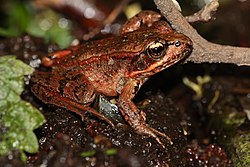
Northern red-legged frogs (Rana aurora) are an amphibian species in the true frog family. They have greenish- to reddish-brown skin, red hind legs, dark spots across their backs, and dark facial masks. As a member of the genus Rana, this species is considered a true frog, with characteristic smooth skin and a narrow waist. These frogs are distributed along the Pacific coast of the United States and Canada, from Northern California to southwest British Columbia.[2][3] There is some range overlap with the federally protected California red-legged frog.[4] Northern red-legged frogs generally breed from January to March, laying eggs in water with submerged vegetation.[5]
Northern red-legged frogs have decreasing population sizes and are listed as "Least Concern" by IUCN.[3] They are a conservation strategy species in Oregon.[6] These frogs are negatively affected by roads due to their characteristic breeding migration from upland-terrestrial to aquatic habitat.[7] Excessive road fatalities have led to novel volunteer programs and wildlife undercrossing projects to protect urban frog populations in Portland, Oregon.[8][9]
Taxonomy
[edit]Northern red-legged frogs' genus and species name is Rana aurora. They are in the "true frog" family Ranidae and are one of two amphibian species classified as red-legged frogs, the other being the California red-legged frog (Rana draytonii).
Both species of red-legged frogs were initially described as distinct by Baird and Girard in 1852.[10] At some point after their initial classification, the frogs were grouped as one red-legged frog species (Rana aurora), with northern (Rana aurora aurora) and California (Rana aurora draytonii) subspecies.[11] This classification was eventually reversed with evidence from DNA analysis and identification of distinct anatomical differences.[4] The northern red-legged frog does not have vocal sacs, which are paired in California red-legged frogs.[12]
Analysis of the mitochondrial DNA cytochrome b gene confirms that the northern red-legged frog and the California red-legged frog are distinct species from one another.[4] Despite similar names, the northern red-legged frog is more closely related to its sister species, the Cascades frog (Rana cascadeae), than the California red-legged frog.[4] An earlier, contrasting hypothesis suggested the Cascades frog was more closely related to the Oregon spotted frog (Rana pretiosa) based on similarities in breeding vocalizations and oviposition patterns.[13]
Description
[edit]Northern red-legged frogs have smooth skin that ranges from greenish- to reddish-brown in color. Their name comes from the bright-red coloration found underneath their relatively long, webbed hind legs. There are variable densities and patterns of dark spots and flecks across the frog's body. Their eyes are golden-brown. A thin, horizontal dark marking extends from the front of their eye to their nostrils, and a light stripe follows their jawline.[14] A reddish-brown mask covers their tympanum. Adults have characteristic Rana species features, including prominent dorsolateral folds (ridges along their backs) along the entire dorsal margin, non-warty skin, and a small waist.[5] The northern red-legged frog has long, powerful legs well adapted to jumping.
Northern red-legged frogs demonstrate sexual dimorphism in their size. Larger females can reach 10.7 cm (4.2 in), and males can reach 8.1 cm (3.2 in), but size varies by location. Both sexes are typically a few inches smaller than these maximums in Washington state.[5]
Noted lookalike species are the California red-legged frog, Oregon spotted frog, and the Cascades frog.[5][15] Northern red-legged frogs are smaller than California red-legged frogs, and demonstrate differences in color pattern, limb length, and eye size.[15] Distinguishing features of the northern red-legged frog from the Oregon spotted frog and Cascades frog include groin coloration, dorsolateral fold length, eye orientation, posture, toe webbing, and terrestrial habitat use.[5]
Distribution
[edit]The northern red-legged frog is found west of the Cascade mountain range in the Pacific Northwest. Their range includes Northern California, western Oregon, western Washington and southwestern British Columbia, including Vancouver Island.[3][16] It also occurs somewhat less-commonly in the southern Cascade Range.[2] Their California range spans every coastal county from southern Mendocino County northward. These frogs can live at elevations up to 1,426 m (4,680 ft), though is not found above an elevation of 1,200 m (3,937 ft) in Northern California coastal mountain ranges, or above 914 m (3,000) in Washington.[2][5][6] It is considered introduced to Alaska.[17]
The southern limit of the northern red-legged frog ends in Northern California's Mendocino County, as is the case for some other Pacific Northwest amphibians. Most California and northern red-legged frog populations demonstrate genetically distinct mitochondrial DNA in their range overlap, indicating a narrow band of hybridization across the region.[4] One study looking at both California and northern red-legged frog presence in southern Mendocino County did not find widespread distribution in forest streams after analyzing environmental DNA.[18]
Habitat
[edit]
Northern red-legged frogs utilize both upland-terrestrial and aquatic habitats. Overwintering habitat data is sparse, though sword fern associations and terrestrial habitation encompass at least part of this period.[5] The still or slow moving waters of ponds, marshes or streams are essential breeding habitat.[19] These frogs' aquatic habitat includes both vernal and permanent bodies of water with submerged vegetation.[6][7]
This species is considered unusually highly oriented to its aquatic habitat, with a clear preference for thickly vegetated shoreline.[20] Northern red-legged frogs require cover because they are subject to predation by various fishes, snakes, birds, mammals, and even other amphibians.
Northern red-legged frogs demonstrate a preference for breeding ponds with sunny patches.[6] Indirect sunlight allows for eggs to absorb heat while embryos develop.[21] Other research and data suggests that closed-canopy ponds may be tolerated and are preferable for tadpole survival in some populations.[22]
Ecology and behavior
[edit]Diet
[edit]Mature R. aurora prey upon terrestrial insects, but will also take small snails and crustaceans.[23] Adults also consume worms, tadpoles, small fish, and even small frogs of other species.[citation needed] Tadpole larvae are herbivorous, and eat algae.[5]
Reproduction
[edit]Males and females begin to move to the breeding sites as early as October, and sometimes as late as January, depending on latitude, cumulative rainfall for the season, and average temperature.[20] The breeding period generally occurs between January and March.[13][5][6] Adult frogs may spend between one and two weeks at their breeding sites.[6] Observations of adult migration are best made on moonlit nights with light rains. Typically, stable minimum temperatures of 5.5 to 6.5 °C (42 to 44 °F) are required to induce breeding.[citation needed] Females deposit eggs in surface water temperatures of at least 6.1 °C (43 °F).[5] Breeding sites can be either permanent or temporary, with inundation usually necessary into June for successful metamorphosis in Oregon, and late May or June in Northern California.[23]
Male frogs arrive at breeding sites before females. The male is thought to defend his territory using nocturnal displays once he reaches the breeding pond.[citation needed] Courtship behaviors commence in January in the California part of the range, and as late as March in northerly regions.[citation needed] Male courtship vocalizations include underwater breeding choruses unique among ranid species, and mating calls during amplexus.[13][21] Eggs are deposited by gravid females in shallow water and attached to submerged vegetation or twigs during amplexus.[13] Males fertilize the eggs as they are deposited.[24] Egg masses are characteristically deposited seven to 15 cm (5.9 in) below the pond surface and away from the water edge.[14][21] Oviposition generally takes place in densely vegetated, shallow portions of wetlands with little current. In unusual cases, egg masses have been observed in water up to 500 cm in depth.[citation needed]

Egg masses are globular in shape, typically about 10 cm (3.9 in) in diameter, and may disperse into an irregular form underwater or float to the surface.[21] Jelly surrounding the eggs swells in size after oviposition due to water uptake.[13] Estimates for the number of eggs contained in each egg mass vary between 500 to 1100 and up to 2,000 eggs.[6][24] Eggs are between 2.0 and 3.0 mm in diameter.[21][24] Eggs generally hatch 3 to 5 weeks after fertilization, which is unusually long for other Rana species.[5] Tadpoles will emerge after hatching; they are oval in shape, and gradually get lighter in color with age.[5] There is a spike in mortality among the tadpoles shortly after hatching due to predation and density of the population.[25] The tadpoles that do survive will metamorphose once they reach 5–7.6 cm (2–3 in), and newly metamorphosed frogs will be smaller; between 2 and 2.5 cm (0.8–1 in).[5][21]
Adults leave the breeding pond soon after the breeding activity is concluded and may migrate about one half kilometer to their summer locations, which are likely to be riparian zones. Juveniles are slow to leave the breeding ponds, tend to find cover in riparian areas, and may readily migrate about 0.5 km (0.3 mi) by summertime.[citation needed]
Other behaviors
[edit]In the northern part of their range, adults may hibernate.[citation needed] When this frog senses danger, it will quickly plunge to depths of one meter or more to seek safety in the benthic zone of a pond.[citation needed]
Conservation
[edit]Northern red-legged frogs are listed as "Least Concern" by ICUN, though their decreasing population size is noted.[3] Frog populations have been extirpated or have reached near-extinction in some regions of California.[4] They are a designated species of concern by the Oregon Conservation Strategy, Oregon's State Wildlife Action Plan.[6]
Increased distance to forest patches and impervious surfaces—such as roads—negatively impact the presence of northern red-legged frogs. Urban frog populations are at risk due to high rates of pavement and forest habitat degradation.[7]
Road fatalities are a conservation concern for northern red-legged frogs. Each frogs' annual breeding migration from upland forest habitat to lowland wetlands can involve crossing busy roads.[6] For the northern red-legged frog population in Portland, Oregon, road fatalities led to the formation of a volunteer program called the Harborton Frog Shuttle in 2013.[8] Frog migration from upland habitat in Forest Park to the Harborton wetlands involves crossing five lanes of traffic on U.S. Highway 30.[26] During the frog's breeding season, volunteers collect frogs stopped by temporary barriers that prevent them from crossing the roads. People then shuttle the frogs to and from the wetlands. Volunteers have escorted hundreds to thousands of frogs to safety each year.[8][27]
The Palensky wildlife undercrossing is another effort to reduce road fatalities across U.S. Highway 30. The culvert is the first amphibian-specific wildlife crossing structure in Oregon as of 2025, though the culvert is large enough to allow passage of other animals, as well.[9]
References
[edit]- ^ IUCN SSC Amphibian Specialist Group (2015). "Rana aurora". IUCN Red List of Threatened Species. 2015 e.T58553A78906924. doi:10.2305/IUCN.UK.2015-4.RLTS.T58553A78906924.en. Retrieved 12 November 2021.
- ^ a b c California Wildlife, Volume I: Amphibians and Reptiles, ed. by D.C. Zeiner et al., published by the California State Department of Fish and Game, 2 May 1988
- ^ a b c d IUCN SSC Amphibian Specialist Group (IUCN SSC) (16 February 2021). "IUCN Red List of Threatened Species: Rana aurora". IUCN Red List of Threatened Species. Archived from the original on 22 February 2025.
- ^ a b c d e f Bradley Shaffer, H.; Fellers, G. M.; Randal Voss, S.; Oliver, J. C.; Pauly, Gregory B. (12 August 2004). "Species boundaries, phylogeography and conservation genetics of the red-legged frog ( Rana aurora/draytonii ) complex". Molecular Ecology. 13 (9): 2667–2677. doi:10.1111/j.1365-294X.2004.02285.x. ISSN 0962-1083.
- ^ a b c d e f g h i j k l m "Northern red-legged frog | Washington Department of Fish & Wildlife". wdfw.wa.gov. Retrieved 10 February 2025.
- ^ a b c d e f g h i "Northern Red-legged Frog – Oregon Conservation Strategy". www.oregonconservationstrategy.org. Retrieved 10 February 2025.
- ^ a b c Guderyahn, Laura B.; Smithers, Ashley P.; Mims, Meryl C. (December 2016). "Assessing habitat requirements of pond-breeding amphibians in a highly urbanized landscape: implications for management". Urban Ecosystems. 19 (4): 1801–1821. doi:10.1007/s11252-016-0569-6. ISSN 1083-8155.
- ^ a b c "Linnton FrogsLinntonFrogs". Linnton Frogs. Retrieved 10 February 2025.
- ^ a b Cassidy, Kaelyn (26 December 2024). "Oregon's first amphibian underpass: Northern red-legged frogs get safe passage under Highway 30". ColumbiaCountySpotlight.com. Retrieved 10 February 2025.
- ^ Baird, Spencer Fullerton; Girard, C. (1852). "Description of new species of reptiles, collected by the US Exploring Expedition under the command of Capt. Charles Wilkes, USN Part 1". ISSN 0097-3157.
{{cite journal}}: Cite journal requires|journal=(help) - ^ Hayes, M. P.; Miyamoto, M. M. (1984). "Biochemical, Behavioral and Body Size Differences between Rana aurora aurora and R. a. draytoni". Copeia. 1984 (4): 1018–1022. doi:10.2307/1445357. ISSN 0045-8511. JSTOR 1445357.
- ^ "Natural history". www.biologicaldiversity.org. Retrieved 15 February 2025.
- ^ a b c d e Briggs, Jeffrey L. (1987). "Breeding Biology of the Cascade Frog, Rana cascadae, with Comparisons to R. aurora and R. pretiosa". Copeia. 1987 (1): 241–245. doi:10.2307/1446066. ISSN 0045-8511. JSTOR 1446066.
- ^ a b Stebbins, R.C. Amphibians and Reptiles of North America, McGraw Hill, New York (1954)
- ^ a b "AmphibiaWeb – Rana aurora". amphibiaweb.org. Retrieved 15 February 2025.
- ^ IUCN SSC Amphibian Specialist Group (2015). "Rana aurora". IUCN Red List of Threatened Species. 2015 e.T58553A78906924. doi:10.2305/IUCN.UK.2015-4.RLTS.T58553A78906924.en. Retrieved 12 November 2021. Database entry includes a range map and justification for why this species is considered least concern. Entry covers R. aurora.
- ^ "Red-legged Frog". Alaska Herpetological Society. Retrieved 23 September 2024.
- ^ Halstead, Brian J; Kleeman, Patrick M; Goldberg, Caren S; Bedwell, Mallory; Douglas, Robert B; Ulrich, David W (March 2018). "Occurrence of California Red-Legged ( Rana draytonii ) and Northern Red-Legged ( Rana aurora ) Frogs in Timberlands of Mendocino County, California, Examined with Environmental DNA". Northwestern Naturalist. 99 (1): 9–20. doi:10.1898/NWN17-17.1. ISSN 1051-1733.
- ^ U.S. Department of Agriculture Northern Red-legged Frog profile (2003)
- ^ a b Red-legged Frog observations in the coastal ranges and development impact analysis, Lumina Technologies, Tiburon (1997)
- ^ a b c d e f Licht, Lawrence E. (1971). "Breeding Habits and Embryonic Thermal Requirements of the Frogs, Rana Aurora Aurora and Rana Pretiosa Pretiosa, in the Pacific Northwest". Ecology. 52 (1): 116–124. doi:10.2307/1934742. ISSN 1939-9170. JSTOR 1934742.
- ^ McHarry, Kecly (1 January 2017). "The influence of canopy cover and climate on early life-stage vital rates for northern Red-legged frogs (Rana aurora), and the implications for population growth rates". Cal Poly Humboldt Theses and Projects.
- ^ a b "Amphibian Declines: The Conservation Status of United States Species, edited by Michael Lannoo ©2005 website excepted from University of California Press". Archived from the original on 4 April 2016. Retrieved 10 November 2006.
- ^ a b c Brown, Sarita Lynn. "Rana aurora (Northern Red-legged Frog)". Animal Diversity Web. Retrieved 14 February 2025.
- ^ Calef, George Waller (1973). "Natural Mortality of Tadpoles in a Population of Rana Aurora". Ecology. 54 (4): 741–758. doi:10.2307/1935670. ISSN 1939-9170. JSTOR 1935670.
- ^ "Frogs". Oregon Wildlife Foundation. Retrieved 10 February 2025.
- ^ "Portland's 'frog taxi' offers a life-saving lift to a struggling species". opb. Retrieved 10 February 2025.
Further reading
[edit]- Hillis, D. M. & Wilcox, T. P. (2005): Phylogeny of the New World true frogs (Rana). Mol. Phylogenet. Evol. 34(2): 299–314. doi:10.1016/j.ympev.2004.10.007 PDF fulltext.
- Hillis, D. M. (2007) Constraints in naming parts of the Tree of Life. Mol. Phylogenet. Evol. 42: 331–338.
- Shaffer, H. Bradley, Gary M. Fellers, S. Randal Voss, Jeff Oliver, Greg Pauly. (2004): Species boundaries, phylogeography, and conservation genetics of the red-legged frog (Rana aurora/draytonii) complex. Molecular Ecology. 13(9): 2667–2677.
External links
[edit] Data related to Rana aurora at Wikispecies


- Identification and habitat of the northern red-legged frog
- Rana aurora Archived 4 April 2016 at the Wayback Machine
_Ranomafana.jpg)