Hubbry Logo
NommoNommoMain
Open search
Nommo
Community hub
Nommo
logo
8 pages, 0 posts
0 subscribers
Be the first to start a discussion here.
Nommo
Nommo
from Wikipedia
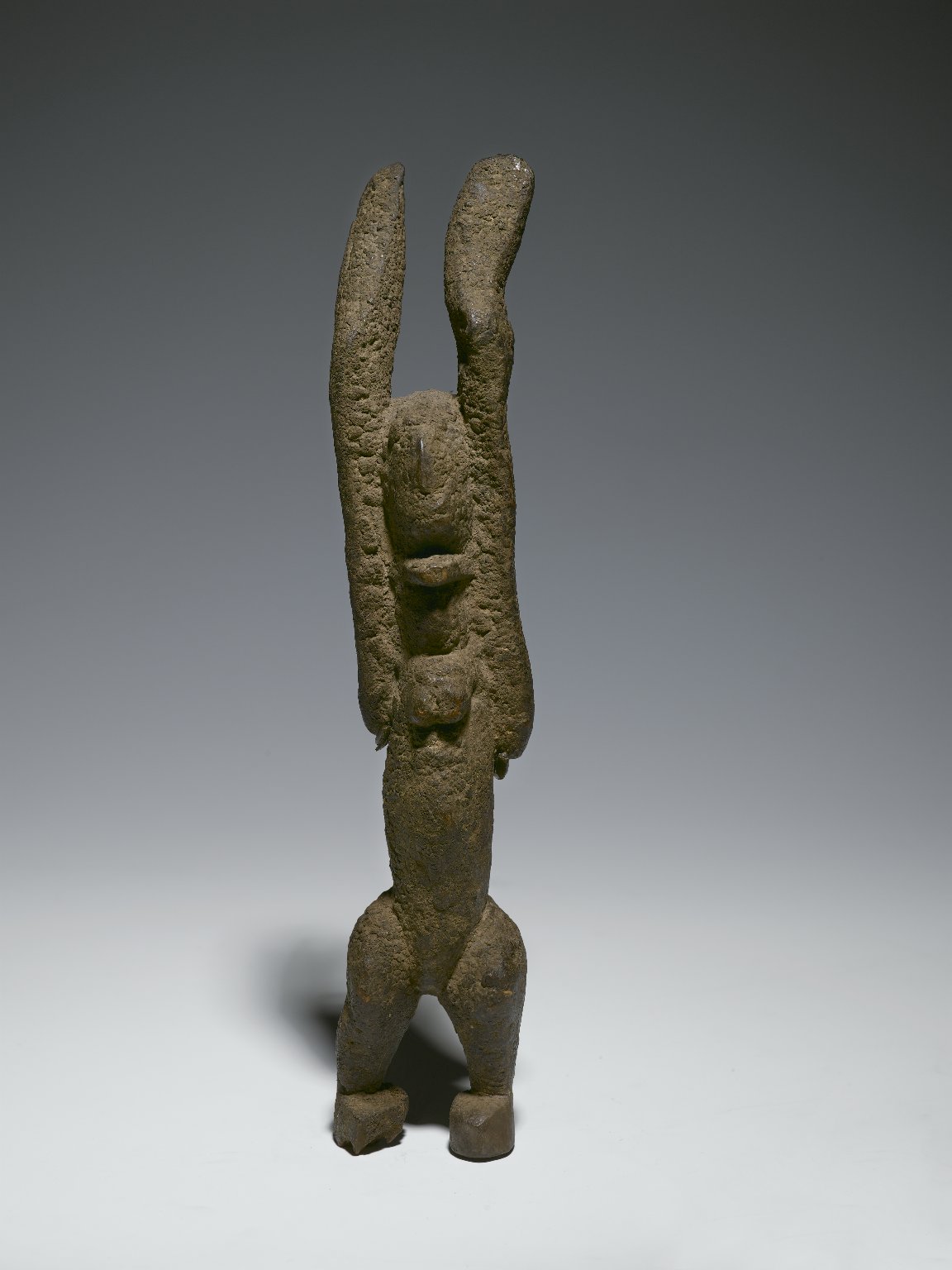
A Nommo figure of the Tellem people

The Nommo or Nummo are primordial ancestral spirits in Dogon religion and cosmogony (sometimes referred to as demi deities) venerated by the Dogon people of Mali.[1] The word Nommos is derived from a Dogon word meaning "to make one drink." Nommos are usually described as amphibious, hermaphroditic, fish-like creatures. Folk art depictions of Nommos show creatures with humanoid upper torsos, legs/feet, and a fish-like lower torso and tail. Nommos are also referred to as "Masters of the Water", "the Monitors", and "the Teachers". Nommo can be a proper name of an individual or can refer to the group of spirits as a whole. For purposes of this article, "Nommo" refers to a specific individual and "Nommos" is used to reference the group of beings.[2]

Nommo mythology

[edit]

Dogon religion and creation mythology [fr] says that Nommo was the first living creature created by the sky god Amma. Shortly after his creation, Nommo underwent a transformation and multiplied into four pairs of twins. One of the twins rebelled against the universal order created by Amma. To restore order to his creation, Amma sacrificed another of the Nommo progeny, whose body was dismembered and scattered throughout the universe.[3] This dispersal of body parts is seen by the Dogon as the source for the proliferation of Binu shrines throughout the Dogons' traditional territory; wherever a body part fell, a shrine was erected.

In the latter part of the 1940s, French anthropologists Marcel Griaule and Germaine Dieterlen (who had been working with the Dogon since 1931) wrote that they were the recipients of additional, secret mythologies, concerning the Nommo. The Dogon reportedly related to Griaule and Dieterlen a belief that the Nommos were inhabitants of a world circling the star Sirius (see the main article on the Dogon for a discussion of their astronomical knowledge). The Nommos descended from the sky in a vessel accompanied by fire and thunder. After arriving, the Nommos created a reservoir of water and subsequently dived into the water. The Dogon legends state that the Nommos required a watery environment in which to live. According to the myth related to Griaule and Dieterlen: "The Nommo divided his body among men to feed them; that is why it is also said that as the universe "had drunk of his body," the Nommo also made men drink. He gave all his life principles to human beings." The Nommo are also thought to be the origin of the first Hogon.[4][5]

Controversy

[edit]

Walter van Beek, an anthropologist studying the Dogon, found no evidence that they had any historical advanced knowledge of Sirius. Van Beek postulated that Griaule engaged in such leading and forceful questioning of his Dogon sources that new myths were created in the process by confabulation, writing that:

...though they do speak about sigu tolo [what Griaule claimed was Sirius] they disagree completely with each other as to which star is meant; for some it is an invisible star that should rise to announce the sigu [festival], for another it is Venus that, through a different position, appears as sigu tolo. All agree, however, that they learned about the star from Griaule.[6]

Carl Sagan has noted that the first reported association of the Dogon with the knowledge of Sirius as a binary star was in the 1940s, giving the Dogon ample opportunity to gain cosmological knowledge about Sirius and the Solar System from more scientifically advanced, terrestrial societies whom they had come in contact with. It has also been pointed out that binary star systems like Sirius are theorized to have a very narrow or non-existent Habitable zone, and thus a high improbability of containing a planet capable of sustaining life (particularly life as dependent on water as the Nommos were reported to be).

Daughter and colleague of Marcel Griaule, Geneviève Calame-Griaule, defended the project, dismissing Van Beek's criticism as misguided speculation rooted in an apparent ignorance of esoteric tradition.[7] Van Beek continues to maintain that Griaule was wrong and cites other anthropologists who also reject his work.[8]

The assertion that the Dogon knew of another star in the Sirius system, Emme Ya, or "larger than Sirius B but lighter and dim in magnitude" continues to be discussed. In 1995, gravitational studies indicated the possible existence of a red dwarf star circling around Sirius[9] but further observations have failed to confirm this.[10] Space journalist and sceptic James Oberg collected claims that have appeared concerning Dogon mythology in his 1982 book and concedes that such assumptions of recent acquisition are "entirely circumstantial" and have no foundation in documented evidence and concludes that it seems likely that the Sirius mystery will remain exactly what its title implies: a mystery.[11] Earlier, other critics such as the astronomer Peter Pesch and his collaborator Roland Pesch[12] and Ian Ridpath[13] had attributed the supposed "advanced" astronomical knowledge of the Dogon to a mixture of over-interpretation by commentators and cultural contamination.

References in fiction

[edit]
[edit]

Jazz composer and bassist Jymie Merritt dedicated a composition to the Nommo, circa 1965, entitled "Nommo."

References

[edit]
[edit]
Revisions and contributorsEdit on WikipediaRead on Wikipedia
from Grokipedia
The Nommo are amphibious, hermaphroditic ancestral spirits central to the mythology of the , an ethnic group residing in the region of , . Described as fish-like celestial beings, they are revered as the progenitors of humanity and the bringers of essential knowledge, including agricultural techniques, moral codes, and astronomical insights, embodying the dual forces of cosmic order and fertility tied to water as a life-giving element. Their name derives from a Dogon term meaning "to make one drink," symbolizing their role in providing sustenance and purification. In Dogon cosmology, the Nommo originate from the creator god Amma, who formed the universe from a containing the fundamental elements of air, , fire, and water. Amma's initial act of creation produced twins—Nommo (the obedient male) and Ogo (the rebellious male)—emerging from paired placentas after Amma planted a divine seed. Ogo's premature escape and failed attempt to form his own led to chaos, prompting Amma to and dismember Nommo, whose body parts were scattered to restore universal order and fertilize the ; Nommo was then revived and sent to in an ark with four attendant spirits, who became the ancestors of the Dogon. This underscores themes of , , and the Nommo's role as mediators between the divine and human realms, with their eight offspring (four pairs) further propagating life and culture among the Dogon. The Nommo are often linked to the star system of Sirius, from which they are said to have descended via the Milky Way, imparting advanced celestial knowledge such as the existence of a dense companion star (Po Tolo) orbiting Sirius every 50 years. As "masters of water" and "monitors," they oversee rituals involving shrines built from Nommo's dismembered remains, which serve as sites for renewal and protection against chaos. Dogon traditions hold that the Nommo will one day return in human form to guide humanity, reinforcing their enduring significance in religious practices, art, and oral lore that blend mythology with environmental and ethical teachings.

Origins in Dogon Culture

Dogon People and Cosmology

The Dogon are an ethnic group numbering approximately 400,000 to 800,000 people (as of the 2020s), primarily residing in the Bandiagara Escarpment region of central Mali, where they have established cliff-dwelling villages for protection and resource access. Known for their agricultural economy focused on cultivating millet, sorghum, and onions, the Dogon maintain a society structured around kinship clans and age-grade systems. Their cultural heritage is preserved through oral traditions, transmitted by specialized priesthoods, including the Hogon, the eldest ritual leader in each village who oversees spiritual and communal affairs. Dogon cosmology centers on Amma, the supreme , who formed the from a primordial containing all potential elements, initiating creation through a spiral motion that generated vibrations known as the "Word"—a vibratory force embodying life and ordering and spirit in dualistic balance. This framework emphasizes the interplay of cosmic forces, with serving as navigational and symbolic anchors in the heavens, representing essential and renewal tied to and rivers, and agricultural motifs underscoring themes of growth and sustenance. Granaries, as architectural symbols, embody the cosmos's structured , their doors and walls inscribed with signs that evoke protective energies and the containment of vital seeds. Historically, the Dogon migrated to the during the 15th and 16th centuries, likely fleeing invasions from the Mandé or Songhai empires in the Mandé region of western , where they displaced earlier inhabitants like the Tellem. Exposure to via neighboring Fulani herders from the 15th century onward led to partial conversions, while French colonial administration from 1890 to 1960 introduced and administrative changes, yet the Dogon largely retained their animist cosmology and rituals through isolated escarpment life and priestly guardianship.

Introduction to Nommo Mythology

In Dogon mythology, the (or Nommos) represent primordial ancestral spirits, with the term derived from a Dogon word meaning "to make one drink," signifying their association with as a life-giving force. These beings are conceptualized as eight twin ancestral spirits, often described as four pairs, embodying the foundational principles of duality and multiplicity in the cosmos. As central figures in the creation narrative, the Nommo emerged as the first organized living entities, formed by the supreme creator god Amma from a divine seed within the world egg (aduno talu), establishing them as the initial bridge between the divine order and material existence. The Nommo possess a hermaphroditic and aquatic nature, symbolizing the dualities of life such as , and purification, and chaos and order; each originates from a half-placenta in the world egg, producing hermaphroditic couples linked to as the source of vital speech (la parole) and renewal. Venerated as intermediaries between humanity and Amma, they sacrificed their bodies to purify the , disseminating regenerative essence and instructing the first ancestors in rituals and . This role underscores their status as redeemers, restoring balance after earlier imperfections in creation. Within the mythic , the Nommo occupy a position directly below Amma but above human forebears, such as the subsequent Nummo twins who became the eight ancestral clans; they oversee the transmission of cosmic knowledge, including the structuring of into four tribes aligned with cardinal directions and elements. The Nommo are integral to the sigui ceremonies, held every 60 years to commemorate the of and renewal, aligning with the perceived cycles of the of Sigui (Sirius) and reinforcing Dogon cosmological dualism through reenactments of their descent and .

Mythological Descriptions and Roles

Physical Characteristics

In Dogon mythology, the Nommo are portrayed as amphibious and androgynous entities, combining and aquatic features in their form. They are typically described as having an upper resembling that of a , with arms and sometimes legs, transitioning into a serpentine or fish-like tail that enables movement in water. This hybrid structure symbolizes their origin from a watery realm and their role as intermediaries between the divine and earthly domains, with often depicted as and scaly, evoking the essence of and regeneration. Variations in Nommo depictions highlight both singular and plural forms, reflecting their mythological multiplicity. The singular Nommo die, or "great fish," is envisioned as a prominent leader figure with an elongated, fish-shaped body, while pairs or twins represent complementary male and female aspects, emphasizing balance and duality. These beings are associated with vital life essences such as water for sustenance, blood for vitality, and millet for growth, attributes that underscore their regenerative flesh capable of renewal, as if composed of living water that heals and transforms. Artistic representations of the Nommo appear prominently in Dogon , capturing their physical traits through symbolic . In wooden carvings and figures, such as seated Nommo statues, they are shown with erect phalluses signifying and the generative power of creation, often placed on altars or in binu shrines dedicated to ancestral spirits. and paintings further illustrate their webbed limbs and tail, using green or pigments to denote their aquatic nature, while the overall forms blend human proportions with piscine elements to evoke their amphibious essence.

Creation and Arrival Narratives

In Dogon mythology, the Nommo originate from the creative act of Amma, the supreme deity, who formed them as primordial beings of order from a divine or suspended in the celestial realm. This creation followed Amma's initial attempt to structure the , disrupted by the chaotic actions of the Pale (Ogo), prompting the need for restorative forces. The Nommo, conceived as twins embodying harmony and fertility, were essential to Amma's plan for cosmic balance. To purify the disordered , Amma sacrificed one of the Nommo, dismembering its body and distributing the fragments across the world to infuse life and order into all elements. This act of symbolized the foundational cycle of death and rebirth, with the sacrificed Nommo subsequently by Amma, restoring its vitality and completing the generative process. The resurrection underscored the Nommo's role as mediators between the divine and terrestrial realms, ensuring the propagation of existence. The Nommo's arrival on marked a pivotal descent from the in an egg-shaped vessel known as the ark, which spiraled downward amid vibrations and brilliance. Upon landing in a designated watery domain, the ark opened, and the Nommo emerged to establish a sacred lake as their habitat, from which they interacted with the nascent world. This event initiated their terrestrial mission, transforming the landscape and preparing it for habitation. Following their landing, the Nommo underwent a cycle of and revival, mirroring the earlier cosmic , which allowed them to multiply into eight entities—four pairs of twins—who became the direct ancestors of humankind. These eight Nommo dispersed to populate the , founding lineages and imparting essential knowledge such as , , and to the first , thereby embedding the principles of renewal and instruction into Dogon societal origins.

Societal Functions and Symbols

In Dogon society, the Nommo are central to ritual veneration, particularly through the society, a men's initiatory group responsible for masked dances that invoke ancestral spirits during funerary rites and communal ceremonies. These dances, performed by Awa members using elaborate masks, symbolize the Nommo's regenerative powers and are essential for maintaining cosmic balance, with the society's secret language, Sigi so, facilitating esoteric communications during rituals. The Sigui festival, held every sixty years over a seven-year period, honors the Nommo through processions, feasting, and the crafting of new masks, serving to renew societal ties to ancestors and purify the community from spiritual impurities. Nommo altars, often constructed near water sources or agricultural fields, receive offerings such as millet and sacrifices to invoke the spirits' benevolence, ensuring of the and timely rains essential for the Dogon's agrarian livelihood. The Nommo embody profound social symbolism, representing purity through their association with as a cleansing force and their role in rituals that address taboos and moral infractions. As twin figures in Dogon cosmology, they underscore the cultural valorization of duality, prominently featured in Dama funerals where masked performances by the Awa society commemorate the deceased and facilitate the soul's release, emphasizing twinship as a motif of and rebirth. Nommo symbols also evoke , as hogons—village priests—invoke them in councils to resolve disputes, drawing on the spirits' exemplary order to uphold communal equity. This extends to totemic cults centered on Nommo, where lineages venerate them as progenitors, integrating their imagery into protective amulets and village totems that safeguard social cohesion. Granary architecture reflects Nommo influence through carved doors depicting ancestral pairs, symbolizing protection of stored grains as an extension of the spirits' fertility domain. Their androgynous nature further shapes gender roles, promoting balanced complementarity between men and women in labor and rituals, where Nommo's dual essence models ideal unity beyond strict binaries. Cultural transmission of Nommo lore occurs orally through elder priests, known as hogons, who serve as custodians of sacred knowledge passed down in initiatory settings and during society gatherings. These priests recount Nommo narratives in contexts, emphasizing the spirits as moral exemplars who impart lessons on living in —through sustainable farming—and the , via alignments with celestial cycles observed in festivals like Sigui. This reinforces ethical conduct, positioning the Nommo as guides for ecological stewardship and social interdependence across generations.

Modern Interpretations and Controversies

Sirius Mystery and Ancient Astronaut Theories

In the 1970s, the Nommo myths gained prominence in discussions of ancient astronaut theories through Robert Temple's book , which proposed that the Dogon people's astronomical knowledge originated from extraterrestrial contact with beings from the . Temple argued that the Nommo, described in Dogon lore as amphibious entities arriving in a fiery ark, were intelligent visitors who imparted advanced information about the stars to early human civilizations around 5,000 years ago. This interpretation positioned the Nommo as space travelers who influenced Dogon cosmology, linking their descent narratives to interstellar origins. Central to Temple's were the Dogon descriptions of the Sirius system, documented in the ethnographies of French anthropologists and Germaine Dieterlen, who recorded the tribe's oral traditions during extended fieldwork in . The Dogon referred to Sirius A as sigi tolo (the main star) and its invisible companion, Sirius B, as po tolo—a term evoking a tiny, dense seed-like object that orbits every 50 years and possesses immense heaviness, characteristics aligning with modern astronomical observations of Sirius B's properties, invisible without telescopes until 1862. Additionally, the Dogon mentioned emme ya, interpreted by Temple as a potential third body in the system (Sirius C), described as a smaller, orbiting companion, further suggesting knowledge beyond naked-eye visibility. Griaule and Dieterlen's accounts, published in works like Un système soudanais de Sirius (1950), detailed these stellar concepts within Nommo-related rituals and symbols, framing them as inherited wisdom from the visitors. Temple's ideas built on the broader ancient astronaut hypothesis popularized by , whose works like Chariots of the Gods? (1968) posited that extraterrestrial interventions explained anomalous ancient knowledge worldwide, with the Dogon Sirius lore serving as a key African example of alien tutelage via the Nommo. Proponents viewed the Nommo's role in creation myths—bringing seeds of and astronomical secrets—as evidence of directed contact, potentially disseminated from the Sirius system to circa 3500 BCE, influencing not only the Dogon but connected Mediterranean and Sumerian traditions. This framework elevated the Nommo from mythological figures to historical agents of interstellar exchange.

Anthropological and Scientific Critiques

Anthropological critiques of the Nommo myths and their purported astronomical knowledge emphasize the role of cultural contamination and interpretive biases introduced by early ethnographers. Marcel Griaule's fieldwork in the and 1940s, which formed the basis for much of the Dogon cosmology popularized in later theories, has been criticized for relying on leading questions and interactions with informants who had access to European astronomical knowledge. Bernard R. Ortiz de Montellano, in his 1996 analysis, argues that the Dogon descriptions of the Sirius system, including references to a companion star, likely resulted from post-1930s influences such as visits by French astronomers or missionaries, rather than ancient indigenous astronomy. He further contends that Dogon myths, including those involving the Nommo, function as symbolic narratives tied to agricultural and rituals, not literal scientific accounts, and that Griaule's interpretations projected Western astronomical concepts onto Dogon oral traditions. Scientific debunkings focus on the implausibility of the Dogon possessing detailed knowledge of Sirius B—a invisible to the —without telescopic aid, challenging claims of ancient extraterrestrial transmission via the Nommo. Visibility debates highlight that Sirius B's faint magnitude (around 8.3) makes it undetectable without instruments, though some astronomers note rare conditions under ideal skies might allow glimpses; however, no pre-19th-century records from any culture confirm such observations. , in his 1979 book , expressed about the Dogon's alleged unaided detection of Sirius B, pointing out the absence of corroborating in other African or global astronomical traditions and suggesting the information was imported after its 1862 discovery by Alvan . Additionally, claims of a third star (Sirius C) in Dogon lore lack any empirical support, as modern observations confirm only the binary Sirius A and B system. Recent ethnographies underscore the evolving nature of Dogon myths, influenced by external contacts, and reframe Nommo narratives within local ritual contexts rather than extraterrestrial hypotheses. Studies from the , such as those by Walter van Beek, reveal that Dogon astronomical knowledge is primarily ritualistic and symbolic, linked to sigui ceremonies and agricultural cycles, with variations across villages showing adaptations from 20th-century interactions rather than static ancient wisdom. These works emphasize methodological flaws in earlier research, including selective transcription of interviews, and advocate for viewing Nommo as amphibious culture heroes embodying and order in Dogon cosmology, without literal astronomical implications.

Representations in Media and Culture

In Literature and Fiction

The Nommo feature prominently in ethnographic literature documenting Dogon cosmology, most notably in Marcel Griaule's Conversations with Ogotemmêli (originally published as Dieu d'Eau in 1948), where an elder informant describes them as amphibious, hermaphroditic beings who descended from the sky in an ark to impart knowledge of , , and spiritual order to humanity. This work, co-authored with Germaine Dieterlen, established the Nommo as central symbols of creation and in Dogon religious ideas, influencing subsequent anthropological studies of African mythologies. In non-fiction, Robert K.G. Temple's (1976) reframed the Nommo as advanced extraterrestrials from the Sirius star system who visited millennia ago, using Griaule's accounts to argue for ancient astronaut intervention in human civilization. This interpretation inspired alternative history narratives, such as Graham Hancock's (1995), which integrates Dogon astronomical lore—including knowledge of Sirius B—with myths of lost civilizations like to propose a global prehistoric exchange of advanced wisdom. Hancock attributes the Dogon's purported insights into stellar densities and orbits to cultural transmission from ancient seafaring explorers, blending Nommo narratives with broader theories of forgotten human achievements. Fictional portrayals often depict the Nommo as enigmatic aliens in science fiction, echoing Temple's extraterrestrial thesis while exploring themes of otherworldly origins and . In UFO-themed stories, they symbolize mysterious benefactors or monitors of earthly affairs, as seen in speculative works that adapt Dogon myths to probe interstellar contact. African speculative fiction has embraced the Nommo symbolically, particularly in explorations of and ancestral legacies; for instance, Chiagozie Fred Nwonwu's (as Mazi Nwonwu) "Masquerade Stories" in the anthology AfroSF: Science Fiction by African Writers (2012) gestures toward Dogon cosmology by portraying amphibious Sirius beings as progenitors of life on , intertwining alien seeding with postcolonial identity questions. Post-2010 Afrofuturist literature reimagines the Nommo as empowering ancestral guides, reclaiming Dogon mythology to envision decolonized futures amid technological and cosmic challenges. The Speculative Fiction Society's Nommo Awards, established in 2017 and named for these beings, underscore their enduring motif in the , honoring novels and stories that fuse traditional spirits with speculative innovation to affirm African cosmologies in global narratives; as of 2025, the awards continue annually, with the shortlist for 2025 announced in August and voting open through November 14, 2025. In visual arts, contemporary African artists have incorporated Nommo motifs from Dogon mythology into modern sculptures and paintings, often reinterpreting traditional forms to explore themes of ancestry and cosmology. For instance, Malian sculptors continue to produce Nommo-inspired wooden figures, blending ancestral iconography with contemporary aesthetics, as seen in works available through galleries specializing in West African art. Exhibitions since the 2000s, such as the Menil Collection's "ReCollecting Dogon" (2017), have featured over 25 Dogon artifacts, including Nommo representations, highlighting their enduring influence on modern artistic discourse. Nommo have appeared in film and television primarily through documentaries examining Dogon lore and . The History Channel's series dedicates episodes to the amphibious Nommo as extraterrestrial visitors, notably in Ancient Aliens Special Presentation, Season 1, Episode 6 ("Mysteries of the Outer Realms," 2022) and Season 14, Episode 4 ("The Star Gods of Sirius," 2019), which link Nommo to advanced astronomical knowledge. Fictional sci-fi portrayals drawing directly from Nommo as alien fish-like beings remain limited, though their amphibious archetype echoes in underwater alien designs in films like (1989) and related media, indirectly inspired by Dogon narratives. In broader popular culture, Nommo references have gained traction in the via podcasts and online discussions on , with episodes on platforms like Spotify's Ancient Aliens podcast exploring their role in Dogon cosmology and extraterrestrial theories. This surge aligns with viral content on , including documentaries like "The Untold Story of the Dogon Tribe and Their Mysterious Cosmic Gods" (), amplifying Nommo in exploration-themed video games and memes tied to ancient astronaut memes, though direct integrations in music or games are sparse.

References

Add your contribution
Related Hubs
User Avatar
No comments yet.