


Community hub
Recent from talks
Contribute something
Nothing was collected or created yet.
GeForce GTX 16 series
View on Wikipedia
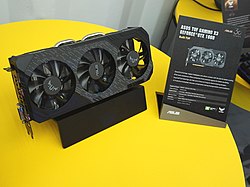
  Top: Logo of the series Bottom: A Nvidia GeForce GTX 1660 ASUS TUF Gaming X3 released in 2019, a higher-end model of the series | |
| Release date | February 22, 2019 |
|---|---|
| Discontinued | March 5, 2024[1] |
| Manufactured by | TSMC |
| Designed by | Nvidia |
| Marketed by | Nvidia |
| Codename | TU11x |
| Architecture | Turing |
| Models | GeForce GTX series |
| Transistors |
|
| Fabrication process | TSMC 12 nm (FinFET) |
| Cards | |
| Entry-level |
|
| Mid-range |
|
| API support | |
| Direct3D | Direct3D 12.0 (feature level 12_1) Shader Model 6.7 |
| OpenCL | OpenCL 3.0[2][a] |
| OpenGL | OpenGL 4.6[3] |
| Vulkan | |
| History | |
| Predecessor | GeForce 10 series |
| Variant | GeForce RTX 20 series |
| Successor | GeForce RTX 30 series |
| Support status | |
| Supported | |
The GeForce GTX 16 series is a series of graphics processing units (GPUs) developed by Nvidia, based on the Turing microarchitecture, announced in February 2019.[5] The GeForce GTX 16 series, commercialized within the same timeframe as the GeForce RTX 20 series, aims to cover the entry-level to mid-range market, not addressed by the latter. As a result, the media have mainly compared it to AMD's Radeon RX 500 series of GPUs.
The GeForce GTX 16 series includes the GTX 1650, 1650 Super, 1660, 1660 Super, 1660 Ti, and a lower-end GTX 1630, which was released later. The GTX 1650 features both a GDDR5 and GDDR6 version.
Like the GeForce RTX 20 series, the GeForce GTX 16 series was followed by the GeForce 30 series. The 16 series was the last GPU generation of the GeForce series that did not support hardware-accelerated real-time ray tracing and was therefore marketed under the GTX instead of RTX prefix.
Architecture
[edit]The GeForce GTX 16 series is based on the same Turing architecture used in the GeForce RTX 20 series, omitting the Tensor (AI) and RT (ray tracing) cores exclusive to the 20 series. The 16 series does, however, retain the dedicated integer cores used for concurrent execution of integer and floating point operations.[6] On March 18, 2019, Nvidia announced that via a driver update in April 2019 they would enable DirectX Raytracing on 16 series cards starting with GTX 1660, together with certain cards in the 10 series, a feature reserved to the RTX series up to that point.[7]
Products
[edit]The GeForce GTX 16 series launched on February 23, 2019, with the announcement of the GeForce GTX 1660 Ti.[8] The cards have a PCIe 3.0 x16 interface, which connects them to the CPU, produced with TSMC's 12 nm FinFET process. On April 22, 2019, coinciding with the announcement of the GTX 1650, Nvidia announced laptops equipped with built-in GTX 1650 chipsets.[9] TU117 does not support Nvidia Optical Flow,[10] which is useful for motion interpolation software. All TU117 GPUs use Volta's NVENC encoder (which has a marginally better improvement over Pascal) instead of Turing's.[11]
Desktop
[edit]| Model | Launch | Launch price (USD) |
Code name(s) |
Transistors (billion)
|
Die size (mm2)
|
Core config[b] |
L2 cache (MB) |
Clock speeds[c] | Fillrate[d][e] | Memory | Processing power (GFLOPS) | TDP | |||||||
|---|---|---|---|---|---|---|---|---|---|---|---|---|---|---|---|---|---|---|---|
| Core (MHz) |
Memory (GT/s) |
Pixel (Gpx/s) |
Texture (Gtex/s) |
Size (GB) |
Band- width (GB/s) |
Type | Bus width (bit) |
Half precision (boost) |
Single precision (boost) |
Double precision (boost) | |||||||||
| GeForce GTX 1630[12][13] |
Jun 28, 2022 | ? | TU117-150 | 4.7 | 200 | 512:32:16 8 SM |
1 | 1740 (1785) |
12.0 | 27.84 (28.56) |
55.68 (57.12) |
4 | 96 | GDDR6 | 64 | 3564 (3656) |
1782 (1828) |
55.68 (57.12) |
75 W |
| GeForce GTX 1650[11][14][15][16] |
Apr 23, 2019 | 149[17] | TU117-300 | 896:56:32 14 SM |
1485 (1665) |
8.0 | 47.52 (53.28) |
83.16 (93.24) |
128 | GDDR5 | 128 | 5322 (5967) |
2661 (2984) |
83.16 (93.24) | |||||
| Apr 3, 2020[18] | 149 | 1410 (1590) |
12.0 | 45.12 (50.88) |
78.96 (89.04) |
192 | GDDR6 | 5053 (5699) |
2527 (2849) |
78.96 (89.04) | |||||||||
| Jul 1, 2020[19] | TU116-150[20] | 6.6 | 284 | 80 W | |||||||||||||||
| Jun 29, 2020[21] | ? | TU106-125[22] | 10.8 | 445 | 90 W | ||||||||||||||
| GeForce GTX 1650 Super[23][24] |
Nov 22, 2019 | 159 | TU116-250 | 6.6 | 284 | 1280:80:32 20 SM |
1530 (1725) |
48.96 (55.20) |
122.4 (138.0) |
7834 (8832) |
3917 (4416) |
122.4 (138.0) |
100 W | ||||||
| GeForce GTX 1660[8][25] |
Mar 14, 2019 | 219 | TU116-300 | 1408:88:48 22 SM |
1.5 | 1530 (1785) |
8.0 | 73.44 (85.68) |
134.6 (157.1) |
6 | GDDR5 | 192 | 8617 (10053) |
4309 (5027) |
134.6 (157.1) |
120 W | |||
| GeForce GTX 1660 Super[26][27] |
Oct 29, 2019 | 229 | 14.0 | 336 | GDDR6 | 125 W | |||||||||||||
| GeForce GTX 1660 Ti[8][28] |
Feb 22, 2019 | 279 | TU116-400 | 1536:96:48 24 SM |
1500 (1770) |
12.0 | 72.00 (84.96) |
144.0 (169.9) |
288 | 9216 (10875) |
4608 (5437) |
144.0 (169.9) |
120 W | ||||||
Laptop
[edit]| Model | Launch | Code name(s) |
Transistors (billion)
|
Die size (mm2)
|
Core config[b] |
L2 cache (MB) |
Clock speeds[c] | Fillrate[d][e] | Memory | Processing power (GFLOPS) | TDP | |||||||
|---|---|---|---|---|---|---|---|---|---|---|---|---|---|---|---|---|---|---|
| Core (MHz) |
Memory (GT/s) |
Pixel (Gpx/s) |
Texture (Gtex/s) |
Size (GB) |
Band- width (GB/s) |
Type | Bus width (bit) |
Half precision (boost) |
Single precision (boost) |
Double precision (boost) | ||||||||
| GeForce GTX 1650 Max-Q (Laptop)[29][30][31][32] |
Apr 23, 2019 | TU117-750[33] (N18P-G0-MP) |
4.7 | 200 | 1024:64:32 16 SM |
1 | 1020 (1245) |
8.0 | 32.64 (39.84) |
65.28 (79.68) |
4 | 128 | GDDR5 | 128 | 4178 (5100) |
2089 (2550) |
65.28 (79.68) |
35 W |
| Apr 15, 2020[34] | TU117-753[35] (N18P-G61-MP2) |
930 (1125) |
12.0 | 29.76 (36.00) |
59.52 (72.00) |
192 | GDDR6 | 3809 (4608) |
1905 (2304) |
59.52 (72.00) |
30 W | |||||||
| GeForce GTX 1650 (Laptop)[29][30][36][37] |
Apr 23, 2019 | TU117-750[33] (N18P-G0-MP) |
1395 (1560) |
8.0 | 44.64 (49.92) |
89.28 (99.84) |
128 | GDDR5 | 5714 (6390) |
2857 (3195) |
89.28 (99.84) |
50 W | ||||||
| Apr 15, 2020[38] | TU117-753[35] (N18P-G61-MP2) |
1380 (1515) |
12.0 | 44.16 (48.48) |
88.32 (96.96) |
192 | GDDR6 | 5653 (6205) |
2826 (3103) |
88.32 (96.96) | ||||||||
| GeForce GTX 1650 Ti Max-Q (Laptop)[30][39][40] |
Apr 2, 2020 | TU117-775[35] (N18P-G62) |
1035 (1200) |
33.12 (38.40) |
66.24 (76.80) |
4239 (4915) |
2120 (2458) |
66.24 (76.80) |
35 W | |||||||||
| GeForce GTX 1650 Ti (Laptop)[30][41][42] |
1350 (1485) |
43.20 (47.52) |
86.40 (95.04) |
5530 (6083) |
2765 (3041) |
86.40 (95.04) |
55 W | |||||||||||
| GeForce GTX 1660 Ti Max-Q (Laptop)[30][43][44] |
Apr 23, 2019 | TU116-750[33] (N18E-G0) |
6.6 | 284 | 1536:96:48 24 SM |
1.5 | 1140 (1335) |
54.72 (64.08) |
109.4 (128.2) |
6 | 288 | 192 | 7004 (8202) |
3502 (4101) |
109.4 (128.2) |
60 W | ||
| GeForce GTX 1660 Ti (Laptop)[30][45][46] |
1455 (1590) |
69.84 (76.32) |
139.7 (152.6) |
8940 (9769) |
4470 (4884) |
139.7 (152.6) |
80 W | |||||||||||
- ^ In OpenCL 3.0, OpenCL 1.2 functionality has become a mandatory baseline, while all OpenCL 2.x and OpenCL 3.0 features were made optional.
- ^ a b Shader processors: Texture mapping units: Render output units and Streaming multiprocessors (SM)
- ^ a b Core boost values (if available) are stated below the base value inside brackets.
- ^ a b Pixel fillrate is calculated as the number of ROPs multiplied by the base (or boost) core clock speed.
- ^ a b Texture fillrate is calculated as the number of TMUs multiplied by the base (or boost) core clock speed.
Reception
[edit]GTX 1630
[edit]Following its June 2022 release, the GTX 1630 received negative reviews. A two-star review by Jarred Walton in Tom's Hardware criticised its price, especially considering that it was released 3 years after most of the 16 series, while only performing better than the GTX 1050. Walton wrote that "the only real contender for the GTX 1630 is AMD's recently launched Radeon RX 6400, but this new Nvidia card actually makes the lackluster 6400 look good". He concluded that "no one should give the GTX 1630 the time of day" and instead recommended the GTX 1650 and 1650 Super for their dramatically improved specs and performance for a similar price.[47] TechSpot characterized the GTX 1630's specs as a "cutdown version of the GTX 1650" from April 2019 which is "3-year-old silicon that to put it mildly was pretty pathetic back then".[48] Jacob Roach of Digital Trends noted that the GTX 1630 released in 2022 was outperformed by AMD's Radeon RX 470 from 2016.[49]
GTX 1650
[edit]Tom's Hardware criticized the GTX 1650, noting that the 8GB variant of the RX 570 is "faster, less expensive and better able to handle games with big memory requirements."[50]
Forbes described the GTX 1650 as "a tempting choice for a super-small and power-efficient gaming PC".[51] However, "when it comes to value and bang for your buck, AMD's RX 570 is the clear choice overall."[51]
GTX 1650 Super
[edit]PC Gamer described the GTX 1650 Super as a "no-brainer" and a "super easy recommendation" over the original 1650, as it only costs $10 more and is "consistently around 30 percent faster".[52] However, they criticized the small amount of VRAM (4GB) and noted that users who have a PC which does not have PCIe power cables available have to "stick with the vanilla 1650" because the Super variant has a higher power consumption (100W vs. 75W).[52] Altogether, it has a "great overall value" and for now "claims the crown for best budget graphics card", being consistently faster than the RX 580 and coming close to the RX 590 when the VRAM is not a limiting factor.[52]
According to German IT online magazine Computerbase, the GTX 1650 Super is "faster than a GeForce GTX 1060 and […] delivers comparable FPS to AMD's Radeon RX 590."[53] They praised the GTX 1650 Super's price while criticizing its small amount of VRAM, claiming "The 4 GB memory these days is too small even in this [price] class."[53]
GTX 1660 Super
[edit]PC Gamer found that the GTX 1660 Super "almost makes the 1660 Ti look redundant" and noted that "it outperforms anything AMD currently offers in the same price range (it's about 20 percent faster than the RX 590)."[54]
See also
[edit]References
[edit]- ^ "NVIDIA discontinues GeForce GTX 16 GPUs, the end of GTX series". VideoCardz. March 5, 2024. Retrieved March 5, 2024.
- ^ "OpenCL Driver Support | NVIDIA Developer". developer.nvidia.com. NVIDIA. April 24, 2013. Retrieved May 30, 2022.
- ^ "OpenGL Driver Support | NVIDIA Developer". developer.nvidia.com. NVIDIA. August 19, 2013. Retrieved May 30, 2022.
- ^ "Vulkan Driver Support | NVIDIA Developer". developer.nvidia.com. NVIDIA. February 10, 2016. Retrieved May 30, 2022.
- ^ "New GeForce GTX 1660 Ti Delivers Great Performance Leap for Every Gamer, Starting at $279 | NVIDIA Newsroom". nvidianews.nvidia.com. NVIDIA. February 22, 2019. Retrieved October 22, 2019.
- ^ Smith, Ryan; Oh, Nate (February 22, 2019). "The NVIDIA GeForce GTX 1660 Ti Review, Feat. EVGA XC GAMING: Turing Sheds RTX for the Mainstream Market". AnandTech. Archived from the original on April 24, 2019.
- ^ Burnes, Andrew (March 18, 2019). "Accelerating The Real-Time Ray Tracing Ecosystem: DXR For GeForce RTX and GeForce GTX". NVIDIA.
- ^ a b c "16: The New Supercharger – GeForce GTX 1660 Ti". Nvidia. Retrieved February 22, 2019.
- ^ "GeForce GTX 1650 Gaming Laptops". Nvidia. Archived from the original on April 23, 2019. Retrieved May 21, 2022.
- ^ "NVIDIA Optical Flow SDK". developer.nvidia.com. Nvidia. November 29, 2018.
- ^ a b "GeForce GTX 1650 Graphics Card". Nvidia. Retrieved October 22, 2019.
- ^ "Compare 16 Series Specs". Nvidia. Retrieved June 28, 2022.
- ^ "NVIDIA GeForce GTX 1630 Specs". TechPowerUp. Retrieved June 28, 2022.
- ^ "NVIDIA GeForce GTX 1650 Specs". TechPowerUp. Retrieved May 21, 2022.
- ^ Dexter, Alan (April 3, 2020). "Nvidia's GTX 1650 gets GDDR6 because 'the industry is running out of GDDR5'". PC Gamer. Retrieved April 4, 2020.
- ^ Liu, Zhiye (June 15, 2020). "Nvidia Goes Nuts and Readies Two More GeForce GTX 1650 Variants". Tom's Hardware. Retrieved November 23, 2022.
- ^ Del Rizzo, Bryan (April 23, 2019). "Turing Now Starts at $149: Introducing GeForce GTX 1650". Nvidia.
- ^ "NVIDIA GeForce GTX 1650 GDDR6 Specs". TechPowerUp. Retrieved May 21, 2022.
- ^ "NVIDIA GeForce GTX 1650 GDDR6 TU116". VideoCardz. Archived from the original on July 20, 2020. Retrieved July 20, 2020.
- ^ "NVIDIA GeForce GTX 1650 TU116 Specs". TechPowerUp. Retrieved May 21, 2022.
- ^ "NVIDIA GeForce GTX 1650 TU106 Specs". TechPowerUp. Retrieved June 29, 2020.
- ^ "GALAX reveals GeForce GTX 1650 Ultra with TU106-125 GPU". VideoCardz. June 29, 2020. Retrieved May 19, 2022.
- ^ "GeForce GTX 1650 SUPER Graphics Card". Nvidia. Retrieved November 22, 2019.
- ^ "NVIDIA GeForce GTX 1650 SUPER Specs". TechPowerUp. Retrieved May 21, 2022.
- ^ "NVIDIA GeForce GTX 1660 Specs". TechPowerUp. Retrieved May 21, 2022.
- ^ "GeForce GTX 1660 SUPER Graphics Card". Nvidia. Retrieved November 22, 2019.
- ^ "NVIDIA GeForce GTX 1660 SUPER Specs". TechPowerUp. Retrieved May 21, 2022.
- ^ "NVIDIA GeForce GTX 1660 Ti Specs". TechPowerUp. Retrieved May 21, 2022.
- ^ a b "GTX 1650 Gaming Laptops". Nvidia. Retrieved May 20, 2022.
- ^ a b c d e f "RTX 20/GTX 16 Series Gaming Laptops". Nvidia. Archived from the original on April 26, 2020. Retrieved May 20, 2022.
- ^ "NVIDIA GeForce GTX 1650 Max-Q Specs". TechPowerUp. Retrieved March 2, 2020.
- ^ "NVIDIA GeForce GTX 1650 Max-Q Mobile Graphics". VideoCardz. Retrieved May 20, 2022.
- ^ a b c "N18E-G0 and N18P-G0-MP GPUs | New Product Notice" (PDF). Nvidia. December 14, 2018. Retrieved May 20, 2022.
- ^ "NVIDIA GeForce GTX 1650 (GDDR6) Max-Q Specs". TechPowerUp. Retrieved May 20, 2022.
- ^ a b c "N18P-G61-MP2 and N18P-G62 GPUs | New Product Notice" (PDF). Nvidia. December 20, 2019. Retrieved May 20, 2022.
- ^ "NVIDIA GeForce GTX 1650 Mobile Specs". TechPowerUp. Retrieved March 2, 2020.
- ^ "NVIDIA GeForce GTX 1650 Mobile Graphics". VideoCardz. Retrieved May 20, 2022.
- ^ "NVIDIA GeForce GTX 1650 (GDDR6) Mobile Specs". TechPowerUp. Retrieved May 20, 2022.
- ^ "NVIDIA GeForce GTX 1650 Ti Max-Q Specs". TechPowerUp. Retrieved May 20, 2022.
- ^ "NVIDIA GeForce GTX 1650 Ti Max-Q Mobile Graphics". VideoCardz. Retrieved May 20, 2022.
- ^ "NVIDIA GeForce GTX 1650 Ti Mobile Specs". TechPowerUp. Retrieved May 20, 2022.
- ^ "NVIDIA GeForce GTX 1650 Ti Mobile Graphics". VideoCardz. Retrieved May 20, 2022.
- ^ "NVIDIA GeForce GTX 1660 Ti Max-Q Specs". TechPowerUp. Retrieved March 2, 2020.
- ^ "NVIDIA GeForce GTX 1660 TI Max-Q Mobile Graphics". VideoCardz. Retrieved May 20, 2022.
- ^ "NVIDIA GeForce GTX 1660 Ti Mobile Specs". TechPowerUp. Retrieved March 2, 2020.
- ^ "NVIDIA GeForce GTX 1660 TI Mobile Graphics". VideoCardz. Retrieved May 20, 2022.
- ^ Walton, Jarred (August 5, 2022). "Nvidia GeForce GTX 1630 Review: Lobotomized Turing". Tom's Hardware. Retrieved December 12, 2022.
- ^ Walton, Steven (July 7, 2022). "Nvidia GeForce GTX 1630 Review: An Insult to Gamers?". TechSpot. Retrieved December 12, 2022.
- ^ Roach, Jacob (June 28, 2022). "Six-year-old AMD GPU smokes Nvidia's new GTX 1630 by more than double". Digitial Trends. Retrieved December 12, 2022.
- ^ Angelini, Chris (April 24, 2019). "Nvidia GeForce GTX 1650 4GB Review: This Turing Fails the Test". Tom's Hardware. Retrieved February 7, 2021.
- ^ a b Leather, Antony (May 9, 2019). "Nvidia GTX 1650 Versus AMD RX 570: What's The Best Budget Graphics Card?". Forbes. Retrieved March 27, 2021.
- ^ a b c Walton, Jarred (November 23, 2019). "Nvidia GeForce GTX 1650 Super review". PC Gamer. Retrieved February 7, 2021.
- ^ a b Andermahr, Wolfgang (November 26, 2019). "Nvidias GeForce GTX 1650 Super im Test: Leistung pro Euro und Fazit". ComputerBase (in German). Retrieved January 14, 2024.
- ^ Walton, Jarred (October 29, 2019). "Nvidia GeForce GTX 1660 Super review". PC Gamer. Retrieved February 7, 2021.