Hubbry Logo
Oblation RunOblation RunMain
Open search
Oblation Run
Community hub
Oblation Run
logo
8 pages, 0 posts
0 subscribers
Be the first to start a discussion here.
Oblation Run
Oblation Run
from Wikipedia

Oblation Run
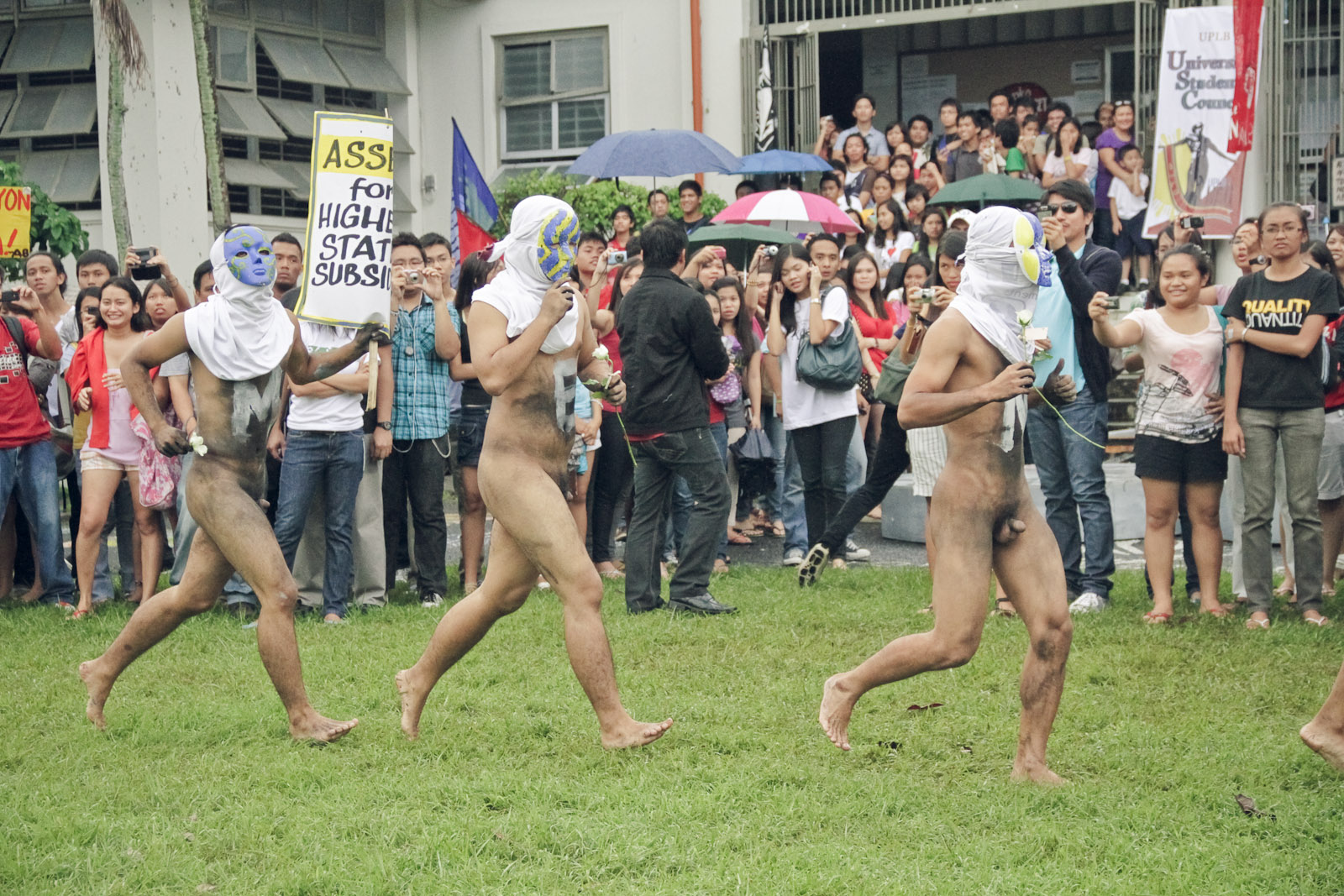
The 2010 Oblation Run at the University of the Philippines Los Baños
GenreStreaking
DateDecember 16
FrequencyAnnual
Years active49
Inaugurated1977
Participants24 (average)[1]
Attendance2,000[2]

The Oblation Run (sometimes referred to as Pylon Run or the Ritual Dance of the Brave) is an annual event held by the University of the Philippines (UP) and Polytechnic University of the Philippines (PUP) chapters of Alpha Phi Omega (APO) on the PUP and different UP campuses. The runners are male, and traditionally run completely naked in public places, with their genitals fully visible, on a designated route. The event was first organized in 1977 at the University of the Philippines Diliman to promote Hubad na Bayani (Tagalog for Naked Hero), a film. It draws its name from the Oblation, a statue of a nude man located in every University of the Philippines campus, which symbolizes "a selfless offering of one's self to the country." The event is usually done on December 16, and serves as a protest to contemporary national issues.[3]

Participants in the Diliman Oblation Run are male APO members numbering 24 on average. Women participating in the event, however, are not unheard of. Runners usually wear masks to hide their identities, and may wear leaves to cover their genitals. They usually hand roses to a number of female spectators. Additional runs are sometimes held at special events, such as the Centennial Run in 2008 where 100 members ran to celebrate the 100th anniversary of UP.

The run has been criticized by Aquilino Pimentel, Jr., a Philippine senator, calling it a "blatant display of male genitals" and a "wanton disregard of the rules of decent society," and comparing it with exhibitionist behaviors that are prohibited by the Revised Penal Code of the Philippines. In line with this, he called for an investigation in March 2009 to determine if the event violated that law.

History

[edit]

Alpha Phi Omega is a fraternity founded on December 16, 1925 at Lafayette College in Easton, Pennsylvania, United States.[4] The first Philippine APO chapter was chartered on March 2, 1950 at the Far Eastern University in Manila.[5] The Eta chapter was established on February 10, 1953 at UP Diliman.[6] UP Diliman is the main campus of the University of the Philippines,[7] a Philippine state university founded in June 1908.[8] It is particularly known for its student activism.[9]

Inception

[edit]

Despite inconsistencies, sources generally agree that the Oblation Run started in 1977.[10][11][12][13] Also known as the Ritual Dance of the Brave, it takes its name from the Oblation, a statue of a nude man unveiled in 1939. Originally completely nude, a fig leaf was added to cover its genitals during UP President Jorge Bocobo's term (1934–1939).[14] It is found in every UP campus, and has since become UP's identifying symbol.[15] The run has since spread to other UP campuses, including Baguio,[16] Los Baños,[17] Manila[18] and Visayas,[19] and non-UP colleges and universities, such as the Polytechnic University of the Philippines,[20] Far Eastern University and Bulacan State University.[21][22]

According to a 1996 article published by the UP Diliman APO website, the run originated when an unnamed APO member ran naked inside the campus to promote an APO-sponsored play called Hubad na Bayani (Tagalog for Naked Hero). The play is dedicated to Rolly Abad, an APO member who was killed in a brawl a few months earlier. The run was a success so APO decided to stage it every year on the fraternity's anniversary, December 16.[10] This view is supported by a GMA News and Public Affairs report.[13]

A newer account by Oble, a student newspaper of University of the Philippines Baguio, gives a different story. According to a 2011 article of the paper, the first Oblation Run was done by Rolly Abad himself to protest the Ferdinand Marcos's banning of Hubad na Bayani, a play detailing human rights violations during his martial law regime. Rolly Abad would be killed a few months later in a brawl. In his honor, APO decided to stage the run annually and voice contemporary socio-political issues along with it.[11]

Meanwhile, the Philippine Daily Inquirer notes an APO member, Menggie Cobarrubias, saying "We [I and four others] started it as a prank when the Marcos dictatorship did not allow the showing of the play, Hubad na Bayani." The play was a political satire against Marcos.[2]

An Associated Press article likewise details a different version of the story. According to Oliver Teves who wrote the article, the run started as a stunt to promote Hubad na Bayani, a film that depicted oppressed plantation workers. Similar to the account by Oble, the film was banned by Marcos.[12] Similarly, the Internet Movie Database lists Hubad na Bayani as 1977 film directed by Robert Arevalo.[23] It reportedly won the 1978 Gawad Urian Awards for best picture, best production design and best screenplay.[24]

Participation of women

[edit]
The two women who ran naked during the 2005 Oblation Run at UP Diliman

During the December 2005 Oblation Run at UP Diliman, two unidentified naked women, according to Philstar, Koreans, were seen tailing 30 members who were part of the event. This is the first ever instance that women took part in the occasion. The two, wearing masks to hide their identities, held banners promoting equal rights for women. After posing for photographers, they entered a car which then sped off. The act, however, was condemned by APO.[2][25]

We are condemning their act not on gender issues because they are women, they can do run naked if they want to. But the event [Oblation Run] was supposed to be ours.

— Joselito Caparino (APO media liaison officer), The Philippine Star[25]

Centennial Run

[edit]

To celebrate the University of the Philippines centennial, 100 APO members ran half a mile around the Diliman campus on June 18, 2008. This is the largest Oblation Run in its history in terms of number of participants. The participants started running on 11 AM PST from Vinzons Hall to the Oblation statue in front of Quezon Hall, the UP administration building. Several runners carried placards stating "Serve the People" and raised social issues, including appeals for greater state subsidy of education and ouster of then-President of the Philippines Gloria Macapagal Arroyo. The event was observed by senior APO alumni, including Jejomar Binay who was the mayor of Makati.[26][12]

Event

[edit]

The Oblation Run is usually held on December 16, in honor of the international founding of Alpha Phi Omega on December 16, 1925. The date may be changed if December 16 falls on a weekend. The run may also be held in concurrence with other significant events, such as APO's national anniversary on March, an APO chapter's anniversary, and occasions significant to their home university.[27] Runners usually bear masks to hide their identities, and may wear leaves to cover their genitals. They usually hand roses to a number of female spectators.[10][12][25]

Members of the Alpha Phi Omega fraternity conducting the annual Oblation Run Protest last February 14, 2025 in Palma Hall, University of the Philippines Diliman

Contrary to popular belief, neophytes are forbidden to run.[10][13]

All those who run are full pledged [sic] members who have volunteered. There is a misconception that the Oblation Run is something our neophytes have to undergo as part of their initiation. That’s not true. We never allow our applicants to join [the Oblation Run].

— Ojie Santillan, APO Auxiliary Chancellor[10]

As a sign of protest, it has called attention to several national issues including appeals for the ouster of former President Joseph Estrada,[2] justice for the victims of the Maguindanao massacre[28] and the 2010 Philippine Bar exam bombing.[29]

Themes

[edit]

UP Diliman Campus

[edit]

Polytechnic University of the Philippines

[edit]

Polytechnic University of the Philippines holds the same version of event known as Pylon Run, organized by the PUP chapter of Alpha Phi Omega (Philippines). The event usually held at PUP's foundation day on October 1, situated in the grounds of main building.[46]

  • 2018 "Kapatiran at Bayan" (Brotherhood and Nation)[47]
  • 2017 Good governance, Respect of Human rights and Better quality of education[48]
  • 2016 Respect human dignity and rule of law.
  • 2013 Abolishment of the priority development assistance fund, a known pork barrel program.[49]

Criticism

[edit]

I ask the UP administration why they allow students to publicly go naked and display their private parts. What benefit does this public institution, paid by people’s money, get out of it [the Oblation Run]?

On March 2009, the Oblation Run was criticized by Aquilino Pimentel, Jr., a Philippine senator, calling it a "blatant display of male genitals" and a "wanton disregard of the rules of decent society." He noted that the Oblation Run, being a public event, was being viewed by young children and "innocent audiences, young and old," comparing it with exhibitionist behaviors that are prohibited by the Revised Penal Code of the Philippines.[1][50][51][52] He also said that it was discriminatory against women.[53]

Pimentel's position was supported by officials of the Catholic Church. For instance, Tagbilaran Bishop Leonardo Medroso identified it as "malicious" and "morally lacking." Like Pimintel, he cited that "innocent youths" are among the spectators of the run. He said that "it could be done in a more decent way without showing their nude bodies" (trans). Lingayen-Dagupan Archbishop Oscar V. Cruz supports this view.[54]

In line with this, he called for an investigation on March 2009 to determine if the event violates the said law.[1][50] He sought "to sanction the parties responsible, including the university authorities, for failure to exercise their bounden duty to see it that the laws and rules of this country prevail."[51][52][53] The Oblation Run was defended by Senator Francis Pangilinan, a former UP Student Council president. He argued that the run is not obscene because the runners were merely exercising their freedom of expression.[55]

I do not feel that students from a Catholic school should be running around the streets naked. It does not show our Christian values in the community.

Salvador Curutchet, GMA News[56]

In 2010, Salvador Curutchet of the Institute of the Incarnate Word banned De La Salle Araneta University students from participating in the run. Two years prior to banning it in 2010, the APO chapter of De La Salle held the Oblation Run after obtaining a permit from the city government of Malabon. This was in celebration of its 50th anniversary since the university recognized the fraternity. In response to the ban, the chapter held a luncheon on its 2010 anniversary instead of a nude run.[56]

Similarly, there used to be an Oblation Run conducted in Taft Avenue, Manila in support of the APO members taking the bar examinations. However, it has been of prohibited since 2008 by the city government of Manila due to complaints from examinees and their guests regarding "the unnecessary noise and obscenity of the said oblation run."[57]

References

[edit]
[edit]
Revisions and contributorsEdit on WikipediaRead on Wikipedia
from Grokipedia
The Oblation Run is an annual tradition of public nudity organized by members of the Alpha Phi Omega (APO) fraternity at the University of the Philippines Diliman, where participants streak naked across campus to protest social and political issues. Initiated in September 1977 as a defiant act against the Marcos regime's censorship of the film Hubad na Bayani, which depicted human rights abuses, the event drew inspiration from the university's iconic Oblation statue by Guillermo Tolentino, symbolizing selfless offering to the nation. Over decades, it has evolved from a secretive promotional stunt involving one or two runners evading police to a larger, escorted demonstration addressing concerns such as corruption, press freedom, tuition hikes, and human rights violations, often timed around December 16 but adaptable for timely causes like electoral integrity in 2025. While celebrated within university culture as a bold emblem of free expression and activism rooted in martial law resistance, the run has faced criticism for obscenity, with Senator Aquilino Pimentel III in 2009 decrying it as a "blatant display of male genitalia" and disregard for anti-obscenity laws, though authorities have increasingly tolerated it as tradition.

Historical Development

Inception During Martial Law

The Oblation Run emerged in September 1977 at the amid the regime's , imposed since September 21, 1972, which enforced strict media censorship and curtailed public dissent to maintain control over narratives of governance and security threats. Members of the (APO) fraternity, known for socio-political activism, initiated the event as a provocative stunt to publicize the regime's ban on Hubad na Bayani (Naked Heroes), a 1976 documentary by that graphically depicted and abuses in detention centers, material deemed subversive by authorities. On that occasion, two APO brothers ran naked across the campus in front of Palma Hall—UP's College of Arts and Sciences building—while hundreds of students observed and cheered, framing the nudity as an unshielded confrontation with repression and a nod to Guillermo Tolentino's 1935 Oblation statue, symbolizing selfless national offering. This act of ritualized exposure served dual purposes: fundraising for the banned film's underground distribution and embodying defiance in an era when overt protests risked arrest under Presidential Decree No. 33, which penalized subversive publications and assemblies. The inception is often credited to APO activists like Nicasio "Nicky" Morales, a student leader whose involvement highlighted -driven resistance, though accounts vary on precise initiators amid the era's undocumented risks. Unlike earlier for mere funds, this politically charged debut transformed into a symbol of vulnerability and truth-telling against state-sanctioned opacity, setting a precedent for annual iterations despite intermittent crackdowns.

Evolution into Annual Tradition

The Oblation Run originated as a one-off incident on September 15, 1977, when two members of the (APO) fraternity at the ran nude in front of Palma Hall to publicize the fraternity-sponsored play Hubad na Bayani, which critiqued abuses under . This act, amid the restrictive environment of President Ferdinand Marcos's regime, drew cheers from hundreds of students but initially faced administrative backlash, including temporary fraternity suspensions. Despite the risks, the stunt's visibility prompted repeat performances tied to APO's activism, marking the shift from isolated protest to recurring demonstration. By the early 1980s, as university tolerance grew amid easing martial law pressures post-1981, the event formalized into an annual ritual, aligning with APO's December 16 founding date in 1950 to leverage the fraternity's anniversary celebrations. Participation expanded from two runners to groups of 10–20, with routes incorporating key campus landmarks like the Oblation statue, symbolizing self-sacrifice and defiance. The tradition persisted through the 1986 People Power Revolution, adapting agendas from anti-dictatorship calls to broader issues like academic freedom, while avoiding outright bans due to its cultural entrenchment. Into the 1990s and beyond, the run's annual cadence solidified, often scheduled on December 16 or the preceding Friday if it fell on a weekend, with participant numbers occasionally reaching 50 amid heightened security protocols. It spread to other UP campuses, such as in , evolving from fraternity-specific to institution-wide expression, though critiques emerged over and dilution of original intent. This institutionalization reflected causal shifts: initial survival through student support and administrative pragmatism, followed by ritualization as a low-stakes outlet for dissent in a democratized .

Key Milestones and Adaptations

The Oblation Run commenced on September 30, 1977, when two (APO) fraternity members streaked naked in front of Palma Hall at the to publicize the film Hubad na Bayani, which depicted violations during the Marcos martial law era and had been restricted by authorities. This initial act, conceived as a bold promotional amid repressive conditions, marked the event's origin as a form of symbolic protest rather than a formalized . By the early 1980s, the run had transitioned into an annual tradition organized by APO's Eta Chapter at UP Diliman, shifting from sporadic acts to structured events typically held on to align with the fraternity's 1925 founding date. Early iterations emphasized anti-authoritarian themes tied to martial law's end in , but post-EDSA adaptations broadened its scope to address evolving national concerns, such as in 2011 when runners dedicated the event to Philippine rivers. Participation averaged 24 male APO members, with runners donning masks and carrying placards to amplify messages while preserving . Key adaptations include date flexibility to avoid weekends or align with significant occasions, as seen in the 2025 event rescheduled to February 14 for advocacy. Female involvement, though exceptional and not fraternity-endorsed, emerged in 2005 when two unaffiliated women streaked alongside male runners, briefly shifting public focus and prompting discussions on inclusivity in forms. The tradition expanded beyond UP Diliman in the 2000s, with APO chapters at institutions like and UP adopting localized versions, such as the latter's resumption after a five-year hiatus in 2024. These developments reflect the event's resilience, adapting from martial-era defiance to a platform for issues like press freedom attacks in 2019 and opposition in 2024, while maintaining as a of unshielded .

Event Description

Rituals and Execution

The Oblation Run is performed by male members of the Alpha Phi Omega (APO) fraternity, who participate fully nude, with genitals exposed, to emulate the nudity of the campus's Oblation statue and symbolize selfless sacrifice. The event typically involves 20 to 40 runners, depending on the year, who assemble prior to the run at a fraternity-designated location such as their tambayan (hangout area). Instructions on conduct and safety are provided, followed by a traditional fraternity salute before disrobing. Execution commences with the runners emerging en masse, often whooping and raising arms in a gesture mirroring the statue's pose, before sprinting along a predefined campus route. The route commonly starts near the Oblation statue at the University of the Philippines Diliman campus and circumnavigates key areas like Palma Hall, covering approximately 1-2 kilometers to maximize visibility among students and faculty. Throughout the run, participants chant or shout slogans aligned with the event's protest theme, such as demands for human rights or opposition to political measures, amplifying their message through public exposure. Runners frequently pause to distribute red roses to onlookers, a practice that gained prominence during runs coinciding with , symbolizing camaraderie or affection amid advocacy. The entire lasts 15 to 30 minutes, concluding with the participants regrouping, redressing, and dispersing to avoid prolonged disruption. measures, including coordination with authorities, ensure the event proceeds without major incidents, though nudity in public spaces contravenes local indecency laws, leading to occasional fines or arrests.

Route and Campus Integration

The Oblation Run at the commences at Palma Hall, the principal building of the College of Arts and Sciences, where participants assemble on the steps for preparatory chants and invocations before initiating the nude procession. This starting point positions the event amid the campus's central academic hub, facilitating immediate interaction with students and faculty during peak hours. From Palma Hall, the runners proceed along designated campus thoroughfares, often traversing streets adjacent to major colleges and the Academic Oval, a 2.2-kilometer loop emblematic of university life. The path emphasizes visibility by weaving through high-traffic zones, including areas near the College of Social Sciences and Philosophy and the Main Library, thereby embedding the ritual within the daily rhythm of lectures, discussions, and student gatherings. This integration underscores the fraternity's alignment with the university's tradition of , as the route avoids external spaces to focus energies on the institutional . At the , the analogous Pylon Run adopts a comparable campus-bound trajectory, centered on the iconic Pylon obelisk symbolizing educational aspirations, to similarly fuse the event with student-centric locales and foster on-site advocacy. In both institutions, the confined routing—typically spanning under 1 kilometer—prioritizes symbolic traversal over distance, ensuring the display remains a disruptive yet contained expression of amid academic environs.

Themes and Symbolism

Historical Protest Agendas

The Oblation Run began in 1977 as a direct protest against censorship under the regime, when fraternity members, led by Rolly Abad, ran nude on the campus to challenge the government's ban on the film Hubad na Bayani, a work depicting violations and extrajudicial killings. This inaugural act symbolized defiance against authoritarian suppression of free expression and artistic critique of regime abuses, aligning with broader anti-martial law sentiments at the state university. Throughout the late 20th and early 21st centuries, the run evolved to address recurring themes of democratic erosion and , including opposition to Ferdinand Marcos's 2016 burial at the , which runners condemned as an affront to martial law victims and a normalization of dictatorship. In 2017, participants targeted Rodrigo Duterte's drug war, protesting extrajudicial killings that had claimed thousands of lives by then, framing as a bold exposure of state-sanctioned violence. Subsequent agendas expanded to institutional and societal reforms, such as campaigns against deaths in fraternities—highlighted in runs protesting the persistence of violent initiation rites despite legal bans—and opposition to mandatory (ROTC), viewed as militaristic and prone to abuse. also featured prominently, with calls in the 2010s for , disaster preparedness, and river conservation amid frequent typhoons and pollution crises. By the , protests incorporated resistance to constitutional changes, as in 2024 when runners decried "people's initiative" efforts for Charter amendments as undemocratic power grabs risking foreign influence over . These agendas consistently invoked anti-authoritarian roots, using the ritual to amplify marginalized critiques against entrenched power structures.

Contemporary Causes and Symbolism of Nudity

In contemporary iterations of the Oblation Run, nudity symbolizes an unreserved, transparent offering of oneself to pressing societal issues, mirroring the Oblation statue's depiction of selfless sacrifice without concealment. Participants emphasize that the bare state represents "not hiding anything," embodying vulnerability and authenticity in to underscore commitment to causes like and democratic integrity. The 2025 event, held on under the theme "Boto Mo, Hindi Benta Mo," leveraged nudity to protest vote-buying, , and , with runners stripping away pretenses to demand voter and fair elections. This act of exposure amplifies visibility, drawing crowds and media scrutiny to highlight systemic electoral flaws, as approximately 50 fraternity members participated in the University of the Philippines Diliman campus run. Similarly, the February 16, 2024, run opposed proposed constitutional amendments, themed "Cha-cha: Hakbang Paurong," where signified raw exposure of perceived threats to democratic progress, rejecting Charter change as a regressive step. members, numbering around 100, used the to political maneuvers, with the serving as a provocative of unfiltered truth against institutional opacity. Beyond elections, recent runs have tied nudity to broader transparency in issues like freedom of expression; for instance, a against media suppression employed the bare run to symbolize unmasked resistance to and . This enduring symbolism of nudity as bravery and sacrifice persists, enabling the event to shock observers into engaging with evolving Philippine challenges, from to .

Institutional Variations

University of the Philippines Diliman

The Oblation Run originated at the University of the Philippines Diliman on December 16, 1977, when members of the Alpha Phi Omega (APO) fraternity, led by Nicky Morales, staged the first event to publicize the play Hubad na Bayani, which exposed human rights abuses under the Marcos dictatorship's martial law. This act of defiance drew inspiration from streaking trends in the United States and coincided with APO's founding anniversary, marking the beginning of a tradition symbolizing vulnerability and sacrifice in emulation of the campus's iconic Oblation statue by National Artist Guillermo Tolentino. Participants, exclusively male APO members, run entirely nude along a designated route through areas, including academic buildings and pathways near the university oval, while carrying placards and shouting slogans to highlight pressing issues such as , , and political accountability. The nudity underscores themes of exposure and unshielded truth-telling, evolving from initial anti-censorship protests to annual commentaries on contemporary concerns, including opposition to tuition hikes and calls to end extrajudicial killings. A key ritual, introduced in the late , involves distributing red roses to female students and onlookers, originally handled by clothed members to manage crowds and foster engagement, symbolizing a respectful for solidarity on causes like fair elections and anti-dynasty measures. Typically held in December to align with APO's anniversary, the event has adapted over time, pausing during the from 2020 to 2022 before resuming in February 2023 with precautions like face masks, and continuing in February 2025 with around 10 runners protesting vote-buying ahead of midterm elections.

Polytechnic University of the Philippines

The Pylon Run represents the Polytechnic University of the Philippines' (PUP) localized variant of the Oblation Run, organized annually by the campus chapter of the Alpha Phi Omega fraternity as part of the university's founding anniversary observances. Participants, primarily male fraternity members, run nude while wearing face masks and brandishing placards to highlight social, political, and educational issues, echoing the protest-oriented nudity of the UP tradition but centered on PUP's main campus grounds in Santa Mesa, Manila. The event draws its name from the Pylon, a prominent campus landmark consisting of three pillars symbolizing wisdom, strength, and beauty—or equivalently, the true, the good, and the beautiful—which functions analogously to UP's Oblation statue as an emblem of selfless offering. Held typically in early October to coincide with festivities marking PUP's establishment on , 1904, the Pylon Run integrates into broader anniversary activities, including convocations and cultural programs, distinguishing it from UP Diliman's fixed December 16 scheduling tied to fraternity service month. Official university records confirm its recurrence, such as during the 113th anniversary in 2017, where it served as a highlighted amid gatherings. The run's execution involves a around key structures like the main building, with runners distributing leaflets or roses to spectators, fostering direct engagement on advocacies ranging from human dignity and governance reforms to campus-specific concerns like tuition policies. While the precise inception date remains undocumented in primary sources, the event has solidified as an established custom by the mid-2010s, with visual records from 2018 and 2019 depicting crowds of students witnessing the nude sprint amid cheers and security presence to maintain order. This adaptation reflects PUP's emphasis on practical, state university , adapting the to amplify student voices within the constraints of an urban, commuter-heavy campus environment.

Reception and Controversies

Supporter Viewpoints

Supporters of the Oblation Run, chiefly members of the (APO) fraternity who organize the event, maintain that it serves as an effective platform for voicing opposition to pressing national issues, including corruption scandals like the P10-billion pork barrel scam, extrajudicial killings, and electoral irregularities such as vote-buying. The fraternity positions the run as a tradition originating in 1977 amid martial law-era censorship, initially protesting the banning of the film Hubad na Bayani and evolving into a broader call for accountability and . APO spokesperson Nero Gianan has described it as a "call to action on national issues," emphasizing its role in reminding citizens that votes are "sacred and not for sale" under themes like "Boto mo, Hindi Benta mo!" (Your vote, not for sale). The nudity is defended as symbolic of vulnerability, purity, and unfiltered truth—termed the "naked truth"—mirroring the unclothed Oblation statue, which represents selfless dedication to the nation. Organizers like Bruno Abenojar assert that the act is not mere exhibitionism but a deliberate stand to amplify messages on human rights violations and government accountability, stating, "Our purpose here is to make a stand." Participants report personal benefits, with APO member Marco Zaplan noting it builds confidence and feels "very liberating," while the exposure ensures issues like the war on drugs (linked to over 7,000 deaths since 2017) gain prominence beyond typical protests. In recent iterations, such as the February 14, 2025, event at UP Diliman, APO alumni like Atty. Fritz Sapon framed the run as an expression of "love for the country," aligning it with to advocate for fair elections, proceedings against figures like , and resistance to university commercialization. Supporters contend the ritual's sustains its efficacy, fostering for and , as articulated in APO's 2017 theme "End wars, not lives," which opposed violence and promoted dissent-tolerant leadership. They view it as a non-obscene exercise of free expression, prioritizing advocacy over decorum to highlight overlooked crises like Mindanao's declaration.

Criticisms of Indecency and Public Order

Senate Minority Leader Aquilino Pimentel Jr. criticized the Oblation Run in a March 2009 privilege speech, labeling it a "blatant display of male genitals" and a "wanton disregard of the sensibilities of others," while asserting it lacked any meaningful social relevance. He further argued that the event's restriction to male participants discriminated against women, preventing them from engaging in equivalent forms of . Such displays of frontal nudity in a public university setting have prompted concerns over violations of Philippine laws prohibiting obscene exhibitions and indecent shows, as outlined in Article 201 of the (as amended by Presidential Decree No. 960), which imposes penalties of prision mayor or fines ranging from 6,000 to 12,000 pesos for acts deemed to corrupt morals or outrage public decency. Critics contend that the ritual's emphasis on genital exposure prioritizes over substantive , potentially undermining public order by drawing crowds that disrupt campus activities and expose unwilling spectators— including students, faculty, and visitors—to unsolicited in a predominantly conservative, Catholic-majority society. Despite these objections, the has tolerated the event annually since its inception in 1977, confining it to campus routes and framing it as symbolic rather than exhibitionism, with no documented prosecutions for or public disturbance to date. Pimentel's call for investigation extended to similar off-campus s, highlighting broader risks to communal norms when such acts extend beyond controlled academic environments.

Debates on Efficacy and Cultural Impact

Supporters of the Oblation Run argue that its provocative nudity effectively draws media attention to pressing social and political issues, amplifying voices that might otherwise be overlooked. For instance, the fraternity has used the event to highlight concerns such as the , violations, and threats to , with participants claiming it serves as a "platform for campaigns for " and underscores deeper socio-political meanings beyond mere spectacle. However, of tangible outcomes remains scarce; while the run garners annual coverage from outlets like GMA News and , no documented instances link it directly to legislative or institutional reforms, suggesting its impact is primarily symbolic rather than causal. Critics contend that the event's reliance on nudity undermines its efficacy by prioritizing shock value over substantive discourse, potentially trivializing serious causes and alienating broader audiences. Senator Aquilino Pimentel Jr. described a 2009 iteration as a "blatant display of male genitals" and a "wanton disregard of the law," arguing it lacked social relevance and exposed innocent bystanders to indecency without advancing meaningful protest. He further criticized its exclusion of women, viewing it as discriminatory and reinforcing gender imbalances in public activism. This perspective aligns with broader skepticism that such spectacles, while tradition-bound, devolve into amusement for onlookers unfamiliar with their historical context, diluting long-term advocacy efforts. On cultural impact, the Oblation Run has embedded itself as an iconic ritual within University of the Philippines campuses, symbolizing fraternity brotherhood, bravery, and unselfish patriotism akin to the Oblation statue it emulates. Proponents see it fostering a culture of bold expression and nation-building, with annual iterations since 1977 sustaining awareness of fraternity-led causes like anti-hazing and press freedom. Conversely, detractors highlight its reinforcement of exhibitionism and potential normalization of public nudity in educational settings, which may erode standards of decorum and prioritize frat visibility over inclusive societal dialogue, as evidenced by persistent calls for probes into its legality and appropriateness. Despite these tensions, the event's endurance reflects a polarized cultural niche: venerated by participants as authentic protest, yet dismissed by others as outdated or counterproductive exhibitionism.

References

Add your contribution
Related Hubs
User Avatar
No comments yet.