Hubbry Logo
OphthalmosaurusOphthalmosaurusMain
Open search
Ophthalmosaurus
Community hub
Ophthalmosaurus
logo
8 pages, 0 posts
0 subscribers
Be the first to start a discussion here.
Ophthalmosaurus
Ophthalmosaurus
from Wikipedia

Ophthalmosaurus
Temporal range: Middle Jurassic to Late Jurassic (Callovian to Oxfordian), 165–157 Ma Possible record during the Berriasian
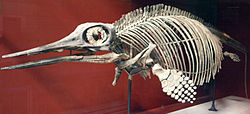
Composite skeleton (NHMUK PV R3702, R3893, R4124) of Ophthalmosaurus icenicus at the Natural History Museum, London, with the forelimbs mounted backwards[1]
Scientific classification Edit this classification
Kingdom: Animalia
Phylum: Chordata
Class: Reptilia
Order: Ichthyosauria
Family: Ophthalmosauridae
Subfamily: Ophthalmosaurinae
Genus: Ophthalmosaurus
Seeley, 1874
Type species
Ophthalmosaurus icenicus
Species
Synonyms
  • Ancanamunia Rusconi, 1942
  • Khudiakovia Arkhangelsky, 1999

Ophthalmosaurus (Greek ὀφθάλμος ophthalmos 'eye' and σαῦρος sauros 'lizard') is a genus of ichthyosaur known from the Middle-Late Jurassic. Possible remains from the earliest Cretaceous (Berriasian stage) are also known. It was a relatively medium-sized ichthyosaur, measuring 4 m (13 ft) long and weighing 940 kg (2,070 lb).[2][3] Named for its extremely large eyes, it had a jaw containing many small but robust teeth. Major fossil finds of this genus have been recorded in Europe with a second species possibly being found in North America.

Description

[edit]
Life restoration of O. icenicus

Ophthalmosaurus was a medium-sized ichthyosaur, growing to measure 4 m (13 ft) in length and weighing between 930–950 kg (2,050–2,090 lb).[2][3] It had a robust, streamlined body that was nearly as wide as it was tall in frontal view. Like other derived ichthyosaurs Ophthalmosaurus had a powerful tail ending in a pronounced bi-lobed caudal fluke whose lower half was formed around the caudal spine whereas the upper lobe was made up entirely from soft tissue. The limbs of Ophthalmosaurus were short and rounded with the forelimbs being noticeably larger than the hind limbs. The combination of rather inflexible trunk, powerful caudal fluke and reduced limbs suggests a tail-propelled mode of locomotion with the limbs helping with steering, differing from the anguilliform (eel-like) way more basal ichthyosaurs swam. The skull of Ophthalmosaurus was long with a slender, toothed rostrum and an enlarged posterior portion of the cranium. The dentition was relatively small with robust tooth crowns and the lateral area of the cranium was almost entirely occupied by the animal's massive eyes that gave the genus its name. The proportionally large eyes of Ophthalmosaurus measured 22–23 centimetres (8.7–9.1 in) in diameter at the outer margin of the bony sclerotic ring, while the sclerotic aperture itself measured 10 centimetres (3.9 in) in diameter.[2][4]

Discovery and species

[edit]

Ophthalmosaurus was first described by Harry Seeley in 1874 with particular focus on the morphology of the clavicular bones. Over the years following its description a variety of genera have been sunk into Ophthalmosaurus.[5] Among them, Apatodontosaurus, Ancanamunia, Baptanodon, Mollesaurus, Paraophthalmosaurus, Undorosaurus and Yasykovia were all considered junior synonyms of Ophthalmosaurus in a study published by Maisch & Matzke in 2000.[6]

However, more recent cladistic analyses have contested Maisch & Matzke's conclusion. Mollesaurus periallus from Argentina was considered a valid genus of ophthalmosaurid by Druckenmiller and Maxwell (2010),[7][8][9] Paraophthalmosaurus and Yasykovia were both recovered as distinct genera by Storrs et al., but were later sunk into Nannopterygius[10][11][12] while Undorosaurus's validity is now accepted by most authors, including Maisch (2010) who originally proposed the synonymy.[8][10][13][14][15] The two other Russian taxa might be also valid.[8][14] Likewise the Mexican ophthalmosaurid Jabalisaurus had also been referred to Ophthalmosaurus before being described as a distinct species and genus in 2021.[16]

Ophthalmosaurus natans was described as Sauranodon, then later renamed to Baptanodon by Marsh in 1880. However this decision was questioned not long afterwards with Baptanodon instead being considered an American species of Ophthalmosaurus. Recent analysis have recovered the species as closer to other ophthalmosaurines than to the Ophthalmosaurus type species,[7][9][17] suggesting that the previous name should be reinstated. Similarly, Ophthalmosaurus chrisorum, whose holotype has been recovered in Canada and described by Russell in 1993, was moved to its own genus Arthropterygius in 2010 by Maxwell.[18]

While primarily known from the Jurassic, material from the Spilsby Sandstone dating to the early Berriasian stage of the Lower Cretaceous has been referred to cf. Ophthalmosaurus (i.e., either Ophthalmosaurus or a closely related species).[19]

Classification

[edit]
O. icenicus in Tübingen

Within Ophthalmosauridae, Ophthalmosaurus was once considered most closely related to Aegirosaurus.[20] However, many recent cladistic analyses found Ophthalmosaurus to nest in a clade with Acamptonectes and Mollesaurus. Aegirosaurus was found more closely related to Platypterygius, and thus does not belong to the Ophthalmosaurinae.[8][9]

Phylogeny

[edit]

The cladogram below follows Fischer et al. 2012.[9]

Thunnosauria

The following cladogram shows a possible phylogenetic position of Ophthalmosaurus in Ophthalmosauridae according to the analysis performed by Zverkov and Jacobs (2020).[12]

Palaeobiology

[edit]

Ophthalmosaurus icenicus possessed small teeth with robust tooth crowns and signs of slight wear differing notably from the robust teeth of later species of Platypterygius, known to have hunted large prey including turtles and birds, and the minute teeth of Baptanodon, interpreted to be a soft prey specialist. Fischer et al. (2016) conclude that this intermediary tooth morphology indicates that Ophthalmosaurus icenicus was most likely a generalist predator, feeding on a variety of smaller prey items.[22]

Ophthalmosaurus could likely dive for around 20 minutes. Assuming a conservative cruising speed of 1 metre per second (3.3 ft/s) (2 metres per second (6.6 ft/s) being more likely), Ophthalmosaurus could reach depths of 600 metres (2,000 ft) or more during a dive, reaching the mesopelagic zone.[3] However, while studies on the biomechanics of Ophthalmosaurus suggests that such feats could be physically achieved, studies on the environment of the Peterborough member of the Oxford Clay suggest that Ophthalmosaurus instead inhabited relatively shallow waters there, being determined to have been just 50 metres (160 ft) deep at a distance of 150 kilometres (93 mi) from the shore.[23]

See also

[edit]

References

[edit]
[edit]
Revisions and contributorsEdit on WikipediaRead on Wikipedia
from Grokipedia
Ophthalmosaurus is an extinct genus of ophthalmosaurid ichthyosaur, a group of streamlined marine reptiles that superficially resembled dolphins, known from the Middle to Late Jurassic periods approximately 165 to 145 million years ago. Named for its disproportionately large eyes—reaching diameters of up to 23 cm, among the largest recorded in any vertebrate—this medium-sized predator measured about 4 meters in length and weighed roughly 950 kg. The genus is characterized by features such as three distal facets on the humerus, a ventral notch on the basioccipital bone, and a concave extracondylar area, adaptations suited to its aquatic lifestyle in ancient epicontinental seas. The , O. icenicus, was first described by Harry Govier Seeley in 1874 based on specimens from the Formation in , with abundant fossils also recovered from the Formation () and the Sundance Formation (). Other species include O. natans from , though taxonomic revisions have restricted the genus to the through possibly Berriasian stages, excluding later Cretaceous records previously attributed to it. Ophthalmosaurus likely inhabited warm, shallow marine environments across , preying primarily on soft-bodied cephalopods like , as evidenced by gastric contents containing coleoid hooklets from O. natans specimens, supplemented by in its mixed diet. The genus went extinct by the , though the broader Ophthalmosauridae family persisted until the stage, succumbing to the decline.

Description

Body plan

Ophthalmosaurus exhibited a streamlined, torpedo-shaped body that facilitated rapid and efficient movement through ancient marine environments. This form, typical of derived ichthyosaurs, measured approximately 3.5 to 4 meters in total length and weighed around 940 kg, enabling a balance between speed and maneuverability without excessive bulk. The skeletal structure emphasized hydrodynamic efficiency, with a fusiform profile that minimized drag during propulsion. The vertebral column comprised approximately 100 , displaying regional differentiation that supported distinct functional zones along the body axis. The cervical region included about 9 to 13 short for neck flexibility, transitioning into a dorsal section of 26 to 35 that formed a relatively rigid trunk for stability. Caudal vertebrae further divided into a tail stock of 30 to 45 for power generation and numerous smaller fluke exceeding 28 in preserved specimens, contributing to the overall elongated posterior. This segmentation allowed for coordinated undulation while maintaining structural integrity during . The limbs were adapted as steering paddles rather than primary propulsors, with short, rounded forelimbs larger than the hind limbs and both exhibiting hyperphalangy— an excess of phalanges beyond the ancestral reptilian count—for enhanced surface area and flexibility. Propulsion relied primarily on a robust, bi-lobed caudal fluke with a straight trailing edge, which generated thrust through lateral of the compressed tail stock. Preserved skin impressions reveal a smooth, scaleless akin to that of modern cetaceans, promoting over the body and reducing frictional resistance in water. This texture, devoid of scales and featuring supple, wrinkle-like patterns, supported the animal's fully aquatic lifestyle. Notably, the large eye size relative to further complemented these adaptations, aiding in low-light underwater navigation.

Skull and sensory adaptations

The skull of Ophthalmosaurus features a slender, elongated rostrum that comprises over half the total skull length, formed primarily by the premaxillae with extensive overlapping of the nasals and vomers creating a tubular structure suited for piercing through water. This rostrum houses small, conical teeth with pointed, slightly recurved crowns bearing fine longitudinal ridges and swollen, cementum-covered roots, numbering approximately 40 per upper jaw ramus and adapted for grasping rather than crushing prey. The teeth exhibit isodonty, with the largest reaching about 3.7 cm in length and decreasing in size anteriorly, emphasizing a design for securing soft-bodied or elusive marine organisms. The most striking feature is the massive orbits, which accommodate exceptionally large eyes measuring 22–23 cm in , protected by a robust sclerotic ring composed of 14–15 that maintain structural integrity under pressure. These orbits occupy a significant portion of the posterior , with an orbital (orbit to jaw length) of approximately 0.28 in large specimens, indicating specialized visual adaptations for dimly lit environments. The braincase further underscores this visual emphasis, featuring a large optic region with prominent impressions for optic lobes on the parietal and basisphenoid, while the olfactory bulbs appear reduced relative to the expanded visual processing areas, suggesting primary reliance on sight over smell for and . A single superior , bounded by the squamosal, parietal, postfrontal, and prefrontal bones, contributes to the lightweight yet sturdy cranial architecture. The jaw articulation, involving a quadrate condyle with two elongate bosses and a central groove fitting into a concave articular surface on the surangular and articular, enables rapid closure for quick strikes, enhanced by the firmly embedded quadrate in a deep squamosal groove for stability.

Discovery and species

Historical discoveries

The genus Ophthalmosaurus was first established in 1874 by British paleontologist Harry Govier Seeley, who named it based on a partial from the Formation near , , highlighting the exceptionally large sclerotic ring impressions suggestive of keen visual adaptations. Seeley designated the O. icenicus from this material, emphasizing features of the pectoral girdle and forelimb that distinguished it from contemporary ichthyosaurs like . Throughout the late 19th century, additional fossils emerged from the exposures in and the Peterborough brick pits, largely through collections by the Leeds brothers, Alfred and Charles. These specimens, including well-preserved skulls and vertebrae, were described in subsequent publications by Seeley in the 1880s, which expanded on the genus's skeletal morphology and confirmed its presence in the Callovian-Oxfordian stages of the Middle-Late . Early taxonomic challenges arose as some fragments were initially confused with other ichthyosaurs, but these finds solidified Ophthalmosaurus as a key . In the , expeditions uncovered further material in , including isolated elements from deposits in and the Volga region of , though many were fragmentary and subject to later scrutiny. Canadian paleontologist Charles McGowan's reassessments in the 1970s, drawing on collections, provided critical revisions through detailed studies of the braincase and overall , clarifying diagnostic traits and resolving ambiguities in prior identifications. The early 21st century brought new insights via partial skeletons from the Formation in , excavated during the 2010s, which enabled analyses of ontogenetic growth series and refined species distinctions within the genus. Taxonomic hurdles persisted, with some Jurassic specimens previously misassigned to the Cretaceous genus Platypterygius undergoing revisions around 2012 that reaffirmed their placement in Ophthalmosaurus based on shared cranial and humeral features.

Valid species and synonyms

The type species of Ophthalmosaurus is O. icenicus Seeley, 1874, established on specimen NHMUK PV R2133 from the Formation near , , . This species is diagnosed by features including a large sclerotic ring enclosing an orbit up to 23 cm in diameter, a with a posteriorly deflected ulnar facet, and a vertebral column comprising approximately 40 presacral and 60 postsacral elements. A second valid species, O. natans Marsh, 1879, is recognized from the Oxfordian Sundance Formation in , , based on material including YPM 1529. It differs from O. icenicus in autapomorphies such as a more elongate and reduced forefin hyperphalangy, though its generic assignment remains debated, with some analyses suggesting separation into a distinct like Baptanodon. Several taxa have been synonymized with Ophthalmosaurus icenicus. Ancanamunia Rusconi, 1942, originally from Argentine material, is considered a junior subjective due to overlapping forefin and humeral morphology consistent with O. icenicus. Khudiakovia calloviensis Arkhangelsky, 1999, based on a partial from the of Russia, shares vertebral proportions and sclerotic ring size with O. icenicus and is similarly synonymized. Other proposed species within Ophthalmosaurus are invalid or reassigned. O. monocharactus and O. pleydelli are junior subjective synonyms of O. icenicus, lacking diagnostic traits beyond potential pathologies. O. chrisorum Russell, 1994, from the Upper Jurassic of Canada, was reassigned to the new genus Arthropterygius in cladistic analyses emphasizing distinct postcranial proportions, rendering it invalid under Ophthalmosaurus. Species delimitation in Ophthalmosaurus relies on cladistic criteria, including shared autapomorphies in and appendicular elements, while accounting for ontogenetic variation in levels and potential geographic isolation between European and North American populations. Post-2010 phylogenetic studies, incorporating up to 150 characters, have refined these boundaries by resolving risks in earlier classifications.

Taxonomy and classification

Placement within Ichthyosauria

Ophthalmosaurus is classified within the order de Blainville, 1835, specifically as a member of the clade Thunnosauria Motani, 1999, which encompasses advanced ichthyosaurs characterized by a streamlined , including a and a heterocercal caudal fluke adapted for thunniform swimming. This placement reflects the evolutionary progression of ichthyosaurs toward more efficient aquatic locomotion during the era. Within Thunnosauria, Ophthalmosaurus belongs to the family Ophthalmosauridae Baur, 1887, a group defined by synapomorphies such as reduced forelimbs with three distal facets on the humerus, large orbits housing a prominent sclerotic ring for enhanced vision in deep-water environments, and a concave extracondylar area on the basioccipital bone. The family was established based on these distinctive cranial and postcranial features observed in Jurassic specimens, distinguishing ophthalmosaurids from earlier ichthyosaur lineages. Ophthalmosauridae further diversified into two subfamilies, with Ophthalmosaurus assigned to Ophthalmosaurinae Baur, 1887, which shares traits like tightly interlocking vertebral centra with posterolateral lamellae and a specialized sclerotic ring structure supporting the oversized eyes. This subfamily includes genera such as Acamptonectes, characterized by similar forelimb reductions and vertebral histology, while Platypterygius represents the sister subfamily Platypterygiinae. The evolutionary context of Ophthalmosaurus highlights the radiation of ophthalmosaurids, which followed a diversification phase where basal forms like Mollesaurus emerged, leading to the dominance of this through the Jurassic-Cretaceous boundary. This radiation is marked by adaptations for pelagic lifestyles, including elongated rostra and reduced dorsal ribs, enabling ophthalmosaurids to occupy diverse marine niches until their decline in the .

Phylogenetic relationships

Phylogenetic analyses have positioned Ophthalmosaurus as a basal member of the subfamily Ophthalmosaurinae within the family Ophthalmosauridae. A key study by et al. (2012) utilized a character matrix of 14 taxa and 36 characters, recovering Ophthalmosaurus icenicus near the base of Ophthalmosaurinae, sister to a including more derived forms like Acamptonectes densus, supported by synapomorphies such as a large extracondylar area on the basioccipital and a plate-like dorsal on the . This analysis highlighted the early divergence of Ophthalmosauridae into Ophthalmosaurinae and Platypterygiinae during the , with Ophthalmosaurus exemplifying the former 's persistence into the . Sister taxa to Ophthalmosaurus include Mollesaurus periallus from the Early Bajocian of , identified as its closest relative in preliminary cladistic analyses based on shared features like an elongated rostrum and a large sclerotic ring relative to size. These synapomorphies suggest close evolutionary affinities, with Mollesaurus also exhibiting a narrow and reduced , traits consistent with basal ophthalmosaurine morphology. Within Ophthalmosauridae, recent updates from the 2020s refine Ophthalmosaurus' position as closer to Acamptonectes than to , based on expanded matrices incorporating cranial and postcranial characters. Zverkov and Jacobs (2020) analyzed 44 taxa with 134 characters, placing Ophthalmosaurus in a with Acamptonectes and basal forms like Nannopterygius, distinguished from the more derived, short-snouted by features such as a proportionally longer and narrower humeral facets. The description of Thalassodraco etchesi in has influenced tree topology, reinforcing a European-North American clade encompassing Ophthalmosaurus, Acamptonectes, and Thalassodraco, supported by shared narial complex morphology and vertebral counts in a matrix of 34 taxa and 112 characters. This emerges as basal to more ophthalmosaurids, indicating transatlantic dispersal during the . Debates persist regarding the monophyly of Ophthalmosaurinae, with some analyses suggesting paraphyly due to the unstable placement of Ophthalmosaurus natans relative to O. icenicus. For instance, Druckenmiller and Maxwell (2010) and subsequent studies found O. natans nesting outside core Ophthalmosaurinae, closer to Platypterygiinae, challenging the subfamily's integrity and prompting calls for taxonomic revision.

Distribution and paleoecology

Fossil sites and temporal range

Ophthalmosaurus fossils are primarily known from the , spanning the late to early stages, approximately 165 to 152 million years ago. This temporal range is well-documented in European deposits, with the earliest reliable records from the Callovian Formation in and the latest from the early Tithonian Formation in the same region. Questionable extensions into the Berriasian stage of the (around 145–140 Ma) have been reported from the Spilsby Sandstone in and Prince in , though these assignments remain debated due to fragmentary material and potential misidentification. The genus exhibits a predominantly Laurasian distribution, with major fossil sites concentrated in and . In , abundant specimens occur in the marine shales of the (late to Oxfordian) and ( to early ) Formations, particularly around and Dorset. Continental European records include the (early ) in , , where ophthalmosaurid remains closely allied to Ophthalmosaurus have been recovered, and the Oxfordian– beds of the Basin in , south of in the Samara region. North American occurrences are represented by the Oxfordian Redwater Shale Member of the Sundance Formation in , , where specimens potentially attributable to O. natans have been found, and additional material from the Canadian Arctic. In , material from the La Casita Formation in was initially referred to Ophthalmosaurus but later described as the distinct genus Jabalisaurus meztli in 2021, underscoring the broader ophthalmosaurid presence across northern margins. Most Ophthalmosaurus fossils derive from shallow marine shelf deposits, reflecting deposition in low-energy, epicontinental seaways with periodic anoxic conditions that favored preservation. Taphonomic evidence indicates that skeletons are typically disarticulated, with bones scattered by currents, scavenging, and prior to burial, as seen in a well-studied ichthyosaur fall from the upper Oxfordian Sandsfoot Formation in Dorset, . Articulated skeletons are rare, comprising only a small fraction of known specimens, likely due to the offshore shelf environment's exposure to post-mortem transport and decay.

Habitat and environment

Ophthalmosaurus primarily inhabited epicontinental seas of the Anglo-Paris Basin during the , where sedimentary deposits such as the and formations indicate warm, shallow marine environments with water depths of approximately 50–200 meters. These settings were characterized by productive, nutrient-rich waters supporting diverse , as evidenced by the co-occurrence of Ophthalmosaurus fossils with plesiosaurs such as , alongside abundant ammonites and belemnites that point to a thriving pelagic . The climatic conditions in these Laurasian seaways were humid and subtropical, with oxygen analyses of shells from the revealing sea surface temperatures averaging around 24°C, fluctuating between approximately 20°C and 25°C across the Oxfordian to Early stages. Seasonal variations of about 5°C in these shallow waters further suggest a stable, greenhouse-like conducive to the survival of warm-adapted marine reptiles. Fossil evidence supports potential migration patterns for Ophthalmosaurus between European and North American seaways, facilitated by the Viking Corridor—an epicontinental pathway connecting the to the Boreal Sea during the . While the genus shows strong dominance, with major occurrences in the UK, , and western , records from the remain sparse and largely limited to indeterminate ophthalmosaurids, highlighting a biogeographic toward Laurasian habitats; as of 2025, no additional major sites or species have been described.

Paleobiology

Feeding and diet

Ophthalmosaurus exhibited a specialized piscivorous and carnivorous diet, primarily consisting of soft-bodied s such as coleoids, with opportunistic consumption of . Stomach contents preserved in specimens of O. natans from the Sundance Formation reveal fragmented coleoid cephalopod hooklets cemented in , indicating these prey items were ingested whole or in large pieces without extensive processing. Gut contents in Ophthalmosaurus comprise soft, unshelled coleoid remains, though the broader Ophthalmosauridae shows dietary diversity including harder prey in some taxa. The dentition of Ophthalmosaurus supported this feeding strategy, featuring numerous small, conical teeth with crowns measuring 10–12 mm in height and 5–7 mm in basal diameter, adapted for piercing and grasping slippery, soft-bodied prey. These teeth, characterized by smooth, slender, recurved crowns lacking wear facets, were loosely attached to the s and unlikely to handle large or hard prey, aligning with the observed stomach contents. The slender rostrum and structure facilitated a wide gape sufficient to engulf cephalopods and small , emphasizing rapid capture over powerful crushing. As an , Ophthalmosaurus likely relied on its exceptionally large eyes—adapted for enhanced vision in low-light deep-water environments—to detect and target elusive prey like schooling or drifting cephalopods. This complemented its streamlined body for short bursts of speed during strikes. Ontogenetic shifts in diet may have occurred, with juveniles potentially specializing in smaller planktonic prey before transitioning to larger cephalopods as adults.

Locomotion and behavior

Ophthalmosaurus utilized thunniform swimming, characterized by lateral oscillation of a lunate caudal fluke as the primary , with minimal involvement of the body trunk and stabilized anterior regions for hydrodynamic efficiency. This style was facilitated by a , compressed caudal peduncle, and vertebral adaptations such as wedge-shaped at the tail bend, enabling sustained cruising through reduced drag and optimized thrust generation. Estimated cruising speeds, derived from and vertebral morphology, reached approximately 2.5 m/s (9 km/h), comparable to modern thunniform swimmers like , though burst speeds may have been higher during pursuits. The species exhibited adaptations for , with bone microstructure revealing a spongious internal organization in long bones like the , lacking a true and featuring high compactness (around 77%) for control via gas-filled lungs. This pachyosteosclerotic-like condition supported dives to depths exceeding 600 m, as inferred from the disproportionately large eyes (up to 23 cm in diameter) protected by sclerotic rings, which enhanced sensitivity in low-light conditions and countered at depth. Reproduction in Ophthalmosaurus likely involved , as evidenced by fossil embryos associated with adult ophthalmosaurids such as and Acamptonectes, indicating live birth in without needing to return to . This strategy, widespread among ichthyosaurs, allowed females to carry multiple (typically 2–5) to term, with tail-first birth orientations preserved in related taxa to prevent . Mass mortality assemblages of ophthalmosaurids, including 46 individuals in a single site, suggest gregarious behavior and possible schooling at the family level, where groups may have traveled together for or migration before catastrophic events like storms or oxygen depletion. Sensory capabilities emphasized vision, with enlarged optic lobes and massive eyeballs enabling detection in dim, deep-sea environments, supplemented by a system along the body for sensing water movements and navigating turbid coastal waters.

References

Add your contribution
Related Hubs
User Avatar
No comments yet.