



Community hub
Recent from talks
Contribute something
Nothing was collected or created yet.
Factor of safety
View on WikipediaIn engineering, a factor of safety (FoS) or safety factor (SF) expresses how much stronger a system is than it needs to be for its specified maximum load. Safety factors are often calculated using detailed analysis because comprehensive testing is impractical on many projects, such as bridges and buildings, but the structure's ability to carry a load must be determined to a reasonable accuracy. Many systems are intentionally built much stronger than needed for normal usage to allow for emergency situations, unexpected loads, misuse, or degradation (reliability).
Margin of safety (MoS or MS) is a related measure, expressed as a relative change.
Definition
[edit]There are two definitions for the factor of safety (FoS):
- The ratio of a structure's absolute strength (structural capability) to actual applied load; this is a measure of the reliability of a particular design. This is a calculated value, and is sometimes referred to, for the sake of clarity, as a realized factor of safety.
- A constant required value, imposed by law, standard, specification, contract or custom, to which a structure must conform or exceed. This can be referred to as a design factor, design factor of safety or required factor of safety.
The realized factor of safety must be greater than the required design factor of safety. However, between various industries and engineering groups usage is inconsistent and confusing; there are several definitions used. The cause of much confusion is that various reference books and standards agencies use the factor of safety definitions and terms differently. Building codes, structural and mechanical engineering textbooks often refer to the "factor of safety" as the fraction of total structural capability over what is needed. Those are realized factors of safety[1][2][3] (first use). Many undergraduate strength of materials books use "Factor of Safety" as a constant value intended as a minimum target for design[4][5][6] (second use).
Calculation
[edit]There are several ways to compare the factor of safety for structures. All the different calculations fundamentally measure the same thing: how much extra load beyond what is intended a structure will actually take (or be required to withstand). The difference between the methods is the way in which the values are calculated and compared. Safety factor values can be thought of as a standardized way for comparing strength and reliability between systems.
The use of a factor of safety does not imply that an item, structure, or design is "safe". Many quality assurance, engineering design, manufacturing, installation, and end-use factors may influence whether or not something is safe in any particular situation.
Design factor and safety factor
[edit]The difference between the safety factor and design factor (design safety factor) is as follows: The safety factor, or yield stress, is how much the designed part actually will be able to withstand (first usage from above). The design factor, or working stress, is what the item is required to be able to withstand (second usage). The design factor is defined for an application (generally provided in advance and often set by regulatory building codes or policy) and is not an actual calculation, the safety factor is a ratio of maximum strength to intended load for the actual item that was designed.
- The design load is the maximum load the part should ever see in service.

By this definition, a structure with an FoS of exactly 1 will support only the design load and no more. Any additional load will cause the structure to fail. A structure with an FoS of 2 will fail at twice the design load.
Margin of safety
[edit]Many government agencies and industries (such as aerospace) require the use of a margin of safety (MoS or MS) to describe the ratio of the strength of the structure to the requirements. There are two separate definitions for the margin of safety so care is needed to determine which is being used for a given application. One usage of MS is as a measure of capability like FoS. The other usage of MS is as a measure of satisfying design requirements (requirement verification). Margin of safety can be conceptualized (along with the reserve factor explained below) to represent how much of the structure's total capability is held "in reserve" during loading.
MS as a measure of structural capability: This definition of margin of safety commonly seen in textbooks[7][8] describes what additional load beyond the design load a part can withstand before failing. In effect, this is a measure of excess capability. If the margin is 0, the part will not take any additional load before it fails, if it is negative the part will fail before reaching its design load in service. If the margin is 1, it can withstand one additional load of equal force to the maximum load it was designed to support (i.e. twice the design load).


MS as a measure of requirement verification: Many agencies and organizations such as NASA[9] and AIAA[10] define the margin of safety including the design factor, in other words, the margin of safety is calculated after applying the design factor. In the case of a margin of 0, the part is at exactly the required strength (the safety factor would equal the design factor). If there is a part with a required design factor of 3 and a margin of 1, the part would have a safety factor of 6 (capable of supporting two loads equal to its design factor of 3, supporting six times the design load before failure). A margin of 0 would mean the part would pass with a safety factor of 3. If the margin is less than 0 in this definition, although the part will not necessarily fail, the design requirement has not been met. A convenience of this usage is that for all applications, a margin of 0 or higher is passing, one does not need to know application details or compare against requirements, just glancing at the margin calculation tells whether the design passes or not. This is helpful for oversight and reviewing on projects with various integrated components, as different components may have various design factors involved and the margin calculation helps prevent confusion.
- The design safety factor is provided as a requirement.


For a successful design, the realized safety factor must always equal or exceed the design safety factor so that the margin of safety is greater than or equal to zero. The margin of safety is sometimes, but infrequently, used as a percentage, i.e., a 0.50 MS is equivalent to a 50% MS. When a design satisfies this test it is said to have a "positive margin", and, conversely, a "negative margin" when it does not.
In the field of nuclear safety (as implemented at US government-owned facilities) the margin of safety has been defined as a quantity that may not be reduced without review by the controlling government office. The US Department of Energy publishes DOE G 424.1-1, "Implementation Guide for Use in Addressing Unreviewed Safety Question Requirements" as a guide for determining how to identify and determine whether a margin of safety will be reduced by a proposed change. The guide develops and applies the concept of a qualitative margin of safety that may not be explicit or quantifiable, yet can be evaluated conceptually to determine whether an increase or decrease will occur with a proposed change. This approach becomes important when examining designs with large or undefined (historical) margins and those that depend on "soft" controls such as programmatic limits or requirements. The commercial US nuclear industry utilized a similar concept in evaluating planned changes until 2001, when 10 CFR 50.59 was revised to capture and apply the information available in facility-specific risk analyses and other quantitative risk management tools.
Reserve factor
[edit]A measure of strength frequently used in Europe is the reserve factor (RF). With the strength and applied loads expressed in the same units, the reserve factor is defined in one of two ways, depending on the industry:
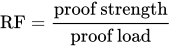
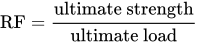
The applied loads have many factors, including factors of safety applied.
Yield and ultimate calculations
[edit]For ductile materials (e.g. most metals), it is often required that the factor of safety be checked against both yield and ultimate strengths. The yield calculation will determine the safety factor until the part starts to deform plastically. The ultimate calculation will determine the safety factor until failure. In brittle materials the yield and ultimate strengths are often so close as to be indistinguishable, so it is usually acceptable to only calculate the ultimate safety factor.
Choosing design factors
[edit]Appropriate design factors are based on several considerations, such as the accuracy of predictions on the imposed loads, strength, wear estimates, and the environmental effects to which the product will be exposed in service; the consequences of engineering failure; and the cost of over-engineering the component to achieve that factor of safety [citation needed]. For example, components whose failure could result in substantial financial loss, serious injury, or death may use a safety factor of four or higher (often ten). Non-critical components generally might have a design factor of two. Risk analysis, failure mode and effects analysis, and other tools are commonly used. Design factors for specific applications are often mandated by law, policy, or industry standards.
Buildings commonly use a factor of safety of 2.0 for each structural member. The value for buildings is relatively low because the loads are well understood and most structures are redundant. Pressure vessels use 3.5 to 4.0, automobiles use 3.0, and aircraft and spacecraft use 1.2 to 4.0 depending on the application and materials. Ductile, metallic materials tend to use the lower value while brittle materials use the higher values. The field of aerospace engineering uses generally lower design factors because the costs associated with structural weight are high (i.e. an aircraft with an overall safety factor of 5 would probably be too heavy to get off the ground). This low design factor is why aerospace parts and materials are subject to very stringent quality control and strict preventative maintenance schedules to help ensure reliability. A usually applied Safety Factor is 1.5, but for pressurized fuselage it is 2.0, and for main landing gear structures it is often 1.25.[11]
In some cases it is impractical or impossible for a part to meet the "standard" design factor. The penalties (mass or otherwise) for meeting the requirement would prevent the system from being viable (such as in the case of aircraft or spacecraft). In these cases, it is sometimes determined to allow a component to meet a lower than normal safety factor, often referred to as "waiving" the requirement. Doing this often brings with it extra detailed analysis or quality control verifications to assure the part will perform as desired, as it will be loaded closer to its limits.
For loading that is cyclical, repetitive, or fluctuating, it is important to consider the possibility of metal fatigue when choosing factor of safety. A cyclic load well below a material's yield strength can cause failure if it is repeated through enough cycles.
History
[edit]According to Elishakoff[12][13] the notion of factor of safety in engineering context was apparently first introduced in 1729 by Bernard Forest de Bélidor (1698-1761)[14] who was a French engineer working in hydraulics, mathematics, civil, and military engineering. The philosophical aspects of factors of safety were pursued by Doorn and Hansson.[15]
See also
[edit]- Engineering tolerance – Permissible limit or limits of variation
- Limit state design – Design method in structural engineering
- Probabilistic design – Discipline within engineering design
- Redundancy (total quality management) – Approach to business improvement
- Sacrificial part – Component engineered to fail first to protect the rest of the device
- Statistical interference – When two probability distributions overlap
- Verification and validation – Methods for checking conformance to requirements
Notes
[edit]- ^ Young, W.: Roark's Formulas for Stress and Strain, 6th edition. McGraw-Hill, 1989.
- ^ Shigley, J and Mischke, C: Standard Handbook of Machine Design, page 2-15. McGraw-Hill, 1986.
- ^ ASME BTH-1: Design of Below-the-Hook Lifting Devices, Section 1-5, ASME, 2005.
- ^ Beer, F and Johnson, R: Mechanics of Materials, second edition. McGraw-Hill,1992.
- ^ Timoshenko, S: Strength of Materials, Volume 1. Krieger, 1958.
- ^ Buchanan, G: Mechanics of Materials, Page 55. Holt, Reinhart, and Watson,1988.
- ^ Burr, A and Cheatham, J: Mechanical Design and Analysis, 2nd edition, section 5.2. Prentice-Hall, 1995.
- ^ Juvinall, R: Stress, Strain, and Strength, section 14.13, Page 295. McGraw-Hill, 1967.
- ^ NASA-STD-5001: Structural Design and Test Factors for Spaceflight Hardware, section 3. NASA, 2008.
- ^ AIAA S-110: Space Systems - Structures, Structural Components, and Structural Assemblies, section 4.2. AIAA, 2005.
- ^ Burr, A and Cheatham, J: Mechanical Design and Analysis, 2nd edition, section 5.2. Prentice-Hall, 1995.
- ^ Elishakoff, I. Safety factors and reliability: friends or foes?, Dordrecht: Kluwer Academic Publishers, 2004
- ^ Elishakoff, I., Interrelation between safety factors and reliability, NASA/CR-2001-211309, 2001
- ^ de Bélidor, Bernard Forest, La science des ingénieurs, dans la conduite des travaux de fortification et d'architecture civile, Paris: Chez Claude Jombert 1729
- ^ Doorn, N. and Hansson, S.O., Should probabilistic design replace safety factors?, Philosophy & Technology, 24(2), pp.151-16, 2011
Further reading
[edit]- Lalanne, C., Specification Development - 2nd Ed., ISTE-Wiley, 2009
Factor of safety
View on GrokipediaDefinition and Fundamentals
Definition
The factor of safety (FoS), also known as the safety factor, is a fundamental engineering metric defined as the ratio of a system's strength or load-carrying capacity to the maximum expected load or stress it will experience under normal operating conditions.[2] This ratio, typically expressed as FoS = Strength / Load, quantifies the reserve capacity beyond the design requirements to prevent failure. In structural engineering, strength refers to the material's or component's ability to withstand failure (such as yield or ultimate strength), while load encompasses applied forces, stresses, or other demands.[2] The FoS inherently incorporates margins to address uncertainties inherent in engineering design, including variability in material properties, manufacturing defects, and environmental influences such as temperature fluctuations or corrosion.[6][7] These factors can lead to deviations from nominal values, and the FoS provides a buffer to ensure reliability despite such unpredictabilities, often derived from empirical data and engineering judgment.[7] For instance, material variability might arise from inconsistencies in alloy composition, while manufacturing defects could include imperfections like voids or misalignments during fabrication.[8] Traditionally, the FoS follows a deterministic approach, treating strength and load as fixed values to yield a single numerical ratio, which serves as a conservative design guideline.[9] In contrast, probabilistic interpretations of FoS integrate statistical distributions of variables like material strength and loads to assess reliability and failure probability, accounting for aleatory and epistemic uncertainties more explicitly.[10] This distinction allows deterministic methods for simpler analyses and probabilistic ones for complex systems requiring quantified risk.[9] A practical illustration is in beam design, where an FoS of 2 indicates that the beam's strength is twice the anticipated maximum load, allowing it to endure overloads or imperfections without failure.[2]Purpose and Importance
The factor of safety (FoS) plays a critical role in engineering design by providing a deliberate margin between the expected loads and the material's capacity to withstand them, thereby ensuring structural integrity against uncertainties such as material variability, unexpected overloads, and environmental factors.[11] This buffer enhances public safety by minimizing the risk of failure in critical infrastructure like bridges and buildings, where even minor deviations can lead to loss of life.[5] Economically, incorporating an appropriate FoS optimizes resource use by avoiding overdesign that wastes materials while preventing costly failures and repairs, striking a balance between safety and efficiency.[12] By design, FoS reduces the probability of catastrophic failure; for instance, in the 2007 collapse of the I-35W Mississippi River bridge in Minneapolis, undersized gusset plates resulted in a safety factor below 1.0 under combined dead and live loads, contributing to the failure that killed 13 people and injured 145.[13] Investigations revealed that modifications, such as added deck weight, further compromised the original design margins, underscoring how inadequate FoS amplifies risks from design errors or changes.[14] Such incidents highlight FoS's importance in mitigating overload scenarios, where failure probabilities can escalate rapidly without sufficient margins. Key benefits of FoS include enabling conservative designs that account for unknowns without excessive conservatism, facilitating compliance with regulatory standards like those from the American Society of Civil Engineers (ASCE), and supporting lifecycle cost analysis by reducing long-term maintenance and liability expenses.[15] In modern reliability engineering, FoS has evolved into probabilistic frameworks that quantify failure risks, targeting probabilities below 10^{-6} per year for high-consequence structures to align safety with statistical confidence rather than deterministic rules alone.[16] This approach, detailed in NASA reliability studies, integrates variability in strength and load to achieve more precise risk mitigation.[5]Calculation Methods
Basic Formulas
The factor of safety (FoS) is fundamentally defined as the ratio of the ultimate load that a component can withstand to the allowable load under operating conditions, expressed as where is the load at failure and is the maximum permissible load based on design requirements.[2] Equivalently, in terms of material behavior, it is the ratio of the material strength to the working stress, where represents the material's failure stress (such as ultimate or yield strength) and is the stress induced by the applied load.[17] This formula derives from the fundamental stress-strain relationships obtained through material testing. The stress-strain curve illustrates how a material responds to increasing loads, identifying key points like the yield strength , beyond which plastic deformation occurs. The working stress is computed as , with as the applied load and as the cross-sectional area. Design specifications then derive the allowable load by incorporating a safety margin: , ensuring the operating stress remains below the material's limit to prevent failure under uncertainties like load variations or material defects.[17][18] Formulas for FoS can be load-based or stress-based, depending on the analysis context. In load-based approaches, units are consistent (e.g., newtons for both loads), with no conversion needed. Stress-based expressions use units of pressure (e.g., pascals), such as where is the yield strength in pascals and is the operating stress in pascals; this form is common for components where deformation is the failure criterion.[18] The choice between approaches depends on whether the design emphasizes total load capacity or localized stress distribution. For illustration, consider a steel cable with a breaking strength (ultimate load) of 10 kN subjected to a working load of 4 kN. The FoS is then indicating the cable can handle 2.5 times the applied load before failure.[2]Related Metrics
In engineering design, several metrics related to the factor of safety (FoS) are used to quantify structural reliability and reserve capacity, often interchangeably or with subtle distinctions depending on context and application. These include the design factor, safety factor, margin of safety, and reserve factor, each serving to ensure systems exceed expected loads while accounting for uncertainties.[19][20] The design factor (DF) represents the minimum FoS mandated by engineering codes, standards, or designers to guide initial specifications, ensuring a baseline level of safety before detailed analysis. For instance, in steel structures under allowable stress design methods, a DF of 1.67 is commonly specified for flexural members to account for material variability and load uncertainties.[20] This input-oriented metric contrasts with the FoS, which emerges as an output from post-design verification calculations.[21] The safety factor (SF) is frequently synonymous with FoS, denoting the ratio of a system's strength to its expected load, but it is sometimes reserved for confirmatory assessments after design to validate compliance with requirements.[22][23] In practice, SF emphasizes the achieved margin against failure in built components, distinguishing it slightly from the prescriptive DF.[21] The margin of safety (MoS) quantifies the excess capacity beyond the design threshold as a fractional or percentage value, calculated as MoS = FoS - 1, where a positive MoS indicates the structure meets safety criteria. For an FoS of 1.5, the MoS is 0.5, or 50%, representing the proportional reserve before reaching failure.[3][19] This metric is particularly useful in probabilistic assessments to express reliability without implying a simple ratio.[24] In aerospace engineering, the reserve factor (RF) is employed to denote the multiplier by which applied loads can increase before causing failure, typically defined as RF = strength / applied load, aligning closely with FoS but emphasizing remaining capacity in high-stakes analyses.[19][25] While occasionally interpreted inversely in specialized contexts, RF standardly serves as a direct measure of reserve, aiding optimization in structural sizing.[26]Strength-Based Applications
Yield Strength Calculations
The factor of safety with respect to yield strength, denoted as FoS_y, is defined for ductile materials as the ratio of the material's yield stress () to the maximum applied stress () in the component: This metric ensures that the design remains within the elastic region, preventing permanent plastic deformation under operational loads.[27][28] Such calculations are particularly critical for components like pressure vessels, where exceeding the yield point could lead to unacceptable distortion and compromise containment integrity, as governed by standards like ASME BPVC Section VIII Division 1, which limits allowable stress to the minimum of or ultimate tensile strength / 3.5.[29] To perform yield strength calculations step-by-step, first determine the maximum stress from applied loads, incorporating any load factors to account for variability (e.g., multiplying nominal loads by a factor of 1.2–1.5 for static cases). For uniaxial loading, is directly computed as force divided by cross-sectional area. For combined stresses in multiaxial loading, apply a yield criterion such as the von Mises distortion energy theory to obtain an equivalent stress : where , , and are the principal stresses; then, FoS_y = . This approach predicts yielding when reaches , providing a conservative margin against the elastic limit.[30] For example, consider a steel beam with a yield strength MPa subjected to a maximum bending stress MPa; the resulting FoS_y = 1.67, aligning with the American Institute of Steel Construction (AISC) safety factor against yield in beams. Typical FoS_y values for ductile metals range from 1.5 to 2.0 when material properties are well-characterized, increasing to 3.0 or higher under uncertainty or fatigue conditions.[31][22] In complex geometries where analytical stress computation is infeasible, finite element analysis (FEA) integrates yield FoS evaluation by simulating stress distributions and computing the von Mises equivalent stress at critical points, then applying the FoS_y formula to verify margins against yielding. For instance, in biomedical implants modeled with Ti-27Nb alloy, FEA-derived maximum von Mises stresses are divided into to yield safety factors exceeding 2.0, ensuring deformation resistance.[32]Ultimate Strength Calculations
The factor of safety based on ultimate strength, denoted as FoS_u, is calculated as the ratio of the material's ultimate tensile strength (σ_u) to the maximum applied stress (σ_max) in the component. This metric ensures that the structure can withstand loads up to the point of catastrophic failure without rupture, providing a margin against total collapse. For ultimate strength assessments, FoS_u is particularly critical in designs where failure implies sudden and irreversible damage, such as in pressure vessels or structural beams.[19] In brittle materials, like cast iron or concrete, the derivation of FoS_u incorporates a higher value, typically ranging from 3 to 5, due to their tendency for sudden fracture without significant plastic deformation or warning. This elevated factor accounts for the lack of ductility, which limits energy absorption before failure, and variability in material properties that could lead to brittle cracking under tensile or shear loads. In contrast, ductile materials, such as mild steel, employ a lower FoS_u of 1.5 to 2.5, as their ability to undergo substantial plastic deformation allows for some redistribution of stresses prior to ultimate rupture, offering inherent warnings like yielding. These ranges are derived from empirical data and failure observations, emphasizing prevention of brittle-like catastrophic events across material classes.[22][33] For multi-axial stress states, ultimate strength calculations adjust the FoS_u using failure theories tailored to material behavior, such as the maximum principal stress theory for brittle materials. This theory posits that failure occurs when the largest principal stress (σ_1) reaches the ultimate strength, so the effective FoS_u becomes σ_u / σ_1, ensuring no principal direction exceeds the failure limit under combined loading like tension and torsion. This approach is preferred for brittle components because fracture initiates perpendicular to the maximum tensile principal stress, avoiding overestimation of capacity seen in shear-based theories.[34] Consider a reinforced concrete column with an ultimate compressive strength σ_u of 40 MPa subjected to a maximum axial stress σ_max of 10 MPa; the resulting FoS_u is 4, indicating the column can endure four times the applied load before compressive failure. To account for cyclic loading, a fatigue-adjusted ultimate FoS_u may be computed by reducing σ_u to an effective endurance limit (e.g., via the Goodman relation for mean and alternating stresses), yielding a lower value such as 2.5 if fatigue reduces capacity by 37.5%, thus preventing crack propagation under repeated service conditions.[19] Probabilistic approaches to ultimate FoS_u address material strength variability using the Weibull distribution, which models the probability of failure based on flaw sizes and stress concentrations in brittle materials. The Weibull reliability function R = exp[-(σ/σ_0)^m], where m is the shape parameter (Weibull modulus) and σ_0 the scale parameter, allows computation of a probabilistic FoS_u as the ratio ensuring, say, 99.9% reliability: FoS_u = (σ_0 / σ_max) * [ -ln(R) ]^{1/m}. This method, applied to ceramics or composites, quantifies scatter in ultimate strength (e.g., m ≈ 10-20 for concrete), yielding design factors higher than deterministic values to mitigate low-probability failures from defects.[35]Selection Criteria
Influencing Factors
The selection of an appropriate factor of safety (FoS) in engineering design is influenced by several key variables that account for uncertainties and potential failure modes. These factors ensure that structures and components can withstand loads beyond expected conditions while maintaining reliability. Primary influences include material properties, loading conditions, environmental exposures, and the severity of potential failure consequences. Material properties, particularly ductility and variability, significantly affect the required FoS. Ductile materials, which can undergo substantial plastic deformation before failure, generally permit lower FoS values because they provide warning through visible deformation. In contrast, brittle materials exhibit greater variability in strength due to inherent defects or inconsistencies, necessitating higher FoS to mitigate the risk of sudden, catastrophic failure. For instance, variability in material properties arises from differences in composition, processing, or testing, which can lead to a 10-20% scatter in measured strengths, prompting engineers to increase FoS by 1.5 to 2 times for brittle components compared to ductile ones.[23][36] Loading conditions further dictate FoS selection, with distinctions between static, dynamic, and fatigue loads. Static loads, which are constant and predictable, typically require lower FoS (often 1.5-2.0) as they induce uniform stress without cyclic effects. Dynamic loads, such as impacts or vibrations, generate higher peak stresses—up to several times those of static equivalents—demanding elevated FoS (e.g., 3-5) to account for shock and energy absorption. Fatigue loading, involving repeated cycles, accelerates crack propagation even below yield strength, often requiring FoS values exceeding 4 to prevent progressive degradation over time.[37][28] Environmental factors like corrosion and temperature variations degrade material integrity, thereby influencing FoS to compensate for reduced effective strength. Corrosion, driven by moisture, pollutants, and relative humidity above 80%, can diminish cross-sectional area and introduce stress concentrations, necessitating FoS adjustments in corrosive environments. Elevated temperatures accelerate reaction kinetics and reduce yield strength, while extreme cold may embrittle materials, both requiring FoS adjustments to maintain design margins.[38][39] The consequence of failure plays a critical role, with higher FoS mandated for applications involving human safety or significant economic loss. Structures occupied by people, such as bridges (FoS 2-4) or aircraft (FoS 1.5 with additional margins), demand higher FoS to minimize the probability of failure, reflecting the irreversible harm potential. In contrast, non-critical components may use FoS as low as 1.5, balancing safety against overdesign.[1][40] Uncertainty quantification, encompassing inspection quality and manufacturing tolerances, directly impacts FoS by addressing variability in production and quality control. Poor inspection processes or wide tolerances (e.g., ±5% in dimensions) introduce uncertainties that can reduce effective strength by 15-25%, often leading to an incremental FoS of 0.5-1.0 to cover these deviations. Rigorous quality control, such as non-destructive testing, allows for tighter tolerances and thus lower FoS, while inconsistent manufacturing amplifies the need for conservative margins to ensure reliability.[41][42] Economic trade-offs arise when selecting FoS, as higher values require costlier materials and thicker sections, increasing capital expenses by 20-50% while reducing failure risk and associated liabilities. Engineers must balance these costs against potential downtime or repair expenses from failure, often using cost-benefit analyses to optimize FoS where a 10% increase might double material costs but halve risk probability.[43][44] In modern practice, computational simulations such as Monte Carlo methods refine FoS by quantifying uncertainties in material properties, loads, and environmental effects through probabilistic modeling. These simulations generate thousands of scenarios to estimate failure probability, enabling tailored FoS values that replace conservative defaults—for example, reducing FoS from 3 to 2.2 in well-characterized systems while maintaining a 99.9% reliability threshold.[45][46]Industry Standards
Industry standards for the factor of safety (FoS) are codified in various engineering codes and regulations to ensure structural integrity and public safety across applications. The American Society of Mechanical Engineers (ASME) Boiler and Pressure Vessel Code (BPVC), particularly Section VIII Division 1, establishes an FoS of 3.5 based on the ultimate tensile strength for the design of pressure vessels, allowing for calculated stresses up to one-third of the material's tensile strength at temperature.[47] Similarly, the American Institute of Steel Construction (AISC) 360 Specification for Structural Steel Buildings specifies an FoS of 1.67 for yielding limit states and 2.0 for ultimate strength in allowable strength design (ASD), applied to nominal strengths to determine allowable values.[48] In contrast, the European Eurocodes utilize partial safety factors that vary from 1.0 to 1.5 depending on the material properties, actions, and design situation, enabling a calibrated approach to overall safety levels rather than a single global FoS.[49] Regulatory frameworks further enforce FoS requirements to mitigate risks in operational environments. In aerospace, the Federal Aviation Administration (FAA) requires an FoS of 1.5 applied to limit loads for aircraft structures, ensuring the ultimate load (150% of limit loads) is withstood without failure and limit loads without yielding.[50] As of 2025, the International Organization for Standardization (ISO) 2394 standard on general principles of reliability for structures promotes a transition from fixed deterministic FoS to probabilistic reliability-based design methods, using target reliability indices (typically β = 3.8 for 50-year reference periods) to calibrate partial factors and account for variabilities in loads, materials, and models.[51] This approach influences ongoing code revisions, such as integrations in Eurocodes and national standards, to achieve consistent safety levels across global applications.| Standard/Regulation | Application | FoS or Partial Factor Range |
|---|---|---|
| ASME BPVC Section VIII | Pressure vessels | 3.5 (on ultimate strength) |
| AISC 360 | Steel structures (yielding) | 1.67 |
| AISC 360 | Steel structures (ultimate) | 2.0 |
| Eurocodes (EN 1990 et seq.) | General structures | 1.0–1.5 (partial factors) |
| FAA (14 CFR Part 25) | Aircraft structures | 1.5 (on limit loads) |
| ISO 2394 | Reliability-based design | Probabilistic (equivalent 1.5–3.0) |