


Community hub
Wikipedia
Overlapping generations model
View on Wikipedia| Part of a series on |
| Macroeconomics |
|---|
_(cropped).jpg) |

The overlapping generations (OLG) model is one of the dominating frameworks of analysis in the study of macroeconomic dynamics and economic growth. In contrast to the Ramsey–Cass–Koopmans neoclassical growth model in which individuals are infinitely-lived, in the OLG model individuals live a finite length of time, long enough to overlap with at least one period of another agent's life.
The OLG model is the natural framework for the study of: (a) the life-cycle behavior (investment in human capital, work and saving for retirement), (b) the implications of the allocation of resources across the generations, such as Social Security, on the income per capita in the long-run,[1] (c) the determinants of economic growth in the course of human history, and (d) the factors that triggered the fertility transition.
History
[edit]The construction of the OLG model was inspired by Irving Fisher's monograph The Theory of Interest.[2] It was first formulated in 1947, in the context of a pure-exchange economy, by Maurice Allais, and more rigorously by Paul Samuelson in 1958.[3] In 1965, Peter Diamond[4] incorporated an aggregate neoclassical production into the model. This OLG model with production was further augmented with the development of the two-sector OLG model by Oded Galor,[5] and the introduction of OLG models with endogenous fertility.[6][7]
Books devoted to the use of the OLG model include Azariadis' Intertemporal Macroeconomics[8] and de la Croix and Michel's Theory of Economic Growth.[9]
Pure-exchange OLG model
[edit]
The most basic OLG model has the following characteristics:[10]
- Individuals live for two periods; in the first period of life, they are referred to as the Young. In the second period of life, they are referred to as the Old.
- A number of individuals are born in every period. denotes the number of individuals born in period t.
- denotes the number of old people in period t. Since the economy begins in period 1, in period 1 there is a group of people who are already old. They are referred to as the initial old. The number of them can be denoted as .
- The size of the initial old generation is normalized to 1: .
- People do not die early, so .
- Population grows at a constant rate n:


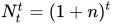
- In the "pure exchange economy" version of the model, there is only one physical good and it cannot endure for more than one period. Each individual receives a fixed endowment of this good at birth. This endowment is denoted as y.
- In the "production economy" version of the model (see Diamond OLG model below), the physical good can be either consumed or invested to build physical capital. Output is produced from labor and physical capital. Each household is endowed with one unit of time which is inelastically supply on the labor market.
- Preferences over consumption streams are given by
- where is the rate of time preference.


OLG model with production
[edit]Basic one-sector OLG model
[edit]The pure-exchange OLG model was augmented with the introduction of an aggregate neoclassical production by Peter Diamond.[4] In contrast, to Ramsey–Cass–Koopmans neoclassical growth model in which individuals are infinitely-lived and the economy is characterized by a unique steady-state equilibrium, as was established by Oded Galor and Harl Ryder,[11] the OLG economy may be characterized by multiple steady-state equilibria, and initial conditions may therefore affect the long-run evolution of the long-run level of income per capita.
Since initial conditions in the OLG model may affect economic growth in long-run, the model was useful for the exploration of the convergence hypothesis.[12]

The economy has the following characteristics:[13]
- Two generations are alive at any point in time, the young (age 1) and old (age 2).
- The size of the young generation in period t is given by Nt = N0 Et.
- Households work only in the first period of their life and earn Y1,t income. They earn no income in the second period of their life (Y2,t+1 = 0).
- They consume part of their first period income and save the rest to finance their consumption when old.
- At the end of period t, the assets of the young are the source of the capital used for aggregate production in period t+1.So Kt+1 = Nt,a1,t where a1,t is the assets per young household after their consumption in period 1. In addition to this there is no depreciation.
- The old in period t own the entire capital stock and consume it entirely, so dissaving by the old in period t is given by Nt-1,a1,t-1 = Kt.
- Labor and capital markets are perfectly competitive and the aggregate production technology is CRS, Y = F(K,L).
Two-sector OLG model
[edit]The one-sector OLG model was further augmented with the introduction of a two-sector OLG model by Oded Galor.[5] The two-sector model provides a framework of analysis for the study of the sectoral adjustments to aggregate shocks and implications of international trade for the dynamics of comparative advantage. In contrast to the Uzawa two-sector neoclassical growth model,[14] the two-sector OLG model may be characterized by multiple steady-state equilibria, and initial conditions may therefore affect the long-run position of an economy.
OLG model with endogenous fertility
[edit]Oded Galor and his co-authors develop OLG models where population growth is endogenously determined to explore: (a) the importance the narrowing of the gender wage gap for the fertility decline,[6] (b) the contribution of the rise in the return to human capital and the decline in fertility to the transition from stagnation to growth,[7][15] and (c) the importance of population adjustment to technological progress for the emergence of the Malthusian trap.[16]
Dynamic inefficiency
[edit]One important aspect of the OLG model is that the steady state equilibrium need not be efficient, in contrast to general equilibrium models where the first welfare theorem guarantees Pareto efficiency. Because there are an infinite number of agents in the economy (summing over future time), the total value of resources is infinite, so Pareto improvements can be made by transferring resources from each young generation to the current old generation,[17] similar to the logic described in the Hilbert Hotel. Not every equilibrium is inefficient; the efficiency of an equilibrium is strongly linked to the interest rate and the Cass Criterion gives necessary and sufficient conditions for when an OLG competitive equilibrium allocation is inefficient.[18]
Another attribute of OLG type models is that it is possible that 'over saving' can occur when capital accumulation is added to the model—a situation which could be improved upon by a social planner by forcing households to draw down their capital stocks.[4] However, certain restrictions on the underlying technology of production and consumer tastes can ensure that the steady state level of saving corresponds to the Golden Rule savings rate of the Solow growth model and thus guarantee intertemporal efficiency. Along the same lines, most empirical research on the subject has noted that oversaving does not seem to be a major problem in the real world.[citation needed]
In Diamond's version of the model, individuals tend to save more than is socially optimal, leading to dynamic inefficiency. Subsequent work has investigated whether dynamic inefficiency is a characteristic in some economies[19] and whether government programs to transfer wealth from young to poor do reduce dynamic inefficiency[citation needed].
Another fundamental contribution of OLG models is that they justify existence of money as a medium of exchange. A system of expectations exists as an equilibrium in which each new young generation accepts money from the previous old generation in exchange for consumption. They do this because they expect to be able to use that money to purchase consumption when they are the old generation.[10]
See also
[edit]References
[edit]- ^ Imrohoroglu, Selahattin; Imrohoroglu, Ayse; Joines, Douglas (1999). "Social Security in an Overlapping Generations Economy with Land". Review of Economic Dynamics. 2 (3): 638–665. doi:10.1006/redy.1999.0066.
- ^ Aliprantis, Brown & Burkinshaw (1988, p. 229): Aliprantis, Charalambos D.; Brown, Donald J.; Burkinshaw, Owen (April 1988). "5 The overlapping generations model (pp. 229–271)". Existence and optimality of competitive equilibria (1990 student ed.). Berlin: Springer-Verlag. pp. xii+284. ISBN 978-3-540-52866-1. MR 1075992.
- ^ Samuelson, Paul A. (1958). "An exact consumption-loan model of interest with or without the social contrivance of money". Journal of Political Economy. 66 (6): 467–482. doi:10.1086/258100. S2CID 153586213.
- ^ a b c Diamond, Peter (1965). "National debt in a neoclassical growth model". American Economic Review. 55 (5): 1126–1150.
- ^ a b Galor, Oded (1992). "A Two-Sector Overlapping-Generations Model: A Global Characterization of the Dynamical System". Econometrica. 60 (6): 1351–1386. doi:10.2307/2951525. JSTOR 2951525.
- ^ a b Galor, Oded; Weil, David N. (1996). "The gender gap, fertility, and growth". American Economic Review. 86 (3): 374–387.
- ^ a b Galor, Oded; Weil, David N. (2000). "Population, technology, and growth: From Malthusian stagnation to the demographic transition and beyond". American Economic Review. 90 (4): 806–828. CiteSeerX 10.1.1.195.5342. doi:10.1257/aer.90.4.806.
- ^ "Wiley: Intertemporal Macroeconomics - Costas Azariadis". eu.wiley.com. Retrieved 2015-10-24.
- ^ "A Theory of Economic Growth - 9780521001151 - Cambridge University Press". www.cambridge.org. Retrieved 2015-10-24.
- ^ a b Lars Ljungqvist; Thomas J. Sargent (1 September 2004). Recursive Macroeconomic Theory. MIT Press. pp. 264–267. ISBN 978-0-262-12274-0.
- ^ Galor, Oded; Ryder, Harl E. (1989). "Existence, uniqueness, and stability of equilibrium in an overlapping-generations model with productive capital". Journal of Economic Theory. 49 (2): 360–375. doi:10.1016/0022-0531(89)90088-4.
- ^ Galor, Oded (1996). "Convergence? Inferences from theoretical models" (PDF). The Economic Journal. 106 (437): 1056–1069. doi:10.2307/2235378. JSTOR 2235378.
- ^ Carrol, Christopher. OLG Model.
- ^ Uzawa, Hirofumi (1964). "Optimal growth in a two-sector model of capital accumulation". The Review of Economic Studies. 31 (1): 1–24. doi:10.2307/2295932. JSTOR 2295932.
- ^ Galor, Oded; Moav, Omer (2002). "Natural selection and the origin of economic growth". The Quarterly Journal of Economics. 117 (4): 1133–1191. CiteSeerX 10.1.1.199.2634. doi:10.1162/003355302320935007.
- ^ Ashraf, Quamrul; Galor, Oded (2011). "Dynamics and stagnation in the Malthusian epoch". American Economic Review. 101 (5): 2003–2041. doi:10.1257/aer.101.5.2003. PMC 4262154. PMID 25506082.
- ^ Acemoglu, Daron (2009). Introduction to modern economic growth. Princeton, New Jersey Oxford: Princeton University Press. ISBN 978-0-691-13292-1.
- ^ Cass, David (1972). "On capital overaccumulation in the aggregative neoclassical model of economic growth: a complete characterization". Journal of Economic Theory. 4 (2): 200–223. doi:10.1016/0022-0531(72)90149-4.
- ^ N. Gregory Mankiw; Lawrence H. Summers; Richard J. Zeckhauser (1 May 1989). "Assessing Dynamic Efficiency: Theory and Evidence". Review of Economic Studies. 56 (1): 1–19. doi:10.2307/2297746. JSTOR 2297746.
Further reading
[edit]- Acemoğlu, Daron (2008). "Growth with Overlapping Generations". Introduction to Modern Economic Growth. Princeton University Press. pp. 327–358. ISBN 978-0-691-13292-1.
- Barro, Robert J.; Sala-i-Martin, Xavier (2004). "Appendix: Overlapping-Generations Models". Economic Growth (Second ed.). New York: McGraw-Hill. pp. 190–200. ISBN 978-0-262-02553-9.
- Blanchard, Olivier Jean; Fischer, Stanley (1989). "The Overlapping Generations Model". Lectures on Macroeconomics. Cambridge: MIT Press. pp. 91–152. ISBN 978-0-262-02283-5.
- Romer, David (2006). "Infinite-Horizon and Overlapping-Generations Models". Advanced Macroeconomics (3rd ed.). New York: McGraw Hill. pp. 47–97. ISBN 978-0-07-287730-4.
- Weil, Philippe (2008). "Overlapping Generations: The First Jubilee". Journal of Economic Perspectives. 22 (4): 115–34. CiteSeerX 10.1.1.513.4087. doi:10.1257/jep.22.4.115.
- Azariadis, Costas (1993), "Intertemporal Macroeconomics", Wiley-Blackwell, ISBN 978-1-55786-366-9.
- de la Croix, David; Michel, Philippe (2002), "A Theory of Economic Growth - Dynamics and Policy in Overlapping Generations", Cambridge University Press, ISBN 9780521001151.
Grokipedia
Overlapping generations model
View on GrokipediaHistorical Development
Origins in Pure Exchange Models
The overlapping generations (OLG) model in its pure exchange form emerged as a framework to analyze intertemporal resource allocation among agents with finite lifetimes in an economy without production. Maurice Allais first formulated the basic structure in 1947 within an appendix to his book Économie et Intérêt, modeling a pure-exchange economy where successive generations overlap and trade claims on goods across periods.[7] This approach addressed intergenerational transfers but received limited attention initially due to its publication in French and lack of widespread dissemination.[8] Paul Samuelson independently and more rigorously introduced the OLG model in 1958 through his seminal paper "An Exact Consumption-Loan Model of Interest with or without the Social Contrivance of Money," published in the Journal of Political Economy.[9] Samuelson's setup posits an infinite-horizon economy populated by agents who live for two periods: the young, endowed with a perishable consumption good, and the old, who seek to consume but hold no endowment.[2] Absent production, young agents must transfer resources to the old via consumption loans or fiat money to enable old-age consumption, with equilibrium interest rates determined by population growth and time preferences.[9] This pure exchange OLG framework highlighted the role of money as a store of value in stationary economies and demonstrated that decentralized equilibria could feature positive interest rates even without productive capital, contrasting with neoclassical growth models.[2] Samuelson showed that such equilibria might not achieve Pareto optimality, introducing the possibility of dynamic inefficiency where the economy over-accumulates stores of value relative to the golden rule level.[9] These insights laid the groundwork for later extensions, emphasizing the model's utility in capturing realistic demographic structures absent in representative-agent infinite-horizon frameworks.[10]Introduction of Production and Key Extensions
Peter Diamond introduced production into the overlapping generations model in his 1965 paper "National Debt in a Neoclassical Growth Model," published in the American Economic Review.[3] This built upon Paul Samuelson's 1958 pure exchange framework by adding a production sector where output is generated using capital and labor inputs via a neoclassical aggregate production function exhibiting constant returns to scale and Inada conditions.[11] In the model, young agents supply labor inelastically, receive wages, and allocate income between current consumption and savings, which form the capital stock for the subsequent period after accounting for population growth at rate .[12] Elderly agents consume from their accumulated savings plus rental returns, with no further labor supply or bequests.[13] Firms operate competitively, hiring labor at wage and capital at rental rate , where denotes per capita output from capital per worker and the production function .[12] Household optimization yields savings that determine capital accumulation via , leading to a dynamic system with a unique stable steady state under standard parameter values, such as discount factor and capital share .[13] Diamond's formulation enabled analysis of long-run equilibria and transitions, highlighting how savings-driven capital accumulation differs from exogenous growth assumptions in earlier Solow-style models.[3] Key extensions incorporated fiscal elements within Diamond's structure, including government debt and pay-as-you-go social security, where unfunded liabilities crowd out private capital and may induce dynamic inefficiency if steady-state capital exceeds the Golden Rule level satisfying .[13] Diamond demonstrated that internal debt reduces capital accumulation by transferring resources intertemporally, while external debt's effects depend on interest rates relative to growth.[3] Later historical developments, such as Auerbach and Kotlikoff's 1987 multi-period OLG models with heterogeneous agents and life-cycle heterogeneity, expanded the framework for computational general equilibrium analysis of demographic shifts and policy reforms, popularizing its use in public finance simulations.[14]Evolution in Macroeconomic Theory
The overlapping generations (OLG) model emerged as a foundational tool in macroeconomic theory through Paul Samuelson's 1958 analysis of a pure exchange economy, where finite-lived agents overlap across periods, enabling the demonstration of fiat money's positive value as a store of worth despite its intrinsic worthlessness and highlighting potential inefficiencies in decentralized equilibria compared to optimal social allocations.[9] This framework contrasted with infinite-horizon representative agent models by incorporating realistic demographic structure, where agents save for retirement without intergenerational altruism, leading to equilibria that may fail Pareto optimality due to missing intertemporal markets.[12] Peter Diamond's 1965 extension integrated production into the OLG setup, adapting neoclassical growth dynamics to finite lives and showing that competitive steady-state capital accumulation could exceed the golden rule level, resulting in dynamic inefficiency where the interest rate falls below the growth rate, rendering public debt or resource transfers Pareto improving.[3] This revealed a key theoretical insight: market-driven savings, motivated by life-cycle needs rather than dynastic preferences, could overaccumulate capital relative to socially optimal paths, influencing debates on fiscal policy's role in correcting such distortions.[15] Post-Diamond developments expanded OLG applications to monetary and fiscal analysis, with extensions incorporating endogenous money supply and banking to explain inflation dynamics and seigniorage, while emphasizing the model's capacity to generate valued intrinsically useless assets through sequential trading.[4] In the 1980s, Auerbach and Kotlikoff pioneered large-scale, multi-period OLG simulations for quantitative policy evaluation, modeling heterogeneous cohorts with age-specific earnings and consumption to assess tax reforms, social security sustainability, and demographic transitions like aging populations, which revealed transition generations bearing disproportionate burdens in pay-as-you-go systems.[16][14] By the late 20th century, OLG frameworks evolved into computational workhorses for addressing heterogeneity absent in representative agent models, facilitating analysis of inequality, lifecycle risk-sharing, and aggregate fluctuations driven by cohort effects.[17] In modern macroeconomics, OLG structures inform heterogeneous agent New Keynesian models, incorporating nominal rigidities and demographic variation to better capture policy transmission, such as how monetary shocks disproportionately affect younger borrowers versus older savers, thus providing microfoundations for empirical regularities in consumption and savings behavior.[6] This evolution underscores OLG's enduring role in privileging agent-specific horizons over infinite-lived approximations, yielding predictions aligned with observed intergenerational trade-offs.Core Model Frameworks
Pure Exchange OLG Model
The pure exchange overlapping generations (OLG) model posits an economy spanning infinite discrete time periods $ t = 0, 1, 2, \dots $, where each generation lives for two periods—youth and old age—overlapping with the subsequent generation. [18] Agents born in period $ t $, denoted generation $ t $, are endowed with $ w > 0 $ units of a perishable consumption good solely in their youth (period $ t $) and nothing in old age (period $ t+1 $); the good cannot be stored or produced.[19] [18] Population size of newborns grows exogenously at constant rate $ n \geq 0 $, so the number of young in period $ t $ is $ N_t^t = (1+n)^t $.[19] [20] Preferences are time-separable and concave, with utility $ u(c_t^t, c_{t+1}^t) = U(c_t^t) + \beta U(c_{t+1}^t) $, where $ c_t^t $ is young-age consumption, $ c_{t+1}^t $ old-age consumption, $ U(\cdot) $ strictly increasing and concave, and $ 0 < \beta < 1 $ the discount factor.[19] In autarky—absent any mechanism for intertemporal transfer—each generation consumes its full endowment when young ($ c_t^t = w c_{t+1}^t = 0 $), yielding zero old-age utility and precluding consumption smoothing despite agents' willingness to trade current for future goods. [18] This outcome is Pareto dominated, as reallocations could increase welfare without harming prior generations, highlighting the model's demonstration of market failure in achieving optimality without coordination.[20] To facilitate exchange, the model introduces fiat money as a non-productive store of value with fixed aggregate supply $ M \geq 0 $, intrinsically worthless but accepted due to anticipated future exchange. [21] Let $ p_t $ denote the price level (goods per unit money) in period $ t $; young agents maximize utility subject to budget $ c_t^t + m_t / p_t = w $ (where $ m_t $ is real money balances acquired) and anticipated old-age $ c_{t+1}^t = m_t / p_{t+1} $.[19] [21] The first-order condition yields $ U'(c_t^t) = \beta U'(c_{t+1}^t) (p_t / p_{t+1}) $, equating marginal utilities adjusted for the money return $ p_t / p_{t+1} = 1 + r_{m,t} $.[19] Money market clearing requires aggregate demand by young equals supply: $ N_t^t m_t = M $, so per-young balances $ m_t = M / N_t^t $.[21] In stationary monetary equilibrium (constant allocations, prices adjusting to growth), young consumption solves $ c^y + (M / p) / N_0 = w $ and $ c^o = (M / p) / N_0 \cdot (1+n) $ (old outnumber young by factor $ 1+n $), with $ U'(c^y) = \beta U'(c^o) (1+n) $.[19] [21] The implied money return is $ r_m = n $, or gross rate $ 1 + r_m = 1 + n $; for $ n > 0 $, this falls below the autarkic marginal product of capital (effectively infinite, as goods perish), rendering the equilibrium dynamically inefficient per the Golden Rule, where capital (here, claims on future goods) yields returns below population growth.[20] [19] If $ n = 0 i = 0 $), mimicking optimal loan rates; otherwise, positive growth dilutes money's purchasing power, bounding transfers. Multiple equilibria exist: the autarkic (zero money value, $ p_t = 0 $) or positive-value monetary steady state, with sunspot-driven fluctuations possible under certain utilities.[21]One-Sector Production OLG Model
The one-sector production overlapping generations (OLG) model integrates capital accumulation and neoclassical production into the basic OLG framework, allowing analysis of intergenerational resource allocation through savings and investment. Developed by Peter Diamond in 1965, it features competitive firms producing output using capital and labor inputs under constant returns to scale, with output serving dual roles as consumption goods and capital for future production.[12][13] Individuals live for two periods: the young supply inelastic labor, receive wages, consume part of earnings, and save the rest by acquiring capital claims; the old consume returns on prior savings without working.[22] Population grows exogenously at constant rate , ensuring overlapping cohorts where each period's young generation equals the prior young's size times .[12] Households derive utility from consumption in both periods via time-separable preferences, typically where discounts future utility and exhibits positive marginal utility with diminishing returns, such as CRRA form.[12] The young in period , facing wage , solve subject to , yielding savings where marginal conditions equate .[13] Aggregate savings by the young generation, scaled by cohort size , finance next-period capital . Firms operate in competitive markets with production function exhibiting Inada conditions: positive but diminishing marginal products, constant returns, and output malleability for consumption or investment.[22] Labor supply equals young population , as old retire; capital derives from prior savings. Profit maximization yields factor prices: rental rate and wage , with per-effective-worker terms , , so and .[13] Goods market clears via , where is depreciation (often 1 for full in simple versions).[12] Competitive equilibrium sequences satisfy household optimization, firm pricing, capital accumulation , and market clearing for all , with transversality ensuring finite asset holdings asymptotically. Steady-state analysis sets growth rates to zero post-per-capita: implies if including tech growth , but base Diamond omits .[13] Existence and uniqueness hinge on parameters; for Cobb-Douglas , , steady solves implicit savings equaling investment needs, with capital deeper than Ramsey due to operative bequest motive absence, potentially yielding dynamic inefficiency if .[22][13]Multi-Sector and Endogenous Fertility Extensions
Multi-sector extensions of the overlapping generations (OLG) model introduce heterogeneity in production technologies across goods, departing from the single aggregate output assumption of the Diamond (1965) framework to capture structural features like sector-specific capital and relative price dynamics. In a canonical two-sector OLG model, one sector produces a consumption good using labor and capital, while the other produces an investment good, enabling analysis of intertemporal substitution and potential business cycles driven by sector reallocations. [23] [24] These models characterize global dynamics, including saddle-path stability under gross substitutability conditions, and demonstrate how sector-specific shocks can generate oscillatory equilibria absent in one-sector setups. [25] Further refinements incorporate heterogeneous capital across sectors, allowing for non-homothetic preferences or vintage-specific technologies, which reveal inefficiencies in capital allocation and transitions to steady states influenced by demographic rates. [25] Empirical applications, such as multi-sector OLG simulations for open economies, quantify welfare effects of trade liberalization by tracing intergenerational resource shifts across industries like manufacturing and services. [26] Endogenous fertility extensions embed household decisions on family size into the OLG structure, treating population growth as an outcome of utility maximization rather than an exogenous parameter, thus linking demographics to savings and capital accumulation. Agents balance child-rearing costs—often modeled as time or resource inputs—against benefits like old-age support or altruism, yielding fertility rates that respond to wages, interest rates, and public policies. [27] [28] In such models, higher wage rates can reduce fertility via substitution toward child quality (e.g., education) or income effects, reconciling opposing theoretical predictions in static frameworks. [29] These extensions highlight dynamic efficiency challenges: endogenous fertility may lead to over-accumulation if parental altruism distorts transfers, violating Pareto optimality unless property rights enforce minimum bequests. [30] Applications to policy, such as pension reforms, show that pay-as-you-go systems can lower fertility by weakening intergenerational links, slowing long-run growth unless offset by human capital investments. [31] Steady-state analysis often reveals a unique balanced growth path where fertility aligns with discount factors, supporting positive population growth under neoclassical production. [27]Fundamental Properties
Equilibrium Dynamics and Capital Accumulation
In the Diamond (1965) overlapping generations model with production, competitive equilibrium dynamics are governed by the intertemporal choices of households and profit-maximizing behavior of firms, leading to a recursive law of motion for the capital-labor ratio. Households, living for two periods, allocate earnings from labor supplied inelastically when young between current consumption and savings, which fund consumption when old; savings earn returns from capital rented to firms. Firms produce output using capital and labor via a neoclassical production function $ y_t = f(k_t) $ with constant returns, Inada conditions, and full depreciation for simplicity in basic formulations, yielding factor prices as marginal products: wage $ w_t = f(k_t) - k_t f'(k_t) $ and rental rate $ r_{t+1} = f'(k_{t+1}) $.[12][13] Aggregate savings per young worker $ s_t $ thus depend on current wages and anticipated future returns, with the savings function $ s(k_t) $ derived from the first-order condition of household utility maximization, typically $ s_t = w_t \cdot \frac{1}{1 + \left( \frac{1 + r_{t+1}}{\beta^{-1}} \right)^{1/\sigma - 1}} $ under CRRA preferences with elasticity $ \sigma $, where $ \beta $ is the discount factor. The next-period capital-labor ratio evolves as $ k_{t+1} = \frac{s(k_t)}{1 + n} $, with $ n $ the exogenous population growth rate, ensuring market clearing in goods and capital markets.[12][13][15] The steady-state capital stock $ k^* $ satisfies $ s(k^) = (1 + n) k^ $, uniquely determined under standard assumptions where $ s(k) $ is increasing in wages (hence decreasing in $ k $) and concave, intersecting the $ (1 + n) k $ line once with slope less than $ 1 + n $. Transitional dynamics exhibit monotonic convergence to $ k^* $: if initial $ k_0 < k^* $, capital accumulates as savings exceed depreciation and dilution by population growth, raising $ k_t $ over time; conversely, if $ k_0 > k^* $, capital decumulates. This stability mirrors Solow-Swan dynamics but arises endogenously from decentralized saving decisions rather than an exogenous savings rate.[12][15][22] Capital accumulation in equilibrium thus reflects the balance between productive capacity (via marginal returns) and intergenerational altruism (via $ \beta $), with paths potentially featuring dynamic inefficiency if $ k^* > k_g $, where $ k_g $ maximizes steady-state consumption $ c^y + c^o / (1 + n) $ by equating $ f'(k_g) = n + \delta \beta (1 + n) > 1 $) save excessively relative to the social optimum, lowering returns below growth rates. Empirical calibrations, such as those matching U.S. data on savings rates and returns, often indicate such inefficiency, supporting policies like public debt to redistribute resources intertemporally.[13][22][4]Dynamic Efficiency and the Golden Rule
In overlapping generations (OLG) models with production, dynamic efficiency refers to the property that the economy's steady-state allocation cannot be Pareto improved by discarding some capital stock, thereby freeing resources for greater aggregate consumption without harming any generation.[4] This contrasts with infinite-horizon representative agent models, where competitive equilibria are always dynamically efficient due to transversality conditions ensuring optimal capital accumulation.[13] In the canonical Diamond OLG framework, each generation consists of agents living for two periods: the young supply labor inelastically and save part of their wage income for old-age consumption, while capital is produced via aggregate output assuming constant returns and Inada conditions.[4] The steady-state capital per worker solves the condition where young agents' savings equal , with population growth rate , wage , and rental rate , often under log utility and Cobb-Douglas production yielding where is capital's share.[13] Dynamic inefficiency arises when the steady-state net marginal product of capital , implying over-accumulation of capital relative to the level that maximizes intergenerational welfare.[4] In this case, reducing by each period allows the economy to permanently increase consumption: the immediate gain from lower investment exceeds the future loss from reduced capital income, as the low return on capital fails to justify its opportunity cost in terms of foregone consumption.[13] This inefficiency stems from decentralized saving decisions ignoring the externalities on future generations' capital dilution via population growth; high time preference (low ) or low capital share exacerbates it, potentially making fiat money or government debt Pareto improving by crowding out capital.[4] Empirical assessments, such as those calibrating to U.S. data, suggest rare but plausible inefficiency in post-WWII economies if safe asset returns persistently fall below , though stochastic extensions complicate tests by requiring checks on expected returns.[32] The golden rule capital stock maximizes steady-state per capita consumption (ignoring depreciation for simplicity), satisfying the first-order condition .[4] Unlike the modified golden rule in Ramsey models, where with subjective discount , the OLG golden rule equates the marginal product to growth alone, reflecting the social planner's effective discount rate tied to demographic expansion rather than individual impatience.[13] The competitive steady state achieves the golden rule only if agents' savings propensity aligns precisely with , typically when , but deviations occur due to incomplete altruism across generations.[4] If , the economy is dynamically inefficient (); if , it is efficient but potentially under-accumulating, precluding gains from money issuance.[13] Policy interventions like capital income taxes or pay-as-you-go social security can shift toward , though their welfare effects depend on initial conditions and whether inefficiency prevails.[32]Pareto Optimality Conditions
In the overlapping generations (OLG) framework, a feasible allocation is Pareto optimal if no alternative feasible allocation exists that increases the utility of at least one generation without reducing the utility of any other generation. This definition extends across the infinite sequence of generations, accounting for the sequential entry and exit of cohorts. Unlike in infinitely lived representative-agent models where competitive equilibria are typically Pareto optimal under standard assumptions, OLG equilibria often fail this criterion due to missing markets for intergenerational trade and pecuniary externalities from aggregate capital decisions, which impose uninternalized costs or benefits on future cohorts.[33][12] In pure exchange OLG models without production, competitive equilibria under autarky or with non-monetary assets are generally Pareto optimal, as they clear markets period-by-period given fixed endowments and resemble Edgeworth-box allocations within overlapping cohorts. However, equilibria involving fiat money introduce potential inefficiency: the stationary monetary equilibrium may be Pareto dominated by the autarkic one if money facilitates suboptimal intertemporal transfers, though Pareto improvements are constrained by the zero initial endowment of money for the first generation.[4][34] In production-based OLG models, such as the one-sector Diamond (1965) framework with constant population growth rate n > 0, Cobb-Douglas production f(k) = k^α, depreciation rate δ, and two-period lived agents with utility u(c_t^t) + β u(c_{t+1}^{t}), the steady-state competitive equilibrium is Pareto optimal if and only if it satisfies dynamic efficiency, defined by the condition that the steady-state real interest rate r ≥ n. This ensures the capital-labor ratio k^ * ≤ k_g, the golden rule level maximizing steady-state per capita consumption, where f'(k_g) = n + δ. Equivalently, excess capital accumulation (k^ > k_g*, implying r < n) allows Pareto-improving policies, such as lump-sum taxes on capital income to reduce savings and reallocate resources toward current consumption, benefiting all generations from the initial reform onward without harming prior cohorts, as the marginal return on capital falls below the economy's growth rate.[12][35][13] To verify dynamic efficiency formally, compute the golden rule from the steady-state resource constraint c_y + c_o = f(k) - (n + δ)k, where young consumption c_y and old c_o are aggregated; maximization yields the first-order condition f'(k_g) = n + δ. In equilibrium, r = f'(k^) - δ*, derived from agents' optimality u'(c_y) = β(1 + r) u'(c_o) and market clearing k_{t+1} = s(k_t) / (1 + n), with savings s depending on wages w = f(k) - k f'(k). Parameter values yielding β(1 + n) > 1 (low discount, high growth) can produce k^ > k_g* and thus inefficiency; empirical calibrations with α ≈ 0.3, n ≈ 0.01, δ ≈ 0.05, β ≈ 0.96 often yield r > n, implying efficiency.[13][35] For transitional dynamics or non-steady-state allocations, Pareto optimality requires solving a planning problem maximizing ∑{t=0}^∞ λ_t [U_t + β U{t+1}] subject to aggregate constraints k_{t+1}(1 + n) = f(k_t) - c_t^y - c_t^o / (1 + n), where λ_t are Pareto weights ensuring feasibility and no-arbitrage across generations. First-order conditions imply intergenerational Euler equations linking marginal utilities via β(1 + n) u'(c_{t+1}^{t+1}) / u'(c_t^t) = f'(k_{t+1}) / (1 + δ), adjusted for weights; violations signal inefficiency amenable to transfers. In stochastic extensions, interim Pareto optimality equates to exchange efficiency in contingent claims equilibria, with dominant root conditions on price matrices ensuring no arbitrage opportunities across states.[36][37][38]| Condition | Implication for Pareto Optimality | Supporting Model Feature |
|---|---|---|
| r ≥ n in steady state | Efficient (no overaccumulation) | Diamond production OLG; holds if β low or α high[35][13] |
| k^ > k_g* (f'(k_g) = n + δ) | Inefficient; Pareto improvable via reduced savings | Arises from high patience (β close to 1/(1 + n)) |
| Monetary steady state vs. autarky | May be dominated if money crowds out goods transfers | Pure exchange OLG; initial old generation constraint[4] |