


Community hub
Recent from talks
Contribute something
Nothing was collected or created yet.
Order of operations
View on WikipediaIn mathematics and computer programming, the order of operations is a collection of conventions about which arithmetic operations to perform first in order to evaluate a given mathematical expression.
These conventions are formalized with a ranking of the operations. The rank of an operation is called its precedence, and an operation with a higher precedence is performed before operations with lower precedence. Calculators generally perform operations with the same precedence from left to right,[1] but some programming languages and calculators adopt different conventions.
For example, multiplication is granted a higher precedence than addition, and it has been this way since the introduction of modern algebraic notation.[2][3] Thus, in the expression 1 + 2 × 3, the multiplication is performed before addition, and the expression has the value 1 + (2 × 3) = 7, and not (1 + 2) × 3 = 9. When exponents were introduced in the 16th and 17th centuries, they were given precedence over both addition and multiplication and placed as a superscript to the right of their base.[2] Thus 3 + 52 = 28 and 3 × 52 = 75.
These conventions exist to avoid notational ambiguity while allowing notation to remain brief.[4] Where it is desired to override the precedence conventions, or even simply to emphasize them, parentheses ( ) can be used. For example, (2 + 3) × 4 = 20 forces addition to precede multiplication, while (3 + 5)2 = 64 forces addition to precede exponentiation. If multiple pairs of parentheses are required in a mathematical expression (such as in the case of nested parentheses), the parentheses may be replaced by other types of brackets to avoid confusion, as in [2 × (3 + 4)] − 5 = 9.
These conventions are meaningful only when the usual notation (called infix notation) is used. When functional or Polish notation are used for all operations, the order of operations results from the notation itself.
Conventional order
[edit]The order of operations, that is, the order in which the operations in an expression are usually performed, results from a convention adopted throughout mathematics, science, technology and many computer programming languages. It is summarized as:[2][5]
This means that to evaluate an expression, one first evaluates any sub-expression inside parentheses, working inside to outside if there is more than one set. Whether inside parentheses or not, the operation that is higher in the above list should be applied first. Operations of the same precedence are conventionally evaluated from left to right.
If each division is replaced with multiplication by the reciprocal (multiplicative inverse) then the associative and commutative laws of multiplication allow the factors in each term to be multiplied together in any order. Sometimes multiplication and division are given equal precedence, or sometimes multiplication is given higher precedence than division; see § Mixed division and multiplication below. If each subtraction is replaced with addition of the opposite (additive inverse), then the associative and commutative laws of addition allow terms to be added in any order.
The radical symbol which signifies a square root is traditionally extended by a bar (the vinculum) over the radicand; this avoids the need for parentheses around the radicand. Other functions use parentheses around the input to avoid ambiguity.[6][7][a] The parentheses can be omitted if the input is a single numerical variable or constant,[2] as in the case of sin x = sin(x) and sin π = sin(π).[a] Traditionally this convention extends to monomials; thus, sin 3x = sin(3x) and even sin 1/2xy = sin(1/2xy), but sin x + y = sin(x) + y, because x + y is not a monomial. However, this convention is not universally understood, and some authors prefer explicit parentheses.[b] Some calculators and programming languages require parentheses around function inputs, while others do not.

Parentheses and alternate symbols of grouping can be used to override the usual order of operations or to make the intended order explicit. Grouped symbols can be treated as a single expression.[2]
Examples
[edit]Multiplication before addition:

Parenthetical subexpressions are evaluated first:

Exponentiation before multiplication, multiplication before subtraction:

When an expression is written as a superscript, the superscript is considered to be grouped by its position above its base:

The operand of a root symbol is determined by the overbar:

A horizontal fractional line forms two grouped subexpressions, one above divided by another below:
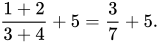
Parentheses can be nested, and should be evaluated from the inside outward. For legibility, outer parentheses can be made larger than inner parentheses. Alternately, other grouping symbols, such as curly braces { } or square brackets [ ], are sometimes used along with parentheses ( ). For example:
![{\displaystyle {\bigl [}(1+2)\div (3+4){\bigr ]}+5=(3\div 7)+5}](https://wikimedia.org/api/rest_v1/media/math/render/svg/7104db19815d8411864ae450eb118ee4f064dce1)
Special cases
[edit]Unary minus sign
[edit]There are differing conventions concerning the unary operation '−' (usually pronounced "minus"). In written or printed mathematics, the expression −32 is interpreted to mean −(32) = −9.[2][8]
In some applications and programming languages, notably Microsoft Excel, PlanMaker (and other spreadsheet applications) and the programming language bc, unary operations have a higher priority than binary operations, that is, the unary minus has higher precedence than exponentiation, so in those languages −32 will be interpreted as (−3)2 = 9.[9] This does not apply to the binary minus operation '−'; for example in Microsoft Excel the formulas =-2^2, =(-2)^2 and =0+-2^2 return 4, but the formulas =0-2^2 and =-(2^2) return −4.
Mixed division and multiplication
[edit]There is no universal convention for interpreting an expression containing both division denoted by '÷' and multiplication denoted by '×'. Proposed conventions include assigning the operations equal precedence and evaluating them from left to right, or equivalently treating division as multiplication by the reciprocal and then evaluating in any order;[10] evaluating all multiplications first followed by divisions from left to right; or eschewing such expressions and instead always disambiguating them by explicit parentheses.[11]
Beyond primary education, the symbol '÷' for division is seldom used, but is replaced by the use of algebraic fractions,[12] typically written vertically with the numerator stacked above the denominator – which makes grouping explicit and unambiguous – but sometimes written inline using the slash or solidus symbol '/'.[13]
Multiplication denoted by juxtaposition (also known as implied multiplication) creates a visual unit and is often given higher precedence than most other operations. In academic literature, when inline fractions are combined with implied multiplication without explicit parentheses, the multiplication is conventionally interpreted as having higher precedence than division, so that e.g. 1 / 2n is interpreted to mean 1 / (2 · n) rather than (1 / 2) · n.[2][10][14][15] For instance, the manuscript submission instructions for the Physical Review journals directly state that multiplication has precedence over division,[16] and this is also the convention observed in physics textbooks such as the Course of Theoretical Physics by Landau and Lifshitz[c] and mathematics textbooks such as Concrete Mathematics by Graham, Knuth, and Patashnik.[17] However, some authors recommend against expressions such as a / bc, preferring the explicit use of parenthesis a / (bc).[3]
More complicated cases are more ambiguous. For instance, the notation 1 / 2π(a + b) could plausibly mean either 1 / [2π · (a + b)] or [1 / (2π)] · (a + b).[18] Sometimes interpretation depends on context. The Physical Review submission instructions recommend against expressions of the form a / b / c; more explicit expressions (a / b) / c or a / (b / c) are unambiguous.[16]

This ambiguity has been the subject of Internet memes such as "8 ÷ 2(2 + 2)", for which there are two conflicting interpretations: 8 ÷ [2 · (2 + 2)] = 1 and (8 ÷ 2) · (2 + 2) = 16.[15][19] Mathematics education researcher Hung-Hsi Wu points out that "one never gets a computation of this type in real life", and calls such contrived examples "a kind of Gotcha! parlor game designed to trap an unsuspecting person by phrasing it in terms of a set of unreasonably convoluted rules".[12]
Serial exponentiation
[edit]If exponentiation is indicated by stacked symbols using superscript notation, the usual rule is to work from the top down:[2][7]
- abc = a(bc),
which typically is not equal to (ab)c. This convention is useful because there is a property of exponentiation that (ab)c = abc, so it's unnecessary to use serial exponentiation for this.
However, when exponentiation is represented by an explicit symbol such as a caret (^) or arrow (↑), there is no common standard. For example, Microsoft Excel and computation programming language MATLAB evaluate a^b^c as (ab)c, but Google Search and Wolfram Alpha as a(bc). Thus 4^3^2 is evaluated to 4,096 in the first case and to 262,144 in the second case.
Mnemonics
[edit]Mnemonic acronyms are often taught in primary schools to help students remember the order of operations.[20][21] The acronym PEMDAS, which stands for Parentheses, Exponents, Multiplication/Division, Addition/Subtraction,[22] is common in the United States[23] and France.[24] Sometimes the letters are expanded into words of a mnemonic sentence such as "Please Excuse My Dear Aunt Sally".[25] The United Kingdom and other Commonwealth countries may use BODMAS (or sometimes BOMDAS), standing for Brackets, Of, Division/Multiplication, Addition/Subtraction, with "of" meaning fraction multiplication.[26][27] Sometimes the O is instead expanded as Order, meaning exponent or root,[27][28] or replaced by I for Indices in the alternative mnemonic BIDMAS.[27][29] In Canada and New Zealand BEDMAS is common.[30]
These mnemonics may be misleading when written this way.[25] For example, misinterpreting any of the above rules to mean "addition first, subtraction afterward" would incorrectly evaluate the expression[25] as , while the correct evaluation is . These values are different when .


In Germany, the convention is simply taught as Punktrechnung vor Strichrechnung, "dot operations before line operations" referring to the graphical shapes of the taught operator signs U+00B7 · MIDDLE DOT (multiplication), U+2236 ∶ RATIO (division), and U+002B + PLUS SIGN (addition), U+2212 − MINUS SIGN (subtraction). This avoids the potential for the above misunderstanding.
Mnemonic acronyms have been criticized for not developing a conceptual understanding of the order of operations, and not addressing student questions about its purpose or flexibility.[31][32] Students learning the order of operations via mnemonic acronyms routinely make mistakes,[33] as do some pre-service teachers.[34] Even when students correctly learn the acronym, a disproportionate focus on memorization of trivia crowds out substantive mathematical content.[12] The acronym's procedural application does not match experts' intuitive understanding of mathematical notation: mathematical notation indicates groupings in ways other than parentheses or brackets and a mathematical expression is a tree-like hierarchy rather than a linearly "ordered" structure; furthermore, there is no single order by which mathematical expressions must be simplified or evaluated and no universal canonical simplification for any particular expression, and experts fluently apply valid transformations and substitutions in whatever order is convenient, so learning a rigid procedure can lead students to a misleading and limiting understanding of mathematical notation.[35]
Calculators
[edit]Different calculators follow different orders of operations.[2] Many simple calculators without a stack implement chain input, working in button-press order without any priority given to different operations, give a different result from that given by more sophisticated calculators. For example, on a simple calculator, typing 1 + 2 × 3 = yields 9, while a more sophisticated calculator will use a more standard priority, so typing 1 + 2 × 3 = yields 7.
Calculators may associate exponents to the left or to the right. For example, the expression a^b^c is interpreted as a(bc) on the TI-92 and the TI-30XS MultiView in "Mathprint mode", whereas it is interpreted as (ab)c on the TI-30XII and the TI-30XS MultiView in "Classic mode".
An expression like 1/2x is interpreted as 1/(2x) by TI-82,[3] as well as many modern Casio calculators[36] (configurable on some like the fx-9750GIII), but as (1/2)x by TI-83 and every other TI calculator released since 1996,[37][3] as well as by all Hewlett-Packard calculators with algebraic notation. While the first interpretation may be expected by some users due to the nature of implied multiplication,[38] the latter is more in line with the rule that multiplication and division are of equal precedence.[3]
When the user is unsure how a calculator will interpret an expression, parentheses can be used to remove the ambiguity.[3]
Order of operations arose due to the adaptation of infix notation in standard mathematical notation, which can be notationally ambiguous without such conventions, as opposed to postfix notation or prefix notation, which do not need orders of operations.[39][40] Hence, calculators utilizing reverse Polish notation (RPN) using a stack to enter expressions in the correct order of precedence do not need parentheses or any possibly model-specific order of execution.[25][22]
Programming languages
[edit]Most programming languages use precedence levels that conform to the order commonly used in mathematics,[41] though others, such as APL, Smalltalk, Occam and Mary, have no operator precedence rules (in APL, evaluation is strictly right to left; in Smalltalk, it is strictly left to right).
Furthermore, because many operators are not associative, the order within any single level is usually defined by grouping left to right so that 16/4/4 is interpreted as (16/4)/4 = 1 rather than 16/(4/4) = 16; such operators are referred to as "left associative". Exceptions exist; for example, languages with operators corresponding to the cons operation on lists usually make them group right to left ("right associative"), e.g. in Haskell, 1:2:3:4:[] == 1:(2:(3:(4:[]))) == [1,2,3,4].
Dennis Ritchie, creator of the C language, said of the precedence in C (shared by programming languages that borrow those rules from C, for example, C++, Perl and PHP) that it would have been preferable to move the bitwise operators above the comparison operators.[42] Many programmers have become accustomed to this order, but more recent popular languages like Python[43] and Ruby[44] do have this order reversed. The relative precedence levels of operators found in many C-style languages are as follows:
| 1 | () [] -> . :: |
Function call, scope, array/member access |
| 2 | ! ~ - + * & sizeof type cast ++ -- |
(most) unary operators, sizeof and type casts (right to left) |
| 3 | * / % MOD |
Multiplication, division, modulo |
| 4 | + - |
Addition and subtraction |
| 5 | << >> |
Bitwise shift left and right |
| 6 | < <= > >= |
Comparisons: less-than and greater-than |
| 7 | == != |
Comparisons: equal and not equal |
| 8 | & |
Bitwise AND |
| 9 | ^ |
Bitwise exclusive OR (XOR) |
| 10 | | |
Bitwise inclusive (normal) OR |
| 11 | && |
Logical AND |
| 12 | || |
Logical OR |
| 13 | ? : |
Conditional expression (ternary) |
| 14 | = += -= *= /= %= &= |= ^= <<= >>= |
Assignment operators (right to left) |
| 15 | , |
Comma operator |

(a+b)^2/2 (right). The latter corresponds to a hierarchical structure ("syntax tree") which is unique for the given expression. The compiler generates machine code from the tree in such a way that operations originating at the lowest hierarchy level are executed first.Examples:
!A + !Bis interpreted as(!A) + (!B)++A + !Bis interpreted as(++A) + (!B)A + B * Cis interpreted asA + (B * C)A || B && Cis interpreted asA || (B && C)A && B == Cis interpreted asA && (B == C)A & B == Cis interpreted asA & (B == C)
(In Python, Ruby, PARI/GP and other popular languages, A & B == C is interpreted as (A & B) == C.)
Source-to-source compilers that compile to multiple languages need to explicitly deal with the issue of different order of operations across languages. Haxe for example standardizes the order and enforces it by inserting brackets where it is appropriate.
The accuracy of software developer knowledge about binary operator precedence has been found to closely follow their frequency of occurrence in source code.[46]
History
[edit]The order of operations emerged progressively over centuries. The rule that multiplication has precedence over addition was incorporated into the development of algebraic notation in the 1600s, since the distributive property implies this as a natural hierarchy. As recently as the 1920s, the historian of mathematics Florian Cajori identifies disagreement about whether multiplication should have precedence over division, or whether they should be treated equally. The term "order of operations" and the "PEMDAS/BEDMAS" mnemonics were formalized only in the late 19th or early 20th century, as demand for standardized textbooks grew. Ambiguity about issues such as whether implicit multiplication takes precedence over explicit multiplication and division in such expressions as a/2b, which could be interpreted as a/(2b) or (a/2) × b, imply that the conventions are not yet completely stable.[47][48]
See also
[edit]Notes
[edit]- ^ a b Some authors deliberately avoid any omission of parentheses with functions even in the case of single numerical variable or constant arguments (i.e. Oldham in Atlas), whereas other authors (like NIST) apply this notational simplification only conditionally in conjunction with specific multi-character function names (like
sin), but don't use it with generic function names (likef). - ^ To avoid any ambiguity, this notational simplification for monomials is deliberately avoided in works such as Oldham's Atlas of Functions or the NIST Handbook of Mathematical Functions.
- ^ For example, the third edition of Mechanics by Landau and Lifshitz contains expressions such as hPz/2π (p. 22), and the first volume of the Feynman Lectures contains expressions such as 1/2√N (p. 6–7). In both books, these expressions are written with the convention that the solidus is evaluated last.
References
[edit]- ^ "Calculation operators and precedence: Excel". Microsoft Support. Microsoft. 2023. Retrieved 2023-09-17.
- ^ a b c d e f g h i Bronstein, Ilja Nikolaevič; Semendjajew, Konstantin Adolfovič (1987) [1945]. "2.4.1.1. Definition arithmetischer Ausdrücke" [Definition of arithmetic expressions]. In Grosche, Günter; Ziegler, Viktor; Ziegler, Dorothea (eds.). Taschenbuch der Mathematik [Pocketbook of mathematics] (in German). Vol. 1. Translated by Ziegler, Viktor (23rd ed.). Thun, Switzerland: Harri Deutsch. pp. 115–120, 802. ISBN 3-87144-492-8.
Regel 7: Ist F(A) Teilzeichenreihe eines arithmetischen Ausdrucks oder einer seiner Abkürzungen und F eine Funktionenkonstante und A eine Zahlenvariable oder Zahlenkonstante, so darf F A dafür geschrieben werden. [Darüber hinaus ist noch die Abkürzung Fn(A) für (F(A))n üblich. Dabei kann F sowohl Funktionenkonstante als auch Funktionenvariable sein.]
- ^ a b c d e f
Peterson, Dave (Sep–Oct 2019). The Math Doctors (blog). Order of Operations: "Why?"; "Why These Rules?"; "Subtle Distinctions"; "Fractions, Evaluating, and Simplifying"; "Implicit Multiplication?"; "Historical Caveats". Retrieved 2024-02-11.
Peterson, Dave (Aug–Sep 2023). The Math Doctors (blog). Implied Multiplication: "Not as Bad as You Think"; "Is There a Standard?"; "You Can't Prove It". Retrieved 2024-02-11. - ^ Swokowski, Earl William (1978). Fundamentals of Algebra and Trigonometry (4 ed.). Boston: Prindle, Weber & Schmidt. ISBN 0-87150-252-6. p. 1:
The language of algebra [...] may be used as shorthand, to abbreviate and simplify long or complicated statements.
- ^ Weisstein, Eric Wolfgang. "Precedence". MathWorld. Retrieved 2020-08-22.
- ^ Oldham, Keith B.; Myland, Jan C.; Spanier, Jerome (2009) [1987]. An Atlas of Functions: with Equator, the Atlas Function Calculator (2nd ed.). Springer. doi:10.1007/978-0-387-48807-3. ISBN 978-0-387-48806-6.
- ^ a b Olver, Frank W. J.; Lozier, Daniel W.; Boisvert, Ronald F.; Clark, Charles W., eds. (2010). NIST Handbook of Mathematical Functions. National Institute of Standards and Technology. ISBN 978-0-521-19225-5. MR 2723248.
- ^ Angel, Allen R.; Runde, Dennis C.; Gilligan, Lawrence; Semmler, Richard (2010). Elementary Algebra for College Students (8th ed.). Prentice Hall. Ch. 1, §9, Objective 3. ISBN 978-0-321-62093-4.
- ^ "Formula Returns Unexpected Positive Value". Microsoft. 15 Aug 2005. Archived from the original on 2015-04-19. Retrieved 2012-03-05.
- ^ a b Chrystal, George (1904) [1886]. Algebra. Vol. 1 (5th ed.). "Division", Ch. 1 §§19–26, pp. 14–20.
Chrystal's book was the canonical source in English about secondary school algebra of the turn of the 20th century, and plausibly the source for many later descriptions of the order of operations. However, while Chrystal's book initially establishes a rigid rule for evaluating expressions involving '÷' and '×' symbols, it later consistently gives implicit multiplication higher precedence than division when writing inline fractions, without ever explicitly discussing the discrepancy between formal rule and common practice.
- ^ Cajori, Florian (1928). A History of Mathematical Notations. Vol. 1. La Salle, Illinois: Open Court. §242. "Order of operations in terms containing both ÷ and ×", p. 274.
- ^ a b c Wu, Hung-Hsi (2007) [2004]. ""Order of operations" and other oddities in school mathematics" (PDF). Dept. of Mathematics, University of California. Retrieved 2007-07-03.
- ^ In the ISO 80000 standard, the division symbol '÷' is entirely disallowed in favor of a slash symbol: ISO 80000-2:2019, "Quantities and units – Part 2: Mathematics". International Standards Organization.
- ^ Lennes, N. J. (1917). "Discussions: Relating to the Order of Operations in Algebra". The American Mathematical Monthly. 24 (2): 93–95. doi:10.2307/2972726. JSTOR 2972726.
- ^ a b Strogatz, Steven (2 Aug 2019). "The Math Equation That Tried to Stump the Internet". The New York Times. Retrieved 2024-02-12. In this article, Strogatz describes the order of operations as taught in middle school. However, in a comment, he points out, "Several commenters appear to be using a different (and more sophisticated) convention than the elementary PEMDAS convention I described in the article. In this more sophisticated convention, which is often used in algebra, implicit multiplication (also known as multiplication by juxtaposition) is given higher priority than explicit multiplication or explicit division (in which one explicitly writes operators like × * / or ÷). Under this more sophisticated convention, the implicit multiplication in 2(2 + 2) is given higher priority than the explicit division implied by the use of ÷. That’s a very reasonable convention, and I agree that the answer is 1 if we are using this sophisticated convention. "But that convention is not universal. For example, the calculators built into Google and WolframAlpha use the less sophisticated convention that I described in the article; they make no distinction between implicit and explicit multiplication when they are asked to evaluate simple arithmetic expressions. [...]"
- ^ a b "Physical Review Style and Notation Guide" (PDF). American Physical Society. 2012. § IV.E.2.e. Retrieved 2012-08-05.
- ^ Graham, Ronald L.; Knuth, Donald E.; Patashnik, Oren (1994). Concrete Mathematics (2nd ed.). Reading, Mass: Addison-Wesley. "A Note on Notation", p. xi. ISBN 0-201-55802-5. MR 1397498.
An expression of the form a/bc means the same as a/(bc). Moreover, log x/log y = (log x)/(log y) and 2n! = 2(n!).
- ^ Fateman, R. J.; Caspi, E. (1999). Parsing TEX into mathematics (PDF). International Symposium on Symbolic and Algebraic Computation, Vancouver, 28–31 July 1999.
- ^ Haelle, Tara (12 Mar 2013). "What Is the Answer to That Stupid Math Problem on Facebook? And why are people so riled up about it?". Slate. Retrieved 2023-09-17.
- ^ "Rules of arithmetic" (PDF). Mathcentre.ac.uk. 2009. Retrieved 2019-08-02.
- ^ Ginsburg, David (1 Jan 2011). "Please Excuse My Dear Aunt Sally (PEMDAS)--Forever!". Education Week - Coach G's Teaching Tips. Retrieved 2023-09-17.
- ^ a b Vanderbeek, Greg (2007). Order of Operations and RPN (Expository paper). Master of Arts in Teaching (MAT) Exam Expository Papers. Lincoln: University of Nebraska. Paper 46. Retrieved 2020-06-14.
- ^ Ali Rahman, Ernna Sukinnah; Shahrill, Masitah; Abbas, Nor Arifahwati; Tan, Abby (2017). "Developing Students' Mathematical Skills Involving Order of Operations" (PDF). International Journal of Research in Education and Science. 3 (2): 373–382. doi:10.21890/ijres.327896 (inactive 12 Jul 2025). p. 373:
The PEMDAS is an acronym or mnemonic for the order of operations that stands for Parenthesis, Exponents, Multiplication, Division, Addition and Subtraction. This acronym is widely used in the United States of America. Meanwhile, in other countries such as United Kingdom and Canada, the acronyms used are BODMAS (Brackets, Order, Division, Multiplication, Addition and Subtraction) and BIDMAS (Brackets, Indices, Division, Multiplication, Addition and Subtraction).
{{cite journal}}: CS1 maint: DOI inactive as of July 2025 (link) - ^ "Le calcul qui divise : 6÷2(1+2)". Micmaths (Video) (in French). 17 Nov 2020.
- ^ a b c d Ball, John A. (1978). Algorithms for RPN calculators (1st ed.). Cambridge, Mass: Wiley. p. 31. ISBN 0-471-03070-8.
- ^ Davies, Peter (1979). "BODMAS Exposed". Mathematics in School. 8 (4): 27–28. JSTOR 30213488.
- ^ a b c Knight, I. S. (1997). "Why BODMAS?". The Mathematical Gazette. 81 (492): 426–427. doi:10.2307/3619621. JSTOR 3619621.
- ^ "Order of operations". Syllabus.bos.nsw.edu.au. Archived from the original (DOC) on 2021-02-24. Retrieved 2019-08-02.
- ^ Foster, Colin (2008). "Higher Priorities". Mathematics in School. 37 (3): 17. JSTOR 30216129.
- ^ Naddor, Josh (2020). Order of Operations: Please Excuse My Dear Aunt Sally as her rule is deceiving (MA thesis). University of Georgia.
- ^ Ameis, Jerry A. (2011). "The Truth About PEDMAS". Mathematics Teaching in the Middle School. 16 (7): 414–420. doi:10.5951/MTMS.16.7.0414. JSTOR 41183631.
- ^ Cheng, Eugenia (2023). Is Math Real? How Simple Questions Lead Us to Mathematics' Deepest Truths. Basic Books. pp. 235–238. ISBN 978-1-541-60182-6.
- ^ Lee, Jae Ki; Licwinko, Susan; Taylor-Buckner, Nicole (2013). "Exploring Mathematical Reasoning of the Order of Operations: Rearranging the Procedural Component PEMDAS". Journal of Mathematics Education at Teachers College. 4 (2): 73–78. doi:10.7916/jmetc.v4i2.633. p. 73:
[...] students frequently make calculation errors with expressions which have either multiplication and division or addition and subtraction next to each other. [...]
- ^ Dupree, Kami M. (2016). "Questioning the Order of Operations". Mathematics Teaching in the Middle School. 22 (3): 152–159. doi:10.5951/mathteacmiddscho.22.3.0152.
- ^ Taff, Jason (2017). "Rethinking the Order of Operations (or What Is the Matter with Dear Aunt Sally?)". The Mathematics Teacher. 111 (2): 126–132. doi:10.5951/mathteacher.111.2.0126.
- ^ "Calculation Priority Sequence". support.casio.com. Casio. Retrieved 2019-08-01.
- ^ "Implied Multiplication Versus Explicit Multiplication on TI Graphing Calculators". Texas Instruments. 2011. Retrieved 2025-07-22.
- ^ Announcing the TI Programmable 88! (PDF). Texas Instruments. 1982. Retrieved 2017-08-03.
Now, implied multiplication is recognized by the AOS and the square root, logarithmic, and trigonometric functions can be followed by their arguments as when working with pencil and paper.
(NB. The TI-88 only existed as a prototype and was never released to the public.) - ^ Simons, Peter Murray (2021). "Łukasiewicz's Parenthesis-Free or Polish Notation". Stanford Encyclopedia of Philosophy. Dept. of Philosophy, Stanford University. Retrieved 2022-03-26.
- ^ Krtolica, Predrag V.; Stanimirović, Predrag S. (1999). "On some properties of reverse Polish Notation". Filomat. 13: 157–172. JSTOR 43998756.
- ^ Henderson, Harry (2009) [2003]. "Operator Precedence". Henderson's Encyclopedia of Computer Science and Technology (Rev. ed.). New York: Facts on File. p. 355. ISBN 978-0-8160-6382-6. Retrieved 2023-09-17.
- ^ Ritchie, Dennis M. (1996). "The Development of the C Language". History of Programming Languages (2 ed.). ACM Press.
- ^ "6. Expressions". Python documentation. Retrieved 2023-12-31.
- ^ "precedence - RDoc Documentation".
- ^ Backus, John Warner; et al. (1963). "§ 3.3.1: Arithmetic expressions". In Naur, Peter (ed.). Revised Report on the Algorithmic Language Algol 60 (Report). Retrieved 2023-09-17. (CACM Vol. 6 pp. 1–17; The Computer Journal, Vol. 9, p. 349; Numerische Mathematik, Vol. 4, p. 420.)
- ^ Jones, Derek M. (2008) [2006]. "Developer beliefs about binary operator precedence". CVu. 18 (4): 14–21. Retrieved 2023-09-17.
- ^ Jensen, Patricia. "History and Background". 5010.mathed.usu.edu. Utah State University. Retrieved 2024-10-04.
- ^ Peterson, Dave (22 Nov 2000). "History of the Order of Operations". The Math Forum: Ask Dr Math. Archived from the original on 2002-06-19.
Further reading
[edit]- Fothe, Michael; Wilke, Thomas, eds. (2015). Keller, Stack und automatisches Gedächtnis – eine Struktur mit Potenzial [Cellar, stack and automatic memory – a structure with potential] (PDF). Kolloquium 14 Nov 2014 in Jena, Germany (in German). Bonn: Gesellschaft für Informatik. ISBN 978-3-88579-426-4.
External links
[edit]- Bergman, George Mark (2013). "Order of arithmetic operations; in particular, the 48/2(9+3) question". Dept. of Mathematics, University of California. Retrieved 2020-07-22.
- Zachary, Joseph L. (1997) "Operator Precedence", supplement to Introduction to Scientific Programming. University of Utah. Maple worksheet, Mathematica notebook.
Order of operations
View on GrokipediaFundamentals
Definition
The order of operations refers to a set of conventions that dictate the sequence in which arithmetic operations are performed when evaluating mathematical expressions containing multiple operators, ensuring consistent and unambiguous results.[6] These rules prioritize certain operations over others and specify how operations of equal precedence are handled, primarily applying to addition, subtraction, multiplication, division, exponentiation, and roots.[6] The core components of these conventions are as follows: first, evaluate expressions within parentheses or other grouping symbols; second, compute exponents and roots; third, perform multiplications and divisions from left to right; and finally, carry out additions and subtractions from left to right.[6] This structured approach resolves potential ambiguities in written expressions, such as 2 + 3 × 4, which could otherwise be interpreted in multiple ways depending on the sequence applied, leading to different outcomes like 20 (if addition precedes multiplication) or 14 (if multiplication precedes addition).[7] Unlike fundamental mathematical laws derived from axioms, the order of operations is a human-invented standard that evolved gradually through mathematical practice and notation development, rather than being discovered as an inherent property of numbers.[8]Importance
The order of operations serves as a foundational convention in mathematics, ensuring that expressions are evaluated unambiguously to yield a single, consistent result regardless of the interpreter. Without this standardized hierarchy, a simple expression like 2 + 3 × 4 could be computed as 20 (left-to-right) or 14 (multiplication first), leading to widespread confusion and inconsistent outcomes. This clarity is crucial in educational settings, where students learn to apply rules like PEMDAS (Parentheses, Exponents, Multiplication/Division, Addition/Subtraction) to build reliable problem-solving skills, as emphasized in mathematical curricula to foster precise reasoning. In engineering and scientific applications, adherence to these rules prevents misinterpretation of formulas used in calculations for circuit design, physical modeling, or data analysis, where ambiguity could compromise accuracy.[9] Ignoring the order of operations can result in significant real-world errors, particularly in high-stakes fields like medicine and engineering. For instance, misapplying these rules in pharmaceutical dosage computations might lead to incorrect drug quantities, potentially causing overdoses or underdoses that endanger patient safety, as highlighted in studies on calculation pitfalls in clinical practice.[10] In structural engineering, calculation errors could contribute to failures in load-bearing designs, underscoring the need for rigorous adherence to prevent costly or hazardous mistakes.[11] The order of operations functions analogously to grammar in natural language, resolving inherent ambiguities to standardize communication and enable shared understanding among mathematicians, scientists, and practitioners worldwide. Just as syntactic rules prevent misreadings in sentences, this mathematical framework eliminates interpretive variability, allowing complex equations to convey intended meanings reliably across disciplines. This parallel highlights its role in elevating mathematics from a subjective art to a precise science.[12]Core Rules
Conventional Priority
In conventional arithmetic, the order of operations establishes a strict hierarchy to ensure unambiguous evaluation of expressions containing multiple operators. This hierarchy prioritizes operations as follows: first, parentheses and other grouping symbols, which are evaluated innermost to outermost; second, exponents and roots, including fractional exponents and radicals; third, multiplication and division, performed at the same priority level from left to right; and fourth, addition and subtraction, also at the same level and evaluated from left to right.[13][14] Fractional exponents, such as for the square root of , and radicals, denoted by the symbol , are treated equivalently to integer exponents within this second priority level, as radicals can be rewritten as fractional powers (e.g., ).[15] This integration maintains consistency in handling power-related operations before multiplicative or additive ones. A point of variability arises with implied multiplication, where juxtaposition of terms (e.g., ) may be interpreted in some conventions as having higher precedence than explicit division, equivalent to , though standard rules treat it as ordinary multiplication evaluated left to right without elevated priority.[16][14] This convention is not universally enforced and can lead to ambiguity, underscoring the importance of explicit parentheses for clarity. The general evaluation algorithm proceeds iteratively through these levels:- Identify and resolve all grouping symbols, starting with the innermost.
- Compute all exponents and roots.
- Perform multiplications and divisions sequentially from left to right.
- Perform additions and subtractions sequentially from left to right.
Associativity
In the context of order of operations, associativity refers to the convention for grouping operations of the same precedence level when parentheses are absent, ensuring unambiguous evaluation of expressions.[17] For most arithmetic operations, including addition, subtraction, multiplication, and division, the standard mathematical convention is left-associativity, meaning expressions are evaluated from left to right.[17][18] This left-to-right grouping has a direct impact on the interpretation of chained operations. For instance, in an expression like , the division is performed as rather than , reflecting the non-commutative and non-associative nature of division while adhering to the left-associative rule.[17] Similarly, for subtraction, evaluates to , which differs from due to the operation's lack of associativity.[18] These conventions prevent ambiguity in linear expressions by imposing a consistent direction for evaluation within the same precedence level.[18] An exception to this left-to-right rule occurs with exponentiation, which follows right-associativity. Thus, is interpreted as rather than , aligning with the top-down grouping common in mathematical notation for power towers.[17][18] Exponentiation is non-associative, as while generally yields a different result, and the right-associative convention avoids confusion in stacked exponents by prioritizing the higher tower.[18] Such associativity rules are essential for operations that are not associative, like subtraction and division, where regrouping alters the outcome; without these conventions, expressions would require explicit parentheses to resolve grouping, leading to potential errors in computation and communication.[18] By standardizing left-associativity for additive and multiplicative operations and right-associativity for exponentiation, mathematics maintains clarity and consistency across expressions of equal priority.[17]Illustrations and Examples
Basic Arithmetic Examples
The order of operations ensures consistent evaluation of arithmetic expressions by prioritizing certain operations over others, as outlined in the PEMDAS convention: parentheses first, then exponents, followed by multiplication and division from left to right, and finally addition and subtraction from left to right.[13][19] This approach prevents ambiguity in simple calculations. Consider the expression . Multiplication precedes addition, so first compute , then add: .[20][21] Without this priority, the result would incorrectly be 20 if addition were done first. Parentheses override the standard priority, grouping operations to be performed first. For , evaluate inside the parentheses: , then multiply: .[13][20] This contrasts with the unparenthesized version, highlighting how grouping changes the outcome. Exponents are evaluated after parentheses but before multiplication or addition. In , compute the exponent: , then add: .[8][19] For mixed operations at the same level, such as addition and subtraction after higher priorities, proceed left to right. Evaluate : first multiplication , then left-to-right: , followed by .[13][21] This left-to-right rule applies similarly to multiplication and division.Advanced Expression Examples
To illustrate the application of order of operations in expressions with nested parentheses, consider . The innermost operation is the exponent: . Then add within the parentheses: . Proceed to multiplication: . Finally, subtract: . This step-by-step evaluation prioritizes parentheses and exponents before multiplication and subtraction, ensuring unambiguous results in complex arithmetic.[22] Expressions incorporating roots and fractions further demonstrate the hierarchy, where roots are treated equivalently to exponents and evaluated after parentheses but before multiplication or division. For example, evaluate . First, perform the division inside the radicand: . Then apply the square root: . Lastly, add: . This order prevents errors by resolving the fraction before the root function.[23] When combining multiple levels of operations, the full PEMDAS/BODMAS sequence applies sequentially from left to right for operations at the same level. Take . Start with the exponent inside parentheses: . Subtract: . Multiply: . Divide (left to right): . Add: . Such evaluations highlight how parentheses group terms to override default precedence.[24] A common pitfall arises in expressions like , where implied multiplication by juxtaposition—such as after resolving the parentheses to —creates ambiguity. Under the conventional strict PEMDAS rule, treat it as , yielding via left-to-right multiplication and division. However, some algebraic conventions prioritize implied multiplication, interpreting it as , underscoring the need for explicit parentheses to avoid confusion.[14]Exceptions and Clarifications
Unary Operators
Unary operators, particularly the unary minus (also known as negation), apply to a single operand to indicate its additive inverse, such as transforming 3 into -3.[25] This operator is distinct from the binary minus used for subtraction, which requires two operands, like in 5 - 3; the unary form specifically negates an individual term without involving another quantity.[25] In the order of operations, unary negation holds higher precedence than binary operators like multiplication, division, addition, and subtraction, ensuring it is evaluated early in expressions.[26] When unary negation interacts with exponentiation, it is applied after the exponentiation if positioned before the base, as the exponent binds more tightly to the base than the negation does. For instance, the expression is interpreted as , rather than .[27] This convention maintains consistency in algebraic evaluation, where the negation acts on the result of the powered term.[27] In mixed expressions, unary negation is resolved before surrounding binary operations, treating the negated term as a unit. Consider : the unary minus first negates 3 to yield -3, then multiplication produces , and finally addition gives .[26] This step-by-step precedence avoids ambiguity and aligns with standard mathematical parsing.[27]Multiplication and Division
In standard mathematical conventions, multiplication and division are operations of equal precedence and are evaluated from left to right when they appear in an expression without parentheses. For example, the expression is computed as . This left-to-right rule ensures consistent results in arithmetic and is a core component of the order of operations as taught in most educational systems.[22][28] A notable ambiguity arises with implied multiplication, also known as multiplication by juxtaposition, where numbers or variables are placed adjacent without an explicit multiplication symbol, such as in . Strict adherence to left-to-right evaluation would interpret this as , but in certain contexts, it is treated as by giving the implied multiplication higher precedence, as if parentheses were present around . This debate stems from variations in notational conventions, where implied multiplication is sometimes viewed as a tighter binding operation than explicit division.[16][14] The expression is mathematically ambiguous because multiplication and division have equal priority, leading to left-to-right evaluation as , but the colon can be misinterpreted as a fraction bar separating numerator and denominator , yielding . This highlights the need for explicit parentheses in inline expressions to avoid such misinterpretations.[29][30] Historically and contextually, implied multiplication often receives priority in physics and some advanced mathematical texts, reflecting a tradition of compact notation to emphasize functional relationships. For instance, physics literature, including style guides from journals like Physical Review, frequently interprets expressions like as to align with physical formulas where juxtaposition implies grouping. This practice contrasts with the stricter left-to-right approach in elementary mathematics and general computing, leading to inconsistencies across disciplines.[16][31] To resolve such ambiguities, international standards and mathematical authorities recommend the explicit use of parentheses in expressions involving mixed multiplication and division, particularly with implied operations. The ISO 80000-1 standard explicitly advises against ambiguous forms like and suggests clarifying notation to prevent misinterpretation. This practice promotes clarity and universality in mathematical communication.[16]Exponentiation Chains
In mathematics, chains of exponentiation, also known as power towers, are evaluated from right to left due to the right-associativity of the exponentiation operator. This convention ensures that an expression like is interpreted as rather than . Evaluating right to left yields , whereas left-to-right evaluation would give .[32][33] To explicitly denote such nested structures and avoid ambiguity, power towers are often written using stacked notation, such as , which confirms the right-associative grouping . This vertical representation aligns with the recursive definition of iterated exponentiation, where each level builds upon the previous one from the top down.[33] A common error arises when students apply left-to-right associativity to exponentiation chains, mistakenly treating them like multiplication or addition, which leads to incorrect results such as computing as 64. Right-associativity is the standard convention because exponentiation is not associative— in general—and the right-to-left rule preserves the intended hierarchical structure in mathematical notation, promoting consistency across expressions.[32] When exponentiation chains interact with other operations, the overall order of operations still applies, with exponents evaluated before addition or subtraction. For instance, is computed as , since the chain is first resolved right to left as , yielding .[32]Educational Tools
Mnemonics
Mnemonics serve as memory aids to help students recall the conventional order of operations in mathematics. The most widely used acronym in the United States is PEMDAS, which stands for Parentheses (grouping symbols evaluated first), Exponents (powers and roots next), Multiplication and Division (performed from left to right), and Addition and Subtraction (also from left to right).[34] This device emphasizes the hierarchy while reminding learners that operations of equal precedence, such as multiplication and division, are not strictly sequential but associative.[35] In the United Kingdom and Commonwealth countries, the equivalent mnemonic is BODMAS, representing Brackets (equivalent to parentheses), Orders (or Indices, for exponents), Division and Multiplication (left to right), and Addition and Subtraction (left to right).[36] A variation common in Canada is BEDMAS, where "B" denotes Brackets and "E" stands for Exponents, reflecting regional terminology preferences but maintaining the same operational sequence as PEMDAS and BODMAS.[35] These acronyms differ primarily in wording—such as "parentheses" versus "brackets" or "exponents" versus "orders"—to align with British English conventions, yet they convey identical rules.[2] Despite their popularity, these mnemonics have limitations, as they do not explicitly address associativity, leading students to overlook the left-to-right evaluation for operations of equal priority, such as treating multiplication before division simply because "M" precedes "D" in PEMDAS.[27] This can mislead learners into assuming a rigid linear order rather than the correct pairwise processing.[37] Research on their educational effectiveness indicates that mnemonics like PEMDAS improve short-term recall and academic performance in basic computations, with one study of Grade 8 students showing a significant posttest score increase (mean 84.34 versus 77.88 in traditional methods, t=4.801, p=0.001).[38] However, they often promote rote memorization over conceptual understanding, failing to foster reasoning about why operations are prioritized, as evidenced by persistent errors in applying rules flexibly.[37] Classroom investigations further reveal mixed long-term benefits, with initial gains in engagement and homework accuracy for many students but limited evidence of deeper mathematical insight.[39]Teaching Strategies
Teaching the order of operations effectively requires structured methods that build conceptual understanding and practical application in classroom settings. Educators often employ a combination of visual representations, hands-on activities, and targeted discussions to help students internalize the precedence rules, ensuring consistent evaluation of mathematical expressions across diverse learning needs.[37] Visual aids such as flowcharts and hierarchical diagrams play a crucial role in illustrating the step-by-step evaluation process. For instance, flowcharts can be constructed collaboratively by students using index cards to sequence operations like parentheses first, followed by exponents, then multiplication/division from left to right, and finally addition/subtraction, promoting algorithmic thinking and decomposition of complex problems.[40] Similarly, the "hierarchy-of-operators triangle" visually positions exponents at the apex, multiplication and division in the middle tier, and addition/subtraction at the base, helping learners grasp precedence without rote memorization alone.[37] Interactive exercises encourage active engagement by having students construct and evaluate expressions, fostering prediction of outcomes and peer collaboration. In group activities, such as the "Circle of Expressions" game, participants receive numbers and operations, build an expression incorporating all elements (e.g., using brackets to alter order), and pass it to peers for solving, rewarding integer results and eliminating creators of unsolvable ones to reinforce BODMAS/PEMDAS application.[41] These exercises progress from simple numerical problems to those with variables, allowing students to predict results before computation and discuss discrepancies.[37] Addressing common misconceptions, such as treating multiplication strictly before division or addition before subtraction regardless of position, involves explicit lessons on left-to-right evaluation within same-precedence operations and the role of negation. Teachers can use reciprocal explanations (e.g., division as multiplication by the inverse) to clarify why 8 ÷ 2 × 4 equals 16, not 1, and emphasize that negation applies after exponents, as in -3² = -9 rather than 9.[27] Storytelling and peer correction in small groups further target errors like over-reliance on strict acronym sequencing, leading to improved accuracy in expression evaluation.[37] Age-appropriate approaches tailor complexity to developmental stages, starting with basic rules in elementary school and advancing to algebraic integration. In fourth and fifth grades (ages 9-11), instruction focuses on simple expressions with parentheses and basic operations using concrete examples, building foundational fluency before introducing exponents.[42] By middle school (grades 6-8, ages 11-14), lessons incorporate multi-step problems with exponents and fractions, emphasizing associativity through group discussions for low-ability learners.[37] In algebra courses (high school, ages 14+), strategies extend to variable-containing expressions, using visual aids to explore how order affects equation solving and real-world modeling.[42]Practical Applications
In Calculators
Most scientific calculators implement the standard order of operations, adhering to the PEMDAS convention (Parentheses first, followed by Exponents, then Multiplication and Division from left to right, and finally Addition and Subtraction from left to right).[43][44] This ensures consistent evaluation of complex expressions entered directly into the device. For instance, Texas Instruments' TI-84 Plus CE graphing calculator employs an Equation Operating System (EOS) that prioritizes parentheses, followed by functions, powers and roots, permutations and combinations, multiplication/division (including implied), and then addition/subtraction, all evaluated left to right within the same precedence level.[43] Similarly, Casio's fx-570CW and fx-991CW scientific calculators use a priority sequence beginning with parenthetical expressions, then functions and powers, omitted (implied) multiplication, explicit multiplication/division, and addition/subtraction.[44] Basic four-function calculators, however, deviate significantly by processing operations strictly from left to right without applying precedence rules, requiring users to enter expressions in a specific sequential order to achieve correct results.[27] For example, entering 2 + 3 × 4 on such a device might compute as (2 + 3) × 4 = 20 instead of 2 + (3 × 4) = 14, necessitating manual adjustments like computing the multiplication first and adding parentheses-equivalent steps.[27] Some scientific and financial calculators offer a chain calculation mode as an alternative, where operations execute sequentially as entered (left to right) without full precedence enforcement, useful for simple sequential computations but potentially leading to errors in complex expressions unless parentheses are used.[45][46] A notable variation occurs in handling implied multiplication, where juxtaposition (e.g., 2x meaning 2 × x) is interpreted differently across models. On the TI-83 graphing calculator, implied multiplication shares the same precedence as explicit multiplication and division, evaluated left to right; thus, 1/2x is computed as (1/2) × x = 0.5x.[47] In contrast, certain Casio scientific calculators assign higher priority to implied multiplication, treating 1/2x as 1/(2x).[48] This discrepancy can affect results in expressions like 6 ÷ 2(1 + 2), yielding 9 on TI devices (left-to-right explicit priority) and 1 on some Casio models (implied higher priority).[47][48] Common errors in calculator use stem from inline entry methods, where the order of key presses influences interpretation without sufficient parentheses, leading to unintended precedence application.[49] Neglecting parentheses in ambiguous inputs, such as entering multi-step operations sequentially on chain-mode devices or misjudging implied multiplication, often results in incorrect outputs, emphasizing the need for explicit grouping to override default behaviors.[50][51]In Programming Languages
In programming languages, operator precedence rules dictate the order in which expressions are evaluated, often mirroring mathematical conventions but with language-specific nuances. Languages such as C++, Java, and Python generally follow left-to-right associativity for operations like multiplication (*), division (/), addition (+), and subtraction (-), while exponentiation—implemented as ** in Python—is right-associative. For instance, in Python, the expression 2 ** 3 ** 2 evaluates as 2 ** (3 ** 2) or 512, due to the right-to-left evaluation of the exponentiation operator.[52] Similarly, in C++ and Java, arithmetic operators adhere to the same left-to-right rule for multiplicative and additive operations, ensuring 2 + 3 * 4 yields 14 rather than 20.[53]
Ruby maintains a comparable precedence hierarchy, with ** evaluated right-to-left and *, /, +, - left-to-right, though it lacks a built-in implied multiplication for juxtaposed operands like 2(3), requiring explicit operators to avoid syntax errors. In contrast, SQL dialects exhibit variations, such as lower precedence for additive operators relative to multiplicative ones in arithmetic expressions, but with logical operators like AND taking precedence over OR, which can alter query outcomes without parentheses—for example, WHERE a = 1 OR b = 2 AND c = 3 is interpreted as WHERE a = 1 OR (b = 2 AND c = 3).[54][55] These differences from standard mathematical implied multiplication priorities, seen in some tools, highlight the need for explicit handling in code.[56]
Programmers can override default precedence using parentheses, which universally have the highest priority across these languages, allowing precise control over evaluation order—e.g., (2 + 3) * 4 in Python or Java. Some languages provide libraries or functions for custom operator behaviors, such as Python's operator module for functional equivalents like operator.add and operator.mul, enabling modular expression building. For debugging precedence-related issues, language documentation offers detailed tables; consulting Python's official reference or C++'s cppreference ensures accurate parsing of complex expressions like a * b + c / d % e.[52][53]