Hubbry Logo
Pacemaker (running)Pacemaker (running)Main
Open search
Pacemaker (running)
Community hub
Pacemaker (running)
logo
8 pages, 0 posts
0 subscribers
Be the first to start a discussion here.
Pacemaker (running)
Pacemaker (running)
from Wikipedia

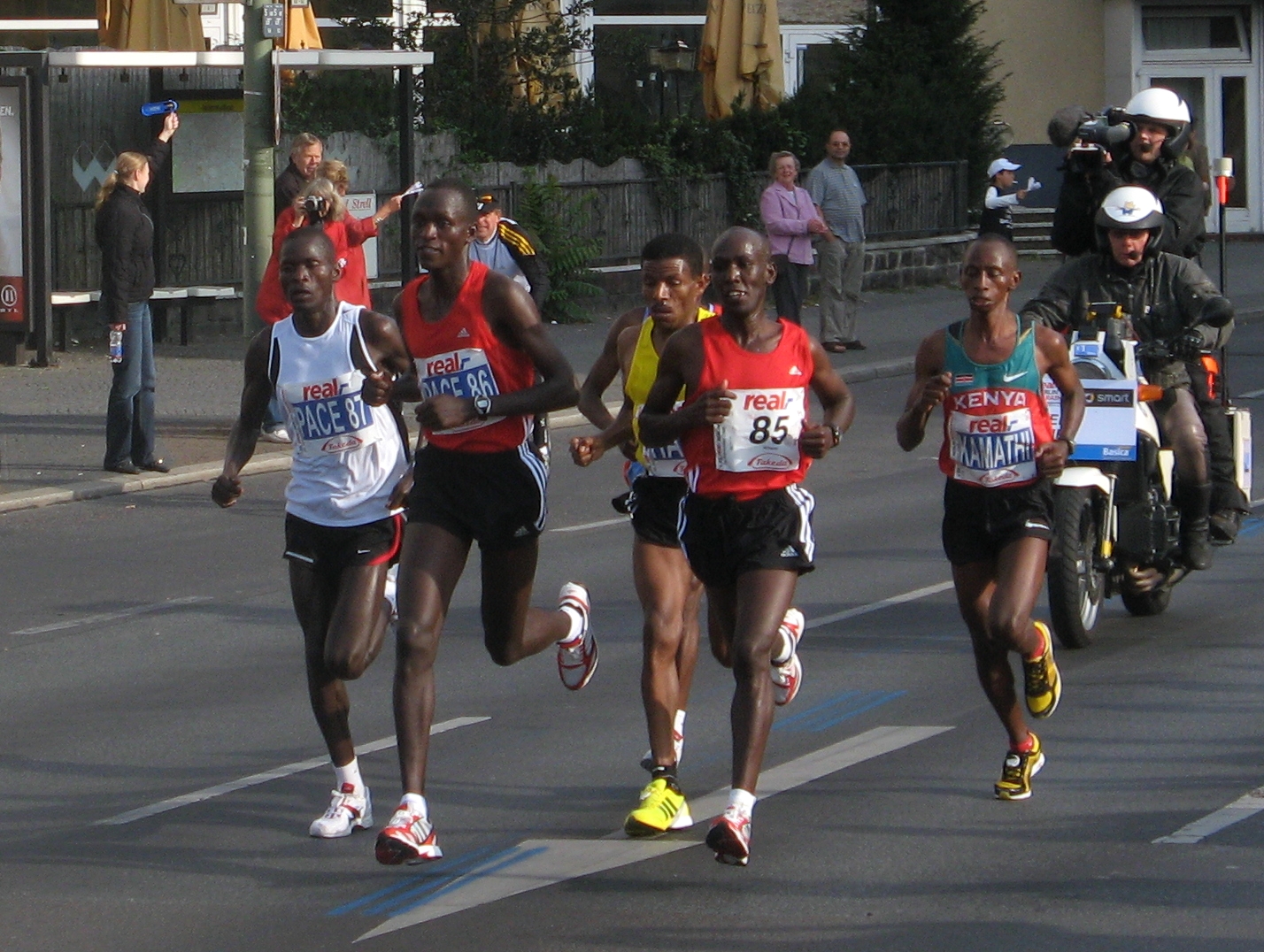
Rabbits Abel Kirui, Elijah Keitany [de] and Wilson Kigen [de] pacing Haile Gebrselassie and Charles Kamathi at the Berlin Marathon 2008

A pacemaker or pacesetter, sometimes informally called a rabbit,[1] is a runner who leads a middle- or long-distance running event for the first section to ensure a high speed and to avoid excessive tactical racing. A competitor who chooses the tactic of leading in order to win is called a front-runner rather than a pacemaker.

Pacemakers are frequently employed by race organisers for world record attempts with specific instructions for lap times, or helping runners knows where their invisible "opponent" predecessor is at that stage of the race. Some athletes have essentially become professional pacemakers. Pacemakers may be used to avoid deceptive tactics by competitors who, for example, race away from the start line and are likely to subsequently slow down, giving the other runners the impression that they are far behind. A trusted team of pacemakers who are paid to keep the runners at a speed that they can manage for the rest of the race become useful in such a situation. Pacemakers can also facilitate drafting and convey tangible pacing information during a race.

For amateur runners, pacemakers assist in reaching personal goals -- for example, in marathons there are often pacemakers for 3 hours, 3:30, 4 hours, etc. Such pace-setters are referred to as a pacing bus or bus in South African races.[2][3] This role differs from ultramarathon running, where pacers typically join individual runners partway through the race to provide support and companionship rather than setting the overall race pace.

Flashing lights in the side of tracks set to a specific pace were an innovation introduced in 1972 by the professional International Track Association to provide visual excitement to their races.[4] The Wavelight system using LEDs became common at major competitions in the early 2020s and is permitted by World Athletics for record ratification.[5]

History

[edit]
Pacemaker (on the left) at London Marathon 2014

The use of pacemaking increased after Chris Brasher and Chris Chataway successfully paced Roger Bannister to break the four-minute mile for the first time in 1954.[6][7]

Purists argue that employing pacemakers detracts from the competitive nature of racing. Original rules frowned on a competitor who was not actively trying to win, and pacemakers were required to finish a race for any record to count. This rule was later dropped, though the pacemaker must start with the other competitors as a registered entrant. A lapped competitor may not act as a pacemaker.

Ben Jipcho acted as a pacemaker for Kenyan teammate Kipchoge Keino in the 1968 Olympic men's 1500m, allowing Keino's sustained speed to build up enough of a lead to counteract rival Jim Ryun's fast kick finish. Whereas most pacemakers are shorter-distance runners assisting in a longer-distance record attempt, Jipcho's favoured events were longer than 1500m, and there was no prospect of breaking a record.

The 1500 metres at the Bislett Games in 1981 became part of track folklore when star athletes including Steve Ovett chose not to follow pacemaker Tom Byers but race among themselves. Ovett's last lap was almost 10 seconds faster than Byers's, but Byers, though a pacemaker, held on to win by a few metres.[8] There was a similar case in the 1994 Los Angeles Marathon when veteran marathoner Paul Pilkington was paid to set a fast pace then drop out. When the elite athletes failed to follow his pace, he kept going, ultimately winning US$27,000 and a new Mercedes car,[9] to the surprise of the expected favourites. That year, the L.A. Marathon was the National Championship race, so he also became the United States National Champion. Brazilian Vanderlei De Lima, later the marathon bronze medalist in the 2004 Summer Olympics, was a pacemaker at the Reims Marathon in 1994. It was his first competitive marathon, and he was supposed to be a pacemaker up to the 21-kilometre (13-mile) point, but won the race.[10]

During the Berlin Marathon in 2000, Simon Biwott was hired as a pacemaker, but crossed the finish line as the winner.

The rules for pacemakers specify that not more than three of them are dedicated to one group of runners.[11]

In the 2003 Berlin Marathon, Paul Tergat (Kenya) set a new world record with 2:04:55; pacemaker Sammy Korir finished 1 second behind in second place. At 34.5 km (21.5 miles) into the run, Korir tried, unsuccessfully, to make a move on Tergat.[12]

In the April 2024 Beijing Half-Marathon, He Jie had his medal revoked when it was discovered, by a special committee, that three pacemakers deliberately slowed down to let him win. The event operators apologized saying they were unaware that one of their sponsors, had hired four pacemakers (one pacemaker did not finish the race). The committee disqualified the operator from hosting the Beijing Half Marathon and banned the sponsor from sponsoring any more races this season. When interviewing one of the pacemakers, they responded, “I was hired to be a pacemaker, not to win the race.”[13]

Pacemakers are also used in horse racing, where in "classic" distance races (over 1 mile or 8 furlongs or 1.5 kilometres) horses that are better at sprint distances (roughly 5–6+12 furlongs or 1.0–1.3 kilometres) may be entered into major races specifically to set the pace for the top horses from the same stable. On a few occasions, pacemakers have finished ahead of the horses they were setting the pace for, such as when Summoner won the 2001 Queen Elizabeth II Stakes, and At First Sight running second in the 2010 Epsom Derby ahead of his two more-favoured stablemates.

See also

[edit]

References

[edit]
[edit]
Revisions and contributorsEdit on WikipediaRead on Wikipedia
from Grokipedia
A pacemaker, also known as a pacesetter or , is a runner who intentionally leads a middle- or long-distance race for an initial portion to establish a targeted pace, enabling competitors to conserve energy and achieve optimal performance before the pacemaker typically withdraws prior to the finish. This role is distinct from competitive participants, as pacemakers are often hired professionals focused solely on rhythm-setting rather than winning, and they may rotate in formations like a V-shape to shield followers from wind resistance. In practice, pacemakers help prevent runners from starting too aggressively, maintain even splits, and reduce mental fatigue by eliminating the need for constant pace monitoring. The use of pacemakers traces back to at least 1954, when Chris Brasher and Chris Chataway assisted Sir in breaking the barrier at Iffley Road Track in , with Brasher leading the first two laps and Chataway the third, culminating in Bannister's 3:59.4 finish. This informal pacing evolved into a formalized strategy in professional athletics during the late , particularly in record-attempt races, where pacemakers ensure consistent speeds to push human limits, as seen in Eliud Kipchoge's INEOS 1:59 Challenge in 2019, supported by a rotating team of 41 pacers. Their contributions have been pivotal in numerous world records, though they remain unsung, often earning fees for travel and performance while forgoing personal glory. Under World Athletics regulations, pacemakers are permitted in labeled road races but must be clearly identifiable via distinctive uniforms or bibs marked "PACE". In track events and major championships like the Olympics, external pacing assistance is prohibited to preserve competitive integrity, though pacemakers are allowed in non-championship meets for record ratification if they fully participate from the start. This distinction underscores their role in exhibition-style or record-focused events, where innovations like rotating pacers and wind-blocking tactics have become standard to optimize outcomes.

Definition and Role

Definition

A pacemaker, also known as a pacesetter or , is a runner who intentionally leads a middle- or long-distance race at a predetermined pace to guide the elite competitors and facilitate optimal performance conditions. Unlike athletes contending for victory, pacemakers typically withdraw before the finish line after completing their pacing duties and thus do not claim places, win prizes, or set official records in that role. The term "" is used as a shorthand for pacesetter, particularly in middle-distance track events. By breaking the wind and establishing a consistent rhythm, pacemakers enable elite runners to achieve faster overall times than they might in a more tactical, unassisted race.

Primary Functions

Pacemakers in running events serve to set an optimal pace that aligns with specific performance targets, such as attempts, by leading the field at predefined split times to ensure runners adhere to the desired rhythm. This function minimizes tactical energy expenditure, as followers avoid the responsibility of initiating surges or monitoring pace independently, thereby reducing and promoting more efficient race execution. In record-focused scenarios, pacemakers receive explicit instructions from organizers to hit or segment goals, facilitating collective progress toward ambitious time objectives. A core benefit of this pacing arises from aerodynamic advantages, where the lead pacemaker breaks the wind, creating a slipstream that substantially lowers drag for trailing athletes. Studies indicate that runners directly behind a pacemaker can experience up to a 67% reduction in aerodynamic drag, which can translate to energy savings allowing approximately 2-3% faster in optimized formations, depending on race conditions. This conservation allows elite competitors to run more efficiently, preserving physiological resources for a decisive finish surge rather than depleting them on wind resistance or inconsistent efforts. The application of these functions adapts to race distances, with pacemakers in middle-distance events like the 800m or 1500m typically adopting aggressive strategies to accelerate the opening and deter conservative tactics, thus enabling faster overall times. In contrast, for longer races such as marathons, pacemakers prioritize a uniform to sustain endurance, helping athletes distribute energy evenly across the distance and avoid mid-race slowdowns.

Applications in Events

Track and Field Races

Pacemakers play a crucial role in track and field races by setting an initial tempo to facilitate faster overall times and reduce tactical maneuvering among competitors. They are commonly employed in middle- and long-distance events ranging from 800 meters to 10,000 meters, both indoors and outdoors, particularly in high-profile series such as the . In these races, pacemakers start at the front of the field and lead for the initial laps at a predetermined pace designed to align with target splits for record attempts or optimal . For instance, in an -meter race, a pacemaker might cover the first 400 meters before exiting, while in a 1,500-meter or mile event, they often lead the first to 1,000 meters. regulations, as outlined in the Continental Tour guidelines, incorporate pacemakers into maximum field sizes—such as 11 athletes (including pacemakers) for meters and 15 for 1,500 meters—to ensure organized competition. Pacemakers are required to drop out before the final stages of the race, typically stepping off the track inside or outside the lanes to avoid influencing the outcome, resulting in a "" (DNF) status. This practice adheres to technical rules prohibiting undue assistance while permitting registered pacemakers as participants. In longer events like the 5,000 meters or 10,000 meters, multiple pacemakers may rotate to sustain the pace across early laps. Their integration is most prominent in invitational meets and dedicated record-attempt races within the , such as the Dream Mile, where pacemakers help athletes like those in the 2010 1,500 meters achieve sub-3:30 times by minimizing early slowdowns. This setup contrasts with major championships, where pacemakers are generally not used to maintain competitive integrity.

Road and Marathon Events

In road running events, particularly marathons and half-marathons, pacemakers—often referred to as "rabbits" or "pacesetters"—play a crucial role in guiding elite athletes through the initial portions of the race to foster competitive pacing and potentially faster overall times. These runners, typically elite athletes themselves, lead the field at a predetermined speed, often dropping out after 10 to 20 kilometers to allow the main competitors to surge ahead without competition from the pacer. For instance, in the , pacemakers have been employed since the to support attempts, as seen in Paula Radcliffe's 2003 performance where male rabbits helped her achieve a then-world-best time of 2:15:25. Similarly, the frequently uses multiple pacemakers to optimize even splits over the 42.195-kilometer distance, contributing to records like Kelvin Kiptum's 2:00:35 in Chicago 2023 and Tigist Assefa's women's of 2:11:53 in Berlin 2023. In half-marathons, such as the Rotterdam Half Marathon, pacesetters guide elite waves for the first half, adapting their role to the shorter 21.1-kilometer format while emphasizing early surge control. Road events demand distinct adaptations from pacemakers compared to track races, primarily due to unpredictable terrain, fluctuating weather, and large crowds that can disrupt rhythm. Pacers must navigate hills, uneven surfaces, and urban obstacles—such as those in the 's route through and —while maintaining consistent splits, often relying on lead vehicles equipped with digital clocks for real-time feedback visible to the pack. Weather variations further complicate this; for example, in the 1993 , pacers faced strength-sapping 80°F (27°C) heat, requiring adjustments for and hydration needs. Crowd effects are mitigated through group formations, where pacemakers run in clusters of 3–6 to shield elites from wind and enhance visibility, with planned exits (e.g., veering to the side at aid stations) to avoid impeding the leaders. These strategies ensure pacers provide reliable guidance across the variable conditions inherent to road courses, unlike the controlled laps of tracks. Regulatory frameworks for pacemakers in road and marathon events are less uniform than in track competitions, reflecting the diverse nature of urban races and a balance between spectacle and purity. Under World Athletics Rule 6.3.1, pacing assistance from non-participants or lapped runners is prohibited in sections of races, but designated pacemakers are permitted if they start with the field as entrants, often without bib numbers to denote their non-competitive status. Major events vary in policy: the bans formal pacemakers to preserve its championship-style head-to-head racing, emphasizing unassisted performances since its inception in 1897, while the London and Marathons allow them exclusively in waves to attract top talent and records. Some races, like the , eliminated pacemakers in 2007 to align with this purist approach, though informal pacing by teammates occasionally occurs. For world records, assistance from opposite-sex pacers is restricted, leading to separate categories, as when Radcliffe's mark was reclassified in 2011. This patchwork regulation underscores running's emphasis on event-specific governance over track's standardized protocols.

Historical Development

Origins in Early Athletics

The practice of pacing in running emerged informally during the through the sport of , a form of competitive endurance walking and running that originated in Britain and gained widespread popularity in and the . Pedestrianism involved challenge races and multi-day events funded by wagering, where athletes attempted feats like walking 1,000 miles in 1,000 consecutive hours or competing in six-day "go-as-you-please" races on indoor tracks. In these grueling contests, runners frequently received support from companions or trainers who provided encouragement, monitored progress, and helped sustain a consistent through off-track assistance, laying the groundwork for structured pacing tactics. As organized meets proliferated in and the following the establishment of athletic associations like the in America (1888) and the growth of international competitions, informal support practices from contributed to the broader development of . However, such assistance remained unregulated and often controversial due to amateur ideals emphasizing individual effort. This period marked the integration of tactics into standardized tracks. A pivotal moment came at the 1908 London Olympics, where pacing tactics subtly shaped outcomes in track and marathon events despite official prohibitions in preparatory trials. In the marathon, British runners like Jack Price adopted aggressive leading strategies to "hold" rivals such as Canada's , setting a fast early pace that exhausted the field amid hot conditions, though it led to several collapses including Price's at 17.5 miles. Organizers explicitly banned pace-making in the Midland Olympic Trial to ensure fair competition, underscoring the tactic's growing prevalence and the need for rules. These Olympics exemplified how pacing could control race dynamics, influencing performances in middle-distance events as well. This early use of pacing in competitive settings reflected broader changes, with the tactic becoming a tool for tactical advantage in an era of rising competition standards.

Evolution in Professional Era

The use of pacemakers in professional athletics began to formalize in the mid-20th century, particularly following Bannister's landmark sub-four-minute mile in 1954, where pacemakers played a crucial role in pacing the effort, leading to increased acceptance under International Amateur Athletic Federation (IAAF, now ) guidelines that permitted such assistance as long as participants were official entrants competing in the race. By the 1950s and 1960s, IAAF rules evolved to implicitly allow pacemakers in record attempts, shifting from earlier prohibitions on non-competitive assistance to recognizing their role in structured events, though they were required to complete the race for records to be ratified. This period marked a transition from informal "ghost runners" to more regulated usage in elite competitions. The 1970s saw a notable rise in pacemaker employment, driven by growing professionalism in athletics and the popularity of indoor meets, where controlled environments facilitated precise record chases in middle- and long-distance events. Indoor competitions, such as those in the United States and Europe, increasingly incorporated pacemakers to maintain even splits, enhancing the feasibility of breaking longstanding marks amid expanding global interest and sponsorship. Key milestones in the included a boom in pacemaker usage within European track circuits, exemplified by the launch of the in 1981, which standardized their role in high-profile meets to attract top talent and spectators. By the 2000s, pacemakers were fully integrated into the IAAF Grand Prix series, becoming a norm for optimizing performances in series events and world record pursuits, with organizers routinely employing them to ensure competitive pacing. Recent trends post-2020 have introduced virtual pacing aids, such as the Wavelight system—approved by in 2019 under updated technical rules (C2.1)—which uses LED lights embedded in the track to provide visual pace guidance without human intervention. Commercially, pacemakers transitioned from volunteers or teammates to paid professionals, with meet organizers or sponsors covering fees, travel, and bonuses tied to achieving target splits, reflecting the sport's shift toward a more market-driven model. This evolution has positioned pacemakers as specialized athletes, often former competitors, earning competitive compensation for their contributions to event success.

Notable Examples and Impact

Prominent Pacemakers

One of the most celebrated pacemakers in running history is Chris Brasher, who played a pivotal role in Roger Bannister's groundbreaking sub-four-minute mile on May 6, 1954, by leading the first two laps at the Iffley Road track in . As an accomplished steeplechaser, Brasher had competed at the 1952 Olympics, finishing 11th in the 3000m steeplechase, before transitioning to a supporting role that cemented his legacy in athletics. His career path exemplified many elite runners who, after competitive peaks, contributed to the sport through pacing, later earning recognition as an unheralded hero of Bannister's achievement and going on to found the London Marathon in 1981. Equally instrumental was , who took over pacing duties from Brasher, guiding Bannister through the third lap to ensure the record pace held during that historic 3:59.4 performance. A British Olympian and 5000m specialist, Chataway set a in the 5000m later in 1954 with a time of 13:51.6, showcasing his credentials before embracing pacing as a way to influence major milestones. Many pacemakers like Chataway were former top competitors who shifted roles due to the demands of the sport, and his contributions were honored through his later prominence in and , where he reflected on pacing as a selfless act central to athletics lore. In the modern track era, has emerged as a prominent pacemaker, notably serving in Eliud Kipchoge's 1:59 Challenge in 2019, where he helped maintain the grueling pace during the sub-two-hour marathon attempt in . A two-time Olympic medalist in the 5000m—silver in 2016 and bronze in 2021—Chelimo's career path transitioned from front-line racing to pacing after navigating injuries and tactical shifts, allowing him to leverage his speed and experience in support roles at events like the . His efforts have been recognized within athletics circles for bridging elite competition and assistance, earning praise from peers for his reliability in high-stakes record attempts. Simon Biwott stands out among marathon pacemakers for his unexpected victory in the 2000 , where he was hired to lead the elite field but surged ahead to win in 2:07:42 after his designated drop-out point, marking a rare triumph for a pacemaker. As a Kenyan runner from with a background in competitive marathons, Biwott's path involved pacing as a professional side pursuit amid a career affected by injuries, similar to many East African athletes who balance multiple roles to sustain their livelihoods. This feat garnered him significant prize money—50,000 German marks (equivalent to about $25,000 USD at the time)—and enduring recognition in records as a symbol of the unpredictable impact pacemakers can have. Josphat Boit has made unique contributions as a pacemaker in world-record marathons, including leading through the halfway point before dropping out at 25 km during the 2018 , where Kipchoge set a then-world record of 2:01:39. A lesser-known Kenyan with competitive experience in half-marathons, Boit's career reflects the common trajectory of emerging talents who turn to pacing after limited success in solo races, providing steady support in major events. While formal awards for pacemakers remain scarce, Boit's role in historic performances has been acknowledged in athletics media as vital to the evolution of marathon pacing strategies. Erik Sowinski exemplifies the professional pacer in contemporary track events, frequently leading middle-distance races like the 800m and 1500m at Diamond League meets to facilitate fast times and records. A former collegiate standout and sub-1:45 800m runner, Sowinski shifted to full-time pacing after injuries curtailed his competitive career, becoming one of the most in-demand "rabbits" due to his precise tempo control and endurance. His contributions have earned quiet respect within the track community, though recognition often comes through the success of the athletes he supports rather than individual honors. In women's events, pacing has also enabled record pursuits, as seen with British Olympian Georgia Bell serving as a key pacer for Faith Kipyegon's 2025 Breaking4 mile attempt in , where Kipyegon ran 4:06.42—the fastest women's mile ever—supported by a team of 12 international Nike athletes in a controlled exhibition format.

Influence on Records and Performances

Pacemakers have played a pivotal role in facilitating breaks across various running distances, particularly by enabling athletes to sustain optimal speeds through controlled pacing and drafting. In middle-distance events such as the 1500m and mile, the majority of modern s have been achieved in races featuring pacemakers, who set an even tempo for the initial laps to minimize energy waste on surge management. For example, Hicham El Guerrouj's 1999 mile of 3:43.13 was supported by pacers who led the early stages, allowing him to focus on a strong finish. Similarly, in longer events, Eliud Kipchoge's landmark 1:59:40 marathon during the 2019 INEOS 1:59 Challenge relied on a rotating team of elite pacemakers, with groups of 5-7 running simultaneously in a V-formation to shield him from wind resistance and maintain a precise pace, though the performance was not ratified as an official due to the experimental format and multiple aids. The performance enhancements provided by pacemakers are quantifiable, primarily through aerodynamic drafting and psychological relief from pace monitoring. Drafting behind a pacemaker can reduce air resistance, saving elite runners approximately 80% of the energy expended against wind at paces around 4:30 per mile, equivalent to about 1 second per 400 meters or 2-3 seconds per kilometer. This benefit compounds over distance; in a 1500m race, it could shave 4-6 seconds off the total time compared to an unpaced effort, while in marathons, cumulative savings from sustained drafting can exceed several minutes. Pacemakers have thus been instrumental in pushing physiological limits, such as enabling repeated sub-4-minute miles since Roger Bannister's 1954 breakthrough, which itself utilized informal pacers Chris Brasher and Chris Chataway to break the psychological barrier. Over the long term, the integration of pacemakers has elevated global performance standards by fostering faster average race times and inspiring training innovations, with elite fields now routinely targeting paced efforts in major meets. However, this reliance has fueled ongoing debates about the authenticity of records set under such conditions, as evidenced by ' refusal to ratify Kipchoge's sub-two-hour marathon due to the non-standard use of multiple rotating pacers and pacing aids like lasers, which deviate from open-competition protocols. These discussions highlight a tension between technological and tactical advancements that drive progress and the desire to preserve the purity of unassisted human achievement.

Techniques and Challenges

Pacing Strategies

Pacemakers employ precise pacing strategies to guide elite runners toward target times, particularly in middle- and long-distance track events, by maintaining consistent splits and adapting to race conditions. These tactics prioritize even pacing to minimize energy waste, allowing athletes to conserve resources for a strong finish while benefiting from drafting. For instance, in the 1500m, pacemakers often target lap times around 55 seconds per 400m to achieve world-record paces, as seen in Hicham El Guerrouj's 1998 record (3:26.00) where the first 400m was run in 55 seconds, slightly faster than subsequent laps. Pace-setting techniques focus on split management, with pacemakers aiming for segments to counteract natural deceleration. In events like the mile, a pacemaker might hit the first quarter in 57 seconds to set an even , adjusting speed if the pursuing pack falls behind to keep the group intact. Adjustments for external factors, such as wind resistance, involve positioning to shield followers through drafting, which can reduce effort by up to 15% by breaking the . Group dynamics also influence tactics; pacemakers monitor the lead pack's cohesion, slowing marginally if runners lag to prevent splits that could disrupt the race flow. Preparation for pacing duties begins with detailed pre-race planning, incorporating input to define target splits based on the athlete's goals and event specifics. Pacemakers use tools like GPS-enabled watches to simulate race conditions and rehearse times, ensuring familiarity with the track's layout, such as tight turns that affect . In multi-pacer setups, common for longer distances like the 5000m, rotations are scheduled—typically every few laps—to maintain fresh leadership and sustain the pace without fatigue impacting accuracy. Simulations, often conducted in training sessions, help pacemakers internalize adjustments for variables like or . During execution, pacemakers initiate a strong start to assemble a lead pack, surging ahead to enforce the planned from the gun and discourage tactical slowing by competitors. They signal pace primarily through consistent positioning at , with occasional verbal calls or gestures to confirm splits if needed, though many rely on the visual cue of their stride for followers to match. The drop-out is timed precisely, often after halfway (e.g., 800m in a 1500m), executed by veering to the outside or inside to avoid , ensuring the pacemaker's exit does not alter the race's competitive dynamics. This controlled withdrawal allows the targeted athletes to surge independently toward the finish.

Physical and Ethical Considerations

Pacemakers in running face significant physical demands due to the intense, high-speed efforts required in the early stages of races, often without the full commitment to completing the event. These athletes typically train with regimens similar to elite middle-distance runners, emphasizing speed endurance through workouts such as repeated 150-400 meter intervals at with short recoveries, which build the anaerobic capacity needed for leading at record paces. However, the role's focus on short, explosive bursts increases the risk of overuse injuries common in , including strains, calf injuries, and lower back issues, as the abrupt cessation after pacing can lead to imbalanced recovery patterns. Compensation for professional pacemakers varies by event prestige and race distance but is generally modest compared to top competitors, with reports indicating payments of $2,000 to $3,000 per race for high-profile assignments, such as pacing Olympic champions in 800-meter events. Many transition to or administrative roles in , facing challenges like identity loss and financial instability common to retiring athletes, who must adapt skills in and to non-competitive environments. Ethical debates surrounding pacemakers center on their impact on race integrity, with critics arguing that they create "manufactured" outcomes by providing an unfair aerodynamic and psychological advantage, potentially blocking other competitors and diminishing the sport's tactical depth, as seen in criticisms of elite marathons where pacers enable records but skew natural competition. Proponents counter that pacemakers serve as a legitimate to minimize negative splitting and deceptive tactics, allowing athletes to focus on optimal pacing for genuine performances, a practice endorsed in track events to promote faster times without external interference. World Athletics regulations address these concerns through Rule 6.3.1, which prohibits pacing by non-participants, lapped athletes, or unauthorized devices to ensure fairness, requiring pacemakers to be registered competitors for eligibility and transparency in official races. Additionally, Rule 9.2.1 bans cross-sex pacing in mixed events over 5000 meters to prevent imbalances, while Section 57.8.2 extends prohibitions on unauthorized assistance to mountain and trail races.

References

Add your contribution
Related Hubs
User Avatar
No comments yet.