


Community hub
Recent from talks
Contribute something
Nothing was collected or created yet.
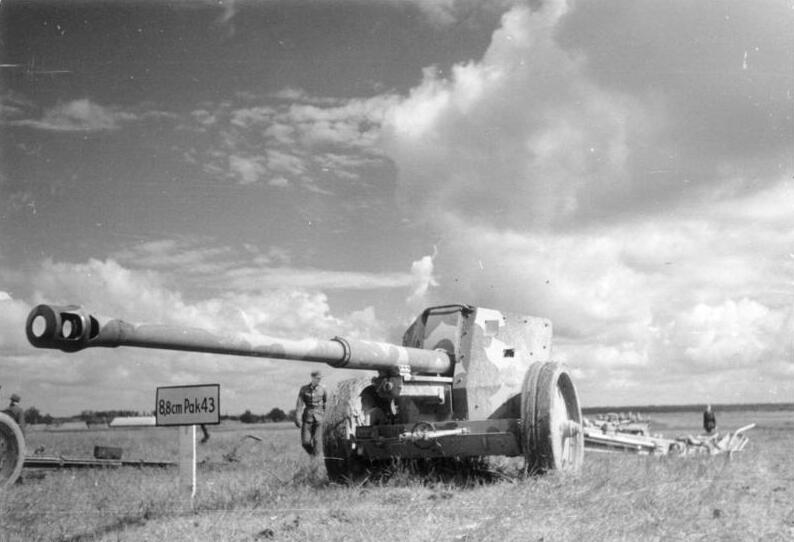
8.8 cm Pak 43
View on Wikipedia | This article includes a list of general references, but it lacks sufficient corresponding inline citations. (April 2009) |
The Pak 43 (Panzerabwehrkanone 43 and Panzerjägerkanone 43[2][3][4]) was a German 8.8 cm anti-tank gun developed by Krupp in competition with the Rheinmetall 8.8 cm Flak 41 anti-aircraft gun and used during World War II. The Pak 43 was the most powerful anti-tank gun of the Wehrmacht to see service in significant numbers, also serving in modified form as the 8.8 cm KwK 43 main gun on the Tiger II tank, the open-top Nashorn and fully enclosed, casemate-hulled Elefant and Jagdpanther tank destroyers.
Key Information


The improved 8.8 cm gun was fitted with a semi-automatic vertical breech mechanism that greatly reduced recoil.[5] It could also be fired electrically while on its wheels.[5] It had a very flat trajectory out to 910 m (1,000 yd), making it easier for the gunner to hit targets at longer ranges as fewer corrections in elevation were needed. The gun had exceptional penetration and could defeat the frontal armour of any Allied tank to see service during the war at long range, even the Soviet IS-2 tanks and IS chassis-based tank destroyers. The gun's maximum firing range exceeded 15 km (9.3 mi).
Design
[edit]KwK 43 and Pak 43s were initially manufactured with monobloc barrels but the extremely high muzzle velocity and operating pressures caused rapid barrel wear, resulting in a change to a two-piece barrel. This did not affect performance but made replacing a worn out barrel much faster and easier than before. A new PzGr.39/43 APCBC-HE projectile was designed, which, apart from the addition of much wider driving bands, was identical to the older 10.2 kg (22 lb) PzGr.39-1 APCBC-HE projectile used by the 8.8 cm KwK 36 and Pak 43 guns. The wider driving bands resulted in an increased weight to 10.4 kg (23 lb) for the PzGr.39/43.[6] The older PzGr.39-1 was used for the KwK & Pak 43 before new PzGr.39/43 rounds came into use but only if the gun had fired no more than 500 rounds. Over this, the expected barrel wear combined with the narrow driving bands could lead to a loss of pressure. The new PzGr.39/43 could be fired without loss of pressure until the barrel was worn out, thus requiring no restriction.
PzGr.39-1 FES & Al all up weight: 10.2 kg (9.87 kg without fuse & bursting charge)
PzGr.39/43 FES & Al all up weight: 10.4 kg (10.06 kg without fuse & bursting charge)
The same 278-gram BdZ 5127 fuse and 59-gram Amatol bursting charge was used for PzGr.39-1 and PzGr.39/43 rounds, requiring armoured targets of 30 mm or thicker to ignite after penetration for maximum effect.
Versions
[edit]| Specification | Pak 43 | Pak 43/41 |
|---|---|---|
| Weight | Travel: 4,750 kg (10,470 lb) Combat: 3,650 kg (8,050 lb) |
Combat: 4,350 kg (9,590 lb) |
| Length | 9.2 m (30 ft 2 in) | 9.144 m (30 ft 0 in) |
| Barrel length | 6.35 m (20 ft 10 in) | 6.36 m (20 ft 10 in) |
| Width | 2.527 m (8 ft 3.5 in) | |
| Height | 1.7 m (5 ft 7 in) | 1.981 m (6 ft 6.0 in) |

The main version of the Pak 43 was based on a highly effective cruciform mount, which offered a full 360 degree traverse and a much lower profile than the ubiquitous anti-aircraft 8.8 cm Flak 37. However the manufacture of this version was initially slow and costly, a situation that was made worse by the destruction of the carriage production line by Allied bombing.
As part of the design effort from Krupp to compete with the Flak 41, a barrel had been produced to prove the ballistics and design. This barrel design was developed, via an intermediate design known as the Gerät 42, to become the barrel used with Pak 43/41 design. When the Pak 43 was delayed, Krupp was asked to produce a weapon using this barrel using as many existing components as possible. This previous barrel design was then designated the Pak 41.[8]
The Pak 41 barrel was fitted with a horizontal sliding-block breech mechanism resembling that of the 7.5 cm Pak 40, and the semi-automatic gear was a simplified version of that used on the Pak 43. The two-wheel split-trail carriage was from the 10.5 cm leFH 18 field howitzer, with the wheels from the 15 cm s FH howitzer. The Pak 41 was ballistically identical to the Pak 43 and fired the same ammunition, hence its performance was identical. Sources are unclear as to whether the Pak 41 and the Pak 43 barrels were identical; either way it is responsible for the Pak 43/41 designation for the whole design.[9][10][11][12]
The 43/41 proved heavy and awkward to handle in the mud and snow of the Eastern Front and gunners referred to 43/41 as the "barn door" (German: Scheunentor),[13] a reference to the size and weight of the gun. Nevertheless, the improvised Pak 43/41 proved an effective substitute for the Pak 43 until sufficient numbers of the more complex cruciform mounts could be manufactured to replace it in service.
The Pak 43 was also mounted in German armored vehicles, and this version was known as the 8.8 cm KwK 43. Versions of this gun were mounted in a number of German armored vehicles under different designations, including the Tiger II heavy tank (KwK 43 L/71) and several tank destroyers: the Hornisse/Nashorn (Pak 43/1), Ferdinand/Elefant (Pak 43/2, early name Stu.K. 43/1), and Jagdpanther (Pak 43/3 and Pak 43/4, early name Stu.K. 43). A few examples of the Tiger II-based Jagdtiger were also completed with the 8.8 cm weapon due to a shortage of the 12.8 cm Pak 44, but these tank destroyers are not believed to have seen operational service.


Service
[edit]There were 578 8.8 cm Pak in German army service on 1 October 1944 and 829 on 1 January 1945.[5]
The Royal Hungarian Army also had a minimum of 31 pieces. The Hungarian First Army used them in the Northeastern Carpathians and later withdraw them to the "Attila" Line for the defence of Budapest.[14]
Ammunition and penetration
[edit]
The Pzgr. 39/43 and HE shells were generally available. Pzgr. 40/43 were in severely short supply.
Pzgr. 39/43 APCBC-HE
[edit]- Type: Armour-piercing Capped with Ballistic Cap - High Explosive
- Projectile weight: 10.4 kg (22.92 lbs)
- Muzzle velocity: 1,000 m/s (3,300 ft/s)
| Penetration | Hit probability versus 2.5 m x 2 m target[15] | ||
|---|---|---|---|
| Range | RHA plate at 30° from vertical |
in training | in combat |
| 100 m | 202 mm | 100% | 100% |
| 500 m | 185 mm | 100% | 100% |
| 1,000 m | 165 mm | 100% | 85% |
| 1,500 m | 148 mm | 95% | 61% |
| 2,000 m | 132 mm | 85% | 43% |
| 2,500 m | n/a | 74% | 30% |
| 3,000 m | n/a | 61% | 23% |
| 3,500 m | n/a | 51% | 17% |
| 4,000 m | n/a | 42% | 13% |
Pzgr. 40/43 APCR
[edit]- Type: Armour-Piercing Composite Rigid
- Projectile weight: 7.3 kg (16 lbs)
- Muzzle velocity: 1,130 m/s (3,707 ft/s)
| Hit probability versus 2.5 m x 2 m target[15] | |||
|---|---|---|---|
| Range | Penetration | in training | in combat |
| 100 m | 238 mm | 100% | 100% |
| 500 m | 217 mm | 100% | 100% |
| 1000 m | 193 mm | 100% | 89% |
| 1500 m | 171 mm | 97% | 66% |
| 2000 m | 153 mm | 89% | 47% |
| 2500 m | n/a | 78% | 34% |
| 3000 m | n/a | 66% | 25% |
Gr. 39/3 HL (HEAT)
[edit]- Type: High explosive anti-tank
- Projectile weight: 7.65 kg (17 lbs)
- Muzzle velocity: 600 m/s (1,968 ft/s)
- Penetration: 110 mm
See also
[edit]Notes
[edit]- ^ Williams, Anthony G. "78-100 mm calibre cartridges". Military Guns & Ammunition. Archived from the original on 13 August 2017. Retrieved 19 June 2019.
- ^ D 2030 – 8,8 cm Panzerjägerkanone 43/2 (L/71), Beschreibung, 28.1.1944. Berlin.
- ^ D97/1+ Gerätliste, Oberkommando des Heeres Heereswaffenamt, s.45, Berlin 1.7.43
- ^ "Gerätliste s.45". Archived from the original on 17 November 2015. Retrieved 21 November 2015.
- ^ a b c Haupt 1990, p. 39.
- ^ US Army Technical Manual TM9-1985-3, United States Government Printing Office Washington, 1953
- ^ Haupt 1990, pp. 40, 44.
- ^ I V Hogg, German Artillery WW2 pp. 217–218
- ^ I V Hogg, German Artillery WW2 pp. 217–218
- ^ T Gander, German 88 pp. 114–115
- ^ Bob Carruthers, German Tank Hunters p. 174
- ^ New Vanguard 46: 88mm Flak 18/36/37/41 & Pak 43
- ^ Gander and Chamberlain (1979) p. 119
- ^ Számvéber 2024, p. 23.
- ^ a b Jentz, Thomas L.; Kingtiger Heavy Tank: 1942–1945; ISBN 185532 282 X


References
[edit]- Gander, Terry and Chamberlain, Peter. Weapons of the Third Reich: An Encyclopedic Survey of All Small Arms, Artillery and Special Weapons of the German Land Forces 1939–1945. New York: Doubleday, 1979 ISBN 0-385-15090-3
- Haupt, W. (1990) [1989]. Panzerabwehrgeschütze 1935–1945 [German Anti-Tank Guns 1935–1945]. Translated by Force, E. West Chester, PA: Schiffer Publishing. ISBN 978-0887402418.
- Hogg, Ian V. German Artillery of World War Two. 2nd corrected edition. Mechanicsville, PA: Stackpole Books, 1997 ISBN 1-85367-480-X
- Wolfgang Fleischer. Die Deutsches Panzerjägertruppe Waffen, Munition und Fahrzeuge 1935–1945. — Eggolsheim: Dörfler im Nebel GmbH, 2003 ISBN 978-3-89555-439-1.
- H.Dv. 119/329 ± Vorläufige Schußtafel für die 8,8 cm Kampfwagenkanone 43 (L/71) (8,8 cm Kw.K 43), 8,8 cm Panzerjägerkanone 43/1 (L/71) (8,8 cm Pak 43/1), 8,8 cm Panzerjägerkanone 43/2 (L/71) (8,8 cm Pak 43/2), 8,8 cm Panzerjägerkanone 43/3 (L/71) (8,8 cm Pak 43/3) und 8,8 cm Panzerjägerkanone 43/41 (L/71) (8,8 cm Pak 43/41), Juni 1943 mit eingearbeiteten Deckblättern Nr. 1 bis 9 (Ausgabe 1944).
- New Vanguard 46: 88mm Flak 18/36/37/41 & Pak 43 1936-45 (Osprey Publishing). Written by John Norris, illustrated by Mike Fuller.
- Bob Carruthers "German Tank Hunters" Pen and Sword, 2013 ISBN 1781591326, ISBN 9781781591321
- Terry Gander "German 88: The Most Famous Gun of the Second World War" Pen and Sword, 2009 ISBN 1783374799, ISBN 9781783374793
- Számvéber, Norbert (2024). Páncélosok Magyarország Északkeleti részén 1944-45 (in Hungarian). Peko kiadó. ISBN 9786156602114.
External links
[edit]
- 8,8 cm Pak 43 (L/71) - Panzerworld
- 8,8 cm Pak (album) - flickr
- D97/1+ Gerätliste 1943, p.45 - guns.ru
8.8 cm Pak 43
View on GrokipediaDevelopment and Production
Background and Design Requirements
Prior to World War II, German anti-tank doctrine emphasized mobile, lightweight artillery such as the 3.7 cm Pak 36 to counter expected infantry support tanks with thin armor.[6] However, the invasion of the Soviet Union in June 1941 exposed severe limitations when German forces encountered the T-34 medium tank and KV-1 heavy tank, which featured sloped armor up to 70 mm thick on the T-34 and 120 mm on the KV-1, rendering the standard 5 cm Pak 38 nearly ineffective beyond close ranges even with armor-piercing composite rigid (APCR) ammunition.[6] This antitank crisis prompted a doctrinal shift toward heavier calibers, with the 7.5 cm Pak 40 entering service in late 1942 to reliably penetrate Soviet armor at combat distances.[6] In response to these evolving armored threats, the Heereswaffenamt issued design requirements in 1942 for a dedicated high-velocity 8.8 cm anti-tank gun, specifying penetration of at least 100 mm of armor at 1,500 meters under a 30-degree impact angle and a long L/71 barrel length to achieve superior ballistics compared to adaptations of the existing 8.8 cm Flak 18/36 anti-aircraft gun.[7] The emphasis on extended barrel length and muzzle velocity aimed to enable engagements at standoff ranges, addressing the Pak 40's vulnerabilities against thicker frontal armor.[7] Allied tank developments further underscored the need for such a weapon, as the British Churchill infantry tank's up to 152 mm armor and the American M4 Sherman's increasing variants with improved protection began challenging the Pak 40's effectiveness beyond 1,000 meters, particularly in anticipated Western Front operations.[6] Early prototyping efforts included Rheinmetall's adaptation of the 8.8 cm Flak 41 anti-aircraft gun into the Pak 43/41 configuration, but testing revealed insufficient muzzle velocity to meet the penetration requirements at long range, leading to its rejection in favor of Krupp's dedicated design.[7]Development Process and Manufacturers
The development of the 8.8 cm Pak 43 was initiated in late 1942 by Krupp as part of a competition with Rheinmetall, where Krupp's design was selected for its superior ballistics, while Rheinmetall's Flak 41-based proposal was rejected due to production complexities.[8][1] The first prototypes, featuring the characteristic long L/71 barrel, underwent initial testing, where they demonstrated superior penetration capabilities against simulated heavy armor.[9] Key engineering challenges included attaining a muzzle velocity of approximately 1,000 m/s to ensure effective range and penetration, while effectively managing the intense recoil generated by the high-pressure propellant charges. Krupp engineers addressed this through the adoption of a semi-automatic vertical sliding block breech mechanism, which allowed for rapid reloading and improved operational efficiency under combat conditions.[9] These innovations were refined during iterative trials, balancing the gun's power with the structural integrity of the split-trail carriage design. Following successful trials which confirmed the weapon's ability to penetrate frontal armor at extended ranges, the Pak 43 was officially adopted by the Wehrmacht. Initial production commenced in September 1943 at Krupp's main factory in Essen, with early units prioritized for frontline deployment.[9] By the end of the war, approximately 2,100 towed units and around 1,500 vehicle-mounted guns were produced, for a total of about 3,600 L/71 guns. Production peaked at around 100 units per month in 1944, though output was hampered by Allied bombing raids on German industrial centers, leading to frequent relocations and delays.[10][5] Krupp relied on subcontractors like Rheinmetall-Borsig for critical components, including barrels and recoil systems, to accelerate assembly. Wartime resource shortages prompted adaptations such as the use of stamped steel for non-critical parts, simplifying manufacturing processes and reducing reliance on precision machining without compromising the gun's core performance.[8]Design and Specifications
Gun Mechanism
The 8.8 cm Pak 43 was equipped with an 88 mm caliber barrel measuring 71 calibers in length, equivalent to approximately 6.28 meters overall, featuring a rifled bore with 32 grooves in a right-hand twist to ensure projectile stabilization during flight.[11][7] The barrel incorporated a hydropneumatic recoil system capable of managing significant forces generated during firing, with a normal recoil length of 47.5 inches.[11] The breech mechanism employed a horizontal sliding-block design operated semi-automatically and electrically fired, enabling efficient reloading and a practical rate of fire of 6-10 rounds per minute under optimal conditions.[12][11][7] This configuration allowed the breech to open and close via mechanical interlocks tied to the recoil motion, with manual override handles for emergency operations.[12] Sighting was provided by dual telescope mounts positioned side-by-side on the left of the gun, including a primary rocking-bar type optimized for direct anti-tank fire with a range drum graduated from 0 to 4,000 meters, alongside a secondary mount featuring scales for elevation (0 to 800 mils in 2-mil increments) and adjusted ranges for specific ammunition types such as the 8.8 cm Sprenggranate L/4.7 (up to 5,500 meters) and 8.8 cm Sprenggranate 39/1 (up to 3,000 meters), supporting both direct and limited indirect fire roles with an elevation range of -8° to +40°.[11][12][5] A double-baffle muzzle brake was fitted to the barrel end, effectively reducing recoil impulse to facilitate sustained fire from relatively lightweight mountings without undue strain on the crew or platform.[13] The gun tube itself weighed 1,155 kg, contributing to an overall service weight in the firing position of approximately 3,583 kg when integrated with mountings.[7][11]Carriage and Mobility
The standard carriage of the 8.8 cm Pak 43 featured a two-bogie cruciform mount with tubular steel construction, enabling a full 360° traverse and a low firing height of 4 ft 6 in (1.37 m) that supported hull-down firing positions.[12][14] This design incorporated extendable side legs for stability when firing beyond 30° from the longitudinal axis without lowering the central platform.[12] Mobility relied on towing, typically by the Sd.Kfz. 7 half-track, achieving road speeds up to 50 km/h; the gun was transported on two single-axle limbers with pneumatic tires on light alloy wheels for rough terrain traversal.[15][12] In travel configuration, it weighed 13,000 lb (5,897 kg) and stood 5 ft 6 in (1.68 m) high, rendering it vulnerable to aerial observation and attack.[14] Off-road performance was limited by its mass, with the heavy weight impeding movement across soft or uneven ground compared to lighter anti-tank guns.[2] A six-man crew—comprising a commander, gunner, loader, and support personnel—handled operations, including rapid setup using spade anchors at the trail ends to counter recoil and ensure stability in firing.[2] The carriage included a thin armored shield, optional on later models, offering basic protection against shell fragments but little against direct hits.[12] Hydro-pneumatic recoil mechanisms integrated with the mounting allowed for controlled firing, though elevation was restricted to 12–16° when traversing over the legs.[12]Variants
Towed Configurations
The primary towed configuration of the 8.8 cm Pak 43 utilized a low-profile cruciform mount introduced in 1943, designed to provide a stable firing platform with full 360° traverse while minimizing the gun's silhouette for concealed anti-tank operations in defensive lines supporting infantry units. This mount rested on four outriggers for stability during firing, with the gun's combat weight at 3,650 kg, enabling effective engagement of armored threats at long ranges. A total of approximately 2,100 units in towed form were produced from 1943 to 1945 by manufacturers including Krupp and Rheinmetall.[16][7] Due to production challenges with the complex cruciform carriage, the Pak 43/41 variant was introduced as an interim solution in late 1943, adapting the Pak 43 barrel to a modified split-trail carriage borrowed from the 8.8 cm Flak 41 anti-aircraft gun to accelerate output and conserve materials. This configuration, adopted more widely in 1944, offered a traverse of 56° and elevation from -5° to +38°, but resulted in a higher silhouette of approximately 1.7 meters and combat weight of 4,380 kg, which compromised concealment and cross-country mobility compared to the standard Pak 43. An estimated several hundred units were manufactured before production shifted back to the cruciform mount by August 1944.[17][7] A late-war adaptation involved mounting the Pak 43 on the Sonderanhänger 204, a lightweight split-trail towing trailer originally developed for heavy anti-aircraft guns, which allowed for improved cross-country towing and even direct firing in emergencies with a simplified gun shield. This setup reduced the overall transport weight while maintaining the gun's combat readiness at 3,650 kg, enhancing mobility for rapid deployment in fluid fronts such as during the Ardennes Offensive in December 1944.[16][18] Towed Pak 43 configurations provided exceptional armor penetration capabilities surpassing lighter anti-tank guns like the 7.5 cm Pak 40, capable of defeating heavy Allied tanks at distances up to 2,000 meters, but their multi-part assembly and disassembly for towing—requiring a crew of six to seven and up to 30 minutes—severely limited repositioning in dynamic combat environments. These guns were primarily deployed with Panzerjäger battalions in divisional anti-tank units for static defense.[7]Vehicle-Mounted Versions
The KwK 43 represented a direct adaptation of the Pak 43 for installation in the turret of the Panzerkampfwagen VI Ausf. B Tiger II heavy tank, featuring a coaxial 7.92 mm MG 34 machine gun for secondary fire support. This tank-mounted version maintained the L/71 barrel length but incorporated modifications for enclosed turret integration, including a semi-automatic vertical sliding breech to manage recoil within the confined space. Production of the Tiger II, and thus the associated KwK 43 guns, totaled 489 units by Henschel from January 1944 to March 1945, with the turret allowing full 360-degree rotation powered by a hydraulic system geared to engine speed.[19] Casemate-mounted variants of the Pak 43 provided self-propelled antitank capability on various chassis. The Pak 43/1 was mounted in the Nashorn (Sd.Kfz. 164), utilizing an open-top superstructure on a modified Panzer IV chassis, produced from 1943 to 1944 in 494 units by Alkett and Famo, exposing the crew to small-arms and artillery fire but enabling rapid deployment for long-range engagements. The Pak 43/2 was used in the Ferdinand/Elefant (Sd.Kfz. 184), a heavy casemate design on the Porsche VK 45.01 (P) chassis, with 91 units produced in 1943 by Nibelungenwerke; it featured an open-top superstructure (later fitted with a ball-mounted MG 34 for close defense) and limited gun traverse of approximately 10° left and 30° right. The Pak 43/3 was mounted in the Jagdpanther (Sd.Kfz. 173), featuring an enclosed casemate on the Panther chassis for superior crew protection, with 415 units manufactured from January 1944 to April 1945 by MIAG, MNH, and Daimler-Benz, prioritizing sloped armor up to 80 mm thick. A combined production of over 1,000 such vehicles was achieved across these designs. Both the Nashorn and Jagdpanther limited gun traverse to approximately 10-13 degrees left and right due to the fixed superstructure, relying on vehicle hull pivoting for broader targeting, while the Elefant had a slightly wider arc.[20][21][22] Installation in these vehicles required adaptations such as a shortened recoil mechanism using hydraulic buffers to fit the gun within hull constraints, reducing overall length while preserving muzzle velocity. The Jagdpanther employed a hydraulic traverse system for fine adjustments within its limited arc, complemented by manual elevation controls. Ammunition storage varied by design: the Nashorn carried 24-40 rounds in the fighting compartment and rear bins, the Elefant held 36 rounds, while the Jagdpanther held up to 57-60 rounds in side racks and hull stowage, emphasizing armor-piercing projectiles for antitank roles.[12] Following initial towed deployments, vehicle-mounted Pak 43 variants gained priority in production after mid-1944 to address the vulnerability of static guns to air and artillery attacks, with over 300 Nashorns, 91 Ferdinands/Elefants, and 415 Jagdpanthers deployed to heavy antitank battalions on both fronts. However, these integrations often overloaded the chassis, leading to mechanical issues; the Nashorn's Maybach HL 190 P30 engine (320 hp) proved underpowered for the 24-ton vehicle's off-road demands, resulting in frequent breakdowns and limited operational range of about 260 km.[20][21]Operational History
Introduction and Deployment
The 8.8 cm Pak 43 anti-tank gun entered service with the German Wehrmacht in mid-1943, marking a significant upgrade in anti-tank capabilities amid escalating armored threats on the Eastern Front. Initial deployments were limited due to production delays, with the first combat uses occurring during the Battle of Kursk in summer 1943, primarily in vehicle-mounted form. Elite units, such as the Grossdeutschland Panzergrenadier Division, received priority issuances, integrating the gun into their Panzerjäger battalions to counter Soviet heavy tanks like the KV series and early IS models. These early fieldings emphasized the weapon's role in defensive positions, where its long-barreled L/71 design provided superior range and penetration over predecessors like the 7.5 cm Pak 40.[7][21] By mid-1944, the Pak 43 had scaled to over 1,000 units in active service, reflecting accelerated production that totaled approximately 2,900 guns by war's end. These were primarily organized into independent schwere Panzerjäger Abteilungen, each equipped with 12 guns and supporting 192 personnel, and assigned to Panzer divisions for mobile defense. Examples include allocations to the 1st SS Panzer Division, with strategic priority shifting to the Western Front in anticipation of the Normandy landings, where battalions were rushed to bolster Atlantic Wall defenses against anticipated Allied armored assaults. This expansion allowed for broader integration into infantry and Panzergrenadier formations, though full battalion equipping remained incomplete in many sectors until early 1945 due to ongoing resource strains.[7][9] Logistical challenges hampered the Pak 43's effectiveness from the outset, as its 4.38-ton (4,380 kg) weight on a split-trail carriage made rapid repositioning difficult without prime movers like the Sd.Kfz. 7 half-track, exacerbating transport bottlenecks on disrupted front lines. Ammunition supply was particularly acute, with tungsten-core Pzgr. 40/43 APCR rounds strictly rationed due to critical shortages of the strategic metal, forcing reliance on standard Pzgr. 39/43 APCBC projectiles that offered reduced penetration against heavily armored targets at longer ranges. These issues delayed widespread adoption and contributed to uneven distribution across theaters.[21][23] Allied intelligence efforts were spurred by early encounters with the Pak 43, which informed countermeasures like the Soviet 100 mm D-10 tank gun's development as a response to its penetration capabilities. Limited foreign aid extended to Axis allies involved training programs for Romanian and Hungarian forces on Pak 43 operations, but production constraints prevented any operational transfers. The Hungarian Army fielded examples independently by late war, though without significant combat impact.[24][7] On the Italian front, towed Pak 43s and Nashorn-mounted variants were deployed with units such as s.Pz.Jg.Abt. 525, engaging Allied forces in defensive battles from Salerno to the Gothic Line in 1943-1945, where their long-range fire contributed to delaying advances despite mobility limitations.[20]Combat Performance and Notable Uses
The 8.8 cm Pak 43 demonstrated exceptional combat effectiveness on the Eastern Front, particularly in defensive roles where its long-range capabilities allowed for first-shot engagements against Soviet armor. During the Battle of Kursk in July-August 1943, a battalion equipped with Ferdinand tank destroyers mounting the Pak 43 claimed the destruction of 320 Soviet tanks while suffering only 13 losses, primarily to mines and mechanical failures rather than enemy fire.[21] On the Nashorn variant, Schwere Panzerjäger Abteilung 655's 2nd Company at Orel in July 1943 claimed 430 T-34 tanks, 19 KV-1s, and other vehicles, losing just two Nashorns in the process.[20] Later, in the Vitebsk region during December 1943 to February 1944, Abteilung 519 destroyed 290 enemy tanks, including multiple IS-2 heavy tanks engaged from hull-down positions at ranges exceeding 2,000 meters, enabling high first-hit probabilities against heavily armored targets.[20] On the Western Front, the Pak 43 proved equally lethal in ambushes and defensive stands, leveraging its flat trajectory for accurate fire up to 3,200 meters. During the Western Allied advance into Germany in March 1945, a Nashorn of Schwere Panzerjäger Abteilung 93 destroyed an M26 Pershing heavy tank at close range near Niehl, north of Cologne, contributing to broader claims of over 100 Allied Sherman tanks ambushed by German anti-tank units in the sector.[20] German tactical doctrine emphasized camouflaged emplacements and hull-down firing to maximize the gun's 4,000-meter effective range, allowing crews to engage advancing armor before it could close; however, the low rate of fire (6-10 rounds per minute) left guns vulnerable to infantry assaults at short ranges, often resulting in close-quarters losses.[21] Overall, the Pak 43 achieved an estimated 10:1 kill ratio against Allied armor in defensive operations, with individual aces like Lieutenant Albert Ernst of Abteilung 519 destroying 14 T-34s in a single day on December 23, 1943, using just 21 rounds.[20] Limitations included crew exposure to artillery, leading to high casualties, and late-war shortages of fuel and ammunition that immobilized vehicle-mounted versions.[21] Post-1945, captured Pak 43s influenced Cold War anti-tank designs; the Soviets extensively tested them to develop frontal armor for T-54/55 tanks.[24]Ammunition
Projectile Types
The 8.8 cm Pak 43 utilized a variety of fixed ammunition rounds with brass cartridge cases (88x571R) measuring approximately 571 mm in length, loaded with diglycol-based RPC 39 tubular propellant charges weighing around 4.8 kg for standard anti-tank rounds to achieve high muzzle velocities. These rounds were single-loaded into the semi-automatic vertical sliding breech for rapid fire, while vehicle-mounted variants like the Jagdpanther could carry up to 60 rounds in dedicated storage racks.[20][12] The primary anti-tank projectile was the PzGr. 39/43, an armor-piercing capped ballistic cap with high-explosive filler (APCBC-HE) round designed for engaging armored vehicles at typical battlefield ranges.[20] This round featured a hardened steel core with a ballistic cap to improve aerodynamics and accuracy, along with a small explosive charge (approximately 59 grams of RDX/wax) to enhance post-penetration fragmentation and damage inside the target.[25] Weighing 10.16 kg for the projectile, it served as the general-purpose ammunition for most anti-tank engagements.[25] For confronting heavily armored targets at longer distances, the PzGr. 40/43 was developed as a high-velocity armor-piercing composite rigid (APCR) round with a tungsten carbide core to achieve superior penetration.[20] Lighter at 7.3 kg, this projectile relied on its reduced mass and higher muzzle velocity for kinetic energy, but its deployment was severely restricted due to tungsten shortages by late war.[20] The Gr. 39/3 HL/A served as the hollow-charge (HEAT) anti-tank round, providing consistent penetration regardless of engagement range through a shaped explosive charge that generated a high-velocity metal jet upon impact.[20] With a projectile weight of approximately 7.65 kg, it doubled as a dual-purpose munition effective against infantry, fortifications, and light vehicles, filling a gap in versatility for the otherwise specialized Pak 43.[20] Supporting roles were covered by the Sprgr. L/4.5 high-explosive (HE) round, optimized for indirect fire against soft targets or unarmored positions, featuring a 7 kg projectile filled with about 0.58 kg of TNT or amatol for fragmentation effects at a muzzle velocity of 720 m/s.[20] Additionally, Nebelgranate smoke rounds were available to create obscuring screens for troop movements or to mask gun positions, dispersing a chemical payload to produce dense white smoke upon bursting.[20]Ballistics and Penetration
The 8.8 cm Pak 43 exhibited exceptional ballistics due to its long 71-caliber barrel, which imparted high muzzle velocities to its projectiles. The standard armor-piercing capped ballistic cap (APCBC) round reached 1,000 m/s, while the armor-piercing composite rigid (APCR) variant achieved 1,130 m/s, and the high-explosive anti-tank (HEAT) round was fired at 600 m/s. These velocities enabled a maximum effective range of 15,300 meters for indirect fire, though practical anti-tank engagements were most effective up to 4,000 meters where accuracy and penetration remained optimal.[7] Penetration performance against homogeneous armor at a 30° obliquity angle was a key strength, allowing the Pak 43 to defeat heavy Allied and Soviet tanks at extended ranges. The APCBC round penetrated 203 mm at 100 meters, 165 mm at 1,000 meters, and 132 mm at 2,000 meters. The higher-velocity APCR round offered superior close-range capability with 231 mm at 100 meters and 185 mm at 1,000 meters, though its effectiveness dropped more sharply beyond that due to aerodynamic drag. In contrast, the HEAT round provided a consistent 90 mm penetration regardless of distance, owing to its shaped-charge mechanism that relied on chemical energy rather than kinetic impact.[7]| Ammunition Type | Muzzle Velocity (m/s) | Penetration at 100 m (mm, 30°) | Penetration at 1,000 m (mm, 30°) | Penetration at 2,000 m (mm, 30°) |
|---|---|---|---|---|
| APCBC | 1,000 | 203 | 165 | 132 |
| APCR | 1,130 | 231 | 185 | 145 |
| HEAT | 600 | 90 | 90 | 90 |