Hubbry Logo
Panj (river)Panj (river)Main
Open search
Panj (river)
Community hub
Panj (river)
logo
8 pages, 0 posts
0 subscribers
Be the first to start a discussion here.
Panj (river)
Panj (river)
from Wikipedia
Panj
The Panj river forms much of the border between Tajikistan and Afghanistan
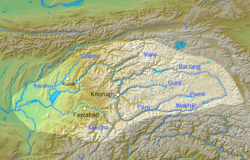
Map
Location
CountriesAfghanistan and Tajikistan
Physical characteristics
Source 
 • locationconfluence of Pamir and Wakhan Rivers
MouthAmu Darya
 • coordinates
37°06′39″N 68°18′53″E / 37.11083°N 68.31472°E / 37.11083; 68.31472
Length921 km (572 mi)
Basin size114,000 km2 (44,000 sq mi)
Discharge 
 • average1,000 m3/s (35,315 cu ft/s)
Basin features
ProgressionAmu DaryaAral Sea
Official nameLower part of Pyandj River
Designated18 July 2001
Reference no.1084[1]
The Panj River from space

The Panj (UK: /ˈpæn/ PANJ, US: /ˈpɑːn/ PAHNJ),[a] traditionally known as the Ochus River, is a river in Afghanistan and Tajikistan and a tributary of the Amu Darya. The river is 921 kilometres (572 mi) long and has a basin area of 114,000 square kilometres (44,000 sq mi).[2] It forms a considerable part of the Afghanistan–Tajikistan border.[3]

The river is formed by the confluence of the Pamir River and the Wakhan River near the village of Qalʿa-ye Panja (Qalʽeh-ye Panjeh). From there, it flows westwards, marking part of the border of Afghanistan and Tajikistan. After passing the city of Khorugh, capital of the Gorno-Badakhshan Autonomous Region of Tajikistan it receives water from one of its main tributaries, the Bartang River. It then turns towards the southwest, before joining the river Vakhsh and forming the greatest river of Central Asia, the Amu Darya. The Panj played an important role during Soviet times, and was a strategic river during the Soviet military operations in Afghanistan in the 1980s.

Water consumption

[edit]
The Panj near Kevron, on the border of Tajikistan and Afghanistan
Panj river

A water treaty between the Soviet Union and Afghanistan, signed in 1946, allows Afghanistan to draw 9 million cubic metres of water a year from the Panj.[3] It currently draws 2 million cubic metres of water. According to the Panj River Basin Project, environmental damage could be expected if Afghanistan drew the entire amount of allocated water from the river under the treaty.

Bridges

[edit]
  • Afghanistan-Tajikistan Bridge: A highway bridge was built over the river between Tajikistan and Afghanistan at Nizhnii Panj. The contract was awarded in May 2005 and the construction of the bridge began in Jan 2006 and was completed in August 2007. The financing was provided by the US, amounting to US$37 million, and the construction was done by an Italian General Construction company Rizzani de Eccher S.p.A. under the ownership of US Army Corps of Engineers. The bridge replaces a barge that could transport only 60 cars a day and which was unusable many months in the year due to strong currents in the river. RAWA reports[4] that this facilitates the heroin trade, the key to the economic miracle in Afghanistan.
  • Another bridge was built at the confluence with the Gunt River at Khorog in 2003.
  • A bridge exists at Langar, which may still be closed.

The Aga Khan Development Network has been engaged in a project to build a series of three bridges across the Panj River between Tajikistan and Afghanistan.[5]

See also

[edit]

Notes

[edit]

References

[edit]
Revisions and contributorsEdit on WikipediaRead on Wikipedia
from Grokipedia
The Panj River, also spelled Pyanj or Pyandzh, is a major Central Asian river and the primary headstream of the Amu Darya, formed by the confluence of the Pamir and Wakhan rivers near Qila-e Panja in the Pamir Mountains straddling Tajikistan and Afghanistan, and flowing approximately 1,125 kilometers westward through rugged terrain. It demarcates much of the international border between Tajikistan and Afghanistan along its course, contributing to regional geopolitical dynamics due to its strategic position and water resources. The river drains a basin of about 114,000 square kilometers, supporting irrigation, hydropower potential, and ecosystems in arid downstream areas, though water usage is governed by historical treaties limiting Afghanistan's allocation to modest volumes relative to its flow. At its mouth near Qal'eh-ye Panj, it merges with the Vakhsh River to initiate the Amu Darya, one of Central Asia's vital waterways historically known as the Oxus.

Names and Etymology

Alternative Names and Origins

The name Panj originates from the Persian and Tajik term panj, meaning "five," reflecting the river's formation through the confluence of five primary tributaries in the : the Bartang (which incorporates the Gunt and Yazgulyam), Vanj, Kyzylsu, and Ob-i-Khoh rivers. In local Central Asian languages, it appears in variants such as Daryoi Panj (Tajik), Darya-ye Panj (/Persian), and Daryo'i Ponj (Uzbek), emphasizing its role as a major waterway. Russian transliterations render it as Pyanj or Pyandzh (from Cyrillic Пяндж), a convention used in Soviet-era geographic surveys and persisting in some technical literature. Historically, ancient sources identified the upper course as the Ochus River, a designation appearing in Greco-Roman texts as a of the broader Oxus system, though specific references to its full extent remain limited in surviving accounts from geographers like .

Geography

Source and Upper Reaches

The Panj River originates at the confluence of the and the in the eastern of Tajikistan's Autonomous Region, near the Afghan border village of Qalʿa-ye Panja. The emerges from Lake Zorkul, situated at an elevation of approximately 4,130 meters above . The forms upstream from the junction of the Wakhjir River, issuing from an at , and the Bozai Darya, both sourced in glacial melt from the Hindu Kush and Pamir ranges. From this high-altitude , estimated at over 3,500 meters based on regional , the Panj flows westward through narrow, steep-sided valleys characterized by rugged and active glacial processes. The initial path traverses the remote eastern sectors of , where steep longitudinal gradients—often exceeding 10 meters per kilometer in the uppermost sections—facilitate rapid downcutting and high erosive power, shaping deep gorges and contributing to substantial from exposed and moraines. In its upper reaches, prior to descending toward , the Panj receives early inflows from minor glacial streams, building discharge from meltwater-dominated sources. Key tributaries such as the Gunt River, draining the southern Alai Range and joining near at around 2,200 meters , and the Bartang River, which incorporates waters from Lake Sarez and enters at Rushan, augment the main stem's volume and sediment load. Hydrological assessments indicate these confluences introduce elevated , with glacial and tectonic in the catchment yielding average annual sediment yields exceeding 1,000 tons per square kilometer in upstream sub-basins.

Course Through Tajikistan and Afghanistan

The Panj River courses westward through the Gorno-Badakhshan Autonomous Region of Tajikistan and the Badakhshan Province of Afghanistan, forming the international border between the two countries for much of its length, approximately 700 kilometers. This segment begins after the river's formation near Qalʿa-ye Panja and continues through the Wakhan Corridor, where it separates towering peaks of the Hindu Kush to the south from the Pamir Mountains to the north, creating a deep valley landscape. In the Darvaz region, the river narrows into steeper gorges and canyons, such as those between Kalai-Khumb and the Vanch River , where the valley walls rise sharply, influencing the river's meandering path and constraining its channel. Further downstream, near , the Panj flows through imposing gorges that highlight the rugged topography of the border area. These physical features, including braided channels in broader sections and confined flows in narrows, shape and potential flood pathways without commercial navigation feasibility in the upper and middle reaches due to steep drops and obstacles. The river maintains this border alignment until its lower course, descending from highland elevations over 3,000 meters to lowland plains around 400 meters above sea level. It culminates at the confluence with the Vakhsh River near the tripoint of Tajikistan, Afghanistan, and Uzbekistan, approximately 921 kilometers from its source, where the combined waters form the Amu Darya downstream of Termez. In these terminal sections, the terrain transitions to wider valleys, allowing for more extensive alluvial deposits and meanders.

River Basin Characteristics

The Panj River basin covers approximately 113,600 km², with the majority of the area located in and a significant portion extending into northeastern . This transboundary drainage area is characterized by stark physiographic contrasts, from high-altitude plateaus in the to lower foothills, influencing hydrological dynamics across diverse elevations. Annual within the basin varies widely due to its alpine to arid climatic , ranging from less than 300 mm in eastern sectors to over 1,000 mm in northern highland regions, primarily as in winter and spring. Glaciers occupy about 13% of the basin's and contribute roughly 35% of the annual runoff through , buffering seasonal flow variability based on hydrological modeling and glaciological assessments. The basin's features rugged Pamir plateaus transitioning to narrower valleys and , with permanent and alongside barren or sparsely vegetated comprising over 70% of the surface. Soils are predominantly thin and rocky in mountainous zones, limiting to narrow valley floors where terraced agriculture is practiced on a small fraction of the total area, supported by alluvial deposits. Grasslands cover approximately 28% of the basin, primarily in mid-elevations, reflecting the constrained potential for intensive cultivation amid steep gradients and erosion-prone slopes.

Hydrology

Seasonal Flow and Discharge

The Panj River displays a pronounced seasonal flow regime characteristic of high-mountain nivo-glacial hydrology, where discharge is primarily driven by and glacial during warmer months, supplemented by . Empirical measurements from gauging stations such as Khirmanjo and Nizhny Panj indicate an average annual discharge ranging from 838 m³/s to 1,026 m³/s, reflecting contributions from its extensive basin in the Pamirs. Flow peaks in late spring and summer, particularly from June 21 to July 20, when intensifies due to rising temperatures, accounting for the majority of annual volume—up to 71.4% of peak discharge periods at Khirmanjo. Maximum observed summer discharges have reached approximately 3,000–4,000 m³/s in non-extreme years, though flood events can exceed 4,000 m³/s. Winter and early spring minima occur under low precipitation and frozen conditions, with discharges dropping to around 200–300 m³/s, representing less than 20% of annual flow. Approximately 70% of total discharge derives from snow and ice melt in the western Pamir sectors, underscoring the causal role of seasonal temperature-driven ablation in sustaining flow volumes. Soviet-era hydrological records from the 1960s onward, maintained by Tajik hydrometeorological services, reveal interannual variability linked to precipitation anomalies and glacier mass balance fluctuations, with gauges showing consistent summer dominance but potential shifts toward earlier peaks from altered melt timing. Upstream reservoirs influence observed patterns, yet core meltwater dependency exposes the regime to sensitivities in seasonal snow accumulation.

Water Balance and Quality

The water balance of the Panj River basin is primarily driven by inputs from and melt in the , with providing supplementary contributions in the high-altitude headwaters. account for approximately 35% of the basin's annual runoff, buffering seasonal variability by sustaining flows during dry periods. Total resources in the broader basin, to which the Panj is the primary upper , average around 78 km³ per year, with the Panj's outflow forming the dominant share before confluences with rivers like the Vakhsh. losses are substantial in the arid lower basin reaches, reducing net outflow to the to levels that reflect high potential evapotranspiration rates exceeding in downstream areas. Water quality in the Panj's upper reaches remains relatively pristine, characterized by low anthropogenic pollution due to limited industrial activity in the remote Tajik and Afghan portions of the basin. Natural geochemical influences from Pamir contribute to elevated mineral content, including sulfates derived from evaporitic deposits, though specific concentrations vary seasonally with melt inputs. levels are elevated from ongoing processes in steep, unglaciated slopes and areas, exacerbated by tectonic activity and sparse vegetation cover, leading to increased loads. Monitoring efforts, including transboundary assessments, indicate neutral to slightly alkaline values and low heavy metal concentrations in upstream sections, with potential salinization risks emerging from upstream return flows in adjacent sub-basins. Overall, pollution indices classify upper waters, including the Panj, as cleaner compared to downstream segments affected by agricultural intensification.

Infrastructure

Dams and Hydropower Facilities

The Panj River features limited large-scale dams on its main stem owing to its status as the international border between Tajikistan and Afghanistan, which hinders joint development and construction logistics. Instead, hydropower infrastructure in the Panj basin emphasizes tributaries and the parallel Vakhsh River, whose regulated flows indirectly modulate the Panj's downstream hydrology by comprising about half of the combined Amu Darya discharge at their confluence. Tajikistan's overall hydropower potential, including the Panj system, stands at approximately 527 billion kWh annually, with over 90% untapped as of 2022, prompting surveys for cascade developments on the Panj and its tributaries that could yield more than 10 GW in aggregate capacity through 14 proposed plants ranging from 300 MW to 4,000 MW each. Prominent facilities include the Sangtuda 1 Hydroelectric Power Plant on the Vakhsh River, operational since July 2009 with an installed capacity of 670 MW across four turbines, producing around 2.7 billion kWh yearly. Developed as a Tajik-Russian joint venture with Russian investment exceeding $500 million for 75% ownership, it bolsters Tajikistan's grid reliability and enables seasonal electricity exports to Afghanistan, addressing chronic winter shortages in both countries. Complementing this is Sangtuda 2, commissioned in 2013 on the same river with 220 MW capacity via two 110 MW units, constructed with $180 million in Iranian funding as part of bilateral cooperation, enhancing combined basin output to nearly 900 MW from these sites alone. The ongoing project on the Vakhsh, initiated in the 1970s and accelerated since 2017, exemplifies ambitious basin-scale engineering, targeting 3,600 MW capacity and a volume of 13.3 billion cubic meters upon full operation projected for the late . This rockfill structure, reaching 335 meters in height, will regulate Vakhsh inflows to the Panj, providing attenuation and year-round power generation to double Tajikistan's output. Empirical advantages encompass peak flow reductions via storage, as demonstrated by upstream Vakhsh facilities like , which have historically mitigated downstream ing in the system; power revenues also fund exports stabilizing regional grids. However, causal trade-offs include forced resettlement—Rogun alone has displaced over 15,000 individuals with associated socioeconomic costs—and from high loads in glaciated catchments, empirically shortening operational lifespans by 20-50% in comparable Central Asian without like flushing. These developments underscore energy gains against environmental costs, with transboundary silt and flow alterations potentially straining Afghan downstream users absent cooperative monitoring.

Bridges and Transportation Crossings

The Panj River is crossed by at least five major road bridges serving as official border points between and , with designs adapted to the river's swift currents and seasonal high waters in a seismically active, mountainous corridor. These and structures, often incrementally launched or girder-based, support two-lane vehicular traffic and movement, providing essential links for freight and local commerce in otherwise isolated districts. A sixth informal crossing utilizes a for heavy materials like , underscoring the logistical constraints of permanent in flood-prone reaches. The bridge at Panji Poyon (also termed Nizhny Pyandzh), spanning 672 meters and 11.6 meters wide, connects Nizhny Pyandzh in to Shir Khan Bandar in ; opened on August 26, 2007, this incrementally launched steel-concrete enables overland trade corridors extending more than 1,400 miles from through . Earlier crossings, such as the Tem-Demogan bridge completed in 2002, initiated a series of permanent links funded by development organizations to replace vulnerable ferries and ropeways susceptible to washouts during surges. By 2019, six such bridges had been constructed with support across the Panj, bolstering border access for security patrols and commercial convoys amid engineering demands like deep scour-resistant piers to counter the river's erosive force and debris loads. These crossings handle routine cross-border traffic, including market goods and supplies, while historical temporary spans—often wooden or cable-suspended—faced frequent disruptions from turbulent flows, highlighting the shift to resilient modern builds for sustained logistical reliability.

Water Usage and Management

Agricultural Irrigation Demands

In the Panj River basin, agricultural irrigation primarily supports staple and cash crop production in the narrow valleys of Tajikistan's Gorno-Badakhshan Autonomous Oblast and Afghanistan's , where aridity limits rain-fed farming. Tajikistan's total national irrigation withdrawals average 8-10 km³ annually, with a portion derived from the Panj and its tributaries to irrigate approximately 10-15% of the river's flow for local , focusing on terraced fields along the riverine corridors. In Afghanistan, irrigation demands from the Panj are capped at 9 km³ per year under a 1946 agreement with the , though historical Soviet-era planning assumed actual extractions closer to 2.1 km³ to meet downstream needs in the basin. Actual current withdrawals remain below these limits due to underdeveloped infrastructure, with the Panj supplying roughly 30% of the Amu Darya's upper flow that feeds into broader irrigation systems claiming up to 40% of the main stem's discharge for across riparian states. Key irrigated crops include wheat, cotton, rice, maize, and barley, which dominate in Badakhshan valleys enabled by river diversions; cotton occupies significant acreage in Tajik lowlands, while wheat and fodder prevail in higher-altitude Afghan and Tajik plots for food security. Crop yields are constrained by low irrigation efficiency, estimated at 50-60% in Central Asian systems like those in the Panj-Amu basin, where 40% of diverted water is lost to seepage from unlined earthen canals and evaporation. These losses exacerbate salinization, with return flows—comprising 20-30% of applied water—carrying accumulated salts back to rivers and groundwater, affecting over 50% of irrigated lands in the region through secondary soil degradation. Soviet-era infrastructure, including diversion canals built from the 1950s onward, historically channeled several km³ annually from tributaries like the Panj for expanded and grain cultivation, supporting peak irrigated areas before systemic inefficiencies emerged. Following the Soviet dissolution and ensuing conflicts— including Tajikistan's 1992-1997 civil war and prolonged instability in —irrigation diversions declined by 20-30% in upper basin areas due to neglected maintenance, canal breaches, and reduced pumping capacity, limiting effective water use to underutilized potential. Recent assessments indicate that modernizing conveyance could reclaim 1-2 km³ in lost efficiency annually without expanding withdrawals.

Hydropower Generation Priorities

prioritizes hydropower development along the Panj and its systems, such as the Vakhsh, which collectively supply over 90% of the country's . The Panj's upstream reaches, fed by glacial melt from the Pamir and mountains, provide reliable high-head flows suitable for run-of-river facilities that minimize storage needs while maximizing utilization of natural discharge gradients. This approach aligns with national energy strategy, emphasizing expansion of installed capacity—currently around 5.8 GW total, predominantly hydro—to exploit untapped potential estimated at over 500 TWh annually, though actual output remains constrained by seasonal . Key facilities like Sangtuda-1 (670 MW, commissioned 2009) and Sangtuda-2 (220 MW, operational from 2012) on the Vakhsh have boosted system capacity by nearly 900 MW, enabling verifiable increases in annual generation from approximately 17 TWh in earlier years to 22.4 TWh by 2024. These developments support export priorities, with Tajikistan shipping 1.9–3.2 TWh annually in recent years, over 80% directed to Afghanistan under bilateral agreements initiated in the 2000s to address regional deficits. However, the run-of-river model's dependence on results in pronounced seasonal imbalances, with summer surpluses contrasting winter shortfalls of up to 2.7 TWh, compelling imports from and others despite expanded . This underscores opportunity costs: high summer load factors enable exports yielding revenue, but limited storage yields lower firm capacity during dry periods, prioritizing rapid deployment over comprehensive flood control or integration. Development efforts thus focus on incremental cascade expansions to enhance peak output while mitigating winter vulnerabilities through interconnections, balancing energy security against the high capital demands of alpine terrain projects.

Allocation Challenges in Transboundary Context

The Panj River lacks a binding bilateral treaty governing water allocation between Tajikistan and Afghanistan, with post-Soviet arrangements relying on informal understandings rather than enforceable agreements. During the Soviet era, a 1946 pact permitted Afghanistan annual withdrawals of up to 9 cubic kilometers from the Panj, reflecting centralized planning that prioritized irrigation in downstream Afghan territories while reserving upstream flows for Tajik and Soviet infrastructure. Post-independence, Tajikistan has invoked sovereign rights to develop hydropower, constructing or planning dams such as those on the Panj's upper reaches, which reduce downstream flows essential for Afghan agriculture; these interventions, combined with evaporation and seepage, diminish Panj contributions to the Amu Darya by approximately 10-20%, exacerbating inequities in a basin where average annual Panj discharge totals around 33.4 cubic kilometers. Upstream-downstream tensions manifest in conflicting priorities: Tajikistan emphasizes national sovereignty and through to meet domestic demands, arguing that Soviet-era quotas undervalued upper riparian potential and that new enables efficient seasonal storage without inherent harm to neighbors. In contrast, asserts historical usage rights and equitable utilization principles under international water law, contending that Tajik dams infringe on downstream needs supporting over 80% of its in the Panj basin, where reduced winter flows have intensified drought vulnerability since the early . Since the Taliban's , Afghan authorities have escalated demands for augmented Panj flows, framing them as restitution for perceived Soviet imbalances and upstream over-abstraction, though these claims remain unsubstantiated by joint hydrological assessments and prioritize unilateral canal projects over basin-wide equity. Empirical challenges persist due to monitoring discrepancies, with Tajikistan and Afghanistan maintaining parallel gauge networks that yield divergent flow data, hindering verification of allocation claims amid climate variability and infrastructure opacity. United Nations initiatives, including UNECE proposals for standardized data-sharing protocols under the Water Convention framework, have urged real-time hydrological exchange to resolve these gaps but remain stalled by trust deficits and technical incompatibilities as of 2025. Without resolved transparency, upstream developments risk amplifying downstream scarcities, underscoring the causal primacy of verifiable metrics over unilateral assertions in transboundary equity.

Environmental Aspects

River Ecology and Biodiversity

The riparian zones of the Panj River, especially in its upper reaches through the , provide critical habitats for mammalian species such as snow leopards (Panthera uncia) and (Capra sibirica), which rely on the valley slopes and proximity to water sources for foraging and movement. These areas, including tributaries in Wakhan National Park along the upper Panj, support populations monitored through surveys targeting and related ungulates in the Hindu Kush-Pamir transition zone. Aquatic biodiversity in the Panj features cold-water adapted fish, including marinka species (Schizothorax spp.), which inhabit the fast-flowing, oxygenated upper sections. The Upper Amu Darya ecoregion encompassing the Panj supports endemic cyprinids like the rheophilic dace Leuciscus latus, alongside other native taxa suited to montane river conditions. Tajikistan's overall freshwater fish diversity, including the Panj basin, totals approximately 60 species, with 44 native and several endemics confined to isolated Central Asian drainages. The Panj basin overlaps with biodiversity hotspots such as the Pamir-Alai temperate forests, where richness is high, featuring numerous endemics amid fragmented habitats shaped by steep terrain. This region forms part of the hotspot, with the Upper Amudarya and Panj River corridor spanning 1,600 km² of key ecosystems along international borders. Human influences, including agricultural encroachment, have progressively narrowed riparian corridors along the Panj, reducing available habitat width for and . Prior to extensive dam development, losses of endemic remained limited, supported by natural reserves like zapovedniks in the Panj valley that mitigate ongoing pressures from land conversion and .

Flood Dynamics and Morphological Changes

The Panj River's flood dynamics are primarily driven by seasonal from the Pamir and ranges, augmented by intense summer convective in its high-altitude catchment, leading to peak discharges typically between May and . These events generate high-velocity flows that transport substantial loads, with empirical gauging data showing that extreme magnitudes correlate strongly with interannual variability and rapid melt episodes rather than persistent long-term trends in temperature or volume. Hydrologic records indicate that flood peaks can exceed mean flows by factors of 5–10 during anomalous years, triggering channel cutoffs and avulsions through erosive scour. Morphologically, the Panj exhibits dynamic braided channel patterns across much of its middle and lower reaches, characterized by multiple active threads weaving through gravel bars and islands on wide alluvial plains. Geomorphic analyses reveal lateral channel migration rates of 1–2 km per decade in vulnerable segments, propelled by flood-induced and redistribution, with intrinsic processes—such as bar instability and flow bifurcation—dictating shift locations over external forcings. These shifts exacerbate flood risks by unpredictably altering inundation zones, as evidenced by repeated breaches in erodible cobble-sand banks during high-magnitude events. Engineering interventions, including earthen levees and embankments along populated riparian corridors, provide localized short-term containment of floods but induce causal downstream consequences by constricting flow, elevating shear stresses, and disrupting natural conveyance. This confinement accelerates incision and undercutting in adjacent reaches, as confined high-energy flows bypass deposition, leading to heightened rates and potential underflow failures over multi-year cycles. Such measures, while reducing immediate overflow in protected areas, fail to address the river's inherent braiding tendencies, often amplifying morphological instability farther downstream.

Climate Change Influences on Flow and Resources

The Panj River basin has experienced air temperature increases of approximately 1–2°C since the 1950s, contributing to glacier retreat in the Pamir Mountains, where glacier area has decreased by about 10.8% from the early 1960s to 2009. Glacier mass balance in the region turned negative at rates of -0.52 meters water equivalent per year during 2002–2013, reflecting thermodynamic responses to warming rather than anomalous scarcity. These changes align with broader Pamir dynamics, where recent shrinkage rates remain modest at 0.07% per year from 2000 to 2017, contrasting with more rapid losses elsewhere in High Mountain Asia. Glaciers supply roughly 35% of the Panj's annual runoff and buffer seasonal variability by compensating 30–60% of deficits during low-precipitation years through release. Observed shifts include elevated winter flows from increased precipitation (up 8% since 1940 in ) and earlier melt, partially offsetting summer declines amid depletion. This melt-driven augmentation follows basic hydrological principles, where initial warming accelerates ice loss before long-term volume exhaustion, tempering immediate flow reductions. Tajik analyses confirm winter elevations in recent decades compared to mid-20th-century baselines. Projections indicate air temperatures rising by 1.7°C in the basin by 2050, potentially peaking glacier-fed flows before a 10–15% decline thereafter due to sustained mass loss, though storage can adaptively manage this transition. models forecast amplified droughts and floods from altered melt timing, but these build on inherent basin variability rather than unprecedented scarcity. Such estimates derive from thermodynamic responses and patterns, prioritizing empirical comparisons over alarmist narratives. Soviet-era records (pre-1990s) document flow fluctuations in Central Asian rivers comparable to recent variations, driven by natural teleconnections and winter precipitation, exceeding isolated warming effects in magnitude. This historical precedent underscores that Panj variability stems from multi-decadal cycles, with glacier dynamics providing temporary stabilization rather than heralding .

Geopolitical Significance

Role as International Border

The Panj River demarcates the international border between and along approximately 1,100 kilometers of its course, forming the northern boundary of Afghanistan's and the southern edge of Tajikistan's Gorno-Badakhshan Autonomous Region. This alignment stems from 19th-century Anglo-Russian agreements that recognized the river system, including the Panj as its upper tributary, as the northern limit of Afghan territory, with Afghanistan relinquishing claims to areas north of the river. The river's meandering path through steep, mountainous terrain provides a natural barrier, contributing to the border's relative stability by hindering large-scale incursions, though isolated crossings occur for trade and illicit activities. Demarcation efforts intensified in the Soviet era, with surveys in the producing detailed maps of the basin to formalize the boundary following the redrawing of Central Asian republics. These efforts addressed ambiguities arising from the river's shifting channels and mid-stream islands, some of which have sparked localized disputes over due to and altering their positions. Modern refinements, including GPS technology, have been employed to update boundary markers, enhancing precision amid ongoing challenges like routes that exploit the rugged landscape for narcotics and migrant transit from . The terrain's low permeability—characterized by deep gorges and high velocities—limits routine permeability, yet official bridges at points like Tem and Nizhny Pyanj enable regulated cross-border commerce, underscoring the border's dual role in separation and economic linkage.

Transboundary Cooperation Efforts

In September 2020, and signed a five-year (MoU) between their respective environmental authorities to foster bilateral on shared ecosystems, including adaptation to , , biodiversity conservation, and pollution control in the Pyanj (Panj) and river basins. The agreement outlined annual meetings alternating between the two countries and provisions for joint technical working groups, aiming to build institutional frameworks for data exchange and . Implementation stalled after the Taliban's 2021 takeover in , with the MoU's environmental framework effectively suspended amid shifting political priorities and security concerns. United Nations Economic Commission for Europe (UNECE)-supported projects, initiated in December 2018, have targeted hydrology and environmental cooperation in the upper Amu Darya basin, encompassing the Panj River sub-basin shared by the two nations. These efforts, extended into Phase II under project E220, facilitated joint assessments, installation of monitoring equipment at gauging stations, and protocols for real-time hydrological data sharing to support flood forecasting and water resource planning. By 2020, milestones included bilateral workshops and preliminary data exchanges that enhanced mutual understanding of river flows, though sustained enforcement has been challenged by Afghanistan's internal instability. In response to an August 24, 2025, armed clash along the Panj River border in —stemming from disputes over mining and water diversion—military representatives from and the administration convened talks to address river and resource allocation issues. These discussions, while limited in scope, underscore pragmatic on transboundary concerns, with Tajik officials expressing cautious optimism for reciprocal benefits in stability and amid shared vulnerabilities to glacial melt. Skepticism persists, however, regarding the administration's reliability in upholding data-sharing commitments or avoiding unilateral projects, as evidenced by prior suspensions of cooperative mechanisms post-2021. Ongoing [Global Environment Facility](/page/Global Environment Facility) initiatives seek to institutionalize Panj sub-basin through operational mechanisms for joint commissions, though progress remains incremental due to enforcement gaps.

Disputes Over Resources and Borders

The Afghanistan-Tajikistan border along the Panj River has been a site of recurrent skirmishes since the , exacerbated by the Tajik Civil War (1992-1997) and spillover from Afghanistan's internal conflicts, including cross-border incursions by armed opposition groups and militants. These incidents involved sporadic firefights and incursions, often linked to territorial ambiguities in remote, mountainous areas where the river delineates the boundary, leading to dozens of clashes that heightened regional instability without formal resolution mechanisms. Tajik forces, supported by Russian border guards until 2013, frequently repelled incursions, as in the 1993 "Black Tuesday" battle where Islamist radicals attacked a Tajik post, resulting in heavy casualties and underscoring the river's role as a volatile . Following the Taliban's 2021 takeover in Afghanistan, border tensions escalated, with at least ten armed clashes reported in 2025 alone, many tied to disputes over resource access and undefined riverine territories. A notable incident occurred on August 24, 2025, near the Panj in Badakhshan province, where Tajik border forces engaged Taliban fighters, killing one and wounding four, amid accusations of unauthorized Afghan gold mining in the riverbed that altered the channel and threatened Tajik water supplies and farmland downstream. The Taliban countered that Tajik forces initiated the firefight to assert control over shared border islands and mining sites, while subsequent talks between local officials addressed river water flows alongside mining, revealing intertwined claims over riparian resources without de-escalation. Afghan authorities under Taliban rule have accused Tajikistan of hoarding Panj waters through upstream hydropower infrastructure, such as dams on tributaries feeding the river, which prioritize seasonal storage for over consistent downstream releases critical for Afghan irrigation and livelihoods. This upstream advantage allows Tajikistan to retain flows for domestic needs during low-water periods, causally reducing availability in Afghan border regions and fueling protests from onward that link to broader grievances. Tajik officials reject these claims, asserting equitable use under historical basin norms, but the absence of an effective bilateral arbitration body perpetuates imbalances, with Afghanistan—contributing significantly to the system yet receiving minimal allocations—facing chronic shortages amid no binding Panj-specific treaty.

Historical Development

Pre-20th Century Usage and Exploration

The Panj River, forming the upper reaches of the ancient Oxus (modern ), supported trade networks integral to the , channeling caravans through the rugged Pamir and corridors from at least the 2nd century BCE onward, as evidenced by archaeological traces of waystations and routes paralleling its valleys. In the Bactrian region downstream, where Oxus tributaries including the Panj's waters converged, ancient canals—some dating to the Oxus Civilization around 2200–1700 BCE—diverted river flows to sustain settled in arid lowlands, enabling crop cultivation and urban centers like those at Sapalli Tepe. By the 13th century, Venetian traveler documented the Oxus as a majestic river coursing through a picturesque valley flanked by towering ranges, noting its role in regional commerce and its feeders originating in the Pamirs, though he did not traverse the Panj proper. Pre-modern local economies along the Panj emphasized , with ethnic groups such as Kyrgyz and Wakhi herders relying on seasonal migrations to exploit high-altitude meadows (yaylags) for livestock grazing, constrained by the river's steep gorges that limited large-scale diversion or sedentary farming technologies. In the , amid the Anglo-Russian "" rivalry for Central Asian dominance, British explorers like William Moorcroft probed the upper Oxus sources in the , while Russian forces under generals such as Mikhail Cherniaev advanced surveys into the Pamirs by the , mapping the Panj's course to assert territorial claims and establish buffer zones, culminating in the river's demarcation as an Afghanistan-Tajik border by the early 1900s. These expeditions prioritized geopolitical reconnaissance over economic exploitation, yielding rudimentary hydrographic data amid hostile terrain and local resistance.

Soviet-Era Engineering and Control

During the Soviet era, the USSR pursued ambitious in the Panj River basin as part of a broader "hydraulic mission" to expand irrigation for across , constructing extensive networks and diversions from the Panj and its tributaries starting in . These projects, coupled with standardized hydrological gauging stations for basin-wide flow monitoring, enabled precise control over water allocation to support agricultural quotas. By the 1970s, such infrastructure had expanded irrigated areas in the basin, including Tajik territories along the Panj, by approximately 150 percent, prioritizing production that covered nearly all in the Tajik SSR. Key achievements included major dams on Panj tributaries, such as the Nurek Dam on the Vakhsh River, construction of which began in 1961 and concluded in 1980, creating a reservoir with 10.5 cubic kilometers of storage capacity for hydropower (2,100 MW) and seasonal flow regulation into the Panj. This facility, along with precursor smaller impoundments and pump stations, reallocated upstream waters to downstream irrigation needs, boosting Tajik cotton yields but inducing salinization and ecological degradation through overuse for monoculture. Soviet planning emphasized infrastructural scale over sustainability, with canals often unlined, leading to high seepage losses estimated at 30-50 percent in early systems. The 1911 Sarez earthquake, which triggered a landslide forming a natural dam on the Bartang River (a Panj tributary) and creating Lake Sarez with over 16 cubic kilometers of volume, prompted Soviet-era interventions focused on risk mitigation and resource utilization. From the 1920s onward, Soviet geologists and engineers established monitoring stations and conducted systematic seismic and hydrological research through the 1980s, proposing a tunnel-boring project for controlled outflow, hydropower generation, and flood prevention to avert potential downstream catastrophe affecting the Panj valley. These plans, though unrealized due to technical challenges and the USSR's dissolution, exemplified causal resource reallocation by viewing the lake as an untapped asset for energy and stabilization rather than solely a hazard. Overall, Soviet engineering entrenched upstream storage in Tajik SSR for downstream Soviet republics' benefit, with water quotas favoring Uzbekistan and Turkmenistan's , fostering dependencies that ignored local ecological limits and presaged transboundary conflicts after 1991.

Post-Soviet and Conflicts

Following Tajikistan's independence from the in 1991, the Tajik Civil War erupted in 1992 and lasted until 1997, resulting in 20,000 to 150,000 deaths and displacing 10 to 20 percent of the population. The conflict transformed the Panj River border into a major crossing point, with hundreds of thousands of Tajik refugees fleeing into , exacerbating cross-border instability and diverting resources from infrastructure maintenance along the river. State fragility during this period led to neglect of water management systems, contributing to inefficiencies in river flow regulation and heightened vulnerability to seasonal fluctuations in the Panj basin. In the 2000s, amid ongoing and reconstruction challenges, limited joint initiatives emerged, including the 2007 opening of a U.S.-funded bridge across the Panj at Sher Khan Bandar to facilitate trade between and . However, transboundary cooperation remained hampered by weak institutional enforcement under frameworks like the Interstate Commission for Water Coordination (ICWC) and the International Fund for Saving the (IFAS), established in 1993 to address Amu Darya basin issues including the Panj, yet plagued by non-binding agreements and upstream-downstream tensions. The Taliban's recapture of Afghanistan in August 2021 intensified border security concerns, with Taliban forces gaining control of key Panj crossings and prompting Tajikistan to bolster fortifications amid fears of spillover instability. Tensions escalated into armed clashes, including exchanges of fire on August 24, 2025, near the Panj River in Badakhshan province, where Tajik border guards engaged Taliban fighters, resulting in at least one Taliban killed and four wounded, reportedly triggered by disputes over gold mining activities encroaching on border areas. These incidents underscore persistent resource mismanagement linked to Afghanistan's governance vacuum and Tajikistan's economic constraints, with irrigation and hydropower disputes along the Panj continuing despite initiatives like FAO-supported transboundary management efforts in the sub-basin. While Tajikistan has pursued hydropower expansion in adjacent Vakhsh-Panj systems, drawing partial flows from the Panj, overall output gains have been offset by unresolved bilateral frictions over water allocation.

References

Add your contribution
Related Hubs
User Avatar
No comments yet.