Hubbry Logo
Pseudis paradoxaPseudis paradoxaMain
Open search
Pseudis paradoxa
Community hub
Pseudis paradoxa
logo
8 pages, 0 posts
0 subscribers
Be the first to start a discussion here.
Pseudis paradoxa
Pseudis paradoxa
from Wikipedia

Pseudis paradoxa
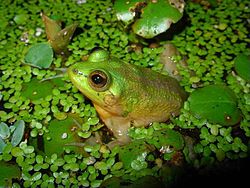
Two colour variants:

above – Mana, French Guiana
below – Apure, Venezuela

Scientific classification Edit this classification
Kingdom: Animalia
Phylum: Chordata
Class: Amphibia
Order: Anura
Family: Hylidae
Genus: Pseudis
Species:
P. paradoxa
Binomial name
Pseudis paradoxa

Pseudis paradoxa, known as the paradoxical frog or shrinking frog, is a species of hylid frog from South America.[2] Its name refers to the very large—up to 27 cm (11 in) long—tadpole (the world's longest), which in turn "shrinks" during metamorphosis into an ordinary-sized frog, only about a quarter or third of its former length. Although the recordholder was a tadpole in Amapá that belonged to this species, others in the genus Pseudis also have large tadpoles and ordinary-sized adults.[3][4][5]

Distribution and habitat

[edit]

The species inhabits ponds, lakes, lagoons and similar waters from the Amazon and the Guianas, to Venezuela and Trinidad, with a disjunct distribution in the Magdalena River watershed in Colombia and adjacent far western Venezuela.[6][7] More southerly populations from the Pantanal region to northeastern Argentina have been recognized as a subspecies, but are now often considered a full species, P. platensis,[6] although the validity of this split is questionable.[4]

Appearance and behavior

[edit]
Mating pair in São Paulo, Brazil (left), models of full-grown tadpole and adult frog (right)

The adult frogs of P. paradoxa have a snout–to–vent length of 3.4–7.6 cm (1.3–3.0 in) and are green to brown coloured with dark green, olive or dark brownish stripes or mottling; the pattern and hue varies significantly.[4][8]

The female of P. paradoxa lay eggs among water plants; the eggs develop into tadpoles. They always reach a large size, but there are noticeable local variations in the final size of the tadpoles, with those in large temporary waters with plenty of food and few aquatic predators growing larger than those in smaller waters with less food or waters with more aquatic predators.[4]

The tadpoles feed mostly on algae. The adult frogs, which are active both day and night and always in or near water, eat insects (such as flies, beetles, true bugs, plantsuckers, butterflies, moths and dragonflies)[9] and other invertebrates (such as crabs),[9] and small frogs.[8][9] When threatened, the frog uses its strong toes with an extra joint to stir up the muddy bottom and hide. The frog also uses this mechanism to find food on the bottom of lakes and ponds.

Potential use in medicine

[edit]

In March 2008, scientists working from the Universities of Ulster and United Arab Emirates released findings of a study on pseudin-2, a skin compound which protects the paradoxical frog from infection.[10] This work found that a synthetic version of this compound was able to stimulate the secretion of insulin in pancreatic cells under laboratory conditions without toxicity to the cells.[11] As such, this synthetic medicine could be used in the treatment of Type 2 diabetes.

References

[edit]
[edit]
Revisions and contributorsEdit on WikipediaRead on Wikipedia
from Grokipedia
Pseudis paradoxa, commonly known as the paradoxical frog or shrinking frog, is a of in the Hylidae, characterized by its remarkable metamorphic size reduction, where large aquatic tadpoles transform into much smaller semi-aquatic adults. Native to northern and central , adults typically measure 45–65 mm in snout-vent length (up to 75 mm), with a short, paunchy body, small head, round snout, and fully adapted for swimming; the dorsal surface is green with possible brown anterior markings and dark spots posteriorly, while the ventral surface is whitish with brown spots. In stark contrast, tadpoles grow to extraordinary sizes of up to 220 mm in total length—three to four times larger than adults—making them among the largest anuran larvae known, a trait unique to the Pseudis where most growth occurs during the larval stage. This frog inhabits open marshy areas with floating vegetation, including permanent and temporary ponds, lakes, and lagoons, typically in regions without extreme seasonal temperature fluctuations. Its distribution spans east of the Andes across river drainage systems from Venezuela to Paraguay, with a presence in Trinidad, encompassing countries such as Argentina, Bolivia, Brazil, Colombia, French Guiana, Guyana, Paraguay, Peru, Suriname, Trinidad and Tobago, and Venezuela; populations show a disjunct pattern, including isolated groups in the Pantanal wetlands and Amazon basin. Diurnally and nocturnally active, P. paradoxa floats at the water's surface, feeding on insects, invertebrates, and occasionally small frogs, while breeding is triggered by rainfall, with eggs laid in frothy masses among aquatic plants. The species faces no major threats and maintains a stable population across its wide range, leading to its classification as Least Concern on the . Conservation efforts are minimal, with no specific protections under or national regulations, though ongoing habitat monitoring in wetland ecosystems is recommended to address potential localized impacts from or water management.

Taxonomy

Classification

Pseudis paradoxa is classified within the domain Eukaryota, kingdom Animalia, phylum Chordata, class Amphibia, order Anura, family Hylidae, subfamily Hylinae, genus Pseudis, and species paradoxa, with the binomial authority attributed to Linnaeus in 1758. The species was originally described by Carl Linnaeus as Rana paradoxa in his 1758 work Systema Naturae, based on specimens from South America, reflecting the limited understanding of neotropical anuran diversity at the time. In 1830, Johann Georg Wagler transferred it to the newly established genus Pseudis, recognizing its distinct morphological traits that set it apart from typical ranids. Within the Hylidae, Pseudis paradoxa is placed in the tribe Pseudae, a group characterized by molecular and osteological synapomorphies, including a robustly ossified cranium with expanded frontal processes and a reduced squamosal that differs from the more gracile structure in other hylines. These features, observed in comparative skeletal analyses of Pseudis and related genera like Lysapsus, support the of Pseudae relative to other hylid tribes, with adaptations linked to aquatic lifestyles. A 2024 molecular phylogenetic study utilizing mitochondrial and nuclear DNA sequences confirmed the of the Pseudis, including P. paradoxa, while revealing unrecognized within P. platensis, a distinct from P. paradoxa. The analysis also synonymized the Lysapsus under Pseudis based on shared clades, a change accepted in taxonomic databases as of December 2024. No further revisions have been reported as of 2025. This placement underscores the paradoxical size reduction from larva to adult as a derived trait within the , though detailed morphology is addressed elsewhere.

Etymology and synonyms

The genus name Pseudis derives from the Greek words pseudēs (ψευδής), meaning "false," and isós (ἰσός), meaning "equal," alluding to the deceptive morphological similarities this group of frogs shares with other genera, leading to early taxonomic misplacements. The specific epithet paradoxa comes from the Latin paradoxus, derived from Greek para (beside) and doxa (opinion), alluding to the paradoxical nature of the species, particularly the dramatic size reduction during metamorphosis to become smaller adults (though early descriptions emphasized unusual aquatic traits). This naming reflects the species' most striking biological trait, first noted in early descriptions. The species was originally described as Rana paradoxa by Linnaeus in 1758, based on specimens from , with subsequent combinations including Hyla paradoxa by Schneider in 1799, reflecting its initial classification among treefrogs despite its aquatic habits. Other historical synonyms include Rana piscatrix (Fermin, 1765), Rana piscis (Linnaeus, 1766), Proteus raninus (Laurenti, 1768), Rana jackia (Bonnaterre, 1789), Pseudes paradoxa (Wiegmann, 1832), Pseudis merianae (Duméril and Bibron, 1841), Batrachythys paradoxa (Pizarro, 1876), and Pseudis paradoxus (Savage and Carvalho, 1953). Historically, subspecies such as P. p. paradoxa and P. p. platensis were recognized within P. paradoxa, with the latter described by Gallardo in 1961 from populations in southern South America. However, P. platensis is now widely treated as a distinct species based on morphological differences noted by Gallardo and supported by genetic evidence from a 2024 phylogenetic study, which confirmed its monophyly and divergence from P. paradoxa. Nomenclatural debates have arisen from color variations, leading to confusion between P. paradoxa and the closely related P. fusca (formerly a subspecies P. p. fusca), as darker morphs of P. paradoxa were sometimes misidentified as the more uniformly brown P. fusca. This overlap, combined with variable dorsal patterning, has prompted revisions in to clarify boundaries using molecular data.

Description

Adult morphology

Adult Pseudis paradoxa frogs possess a short, paunchy body with smooth dorsal and ventral surfaces, adapted for an aquatic lifestyle. The snout-vent length of adults typically measures 4.5–7.5 cm. The head is small relative to the body, featuring a round and eyes positioned dorsolaterally. Dorsally, the skin is green anteriorly transitioning to brown posteriorly, often marked with dark spots or stripes; the ventral surface is pale yellow to whitish, sometimes with brown spots and 3–4 longitudinal lines near the thighs. Regional color variants include a predominantly green form from Mana, , and a browner variant from , . The iris is yellow with a transverse brown bar. Hind feet are fully webbed (completely palmate toes) to facilitate swimming, while fingers remain free; there is no external metatarsal tubercle, but an internal one is prominent. Males exhibit a single subgular vocal sac used for calling and develop nuptial pads on the digits during the breeding season. Sexual dimorphism is evident in size, with females slightly larger than males, though both sexes share similar overall color patterns. In contrast to the massive tadpoles, which can exceed 25 cm in total length, the adults represent a dramatic reduction in body size post-metamorphosis.

Larval morphology

The tadpoles of Pseudis paradoxa, known as one of the largest among anurans, can reach a total length of up to 22 cm (220 mm), with body length up to 65 mm (6.5 cm) and tail length up to approximately 170 mm in a deep, muscular build enabling powerful propulsion through aquatic environments. Late-stage specimens (Gosner stage 37–38) have been recorded at 155–180 mm total length, with body lengths up to 65.6 mm, highlighting their exceptional size relative to the smaller form. Early-stage tadpoles exhibit dark coloration with vertical stripes or bands at the midbody and tail-body junction, providing among aquatic vegetation, though these patterns are lost as the tadpoles grow larger; the tail fins remain translucent. Eyes are positioned dorsolaterally, directed outward for broad visual coverage in open water. Key anatomical adaptations support the tadpole's prolonged aquatic phase and herbivorous diet, including a greatly enlarged gut with longitudinal ridges by stage 38, reaching lengths of up to 1149 mm and capacities of 13 ml to facilitate algal . The keratinized mouthparts feature a serrated and rows of teeth (two dorsal, three ventral) suited for scraping from substrates, with the oral disc width scaling proportionally to body length. Lungs develop internal septations and thickened walls by stage 37, aiding in the large body, while the deep, muscular —reminiscent of overwintering adaptations in temperate anurans—likely stores energy reserves for extended development. Tadpole size shows variation across populations and habitats, with larger individuals observed in nutrient-rich permanent that support prolonged growth, potentially exceeding 20 cm total length; anatomical studies indicate adaptations for extended larval periods, such as enhanced organ systems for rapid accumulation, akin to overwintering strategies despite the tropical range. During , the undergoes significant shrinkage, reducing to about one-third its larval size.

Distribution and habitat

Geographic range

Pseudis paradoxa is distributed east of the in riverine systems across northern and central , from southward to and including the island of Trinidad. Its range encompasses the in , , and ; the (, , and ); ; and Trinidad. A disjunct population occurs in the watershed of . The distribution extends southward to the wetlands of , , and northern . Three subspecies are traditionally recognized: P. p. paradoxa in the northern portions of the range, including the eastern and ; P. p. platensis in the southern extensions, such as the Paraná and basins in , , and ; and P. p. occidentalis in parts of the range. However, a 2024 phylogenetic analysis reveals previously unrecognized diversity within P. paradoxa and P. platensis, with multiple well-supported clades and the topotype of P. p. occidentalis nesting within clades of P. paradoxa, debating the status of P. platensis as a distinct based on molecular evidence and suggesting further taxonomic revision may be warranted. The species was first described by Linnaeus in 1758 from specimens collected in (type locality: "Hollande Equinoxiale"). No significant historical range contraction has been documented, consistent with its IUCN Least Concern status due to a wide distribution and presumed large .

Preferred habitats

_Pseudis paradoxa primarily inhabits open marshy areas, ponds, lakes, lagoons, and slow-moving rivers featuring abundant floating and emergent vegetation, such as water lilies and other aquatic plants. These environments include both permanent and temporary water bodies, often associated with stagnant or lentic waters that support dense plant cover. The species is commonly found in flooded plains and at the edges of swamps and ponds, including mildly brackish conditions in some locations. The preferred conditions are warm and shallow in tropical settings, fostering nutrient-rich waters that promote algal growth essential for development. These habitats generally feature conditions conducive to the proliferation of supporting and , though the shows tolerance for a range of water qualities in lentic systems. Such conditions are prevalent in river floodplains, avoiding areas with large seasonal temperature fluctuations. Adults utilize microhabitats by perching on the edges of floating vegetation or lily pads, often floating at the water surface concealed among , particularly at night. Tadpoles occupy open water columns within these vegetated areas, where they can grow to large sizes in permanent waters. The species demonstrates tolerance for seasonal flooding, as seen in Amazonian fragments and floodplains, where dynamic water levels influence habitat availability.

Life cycle

Reproduction

_Pseudis paradoxa exhibits breeding activity that is prolonged in its tropical range, occurring year-round but peaking during the rainy season, with records from October to May in the Pantanal region of southwestern Brazil. Mating is triggered by sudden rainfall or seasonal fluctuations, during which males produce a loud advertisement call consisting of pulsed notes with 8–11 pulses per note, while floating and hidden among emergent aquatic vegetation. Mating involves axillary , in which the male grasps the female from behind to stimulate deposition and . Females deposit clutches averaging 1834 (range 1000–4624), forming frothy, greenish masses among aquatic plants along shorelines. The are small, measuring approximately 1.4 mm in diameter, and pigmented green, which aids in and oxygenation within the foam. Eggs hatch into tadpoles within a few days, retaining a greenish coloration on their venters. No is provided, leaving eggs and early tadpoles highly vulnerable to predation by aquatic and .

Development and metamorphosis

The larval stage of Pseudis paradoxa is characterized by rapid growth, with tadpoles reaching a total length of up to 23 cm (230 mm), primarily fueled by a diet dominated by such as and Euglenophyceae. This growth rate is comparable to that of other tropical anuran tadpoles, but P. paradoxa uniquely prolongs the larval phase, continuing to increase in size rather than initiating early; in temperate regions at the edges of its range, tadpoles may overwinter, further extending this period through prolonged exposure to that suppresses metamorphic progression. Metamorphosis in P. paradoxa is triggered by environmental cues, such as the drying of temporary ponds or seasonal fluctuations in water levels, leading to a dramatic size reduction where tadpoles shrink by 70–80% in total length over 1–2 weeks as they transition from Gosner stages 41–46. During this process, the tail is resorbed, and larval tissues, including tail musculature, undergo and are recycled via to support the formation of adult structures such as limbs and redesigned organs, resulting in froglets of approximately 7 cm in length. This transformation is driven by surges in , which remain low during premetamorphosis to permit extended growth but activate extensively at , a process extreme in its scale compared to other anurans. The entire life cycle from to sexually mature typically spans 3–6 months, though post-metamorphic growth is minimal, contributing to the ' paradoxical size dynamics. In , individuals can achieve of up to 11 years.

Behavior and

Activity patterns

Adult Pseudis paradoxa exhibit both diurnal and nocturnal activity, frequently observed floating on the water surface during nighttime hours while remaining closely associated with aquatic environments. Males produce advertisement calls consisting of 8-11 pulse groups while positioned on the water surface amid emergent , with vocal activity peaking in the hours immediately following dusk, aligning with diel patterns documented in congeners. Tadpoles of P. paradoxa are obligately aquatic, relying on their elongated, muscular tails for propulsion through the water column via powerful lateral undulations, enabling sustained swimming in permanent swamp habitats. Upon metamorphosis, adults demonstrate efficient aquatic locomotion facilitated by fully webbed hind feet, which support rapid movement and maneuvering in vegetated ponds and lagoons. Seasonal activity in P. paradoxa is closely tied to rainfall patterns, with heightened reproductive behaviors and calling occurring over approximately 20 weeks during wetter periods, often triggered by sudden precipitation; activity diminishes markedly during the driest and hottest months across its range. In regions with pronounced dry seasons, such as the Brazilian Pantanal, calling commences earlier but remains limited under extreme low humidity, reflecting adaptations to variable tropical climates.

Diet and feeding

_Pseudis paradoxa adults are carnivorous, primarily consuming such as beetles and flies, along with small crustaceans like crabs and occasionally small conspecific frogs. These frogs employ an opportunistic strategy, perching on aquatic vegetation to project their sticky and capture prey in sudden strikes. There is no parental provisioning of food to offspring in this . In contrast, the tadpoles of P. paradoxa are primarily herbivorous, feeding on —including chlorophytes, euglenoids, and diatoms—and scraped from submerged surfaces. They utilize specialized rasping mouthparts equipped with rows of tiny teeth to graze on and filter while maintaining nectonic positions in the . Although the larval gut is adapted for digesting plant material—as detailed in the larval morphology section—small amounts of and other may supplement their diet. As mid-level consumers, P. paradoxa across life stages contribute to wetland food webs by regulating and algal populations, facilitating nutrient cycling through herbivory in tadpoles and predation in adults.

Predators and defenses

Adult Pseudis paradoxa face predation primarily from birds such as (Ardea cocoi and Ardea alba), hawks (Buteo magnirostris), and snakes including water snakes (Helicops carinicaudus) and green racers (Philodryas olfersii). Aquatic like Hoplias malabaricus may also prey on adults in shallow waters. To counter these threats, adults rely on cryptic coloration, with a dorsal surface mottled with brown spots that blends into aquatic vegetation, making them difficult to detect. They exhibit nocturnal activity patterns and rapid escape behaviors, quickly diving into water or burrowing into mud using strong, fully webbed hind feet when disturbed. Tadpoles of P. paradoxa are vulnerable to aquatic predators including fish (Hoplias malabaricus), dragonfly nymphs (Anax sp.), and wading birds. Their exceptionally large size, reaching up to 22 cm (220 mm) in total length, serves as a key defense by deterring smaller gape-limited predators, allowing them to graze on algae in open water with reduced risk. Early-stage tadpoles feature vertical black stripes along the body and tail for disruptive camouflage against aquatic backgrounds, which they lose as they grow larger and adopt a uniform greenish hue that matches surrounding vegetation. Skin secretions provide an additional layer of protection across life stages, particularly against pathogens and parasites. The granular glands produce such as pseudin-2, a 24-residue with potent activity against and fungi while exhibiting low toxicity to eukaryotic cells, potentially reducing infection risks that could weaken individuals against predators. Overall survival is bolstered by life history strategies that offset high predation pressure, including substantial sizes typical of pond-breeding hylids, which produce thousands of eggs per female (range 1000–4624). In temporary habitats with elevated predator densities, tadpoles accelerate growth and metamorphose earlier to exit the water sooner, minimizing exposure during vulnerable stages.

Conservation

Status and threats

Pseudis paradoxa is classified as Least Concern on the , with the assessment conducted in 2010 and no subsequent revisions indicating a change in status as of 2025. This designation reflects its extensive geographic range across northern and its ability to tolerate moderate levels of habitat modification, such as altered aquatic environments. Potential threats to P. paradoxa include habitat loss due to and in the , which may fragment wetlands and reduce breeding sites, as well as from runoff contaminating larval habitats. may disrupt seasonal flooding patterns essential for . Direct exploitation remains minimal, with no significant collection or trade reported for this species. Overall population trends for P. paradoxa are considered stable, supported by its presumed and lack of evidence for rapid global decline. However, local populations in highly fragmented habitats, such as deforested agricultural zones, may experience declines due to reduced connectivity and resource availability. No are recognized as endangered. Monitoring efforts for P. paradoxa are integrated into broader surveys across its range, aiding in the detection of regional changes. Nonetheless, the stage remains understudied in many anuran species, including aspects of P. paradoxa , as highlighted in a 2023 global review of anuran larval knowledge gaps.

Protection and research

Pseudis paradoxa receives no species-specific legal protections but benefits from broader efforts in the , where it occurs in numerous protected areas that safeguard its aquatic habitats. It is not listed under the Convention on International Trade in Endangered Species of Wild Fauna and Flora (), reflecting its stable population and lack of significant trade pressures. A 2023 comparative osteological analysis detailed skeletal features of paradoxical frogs, identifying unique adaptations while distinguishing P. paradoxa from congeners. Life cycle investigations, including the dramatic size reduction during , gained public attention through 2025 Focus coverage, underscoring ongoing field observations of growth in South American wetlands. However, a 2023 review in npj highlighted persistent knowledge gaps in anuran ecology, noting insufficient data on P. paradoxa larval behaviors and requirements despite its well-known paradoxical development. Conservation initiatives include ongoing monitoring by organizations such as AmphibiaWeb, which tracks distribution and threats, and the , which assesses population trends through periodic evaluations. Future research priorities emphasize filling data gaps on larval survival rates and the impacts of , such as altered flooding regimes in Amazonian wetlands, to inform strategies.

Human interest

Medical potential

Pseudin-2, a 24-amino acid cationic α-helical (sequence: GLNALKKVFQGIHEAIKLINNHVQ), is the primary isolated from the skin secretions of Pseudis paradoxa, exhibiting promising therapeutic properties. This was first identified through of extracts and demonstrates low hemolytic activity, with no significant observed in preclinical assays at concentrations up to 10⁻⁶ M. In studies focused on diabetes treatment, pseudin-2 has been shown to stimulate insulin from BRIN-BD11 clonal β-cells in a concentration-dependent manner (10⁻⁹ to 10⁻⁶ M), without elevating levels, indicating preserved cell integrity; its [Lys¹⁸] analogue increased release by up to 215%. The mechanism involves Ca²⁺-independent pathways, as pseudin-2 remains effective in the absence of external calcium, with the [Lys¹⁸] analogue also effective in the presence of and verapamil, suggesting potential for development as an antidiabetic agent. Additionally, pseudin-2 displays broad-spectrum activity, with minimum inhibitory concentrations of 2.5 µM against , 80 µM against , and 130 µM against , which also supports its role in the frog's innate defense. As of 2025, analogues like Pse-T2 have been developed, demonstrating high-level broad-spectrum activity and efficacy in alleviating sepsis-induced organ damage in preclinical models. Research on pseudin-2 remains preclinical, with no reported clinical trials as of 2025, though its low profile—evidenced by hemolytic activity only above 300 µM—positions it as a candidate for further . Skin secretions for such studies are obtained non-lethally using methods such as mild electrical or norepinephrine injection, followed by washing the skin in controlled environments.

Cultural and scientific significance

Pseudis paradoxa serves as a key in scientific research on metamorphosis and growth regulation, with studies highlighting its unique larval development where grow to exceptional before shrinking during transformation into adults. This species has been featured prominently in development research since 1988, when detailed examinations of its giant morphology revealed adaptations for prolonged aquatic growth in tropical environments. Its extreme disparity—tadpoles up to three to four times larger than adults—provides insights into metabolic scaling and evolutionary strategies for optimization in anurans. In and media, P. paradoxa is often dubbed the "shrinking frog" due to its counterintuitive life cycle, gaining attention in outlets like a 2025 Science Focus article that explored its rule-breaking . This nickname underscores its role as an engaging example of 's paradoxes, featured in documentaries and articles to illustrate in South American wetlands. The species appears in field guides as a representative of hylid diversity, aiding education on Neotropical ecology and . Pseudis paradoxa contributes to research, with records showing a maximum lifespan of 11 years in , informing studies on aging and environmental influences on life history traits. Historically, Linnaeus's 1758 description in named the species for its paradoxical traits, igniting early debates on transformation and size anomalies.

References

Add your contribution
Related Hubs
User Avatar
No comments yet.