Hubbry Logo
PashPashMain
Open search
Pash
Community hub
Pash
logo
8 pages, 0 posts
0 subscribers
Be the first to start a discussion here.
Contribute something
Pash
Pash
from Wikipedia

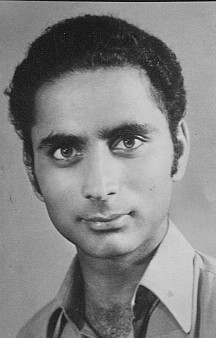
Avtar Singh Sandhu (9 September 1950 – 23 March 1988), who wrote under the pen name Pash,[1] was an Indian poet, one of the major poets in Punjabi of the 1970s. He was killed by Sikh extremists on 23 March 1988.[2] His strongly left-wing views were reflected in his poetry.

Key Information

Early life and activism

[edit]

Pash was born as Avtar Singh Sandhu in 1950 in a small village called Talwandi Salem in Jalandhar district of Punjab, India, in a middle-class farmers family. His father Sohan Singh Sandhu was a soldier in the Indian Army who also composed poetry as a hobby. Pash grew up in the midst of the Naxalite movement, a revolutionary movement in India against the landlords, industrialists, traders, etc. who control the means of production. This was in the midst of the Green revolution which had addressed India's problem of famine using high yield crops, but had also unconsciously led to other forms of inequities in Punjab.[3]

In 1970, he published his first book of revolutionary poems, Loh-Katha (Iron Tale), at the age of 18. His militant and provocative tone raised the ire of the establishment and a murder charge was soon brought against him. He spent nearly two years in jail, before being finally acquitted.

Pash in 1973 in Nakodar

On acquittal, the 22-year-old became involved in Punjab's Maoist front, editing a literary magazine, Siarh (The Plow Line) and in 1973 Pash founded 'Punjabi Sahit Te Sabhiachar Manch' (Punjabi Literature and Culture Forum). He became a popular political figure on the Left during this period and was awarded a fellowship at the Punjabi Academy of Letters in 1985. He ran to the United Kingdom and the United States the following year; while in the US, he became involved with the Anti-47 Front, opposing Khalistani violence. His words had a great influence on the minds of the people.

Assassination

[edit]

At the beginning of 1988 Pash was in Punjab for the renewal of his visa from the US.[4] A day before leaving for Delhi, however, he was gunned down by three men along with his friend Hans Raj at the well in his village Talwandi Salem on 23 March 1988.[5] Pash was assassinated for being a vocal critic of Sikh leader Jarnail Singh Bhindranwale.[6]

Literary works

[edit]
Original Transcript of a poem by Pash (Avatar Singh) - a revolutionary poet of Punjab, India. Reproduced here under creative commons - original copyright remains with the author and his family.
Original transcript of Hakumat (By Pash)
  • Loh-katha (Iron-Tale) (1970),
  • Uddade Bazan Magar (Following The Flying Hawks) (1973),
  • Saadey Samiyaan Vich (In Our Times) (1978), and
  • Khilre Hoye Varkey (Scattered pages) (1989)

Khilre Hoey Varkey was posthumously published in 1989 after his death, followed by his journals and letters. A selection of his poems in Punjabi, Inkar, was published in Lahore in 1997. His poems have been translated in many languages including other Indian languages, Nepali and English. One of Pash's most popular and often cited poems is titled in Hindi Sabse Khatarnak hota hai hamare sapnon ka mar jaana - meaning: The most dangerous thing is the demise of our dreams.[7] In 2005, this poem was included in NCERT's Hindi book for 11th standard.[8]

Poems written by Pash are popular in India, especially in Punjab and North India. Recitations of his poems are often carried out, especially on the weekends close to his death anniversary.

In the media

[edit]

In 2015, Punjabi singer and songwriter Gurvinder Brar released a song entitled "Shiv Di Kitaab" which was about poetry comparison in Shiv Kumar Batalvi's and Pash's styles. Couplets from Pash's famous writings were used as references in the song's music video. This song also happened to be the debut music video appearance for Indian actress Shehnaaz Gill.[9]

In 2017, Punjabi rapper Kay Kap created a song entitled "My Land Is Dyin'" featuring a narrative upon visualizing what must have happened moments before Pash was gunned down. The song lyrics featured a verse in storytelling format about a poet and a farmer discussing the future of Punjab. The single was released on Pash's 29th death anniversary.[10] In 2020, Kay Kap's album Rough Rhymes for Tough Times featured a song entitled "Ijaad" which had couplets from Pash's poem "Ghaah" in the outro vocals.[11]

In 2021, Punjabi singer and songwriter Sidhu Moose Wala's album Moosetape featured two songs entitled "G-Shit" and "Power". Lyrics of both songs mentioned Pash in a similar manner. Sidhu self-proclaimed himself to be modern-day Pash in terms of vision.[12]

See also

[edit]

References

[edit]
[edit]
Revisions and contributorsEdit on WikipediaRead on Wikipedia
from Grokipedia
Avtar Singh Sandhu (9 September 1950 – 23 March 1988), better known by his pen name Pash, was a Punjabi poet and activist born into a middle-class farming family in Talwandi Salem village, , . His early exposure to the region's post-Partition recovery and rural hardships shaped his worldview, leading him to produce revolutionary poetry from age fifteen that employed to dismantle traditional Punjabi literary norms dominated by rhyme and meter. Influenced by Marxist principles and the Naxalite movement, Pash's oeuvre addressed caste oppression, feudal exploitation, and state complicity in social inequities, positioning him as a key figure in "jujharu" (militant struggle) that prioritized ideological commitment over aesthetic conformity. Collections of his work critiqued religious communalism and advocated for class-based solidarity, earning acclaim for embodying the archetype of a poet-activist amid Punjab's turbulent socio-political landscape. Pash's refusal to align with emerging Khalistani , which he viewed as a diversion from material struggles, culminated in his by militants on 23 March 1988 in his native village, alongside collaborator Hans Raj Kareer, highlighting the lethal tensions between secular leftism and in late-1980s . Despite his brief life, Pash's uncompromising critique of power structures continues to influence , underscoring the causal links between ideological dissent and targeted violence in contexts of institutional bias toward communal narratives over empirical class analysis.

Biography

Early life and family background

Avtar Singh Sandhu, who later adopted the pen name Pash, was born on September 9, 1950, in Talwandi Salem village, , . He came from a family engaged in farming, reflecting the predominant agrarian community structure in rural at the time. His father, Sohan Singh Sandhu, a retired major, supported the family through farming on modest landholdings amid the economic strains of post-Partition , including disrupted agricultural systems, refugee influxes, and limited access to resources in the early years of independent . The household's circumstances, described variably as middle-class or marked by , immersed young Sandhu in the rhythms of rural life, local Punjabi dialect, and folk cultural practices tied to the land and community labor. This environment highlighted everyday disparities in rural socioeconomic conditions, such as unequal land distribution and dependence on seasonal harvests.

Education and initial influences

Avtar Singh Sandhu, who adopted the pen name Pash, commenced his formal schooling at age six in a located in a village neighboring his birthplace of Talwandi Salem in , . He progressed to complete his middle school examination, demonstrating early academic engagement, but advanced education remained constrained by his family's middle-class agrarian circumstances. Subsequently, he enrolled in a vocational training center, though he departed prior to finishing the program, forgoing higher studies in favor of self-directed intellectual pursuits. In his mid-teens to early twenties, roughly ages 15 to 20 during the late 1960s, Pash encountered progressive literature that ignited his radical inclinations, including Punjabi poetic traditions alongside global leftist voices such as Pablo Neruda, Bertolt Brecht, Faiz Ahmad Faiz, and Maxim Gorky. His adopted nom de plume derived from Pasha, a character in Gorky's novel Mother, symbolizing proletarian resilience. These readings, compounded by exposure to Marxist theorists like Leon Trotsky and Russian revolutionaries, fostered a foundational critique of feudalism and social inequities. Pash's initial foray into student circles coincided with Punjab's turbulent peasant unrest, particularly the Naxalite insurgency in the region, where he expressed sympathy for agrarian rebellions against landlord dominance. By age 18 to 20, this milieu prompted his alignment with revolutionary ideologies emphasizing armed resistance to state-backed exploitation, laying the groundwork for his emergent worldview without yet manifesting in organized activism.

Emergence as a poet and activist

Avtar Singh Sandhu adopted the pen name Pash, derived from Maxim Gorky's character Pasha and connoting "noose" in Punjabi to evoke revolutionary constriction against oppression, during his early writings in the late 1960s. His initial poems appeared in Punjabi literary magazines, marking his entry into public literary circles amid the rising Naxalite influences in Punjab. In 1970, at age 20, he published his debut collection Loh-Katha (Iron Tale), a volume of revolutionary verses that critiqued social hierarchies through militant imagery. That same year, Pash faced arrest in May 1970 on fabricated murder charges stemming from his acquaintanceship with Naxalites implicated in the killing of a brick kiln owner, reflecting state efforts to suppress leftist sympathies. He endured nearly two years of imprisonment before acquittal, an experience that underscored patterns of judicial overreach against activists and sharpened his poetic focus on repression. Upon release around 1972, Pash channeled this into activism by editing left-oriented literary journals such as Siarh (The Plow Line), which he helped launch, and Rohle Baan (Raging Arrows), platforms for disseminating grassroots dissent. Pash's editorial roles by age 22 positioned him as a bridge between and mobilization, fostering verse that prioritized subaltern voices over elite aesthetics—inspired by figures like , whom he credited for "poetry from below." This approach emphasized anti-elite, experiential expression drawn from peasant and worker realities, distinguishing his work from establishment . Through these outlets, he organized literary efforts that intertwined writing with calls for social upheaval, solidifying his dual identity as poet and agitator in Punjab's turbulent 1970s landscape.

Political Ideology and Activism

Alignment with Marxist and Naxalite movements

Pash drew significant ideological inspiration from the of May 1967, interpreting it as a spontaneous peasant insurrection against entrenched feudal landlords and governmental indifference to rural exploitation in . This Maoist-led revolt, initiated by the Communist Party of India (Marxist-Leninist) faction, resonated with Pash's observations of Punjab's agrarian inequities, where small landholdings and perpetuated class disparities among farmers and landless laborers. His alignment manifested in active participation within Naxalite-influenced circles during the 1970s, including affiliations with student groups propagating revolutionary land redistribution and the overthrow of bourgeois state apparatus. In speeches and pamphlets, Pash explicitly championed Marxist class struggle as essential for dismantling Punjab's semi-feudal economy, urging the and peasantry to seize control of productive resources from absentee owners and moneylenders who dominated the Green Revolution's benefits post-1960s. He critiqued capitalist penetration in agriculture, arguing that and hybrid seeds exacerbated rather than alleviated exploitation, with over 60% of Punjab's cultivated land concentrated among 5% of households by the mid-1970s, fueling demands for radical reforms like ceiling enforcement and cooperative farming under proletarian leadership. This stance echoed Naxalite calls for armed agrarian revolution, as evidenced by his valorization of militant actions against zamindars, which historical accounts link to escalated rural violence in , including over 100 reported landlord assassinations tied to leftist factions between 1968 and 1972. Pash's practical expressions of alignment included organizational ties to the Students Union (Marxist), a Naxalite-leaning body that mobilized against state repression during the (1975–1977), resulting in his own imprisonment on suspicions of subversive activities. While not formally a cadre of the CPI(ML), his rhetoric provided ideological justification for targeted confrontations with class enemies, contributing to the broader cycle of unrest where Naxalite groups in Punjab claimed responsibility for disrupting landlord hegemony through expropriatory tactics, as documented in contemporaneous police records and leftist manifestos. This phase underscored his commitment to Maoist protracted adapted to Punjab's context, prioritizing empirical mobilization over abstract theory.

Critiques of state power and social structures

Pash's poetry incisively targeted the embedded in Indian state institutions, portraying it as a mechanism that perpetuated exploitation amid Punjab's agrarian distress and political unrest. In "Sab Ton Khatarnak" (The Most Dangerous), he delineated escalating perils—from overt graft and police brutality to the profound threat of apathy and eroded aspirations—arguing that systemic silence enabled state-sanctioned looting of laborers' efforts. This critique resonated with Punjab's realities, where bureaucratic compounded economic hardships for small farmers and workers, fostering cycles of dependency and revolt. His opposition to central government overreach intensified after the (1975–1977), during which he faced for anti-authoritarian dissent, including speeches condemning Indira Gandhi's suspension of democratic norms. Pash linked such episodes to broader institutional failures, as in "Haath" (1973), where he depicted the hands of the repressed as symbols of inherent resistance against coercive state machinery, underscoring causal chains from policy-induced scarcity to popular defiance. Pash also assailed entrenched social hierarchies in , particularly feudal landlordism and residual inequalities that contradicted egalitarian ideals, attributing them to power concentrations enabling elite dominance over land and resources. Through satirical lenses in poems like "Do te Do Tinn" (1970), he exposed betrayals within these structures, connecting localized feudal remnants—such as exploitative tenancy practices—to statewide discontent and the erosion of communal solidarity. These observations, rooted in Naxalite-influenced analyses of Punjab's semi-feudal economy, highlighted how unaddressed imbalances perpetuated marginalization without invoking ideological abstractions.

Stance against religious extremism and separatism

Pash publicly denounced religious fundamentalism, including Sikh extremism, as incompatible with his vision of a secular, pluralistic Punjab. In his writings and activism during the 1980s, he criticized theocratic ideologies that sought to impose religious supremacy, arguing they undermined communal harmony and rational discourse. For instance, he targeted Sikh militants' demands for Khalistan—a proposed independent Sikh state—as regressive separatism driven by fanaticism rather than legitimate grievances, emphasizing instead class-based solidarity across religious lines. While in the United States in the mid-1980s, Pash launched the journal Anti-1947, named to evoke rejection of the 1947 Partition's communal divisions, where he explicitly condemned Sikh extremist violence and propaganda amid escalating . In this publication and related essays, he highlighted militants' attacks on civilians, such as bus massacres and targeted killings, as terrorist acts that betrayed Sikh egalitarian traditions and provoked state crackdowns. Pash positioned himself as a defender of Punjab's syncretic culture against such extremism, drawing on Marxist critiques to frame as a diversion from anti-feudal and anti-capitalist struggles. This stance unfolded against the backdrop of Punjab's from the late 1970s to 1990s, where groups like the cited perceived discrimination—such as river water disputes and underrepresentation—as justification for armed , leading to over 20,000 deaths by 1993. Pash prioritized combating fundamentalism's causal role in fueling cycles of , even as militants controlled rural areas by 1987 and enforced parallel governance. His poetry, such as in collections like Loh Kite Reh Gaye (1970s onward), wove anti-extremist themes with calls for unified resistance, refusing to romanticize religious mobilization. Left-wing admirers hailed Pash's position as principled that exposed extremism's threat to progressive politics, crediting it with preserving intellectual space amid militancy's dominance. Critics, however, contended his focus on anti-fundamentalism overlooked state excesses, notably in June 1984, where Indian forces' assault on the complex—resulting in hundreds of deaths and damage to the Sikh holy site—intensified grievances and recruitment for militants, potentially rendering his critiques provocative rather than pragmatic. This duality reflects causal tensions in the : extremism's ideological rigidity versus reactive state measures, with Pash's unwavering opposition ultimately cited by militants as justification for his 1988 .

Assassination

Context within Punjab insurgency

The Punjab insurgency originated from long-standing Sikh political grievances formalized in the of October 1973, adopted by the , which demanded greater autonomy for , including exclusive control over its river waters, the transfer of Chandigarh as the state capital, and safeguards against perceived cultural erosion. These demands, initially pursued through constitutional means, escalated into widespread unrest by the late 1970s amid economic disparities, disputes over resource allocation, and accusations of central government overreach, fostering support for separatist ideologies advocating an independent Sikh state of Khalistan. Militancy intensified in the early 1980s under the influence of figures like , who consolidated disparate Khalistani factions by blending religious revivalism with armed resistance from the complex in , amassing weapons and followers while denouncing opponents as traitors to Sikh interests. The Indian government's in June 1984, aimed at dislodging militants from the temple, resulted in hundreds of deaths and deepened communal divides, triggering Indira Gandhi's by her Sikh bodyguards on October 31, 1984, and subsequent anti-Sikh riots that killed over 3,000 civilians in alone. This cycle propelled the insurgency into full-scale armed conflict, with Khalistani groups conducting assassinations, bombings, and extortion to enforce their agenda. By the mid-1980s, the violence manifested as tit-for-tat killings involving militants, , and civilians, as separatist outfits targeted perceived apostates—including left-wing activists and intellectuals who critiqued religious extremism and —labeling them collaborators with the state. Examples included the execution of leaders like Darshan Singh Canadian in 1984 by militants, reflecting a pattern where ideological dissenters faced elimination to suppress opposition and consolidate militant control. The conflict, peaking in 1988, claimed over 20,000 lives according to government-compiled data on militants, police, and civilians killed between 1981 and 1993, amid a breakdown in civil order that heightened vulnerability for public figures opposing the dominant Khalistani narrative.

The killing and immediate perpetrators

On March 23, 1988, Avtar Singh Sandhu, known by his pen name Pash, was fatally shot at the age of 37 in the fields near a tubewell in his native village of Talwandi Salem, , . He was accompanied by his friend Hans Raj at the time, when three assailants approached on a scooter and fired multiple rounds at them from close range. Pash sustained wounds to the chest and , succumbing shortly after at a local hospital, while Hans Raj survived the attack. The immediate perpetrators were identified as Khalistani militants targeting Pash for his outspoken criticism of Sikh separatism and religious extremism in his poetry, which had gained prominence amid the escalating Punjab insurgency. Sources attribute the operation to elements within the , a militant outfit active in the region during that period, though specific names of the shooters remain unprosecuted in documented records. The assailants fled the scene immediately after the shooting, leaving no pamphlets or direct claims of responsibility at the site, but the modus operandi aligned with tactics used by Khalistani groups against perceived ideological opponents. The killing left Pash's wife, , and their two young sons without a provider, compounding the personal tragedy amid the broader violence in . Local reports noted an outpouring of grief from villagers and fellow writers, who gathered at the site within hours, highlighting Pash's status as a vocal leftist opposed to both state repression and militant . No arrests were made in the immediate aftermath, reflecting the challenges of targeting militants in insurgency-affected areas at the time.

Investigations, trials, and unresolved questions

The Punjab Police investigation into Pash's assassination on March 23, 1988, promptly attributed the attack to Khalistani militants affiliated with the (KCF), a group known for targeting critics of during the . The probe identified the two assailants as young militants who had posed as poetry enthusiasts to gain access to his home, firing multiple shots before fleeing; ballistic evidence linked the weapons to other KCF operations. Initial arrests of suspected accomplices followed within weeks, with charges filed under sections 302 (murder) and 120B (), but the primary shooters evaded immediate capture amid widespread militant support networks and rural safe havens. Legal proceedings were protracted and undermined by the insurgency's volatility, including witness intimidation and assassinations; at least two key eyewitnesses retracted statements under duress, citing threats from cadres, while judicial delays stemmed from frequent court disruptions and security force priorities focused on counter-militancy operations. Some peripheral suspects faced trials in consolidated militancy cases during the early , resulting in convictions for broader terrorist activities—such as life sentences for KCF operatives in unrelated but contemporaneous killings—but no definitive convictions solely for Pash's murder have been documented, with evidentiary chains compromised by destroyed records and deceased witnesses. This pattern mirrored dozens of intellectual assassinations, where police encounters eliminated suspects without , as seen in over 20,000 militant-related deaths between 1988 and 1993, per official data, leaving judicial closure elusive. Unresolved questions persist regarding higher-level orchestration within KCF leadership, potentially involving cross-border directives from Pakistan-based handlers, as alleged in declassified summaries from the , though lacking substantiation due to operational secrecy. Critics, including leftist groups, have highlighted failures—Pash had publicly reported threats yet received no state protection despite his status as a vocal anti-extremist—contrasting official narratives of resource constraints with claims of selective inaction amid documented police abuses like extrajudicial killings exceeding 2,500 cases by 2007 estimates. These debates underscore evidentiary gaps, where militant accountability clashed with state excesses, preventing comprehensive truth-finding amid mutual violations by insurgents and forces.

Literary Contributions

Major works and publications

Pash published his debut collection of revolutionary poems, Loh-Katha (Iron Tale), in 1970 at the age of 18, marking his entry into with themes of social upheaval. This was followed by Uddian Bazan Magar (Following the Flying Hawks) in 1973, a volume that continued his focus on militant resistance against oppression. In 1978, he released Saade Samiyan Vich (In Our Times), addressing rural struggles and contemporary Punjab's socio-economic conditions amid political turmoil. Pash's oeuvre encompassed over 200 poems alongside political pamphlets, many disseminated through underground networks during periods of in from the mid-1970s onward, evading state restrictions on dissenting voices. Posthumously, Sabh Ton Khatarnak (The Most Dangerous), compiled in 1989, featured key works including the 1983 poem critiquing the erosion of aspirations under systemic failures.

Poetic style, themes, and influences

Pash's poetic style is characterized by the use of , which allowed him to convey urgent political messages without the constraints of traditional rhyme or meter, emphasizing raw emotional and ideological directness over aesthetic ornamentation. He drew on colloquial Punjabi , incorporating everyday idioms and spoken rhythms to bridge the gap between elite literary forms and the language of the oppressed masses, thereby democratizing as a tool for agitation rather than detached artistry. This rejection of ornate metaphors in favor of stark, unfiltered imagery reflected a deliberate shift toward functional verse that prioritized causal clarity in depicting power dynamics over romantic evasion. His themes revolve around the mechanics of , the erosion of human agency under state and social , and the imperative of revolutionary as a to despair. Poems often dissect how systemic exploitation manifests not just in overt but in internalized submission, portraying as an active resistance born from collective awakening rather than passive . For instance, in "Sab Ton Khatarnak" ("The Most Dangerous"), Pash contends that psychological numbness and the death of dreams pose greater threats than bullets or graft, as they enable unchallenged tyranny by fostering apathy toward suffering. This motif underscores a causal realism: true danger lies in the surrender of critical faculties, which perpetuates cycles of domination more insidiously than physical force. Influences on Pash included Pablo Neruda's model of committed, earth-bound poetry rooted in the specifics of local struggle, which inspired his ambition to craft "poetry from below"—verse emerging from the subaltern experience to challenge hegemonic narratives. Complementing this, Bertolt Brecht's and alienation effects shaped Pash's technique of estranging familiar oppressions to provoke reader reflection and action, transforming poetry into a Brechtian tool for unveiling ideological illusions rather than evoking alone. These elements converged in a revolutionary aesthetic that favored clarity, empirically grounded in observations of peasant and worker realities, over escapist .

Critical reception of his oeuvre

Pash's has been lauded by literary scholars for its innovative fusion of fervor with accessible Punjabi vernacular, effectively democratizing verse and inspiring the wave of 1980s protest poetry amid Punjab's socio-political turmoil. Tejwant Singh Gill, in his 1999 monograph Makers of —Pash, praises the oeuvre's political depth, drawing parallels to influences like , , and , positioning as a direct instrument of societal upheaval rather than mere aesthetic exercise. This reception underscores Pash's role in amplifying critiques of , religious extremism, and state oppression, as noted by analysts like Ashutosh Sharma, who highlight the unflinching tone in collections such as Loh-Katha (1970) and Sab Ton Khatarnak (1985), the latter emerging as an enduring anthem of resistance. However, the work has faced scrutiny for prioritizing ideological imperatives over literary nuance, with detractors arguing it occasionally devolves into dogmatic sloganeering. Prominent critic dismissed much of Pash's output as lacking intrinsic value beyond serving as a "red rag"—a for —prompting Pash's defensive response in the poem "Inkaar." Even Pash acknowledged this tension, stating in correspondence that "good ideology can give birth to bad poetry; bad ideology can birth good poetry," reflecting self-awareness of how Marxist frameworks might constrain poetic subtlety. Such views gain traction when considering the oeuvre's relative silence on emergent economic realities like market liberalization's role in alleviating rural distress, a nuance often overlooked in favor of anti-capitalist tropes. Reception dynamics reveal a skew toward acclaim from left-leaning academic circles, where Pash is recited at protests and enshrined as a martyr-poet, potentially amplifying echo-chamber effects amid Punjab's polarized literary scene. Posthumously, a Hindi translation of his collected works earned the for translator in 2012, signaling broader institutional nod despite debates over the award's politicization when Dabral returned it in 2015 amid national controversies. This mixed legacy—innovation tempered by rigidity—positions Pash as a polarizing figure whose verse prioritizes causal of power structures over balanced .

Controversies and Criticisms

Plagiarism allegations

In 2017, discussions among Sikh netizens and commentators, including writer Rajwinder Rahi, alleged in two of Pash's poems: Sabh Ton Khatarnak and Mainu Ghah Haan. For Sabh Ton Khatarnak, accusers highlighted the first line's resemblance to Russian poet Mikhail Kulchytskyi's "The Most Terrible Thing in the World," while others noted parallels to Brazilian author Medeiros' "Die Slowly," a piece previously misattributed to . In Mainu Ghah Haan, three of its eleven lines were claimed to be direct translations from American poet Carl Sandburg's "The Grass." Defenders, such as poet and translator Amarjit Chandan, countered that the similarity in Sabh Ton Khatarnak to Kulchytskyi was coincidental, with no substantive overlap to Medeiros' work, and described Mainu Ghah Haan as a loose adaptation of Sandburg rather than outright copying, though acknowledgment of the source would have been preferable. Chandan framed the accusations as politically motivated, linked to opposition from Khalistani sympathizers amid a broader over Pash's inclusion in NCERT textbooks. No formal investigation, legal proceedings, or followed the claims, leaving the matter unresolved. The fueled online scrutiny of Pash's authenticity, particularly regarding uncredited borrowings in revolutionary verse influenced by global literary motifs and Punjabi oral traditions, where shared phrasing often reflects common cultural archetypes rather than deliberate theft.

Ideological biases in his writings

Pash's poetry and prose consistently reflected a Marxist-Leninist framework, emphasizing class struggle, economic exploitation by feudal landlords and capitalists, and the necessity of to achieve . This ideological orientation, rooted in his involvement with the Naxalite movement during the 1970s, positioned systemic economic inequities as the root cause of Punjab's turmoil, often subordinating ethnic or religious dimensions to materialist analysis. Critics from conservative perspectives have contended that this class-centric lens blinded Pash to the potency of confessional grievances in mobilizing Sikh separatism, particularly amid perceptions of cultural and political marginalization by the Hindu-majority Indian state in the 1980s. While Pash explicitly denounced religious —targeting both Sikh militants and Hindu nationalists—his prescriptions for resolution remained anchored in Marxist agitation rather than addressing identity-based demands, which empirical evidence from the Punjab suggests were central drivers of violence, with over 20,000 deaths attributed largely to ethno-religious fault lines between 1981 and 1993. Such an approach, detractors argue, inadvertently amplified instability by dismissing reformist paths that could have mitigated separatism's appeal, as evidenced by the insurgency's escalation despite Naxalite-inspired efforts. Discussions of Pash's work are predominantly sourced from left-leaning literary circles, which may underemphasize these limitations due to ideological affinity, contrasting with scarcer right-leaning analyses that view his revolutionary rhetoric as contributory to Punjab's protracted disorder. On economic themes, Pash's writings highlighted disparities exacerbated by Punjab's —such as indebtedness among small farmers despite the state's wheat production surging from 1.9 million tons in 1960-61 to 11.8 million tons by 1990-91—but selectively amplified systemic failures while overlooking the policy's role in transforming Punjab into India's breadbasket and averting famines through hybrid seeds and irrigation expansion. This utopian envisioning of class upheaval, untested against post-Cold War realities like the Soviet Union's 1991 amid , underscored a disconnect from causal mechanisms favoring market-oriented incentives over state-enforced collectivization. Nonetheless, his critiques effectively exposed and landlordism, fostering awareness of graft that plagued Punjab's agrarian in the 1970s and 1980s.

Debates over his role in political violence

Pash's early sympathies with the Naxalite movement, rooted in Maoist ideology, have fueled ongoing debates about his indirect contributions to in Punjab during the 1970s. At age 21 in 1971, he faced trial on charges stemming from alleged involvement in a case tied to Maoist activities, though the charges were framed and he was acquitted after nearly two years in prison, highlighting police perceptions of his ideological alignment with groups engaging in targeted killings of landlords and officials. Following his release around 1973, Pash edited Siarh (The Plow Line), a associated with Punjab's Maoist front, during a period when Naxalite actions nationwide peaked with over 3,650 reported class-based attacks and more than 850 deaths by 1971, including assassinations and clashes in rural . Critics, drawing from police records and analyses of revolutionary literature, contend that such affiliations and his jujharu (militant struggle) helped sustain a that romanticized armed resistance against feudal oppression, potentially normalizing violence in cycles of rural unrest where Maoist factions initiated attacks on perceived class enemies. Supporters of Pash argue that his work reflected the legitimate grievances of landless peasants and marginalized communities rather than inciting , positioning his verses as a call for systemic change amid state repression of left-wing , with his underscoring the fabricated nature of force accusations. They emphasize that leftist narratives often frame Naxalite actions as defensive responses to entrenched and police brutality, citing bidirectional in the where authorities conducted encounter killings against suspected insurgents. Pash's later opposition to Khalistani militancy—evident in his involvement with the Anti-1947 Front and critiques of Sikh extremist during the 1980s —further bolsters this view, portraying him as a consistent anti-authoritarian voice against all forms of rather than a partisan enabler of Maoist aggression. These debates remain unresolved, particularly regarding whether Pash's rejection of Khalistani separatism represented ideological redemption or revealed fractures within radical leftism, as Maoist and Sikh militant currents both drew from anti-state grievances but clashed violently, with empirical patterns showing Naxalite-initiated rural killings preceding broader insurgencies. While academic and literary sources prioritize his poetic articulation of revolt against injustice, security-oriented critiques highlight how sympathies with armed groups like those active in contributed to environments permissive of targeted violence, though direct causal links to specific acts remain unproven beyond ideological overlap.

Legacy and Impact

Posthumous recognition and memorials

In the years following Avtar Singh Sandhu's assassination on March 23, 1988, the International Pash Memorial Trust was formed to preserve his legacy, including organizing memorial functions such as one held in the Bay Area, California, on July 10, 2010. His poetry received further recognition through translations, notably a rendition of his collected works that earned the for its translator. On July 14, 2025, plans were announced for a memorial to be constructed at the site where was gunned down by militants, reflecting ongoing state-level efforts in to commemorate figures from the post-insurgency era. This initiative aligns with broader reconciliation processes in the region, where tributes to such individuals have been erected amid healing from the 1980s-1990s violence. Organizations affiliated with the , along with international radio and television channels, continue to promote recitations and discussions of his work at dedicated events.

Influence on Punjabi literature and activism

Pash's initiation of the "Poetry from Below" movement marked a pivotal shift in , emphasizing subaltern perspectives and the material realities of the , drawing from influences like Pablo Neruda's autochthonous style and Bertolt Brecht's revolutionary ethos. This approach injected vitality into proletarian and resistance poetry, fostering a surge in works that prioritized class struggle and socio-political critique over traditional romanticism, as evidenced by the subsequent era of rebellious ideology that scholars attribute directly to his oeuvre. His emphasis on everyday idioms and confrontational symbolism encouraged later Punjabi writers to engage with Marxist themes and post-Naxalite narratives, broadening the genre's focus on feudal oppression and state violence without diluting its raw, unpolished edge. In , Pash emerged as a enduring symbol for secular-left resistance in , with his verses providing rhetorical ammunition against perceived injustices, though his class-centric framing has been observed to reinforce polarized narratives favoring confrontation over broader reconciliation efforts. Empirical markers of this influence include the widespread recitation of his poem "Sab Ton Khatarnaak" during the 2020–2021 farmers' agitations against agricultural laws, where it functioned as a to sustain morale amid harsh conditions at sites like the Tikri border; protesters displayed it on placards and banners, underscoring its role in mobilizing collective defiance. One documented instance involved a farmer from Faridkot cycling 400 kilometers to the protest site in December 2020, bearing the poem as a personal emblem of solidarity, highlighting how Pash's work continues to catalyze grassroots participation in 21st-century movements. While Pash's legacy invigorated Punjabi literary by linking to tangible political agency, its entrenchment of proletarian motifs has drawn implicit for sidelining integrative cultural dialogues in favor of adversarial class lenses, as reflected in the selective of his texts amid Punjab's ongoing sectarian tensions post-1988. Nonetheless, verifiable lineages persist in contemporary resistance writing, where his unyielding of and inequality informs Dalit-adjacent voices challenging entrenched hierarchies, evidenced by sustained citations in protest literature and performances. This dual impact—vitalizing radical expression while risking discursive silos—demonstrates the causal ripple of his output on Punjab's socio-literary landscape.

Media portrayals and cultural references

Pash's life and revolutionary have been the subject of limited but notable depictions in films and theater. The 1994 Apna Pash, directed by Rajeev Kumar, examines his underground activism and literary output during the turbulent 1970s and 1980s in . In 2009, filmmaker announced plans for a Bollywood biopic on Pash, with cast in the lead role to portray the poet's defiance against political extremism and establishment forces; the project, however, did not advance to production. Theater productions have more directly adapted his works, including the solo play Khetan Da Putt, written and performed by , which premiered in Bhatinda in 2014 and draws from Pash's diaries, letters, and poems to evoke his rural upbringing and ideological commitments. Pash's verse has permeated cultural discourse through recitations and adaptations in protest media, particularly his poem "Sabh Ton Khatarnak" (The Most Dangerous), which critiques the erosion of aspirations and has been featured in videos and performances tied to agrarian movements, such as the 2020–2021 Indian farmers' protests. Shorter works, like a 2018 film adaptation of his poem "Most Dangerous" directed by Uttam Halder, highlight his enduring appeal in activist circles.

References

Add your contribution
Related Hubs
Contribute something
User Avatar
No comments yet.