Hubbry Logo
Pateley BridgePateley BridgeMain
Open search
Pateley Bridge
Community hub
Pateley Bridge
logo
8 pages, 0 posts
0 subscribers
Be the first to start a discussion here.
Pateley Bridge
Pateley Bridge
from Wikipedia

Pateley Bridge (known locally as Pateley) is a market town in the civil parish of High and Low Bishopside, in Nidderdale, in the county and district of North Yorkshire, England. Historically part of the West Riding of Yorkshire, it lies on the River Nidd. It is in the Yorkshire Dales and just outside the Yorkshire Dales National Park.[2]

Key Information

The town has the oldest sweet shop in the world. Established in 1827, it is housed in one of the earliest buildings in Pateley Bridge, dating from 1661.[3] Pateley Bridge is also the home of the Nidderdale Museum.

The last Dales agricultural show of the year, the Nidderdale Show, is held annually on the showground by the River Nidd. The show attracts more than 14,000 visitors each year.

The town is within the Nidderdale National Landscape, an Area of Outstanding Natural Beauty.[4] The town was listed in both the 2017 and 2018 Sunday Times reports on Best Places to Live in northern England.[5] The local tourist authority bills it as "the perfect place to start your exploration of the Yorkshire Dales".[6]

History

[edit]
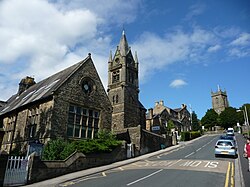
St Cuthbert’s Church

In the early Middle Ages the site of Pateley lay in lands of the Archbishop of York, which came to be known as Bishopside. In the 12th century the principal settlement in Bishopside was at Wilsill, rather than Pateley.[7] Pateley was first recorded in 1175 (though the document survives in a later copy), as Patleiagate, with 14th century forms including Patheleybrig(ge). The final elements are clear, deriving from Old Norse gata ('street') and the northern dialect form brig ('bridge') respectively. The bridge is Pateley Bridge over the River Nidd.

There is more debate about the Pateley section of the name: the usual explanation is Old English pæþ ('path') in the genitive plural form paða + lēah ('open ground, clearing in a forest'); paða lēah would mean "woodland clearing of the paths", referring to paths up Nidderdale and from Ripon to Craven, which intersected here.[8] However, the Pateley name forms competed in the Middle Ages with forms like Padlewath (1227) and Patheslayewathe which could be from Middle English *padil ('a shallow place in water') + Old Norse vath ('ford') and it could be that they owe something to this name.[9] The local story that the name comes from 'Pate', an old Yorkshire dialect word for 'Badger',[10] is incorrect.[11]

Pateley Bridge Methodist Church

In 1320 the Archbishop of York granted a charter for a market and fair at Pateley.[12] From the 14th century until the early part of the 20th century, Scotgate Ash Quarry despatched hard-wearing sandstone from its site on the northern flank above Pateley Bridge. In 1862 the railway arrived in Nidderdale, and the stone was then exported by train and was used in railway platforms, national buildings and harbour walls. Scotgate Ash Quarry closed in 1915.[13]

Pateley Bridge has had two railway stations. Between 1862 and the Beeching cuts in 1964, Pateley Bridge railway station was the terminus of the railway line running up Nidderdale from Nidd Valley Junction, near Harrogate. Between 1907 and 1937, the Nidd Valley Light Railway ran farther up the dale from a separate railway station. Access is now by road, with an hourly bus service from Harrogate.[14]

All Creatures Great and Small TV series was filmed mostly in the Yorkshire Dales with many of the Dales scenes filmed in the National Park around Nidderdale.[15] The crossroads that are so important in the Christmas episode are "on the roads above Pateley Bridge".[16]

Local government

[edit]

Pateley Bridge was once in the Lower Division of Claro Wapentake. In the 19th century local government reforms the town fell within the Pateley Bridge Poor Law Union,[17] later the Pateley Bridge Rural Sanitary District[18] and from 1894 Pateley Bridge Rural District.[19] In 1937 the rural district was merged to become part of Ripon and Pateley Bridge Rural District.[20]

From 1974 to 2023 the town was within the Borough of Harrogate in North Yorkshire. The area is now administered by the North Yorkshire Council unitary authority.

The town is in the electoral ward of Pateley Bridge, which includes the whole of upper Nidderdale as far as Stonebeck Up, with a total population at the 2011 Census of 2,718.[21]

Pateley Bridge is the largest settlement in the civil parish of High and Low Bishopside, Pateley Bridge was granted town status in 1986, and the High and Low Bishopside Parish Council was renamed Pateley Bridge Town Council.[22] However, the official name of the civil parish remains High and Low Bishopside.

The population of the Pateley Bridge Built-up area, which includes Bridgehousegate and Bewerley village, both outside the parish, was 1,432 in 2011.[1]

Local media

[edit]

Local news and television programmes are provided by BBC Yorkshire and ITV Yorkshire. Television signals are received from the local relay TV transmitter. [23]

Local radio stations are BBC Radio York on 104.3 FM, Greatest Hits Radio Harrogate and the Yorkshire Dales on 107.1 FM and Dales Radio on 104.9 FM. [24]

The Pateley Bridge and Nidderdale Herald is the town's local newspaper. [25]

Amenities

[edit]
Pateley Bridge from the bridge

The town can be reached by bus from Harrogate (Harrogate Bus Company number 24 service). Nidderdale is also served by DalesBus services on summer Sundays. The nearest railway station is at Harrogate. Highway access is via A1(M) and the A61 to the east, and the A65, A59, M65 and M62 to the south.[26]

There are bed and breakfast houses, St Cuthbert's Church, Pateley Bridge, a Methodist chapel and a Roman Catholic church, a garage, hotels, Nidderdale Museum, public houses, public library, public park, restaurants, a primary school and a secondary school (Nidderdale High School), shops and a theatre (Pateley Playhouse). Bewerley Park Centre for Outdoor Education is in the nearby village of Bewerley. Brimham Rocks and Stump Cross Caverns are also close by.

The Bridge Inn

The Nidderdale Way and Six Dales Trail both pass through the town.

The town is also a cricketing hub, with several teams (known collectively as 'The Badgers') competing in various leagues. Crown green bowling is also a popular pastime.

Pateley is also served by Nidderdale Pool and Leisure Centre. Comprising a 20-metre swimming pool, gym, sports hall and two squash courts, the facility officially opened in 2005 after many years of local fundraising.

"Oldest Sweet Shop in England"

The town is also famous for the "Oldest Sweet Shop in England", which was established in 1827 and is validated as the longest continuous trading sweet shop in the world (Guinness World Records Book 2014); it is housed in one of the oldest buildings in Pateley Bridge, built in 1661.[27][28] The business had been owned for nearly 25 years by Keith Tordoff,[29] who sold it on to a new owner in March 2021.[30]

King Street workshops can be found on King Street and house a group of artists and designers. Their studios are open and they include jewellers, milliner, textile art and gifts, sculptors, fine artist and glassblowers.[31]

The AONB website provides specifics for activities within the Area of Outstanding Natural Beauty including maps of popular walks, and information on canoeing and kayaking, caving, climbing, cycling, fishing and horse riding.[26]

Madge Hill Campsite, east of Pateley Bridge, is maintained by a team from West Leeds Scout District. The site was presented to Farsley District Scouts in 1930 by the Hainsworth family. The site has a bunkhouse and space for camping.[32]

Climate

[edit]

Like much of the British Isles, Pateley Bridge has a Temperate Maritime Climate. The warmest temperature recorded was 31.0 °C (87.8 °F) on 1 July 2015. The nearest location where data is available is Dishforth Airfield. It is particularly notable that the warmest and the coldest temperatures for May both occurred in 2010, within the space of just 12 days. The heatwave at the beginning of October 2011 was so extreme that the warmest October temperature was recorded, and it was higher than the record high of September in any year. With a mean temperature of 11.4 °C (52.5 °F), December 2015 was easily the warmest December ever recorded, and the warmest ever December temperature of 16.2 °C (61.2 °F) was reached on 19th. In contrast, the December 2010 mean temperature was −1.9 °C (28.6 °F), and the coldest ever temperature of −15.0 °C (5.0 °F) was reached on the 6th.[33]

Climate data for Pateley Bridge, 154m amsl (1981–2010) (extremes 1992–)
Month Jan Feb Mar Apr May Jun Jul Aug Sep Oct Nov Dec Year
Record high °C (°F) 14.6
(58.3)
16.2
(61.2)
21.0
(69.8)
23.9
(75.0)
27.2
(81.0)
30.6
(87.1)
31.0
(87.8)
30.8
(87.4)
27.2
(81.0)
27.5
(81.5)
17.7
(63.9)
16.2
(61.2)
31.0
(87.8)
Mean daily maximum °C (°F) 6.8
(44.2)
7.3
(45.1)
9.9
(49.8)
12.4
(54.3)
15.7
(60.3)
18.5
(65.3)
21.0
(69.8)
20.5
(68.9)
17.8
(64.0)
13.6
(56.5)
9.6
(49.3)
6.8
(44.2)
13.3
(56.0)
Mean daily minimum °C (°F) 0.8
(33.4)
0.8
(33.4)
2.2
(36.0)
3.8
(38.8)
6.4
(43.5)
9.3
(48.7)
11.5
(52.7)
11.2
(52.2)
9.2
(48.6)
6.4
(43.5)
3.2
(37.8)
0.8
(33.4)
5.5
(41.8)
Record low °C (°F) −11.0
(12.2)
−8.8
(16.2)
−7.2
(19.0)
−4.1
(24.6)
−2.5
(27.5)
1.6
(34.9)
4.2
(39.6)
2.5
(36.5)
0.8
(33.4)
−4.3
(24.3)
−9.0
(15.8)
−15.0
(5.0)
−15.0
(5.0)
Average precipitation mm (inches) 53.2
(2.09)
42.2
(1.66)
45.7
(1.80)
49.3
(1.94)
45.1
(1.78)
59.8
(2.35)
51.2
(2.02)
60.1
(2.37)
53.4
(2.10)
64.0
(2.52)
60.3
(2.37)
58.6
(2.31)
642.9
(25.31)
Average rainy days (≥ 1 mm) 11.8 9.2 9.1 9.4 9.8 9.9 9.0 9.6 8.7 10.7 10.9 10.3 118.4
Mean monthly sunshine hours 51.2 76.6 107.0 159.5 190.5 162.2 184.5 173.0 133.9 96.1 60.3 58.6 1,453.4
Source 1: Met Office[34]
Source 2: Climate Dishforth[33]

See also

[edit]

References

[edit]

Further reading

[edit]
[edit]
Revisions and contributorsEdit on WikipediaRead on Wikipedia
from Grokipedia
Pateley Bridge is a small in , , , situated in the of High and Low Bishopside at the mouth of the Nidderdale valley. With a population of 1,341 according to the 2021 census, it serves as the principal settlement in Upper Nidderdale, an area designated as a National Landscape (formerly an ) in 1994. The town's history traces back to Anglo-Saxon times, with scattered farms on land owned by the before the , later named Bishopside. It received a market in the following the disastrous harvests and Scots raids of the early , spurring growth, and expanded significantly in the through industries such as , quarrying of local stone like Scot Gate Ash, and in mills powered by the River Nidd. By the late , these industries declined, leading to economic challenges until revitalized the area from the 1960s onward, supported by its scenic location and accessibility via bus from nearby . Today, Pateley Bridge is renowned for its long, narrow lined with independent shops, cafés, and historic inns like the 17th-century Crown Inn, alongside key attractions including the Nidderdale Museum—housed in a former Victorian exhibiting the region's social and industrial past—and Ye Oldest Sweet Shop, established in 1827 and recognized by . The town acts as a gateway for outdoor activities, marking the starting point of the 53-mile Way circular walking and cycling route, and hosts the annual Nidderdale Show in September, drawing approximately 15,000 visitors to celebrate local agriculture and produce. Nearby sites such as and Studley Royal , a , further enhance its appeal as a base for exploring the .

Geography

Location and topography

Pateley Bridge is situated at coordinates 54°05′10″N 1°45′35″W, with an elevation of approximately 120 meters above (town center). The town lies on the River Nidd at the southern entrance to , forming part of the (AONB), which was designated in 1994 to conserve its scenic landscapes and . This AONB borders the to the west, placing Pateley Bridge at the interface of two protected natural regions characterized by rolling valleys and upland terrain. The town's features an elongated layout along its , which follows the hillside contour rising from the river valley, creating a pattern that integrates with the surrounding undulating landscape. Encircled by expansive , including heather-covered hills and open access areas, Pateley Bridge serves as a key gateway for exploring the region's natural features. The Way, a 53-mile circular through diverse habitats from riverside paths to plateaus, traditionally starts and ends in the town, highlighting its central role in local . Geologically, the area around Pateley Bridge is underlain by sandstone formations, with the town in close proximity to former quarries such as Scotgate Ash, which exploited local deposits for building stone from the medieval period through the early . These quarries, located on the slopes above the town, left behind features like spoil heaps and machine beds that now contribute to the industrial heritage within the natural setting.

Climate

Pateley Bridge features a temperate maritime (Köppen Cfb), typical of much of the , with mild summers and cool winters shaped by its location near the , which moderate temperatures and increase from westerly winds (based on 1991-2020 averages from nearby Dishforth Airfield). The area's average annual temperature is approximately 9.4°C, with seasonal variations marked by highs averaging 21.1°C and January lows around 1.7°C; winters remain above freezing on average, while summers rarely exceed 25°C. Annual rainfall totals about 671 mm, spread across roughly 124 rainy days (≥1 mm), contributing to lush vegetation but occasional damp conditions year-round. Extreme weather records, drawn from nearby Dishforth Airfield, include a high of 34.1°C on 26 July 2019 during a regional heatwave and a low of -15.0°C on 6 2010 amid severe winter cold. This supports local agriculture, particularly , where consistent rainfall fosters productive grasslands essential for grazing in the region, while the mild conditions draw tourists for and outdoor pursuits, though frequent showers can occasionally disrupt visits.

History

Origins and medieval period

The area's history traces to Anglo-Saxon times, with scattered farms on land owned by the Archbishop of York before the Norman Conquest, later named Bishopside. The earliest recorded mention of Pateley Bridge dates to 1175, when it was documented as Patleiagate in a surviving later copy of the original record. The name Pateley derives from Old English "pæþ" (path, in genitive plural paða) meaning "of the paths" and "leah" referring to a woodland clearing, with the early form Patleiagate incorporating Old Norse "gata" (street). This location centered on a natural ford across the River Nidd, which facilitated travel and early human activity in the Nidderdale valley, where woodland clearances for farmland had begun as early as the late 6th century. By the 14th century, Pateley Bridge had solidified its role as a market town, following the granting of a royal charter on April 18, 1320, by King Edward II to William de Melton, Archbishop of York. This charter authorized a weekly market every Tuesday and an annual fair on the Feast of the Nativity of the Blessed Virgin Mary, September 8, establishing the town as a hub for local exchange. A wooden bridge, constructed around this time to replace the ford, further supported connectivity and trade, though it would later be rebuilt in stone during the 18th century. The town's layout organically formed around a central marketplace, with streets radiating from this core to accommodate vendors and travelers, reflecting typical medieval market town planning in the Yorkshire Dales. The medieval economy of Pateley Bridge relied primarily on and localized , sustained by the fertile valley soils and surrounding pastures cleared by early settlers. Grange farms managed by monastic orders produced grains, , and , which were traded at the weekly market, drawing farmers from and nearby dales. Within the broader feudal system, the area had been part of Chase—a royal hunting forest established after the in 1069–1070 devastated local populations—before transitioning to monastic control in the . Ecclesiastical ties were central to the town's medieval development, particularly through the Cistercian abbeys of Fountains and Byland, which acquired vast estates in Chase during the 12th and 13th centuries. These monasteries established granges such as Bewerley and Lodge near Pateley Bridge to oversee agricultural production and resource extraction, including early , integrating the settlement into a network of feudal obligations and spiritual oversight until the in the .

Industrial development

The industrial development of Pateley Bridge accelerated in the 18th and 19th centuries, building on medieval market foundations that enabled expanding trade networks. Lead mining in the surrounding Nidderdale area, particularly around Greenhow and Ashfoldside, reached its peak in the early 19th century, with operations supported by smelt mills such as the Prosperous Smelt Mill and remnants of shafts and water wheels still visible today. Quarrying also expanded significantly, driven by demand for sandstone and limestone; Scot Gate Ash Quarry, overlooking the town, became the largest in the West Riding by the 1880s and operated until 1915, supplying stone for local mills and major national projects via an incline system connected to the railway. The emerged as a key sector in the , with water-powered mills established along the River Nidd to process and other fibers, adapting earlier corn mills for industrial use. Sites like Wath Mill, rebuilt in 1880 on the site of earlier mills, exemplified this industrial development. This growth attracted workers from surrounding areas, leading to a notable influx and transforming Pateley Bridge into a bustling industrial hub by the mid-19th century. Industrialization fostered a vibrant social and cultural life in Pateley Bridge, centered on weekly markets that served as hubs for trade and community interaction, alongside the proliferation of non-conformist chapels and churches that provided spiritual and social support for the growing working-class population. These institutions reflected the town's dynamic religious and communal fabric, with chapels playing a central role in organizing events and mutual aid among miners, quarry workers, and mill hands. By the early , heavy industries in Pateley Bridge began to decline due to the exhaustion of accessible lead ore deposits and diminishing viability, with Scotgate Ash closing in 1915 after resources were depleted. Lead mining operations, once employing hundreds, similarly waned as deeper seams became uneconomical without advanced technology, shifting the local away from large-scale extraction.

Modern era

The Pateley Bridge railway station opened in 1862 as the terminus of the Nidd Valley branch line, providing vital connectivity for passengers and goods transport in the upper area. Passenger services ceased on 31 March 1951 amid declining usage, while freight operations continued until the line's full closure on 30 October 1964, a decision driven by the aimed at rationalizing Britain's rail network. In 1986, Pateley Bridge was granted town status following reorganization, establishing the Pateley Bridge with an annually elected mayor to oversee community affairs. The surrounding area, including Pateley Bridge as its principal settlement, was designated an (AONB) in 1994, spanning 233 square miles and emphasizing protection of its diverse habitats, wildlife, and scenic landscapes. Following , Pateley Bridge experienced a marked economic transition from its industrial base, with the closure of remaining flax and mills in the 1960s exacerbating a period of after earlier declines in mining and quarrying. This shift propelled the town toward a service-oriented , bolstered by the rise of as a regenerative force. The 1994 AONB designation further reinforced conservation efforts, restricting development to preserve the area's natural and while supporting sustainable local services. In recent years, Pateley Bridge has gained increased visibility as a filming location for the television series All Creatures Great and Small, with crossroads above the town featuring prominently in the 2020 Christmas special as the site of a pivotal emotional scene for the protagonist. This exposure has highlighted the town's dramatic rural setting, contributing to its appeal as a gateway to Nidderdale's protected landscapes.

Governance and demographics

Local government

Pateley Bridge serves as the primary settlement within the of High and Low Bishopside in , . The parish is administered by Pateley Bridge Town Council, which was established following the granting of town status to the area in , transforming the former High and Low Bishopside Parish Council into its current form. Since the local government reorganization on April 1, 2023, the parish has fallen under the of , replacing the previous two-tier system that included Borough Council. Prior to 1974, the area was part of the Ripon and Pateley Bridge Rural District, which was dissolved under the Local Government Act 1972 to form the larger district. The Pateley Bridge comprises elected members who oversee local matters such as asset maintenance, including the Village Green in Glasshouses and areas of public open space, while providing community services like support for local events and facilities. The council also appoints a ceremonial annually from among its members, a role established with the 1986 town status. At the higher level, the parish is represented in the Pateley Bridge & electoral division of by Councillor Andrew Murday. In terms of policy, the town council actively contributes to conservation efforts within the Area of Outstanding Natural Beauty (AONB) through consultations on planning applications and advocacy for preserving protected conservation areas in Pateley Bridge, Glasshouses, and Wath. These initiatives align with broader AONB management plans aimed at safeguarding the landscape's natural beauty and supporting sustainable community development.

Population and demographics

According to the 2021 Census, the population of the Pateley Bridge built-up area stood at 1,341 residents, reflecting a slight decline from 1,432 in the 2011 Census. The broader Pateley Bridge electoral ward, which encompasses surrounding rural areas in , had a population of 5,548 in 2021, down marginally from approximately 5,583 in 2011. Historically, the population of the Pateley Bridge Poor Law Union—encompassing the town and nearby parishes—grew steadily from 5,920 in 1801 to a peak of 9,534 in 1861, driven by industrial expansion in lead mining, textiles, and quarrying during the . This growth leveled off thereafter, with the figure falling to 7,753 by 1911 as local industries waned, marking the end of the area's demographic high point. In the medieval period, the settlement was smaller, serving primarily as a modest bridge crossing and market point with limited recorded inhabitants, though no precise census data exists prior to 1801. Demographically, Pateley Bridge exhibits characteristics typical of rural communities, with an aging : in 2021, 32.7% of residents were aged 65 or older, compared to 14.8% under 18 and 53.2% aged 18–64. The median age was approximately 48.4 years, higher than the national average, reflecting migration and out-migration of younger residents. Ethnically, the area remains predominantly , comprising 97.5% of the 2021 , with small proportions from other White backgrounds (2.0%) and mixed or other ethnic groups (0.5%). Household composition is largely families and couples, with about 70% owner-occupied homes and a notable share of households, aligning with the older . Post-1960s trends show a slight overall following the 1964 closure of the Pateley Bridge railway station under the , which reduced connectivity and contributed to rural depopulation in . This downturn, evident in the built-up area's drop from 1,432 in 2011 to 1,341 in 2021 (an annual change of -0.66%), has been partially offset by influxes tied to , drawing retirees and second-home owners to the area's natural beauty and heritage sites.

Economy

Tourism and retail

Pateley Bridge serves as a primary gateway to the Nidderdale National Landscape, drawing visitors eager to explore its scenic valleys and outdoor pursuits. The town is the starting and ending point for the 53-mile Nidderdale Way, a circular long-distance that winds through moorlands, reservoirs, and villages, attracting hikers and year-round. Proximity to the of Fountains Abbey and Studley Royal Water Garden, located just a short drive away, further boosts its appeal, with many tourists using Pateley Bridge as a base for day trips to these historic ruins and landscaped gardens. Among the town's standout attractions is The Oldest Sweet Shop in the World, established in 1827 and recognized by as the oldest sweet shop in the world, offering traditional confections that evoke Victorian-era nostalgia. The Nidderdale Museum, housed in a former Victorian , provides an immersive look at local life over two centuries through exhibits on , industry, and daily routines, making it a popular stop for those interested in regional heritage. The annual Nidderdale Show, held in nearby Bewerley Park, draws over 15,000 attendees each September, showcasing agricultural displays and rural traditions that highlight the area's farming culture. The exemplifies retail vibrancy, lined with independent shops, award-winning butchers, cafes, and inns that cater to seasonal . In , Pateley Bridge's was crowned the best village in the UK by the Great British High Street Awards, recognizing its mix of historic charm, local produce, and artisanal goods. These establishments thrive on visitors seeking authentic experiences, from afternoon teas to boutique stays, supporting a steady influx of day-trippers, particularly from nearby . Tourism forms the backbone of Pateley Bridge's modern , acting as the primary employer in the town and area through , retail, and guided activities. As part of North Yorkshire's visitor , which generated £4.2 billion as of 2024 and sustained 38,500 jobs across direct and indirect roles, Pateley Bridge benefits significantly from this sector's growth, with local businesses relying heavily on seasonal influxes that enhance community vitality. Industrial heritage sites in the vicinity also contribute to visitor numbers, complementing the town's natural and cultural draws.

Agriculture and other industries

The agriculture sector remains a cornerstone of the economy in Pateley Bridge and the surrounding valleys, dominated by and sheep rearing. Traditional upland practices prevail, with hill sheep flocks—primarily , , and Dalesbred breeds—grazing extensively across the landscape, supported by the protected grazing lands of the National Landscape. Cattle breeding for and production complements these activities, utilizing the region's pastures and moorlands to sustain mixed systems. Remnants of historical quarrying persist as a key non-agricultural industry, with active operations such as Pateley Bridge Quarry and nearby Coldstones Quarry extracting and aggregates for and road materials. Small-scale has diminished but endures in niche areas, while modern services emphasize local food producers—such as cheese makers—and craft enterprises that supply regional markets. These activities contribute to supply chains extending beyond , including distribution to urban centers like . As of 2010, employed around 150 in Upper , representing a significant share of local jobs estimated at 20-30% based on regional rural benchmarks; more recent data for the area is limited, though accounts for approximately 7,000 jobs across as of 2019. In the adjacent , farming accounts for approximately one in six positions across the whole economy. The sector grapples with ongoing challenges, including historical farm decline marked by a 22% drop in sheep numbers and a reduction in farm holdings from 90 in to 68 in 2010 in Upper ; as of 2025, there are approximately 557 in the broader National Landscape, alongside low profitability and heavy reliance on environmental support payments. Economic pressures have prompted diversification into supplementary ventures, such as eco-tourism adjuncts like on-farm and nature-friendly , to bolster resilience amid volatile incomes, with over half of farms in and potentially not economically sustainable.

Culture and landmarks

Heritage sites and museum

The Nidderdale Museum, housed in the former Pateley Bridge Union built between 1862 and 1863 to the designs of architects John and William Atkinson, preserves and displays over 30,000 artifacts illustrating local history, industry, and rural life in the valley. The museum features recreated period settings, including a Victorian , cobbler's shop with leather-working tools, joiner's , lead mine tunnel, and general store stocked with vintage goods, alongside exhibits on such as dairy equipment and saw pits, transport like bicycles and railway artifacts, and aspects of daily rural existence through schoolroom and costume displays. These collections, spanning over 150 years, emphasize the ordinary lives of residents, from and trades to domestic and leisure activities, and attract more than 6,000 visitors annually (as of 2023), contributing to public on the region's social heritage. Pateley Bridge features several notable heritage sites, including the ruins of , originally constructed in the late and substantially rebuilt in the , with its surviving tower dating to 1691; the church served as the town's until its closure in 1826 due to inadequate size and accessibility, leaving atmospheric woodland remnants overlooking the River Nidd. Among the town's preserved 17th-century buildings, the structure at 8 , dating to 1661, houses Ye Oldest Sweet Shop, which has operated continuously since 1827 and is recognized by as the oldest sweet shop, retailing traditional sweets made to 19th-century recipes. The Pateley Bridge itself, a multi-arched stone structure listed at Grade II for its architectural and historic interest, spans the River Nidd and reflects the town's evolution as a key crossing point since medieval times, though no prominent physical remnants of earlier bridges survive. Conservation efforts in Pateley Bridge fall under the Nidderdale National Landscape (formerly the Nidderdale Area of Outstanding Natural Beauty, designated in ), which coordinates the protection of historic assets including over 40 Grade II listed buildings concentrated along , such as early houses at numbers 9-11, 35-39, and 41-43, many originating in the 17th and 18th centuries and featuring traditional stone construction and vernacular details. The initiative emphasizes preserving the area's cultural heritage through landscape partnerships that maintain archaeological traces from the medieval period, including evidence of early farmland clearances around the town site by the and monastic influences in the broader valley. These efforts, supported by local volunteers and national bodies like , play a vital role in educating the public and sustaining the town's historic fabric for future generations.

Events and community life

Pateley Bridge's events calendar centers on celebrations of its agricultural roots and natural surroundings, with the Show serving as a highlight. Held annually in at Bewerley , this traditional agricultural fair—affectionately called the Pateley Show—features competitive livestock judging, equestrian displays, craft exhibitions, local produce stalls, and hands-on demonstrations of rural skills, attracting thousands to honor Nidderdale's farming heritage. Festive traditions enliven the winter months, particularly through the Pateley Bridge Late Night Opening in early December, which transforms the high street into a hub of holiday cheer with a lantern parade, visits from Santa and reindeer, live choir performances, and artisan craft stalls offering seasonal goods. Complementing this, music events foster communal gatherings, including the Pateley Bridge Brass Festival, which brings together local bands like the Summerbridge and Dacre Silver Band for joint concerts showcasing brass music traditions. Walking challenges tied to the area's trails draw participants year-round, notably the Nidderdale Charity Walk & Run in May, a fundraising event starting from Pateley Bridge Scout Hall with routes ranging from 8 to 50 miles along the Nidderdale Way, promoting endurance and scenic exploration. Community organizations play a key role in sustaining cultural life, with the Pateley Bridge Dramatic Society staging three to four theatrical productions annually at the historic Pateley Bridge Playhouse, a converted theater that hosts acclaimed amateur performances. Active churches, such as St Cuthbert's—the town's 19th-century —organize regular services, bell-ringing groups, and outreach, while the Our Lady Immaculate Roman Catholic Church supports local worship and social initiatives. Social clubs further knit the fabric, including the Pateley Shed, a workshop where members engage in , crafting, and informal support networks to build connections and skills. Local media amplifies these events, with the Nidderdale Herald providing weekly coverage of town happenings through its print and online editions, distributed across the region to report on festivals, club activities, and community news. Dales Radio, broadcasting on 104.9 FM, features dedicated segments on local events like the Nidderdale Show and walking challenges, including interviews and live updates to engage residents and visitors.

Transport and infrastructure

Road and public transport

Pateley Bridge is primarily accessed by road, with the A660 serving as the main route connecting the town to approximately 8 miles to the south. This A-road winds through the landscape, providing a direct link for commuters and visitors, while secondary roads like the B6265 extend connectivity northward toward . In the town center, traffic management includes designated parking facilities to accommodate visitors, with five council-managed car parks offering spaces for short-term and longer stays, including the convenient Southlands Car Park located just behind the for easier access. Public transport relies on bus services, as there is no active rail connection in the town. The number 24 bus, operated by , runs frequently between and Pateley Bridge, with services departing hourly during peak times and extended evening operations on Fridays and Saturdays until around 8:55 p.m. as of late 2025; connections to are available via the 822 bus route, including a monthly market-day on the first Thursday. Historically, Pateley Bridge had a railway station opened in 1862 as the terminus of the Nidd Valley from , which carried passengers until its withdrawal on April 2, 1951, and saw complete closure to all in 1964 amid declining usage. The nearest operational rail station today is in , approximately 8 miles away. Cycling and walking paths enhance non-motorized access, integrating Pateley Bridge with broader trail networks in the Nidderdale Area of Outstanding Natural Beauty. The Six Dales Trail, a 38-mile route from Otley to Middleham, passes through the town and offers opportunities for hiking and cycling across varied terrain, linking to other paths like those around the River Nidd. Local routes, such as riverside walks and connections to nearby attractions like Brimham Rocks, support pedestrian and bike travel, with the trail designated for multi-use including horse riding. The town's rural setting and hilly present accessibility challenges for , with limited bus frequencies outside peak hours exacerbating isolation for non-drivers in surrounding areas. Steep gradients along approach roads and paths can hinder mobility for those with disabilities or without personal vehicles, though efforts like subsidized community schemes aim to mitigate these issues in .

Utilities and services

Pateley Bridge's water supply is primarily sourced from reservoirs along the River Nidd within the area, including Gouthwaite, Angram, and Scar House, which provide and regulate river flows for local distribution. Electricity distribution in the town is managed by , which serves over 8 million people across and northern through the national grid infrastructure. Broadband access is being enhanced through rural initiatives, such as Quickline Communications' full fibre rollout under the Government's Project Gigabit programme, targeting remote areas including Pateley Bridge to deliver speeds up to one gigabit, with rollout in Pateley Bridge scheduled to begin in spring 2026. Public healthcare services are provided through the Nidderdale Group Practice, a GP surgery located at Feastfield Medical Centre on King Street, offering appointments with doctors, nurses, and extended hours for routine care. Education facilities include Primary School for ages 3-11, situated in the town center, and Nidderdale High School, a comprehensive for ages 11-16 that serves the local rural community. The Nidderdale Plus community on Station Square provides access to books, digital resources, free , and family history services, while also functioning as a hub for local council and police inquiries. Recreational facilities are centered at the Pateley Bridge Leisure and Wellbeing Hub on Low Wath Road, featuring a heated for lessons and exercise classes, a , sports hall, and squash courts. Emergency services in Pateley Bridge fall under protocols, with a local on Old Church Lane operated by the North Yorkshire Fire and Rescue Service, one of 38 stations across the county that includes retained and on-call crews for rapid response. Policing is handled by Police's , , and Rural team, which maintains a presence through a front at Plus and relocated to a modern base in the town in 2021 to enhance community engagement. Waste management and environmental services are coordinated by in alignment with the Nidderdale Area of Outstanding Natural Beauty (AONB) sustainability goals, emphasizing habitat conservation, waste reduction, and low-impact practices to protect the landscape's and .

References

Add your contribution
Related Hubs
User Avatar
No comments yet.