
Hubbry Logo
Perpendicular axis theoremPerpendicular axis theoremMain
Open search
Perpendicular axis theorem
Community hub
Perpendicular axis theorem
logo
7 pages, 0 posts
0 subscribers
Be the first to start a discussion here.
Contribute something
Perpendicular axis theorem
from Wikipedia

The perpendicular axis theorem (or plane figure theorem) states that for a planar lamina the moment of inertia about an axis perpendicular to the plane of the lamina is equal to the sum of the moments of inertia about two mutually perpendicular axes in the plane of the lamina, which intersect at the point where the perpendicular axis passes through. This theorem applies only to planar bodies and is valid when the body lies entirely in a single plane.

Define perpendicular axes , , and (which meet at origin ) so that the body lies in the plane, and the axis is perpendicular to the plane of the body. Let Ix, Iy and Iz be moments of inertia about axis x, y, z respectively. Then the perpendicular axis theorem states that[1]

This rule can be applied with the parallel axis theorem and the stretch rule to find polar moments of inertia for a variety of shapes.

If a planar object has rotational symmetry such that and are equal,[2] then the perpendicular axes theorem provides the useful relationship:

Derivation

[edit]

Working in Cartesian coordinates, the moment of inertia of the planar body about the axis is given by:[3]

On the plane, , so these two terms are the moments of inertia about the and axes respectively, giving the perpendicular axis theorem. The converse of this theorem is also derived similarly.

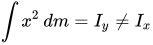
Note that because in , measures the distance from the axis of rotation, so for a y-axis rotation, deviation distance from the axis of rotation of a point is equal to its x coordinate.
References

[edit]

See also

[edit]
Revisions and contributorsEdit on WikipediaRead on Wikipedia
from Grokipedia
The axis theorem, also known as the plane figure theorem, is a fundamental relation in that applies to planar (two-dimensional) objects, stating that the IzI_z about an axis to the plane of the object is equal to the sum of the moments of inertia IxI_x and IyI_y about two mutually axes lying in that plane and intersecting at the same point. Mathematically, this is expressed as Iz=Ix+IyI_z = I_x + I_y, where the moments are calculated relative to the common origin, and the theorem holds for any lamina or thin with mass distribution confined to a single plane, assuming uniform or arbitrary distribution as long as the axes are properly chosen. This theorem is particularly useful in rotational dynamics for simplifying calculations of , especially when the perpendicular-axis moment is known or easier to compute, allowing derivation of in-plane moments by or . For example, it is commonly applied to symmetric shapes like , rings, or rectangular plates; for a uniform of MM and radius RR, the moment about the central perpendicular axis is 12MR2\frac{1}{2}MR^2, so each in-plane axis through the center yields 14MR2\frac{1}{4}MR^2 due to . The theorem derives from the basic definition of as r2dm\int r^2 \, dm, where the perpendicular distance r2=x2+y2r^2 = x^2 + y^2 in the plane splits naturally into components along the x- and y-axes, making it a direct consequence of vector in . It complements the parallel axis theorem for shifting axes and is essential in applications such as analyzing the rotation of flywheels, blades, or other planar components in machinery.

Background Concepts

Definition of Moment of Inertia

The , often denoted as II, quantifies a 's resistance to about a specific axis of . For a continuous , it is defined mathematically as the I=r2dmI = \int r^2 \, dm, where rr is the from the axis to the element dmdm, and the integration is taken over the entire distribution of the body. This formulation arises from considering the body as composed of point masses, where the contribution of each is miri2m_i r_i^2, summed or integrated accordingly. Physically, the moment of inertia serves as the rotational analog to mass in linear motion, determining the torque τ\tau required to produce a given angular acceleration α\alpha via Newton's second law for rotation: τ=Iα\tau = I \alpha. It depends not only on the total mass but also on how that mass is distributed relative to the axis; masses farther from the axis contribute more significantly to II, increasing the body's reluctance to change its rotational speed. The SI unit of moment of inertia is kilogram square meter (kg·m²). For rotation about a fixed axis, the is a scalar . However, in general three-dimensional , the full description requires the tensor, a symmetric that relates the vector ω\vec{\omega}
Add your contribution
Related Hubs
Contribute something
User Avatar
No comments yet.