Hubbry Logo
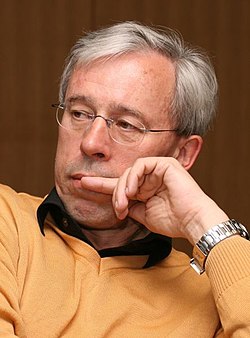
Peter ZollerPeter ZollerMain
Open search
Peter Zoller
Community hub
Peter Zoller
logo
8 pages, 0 posts
0 subscribers
Be the first to start a discussion here.
Peter Zoller
Peter Zoller
from Wikipedia

Peter Zoller (born 16 September 1952)[1] is a theoretical physicist from Austria. He was professor at the University of Innsbruck[1] and is known for his pioneering research on quantum computing, quantum simulation and quantum communication.[2]

Key Information

Biography

[edit]

Peter Zoller studied physics at the University of Innsbruck,[1] where he received his doctorate in February 1977 with a thesis on the Stark effect[3] and then worked as an assistant at the Department of Theoretical Physics. In 1978/79, he was a Max Kade Fellow with Peter Lambropoulos at the University of Southern California and in 1980 he stayed in the group of Dan Walls at the University of Waikato, New Zealand. In 1981, Zoller handed in his work "Über die lichtstatistische Abhängigkeit resonanter Multiphoton-Prozesse"[4] at the University of Innsbruck to become lecturer (Venia docendi). In 1981/82 and 1988 he was Visiting Fellow at the Joint Institute for Laboratory Astrophysics (JILA) at the University of Colorado, Boulder,[5] and 1986 a visiting professor at the Université de Paris-Sud 11, Orsay.

In 1991, Zoller became Professor at the Physics Department of the University of Colorado, Boulder, and JILA Fellow. At the end of 1994, he accepted a chair at the University of Innsbruck, where he worked until 2024. From 1995 to 1999, he headed the Department of Theoretical Physics, from 2001 to 2004, he was vice-dean of studies. From 2003 to 2024, he was a Scientific Director at the Institute for Quantum Optics and Quantum Information (IQOQI) of the Austrian Academy of Sciences.[6]

Zoller remained closely associated with JILA as an Adjoint Fellow. Numerous guest professorships have taken him to major centers of physics. Among others, he was Loeb Lecturer at Harvard University (2004)[7] Yan Jici Chair Professor at the University of Science and Technology of China, Hefei, Chair Professor at Tsinghua University, Beijing (2004), Lorentz Professor at the University of Leiden, Netherlands (2005)[8] and Distinguished Lecturer at the Technion in Haifa (2007).[9] He was Moore Distinguished Scholar at Caltech (2008/2010),[10] Arnold Sommerfeld Lecturer at LMU München (2010)[11], Distinguished Fellow at the Max Planck Institute of Quantum Optics in Garching (2012) and Solvay Professor of Physics at the University of Brussels (2015).[12] In 2014, he became "External Scientific Member" at the Max Planck Institute of Quantum Optics.[13] In 2025, he was Benjamin Lee Professor in South Korea.[14]

In 2018, Peter Zoller co-founded Alpine Quantum Technologies, a quantum computing hardware company.[15]

Research

[edit]

As a theoretical physicist, Zoller has made significant contributions to atomic physics, many-body physics and quantum information science. In particular, his proposals on quantum computing with trapped ions, on quantum simulation with ultracold atoms in optical lattices and on quantum repeaters in quantum communication have made a decisive contribution to bringing theoretical concepts of quantum information into a laboratory setting. This has inspired and guided new experimental research directions and established quantum optical systems as one of the leading experimental platforms for quantum technologies.

In 1995, together with Ignacio Cirac, he proposed a “quantum computer with cold trapped ions”.[16] This was the first experimentally realistic and comprehensive proposal for a universal quantum computer. This work triggered a rapid experimental development in which numerous pioneering achievements such as the demonstration of quantum algorithms, digital quantum simulations, quantum error correction and quantum metrology were achieved. In 1999, Cirac and Zoller proposed a quantum computer based on cold atoms in optical lattices, in which two-qubit gates are executed by controlled collisions.[17] A year later, together with Mikhail Lukin and others, they presented an alternative way to implement these gates using Rydberg atoms.[18] With the ever-improving experimental control of neutral atoms in laser tweezers, this approach is becoming increasingly important.[19]

In 1998, Cirac and Zoller proposed the use of ultracold atoms in optical lattices as an analog quantum simulator for Hubbard models to investigate questions in solid-state physics.[20] This approach allows strongly interacting many-body systems to be probed in both equilibrium and non-equilibrium states, addressing key questions in the theory and design of correlated quantum materials and in regimes challenging for classical calculations.[21] The experimental development of this platform has led to a number of important advances, including the first observation of the transition between superfluidity and a Mott insulator,[22] the creation and study of topological quantum phases of matter with synthetic gauge fields, and the exploration of the 2D fermionic Hubbard model.

Also in 1998, a team led by Zoller presented the concept of quantum repeaters,[23] which overcame the problems associated with noise and the loss of photons in optical fibers and made quantum communication over long distances possible. Previously, they had discovered the possibility of entangling atoms by exchanging photons at a distance.[24] In 2001, they proposed a specific atomic setup to build such quantum repeaters.[25] These have become a crucial building block for the development and deployment of quantum communication.

Zoller's ideas and concepts attract widespread interest within the scientific community and his works are highly cited.[26][27]

Awards

[edit]

Peter Zoller received honorary doctorates of the University of Amsterdam (2012),[28] the University of Colorado Boulder (2019),[29] and the University of Concepción (2024).[30]

For his achievements in the field of quantum optics and quantum information and especially for his pioneering work on quantum computers, quantum simulation and quantum communication he als received numerous prizes, these include:

In 2001, Peter Zoller became full member of the Austrian Academy of Sciences.[47] In 2008 he was elected to the United States National Academy of Sciences[48] and the Royal Netherlands Academy of Arts and Sciences,[49] in 2009 to the Spanish Royal Academy of Sciences,[50] in 2010 to the German Academy of Sciences Leopoldina,[51] in 2012 to the European Academy of Sciences, in 2013 to the Academia Europaea,[52] in 2023 in the Accademia Nazionale dei Lincei[53], and in 2024 to the Bavarian Academy of Sciences and Humanities.

Books

[edit]

Peter Zoller and Crispin Gardiner have jointly written:

  • Quantum Noise; Springer, Berlin Heidelberg, 2nd ed. 1999, 3rd ed. 2004 ISBN 3540223010
  • The Quantum World of Ultra-Cold Atoms and Light Book I: Foundations of Quantum Optics, Imperial College Press, London and Singapore 2014. ISBN 9781783264605
  • The Quantum World of Ultra-Cold Atoms and Light Book II: Physics of Quantum Optical Devices, Imperial College Press, London and Singapore 2015. ISBN 9781783266166
  • The Quantum World of Ultra-Cold Atoms and Light Book III: Ultra-Cold Atoms, World Scientific, London and Singapore 2014. ISBN 9781786344175

See also

[edit]

References

[edit]
[edit]
Revisions and contributorsEdit on WikipediaRead on Wikipedia
from Grokipedia
Peter Zoller (born 16 September 1952) is an Austrian theoretical physicist renowned for his pioneering work in , , and many-body quantum physics. He serves as professor emeritus of at the and former scientific director of the Institute for and (IQOQI) of the in . Zoller's research has bridged fundamental quantum theory with experimental advancements, notably co-proposing the ion-trap quantum computer model in 1995 alongside Ignacio Cirac, which laid foundational concepts for scalable using trapped ions and manipulation. Zoller earned his PhD in 1977 and in 1981 from the , where he began his academic career. He held a professorship at , , from 1991 to 1994 before returning to as a full professor in 1994, a position he maintains as emeritus. From 2003 to 2020, he directed IQOQI, fostering interdisciplinary collaborations in quantum technologies, and since 2020, he has led a research group there while holding an emeritus professorship. His career emphasizes close ties between theory and experiment, particularly in and quantum gases. Zoller's contributions extend to quantum simulation, communication protocols like quantum repeaters, and applications in , influencing fields from ultracold atoms to quantum networks. He has co-authored seminal papers on trapped ions and quantum simulators, earning recognition as one of the world's most highly cited researchers in physics from 2014 to 2024 by Clarivate Analytics. Among his major honors are the Dirac Medal in 2006 for advances in , the Medal in Physics in 2010, the in 2013, and the Prix de l’Académie from the Royal Academy of in 2025, shared with Cirac.

Biography

Early Life and Education

Peter Zoller was born on 16 September 1952 in , , in the post-World War II era when the country was rebuilding its scientific and educational institutions amid economic recovery efforts. Little is documented about his family background or specific early influences, but Innsbruck's growing academic environment likely shaped his path toward . Zoller completed his secondary education at the Reithmann-Gymnasium in from 1962 to 1970, after which he enrolled in undergraduate studies in physics at the . He remained at the institution for his graduate work, earning a PhD in theoretical physics in February 1977. His doctoral thesis, supervised by Ferdinand Ehlotzky, centered on the in , exploring field-induced shifts in atomic energy levels through theoretical models of light-matter interactions. This research involved analytical techniques to describe resonant phenomena, including early investigations into modulated fields and their impact on atomic spectra. Upon completing his PhD, Zoller assumed the position of assistant at the University of Innsbruck's Institute of in 1977. His graduate studies provided an initial foundation in , setting the stage for his subsequent contributions to the field.

Professional Career

Following his PhD, Zoller held a Max Kade Fellowship at the from 1978 to 1979, working under Peter Lambropoulos. In 1980, he conducted postdoctoral research with Dan Walls at the in . He returned to the University of Innsbruck in 1981 as a (Univ. Dozent) in , where he completed his and secured a tenured position. In 1991, Zoller was appointed as a tenured full professor of physics at the , and became a Fellow at , serving in these roles until 1994; during this period, his collaborations, including with Ignacio Cirac, began to shape advancements in . He returned to the in 1994 as Chair Professor of , becoming in October 2020 while being reappointed as university professor and remaining actively involved. From 2003 to present, Zoller has served as Scientific Director of the Institute for and (IQOQI) at the , including stints as Managing Director from 2009 to 2012 and 2017 to 2019. Zoller has held several distinguished guest positions, including as Loeb Lecturer at in 2004, Chair Professor at in 2004, and Moore Distinguished Scholar at Caltech in 2008, with additional visits to Caltech in 2010. In 2018, he co-founded Alpine Quantum Technologies (AQT), a hardware company based in . In 2025, Zoller was appointed as the Professor in by the Asia Pacific Center for Theoretical Physics, where he delivered a series of lectures on quantum simulation. That same year, he joined the jury for the in Physical Sciences.

Research Contributions

Quantum Optics and Noise

Peter Zoller's foundational work in during the 1980s focused on and fluctuations in atomic systems interacting with light, laying the groundwork for understanding dissipation in open . In particular, his research addressed processes governing in nonlinear optical phenomena, such as multiphoton transitions and resonance fluorescence, where quantum fluctuations lead to non-classical effects like sub-Poissonian statistics in emission. A seminal contribution was his 1984 analysis of and fluctuations in multiphoton processes, which provided a theoretical framework for calculating variance in excitation probabilities and counts under strong field interactions, revealing how quantum correlations suppress classical limits. This work, building on earlier studies of reduced quantum fluctuations in resonance fluorescence, emphasized the role of atomic coherence in mitigating . Central to Zoller's approach is the development of methods for open quantum systems, which model the interplay between unitary evolution and environmental dissipation through probabilistic trajectories. These methods, refined in collaboration with Crispin W. Gardiner, enable efficient numerical simulations of complex quantum optical dynamics by unraveling the evolution into an ensemble of stochastic wave functions. The quantum fluctuation-dissipation relations, explored in their joint efforts, ensure that noise terms correctly balance energy exchange with reservoirs, preserving thermodynamic consistency in non-equilibrium settings. A key formalism in this framework is the underlying the quantum s for dissipative systems. The quantum Langevin equation describes the Heisenberg-picture evolution of a system operator A^(t)\hat{A}(t) coupled to a Markovian bath via jump operators L^k\hat{L}_k: dA^dt=i[H^s,A^]+k(L^kA^12{L^kL^k,A^})+F^A(t),\frac{d\hat{A}}{dt} = \frac{i}{\hbar} [\hat{H}_s, \hat{A}] + \sum_k \left( \hat{L}_k \hat{A} - \frac{1}{2} \{\hat{L}_k^\dagger \hat{L}_k, \hat{A}\} \right) + \hat{F}_A(t), where H^s\hat{H}_s is the system Hamiltonian, and F^A(t)\hat{F}_A(t) represents delta-correlated noise with correlations F^A(t)F^B(t)=γδ(tt)δAB\langle \hat{F}_A^\dagger(t) \hat{F}_B(t') \rangle = \gamma \delta(t-t') \delta_{AB} (for a simple damping rate γ\gamma). The derivation begins with the total Hamiltonian H^=H^s+H^B+H^SB\hat{H} = \hat{H}_s + \hat{H}_B + \hat{H}_{SB}, where H^B\hat{H}_B is the bath Hamiltonian and H^SB=k(L^kB^k+B^kL^k)\hat{H}_{SB} = \sum_k (\hat{L}_k^\dagger \hat{B}_k + \hat{B}_k^\dagger \hat{L}_k) couples system and bath modes B^k\hat{B}_k. Under the Born approximation (weak coupling, factorized initial state) and Markov limit (fast bath relaxation), integrating out bath degrees of freedom yields the effective equation. The deterministic terms arise from the mean bath response, while noise F^A\hat{F}_A captures fluctuations, satisfying F^A(t)=0\langle \hat{F}_A(t) \rangle = 0 and ensuring the fluctuation-dissipation theorem holds, e.g., for a thermal bath at temperature TT, the diffusion coefficient relates to the damping via γ(n+1)\gamma (n + 1) for emission and γn\gamma n for absorption, with n=[exp(ω/kT)1]1n = [\exp(\hbar \omega / kT) - 1]^{-1}. Physically, this equation interprets dissipation as irreversible loss to the environment, with noise maintaining quantum uncertainty and preventing classical overdamping, crucial for phenomena like spontaneous emission in atomic systems. Zoller's theories found direct applications in laser cooling and the production of ultracold atoms, where quantum noise dictates the limits of temperature reduction. His early models described atomic motion in optical fields, incorporating Langevin-like forces from momentum kicks due to photon absorption and stimulated/recoiled emission, predicting the Doppler cooling limit TD=γ/2kBT_D = \hbar \gamma / 2k_B from balance between friction and diffusion. These models highlighted how fluctuations in scattering rates impose a fundamental bound, influencing the design of optical molasses and traps for achieving millikelvin temperatures in alkali atoms. Through long-term collaboration with Crispin W. Gardiner, Zoller advanced quantum fluctuation-dissipation relations, integrating them into a comprehensive for , as synthesized in their handbook . This work formalized how noise correlations in open systems underpin non-equilibrium steady states, with applications to squeezed light and sub-shot-noise detection. Zoller's theoretical advancements profoundly influenced experimental , particularly in (QED) systems, where his noise models guide interpretations of strong atom-photon coupling. For instance, predictions of decoherence rates in cavity QED experiments, such as those generating superpositions via dark-state atoms, rely on his frameworks to account for dissipative losses while preserving quantum coherence. These contributions extend briefly to noise mitigation in architectures, informing error models for optical implementations.

Quantum Computing and Simulation

Peter Zoller's contributions to quantum computing began with his 1995 collaboration with Ignacio Cirac, proposing a scalable quantum computer architecture using trapped ions. In this seminal work, they outlined a method to implement universal quantum gates by leveraging the collective vibrational modes of an ion chain confined in a linear Paul trap. The internal electronic states of the ions serve as qubits, while laser pulses manipulate these states to perform operations, enabling the realization of two-qubit entangling gates essential for quantum computation. The ion chain architecture relies on the repulsion between ions, which couples their motion and creates shared vibrational modes that mediate interactions. To execute a controlled-NOT gate, for instance, lasers address individual ions selectively by their motional sidebands, exciting or de-exciting specific phonons in the chain to entangle states without direct ion-ion collisions. This approach addresses challenges by allowing segmented chains and shuttling ions between zones for multi-qubit operations, paving the way for fault-tolerant quantum processors. Shifting focus to quantum simulation, Zoller's 1998 paper with Dieter Jaksch and others introduced ultracold bosonic atoms in optical lattices as a platform for emulating strongly correlated many-body systems. They demonstrated that the dynamics of these atoms map onto the Bose-Hubbard model, where on-site interactions and nearest-neighbor tunneling control phases like superfluids and Mott insulators, offering tunable parameters inaccessible in natural condensed matter systems. This proposal enabled analog simulations of quantum phase transitions, with experimental verification soon following in atom arrays. Subsequent advances by Zoller extended these ideas to simulate condensed matter analogs, including fermionic Hubbard models for and spin models like the Heisenberg chain for quantum magnetism. His work also explored topological phases, such as fractional Chern insulators, using engineered lattice potentials and synthetic gauge fields to realize protected edge states and anyons, providing insights into exotic quantum matter beyond classical computation capabilities. In collaborations with , Zoller developed hybrid quantum systems integrating trapped ions or atoms with solid-state spins, such as nitrogen-vacancy centers in diamond, to create interfaces for scalable quantum networks and enhanced . These hybrids exploit cavity-mediated couplings to transfer between platforms, enabling modular architectures for complex simulations. The impact of Zoller's proposals is evident in experimental realizations, including ion-trap quantum processors that have demonstrated multi-qubit algorithms and error-corrected gates, as pursued by groups at NIST and companies like . Similarly, optical lattice simulators have probed Hubbard physics and , influencing fields from to design.

Quantum Communication and Networks

Peter Zoller, in collaboration with H.-J. Briegel, W. Dür, and J. I. Cirac, introduced the concept of quantum repeaters in 1998 to enable reliable long-distance quantum communication despite photon loss and decoherence in optical channels. The scheme divides the total distance into smaller segments, generating imperfect entangled pairs locally at each end, then employs entanglement swapping via Bell-state measurements to connect adjacent pairs into longer entangled links. To counter fidelity degradation from imperfect operations, a nested purification protocol distills higher-fidelity pairs from multiple lower-fidelity ones, achieving polynomial resource scaling with distance rather than . The key protocol for purification and over lossy channels operates in iterative levels. First, short-range entangled pairs with initial F1>0.5F_1 > 0.5 are created across each elementary segment. At the first level, multiple such pairs are purified using local two-qubit operations and measurements to produce fewer pairs with F>F1F > F_1. These purified pairs are then swapped to form longer segments with reduced F0<F1F_0 < F_1. At higher levels, the process repeats: longer segments are connected via swapping, and parallel copies are purified recursively until a single high-fidelity pair spans the full distance, with the number of required elementary pairs scaling as R(logL)2R \sim (\log L)^2 for channel length LL. This mechanism ensures efficient entanglement distribution even with loss rates up to 50% per segment. In 2001, Zoller, along with L.-M. Duan, M. D. Lukin, and J. I. Cirac, developed a practical realization of quantum repeaters using atomic ensembles as quantum memories interfaced with light via linear optics, forming the foundational Duan-Lukin-Cirac-Zoller (DLCZ) protocol. Atomic ensembles in metastable states interact with off-resonant laser pulses to produce correlated Stokes photons, enabling heralded entanglement generation between remote ensembles upon single-photon detection at a beam splitter; this matter-light interface stores spin excitations collectively in the ensemble, acting as a robust quantum memory with fidelity approaching 1 in the low-excitation limit. Entanglement swapping occurs by interfering Stokes photons from adjacent segments on beam splitters, followed by detection to project onto entangled states, while built-in purification handles losses and errors through probabilistic heralding, yielding communication rates scaling favorably with distance. This architecture supports quantum network designs for distributed quantum computing, where remote modules exchange entanglement to perform nonlocal gates and enable scalable computation across nodes. Zoller's collaborations with J. I. Cirac further advanced cavity-based quantum interfaces for networks, proposing systems where single atoms trapped in high-finesse optical cavities serve as nodes connected by optical fibers. In these setups, cavity-enhanced atom-photon interactions facilitate deterministic entanglement generation and swapping, with the cavity acting as an efficient transducer between stationary atomic qubits and flying photonic qubits; for instance, Raman processes within the cavity enable state transfer and purification, forming building blocks for fault-tolerant quantum repeaters. These interfaces have been pivotal in conceptualizing modular quantum network architectures, where entanglement is generated in elementary links and assembled hierarchically into complex graphs for applications like distributed sensing and computing. Extensions of Zoller's work to quantum concepts emphasize modular entanglement generation, where repeater nodes produce on-demand entangled resources that can be routed and composed into multipartite states across global scales. This modular approach allows flexible network topologies, integrating with end-user devices for secure and blind quantum , building directly on the DLCZ framework's heralded mechanisms. Recent implications extend these protocols to satellite-based quantum communication, where low-Earth-orbit satellites equipped with atomic ensemble memories perform entanglement swapping to chain intercontinental links, achieving global entanglement distribution rates exceeding classical limits despite atmospheric losses.

Awards and Honors

Major Scientific Prizes

Peter Zoller received the Dirac Medal in 2006 from the International Centre for Theoretical Physics (ICTP) for his innovative and prolific work in , including seminal contributions to such as methods for using trapped ions and neutral atoms in quantum computation and . This award highlighted Zoller's foundational role in bridging with , influencing experimental advancements in coherent control of . In 2008, Zoller shared the BBVA Foundation Frontiers of Knowledge Award in Basic Sciences with Ignacio Cirac for their fundamental work on , particularly their theoretical insights into entanglement and protocols. The prize underscored their collaborative impact on developing scalable quantum technologies, paving the way for practical implementations of quantum processors. Zoller was awarded the Benjamin Franklin Medal in Physics in 2010 by the , shared with J. Ignacio Cirac and David J. Wineland, for their theoretical proposal and experimental realization of a quantum computer based on trapped ions. This recognition emphasized Zoller's contributions to processing, which advanced the field by demonstrating feasible architectures for fault-tolerant quantum computation. The 2013 Wolf Prize in Physics, presented by the Wolf Foundation, was shared by Zoller and Ignacio Cirac for their groundbreaking theoretical contributions to processing and , including innovations in quantum simulation using ultracold atoms and ions. Often regarded as one of the highest honors in physics short of the , this accolade affirmed their influence on the theoretical foundations of quantum simulators, enabling studies of complex quantum many-body systems. In 2016, Zoller received the Herbert Walther Award from the Optical Society (now Optica) and the for his pioneering discoveries in interdisciplinary quantum science that unify , , and . The award celebrated his advancements in , such as and , which have driven progress in precision quantum measurements and networks. Zoller and Ignacio Cirac were jointly awarded the John Stewart Bell Prize in 2019 by the Center for Quantum Information and Quantum Control at the for their outstanding achievements in processing, with a focus on foundational aspects like quantum simulation and computing using trapped particles. This biennial prize recognized their work on , reinforcing the robustness of in information-theoretic applications and inspiring global efforts in quantum tech development. In 2019, Zoller shared the inaugural Micius Quantum Prize with Ignacio Cirac, David Deutsch, Peter Shor, and others for their seminal theoretical work on quantum algorithms and physical implementations of quantum computers. Most recently, in 2025, Zoller shared the Prix de l'Académie with Ignacio Cirac from the Royal Academies for Science and the Arts of for their pioneering theoretical contributions to quantum physics and the development of quantum technologies. Presented in on , this honor spotlighted their enduring impact on quantum simulation and communication protocols, solidifying their status as leaders in the quantum revolution.

Academic Recognitions and Memberships

Peter Zoller was elected a full member of the Austrian Academy of Sciences in 2001, following his designation as a corresponding member in 1999. In 2008, he was named a foreign associate of the Royal Spanish Academy of Sciences and a foreign member of the Royal Netherlands Academy of Arts and Sciences. He became a foreign associate of the United States National Academy of Sciences in 2009. Zoller joined the German National Academy of Sciences Leopoldina as a member in 2010. He was elected to the European Academy of Sciences in 2011. In 2014, he became an external scientific member of the Max Planck Society at the Max Planck Institute of Quantum Optics in Garching. Since 2024, Zoller has served as a corresponding member of the Bavarian Academy of Sciences and Humanities in Munich. These elected memberships have facilitated international collaborations in quantum physics research. Zoller received an honorary doctorate from the in 2012. In 2019, he was awarded an honorary degree by the . The University of Concepción in conferred a third honorary doctorate upon him in 2024, recognizing his contributions to and . Among his other academic honors, Zoller received the Medal from the in 2005 for his work in . In 2018, he was awarded the inaugural Norman F. Ramsey Prize from the for his pioneering theoretical work on quantum science and technology. He was also awarded the Willis E. Lamb Award for Laser Physics and Quantum Optics in 2018, specifically for pioneering contributions to , quantum communication, and many-body physics. In 2025, Zoller was appointed to the Professorship at the Center for in , honoring his innovations in , including models for ion trap quantum processors. That same year, he joined the for the in Physical Sciences, contributing his expertise in quantum science to the selection process.

Publications

Co-Authored Books

Peter Zoller has co-authored several influential textbooks on quantum optics and related fields, primarily in collaboration with Crispin W. Gardiner. Their joint work has provided foundational resources for researchers and students in quantum physics. The book Quantum Noise: A Handbook of Markovian and Non-Markovian Quantum Stochastic Methods with Applications to Quantum Optics, first published in 1991, offers a comprehensive treatment of quantum stochastic methods essential for modeling open quantum systems. It covers key topics such as stochastic differential equations, master equations, positive-P representations, and their applications to quantum optics phenomena like photodetection, squeezing, and laser theory. Subsequent editions expanded the scope: the second edition (2000) incorporated advances in quantum feedback and non-Markovian processes, while the third edition (2004) added chapters on the stochastic Schrödinger equation, cascaded quantum systems, Bose-Einstein condensation, and quantum information processing. These updates reflect evolving research in quantum noise theory, making the book a standard reference for graduate-level studies in quantum optics and stochastic quantum dynamics. In the trilogy The Quantum World of Ultra-Cold Atoms and Light, published by World Scientific between 2014 and 2017, Zoller and Gardiner synthesize quantum optics principles with applications to ultra-cold matter and light interactions. Book I: Foundations of Quantum Optics (2014) introduces theoretical tools including classical and quantum stochastic processes, phase-space methods, atom-light interactions, and quantum measurement theory, serving as a pedagogical primer for quantum optics techniques. Book II: The Physics of Quantum-Optical Devices (2015) delves into device-oriented physics, covering coherent manipulation of atoms, cavity quantum electrodynamics (QED), laser cooling, continuous measurement, and quantum information processing with atoms, photons, and phonons, including circuit QED and quantum networks. Book III: Ultra-Cold Atoms (2017) provides detailed analyses of Bose-Einstein condensates, quantum kinetic theory for bosons and fermions, ultra-cold molecules, and atoms in optical lattices, emphasizing nonequilibrium dynamics and interactions with electromagnetic fields. Collectively, these volumes function as advanced textbooks that integrate research syntheses with pedagogical examples, aiding graduate education in quantum technologies, condensed matter physics, and atomic physics.

Editorial and Collaborative Works

Peter Zoller has made significant contributions as an editor and collaborator in the field of quantum physics, particularly through roles that shaped the dissemination of research in quantum optics, computing, and simulation. He served as Associate Editor for Physical Review A from 1998 to 2003, overseeing submissions on atomic, molecular, and optical physics. During 2001–2004, he acted as Editor for Reviews of Modern Physics, guiding the publication of in-depth review articles on foundational topics in theoretical physics. He also held the position of Divisional Associate Editor for Physical Review Letters from 1996 to 1999, facilitating rapid communication of breakthroughs in quantum information science. More recently, Zoller was Associate Editor for Science Advances from 2015 to 2019 and has served as an ad hoc Editor for Proceedings of the National Academy of Sciences since 2009. Additionally, he contributed to editorial boards, including Quantum Information Processing (Springer) and Annals of Physics from 2011 to 2018, influencing the peer-review process for works on quantum networks and simulation. Zoller's key review articles have provided comprehensive surveys of quantum simulation and ion trap technologies, establishing benchmarks for the field. In a 2012 review co-authored with J. Ignacio Cirac, he outlined goals and opportunities in quantum simulation, emphasizing platforms like trapped ions and ultracold atoms for modeling complex quantum systems. These works underscored the transition from theoretical proposals to experimental realizations, citing the potential of trapped ions for high-fidelity quantum gates. His collaborative publications include seminal papers that pioneered quantum technologies. The 1995 collaboration with J. Ignacio Cirac in Physical Review Letters proposed using cold trapped ions, introducing a scheme where laser-manipulated vibrations serve as a quantum bus for entangling qubits, garnering over 6,000 citations and inspiring global experimental efforts. In 1998, Zoller co-authored with H.-J. Briegel, W. Dür, and Cirac a foundational paper on quantum repeaters in Physical Review Letters, addressing imperfect operations in entanglement distribution for long-distance quantum communication, which has been cited more than 2,500 times and remains central to protocols. Post-2020, Zoller's collaborative efforts have focused on advancing quantum networks, including contributions to models integrating error correction with architectures. These works build on his earlier concepts, incorporating recent experimental demonstrations of memory-enhanced distribution. As of November 2025, Zoller continues to publish on topics in quantum simulation and many-body physics, including papers such as "Probing topological entanglement on large scales" in . Zoller's editorial and collaborative outputs have profoundly impacted the field, reflected in his scholarly metrics: as of 2025, his publications exceed 120,000 total citations with an of 173, signaling widespread adoption of his ideas in .

References

Add your contribution
Related Hubs
User Avatar
No comments yet.