Hubbry Logo
Pickering CastlePickering CastleMain
Open search
Pickering Castle
Community hub
Pickering Castle
logo
8 pages, 0 posts
0 subscribers
Be the first to start a discussion here.
Pickering Castle
Pickering Castle
from Wikipedia

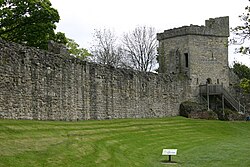
Pickering Castle is a motte-and-bailey fortification in Pickering, North Yorkshire, England. The original castle was made of timber, and the later stone castle was a temporary prison for Richard II in 1399.

Key Information

The castle is owned by the Duchy of Lancaster and managed by English Heritage.[1]

Design

[edit]

Pickering Castle was originally a timber and earth motte and bailey castle.[2] It was developed into a stone motte and bailey castle which had a stone shell keep. The current inner ward was originally the bailey, and was built between 1180 and 1187.[3] The keep was developed into a stone shell keep sometime during the years 1216 to 1236 along with the chapel – there is a reconstruction of the chapel at the site. Between the years 1323 and 1326 there was an outer ward and curtain wall built, along with three towers. There were also two ditches, one situated outside of the curtain wall and one in the outer ward. After this a gatehouse, ovens, hall and the storehouses were built. The castle is situated in the Vale of Pickering and has a considerably steep cliff on the west side which would have been a great defensive attribute.

History

[edit]
Pickering Castle in around 1910

The original structure was built by the Normans under William the Conqueror in 1069–1070.[2] This early building included the large, central mound (the motte), the outer palisades (enclosing the bailey) and internal buildings, notably the keep on top of the motte. Ditches were also dug to make assault on the walls difficult. The main purpose of the castle at this time was to maintain control of the area after the Harrying of the North, though by 1322, the defences had been re-fortified on the orders of Edward II who had narrowly escaped capture by the Scots during battles in the same year.[4] At the same time, due to the fears about the Scottish invasions, the garrison was strengthened.[5] When Richard II of England was deposed as king, he was held prisoner in the castle (c. 1399) until his removal to Pontefract.[6][7]

Its remains are particularly well-preserved because it is one of only a few castles which were largely unaffected by the 15th-century Wars of the Roses and the English Civil War of the 17th century. However, during the civil war, the castle was held for the king and was breached on its west side, with most part of this side being dismantled.[6] Three mounds to the west of the castle are said to have been the positions that Cromwell's forces placed their canons to destroy the west wall.[8] Later in the conflict, Parliamentary troops occupied the site and Sir Hugh Cholmeley stripped the lead, timber, and iron from the towers of the castle to provide extra defences for Scarborough Castle.[9][10]

In 1926, the Ministry of Works (the predecessor of English Heritage) took possession of the castle.[2] It is a Scheduled Monument[11] and open to the public.[12]

See also

[edit]

References

[edit]
[edit]
Revisions and contributorsEdit on WikipediaRead on Wikipedia
from Grokipedia
Pickering Castle is a medieval fortress located in the town of , , originally constructed as a in the late by following the in 1069–1070 to assert Norman control over the region. Over the subsequent centuries, it evolved into a stone-built stronghold with a prominent , serving as a royal hunting lodge, administrative center for the surrounding forests, and occasional prison, remaining in royal or ducal ownership. The castle is owned by the and managed by ; today, the well-preserved ruins are recognized as a for their architectural and historical significance in illustrating the transition from wooden to stone fortifications in Norman . The castle's core features a steep-sided motte approximately 20 meters high with a 60-meter base diameter, topped by a 13th-century , surrounded by an inner bailey measuring about 120 by 35 meters enclosed by a curtain wall that includes the Coleman Tower, a 12th-century structure originally serving as the main entrance, , , and hall. An outer bailey, added and fortified in stone between 1323 and 1326 under Edward II to defend against Scottish incursions, extends roughly 185 by 25 meters and incorporates three towers—Rosamund’s Tower, Diate Hill Tower, and Mill Tower—along with a featuring a sallyport for discreet access. Domestic buildings within the site include the 12th-century Old Hall and the early 14th-century New Hall, a chantry dating to around 1227, and remnants of a brewhouse and bakehouse, reflecting its role in royal hospitality and forest governance. Historically, the castle is first documented in the of 1086 as crown property, underscoring its strategic importance in the feudal administration of . It remained under direct royal control until 1267, when Henry III granted it to his son , ; it reverted to in 1322 and was re-granted to his brother Henry, 1st , in 1327, becoming part of the in 1351, and has remained in the possession of the Duchy (a ) since the Lancastrian ascension in 1399. Notable events include its use as a temporary for the deposed Richard II in 1399 and its avoidance of major destruction during the Wars of the Roses and , which contributed to the survival of its structures. By the Tudor and Stuart periods, the castle fell into disrepair as a military site but retained ceremonial and judicial functions until it passed into state care in 1926.

Location and Setting

Geographical Context

Pickering Castle is situated in the of , , at coordinates 54°15′0″N 0°46′32″W. The site occupies a position within the Vale of Pickering, a low-lying, flat-floored valley characterized by its rural landscape and drained primarily by the River Derwent, with the River Rye contributing to the hydrological system nearby to the north. The castle stands on the southern edge of the , where the topography transitions from the elevated to the broader vale below. This location features a prominent bluff, rising steeply to the west and providing inherent defensive advantages through its elevated and rugged contours. The surrounding environment encompasses fertile agricultural fields interspersed with wooded areas, particularly along watercourses and fringes, shaping a verdant setting conducive to rural activities. The Vale of Pickering's glacial origins have resulted in a broad, sediment-rich plain bounded by hills to the north and wolds to the south, creating a sheltered basin that influences local microclimates and supports mixed farmland. Proximity to the River Rye, approximately 10 miles upstream at , integrates the site into a network of river valleys that enhance the area's and historical connectivity across . This geographical context underscores the castle's placement amid a landscape of natural barriers and productive lowlands, integral to its environmental role.

Strategic Importance

Pickering Castle was constructed in the aftermath of the , specifically around 1069–1070, to secure the Vale of Pickering following William the Conqueror's devastating campaign, which aimed to suppress northern rebellions and enforce Norman control over a resistant region. This military outpost played a crucial role in pacifying the rebellious northern territories, serving as a bulwark against further uprisings by providing a fortified base from which Norman forces could monitor and respond to threats in and beyond. Its strategic selection was driven by the site's commanding position, which offered oversight of vital transport routes and natural defenses, enhancing its effectiveness as a defensive hub. Beyond its initial defensive function, the castle evolved into a key administrative center within the Honor of Pickering, a vast royal estate encompassing lands, forests, and manors that generated revenues through rents, fines, and taxes. It facilitated royal governance by officials who managed the estate's affairs, ensuring the collection of feudal dues and the enforcement of forest laws that regulated hunting and resource use. The castle's proximity to abundant resources—such as the surrounding forests for timber, fuel, and game, and fertile farmlands for provisioning—made it self-sustaining and ideal for supporting extended military or administrative operations. Over time, Pickering Castle transitioned from a primarily defensive outpost to a royal residence, particularly valued as a base for monarchs' in the expansive Pickering Forest, where strict laws preserved game for elite pursuits. Additions like a under Edward II underscored its growing role in leisure and estate management, blending oversight with the comforts of a hunting lodge while maintaining its position as the caput of the Honor of Pickering. This multifaceted importance solidified the castle's enduring place in medieval England's northern frontier administration.

Architecture and Design

Motte and Bailey Layout

Pickering Castle was constructed as a classic Norman around 1069–1070 by , following the to assert control over rebellious northern territories. This earth-and-timber fortification featured a central motte, an artificial mound raised for defensive elevation, surrounded by two concentric baileys that provided enclosed spaces for military and domestic functions. The design exemplified early Norman engineering, prioritizing rapid construction with local earth and wood to dominate the landscape strategically. The motte, the castle's core defensive element, stands approximately 20 meters high with a base diameter of about 60 meters, its steep sides making ascent difficult for attackers. Atop this mound sat a wooden keep, serving as the lord's residence and last refuge during sieges, offering commanding views over the Vale of Pickering. The motte was encircled by a deep ditch, further isolating it from the surrounding terrain and enhancing its impregnability. Adjoining the motte were two baileys: an inner bailey, measuring roughly 120 by 35 , housed high-status timber buildings such as the and for the castle's elite inhabitants. This area was defended by a timber along its northern steep slope and wide ditches to the south, connected to the motte's defenses. The larger outer bailey, approximately 185 by 25 , accommodated support structures like stables and workshops for servants and soldiers, protected by a 5–8 meter high palisaded and multiple ditches that separated it from the inner bailey. Access to both baileys was controlled through timber gateways, reinforced to deter unauthorized entry. These timber elements were later replaced with stone structures beginning in the late , transforming the layout while preserving the original motte-and-bailey footprint.

Stone Fortifications and Features

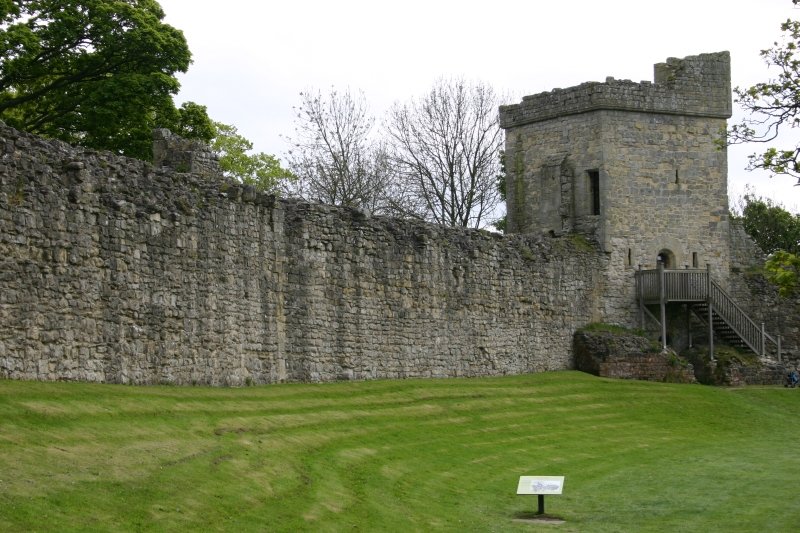
The transition from timber to stone fortifications at Pickering Castle began in the early with the construction of a on the motte, a circular approximately 20 meters in diameter featuring a wall walk and foundations for garrison buildings. This , built during the reign of Henry III (c. 1216–1236), enclosed and protected earlier timber structures atop the mound, marking a significant upgrade in durability and defensive capability. In the late 12th century, the inner bailey's timber was replaced by a stone curtain wall, which was later incorporated into subsequent buildings. Major enhancements occurred between 1324 and 1326 under Edward II, when the outer bailey's wooden defenses were rebuilt in stone, forming a curtain wall measuring about 185 meters by 25 meters, complete with a featuring a over an outer . This provided controlled access, reinforced by a gate for secondary entry. The 1324–1326 works also included the addition of three projecting square towers along the outer curtain wall: Rosamund’s Tower, Diate Hill Tower, and Mill Tower, each designed to offer enfilading fire and overlook key approaches. The Mill Tower served partly as a featuring dual doors for . An earlier square tower, known as Coleman Tower in the inner bailey (dating to the late ), served as a with a first-floor entrance and functioned partly as a . The outer ward was expanded during these 14th-century modifications, incorporating substantial earthworks including a 5–8 meter high and an associated outer ditch, alongside an inner bailey ditch up to 15 meters wide that linked to the motte's base, enhancing overall perimeter defense. These ditches, quarried from the local bluff, not only impeded direct assaults but also supplied material for construction. Built primarily from local , with some elements from the surrounding Vale of Pickering, the fortifications incorporated defensive features such as arrow loops—narrow slits for archers, evident in the and towers—and crenellated battlements along the curtain walls for protected firing positions. These elements underscored the castle's evolution into a robust stone stronghold.

Historical Development

Norman Origins

Pickering Castle was constructed between 1069 and 1070 by as a strategic response to northern resistance in following the , a brutal campaign of suppression that devastated the region in late 1069. This earth-and-timber motte-and-bailey fortification, featuring a prominent motte approximately 20 meters high with a base diameter of about 60 meters, was topped by a timber and flanked by a crescent-shaped inner bailey (roughly 120 meters by 35 meters) and an outer bailey (about 185 meters by 25 meters), both defended by ditches and palisaded banks. The castle's design exemplified early Norman military architecture aimed at consolidating control over rebellious territories in the . Initially held as a royal possession under , as recorded in the of 1086, the castle formed the caput of the Honor of Pickering, a large royal lordship encompassing extensive lands, forests, and manors in the area. Grants of custodianship or portions of the honor were made to loyal Norman lords. The castle served dual roles as a garrison, housing troops to enforce Norman authority and deter uprisings, and as an administrative center for the local wapentake—a district known as Pickering Lythe—where it facilitated judicial proceedings, , and the oversight of royal estates. Archaeological investigations have revealed traces of the original Norman structures, including buried timber foundations for domestic and service buildings within the baileys, as well as the preserved earthworks of the motte and defensive ditches that underscore the site's foundational role in post-Conquest consolidation. These remnants highlight how the castle functioned not only as a defensive outpost but also as a base for aristocratic residence amid the ongoing efforts to pacify and administer the north. Excavations confirm the motte's early form, largely intact beneath later medieval additions, providing tangible evidence of its 11th-century origins.

Medieval Expansions and Events

During the late , significant expansions transformed Pickering Castle from its original timber motte-and-bailey structure into a more robust stone fortress. Under King Henry II, work began around 1180 to construct the inner ward, including a curtain replacing the earlier and the erection of the Coleman Tower as a fortified entrance to the inner bailey. This phase also saw the addition of a and the Old Hall, a half-timbered residence that served as the primary living quarters, enhancing the castle's defensive and residential capabilities. These improvements, continuing into the early under Henry III, included the completion of a on the motte by approximately 1227, solidifying the site's role as a royal stronghold. In the early 14th century, amid escalating threats from Scottish incursions during the , King Edward II initiated major re-fortifications between 1322 and 1326. Following the execution of Thomas, Earl of Lancaster, in 1322, whose estates reverted to , Edward ordered the replacement of the outer bailey's timber with a substantial stone curtain wall, incorporating three towers—Rosamund’s Tower, Diate Hill Tower, and Mill Tower—along with a reinforced featuring double doors for added security. These enhancements, prompted by a Scottish army's advance that year, represented the castle's last significant military upgrade and included the construction of a New Hall for residential and administrative purposes. The site also began serving as a royal around 1322, supporting for the . Pickering Castle played a pivotal role in key late medieval events, notably as a temporary prison for King Richard II in 1399 following his deposition by Henry Bolingbroke, who became Henry IV. By the mid-15th century, the castle's ties to the Lancastrian cause strengthened during the Wars of the Roses (1455–1487), as it remained under Crown control and part of the from 1351 onward, with modifications to accommodate royal visits. Throughout this period, it functioned multifaceted as a hunting lodge adjacent to the royal Forest of Pickering, a holiday retreat for monarchs such as Edward III in the , and an administrative center for enforcing forest laws and managing estates.

Later History and Legacy

Tudor Period to Civil War

During the , Pickering Castle's military significance waned as the structure fell into disrepair, with a survey documenting the decay of its buildings and defenses while noting ongoing administrative uses such as a in the motte hall. As part of the , it remained under ownership, transitioning from a fortified residence to a more symbolic royal asset amid shifting priorities toward centralized governance and reduced northern threats. In the early under the Stuart monarchy, the castle continued as property with minimal maintenance, though inspections highlighted further deterioration, including crumbling walls and limited habitable spaces by the 1630s. Its role shifted primarily to occasional judicial and estate management functions, reflecting the broader decline of medieval fortifications in peacetime . The marked a brief resurgence in the castle's strategic relevance, as it was held for the Royalists but captured by Parliamentary led by William Constable in 1644. Due to its dilapidated state, the occupation caused only slight damage, and the site escaped major destruction or , remaining largely unaffected compared to other northern strongholds. After the war's conclusion in 1651, the castle was sold into private hands during the period under Oliver Cromwell's government but reverted to upon the Restoration of Charles II in 1660, leading to its abandonment as a military fortress and accelerated decay, with only the chapel retaining a by mid-century. This temporary transfer to civilian ownership underscored the obsolescence of such sites in the post-Civil War .

Decline and Modern Preservation

Following the , the site experienced a prolonged period of neglect and decay, with much of the structure reduced to partial ruin by the mid-17th century, as only the retained its roof. Owned by the throughout the 18th and 19th centuries, the castle saw no significant military or residential use, allowing natural deterioration while the surrounding estate supported agricultural activities, including pastoral farming. In 1926, the Ministry of Works—predecessor to —assumed guardianship of the castle to halt further degradation and initiate preservation efforts. During the 20th century, targeted restorations focused on consolidating the surviving walls and towers, stabilizing the ruins against weathering and erosion to maintain their structural integrity. The site was formally designated a on 9 October 1981 under the Ancient Monuments and Archaeological Areas Act 1979, providing legal protection for its historical fabric. Ownership of Pickering Castle remains with the , but management responsibilities transferred to in 1984 following the organization's establishment by the National Heritage Act 1983, ensuring ongoing conservation and public access. As of 2025, the castle is closed to the public for conservation works and is scheduled to reopen in March 2026. Recent archaeological work, including excavations from the 1920s and later investigations, has uncovered artifacts such as medieval arrowheads, iron spurs, and manacles, which illustrate the site's military and custodial roles and are now displayed in the on-site chapel exhibition.

Cultural and Public Significance

Associated Legends and Uses

Local legends associate the town of Pickering, and by extension the site of the castle, with pre-Norman origins, claiming it was founded around 270 BC by a British king named Peredurus (or Peredurus). This myth, recorded in early chronicles such as those by , portrays Peredurus as establishing the settlement amid ancient forests, though archaeological evidence points to later Roman and Anglo-Saxon activity in the area. The legend loosely ties the castle's elevated position to these mythic foundations, symbolizing continuity between ancient British rule and Norman fortification. Royal anecdotes surrounding Pickering Castle include tales of spectral apparitions, notably the of a robed, faceless said to drift through the ruins, evoking the site's monastic or past despite no direct historical link. Such stories contribute to its reputation as a haunted retreat, with sightings reported by visitors over centuries. The castle also served as a romantic holiday home for monarchs, offering seclusion amid the for leisure away from courtly duties. Beyond its defensive role, Pickering Castle functioned as a royal , where Edward II maintained over 50 horses for breeding in the early , leveraging the surrounding forests for pasture. It was particularly favored as a lodge by kings including Henry III, who granted the manor, castle, and adjacent Pickering Forest to his son in 1267, enabling royal pursuits of deer and boar in one of England's largest medieval woodlands. In cultural depictions, the castle appears in medieval chronicles as an emblem of Norman consolidation in , referenced in works like Stow's for its strategic and royal associations. Later narratives and media portray it as a quintessential symbol of Norman power, highlighting its motte-and-bailey origins and enduring forested setting in and documentaries.

Tourism and Exhibitions

Pickering Castle, managed by , is open to the public seasonally (typically April to October), with operating hours varying by season—typically from 10:00 AM to 5:00 PM daily during peak months—and advance online booking recommended for a 15% discount on entry fees. Adult tickets start at £7.50 (including donation), child tickets (ages 5-17) at £4.00, and family tickets (two adults and up to three children) at £19.00, while members enjoy free admission. The site has experienced growing popularity, with visitor numbers rising 30% in 2021 compared to 2019—the best year since 2009—and increasing another 18% in 2022, achieving the highest attendance since 1997. Key on-site facilities enhance the visitor experience, including a dedicated in the 13th-century that showcases artifacts from recent archaeological digs, such as medieval arrowheads, a knife blade, spurs, and manacles, providing tangible insights into the castle's daily life and defenses. The grounds feature well-maintained paths allowing exploration of the motte, bailey, and stone walls, though some areas like the motte stairway involve steps that may limit full for users. Restrooms, a small shop for souvenirs and guidebooks (£3.50), and picnic areas are available, supporting comfortable half-day visits. Guided tours are offered to delve into the castle's and historical uses, while seasonal include historical reenactments, family-oriented activities, and occasional medieval festivals that bring the site's Norman and medieval past to life through demonstrations and interactive sessions. These programs, coordinated by , typically occur during summer weekends and holidays, complementing self-led exploration for groups and schools. The castle's location on the fringe of the integrates it seamlessly with regional tourism, where visitors can combine their trip with scenic walks along nearby trails like the Pickering Castle and Newbridge path, offering elevated views of the ruins against the moorland backdrop. Accessibility features include designated parking and some level paths around the outer bailey, though climbing to the motte summit—rewarded with panoramic vistas over the Vale of Pickering—requires moderate fitness. Interpretive panels throughout the site provide educational content tracing the castle's evolution from its Norman motte-and-bailey origins through medieval expansions to its role in later history, aiding visitors in understanding key events and architectural features without needing a guide. This setup supports curriculum-aligned learning for schools, emphasizing themes like and medieval fortifications, and underscores the site's value as an accessible introduction to England's castle heritage.

References

Add your contribution
Related Hubs
User Avatar
No comments yet.