Hubbry Logo
Pico HousePico HouseMain
Open search
Pico House
Community hub
Pico House
logo
8 pages, 0 posts
0 subscribers
Be the first to start a discussion here.
Pico House
Pico House
from Wikipedia

Pico House
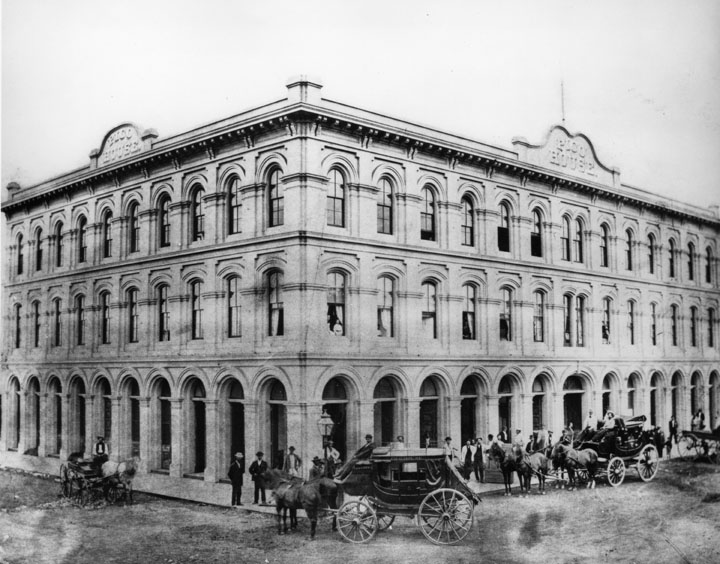
The Pico House hotel in 1875.
Pico House is located in the Los Angeles metropolitan area
Pico House
Pico House is located in California
Pico House
Pico House is located in the United States
Pico House
LocationLos Angeles, California
Coordinates34°03′21.75″N 118°14′22″W / 34.0560417°N 118.23944°W / 34.0560417; -118.23944
Built1869–1870[1]
ArchitectEzra F. Kysor
Architectural styleVictorian
Part ofLos Angeles Plaza Historic District (ID72000231[2])
CHISL No.159 [3]
Designated CPNovember 3, 1972[4]

The Pico House is a historic building in Los Angeles, California, dating from its days as a small town in Southern California. Located on 430 North Main Street, it sits across the old Los Angeles Plaza from Olvera Street and El Pueblo de Los Ángeles Historical Monument.

History

[edit]

Pío Pico, a successful businessman who was the last Mexican Governor of Alta California, ordered construction of a luxury hotel in the growing town.[5][6] The architect was Ezra F. Kysor, who also designed the Cathedral of Saint Vibiana, and it was constructed between 1869 and 1870,[1] opening to serve the small town of 5,700 people.[7]

The Italianate three storey, 33-room hotel, dubbed Pico House (or Casa de Pico), was the most extravagant and lavish hotel in Southern California, and its opening was cause for much celebration. It had a total of nearly 80 rooms, large windows, a small interior court, and a grand staircase. In the days of the hotel's primacy the courtyard featured a fountain[8][full citation needed] and an aviary of exotic birds.[9] The structure forms three sides of a trapezoid whose open end immediately abuts the adjacent Merced Theatre, thus forming the courtyard. The back of the hotel faces Sanchez Street,[10] where the large gate used by supply wagons and other large vehicles can still be seen.

Its time in the spotlight did not last very long. By 1876, the Southern Pacific Railroad had linked the city with the rest of the country and more residents and businessmen began pouring in. Pio Pico himself started having financial troubles, and lost the hotel to the San Francisco Savings and Loan Company.[11]

In 1882, the hotel was so crowded with guests that Manager Dunham secured 30 rooms on the opposite side of the street, "and still the cry is more room."[12] The business center of the city began to move south and, by 1900, the condition of the building began to decline and it was operated as a lodging house until it was acquired by the El Pueblo de Los Ángeles Historical Monument. Parts of this building were renovated in 1981 and 1992. The ground floor is occasionally used for exhibits and other events.

Landmark

[edit]

The Pico House is listed as a California Historical Landmark (No. 159) and a National Historic Landmark as a part of the Los Angeles Plaza Historic District (NPS-72000231).[5]

[edit]

References

[edit]
[edit]
Revisions and contributorsEdit on WikipediaRead on Wikipedia
from Grokipedia
Pico House is a historic three-story hotel building in , , constructed between 1869 and 1870 by , the last governor of under Mexican rule, at a cost exceeding $30,000. Designed in the Italianate style by architect Ezra F. Kysor, it featured approximately eighty rooms, indoor plumbing, gas lighting, and lavish interiors, establishing it as the premier luxury accommodation in and the tallest building in at the time. The structure symbolized the economic ambitions of post-Mexican era , catering to affluent travelers and hosting notable events amid the city's growth following and American annexation. Originally operated as a high-end until the late , Pico House later served various purposes, including as the National Hotel from 1892 to 1920, before falling into disrepair and condemnation in 1922. Acquired by the state as part of the El Pueblo de Los Ángeles Historic Monument in the mid-20th century, it underwent façade restoration in the 1960s and interior renovations in 1980–1981, preserving its role within the Los Angeles Plaza Historic District, a listing. Today, the building functions primarily as a venue for cultural events and exhibitions, underscoring its enduring architectural and historical significance as a bridge between Los Angeles's Mexican heritage and its American development.

History

Construction and Early Development

initiated construction of the Pico House in 1869 to capitalize on the growing influx of American settlers and travelers to , positioning the hotel on the historic Old Plaza amid the southward shift of the city's commercial focus. As the last governor of under Mexican rule, Pico financed the project by selling portions of his ranch lands, reflecting his ambition to establish a premier hospitality venue in the burgeoning town. Pico commissioned architect Ezra F. Kysor, Southern California's first professional architect, to design the structure in the Italianate style, featuring deep-set round-arched windows and a compact interior . Construction commenced on September 18, 1869, and progressed rapidly, resulting in the completion of Los Angeles' first three-story building by mid-1870. The hotel boasted approximately 80 rooms, marking it as the city's inaugural grand luxury establishment south of . The Pico House opened on June 9, 1870, with festivities underscoring its opulence, including and high-quality materials intended to draw elite visitors along emerging rail routes. At the time, it represented a bold in the Plaza's revitalization, equipped with features like spacious parlors to accommodate the era's increasing transient population.

Operations as a Hotel

The Pico House commenced operations as Los Angeles' premier luxury on June 9, 1870, offering high-end lodging amid the city's nascent expansion. Featuring approximately 80 rooms across three stories, it provided amenities including large windows, a grand double staircase, indoor plumbing, and a French restaurant, distinguishing it as the most opulent establishment in at the time. Initially overseen by , the hotel generated revenue through room rentals—such as $1.25 per night, as evidenced by a 1879 for a two-day stay—dining services, and event hosting, thereby bolstering the local economy around the historic Plaza. As a central social hub, the Pico House attracted visitors, politicians, and local elites, facilitating gatherings that underscored its role in civic life during ' growth spurt. Its location near the Plaza positioned it to serve travelers and residents seeking refined accommodations, contributing to the vitality of the downtown area. Management transitioned to on-site operators like John Whitney by 1879, ensuring day-to-day functionality while Pico retained nominal oversight amid mounting personal financial strains. The hotel's success intensified with the arrival of the Southern Pacific Railroad in 1876, drawing increased clientele during the subsequent boom and necessitating operational expansions. By , demand was so robust that management secured additional off-site rooms across the street to accommodate bookings. Despite emerging competition from newer establishments, the Pico House maintained prominence through its event venues and dining, supporting economic activity until broader shifts impacted viability.

Decline and Subsequent Uses

Pío Pico's ownership of the Pico House ended around 1880 through , driven by his mounting personal debts from , profligacy, scams, and losses exacerbated by regional floods. The property was subsequently auctioned in 1882 for $16,000 to the San Francisco Savings and Loan Company. These financial setbacks, compounded by bad investments and deceptions by opportunistic American speculators, eroded Pico's vast land empire and directly impaired the hotel's viability. As ' commercial center migrated southward in the late , the Pico House's location near the aging Plaza became less attractive to affluent travelers, leading to diminished operations. The rise of grander, more modern hotels further supplanted its prominence, transforming it from a luxury establishment into a basic lodging house for transients by the early . In the 1920s, it briefly operated as the National Hotel before reverting to cheaper accommodations. By the 1930s and 1940s, the building had deteriorated into a , supplemented by uses as apartments and a pool hall, amid general neglect and seismic damage from regional earthquakes. The State of acquired the dilapidated structure in 1953 as part of the El Pueblo de Los Ángeles Historic Monument, averting potential demolition amid broader urban redevelopment pressures on the historic core. This marked the transition from private commercial exploitation to public oversight focused on historical retention.

Preservation and Restoration

In 1953, the State of California acquired the Pico House as part of the establishment of the El Pueblo de Los Ángeles Historical Monument, initiating efforts to stabilize the deteriorating structure amid urban redevelopment pressures in . This takeover marked the beginning of systematic preservation, focusing on structural reinforcement to prevent further decay from years of neglect and as commercial spaces. Restoration work accelerated in the , with the Italianate facade rebuilt to its original design using period photographs and architectural records, averting potential threats common to historic buildings in the area during freeway expansion. Additional interior renovations occurred between 1980 and 1981, restoring features such as the grand staircase, courtyard, and room layouts based on historical documentation, while adapting spaces for limited public and event use within the monument. Ongoing maintenance has presented challenges, including operational vacancies and the need for specialized operators to manage the site without compromising its historic integrity. In 2012, the City of issued a public request for proposals to secure a tenant or operator for the and event spaces, aiming to generate for upkeep while ensuring compatibility with preservation standards; however, bids yielded limited long-term commitments. Post-2020 management under El Pueblo has emphasized public access for tours and cultural events, with periodic assessments to address seismic vulnerabilities and material degradation inherent to 19th-century masonry.

Architecture and Design

Structural Features

The Pico House stands as a three-story structure, the first of its height in when completed in 1869–1870, constructed primarily from after the of an existing building on the site. Its load-bearing walls and foundations supported this unprecedented verticality in a city dominated by single-story adobes, providing structural stability in a seismically active region prone to earthquakes. Embodying Italianate style, the building features round-arched windows and doors set deeply into the facades, with the and Plaza elevations stuccoed to simulate blue stone for aesthetic enhancement. Bracketed cornices crown the structure, while wrought-iron balconies adorn the upper levels, contributing to its ornate yet functional design suited for a luxury hotel. Positioned at the edge of the Old Plaza, the Pico House's site planning integrated with neighboring developments, including the adjacent Merced Theatre erected in 1870, forming a cohesive block that advanced the plaza's role as an early urban hub. This layout leveraged the plaza's prominence, with the hotel's scale dominating the surrounding low-rise environment.

Interior and Amenities

The Pico House originally contained approximately 80 guest rooms, along with 21 parlors designed for entertaining and socializing. Each room featured running water and , while the building included and separate bathrooms and water closets for men and women on every floor. These amenities represented advanced conveniences for 1870s , including gas chandeliers that provided dramatic illumination throughout the interior. A grand staircase connected the three stories, facilitating access to the upper-level accommodations, and a small interior courtyard offered an open space within the structure's trapezoidal layout. The hotel's design supported large-scale hospitality, with service areas adapted over time for various uses, including partitioning of spaces during periods of decline. Restoration efforts in the late 20th century aimed to recapture the building's original luxury, focusing on the interior courtyard and public areas like the foyer to evoke 1870s aesthetics. Today, the renovated interiors primarily serve museum functions and occasional events, preserving period elements such as architectural details while adapting to modern interpretive needs.

Pío Pico and the Building's Context

Pico's Background and Motivations

Pío Pico was born on May 5, 1801, at in to José María Pico, a soldier who had migrated north from with the Anza expedition, and María Eustaquia Gutiérrez, both of mestizo descent. From modest origins, Pico demonstrated individual initiative by engaging in trade and politics early on, relocating to after his father's death in 1819 and establishing a small shop there. He ascended through California's ranchero elite and political ranks, serving briefly as interim governor in 1832 before becoming the last substantive governor of from January 1845 to May 1846, a tenure marked by the U.S. conquest during the Mexican-American War. Following California's cession to the in 1848 under the , Pico amassed substantial wealth through land grants, including joint acquisition with his brother Andrés of the expansive Rancho Santa Margarita y Las Flores in 1841 and other holdings totaling over 500,000 acres by the 1850s, positioning him among Alta California's richest rancheros. However, his fortune eroded due to protracted U.S. land title confirmation processes, which demanded costly legal defenses, alongside personal financial choices such as high-interest loans to cover litigation and operations. A notable controversy arose from his 1846 gubernatorial sale of former Mission San Fernando lands to Eulogio F. de Celis for $14,000, which drew criticism for personal benefit, though Pico maintained the proceeds aided Mexico's war efforts against U.S. forces. Pico's construction of the Pico House in 1869-1870 represented a strategic economic pivot, funded partly by selling portions of his holdings to capitalize on ' post-war growth as a commercial hub. As a prominent Californio adapting to American rule, he aimed to deploy his ranching-derived capital into urban , erecting what became the city's first grand luxury to generate streams amid declining cattle-based from droughts and market shifts, thereby sustaining his influence in an increasingly Anglo-dominated economy. This venture underscored Pico's agency in transitioning from political and agrarian pursuits to entrepreneurial investment, seeking to arrest personal financial reversals through direct business action rather than reliance on litigious recoveries.

Economic and Political Influences

The construction of Pico House in 1869–1870 occurred amid ' shift from a rancho-based economy, reliant on ranching and hide trade, to an emerging American urban market driven by Anglo settlement and speculative land development following the in 1848. , having lost much of his ranching wealth to squatters and legal challenges over land titles under U.S. jurisdiction, liquidated holdings in the Ex-Mission San Fernando for $115,000 to finance the project, reflecting a pragmatic adaptation to validate claims and redirect capital into hospitality amid rising transient traffic from overland migrants. This investment aligned with early indicators of growth, as ' population increased from approximately 4,000 in 1860 to over 5,600 by 1870, signaling potential for commercial ventures catering to newcomers despite the absence of rail connections until 1876. Politically, Pico leveraged his experience as a Californio leader in the Mexican era to engage in early governance, including service on the city council, positioning the as a means to sustain the Plaza district's viability against the southward migration of commercial activity along led by entrepreneurs. By erecting Southern California's premier luxury —complete with gas lighting and baths—at the historic heart of the , Pico aimed to attract trade and assert Californio economic agency in a polity increasingly dominated by English-speaking majorities, who by the late outnumbered Spanish-speakers and prioritized favoring newer districts. This strategy countered the marginalization of the old Plaza, where Mexican-era structures clustered, by fostering a hub for regional commerce in an era of tenuous bilingual accommodation before full solidified. Economically, the embodied a calculated response to anticipated booms from population influx and eventual rail integration, with Pico anticipating profits from accommodating travelers in a town transitioning from agrarian isolation to gateway status, though subsequent national depressions and urban reconfiguration later undermined returns. Such ventures underscored the risks of capital redeployment in frontier realignments, where initial optimism from steady American arrivals drove investments despite unresolved disputes and volatile markets.

Significance and Impact

Role in Los Angeles' Growth

The Pico House, completed in 1870 by at a cost exceeding $80,000, served as Los Angeles' inaugural luxury hotel and its tallest structure at three stories, equipped with and to accommodate affluent visitors. Positioned on the historic Plaza, it provided first-class lodging that attracted transients, including businessmen and travelers, fostering commerce in an area facing competition from emerging business districts. This influx supported the Plaza's role as an economic hub during the 1870s, when transitioned from a modest of around 5,600 residents in 1870 to a city experiencing rapid population and infrastructural growth driven by railroad connections and land speculation. Pico's initiative, funded partly by selling ranch lands such as those in the , reflected a strategic effort to revitalize the Plaza amid the shift of commercial activity eastward, thereby anchoring development in the old town core. By hosting guests who contributed to local trade and investment, the hotel acted as a nexus for economic exchanges that propelled urban expansion, including the establishment of nearby businesses and the integration of new capital into the regional economy. Its operations for over a decade paralleled the city's early boom, underscoring how such hospitality infrastructure facilitated the settlement of immigrants and entrepreneurs essential to ' demographic and commercial transformation. As a venture by a prominent Californio landowner adapting to post-Mexican rule, the Pico House symbolized the fusion of Hispanic land wealth with Anglo-American entrepreneurial models, enabling continuity in the Plaza's function while accommodating the cultural and economic shifts that defined ' ascent from frontier outpost to incorporated city in 1850. This adaptation helped sustain transient populations that drove and trade networks, countering narratives of uninterrupted progress by highlighting deliberate investments bridging pre- and post-annexation eras.

Architectural and Cultural Legacy

The Pico House stands as a pioneering example of multi-story commercial in 19th-century , completed in 1870 as the city's first three-story building and grand hotel. Its Italianate design, characterized by deep-set round-arched windows, stuccoed facades imitating stone, and Victorian-era opulence, introduced elevated standards for urban hospitality and construction that foreshadowed later expansions in . While derivative of Eastern architectural trends, this structure demonstrated the viability of brick-and-mortar durability against seismic risks, influencing subsequent buildings by prioritizing grandeur over modest precedents in a transitioning . As a preserved relic within El Pueblo de Los Ángeles, the Pico House remains one of the few intact exemplars of Italianate style in the Southwest, contrasting with the predominance of later Mission Revival and modern forms that overshadowed such Victorian imports. Its endurance highlights both innovative adaptations—like and indoor plumbing for the era—and limitations, such as vulnerability to economic shifts that repurposed it from luxury to utilitarian use by the early . This architectural footprint underscores causal links between individual capital investments and urban verticality, setting a template for commercial density amid ' rapid growth from to metropolis. Culturally, the building symbolizes the proactive agency of Californio elites in the post- era, with Pío Pico's venture reviving plaza-area commerce through ranchero-influenced hospitality that bridged and American business practices. Rather than narratives of inevitable marginalization, its evidences economic realism: strategic development to retain influence during territorial transition, fostering multicultural integration via elite-led modernization over ethnic segregation. In , the Pico House reframes the 1860s–1870s as a period of adaptive , challenging adversarial depictions of Californio decline by documenting tangible contributions to that sustained Los Angeles' foundational . This empirical legacy prioritizes verifiable fiscal roles—such as hotel operations generating local revenue—over romanticized loss, informing causal analyses of how pre-statehood assets propelled regional .

Landmark Status and Recognition

Designations and Protections

Pico House was designated No. 159 due to its status as the first three-story building constructed in , featuring approximately eighty rooms, large windows, a small interior court, and a grand staircase, which exemplified early architectural innovation in the region. This recognition highlights its association with , the last governor of Mexican , who commissioned the structure in 1869–1870 as a luxury hotel to symbolize urban sophistication and hospitality during ' transition from a pueblo to a growing American city. The building contributes to the , listed on the on November 3, 1972 (reference number 72000231), under criteria for its historical associations with significant persons like Pico and events in early development, as well as its representation of mid-19th-century commercial architecture. Inclusion in the district provides federal protections, requiring review for any alterations or demolitions that could impact its . As a key component of El Pueblo de Los Ángeles Historical Monument, established to preserve the site's foundational role in the origins, Pico House benefits from joint state and management that enforces preservation standards and legal barriers to , emphasizing its embodiment of 19th-century economic ambition and multicultural influences in . These designations collectively ensure the structure's safeguarding based on verifiable historical criteria rather than transient interpretive trends.

Current Management and Access

The Pico House is administered by the El Pueblo de Los Angeles Historical Monument, a unit of the City of responsible for preserving and promoting the site's cultural heritage. This entity oversees the property as part of the broader , coordinating maintenance, events, and limited public programming. Public access to the interior remains restricted, with the building primarily utilized for special events, exhibits, and occasional guided tours rather than daily visitation. Walking tours of the El Pueblo area, including exterior views of the Pico House, are available free of charge on select days, focusing on the site's historical context without prioritizing commercial entertainment. These programs aim to balance preservation with educational outreach amid ongoing operational constraints. Efforts to ensure long-term viability have included requests for proposals in and to identify tenants or operators for the Pico House and adjacent structures like the Hellman-Quon Building, driven by needs for rehabilitation funding and sustainable revenue streams. Initial bids yielded no viable proposals, underscoring challenges from limited budgets, urban encroachment, and the high costs of maintaining historic integrity in a densely developed area. Recent , such as the 2024 master plan updates for El Pueblo, continues to address these issues by exploring adaptive uses that prioritize authenticity over modern commercialization.

Controversies and Criticisms

Financial Mismanagement and Loss

Pío Pico's construction of the Pico House in 1870 represented a significant financial outlay, funded in part by mortgaging his extensive land holdings, yet his subsequent personal extravagance and habits accelerated mounting debts that culminated in the property's loss. By the late 1870s, Pico's inability to service loans, exacerbated by high-stakes losses and questionable business ventures, led to proceedings initiated by the Savings and Loan Company. In July 1880, the Pico House was auctioned off for just $16,000—far below its construction value and operational potential—to satisfy creditors, marking a direct consequence of Pico's fiscal imprudence rather than solely external economic pressures. This sale underscored Pico's pattern of leveraging assets for short-term gains, including loans from speculative lenders, which compounded interest burdens and eroded his wealth independently of broader Californio land claim disputes under U.S. rule. Earlier governance decisions further highlighted mismanagement tendencies, as Pico faced contemporary accusations of self-enrichment through the 1845 sale of mission properties in the , from which he personally retained approximately $14,000. While Pico defended these proceeds as funds expended for national defense against invading forces, critics at the time viewed the transactions as opportunistic, prioritizing personal benefit over public duty amid California's transition from to American control. Such choices, when combined with post-statehood and fraudulent dealings, illustrate how individual agency in risk-taking outweighed systemic factors in Pico's—and by extension, many '—economic downfall, challenging narratives that attribute declines primarily to American policies.

Preservation Challenges

In the mid-20th century, the Pico House faced demolition threats amid aggressive programs and freeway construction projects that razed much of ' historic fabric to accommodate modern infrastructure. Proposed expansions, including routes that encroached on older neighborhoods, imperiled structures like those in the El Pueblo area, where economic stagnation had already rendered many buildings vulnerable. Community efforts and legislative action culminated in the 1953 establishment of El Pueblo de as a state historic monument, transferring the Pico House to state ownership and shielding it from immediate development pressures. Pre-1953 state intervention allowed years of private neglect, exacerbating the building's deterioration from disuse after its decline as a viable in the late . Progressive decay, including structural weakening from exposure and lack of , turned the once-grand edifice into a rundown shell by the mid-20th century, a condition historians attribute to economic rather than targeted ideological disregard. This period of deferred public stewardship highlighted logistical failures in early preservation policy, permitting avoidable damage that necessitated extensive later repairs. Contemporary challenges persist, particularly seismic demands for the unreinforced structure vulnerable to California's risks. The building remained shuttered and deteriorated into the 1990s, prompting state-led seismic strengthening and facade restorations completed around 2000 to address these hazards. Occasional , including in the El Pueblo district, adds to maintenance burdens, while internal debates weigh commercial event hosting against purist historical interpretation to sustain public engagement without compromising authenticity.

Depictions in Culture

Pico House has served as a filming location in several productions evoking historic settings, including episodes of Star Trek: The Next Generation, , and the 2020 HBO reboot of . The structure's exterior appeared in the 1982 action film , where its facade represented in downtown scenes. These depictions often utilize the building's to symbolize early grandeur, though they prioritize narrative convenience over historical accuracy. Folklore surrounding Pico House centers on unsubstantiated claims of hauntings, frequently linked to its proximity to the site of the 1871 Chinese Massacre, where 17-20 Chinese immigrants were killed in one of California's deadliest racial lynchings. Anecdotal reports describe apparitions, cold spots, and poltergeist activity attributed to massacre victims or even himself, with some accounts suggesting restless spirits from the hotel's rowdy Prohibition-era days. These tales were popularized by a , 2011, of Travel Channel's , which documented investigators' encounters with alleged EVPs and shadow figures during an overnight lockdown, though the program's methods rely on subjective interpretations rather than replicable evidence. Such ghost lore persists in modern tourism promotions around , where narratives amplify the building's opulent past—claiming it as California's "first luxury hotel" with and —to draw enthusiasts, despite records showing its rapid financial decline post-1880s and conversion into less glamorous uses like a Chinese . These embellishments serve recreational appeal but diverge from primary historical accounts, which emphasize economic and social factors in the hotel's obsolescence over elements; thus functions as cultural embellishment secondary to verified events.

References

Add your contribution
Related Hubs
User Avatar
No comments yet.