Hubbry Logo
Bolonia, SpainBolonia, SpainMain
Open search
Bolonia, Spain
Community hub
Bolonia, Spain
logo
8 pages, 0 posts
0 subscribers
Be the first to start a discussion here.
Bolonia, Spain
Bolonia, Spain
from Wikipedia

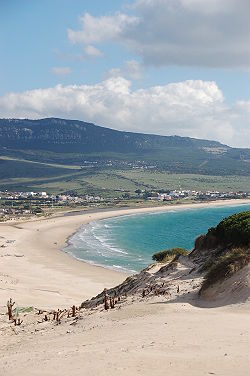
Bolonia is a coastal village and beach in the municipality of Tarifa in the Province of Cadiz in southern Spain. It is located on the Atlantic shore, 22.9 kilometres (14.2 mi) by road west of Tarifa, but is much closer in terms of coastal distance. The beach and bay is also known as Playa de Bolonia ("Bolonia Beach"), Ensenada de Bolonia ("Bolonia Cove"), or Bolonia Bay. The ruins of the Roman town of Baelo Claudia are located near the beach, considered to be the most complete Roman town ruins yet uncovered in Spain.[1][2] The beach is about 3.8 kilometres (2.4 mi) in length, with an average width of about 70 metres (230 ft). In 2011 it had a population of 117 people.

Key Information

Bolonia beach

References

[edit]
Revisions and contributorsEdit on WikipediaRead on Wikipedia
from Grokipedia
Bolonia is a small coastal locality and beach in the municipality of Tarifa, , , in southern , situated approximately 20 kilometers northwest of Tarifa along the , overlooking the . It is best known for its expansive Playa de Bolonia, a 3.8-kilometer-long stretch of fine white sand backed by striking mobile dunes up to 30 meters high, which forms part of the Duna de Bolonia and the broader Parque Natural del Estrecho, offering views toward and opportunities for and . Adjacent to the beach lie the well-preserved ruins of Baelo Claudia, an ancient Roman founded in the as a for garum (fermented fish sauce) production and export, which flourished under emperors and before declining due to earthquakes and raiders, with eventual abandonment by the 6th century. The area's natural beauty and draw over 100,000 visitors annually as of 2023, making Bolonia a key attraction in , with the beach recognized as one of Spain's most beautiful in 2023 by for its unspoiled, semi-virgin landscape and mild . exemplifies classical Roman , featuring a central forum, , theater, temples to and , public baths, an aqueduct spanning 5.2 kilometers, city walls, and industrial facilities like fish-salting vats, all excavated since and now managed as a national historic monument with a and visitor center. The site's strategic position facilitated trade between the and , highlighting its role in the , particularly in preserved production that supplied the empire. Today, Bolonia remains a sparsely populated rural enclave emphasizing , with limited infrastructure including parking, restrooms, and seasonal lifeguards, while prohibiting vehicles on the dunes to preserve the . The locality's isolation and blend of prehistoric, Phoenician, and Roman influences—evidenced by nearby megalithic sites—underscore its layered , though modern challenges include and pressures on this fragile coastal environment.

Geography

Location and Administrative Status

Bolonia is located at coordinates 36°05′23″N 5°46′29″W, approximately 22 kilometers northwest of in the municipality of , within the in the autonomous community of , southern . This coastal area forms part of the region and lies within the El Estrecho Natural Park, a protected maritime-terrestrial zone spanning over 18,900 hectares along the . As a small village without its own independent , Bolonia is administratively integrated into the larger municipality, which governs its planning, services, and development. Access to Bolonia is primarily by road, with the CA-8202 highway providing a direct route from that takes about 15 to 20 minutes by car over roughly 22 kilometers. Public transportation options are limited, mainly consisting of seasonal or weekday bus services operated by local lines from Tarifa's , running a few times daily during peak periods like summer. The nearest airports are , approximately 39 kilometers away, and , about 78 kilometers distant, both requiring a combination of transfers or driving for access. Positioned on the Atlantic coast near the Roman archaeological site of Baelo Claudia, Bolonia overlooks the and stands roughly 15 kilometers from the nearest point on Morocco's coast across the narrow waterway.

Physical Features

Bolonia is characterized by a flat coastal plain nestled in the Bay of Bolonia, within the broader , backed by low hills that rise gradually from the shoreline, including formations like the and Lomo de San Bartolomé. This terrain forms part of the sedimentary environment influenced by deposits from the River, resulting in a predominantly sandy substrate derived from marine origins. The plain's gentle facilitates the extension of dune systems inland, creating a dynamic at the interface of the Atlantic coast and the Mediterranean-influenced . The coastline prominently includes a 3.8-kilometer stretch of fine white sand beach facing the , with an average width of 70 meters, bordered by natural rock formations that form tidal pools known as Baños de Claudia at . Geologically, the area's sandy deposits are shaped by the powerful currents and winds associated with the , which drive , , and the mobility of aeolian features such as the prominent shifting dunes. These dunes, part of a larger system, reach heights of over 30 meters and widths of 200 meters, advancing inland and interacting with surrounding forests. The village itself sits at , with the terrain ascending to dunes of 30 meters and adjacent hills up to approximately 50 meters in elevation, encompassing a compact core area of about 0.1 square kilometers. Hydrologically, the region benefits from nearby freshwater springs, such as those at Realillo in the , Molino de la Plata, and Paloma, which were historically captured by three Roman aqueducts—the Realillo (4 km long), Molino de Sierra Plata (1.2 km), and Paloma (5.5 km)—to supply of Baelo Claudia; these sources remain integrated into the contemporary local water infrastructure.

Climate

Bolonia, located in the , , experiences a characterized by mild winters and warm, dry summers. Average temperatures in range from a high of 16°C to a low of 8–12°C, while July and August see highs of 25–29°C and lows around 19–21°C. Annual totals approximately 630 mm, predominantly occurring between and , with summers largely arid. Peak summer temperatures can occasionally reach 35°C, and the region benefits from over 300 days of sunshine annually, contributing to its appeal as a coastal destination. The area's wind patterns are influenced by its position at the western entrance to the , where the Levante (easterly) and Poniente (westerly) winds prevail for more than 300 days a year. These winds typically average 18–20 km/h, with the Levante often stronger at 20–40 km/h and warmer and drier, while the Poniente is more moderate and thermal in nature. Such consistent breezes make Bolonia particularly suitable for water sports like kitesurfing. Proximity to the creates a moderating , reducing temperature extremes through oceanic influences and leading to common morning and high levels averaging 79–81% year-round. Winters remain temperate without severe frosts, and occasional Atlantic storms can bring heavier rain in the cooler months, though often dissipates by midday under the .

History

Pre-Roman Period

The region encompassing modern Bolonia, Spain, shows evidence of human occupation dating back to the , primarily through indigenous communities associated with the hilltop of La Silla del Papa, a fortified settlement spanning over 3 hectares near the . This site, along with secondary oppida like El Peñón del Aljibe and rural farmsteads (typically 2000–5000 in size), indicates a landscape organized around agriculture and limited resource exploitation. Phoenician influences emerged by the , as demonstrated by imported ceramics such as T-10 amphoras and carinated bowls unearthed in archaeological surveys, alongside local handmade pottery that reflects early cultural exchanges. The subsequent Punic phase, spanning the 6th to 3rd centuries BC, involved greater territorial integration, with Punic-style pottery and bilingual coinage (featuring Phoenician and local scripts) appearing in the broader area, signaling expanded Mediterranean commerce. Near the future site of Baelo Claudia, surface scatters of Iberian and Punic pottery sherds and stone tools have been documented, pointing to intermittent activity but no substantial permanent structures. Economically, the coastal vicinity of Bolonia likely functioned as a seasonal outpost tied to the tuna migration through the , where Phoenician traders from nearby colonies like Gadir (modern ) established temporary camps for and salting beginning around the 8th–6th centuries BC. This activity capitalized on the strait's strategic position for exporting products across the western Mediterranean, though direct evidence at Bolonia remains limited to faunal remains and tool fragments suggestive of such pursuits. By the , these pre-existing trade networks facilitated gradual Roman incorporation, with the indigenous at La Silla del Papa abandoned peacefully during the Augustan era (late ) as populations relocated to the emerging coastal settlement that would become Baelo Claudia.

Roman Era

Baelo Claudia was established in the late as a modest trading and fishing settlement in the Ensenada de Bolonia, strategically positioned along the to facilitate maritime commerce. This location capitalized on the natural abundance of migrations and proximity to North African ports, evolving from earlier pre-Roman occupations such as the inland of Bailo. By the Augustan period in the late , the town had transitioned into a more formalized Roman coastal center, with inhabitants relocating from inland sites to exploit marine resources more effectively. The settlement's prosperity peaked in the 1st and 2nd centuries AD, driven by an economic boom centered on fishing and the production of , a sauce that became a staple export across the . Salting factories, or cetariae, processed vast quantities of fish using layered techniques with salt and spices, yielding high-value products like the renowned gaditanum, which was shipped in amphorae to supply and military outposts. Trade links with North African cities, notably (modern ), further bolstered wealth through the exchange of goods and cultural influences, as noted by the geographer . At its height, the population is estimated to have numbered between 2,000 and 4,000 residents, reflecting the scale of this specialized economy. Urban development followed a classic Roman , oriented along the decumanus maximus and cardus maximus, with public buildings constructed from the onward to support growing administrative and communal needs. Key expansions included temple constructions and the initiation of theater operations during this period, underscoring the town's integration into the provincial framework of . In the mid-1st century AD, Emperor Claudius granted it status, formalizing its autonomy and renaming it Baelo Claudia in his honor. Society in Baelo Claudia comprised a diverse mix of Roman settlers, local Iberian and Phoenician-descended inhabitants, and enslaved laborers who worked in the fishing and salting industries. Administrative structures, such as the and , indicate a governed community with civic participation typical of a . Religious practices blended Roman, Egyptian, and indigenous elements, evidenced by temples dedicated to the (, Juno, and ) and —whose worship arrived via North African trade routes—as well as votive offerings to local deities. This cultural synthesis highlighted the town's role as a crossroads of Mediterranean influences. The city's vitality waned in the mid-2nd century AD, ultimately leading to abandonment following devastating earthquakes in the AD.

Post-Roman and Modern Development

Following the peak of Roman prosperity, Baelo Claudia experienced a gradual decline exacerbated by natural disasters. A major struck the city in the late AD (circa 260–290 AD), causing widespread structural damage, including the collapse of buildings like the and public facilities, due to seismic intensities exceeding IX on the Modified Mercalli scale and amplified by the site's unstable clayey substratum. This event severely disrupted the city's economic activities, particularly its production and trade, leading to partial rebuilding but diminished functionality. The Vandal invasion of in 409 AD overran Baetica province, contributing to regional instability during the site's ongoing decline. The area saw sparse activity under Visigothic rule from the and subsequent Muslim control after the Umayyad conquest of in 711 AD. Archaeological evidence indicates limited settlement continuity, with the landscape primarily supporting pastoral grazing by local herders and small-scale fishing along the coast, rather than organized urban or agricultural development. This low-density occupation persisted through the medieval period, as the region's strategic position near the made it vulnerable to conflicts but not a focal point for expansion. The area remained marginal until the Christian advanced southward, culminating in the conquest of nearby by Castilian forces under Sancho IV in 1294, which secured the southern frontier and facilitated gradual repopulation, though Bolonia itself stayed rural and underdeveloped. In the 19th and early 20th centuries, Bolonia emerged as a modest rural outpost dependent on , with land redistribution following the 19th-century confiscation of church properties enabling peasant occupations for subsistence farming and rearing. The mid-20th century brought revival through , spurred by Spain's national economic policies and the allure of the Roman ruins at Baelo Claudia, which drew increasing visitors from the onward and accelerated in the with rising international interest in coastal heritage sites. This growth transformed the local economy, with visitor numbers to the increasing in the . Recent developments emphasize sustainability amid environmental and heritage pressures. In the early 2000s, Bolonia was integrated into protected frameworks, including the designation of the Natural Park in 2003 and the Bolonia Dunes as a in 2001, later incorporated into the network. These initiatives have enforced strict limits on , preserving Bolonia's pristine dunes, beaches, and ruins as a model of integrated historical and ecological conservation, with the ancient site continuing to anchor modern interest in the locale.

Archaeological Site of Baelo Claudia

Discovery and Excavations

The ruins of Baelo Claudia were first noted by antiquarians in the , though the site remained largely unstudied until modern times. Systematic excavations commenced in 1917 under the direction of French archaeologist Pierre Paris, assisted by Anglo-French archaeologist George Bonsor, and continued through the early 1920s. These efforts focused on uncovering the core urban layout, including major public buildings, and marked the beginning of scientific investigation at the site. In recognition of its importance, Baelo Claudia was declared a in 1925 by Spanish authorities, granting it protected status. Spanish-led campaigns from the through the expanded on Bonsor's work, systematically revealing more of the city's and infrastructure. Renewed efforts in the 1980s and continuing into the 2000s were spearheaded by the University of , which conducted extensive digs that uncovered sections of the aqueduct system and further explored the , including intact burial structures. These investigations also identified pre-Roman layers beneath the Roman levels. In 2020, archaeologists led by the University of discovered an eighth fish-salting factory at the site, enhancing understanding of its production. The university's ongoing excavations marked 25 years of continuous work in 2024. The Archaeological Museum of Baelo Claudia opened in December 2007, serving as a research hub and interpretive center adjacent to the ruins. In the 2010s, natural shifting of the adjacent Bolonia dune exposed previously buried areas, leading to the discovery of new structures and artifacts, such as a marble fragment of a Doryphoros statue copy from the site's maritime thermae. Excavation methods have adapted to the site's coastal environment, incorporating geophysical surveys like ground-penetrating radar to map subsurface features non-invasively, alongside manual and mechanical sand removal techniques to counter the dune's ongoing migration and burial effects.

Key Structures and Artifacts

The archaeological site of Baelo Claudia features a well-preserved array of Roman public buildings that highlight the city's administrative and civic functions. At the heart of the urban layout lies the forum, a rectangular central square measuring 37 meters by 30 meters, constructed during the reign of Augustus in the late 1st century BCE and later modified under the Flavian dynasty in the late 1st century CE; it included a portico, tribunal, curia for municipal meetings, tabularium for archives, and surrounding shops. Adjacent to the forum stands the basilica, a rectangular structure 35.5 meters by 19.5 meters likely built under Nero around 54-68 CE, supported by 20 columns and serving as a venue for legal proceedings and public assemblies, with a notable bronze statue of Emperor Trajan discovered within. Further south, the theater, erected in the Claudian period (41-54 CE), boasts a facade 67 meters wide and could accommodate 1,500 to 2,000 spectators in its cavea, orchestra, and scaena, though it fell into disuse by the 3rd century CE. Religious structures at Baelo Claudia reflect a blend of Roman and imported cults, underscoring the city's diverse cultural influences. The Capitolium, dedicated to the of , Juno, and , consists of three temples arranged on a terrace and dated to the Neronian era (60-70 CE), later incorporating imperial worship. Nearby, the Temple of , constructed around 70 CE, features a and an crypt, with inscriptions honoring donors such as Vecilius and Marcus Sempronius Maximus, evidencing the adoption of Egyptian deities linked to maritime trade. Complementing these are the public baths, or , built in the CE with typical Roman sections including a , , and heated by a system, and modified in the 4th century CE; mosaics depicting marine motifs adorn the floor. Industrial installations demonstrate Baelo Claudia's economic reliance on , particularly production, which played a key role in the through exports across the Mediterranean. The factories, operational from the late 2nd century BCE and reaching peak activity under in the mid-1st century CE, are clustered near the shoreline and include numerous salting vats (pilae) for fermenting in . Supporting this industry and urban water needs, an aqueduct channeled water from a source approximately 5.2 kilometers inland at Punta Paloma, featuring five visible arches and capable of delivering up to 6 million liters daily. Among the artifacts unearthed at the site, inscriptions provide insights into religious and civic life, including dedications to and epitaphs, some on panels with erotic themes. Mosaics, such as those in with polychrome sea creatures like fish and octopuses, along with imported from and , illustrate daily and artistic practices. Notable finds also encompass bronze statues, exemplified by the figure from the , and coins minted locally until the early CE, later supplemented by issues from Gades and evidencing trade ties with .

Significance and Preservation

The of Baelo Claudia holds immense historical value as one of the best-preserved Roman towns in , offering unparalleled insights into ancient urban planning, maritime trade, and community resilience against natural disasters. Founded in the BCE as a coastal settlement, it exemplifies Roman grid-based layout with public forums, temples, and industrial facilities for production, reflecting its role as a key trading hub between the and . The site's stratigraphic layers reveal evidence of major earthquakes in the 1st and 4th centuries CE, followed by systematic repairs—such as reinforced walls and rebuilt structures—that demonstrate the inhabitants' adaptive engineering and social organization in the face of seismic threats. As a designated National Historic Monument and integral part of Andalusia's network under the Museos de Andalucía, Baelo Claudia attracts approximately 100,000 visitors annually, underscoring its status as a vital educational resource for understanding Roman provincial life. The site's completeness, including visible remnants of its theater and aqueduct, allows researchers and the public to study the evolution of a mid-sized Roman without the distortions of later urban overlay. Preservation efforts at Baelo Claudia have intensified since the early 2000s, focusing on stabilizing the adjacent Bolonia dune system through vegetation planting and erosion barriers to prevent sand encroachment on the ruins. These initiatives, combined with the 2007 construction of a modern visitor center and museum designed by architect Guillermo Vázquez Consuegra, house numerous artifacts such as mosaics, inscriptions, and industrial tools recovered from the site, enhancing interpretive access while minimizing on-site handling. To promote sustainable tourism, entry is free for EU citizens upon presentation of identification, with a nominal fee for others, encouraging responsible visitation along designated paths. Ongoing challenges include mitigating exacerbated by climate variability and managing the impacts of high tourist footfall on fragile structures, addressed through integration with the surrounding El Estrecho Natural Park, which provides a protective and regulatory framework for . Collaborative projects between regional authorities and archaeologists continue to prioritize non-invasive techniques, ensuring the site's as a benchmark for Roman studies.

Natural Environment

Bolonia Beach and Dune

Bolonia Beach, located in the municipality of in province, southern , is a striking expanse of fine white sand stretching approximately 3.8 kilometers in length and averaging 70 meters in width. Its pristine shoreline is bordered by the Atlantic , offering clear, turquoise waters that attract visitors seeking natural beauty. A notable feature is the designated nudist section, particularly in the southern portion of the beach known as El Chorrito, where clothing-optional sunbathing is permitted. The area's can reach up to about 2 meters, creating dynamic intertidal zones that vary the beach's usable width throughout the day. Dominating the eastern end of the is the Bolonia Dune, a prominent mobile sand formation recognized as one of Europe's largest active s. Rising to over 30 meters in height and extending about 200 meters along its base, the forms part of a broader coastal system within the Bolonia Inlet. Its shifting nature results from strong levante winds—easterly gusts prevalent in the —that propel sand inland, combined with Atlantic currents that transport along the shoreline. The sand originates primarily from local and river deposits, with contributions from long-range transport including carried by . The dune migrates westward at an average rate of 5 to 10 meters per year, driven by these persistent winds, which causes it to periodically engulf and reveal underlying terrain. This mobility has historically contributed to the partial burial of the adjacent Roman of Baelo Claudia, preserving structures beneath layers of while occasionally exposing them through erosion. The dune's dynamic behavior underscores its role as a and reservoir in the coastal . Recreational activities on the and emphasize low-impact enjoyment, with the expansive sands ideal for sunbathing and leisurely walks along the or up the dune's slopes for elevated views of the . The dune's historical interaction with the Roman ruins highlights its significance beyond aesthetics, as shifting sands have alternately concealed and protected artifacts from over centuries.

Biodiversity and Protected Areas

The region surrounding Bolonia supports a diverse array of flora adapted to its coastal and dune environments, featuring coastal scrublands with (Juniperus phoenicea) and (Limonium spp.), as well as dune-stabilizing grasses like (Ammophila arenaria). Endemic plants such as green-flowered narcissus (Narcissus viridiflorus) and three-spined broom (Genista triacanthos) thrive in the inland scrub near the , contributing to the area's botanical richness. These species reflect the Mediterranean's unique blend of Atlantic and African influences, with over 18 habitats documented in the broader park system. Faunal diversity is equally notable, positioning Bolonia as a key bird migration hotspot along the , where prevailing winds facilitate the passage of species including Bonelli's eagles (Aquila fasciata), greater flamingos (Phoenicopterus roseus), and various raptors during seasonal crossings. Marine biodiversity in the nearby waters encompasses (Thunnus thynnus) and cetaceans such as short-beaked common dolphins ( delphis) and bottlenose dolphins (Tursiops truncatus), with over 1,900 marine species recorded in the park. Terrestrial reptiles like the common chameleon () inhabit the scrub and dunes, while the dune ecosystem harbors rare invertebrates, including endemic snails and beetles that depend on the shifting sands. Bolonia falls within the Parque Natural del Estrecho, established in 2003 to conserve 18,931 hectares of maritime-terrestrial landscapes, and is designated as a site (ES0000337) under the EU to protect priority habitats like embryonic shifting dunes and coastal saltmarshes. This framework ensures the preservation of migratory corridors and endemic populations, preventing . Ecologically, the serves as a critical biodiversity corridor, enabling faunal exchanges between the Mediterranean and Atlantic oceans, as well as avian movements between and , sustaining the region's high species turnover.

Environmental Challenges

The mobile dune system at Bolonia advances at an average rate of 10.9 meters per year, driven by strong easterly winds and historical human interventions such as vegetation planting and , posing a direct threat to the Baelo Claudia ruins through burial and destabilization. Maximum annual movement can reach 22.9 meters, with the dune having advanced 356 meters between 1974 and 2011, exacerbating erosion on the site's coastal edges. Climate-amplified winds further accelerate this inland migration, uncovering artifacts while risking the overlying pine and cork forests in the surrounding natural park. Coastal erosion compounds these issues, intensified by projected sea-level rise of 0.28 to 0.55 meters by 2100 under low-emission scenarios in the Mediterranean, which could inundate low-lying heritage areas like Bolonia. Human-induced pressures from generate substantial beach litter, with s comprising 87.2% of at Bolonia—primarily from recreational activities by visitors—and accumulating at densities linked to over 2.6 million annual stay-nights in province. In early 2024, a spill of plastic pellets from a incident washed up on Bolonia beach, underscoring ongoing threats. Water sports, including kitesurfing prevalent in the area, disturb dune vegetation and sediment stability, while historical depleted eastern stocks by up to 80% in the through excessive catches of 50,000–61,000 tonnes annually. Nearby beaches have faced invasions of invasive Asian (Rugulopteryx okamurae) as of 2025, posing potential risks to Bolonia's coastal ecosystem. Climate change manifests in increased storm frequency across southern , heightening wave energy and dune erosion, alongside prolonged droughts that reduce recharge of local freshwater springs and alter coastal hydrology. These dynamics contribute to broader by fragmenting habitats in the dune and estuarine systems. Mitigation strategies include dune fencing with wicker and wooden barriers to trap sand and curb mobility, alongside failed but ongoing attempts at stabilizing vegetation like , implemented to protect nearby infrastructure and ecosystems. EU-funded initiatives, such as the Culture 2000 programme, have supported integrated projects in Bolonia Cove since 2000, incorporating waste management protocols and low-impact access pathways to minimize tourism-related degradation. The Andalusian regional government oversees continuous through the Partnerships for Conservation framework, tracking visitor impacts (rising 20% from 2013 to 2017) and ecosystem vulnerabilities to inform adaptive protections within the network.

Society and Economy

Demographics and Population

Bolonia, a small rural hamlet within the municipality of in province, , maintains a modest permanent population of 82 inhabitants as of January 1, 2024. This figure marks a slight decline of 3 residents from the previous year, continuing a trend of gradual reduction from 125 inhabitants recorded in 2010. The gender composition shows approximately 44% males and 56% females, based on 2023 estimates. The demographic profile reflects the aging characteristics common to rural Andalusian communities, with the median age in the broader municipality standing at 43.3 years in 2024, up from 41.6 years five years prior. The population is overwhelmingly composed of native Spanish , supplemented by a small contingent that includes retirees from northern European countries such as the and ; foreigners account for about 12.4% of Tarifa's overall residents as of 2025. Given Bolonia's compact size as a , its population density is relatively higher than the municipal average of 44.5 inhabitants per km², though precise boundaries limit exact calculations. Residents of Bolonia depend on the nearby town of for essential , including through local schools and healthcare via municipal clinics and hospitals. Homeownership remains prevalent, aligning with Spain's national rate of 73.7% in 2024 and the even higher tendencies in rural settings. Tourism contributes to a seasonal population surge, with temporary residents and visitors swelling numbers to several hundred during peak summer months due to the appeal of the beach and archaeological site.

Local Economy and Livelihoods

The local economy of Bolonia, a small coastal within the municipality of in province, is overwhelmingly dominated by , which serves as the primary source of income for residents through beach-related activities, visitor fees at the Baelo Claudia ruins, and equipment rentals for water sports like kitesurfing and . This sector has seen a robust recovery post-pandemic, with a 94% increase in visitors to the Tarifa area from 2020 to 2021 and a 12% rise in average stay lengths compared to 2020, underscoring its role as the main economic driver alongside fishing. in tourism is highly seasonal, peaking sharply in summer when demand for accommodations, guided beach experiences, and recreational services surges, supporting temporary jobs in hospitality and maintenance. Complementing tourism are traditional livelihoods rooted in small-scale , where the ancient technique—employing labyrinthine nets to capture migrating —remains a key practice along the Cádiz coast, including near and Bolonia. plays a limited role, confined to groves and extensive farming on the hilly hinterlands, which provide modest supplementary income amid the area's rugged terrain and protected natural zones. These sectors sustain a portion of the community year-round but face constraints from environmental factors, such as invasive reducing fishing yields by up to 90% in recent years, with the issue persisting into 2025 and affecting artisanal fishing in the region. Additional economic activities include operations like beachside chiringuitos (informal bars serving local and drinks) and small guesthouses, which cater to day-trippers and overnight stays, as well as emerging eco-tourism initiatives such as guided nature walks highlighting the dunes and . These ventures foster sustainable livelihoods by linking visitors with the local environment. However, the grapples with challenges, including seasonal unemployment rates climbing to 20-25% in the off-season—aligned with Cádiz province's overall rate of 20.6% in mid-2024—and a heavy dependence on for shopping, services, and broader commerce due to Bolonia's remote, low-population setting. This mirrors historical patterns, such as the Roman-era at Baelo Claudia, which thrived on production from local catches.

Tourism and Culture

Major Attractions

One of the primary attractions in Bolonia is the archaeological site of Baelo Claudia, a well-preserved Roman town founded in the BCE, featuring ruins of temples, a forum, thermal baths, and a factory that highlight daily life in ancient . Guided tours are available through the site's visitor center, offering insights into Roman urban planning and , while the on-site includes interactive exhibits on crafts, , and social structures of the era. The Roman theater, partially intact, occasionally hosts summer performances that recreate ancient spectacles against the coastal backdrop. Bolonia Beach draws visitors for its 3.8-kilometer stretch of fine white sand and clear Atlantic waters, ideal for relaxation and water sports. Local schools offer and kitesurfing lessons, capitalizing on the area's consistent winds, with equipment rentals available directly on the shore. A designated nudist section provides a clothing-optional space for sunbathing, while the beach's western end offers prime sunset views across the toward Africa. The iconic Duna de Bolonia, a 30-meter-high shifting sand dune spanning 200 meters wide, serves as a natural for enthusiasts. Informal trails lead to the summit, providing a moderate 20-30 minute ascent rewarded with panoramic vistas of the coastline, bay, and distant Moroccan hills, making it a favored spot for . Beyond Bolonia proper, nearby , approximately 20 kilometers away, facilitates whale-watching boat trips into the , where operators spot dolphins, pilot whales, and occasionally orcas year-round on 2-3 hour excursions. Beachside chiringuitos in Bolonia offer casual dining with fresh seafood specialties like grilled sardines and , served al fresco overlooking the sea. The site's location within a protected natural area further enhances its appeal for eco-conscious travelers.

Cultural Heritage and Lifestyle

Bolonia's cultural heritage is deeply intertwined with its Roman past and traditional Andalusian practices. The annual Roman Festival of Baelo Claudia, held in summer at the ancient ruins, features reenactments of historical events, workshops on Roman crafts, and theatrical performances that revive the town's classical legacy. This event fosters a strong sense of local identity rooted in the site's history as a prosperous Roman settlement. Complementing this, the preservation of Andalusian fishing folklore emphasizes the almadraba technique of tuna trapping, a millennia-old practice documented through oral histories, songs, and communal rituals passed down by coastal communities in the Tarifa region, including Bolonia. Efforts to safeguard this intangible heritage include ethnographic documentation and classification of related sites as places of ethnological interest, ensuring the continuity of social identities tied to maritime traditions. The lifestyle in Bolonia reflects a relaxed, eco-conscious ethos shaped by its pristine coastal setting and commitment to . Residents prioritize outdoor activities such as the nearby dunes and beach walks, embracing a pace that harmonizes with the natural rhythm of the environment. Local markets in the vicinity, like those in , showcase artesanal products including handmade ceramics, woven goods, and organic produce, supporting small-scale creators and promoting community self-sufficiency. Traditional celebrations and cuisine further highlight Bolonia's cultural fabric, influenced by its proximity to and the . Tuna-related festivals, such as Tarifa's Ruta del Atún, typically held in late May or early June (cancelled in 2025), feature communal feasts and demonstrations of almadraba fishing, extending their cultural resonance to Bolonia through shared regional participation and storytelling. Culinary traditions blend Spanish and North African elements, evident in dishes like espeto de sardinas—fresh sardines skewered and grilled over beach fires—a practice that echoes Moorish grilling techniques while using local Atlantic catches. In contemporary times, Bolonia maintains a low-key vibe that contrasts with Tarifa's vibrant surf scene, offering a serene retreat for reflection amid the latter's wind-driven energy. This tranquility has spurred growing artist residency programs in the surrounding area, such as those in nearby Facinas, where creators engage in site-specific projects exploring and heritage, fostering a subtle influx of artistic expression without overwhelming the community's intimate scale.

References

Add your contribution
Related Hubs
User Avatar
No comments yet.