


Community hub
Recent from talks
Contribute something
Nothing was collected or created yet.
Frogmouth
View on Wikipedia
| Frogmouths | |
|---|---|

| |
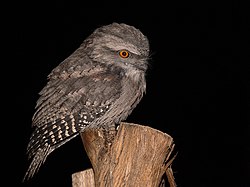
| Tawny frogmouth, at night | |
Scientific classification 
| |
| Kingdom: | Animalia |
| Phylum: | Chordata |
| Class: | Aves |
| Clade: | Strisores |
| Clade: | Vanescaves |
| Order: | Podargiformes Matthews, 1918 |
| Family: | Podargidae Gray, 1847 |
| Genera | |

The frogmouths (Podargidae) are a group of nocturnal birds related to owlet-nightjars, swifts, and hummingbirds. Species in the group are distributed in the Indomalayan and Australasian realms.
Biology
[edit]They are named for their large flattened hooked bill and huge frog-like gape, which they use to capture insects. The three Podargus species are large frogmouths restricted to Australia and New Guinea, that have massive flat broad bills. They are known to take larger prey, such as small vertebrates (frogs, mice, etc.), which are sometimes beaten against a stone before swallowing.[1] The ten Batrachostomus frogmouths are found in tropical Asia. They have smaller, more rounded bills and are predominantly insectivorous. Both Podargus and Batrachostomus have bristles around the base of the bill, and Batrachostomus has other, longer bristles which may exist to protect the eyes from insect prey.[1] In April 2007, a new species of frogmouth was described from the Solomon Islands and placed in a newly established genus, Rigidipenna.[2]
Their flight is weak. They rest horizontally on branches during the day, camouflaged by their cryptic plumage. Through convergent evolution as night hunters, they resemble owls, with large front-facing eyes.[citation needed]
Up to three white eggs are laid in the fork of a branch, and are incubated by the female at night and the male in the day.[citation needed]
Taxonomy
[edit]DNA-DNA hybridisation studies had suggested that the two frogmouth groups may not be as closely related as previously thought, and that the Asian species may be separable as a new family, the Batrachostomidae.[3][4] Although frogmouths were formerly included in the order Caprimulgiformes, a 2019 study estimated the divergence between Podargus and Batrachostomus to between 30 and 50 mya and forming a clade well separated from the nightjars and being a sister group of the swifts, hummingbirds, and owlet-nightjars. The name Podargiformes proposed in 1918 by Gregory Mathews was reinstated for the clade.[5]
Species
[edit]
- Genus Podargus
- Tawny frogmouth, Podargus strigoides
- Marbled frogmouth, Podargus ocellatus
- Papuan frogmouth, Podargus papuensis
- Genus Batrachostomus
- Large frogmouth, Batrachostomus auritus
- Dulit frogmouth, Batrachostomus harterti
- Philippine frogmouth, Batrachostomus septimus
- Gould's frogmouth, Batrachostomus stellatus
- Sri Lanka frogmouth, Batrachostomus moniliger
- Hodgson's frogmouth, Batrachostomus hodgsoni
- Sumatran frogmouth, Batrachostomus poliolophus
- Javan frogmouth, Batrachostomus javensis
- Blyth's frogmouth, Batrachostomus affinis
- Sunda frogmouth, Batrachostomus cornutus
- Palawan frogmouth, Batrachostomus chaseni
- Bornean frogmouth, Batrachostomus mixtus
- Genus Rigidipenna
- Solomons frogmouth, Rigidipenna inexpectata
In culture
[edit]In a journal article published in April 2021, researchers Katja Thömmes and Gregor Hayn-Leichsenring from the Experimental Aesthetics group at the University Hospital Jena, Germany, found the frogmouth to be the most "instagrammable" type of bird.[6] Using an algorithm to analyze the aesthetic appeal of more than 27,000 bird photographs on Instagram, they found that photos depicting frogmouths received the highest number of likes relative to the posts' exposure to users. The journal article was picked up by several news outlets, including The New York Times and The Guardian.[7]

References
[edit]- ^ a b Perrins, Christopher (2003). Firefly Encyclopedia of Birds. Firefly Books. p. 342. ISBN 1-55297-777-3.
- ^ Cleere; et al. (2007). "A new genus of frogmouth (Podargidae) from the Solomon Islands – results from a taxonomic review of Podargus ocellatus inexpectatus Hartert 1901". Ibis. 149 (2): 271–286. doi:10.1111/j.1474-919x.2006.00626.x.
- ^ Sibley, Charles G.; Alquist, John E.; Monroe Jr., Burt L. (July 1988). "A Classification of the Living Birds of the World Based on Dna-Dna Hybridization Studies" (PDF). The Auk. 105 (3): 409–423. doi:10.1093/auk/105.3.409. JSTOR 4087435.
- ^ Mayr, G (2002). "Osteological evidence for paraphyly of the avian order Caprimulgiformes (nightjars and allies)" (PDF). Journal für Ornithologie. 143 (1): 82–97. doi:10.1007/bf02465461. ISSN 0021-8375. S2CID 42119957.
- ^ Chen, Albert; White, Noor D.; Benson, Roger B.J.; Braun, Michael J.; Field, Daniel J. (2019). "Total-Evidence Framework Reveals Complex Morphological Evolution in Nightbirds (Strisores)". Diversity. 11 (9): 143. doi:10.3390/d11090143.
- ^ Thömmes, Katja; Hayn-Leichsenring, Gregor (2021-03-01). "What Instagram Can Teach Us About Bird Photography: The Most Photogenic Bird and Color Preferences". i-Perception. 12 (2) 20416695211003585. doi:10.1177/20416695211003585. ISSN 2041-6695. PMC 8073730. PMID 33996019.
- ^ Waller, Allyson (2021-04-29). "This 'Angry' Bird Is the Most Photogenic, Research Finds". The New York Times. ISSN 0362-4331. Retrieved 2021-04-30.
External links
[edit]

- Frogmouth videos on the Internet Bird Collection
- Video: Finding the Sri-Lanka Frogmouth, Southern India
- Scientists discover new genus of frogmouth bird in Solomon Islands


| National | |
|---|---|
| Other | |

Frogmouth
View on GrokipediaTaxonomy and classification
Etymology
The common name "frogmouth" refers to the birds' distinctive broad, flattened bill and wide gape, which resemble the mouth of a frog.[4] The family Podargidae derives its name from the genus Podargus, established by the English naturalist John Latham in 1801 when he described the tawny frogmouth (Podargus strigoides) in his Supplementum Indicis Ornithologici.[5] The genus name Podargus originates from the Ancient Greek podagra, meaning "gout" (specifically, gout in the foot), alluding to the small, weak, and somewhat swollen appearance of the birds' feet, which causes a distinctive waddling gait reminiscent of someone afflicted with the condition. Subsequent species in the family received binomial nomenclature under Podargus and related genera; for example, Asian frogmouths were classified under Batrachostomus, a name directly combining the Greek batrakhos ("frog") and stoma ("mouth") to highlight the same oral feature.[6] This nomenclature sets frogmouths apart from superficially similar nocturnal birds like nightjars (family Caprimulgidae), whose generic name Caprimulgus stems from Latin capra ("goat") and mulgere ("to milk"), based on a historical myth that they suckle from livestock.[7]Phylogenetic position
Frogmouths belong to the family Podargidae within the order Podargiformes, a classification originally proposed by Gregory M. Mathews in 1918 to distinguish them from the nightjars and allies in Caprimulgiformes.[8] This separation was traditionally based on morphological differences but has been robustly supported by modern genetic analyses, including a 2019 total-evidence study integrating molecular and morphological data that resolved Podargiformes as a distinct clade within the larger group Strisores, separate from Caprimulgiformes.[9] The family Podargidae is monophyletic, forming a close phylogenetic relationship with the owlet-nightjars (family Aegothelidae) and swifts/hummingbirds (order Apodiformes), as sister group to the clade (Aegothelidae + Apodiformes).[10] This positioning places Podargidae near the base of Strisores, a clade encompassing nocturnal, crepuscular, and diurnal birds, including nightjars, frogmouths, owlet-nightjars, potoos, oilbirds, swifts, and hummingbirds. The earliest known fossils attributable to frogmouths date to the early Eocene, approximately 48 million years ago, exemplified by Masillapodargus longipes from the Messel Pit in Germany, which exhibits podargiform characteristics such as a robust bill and skeletal features adapted for perching. Molecular clock analyses indicate that Podargidae diverged from other lineages within or basal to Strisores around 60–70 million years ago, near the Cretaceous-Paleogene boundary, aligning with the broader radiation of Neoaves following the end-Cretaceous extinction.Genera and species
The family Podargidae comprises three genera and a total of 16 species of frogmouths, distributed across Australasia and Southeast Asia.[11] The genus Podargus includes three species, characterized by their large size, robust builds, and broad, flat bills adapted for capturing larger prey such as vertebrates in addition to insects; these species are primarily found in Australia and New Guinea.[12] The species are:- Podargus strigoides (tawny frogmouth)
- Podargus ocellatus (marbled frogmouth)
- Podargus papuensis (Papuan frogmouth)
- Batrachostomus auritus (large frogmouth)
- Batrachostomus harterti (Dulit frogmouth)
- Batrachostomus septimus (Philippine frogmouth)
- Batrachostomus stellatus (Gould's frogmouth)
- Batrachostomus moniliger (Sri Lanka frogmouth)
- Batrachostomus hodgsoni (Hodgson's frogmouth)
- Batrachostomus poliolophus (short-tailed frogmouth)
- Batrachostomus mixtus (Bornean frogmouth)
- Batrachostomus javensis (Javan frogmouth)
- Batrachostomus affinis (Blyth's frogmouth)
- Batrachostomus chaseni (Palawan frogmouth)
- Batrachostomus cornutus (Sunda frogmouth)