Hubbry Logo
Casino chipCasino chipMain
Open search
Casino chip
Community hub
Casino chip
logo
8 pages, 0 posts
0 subscribers
Be the first to start a discussion here.
Casino chip
Casino chip
from Wikipedia
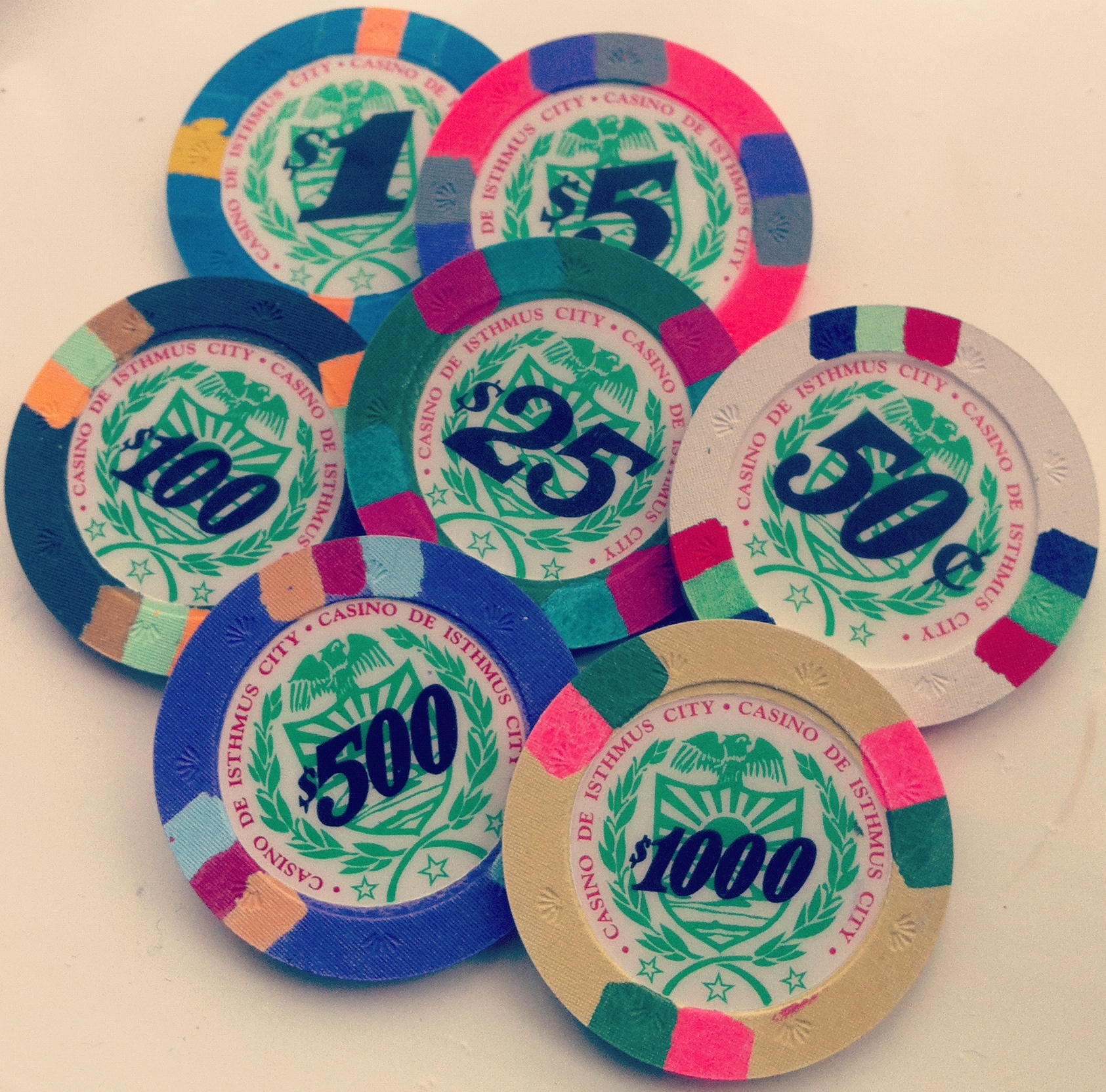
Chips from the fictional "Casino de Isthmus City".
50,000 Malagasy franc gaming plaque from Grand Cercle casino, Antananarivo, Madagascar, circa 1995.

Casino chips (also known as poker chips, gaming tokens, or checks/cheques) are small discs used as currency in casinos. Larger, rectangular gaming plaques may be used for high-stakes games. Poker chips are also widely used as play money in casual or tournament games, are of numismatic value to casino chip collectors, or may be kept as souvenirs.

Chips and plaques used in table games may be made of a mixture of metal, clay, ceramic, and plastic materials inlayed or painted with colors and numbers indicating various denominations, while metal token coins are used primarily in slot machines. Some casinos embed RFID tags into chips to collect data and fight counterfeiting, and plaques may have printed serial numbers.

Use

[edit]

Money is exchanged for tokens in a casino at the casino cage, at the gaming tables, or at a cashier station.[1] The tokens are interchangeable with money at the casino.[1] As they are not legal tender, they generally have no value outside of the casino, but certain businesses (such as taxis or waiters—especially for tips) in gambling towns may honor them informally.[1]

Tokens are employed for several reasons. Because of the uniform size, shape, and patterns of stacks of chips, they are easier to tally compared to currency. This attribute also enables the pit boss or security to quickly verify the amount being paid, reducing the chance that a dealer might incorrectly pay a customer. The uniform weight of the casino's official tokens allows them to weigh great stacks or heaps of chips rather than tally them (though aids such as chip trays are far more common). Furthermore, it is observed that consumers gamble more freely with replacement currencies than with cash.[2] A more pragmatic reason for casinos using chips in place of cash at table games is to discourage players from grabbing back their bet and attempting to flee should their bet not win, because chips, unlike cash, must be redeemed at the casino cashier and have no value outside the casino in question. Lastly, the chips are considered to be an integral part of the casino environment, and replacing them with some alternate currency would be unpopular.[3]

Many casinos have eliminated the use of metal tokens (and coins) in their slot machines, in favor of paper receipts or pre-paid cards, which, while requiring heavy infrastructure costs to install, eliminate the coin handling expenses, jamming problems encountered in machines which took coins or tokens and can allow more game-specific technology in the space of a machine which would usually be dedicated to coin mechanisms. While some casinos (such as the Hard Rock Hotel in Las Vegas) which installed the receipt system had kept the $1 tokens around for use as $1 chips, most other casinos using the receipts had simply scrapped the tokens entirely. Most casinos using receipts have automated machines at which customers may redeem receipts, eliminating the need for coin counting windows and decreasing labor costs.

Casino chip collecting is a part of numismatics, more specifically as specialized exonumia collecting. This hobby has become increasingly popular with the Casino Chips & Gaming Tokens Collectors Club formed in 1988. Some collectors may value certain casino tokens up to $100,000, which are typically traded on online auction websites like eBay. Several casinos sell custom-made sets of chips and one or two decks of cards stamped with the name of the casino on them. Each set is contained in a small briefcase or box.

History

[edit]
A virapulla set
Coloured wooden counters of the type used in European card games. The jetons are the round counters; the fiches are the elongated ones; and the contrats the short rectangles.

The ancestors of modern casino tokens were the counters used to keep score in the card games Ombre, Grosstarock, Belote, Boston, Vira, and the now outmoded Quadrille, as well as the tables game Trictrac. European sets designed for playing these games normally contain a number of different counters, known as contrats, fiches, and jetons (these last optionally of two sizes, mils and cents). At Ombre, the cent is reckoned as twenty units; the mil as ten; the contrat as five; and the fiche as one.[4]

Unlike chips designed for poker, ombre or belote jetons are coloured differently only to determine player ownership for purposes of settling payments at the end of the game, with different denominations differentiated by the different shapes of each counter type.[5]

In the early history of poker during the 19th century, players seemed to use any small valuable object imaginable. Early poker players sometimes used jagged gold pieces, gold nuggets, gold dust, or coins as well as "chips" primarily made of ivory, bone, wood, paper, and a composition made from clay and shellac. Several companies between the 1880s and the late 1930s made clay composition poker chips. There were over 1000 designs from which to choose. Most chips were white, red, blue, and yellow, but they could be made in almost any color desired.

Construction

[edit]
Authentic clay chip manufactured for home use.
$1 chip from Treasure Island, Las Vegas, NV.

The vast majority of authentic casino chips are "clay" chips but can be more accurately described as compression molded chips. Contrary to popular belief, no gaming chip going as far back as the 1950s has been 100% clay. Modern clay chips are a composition of materials more durable than clay alone. At least some percentage of the chips is of an earthen material such as sand, chalk, and clay similar to that found in cat litter. The process used to make these chips is a trade secret, and varies slightly by manufacturer, most being relatively expensive and time-consuming per chip. The edge spots, or inserts, are not painted on; to achieve this effect, this area of the clay is removed and then replaced with clay of a different color; this can be done to each chip individually or a strip can be taken out of a cylindrical block of material and replaced with the alternate color before the block is cut into chips. Then each chip receives a mid-inlay if desired, and is placed in a special mold that compresses the chip, hence the term compression molded chips. The pressure of the compression and the heat that is added varies from manufacturer to manufacturer.

The printed graphics on clay chips is called an inlay. Inlays are typically made of paper and are then clad with a plastic film applied to the chip prior to the compression molding process. During the molding process, the inlay becomes permanently fastened to the chip and cannot be removed from the chip without destroying the inlay.

Ceramic chips were introduced in the mid-1980s as alternative to clay chips, and are also used in casinos, as well as being readily available to the home market. The ability to print lettering and graphics on the entire surface of the chip, instead of just the inlay, made them popular. Ceramic chips are sometimes also referred to as clay or clay composite, but they are in fact an injection molded chip made with a special plastic or resin formula that approximates the feel and sound of ceramic or porcelain. There are less expensive chips for the home market, made from various forms of plastic and plastic covered metal slugs as well.

The chips used in United States casinos typically weigh about 10 grams, but they can be between 8 and 16 g worldwide.

Colors

[edit]

There is no universally standardized color scheme for poker chip values, and schemes not only vary nationally and regionally, but even from venue to venue, or by event type within a single venue.

A standard 300-piece set of Plastic Injection chips often sold as "clay composite" chips.
A set of injection-molded ABS poker chips "hot-stamped" with denominations 100, 50, 25, & 10.

Chip colors found in home sets typically include red, white, blue, and sometimes green and black; however, more recently a wide assortment of colors have become readily available, particularly in lower-cost ABS plastic chips. Common additional colors are pink, purple, yellow, orange, and grey. Newer designs in home chips include three-color designs where a three-step molding process creates a chip with unique base, secondary, and detail colors. As chip sets are tailored to the buyer, the values of various colors vary widely, with less traditional colors either used as very high values such as $500, $1,000, $5,000, and so forth, common in tournaments, or as special "fractional" values such as $2 or $0.50, common in low-limit games.

In casinos, uniform chip colors and sizes are sometimes specified by the local gaming control board for consistency. For example, regulations in New Jersey[6] and Illinois[7] specify similar uniform colors. Notably, Nevada has no regulations regarding color, which is why Nevada casinos may use white, blue, or gray as $1, though $5 through $5000 are almost always consistently colored. All US states where gambling is legal require that casino chips have a unique combination of edge spots for identification, the name and location of the casino and the chip's value, if any, impressed, printed, or molded onto the obverse and reverse of the token.[8]

In 19th-century United States, there was enough of a tradition of using blue chips for higher values that "blue chip" in noun and adjective senses signaling high-value chips and high-value property are attested since 1873 and 1894, respectively.[9] This established connotation was first extended to the sense of a blue-chip stock in the 1920s.[10]

$2.50 chips (colloquially referred to as "snappers" by chip collectors) are mostly used for blackjack tables, since a "natural" (a 21 on the first two cards dealt to a player) typically pays 3:2 and most wagers are in increments of $5. However, the Tropicana Casino and Borgata in Atlantic City, New Jersey, and others, have used $2.50 (pink) chips in $7.50 to $15 and $10 to $20 poker games.

$20 chips are used mostly at baccarat and pai gow poker because a 5% commission charged for all winning banker wagers at baccarat and winning wagers at pai gow converts evenly. Bets of $20 are not uncommon in traditional table games such as craps and roulette; a $20 chip, for example, places a $5 bet on each of the "hard ways" in craps and is preferable to passing a stack of chips or making change.

Because eight is considered a lucky number in Chinese culture, chips denominated 8, 88, and 888 (e.g., $8 in the US) are common in casinos catering to a Chinese clientele, often as a promotion for the Chinese Lunar New Year. They will sometimes contain an image of the animal associated with the year and are issued in a variety of colors.

Low-denomination yellow chips vary in value: $20 in Atlantic City and Illinois (which also uses "mustard yellow" $0.50 chips); $5 at most Southern California poker rooms; $2 at Foxwoods' poker room in Ledyard, Connecticut; Running Aces Casino & Racetrack and Canterbury Park, both in Minnesota; and at Casino del Sol in Tucson, Arizona; and $0.50 at Potawatomi Hotel & Casino in Milwaukee, Wisconsin. Blue chips are occasionally used for $10, most notably in Atlantic City. In Las Vegas and California, most casinos use blue or white for $1 chips, though many Las Vegas casinos now use $1 metal tokens in lieu of chips.

Chips are also available in denominations of $1000 or more, depending on the wagering limits of the casino. Such chips are often yellow or orange.[clarification needed]. Casinos in Nevada, Atlantic City, and other areas that permit high wagers typically have chips available in $5000, $10,000, $25,000, and more; the colors for these vary widely.

Denominations above $5000 are almost never encountered by the general public; their use is usually limited to "high limit rooms" where bet sizes are much greater than on the main floor. Casinos often use gaming plaques for these denominations: These plaques are about the size of a playing card, and must be marked with serial numbers. The greatest value placed on a plaque to date is $10 million, used at the London Club in Las Vegas.[11]

Televised poker tournaments and cash games sometimes use bundled paper bills for high denominations, though the World Series of Poker and the World Poker Tour use round chips exclusively with denominations up to $250,000; tournament chips, however, are not redeemable for cash.

European casinos use a similar scheme, though certain venues, such as the Aviation Club de France, use pink for €2 and blue for €10. European casinos also use plaques rather than chips for high denominations, usually in the €1000 and higher range.

Security

[edit]

Each casino has a unique set of chips, even if the casino is part of a greater company. This distinguishes a casino's chips from others, since each chip and token on the gaming floor has to be backed up with the appropriate amount of cash. In addition, with the exception of Nevada, casinos are not permitted to honor another casino's chips.

The security features of casino chips are numerous. Artwork is of a very high resolution or of photographic quality. Custom color combinations on the chip edge (edge spots) are usually distinctive to a particular casino. UV markings can be made on the inlay. Certain chips incorporate RFID technology, such as those at the Wynn Casino in Las Vegas. Also, makers' marks are difficult to reproduce.

Counterfeit chips are rare. High levels of surveillance, along with staff familiarity with chip design and coloring, make passing fake chips difficult. Casinos, though, are prepared for this situation. All states require that casinos have a set of chips in reserve with alternate markings,[citation needed] though they may not be required to have exactly the same number of reserve chips as they do on the floor. The most notable instance of counterfeiting chips was broken up in 2005, when two men were caught falsely converting $1 chips into higher denominations.[12]

Casino chips used in tournaments are usually much cheaper and of much simpler design. Because the chips have no cash value, usually chips are designed with a single color (usually differing in shade or tone from the version on the casino floor), a smaller breadth, and a basic mark on the interior to distinguish denominations; however, at certain events (such as the World Series of Poker or other televised poker), chips approach quality levels of chips on the floor.

Variations

[edit]

Several casinos, such as the Hard Rock Hotel and Casino in Las Vegas, issue "limited edition" varied-designed chips, commemorating various events, though retaining a common color scheme. This encourages customers to keep them for souvenirs, at a profit to the casino.

In certain casinos, such as the Wynn and Encore casinos in Las Vegas, chips are embedded with RFID tags to help casinos keep better track of them, determine gamblers' average bet sizes, and to make them harder for counterfeiters to reproduce. However, this technique is costly and considered by many to be unnecessary for profit.[by whom?] Also, this technology provides minimal benefits in games with layouts that do not provide gamblers with their own designated betting areas, such as craps.

See also

[edit]

References

[edit]
Revisions and contributorsEdit on WikipediaRead on Wikipedia
from Grokipedia
A casino chip, also known as a gaming token or poker chip, is a small, disk-shaped object used as a representative of value in casinos for wagering on table games such as poker, , , and . These chips serve as an alternative to on the gaming floor, allowing players to place bets efficiently while enabling casinos to track transactions and maintain security. They are issued by the casino upon exchange for or equivalents and must be redeemed back at the issuing establishment. The origins of casino chips trace back to the in the United States, evolving from makeshift markers like , wood, or counters used in early houses during the era. By the late 1800s, clay-based chips became standard, providing durability and a distinctive feel, though modern versions incorporate advanced composites to deter counterfeiting. Although the first legal , the , opened in , , in 1638, systematic chip use proliferated with the expansion of in the mid-1800s. Casino chips are manufactured from materials such as clay composites, , or , sometimes incorporating metal inserts in plastic variants for added weight. They typically feature standardized colors corresponding to denominations—white for $1, red for $5, and green for $25, among others—to facilitate quick identification during gameplay. Security measures include embedded RFID tags in some chips for tracking, unique engravings with the casino's name, location, and value, and designs visible on surveillance footage. In regulated jurisdictions like , chips must comply with strict standards set by gaming control boards, including approval processes, size specifications (e.g., 1.55 inches in for most table games), and redemption protocols to prevent fraud and . Beyond gaming, casino chips have become a popular collectible item, with vintage and rare examples auctioned for their historical and artistic value.

History

Origins in Gambling Tokens

By the , European gambling houses had evolved informal tools into more refined counters to streamline play in burgeoning gaming venues. In aristocratic establishments across and , clay or counters were introduced as standardized markers for bets in card games and , allowing players to wager without handling cash directly and reducing disputes over values. These counters, often handcrafted and marked with denominations, marked a shift toward formalized tokens that enhanced the efficiency and prestige of sessions in private salons and public halls. In the United States during the 1800s, the concept took root in the vibrant riverboat gambling scene along the , where bone or chips became the first dedicated casino-style tokens. These durable, disc-shaped pieces were used in poker and faro games aboard floating saloons, enabling quick exchanges and minimizing the risks associated with carrying gold or in the lawless environment. Produced by local craftsmen, they often featured simple engravings for identification, catering to the itinerant gamblers who frequented these vessels. A landmark development occurred with the legalization of gambling in on March 19, 1931, through Assembly Bill 98, which spurred the creation of standardized chips in emerging casinos to manage high-volume play and enforce house rules. This regulatory shift transformed ad hoc tokens into uniform instruments essential for the nascent industry's growth, as operators like those in Reno and adopted consistent designs to facilitate redemption and prevent counterfeiting in licensed venues.

Evolution in the 20th Century

In the early decades of the 20th century, the legalization of gambling in Nevada in 1931 spurred the industrialization of casino chip production, marking a shift from handmade or rudimentary tokens to more standardized molded clay-composite chips in the 1930s. These composite materials, blending clay with resins for durability and uniformity, allowed for mass production suited to the growing casino industry in Las Vegas. Manufacturers such as Paulson, founded in 1963, and Bud Jones, established in 1965, later became pivotal in refining this molding process, producing high-quality clay-composite chips with distinctive edge designs and inlays that enhanced both aesthetics and functionality. The (1929–1939) and the era (1920–1933) significantly influenced chip design, as often occurred in underground speakeasies and illegal operations where discretion was essential to evade . Chips from this period were typically plain or minimally marked, lacking overt branding to avoid drawing attention during raids, and were produced in small batches using basic clay or early plastic composites for portability and low visibility. This era's constraints fostered innovations in lightweight, unassuming designs that prioritized functionality over ornamentation, setting the stage for post-legalization standardization. Following , the explosive growth of the casino industry in the late 1940s and led to the widespread introduction of chips as cost-effective alternatives to traditional clay composites. These injection-molded variants, first mass-produced in the early 1930s using materials like Plaskon but gaining prominence postwar, offered greater resistance to chipping and easier scalability for high-volume gaming floors. By the , manufacturers mixed clay with plastics and fillers like to create hybrid chips that balanced affordability with the tactile "clack" preferred by players, supporting the expansion of resorts like those on the Las Vegas Strip. A key regulatory milestone in the 1970s came with enhanced Nevada Gaming Commission rules mandating unique chip designs for each casino, including specific edge spots, colors, and engravings to combat fraud and counterfeiting amid the industry's rapid growth. These requirements, building on earlier 1959 regulations, ensured chips bore the casino's name and location, making them non-interchangeable and traceable, which standardized security practices across U.S. jurisdictions. This evolution reflected the broader professionalization of casino operations during the century's latter half.

Modern Developments

In the late 1990s, high-end casinos began adopting ceramic chips as a durable alternative to traditional clay composites, prized for their resistance to wear and ability to support intricate, full-surface designs without cracking or fading over time. Introduced commercially in the mid-1980s by manufacturers like ChipCo International, these chips gained traction in upscale venues such as resorts, where their lightweight yet robust construction—typically weighing around 10 grams—enhanced handling during extended play sessions. By the early 2000s, major operators like the and Bellagio had integrated ceramic chips into their inventories, reducing replacement costs by up to 30% compared to clay variants due to lower breakage rates. The integration of radio-frequency identification (RFID) technology into casino chips emerged prominently in the 2000s, enabling real-time tracking of wagers and bolstering anti-cheating measures through embedded microchips that communicate with table sensors. Pioneered in the mid-1990s with initial sales to Canadian casinos, widespread U.S. adoption accelerated around 2005, exemplified by the Las Vegas Sands Corporation's deployment at properties like The Venetian, where RFID chips facilitated automated bet monitoring and inventory audits with 99% accuracy. This technology not only deterred —such as chip switching or counterfeiting—by verifying authenticity via unique serial numbers but also streamlined operations, allowing pit bosses to track player behavior and house edges instantaneously without manual intervention. By the 2010s, many casinos had incorporated RFID, significantly reducing and . Post-2010, the rise of influenced the development of hybrid physical-digital chips in integrated resorts, blending traditional tokens with digital wallets for seamless transitions between live tables and virtual platforms. Facilities like , opening in 2021, introduced RFID-enabled chips linked to mobile apps via systems like Play+, allowing players to load funds digitally and convert them to physical chips or direct wagers without cash handling. This hybrid model, adopted in Asian integrated resorts such as Singapore's by 2015, supports contactless play and data analytics for personalized offers, with transaction speeds improved by 50% over legacy systems. Such innovations cater to tech-savvy demographics, expanding revenue streams in resorts where non-gaming amenities like hotels and entertainment comprise up to 60% of income. Following the , regulatory frameworks in key jurisdictions like and emphasized enhanced traceability and value limits on casino chips to combat and ensure financial stability. In , the Gaming Inspection and Coordination Bureau has encouraged RFID implementation to track chip movements with audit trails for high-value bets to verify legitimate sources. 's aligned with federal Bank Secrecy Act updates, reinforcing Regulation 12 to promote RFID for compliance reporting and reduce illicit fund flows. These measures, including mandatory serialization and quarterly audits, have fortified industry integrity. In 2024, authorities further urged operators to adopt RFID for tracking foreign players' bets.

Design and Construction

Materials and Manufacturing

Casino chips are primarily constructed from durable composite materials designed to withstand heavy use while providing a distinctive feel and sound. Premium chips, often used in high-stakes environments, are made from clay composites consisting of clay mixed with binders, fillers such as , , and to enhance durability and prevent brittleness. These composites typically include at least 30% clay, though exact formulations vary by manufacturer to balance weight, texture, and longevity. For more economical options, chips are produced from ABS plastic, a that allows for cost-effective via injection molding. Luxury variants employ composites, which incorporate ceramic powders with stabilizing polymers for a smooth, premium surface and resistance to wear. Some eco-friendly casinos use for chips to reduce plastic waste and improve biodegradability. The manufacturing process begins with preparing the composite mixture, which is then formed using compression molding for clay and ceramic types or injection molding for plastic variants. In compression molding, the material is placed into precision dies and subjected to high pressure, up to 10,000 psi, to shape the chip's outer body and ensure uniformity. Edge inlays, often metal or plastic inserts for added detail, are inserted during or after this stage to create a layered structure. The molded chips are then baked at approximately 300°F (149°C) to harden the composite and set the form, a step critical for achieving the characteristic rigidity and clack sound. This process, often a trade secret among producers like Gaming Partners International, emphasizes tight tolerances to maintain consistent dimensions across batches. Standard weights for casino chips typically range from 9 to 11 grams per unit, optimized for easy handling, stacking, and shuffling during gameplay. This range provides a balanced heft that mimics traditional clay tokens while accommodating modern security integrations without compromising usability.

Colors and Denominations

Casino chips employ a color-coding system to facilitate quick identification of their monetary values during gameplay. While no universal standard exists across all casinos, a common scheme in many U.S. establishments assigns to $1 chips, to $5, to $25, to $100, and to $500. Higher denominations for high-roller games often include or orange chips valued at $1,000 or more, with even rarer plaques in colors like red-white-blue for $5,000 and above. Denominations and associated colors can vary significantly by casino and region to suit local preferences or operational needs. For instance, casinos frequently use blue for $10 chips, while other areas like card rooms may assign blue to $1, green to $2, red to $3, yellow to $5, brown to $10, black to $20, and purple to $25, diverging sharply from the Vegas norm. These custom schemes allow casinos flexibility while maintaining internal consistency for their table games. The selection of colors prioritizes high visibility under the bright, varied lighting of floors, enabling dealers, pit bosses, and personnel to rapidly assess bet amounts and player stacks from a distance. Although influenced by guidelines from regulatory bodies such as the , which oversee chip design and approval under Regulation 12, there is no enforced universal color protocol, leading to the observed regional differences. Chip materials, such as or clay composites, contribute to color retention over repeated use, ensuring longevity in high-traffic environments. In poker tournaments, chips serve as non-monetary markers representing tournament points or units rather than direct , with color sets designed for escalating stack values. Typical assignments include green for 25 units, black for 100, purple for 500, red for 1,000, yellow for 5,000, and blue for 10,000, allowing players to track progress through blind levels without cash equivalents. These sets, often customized for events like the , emphasize balanced distribution to support starting stacks of 30,000 to 60,000 units.

Security Features

Casino chips incorporate several anti-counterfeiting measures to protect against , including distinctive edge spots and inlays that allow for tactile and visual identification. Edge spots, which are unique patterns molded directly into the chip's rim using colored materials integrated during , provide a distinctive feel and appearance that is difficult to replicate accurately without specialized equipment. For example, six-spoke designs are common in certain casino chips, where the spokes are formed as part of the mold to ensure permanence and resistance to alteration. Inlays, typically metallic or inserts centered on the chip's faces, feature custom and labels that are laser-printed or embedded to prevent removal or duplication, enabling dealers to verify authenticity by touch and sight during gameplay. Additional security elements include and ultraviolet (UV) inks, which are invisible or illegible without specialized tools. consists of extremely fine text, often smaller than 0.1 in height, etched into the chip's inlays or edges, appearing as solid lines to the but readable only under to confirm legitimacy. UV inks, applied to inlays and patterns, fluoresce under to reveal hidden images, serial numbers, or casino-specific markings that are not visible in normal lighting, making them particularly effective for quick scans at redemption counters. These features are especially prevalent in lower-denomination chips to deter low-value counterfeiting attempts. Since the mid-2000s, many casinos have integrated (RFID) technology into chips for enhanced tracking and verification. Introduced commercially in casino chips around 2005 by pioneers like , RFID transponders are embedded microchips that store unique identifiers and denomination data, readable by antennas up to 10 feet away without physical contact. This allows for real-time monitoring of chip movement across tables, detection of duplicates, and automated counting during redemption, significantly improving security over manual methods. Counterfeiting remains a persistent for . The adoption of advanced technologies like RFID and UV features has helped reduce risks in equipped . Color schemes aid in rapid visual sorting but are secondary to these embedded protections.

Usage

In Table Games

In table games, casino chips facilitate precise wagering by serving as the exclusive currency for bets in live-dealer environments such as , , and . Players place and stack chips directly on designated areas of the table layout, adhering to the standard practice of positioning higher-denomination chips at the top of each stack to enhance visibility and prevent discrepancies during play. For example, in , players stack colored chips—unique to each participant based on their buy-in—on specific numbers, lines, or outside bets on the felt layout to indicate their wagers. Similarly, in , chips are positioned on areas like the pass line for initial come-out rolls or behind flat bets for odds wagers once a point is established. Dealers handle chips methodically to resolve each round, using a rake tool to sweep in losing bets after outcomes are determined, thereby collecting them into the house rack for redistribution. Payouts for winning bets are delivered by stacking equivalent or odds-based chip values adjacent to the original wager; in blackjack, non-busted player hands against a dealer bust or lower total receive 1:1 payouts, where the dealer matches the bet's chip stack from the rack. In contrast, craps odds bets yield true-odds returns, such as 3:2 for points of 5 or 9, with dealers assembling precise chip combinations (e.g., using multiple lower-denomination chips if needed) to fulfill the exact amount. Roulette payouts follow fixed ratios like 35:1 for straight-up bets, where the dealer positions the winning stack next to the player's chips before clearing the table. Table minimum and maximum bet limits, prominently displayed on signage, are strictly enforced through the total value of chips committed to each wager, ensuring players' stacks align with house risk parameters. A $25 minimum table, for instance, requires at least $25 in chips placed in the betting , while exceeding the maximum—often $1,000 or more on higher-stakes games—results in the bet being adjusted or rejected by the dealer. Chip denominations, ranging from $1 to $100 or higher, enable compliance by allowing scalable bet sizing within these bounds. Etiquette surrounding chip use promotes smooth gameplay and prevents misunderstandings, with specific signals standard across games. In blackjack, players indicate a split by placing an equal-value chip bet alongside the original wager without touching the initial chips, signaling the dealer to separate the hand. In poker, tapping the table or verbally saying "check" announces no bet or raise, passing action to the next player.

In Gaming Machines

In gaming machines, metal tokens—distinct from table game chips under regulations—serve as a form of in gaming machines such as slot machines and , allowing players to wager without using actual coins or bills directly in every instance. Physical tokens have largely been phased out in U.S. casinos following widespread ticket-in, ticket-out (TITO) adoption by the . These tokens are inserted directly into the machine's coin acceptor slot, where they are validated and converted into playable credits based on their denomination. Alternatively, players may exchange tokens for paper at a and insert bills into the machine's bill validator, which accepts denominations like $1, $5, $10, and $20 and converts them to credits at a programmed rate, typically 1:1 for dollars. For payouts, gaming machines equipped with a coin hopper dispense automatically for jackpots below the handpay threshold of $1,200 (as of 2025; increasing to $2,000 effective January 1, 2026), ensuring quick redemption without attendant intervention; this process involves the machine's payout mechanism releasing the appropriate number of tokens into a based on the win amount. Winnings exceeding $1,200 (as of 2025; increasing to $2,000 effective January 1, 2026) trigger a handpay, where the machine locks, illuminates a , and requires casino staff to verify the win, issue forms if applicable, and provide payment in cash, check, or equivalent value. Tokens are engineered for compatibility with gaming machine acceptors, featuring precise dimensions such as diameters between 1.459 and 1.95 inches (excluding 1.475–1.525 inches) and specific thicknesses (e.g., 0.095–0.115 inches for $1 tokens) to prevent jamming or misuse while ensuring smooth insertion and dispensing. All tokens must receive prior approval from regulatory bodies like the , including detailed specifications to maintain integrity. The introduction of ticket-in, ticket-out (TITO) systems in the has significantly reduced the reliance on physical in gaming machines, with players now inserting barcoded tickets for credits and receiving printed vouchers for payouts, streamlining operations and minimizing handling of metal . By the 2000s, TITO adoption became widespread in U.S. casinos, transitioning most machines away from token-based play to enhance efficiency and security.

Handling and Redemption

Casino chips are redeemed at the cashier's for at their on a 1:1 basis, reflecting the legal obligation of the issuing to honor them as equivalents within the establishment. For large redemptions exceeding $10,000 in , federal regulations require casinos to file a (CTR) with the (FinCEN), involving identity verification and documentation to prevent , though the redemption itself remains at absent . After play, chips not in active use are stored in secure casino vaults or comparable areas approved by gaming regulators, ensuring protection against theft and counterfeiting. Large operations employ automated sorting machines, such as the Chipper Champ 2, capable of processing up to 500 chips per minute to handle the high volumes returned from tables daily, streamlining inventory management and reducing manual labor. Casinos maintain strict policies for lost or stolen chips, typically holding them as unclaimed property for 30 to 90 days before deeming them non-redeemable, at which point they may be destroyed or retained as a liability on the casino's balance sheet. In Nevada, unredeemed gaming chips are exempt from state unclaimed property escheatment laws, remaining the casino's ongoing obligation, though internal policies govern their fate. International exchange of casino chips presents significant challenges, as chips from foreign casinos are generally not redeemable at other properties due to unique designs, security features, and jurisdictional regulations, often necessitating on-site conversion at the issuing venue to avoid fraud risks. Major international hubs may offer limited foreign currency exchange at the cage but restrict chip redemptions to domestically issued ones, complicating travel-related transactions.

Variations

International Differences

Casino chips exhibit significant regional variations in design, materials, and standards, influenced by local regulations, cultural preferences, and gaming practices. In European casinos, such as the iconic in , chips are typically crafted from high-quality clay or composite materials, providing a premium feel and often featuring intricate designs that reflect elegance and tradition. These chips commonly use euro-denominated color schemes, with white representing €5 to €10, red for €25, green for €100, black for €250 to €500, purple for €1,000, orange for €5,000, and brown for €10,000 or higher values. For higher denominations exceeding €1,000, European venues frequently employ plaques—rectangular tokens—rather than standard round chips to handle larger wagers efficiently. In Asian markets, particularly —the world's largest gambling hub—casino chips tend to be lighter, constructed from or acrylic materials for cost-effectiveness and durability in high-volume play. These chips often incorporate pictorial inlays with vibrant, high-contrast designs inspired by local culture, such as auspicious symbols to appeal to players. RFID technology for and tracking became increasingly common in Macau's high-denomination chips starting in the early , though widespread adoption across all operators accelerated in the without a formal mandate prior to 2020; as of 2025, all six concessionaires have implemented or are in the process of installing RFID technology across their operations to enhance inventory management and combat counterfeiting. As of 2025, implementations have advanced, with major operators like completing RFID table installations by early in the year. Cultural influences are evident in , where —a popular arcade-style game—employs small steel balls that function similarly to casino chips in wagering but are spherical rather than disk-shaped and remain non-redeemable for direct cash prizes due to strict anti- laws dating back to the early . Originating in the amid periods of , these steel balls are exchanged indirectly for goods or prizes, skirting legal restrictions while mimicking the chip-based wagering of traditional .

Specialty and Collectible Chips

Specialty and collectible casino chips encompass non-standard varieties produced for promotional purposes, events, or as memorabilia, distinct from everyday gaming tokens. Promotional chips, often released in limited-edition sets to commemorate casino openings, anniversaries, or special events, feature unique artwork or themes that enhance their appeal to enthusiasts. These chips are manufactured in small quantities, typically ranging from hundreds to a few thousand units, and their scarcity drives values to 5-10 times their nominal , depending on condition and . For instance, a limited-edition $25 promotional chip from the Hard Rock Casino , issued in 2001 for a event, has been valued at around $59 in collector sales. The collectibles market for casino chips thrives on rarity, with discontinued designs from establishments commanding premium prices due to their historical significance and limited survival rates. Factors such as production era, casino legacy, and pristine condition contribute to elevated values; chips from iconic venues like or the Sands, phased out decades ago, exemplify this trend. Annual auctions by reputable houses like routinely feature such items, where individual chips from the era have fetched over $1,000, as seen in sales of rare or high-denomination tokens from that period. A Sands $1,000 chip from the 1980s, bordering the late style, sold for $657 in 2010, illustrating the market's appreciation for vintage scarcity. Souvenir chips represent another category of non-gaming memorabilia, consisting of inert replicas sold exclusively in casino gift shops or online as keepsakes. These items replicate the appearance and weight of authentic chips but are explicitly marked "no cash value" or "souvenir only," rendering them non-redeemable at the cage. Popular among tourists, they often depict famous landmarks or generic casino motifs and serve decorative purposes in homes or collections without any wagering utility. Examples include generic souvenir chips sold in sets, emphasizing their role as affordable mementos rather than functional currency. Counterfeit and replica chips pose challenges in the collecting hobby, prompting collectors to employ meticulous authentication methods. Distinguishing genuine specimens from fakes involves scrutinizing edge wear, where authentic chips display natural abrasion patterns from table use—such as rounded edges or subtle discoloration—absent in newly minted replicas. Additional indicators include material consistency, precise inlay alignment, and embedded security elements like microtext or holograms, which fakes often replicate poorly. Resources from auction experts emphasize examining edge spots for uniformity, as deviations signal manufacturing inconsistencies typical of forgeries.

References

Add your contribution
Related Hubs
User Avatar
No comments yet.