Hubbry Logo
ExonumiaExonumiaMain
Open search
Exonumia
Community hub
Exonumia
logo
8 pages, 0 posts
0 subscribers
Be the first to start a discussion here.
Exonumia
Exonumia
from Wikipedia
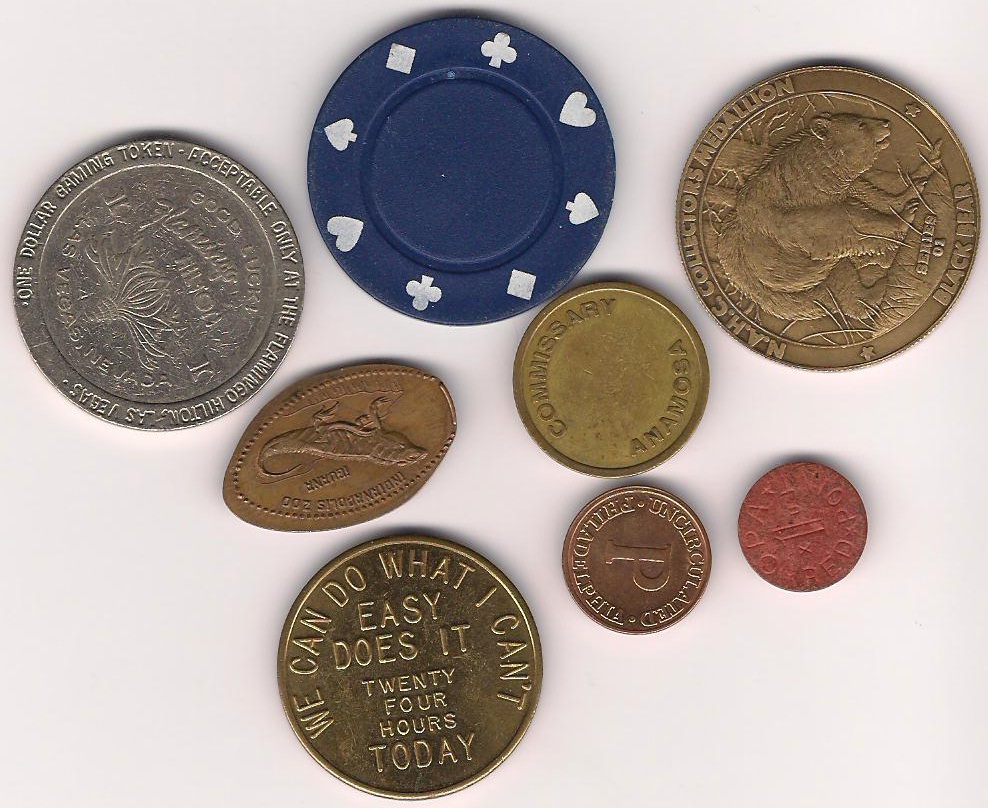
Assorted exonumia, including a poker chip and an elongated coin

Exonumia are numismatic items (such as tokens, medals, or scrip) other than coins and paper money. This includes "Good For" tokens, badges, counterstamped coins, elongated coins, encased coins, souvenir medallions, tags, wooden nickels and other similar items. It is an aspect of numismatics and many coin collectors are also exonumists.

Besides the above strict definition, others extend it to include non-coins which may or may not be legal tenders such as cheques, credit cards and similar paper. These can also be considered notaphily or scripophily.

Etymology

[edit]

The noun exonumia is derived from two classical roots: exo, meaning "out-of" in Greek, and nummus, meaning "coin" in Latin (from Greek νοῦμμος – noummos, "coin"); thus, "out[side]-of-[the category]coins".[1] The equivalent British term, paranumismatica, may also be used.[2]

The words exonumist and exonumia were coined in July 1960 by Russell Rulau,[3] a recognized authority and author on the subject, and accepted by Webster's dictionary in 1965.

Token coins

[edit]

Many tokens were produced and used as currency in the United States and elsewhere when there was a shortage of government-issued money. Tokens have been used for both to advertise and to facilitate commerce and may or may not have a value.

Token authority Russell Rulau offers a broad definition for exonumia in his 1040 page tome, UNITED STATES TOKENS: 1700–1900 [4] but lines between categories can be fuzzy. For example, an advertising token may also be considered a medal. Good For tokens may also advertise. Counter-stamped coins have been called "little billboards."

One way of parsing tokens is into these three general categories:

  • Has a "value," facilitating commerce, such as Good for (something).
  • Commemoration, remembrance, dedication, or the like, for some person, place, idea or event.
  • Of a personal nature.

Typically, catalogs of tokens are organized by location, time period, and/or type of item. Historically, the need for tokens grew out of the need for currency. In America, some tokens legally circulated alongside or instead of currency. Hard Times Tokens and Civil War tokens each were the size of the contemporary cent. Afterwards, value based items, such as Good for (amount of money), Good for One Quart of Milk, Good for One Beer, Good for One Ride… and others were specifically linked to commerce of the store or place of issue.

Medals

[edit]

Medals are coin-like artistic objects, typically with a commemorative purpose. They may be awarded for recognition of achievement or created for sale to commemorate individuals or events. They may be souvenirs, devotional, or purely artistic. Medals are generally not used as currency or for exchange.

Exonumia collecting

[edit]

Exonumia collectors, like coin collectors, are attentive to condition and rarity, as well as to history, form and type. Exonumists may collect items by region, topic, type, shape or material and this affects the ways tokens are documented.

The following categories are typical. This is not all-inclusive but is a sampling of the wide variety of exonumia.

By type

[edit]

Modified/augmented:

  • Love Token: A coin with hand engraving, on one or both sides, or deliberately bent. Some were made by convicts prior to deportation.[5] When bent, the coin indicated the taking of a vow.[6]
  • Carved Potty coins: usually United States Seated Liberty coinage carved to show lady Liberty sitting on a chamber pot.
  • Hobo nickels: Initially, hand-engraved Buffalo nickels mostly in the era 1913–38. Now, applied more generally to hand-engraved coins of different denominations.
  • Counterstamped/countermarked or chopped coins (done by merchants or governments)
  • Cut Coins: artistically carved creations made from genuine coins, both new and old, often for jewelry (e.g. trade-dollar locket).
  • Elongated coins: Rolled out with advertising, commemorative, or souvenir designs on one side
  • Encased Coin: Generally in a ring with advertising
  • Painted or enamelled coins[7]
  • Short snorter: paper money signed by people sharing a common experience
  • Coin slabs: rare or sample slabs[8]
A Smokey Bear Geocoin

Play money / fantasy / counterfeit / art

Government services & non-national tools to facilitate commerce

Transportation tokens

Closed community / membership

Obverse of a communion token from South Leith Parish Church

By material / shapes

Movements and ideals

Of a personal nature – personals

  • Dog license tags
  • Key tags (e.g. In case lost return to …)
  • Badges
    • Company
    • Occupation
  • Post office tags
  • Slave tags: see Slave codes
  • Watch fobs
A Great Western Railway pay cheque

By issuer

Medals

  • Politicians, inventors and other notables, e.g. George Washington
  • World's fairs or other expositions
  • City or state anniversaries
  • So-called dollars: medals and souvenirs similar in size to a silver dollar commemorating American historical events such as world's fairs, anniversary celebrations, dedications, battles, public works projects, etc.[11]

Modern items under the exonumia umbrella include:

By region

[edit]

China

[edit]

There are many types of Chinese exonumia, including alternative currencies:

and numismatic charms:

Germany

[edit]

Notgeld, primarily in the form of paper banknotes, was issued in Germany and Austria during World War I and the interwar period by towns, banks and other institutions due to a shortage of money.

Latin America

[edit]

Latin American coffee or plantation tokens were an important part of commerce.[12] Many plantation owners had their own commissaries and workers used plantation tokens to pay for provisions. Many tokens were made in the United States or Europe. Plantation tokens had an array of denominations and names. The name can be the owner, their relatives or the name of the farm (or finca). Tokens had allegorical symbols to identify the owner. Tokens were used as currency when there was not enough official currency available. Workers could convert the tokens to official currency on Saturdays.[citation needed]

Tokens were made in all types of base metals and alloys plus plastic, celluloid and bakelite. Unique to Costa Rica were tokens made of paper (paper chits). The word "boleto" is used in Costa Rica for the word token whereas "ficha" is used in the rest of Latin America.

United Kingdom

[edit]

Conder tokens were privately minted tokens from the later part of the 18th century and the early part of the 19th century in England, Anglesey and Wales, Scotland, and Ireland.

United States

[edit]
Copper trade token of Durfee & Peck, Indian traders on Missouri River in various locations, circa 1869

Rulau[4] breaks down American tokens into these general time periods:

See also

[edit]

References

[edit]

Further reading

[edit]
[edit]
Revisions and contributorsEdit on WikipediaRead on Wikipedia
from Grokipedia
Exonumia encompasses numismatic items distinct from official coins and paper currency, including tokens, medals, scrip, badges, and similar coin-like objects produced for practical, commemorative, or promotional purposes. The term, blending the Greek prefix "ex-" (out of) with "nomisma" (coin or money), was coined in 1960 by numismatist Russell Rulau to categorize these artifacts, which often circulated locally or served niche functions outside mints. Key examples span and store tokens for , transportation tokens for fares, casino chips, elongated and counterstamped coins, challenge coins, hobo nickels, and historical scrip like German from the era or Lesher Referendum Dollars minted around 1900. Collectors value exonumia for its reflection of regional economies, cultural events, and innovative responses to currency shortages, such as during gold rushes or wartime, offering accessible entry into with emphasis on rarity, condition, and narrative significance rather than intrinsic metal worth. This field highlights human adaptability in exchange systems, with items like communion tokens or scrip providing tangible links to pre-modern or industrial-era practices.

Definition and Scope

Core Definition

Exonumia encompasses numismatic items resembling coins but distinct from official government-issued coins and paper currency, including tokens, medals, badges, , elongated coins, and counterstamped coins. These objects, predominantly produced by private entities rather than state mints, lack status and function outside standard monetary circulation. Such items primarily serve non-currency purposes, such as enabling localized via "Good For" notations redeemable for goods or services, commemorating specific events or achievements, or acting as identifiers for membership in organizations or clubs. For instance, during the (1861–1865), merchants issued store tokens—often denominated in cents—to mitigate shortages of small-denomination federal currency, allowing customers to exchange them directly for merchandise at the issuing establishment. In contemporary contexts, exonumia includes casino chips used within gaming venues for betting, which circulate internally as substitutes for cash but hold no broader legal value. These examples illustrate exonumia's role in practical, situational exchanges or symbolic representation, underscoring its separation from sovereign monetary systems.

Distinction from Traditional Numismatics

Exonumia distinguishes itself from traditional numismatics by excluding items intended or used as circulating legal tender, such as government-issued coins and paper currency, which form the core of conventional numismatic study focused on monetary denominations, metallic composition, and economic circulation. Traditional numismatics emphasizes artifacts with face values redeemable in broader commerce, often struck by state mints for standardized exchange, whereas exonumia centers on privately produced objects lacking such official tender status, valued primarily for their historical, commemorative, or utilitarian significance outside formal economies. This boundary is verifiable through the absence of legal tender designation: for instance, a merchant-issued transportation token redeemable only for specific services contrasts with a minted penny, which holds nominal face value enforceable by law regardless of acceptance in private transactions. Causally, exonumia emerges from private sector responses to gaps in official currency supply, such as shortages prompting merchant scrip or tokens, fostering innovation unbound by governmental minting monopolies that constrain traditional coinage to regulated alloys and designs. In contrast, traditional numismatics prioritizes items tied to sovereign authority and intrinsic bullion worth, often analyzed for economic policy implications rather than ad hoc private adaptations.

Etymology and Terminology

Origin of the Term "Exonumia"

The term "exonumia" derives from the Greek prefix exo- (ἔξω), meaning "outside" or "out of," combined with either the Greek nomisma (νόμισμα), denoting "coin" or "currency," or the Latin nummus, similarly meaning "coin." This etymological construction literally translates to "outside of coins," emphasizing a categorical distinction from official, government-issued coinage intended as legal tender. Russell Rulau, a prominent and founding member of the Token and Medal Society, coined the term in July 1960 to encompass numismatic collectibles—such as tokens, , and —that fall outside traditional coins and but share material and thematic similarities. Prior to this, such items lacked a unified designation in scholarly or collector discourse, often being treated as peripheral anomalies within . Rulau's innovation addressed this gap by providing a precise label for artifacts differentiated primarily by their non-governmental issuance, utilitarian purpose, or commemorative intent rather than circulating monetary function. The adoption of "exonumia" gained traction within organizations like the and the Token and Medal Society during the mid-20th century, facilitating systematic cataloging and study of these overlooked objects. This terminology reflected a pragmatic reclassification driven by collectors' recognition that issuance authority and economic role—rather than mere resemblance to coins—determine an item's numismatic status. By the , it had become standard in numismatic literature, enabling clearer delineation from core coinage while acknowledging shared historical and material contexts.

Historical Development

Ancient and Pre-Modern Origins

In , lead tesserae functioned as non-monetary tokens for practical uses such as admission to theaters, gladiatorial contests, or commercial exchanges, often cast in lead or other base metals to distinguish them from official bronze coinage. Archaeological recoveries from sites across the empire, including thousands of examples in museum collections, indicate their widespread production from the Republican period onward, with designs featuring symbols, numerals, or inscriptions rather than denominational values. These artifacts, sometimes termed symbola in Greek contexts or adapted for voting and guild-like associations, addressed localized needs unmet by imperial mints, such as temporary access rights or informal validation. Byzantine precedents extended this tradition through lead seals and tesserae, employed for sealing documents, validating transactions, or military revaluation, as evidenced by excavations yielding items like fifth- to sixth-century examples with figural motifs. Countermarking on existing copper coins, particularly under Emperor (r. 610–641 CE), involved punching imperial monograms onto older issues in regions like and to affirm authenticity or adjust value amid shortages, a practice confirmed by stratified finds from sites such as Caesarea and . This modification technique, distinct from minting new denominations, pragmatically extended the utility of worn during economic pressures, including seventh-century sieges and episodes. In medieval , jetons emerged as reckoning counters from the mid-13th century, initially in and soon in , crafted in or to facilitate arithmetic on counting boards for merchants and bankers facing irregular supplies. English examples, datable to the fourth quarter of the 13th century, lacked value marks and served accounting roles, filling voids left by royal minting constraints during periods of scarcity. Lead and trade tokens proliferated from the early 14th century in and the , used for local , guild memberships, or small debts when silver coinage was hoarded or insufficient, as documented in hoards and contemporary records predating the 15th-century . These private emissions, often issued by traders or communities, thus compensated for systemic gaps in official currency circulation without pretense to legal tender status.

19th-Century Expansion

During the , exonumia proliferated as industrialization created acute shortages of small change, compelling private entities to issue tokens that facilitated commerce in rapidly expanding economies. In Britain, the forefront of the , employers and merchants produced unofficial copper tokens—often farthing-sized—to pay workers and enable retail transactions, compensating for gaps in official coinage supply amid surging urban populations and factory output. These private issues, struck by local die-sinkers, demonstrated how decentralized production outpaced sluggish government mints, providing immediate liquidity during economic strains like the post-Napoleonic Wars recovery. The U.S. Civil War (1861–1865) accelerated this trend dramatically. Banks suspended specie payments in December 1861, hoarding gold and silver amid wartime demands, which eliminated small coins from circulation and halted trade. Merchants responded by issuing store cards—brass tokens redeemable only at specific businesses—and patriotic tokens bearing pro-Union motifs, with approximately 12,000 varieties produced from late 1862 to mid-1864. Over 25 million such tokens circulated, underscoring private initiative's role in resolving crises faster than federal responses like the Legal Tender Act of 1862, which prioritized paper currency unsuitable for minor exchanges. In , similar dynamics emerged in and hubs, where tokens served as wage proxies or trade media. Welsh copper and slate operations, for instance, extended 18th-century precedents into the 19th by issuing , adapting to labor-intensive extraction booms that official mints could not swiftly accommodate. Technological advances, including steam-powered presses, further enabled of durable, intricate designs, linking exonumia's growth to causal pressures of rather than mere ornamental pursuits.

20th-Century and Contemporary Evolution

During and II, metal shortages and rationing systems spurred the issuance of and as substitutes for currency in controlled economies, including prisoner-of-war camps and domestic allocations. In the United States, the Office of Price Administration (OPA) introduced vulcanized fiber in 1944-1945 to facilitate change for ration stamps on meats, fats (red ), and canned goods (blue ), with ten equaling one stamp to manage wartime . Post-1945 economic recovery and the expansion of leisure travel fueled a surge in exonumia tied to and , particularly medals and elongated coins produced at attractions. Elongated coins, which involve flattening and imprinting circulating pennies with site-specific designs, gained popularity as affordable mementos at world's fairs, national parks, and emerging theme parks, building on their 19th-century origins but proliferating with post-war mobility. In the late , exonumia adapted to for and commemorative purposes, though trade tokens declined due to regulatory shifts favoring paper . By the 2020s, physical exonumia persisted amid digital alternatives like cryptocurrencies, with niche productions of private tokens during the reflecting localized needs, while crypto-themed physical replicas emerged as collectibles blending tangible and virtual appeal; traditional items, however, continued to dominate without evidence of displacement. indicate steady growth in related , valued at $10.74 billion globally in and projected to reach $23.87 billion by 2032 at a 10.5% CAGR, underscoring resilience in physical formats.

Types and Classifications

Tokens and Scrip

Tokens represent a major category of exonumia, consisting of metallic pieces issued by private entities as substitutes for small-denomination coinage, redeemable for specific goods or services rather than serving as general . These "Good For" items, often struck in or , facilitated in settings where official was scarce or inconvenient, such as saloons, stores, or gaming establishments. In the United States, saloon tokens emerged prominently from the mid- to late 19th century, with widespread use in Western states like and , where they were exchanged for drinks, meals, or merchandise at the issuing venue. Scrip, another key exonumia subtype, encompasses company-issued certificates or metallic tokens functioning as provisional , typically in isolated industrial settings, labor disputes, or wartime shortages, with redemption restricted to the issuer's facilities like company stores. Originating in earnest during the early , scrip—often paper notes but sometimes metallic—allowed operators to pay workers in a medium only usable locally, circumventing cash shortages while binding employees to company ecosystems. The exemplified this practice in the 1890s, compensating factory workers with scrip redeemable solely within its town, which exacerbated grievances over wages and dependency during the 1894 strike. Both tokens and derive their value from the issuing entity's promise of redemption, independent of intrinsic content, distinguishing them from bullion-based coinage and rendering them obsolete upon issuer default or policy change. Historical verification relies on period catalogs and merchant records, which catalog denominations from fractions of a cent to dollars, reflecting localized economic necessities rather than standardized minting.

Medals and Commemoratives

Medals and commemoratives constitute a major category within exonumia, comprising struck or cast objects designed primarily for recognition, memorialization, or promotional purposes rather than monetary exchange. These items honor specific achievements, historical events, expositions, or affiliations with fraternal orders and societies, lacking status and circulating value. Unlike , they emphasize artistic design, symbolic imagery, and prestige, often featuring intricate reliefs depicting portraits, allegorical figures, or architectural motifs. Production of medals typically involves die-struck methods akin to coinage but adapted for lower volumes and higher detail, using hubs to create dies that imprint designs on planchets of varying compositions, from base metals like or to precious metals such as silver or . Engraving techniques may supplement striking for personalized or limited editions, enabling finer customization without the mass-production constraints of circulating age. Materials selection reflects intended durability and status: base metals for widespread distribution at events, while higher-grade alloys denote exclusivity for recipients. This contrasts with coin dies optimized for high-speed minting, as medals prioritize aesthetic and evidentiary permanence over wear resistance in commerce. Exposition medals exemplify commemorative intent, as seen in the numerous pieces issued for the 1893 in , including official U.S. Mint-produced brass medals measuring approximately 37 mm in diameter, depicting and exposition buildings to promote the event's 400th-anniversary theme. These served propagandistic roles, boosting public engagement and national pride without any exchange function. Similarly, military medals recognize valor or service, such as campaign awards from conflicts, functioning solely as honors rather than redeemable tokens, thereby preserving historical causality in non-economic recognition. Fraternal order medals, struck for groups like the Masons or , further illustrate prestige-oriented exonumia, often incorporating emblems of membership to foster loyalty and commemoration absent from transactional systems.

Badges, Pins, and Elongated Coins

Badges and pins constitute a category of exonumia characterized by small, wearable decorative items designed to signify membership in fraternal organizations, attendance at conventions, or affiliation with lodges, often incorporating symbolic emblems for identification and status. These items, prevalent in groups like , emerged prominently in the as organizations expanded, with production involving stamping or of metals such as gold, silver, or base alloys to enable affordable replication for members. Masonic pins, for instance, frequently depict tools like the square and compass, serving as overt signals of brotherhood despite the secretive nature of rituals. Elongated coins, a form of modified exonumia, are produced by inserting a standard —typically a low-denomination piece like a U.S. —into a mechanical rolling device that flattens and stretches it while embossing a custom on one or both sides, transforming it into a personalized . This process originated in the United States at the 1893 in , where six rolling machines produced the first such items, featuring exposition motifs and preserving the original coin's obverse orientation in most cases. The technique, utilizing engraved steel rollers to apply pressure and imprint designs, facilitated low-cost of commemorative pieces at events, with visitors paying a small —often five cents—for the service using pre-1893 Indian Head cents or similar. Subsequent popularity surged at U.S. expositions and tourist attractions through the , driven by the simplicity of the rolling mill method, which required minimal material beyond the host coin and allowed rapid customization with site-specific imagery like landmarks or events. Collector interest, documented in numismatic records, underscores their role as accessible exonumia, with production volumes enabling widespread distribution without high overhead, as evidenced by ongoing issuance at over 1,000 machines in locations like national parks by the .

Counterstamped and Modified Items

Counterstamping refers to the practice of applying a secondary punch mark or stamp to an existing , typically to authenticate its weight, quality, or acceptability as in a specific locale or by a particular . This modification, distinct from due to its overt intent to validate rather than deceive, was widespread in eras of scarce local minting, where foreign coins like Spanish silver dollars circulated globally. Merchants or authorities used counterstamps to endorse coins for local trade, blending numismatic utility with rudimentary advertising or political messaging. In 18th- and 19th-century , Spanish 8 reales (pillar or bust dollars) were commonly counterstamped, particularly in , where merchants applied irregular "chop marks"—often indicating verification of silver content—to facilitate trade in regions lacking standardized coinage. These marks, sometimes multiple and overlapping, reflected pragmatic adaptation of imported rather than official recoinage, with examples from the onward showing repeated stamps on Mexican-minted pieces arriving via galleons. Similar practices occurred in and the Pacific, such as counterstamps on Spanish dollars in under Spanish colonial rule, transforming foreign specie into de facto local tender. Beyond authentication, counterstamps served promotional ends; 19th-century U.S. coins, for instance, bore names or product endorsements, like those on eagles used in the and early America. In politically turbulent contexts, such as Mexico's War of Independence (1810–1821), insurgent forces applied counterstamps like "NORTE" to royalist coins from mints like Chihuahua, repurposing them for rebel circulation without altering intrinsic value. Modified items in exonumia encompass hand-engraved or carved alterations to coins for personal, artistic, or sentimental purposes, often rendering them non-circulable but collectible. Love tokens, typically silver U.S. dimes or quarters from the Seated Liberty series (1837–1891), involved smoothing one or both faces and inscribing initials, dates, or motifs, peaking during the (1837–1901) among sailors, soldiers, and immigrants as portable expressions of affection. Originating from medieval British customs of bending coins for luck or vows, these modifications—numbering thousands in surviving examples—prioritized emotional utility over monetary, with engravings verifiable as contemporary via style and tool marks. Hobo nickels, emerging around 1913 with the U.S. Buffalo nickel design, represent folk art modifications where itinerant engravers carved the Indian head profile into whimsical figures like hobos or animals using files and knives, producing an estimated 5,000 to 10,000 pieces during the era. These carvings, executed on low-denomination coins for accessibility, exemplify resourceful reuse amid economic hardship, distinguished from counterfeits by their artistic intent and lack of deceptive valuation. Authentication relies on examining cut depths and consistency, as modern reproductions dilute scarcity. Such alterations underscore exonumia's emphasis on human adaptation of currency, verifiable through metallurgical analysis and historical rather than institutional endorsement.

Collecting and Study

Approaches to Collecting

Collectors approach exonumia acquisition by selecting strategies aligned with personal interests and available resources, such as assembling thematic groups centered on functional or historical motifs or pursuing varieties within defined parameters where documentation permits completeness, given the field's inherent diversity that precludes universal sets. Condition plays a causal role in desirability, with third-party services like NGC and PCGS employing a numerical scale from 1 to 70 to quantify wear, strike quality, and surface preservation, adapting standards originally developed for circulating coins to assess medals and tokens empirically. Primary acquisition channels include specialized auctions, such as those hosted by Stack's Bowers Galleries, which offer verified lots with details drawn from prior sales records, alongside purchases at numismatic conventions and from vetted dealers to mitigate risks of altered or spurious items. Online databases like TokenCatalog.com facilitate identification and rarity assessment by aggregating issuer data and known specimens, enabling collectors to prioritize scarcer pieces over common ones based on population counts rather than anecdotal appeal. Valuation stems from objective factors including rarity indices in catalogs, documented condition grades, and historical demand evidenced by realized prices at , where —such as chain of ownership from notable collections—can elevate worth by confirming authenticity and reducing uncertainty, independent of emotional narratives. Membership in bodies like the Token and Medal Society provides access to peer-reviewed journals and reference works that refine cataloging methods, fostering systematic organization through standardized attributions over subjective curation.

Collecting by Type

Collectors specialize in exonumia by type, narrowing focus within categories such as tokens, medals, badges, pins, elongated coins, and counterstamped items to pursue subtypes defined by historical context, issuance purpose, or artistic attributes. This approach allows for deeper study of , economic functions, or commemorative narratives, often guided by catalogs from organizations like the , which promotes research into these distinctions. In token collecting, subtypes tied to specific eras offer historical insight into economic disruptions or social movements. Civil War tokens, struck primarily between 1861 and 1864 amid U.S. shortages, include over 10,000 varieties of storecards issued by merchants for small transactions and patriotic designs promoting Union causes, reflecting wartime commerce and propaganda. These one-cent equivalents, often made of , are cataloged in the landmark 1924 Hetrich-Guttag reference, which remains foundational for attributing varieties by die and issuer. Medal collecting emphasizes series organized by event, issuer, or artist, capturing institutional or cultural milestones outside official coinage. Commemorative medals for the , for instance, include participation medals awarded to athletes since the 1908 London Games, featuring event-specific designs struck in base metals or silver to symbolize achievement and host symbolism, with complete sets spanning over a century now pursued by specialists using resources like dedicated catalogs. Cross-type thematic collecting unites items across categories around motifs like or transportation, where tokens, , and modified coins promote or services, as seen in merchant-issued pieces from the 19th and early 20th centuries documented in TAMS journals for their role in local economies. Such sets prioritize verifiable attributions from period records over rarity alone, enabling analysis of commercial history through subtypes like wooden nickels or elongated coins stamped with brand logos.

Collecting by Geographic Region

Collectors frequently specialize in exonumia from specific geographic regions due to variations in local production driven by economic necessities, historical events, and cultural practices, which create distinct catalogs and scarcity patterns. , frontier-era tokens such as Alaskan "bingles"—small, often or aluminum pieces used in remote trading posts during the late 19th and early 20th centuries—exemplify regional diversity, with their scarcity tied to isolated and commercial outposts. These items command premiums among collectors due to limited survival rates and localized issuance, as seen in state-specific tokens where rarity within a single can elevate values significantly compared to more common national varieties. In , from the period of the early represents a peak of regional exonumia production, with thousands of municipalities issuing emergency and tokens amid currency collapse; for instance, over 4,000 entities produced such items in 1922-1923 to facilitate local trade when notes became worthless. Collectors prize these for their intricate designs, often featuring local landmarks, and their historical tie to economic turmoil, with sets from specific towns fetching higher prices due to issuance limits and preservation challenges. In the , transport and pub tokens dominate regional interests, including brass pieces from public houses issued between 1845 and 1914 for denominations like 1½d to 3d, redeemable for drinks or services in specific locales. China's exonumia tradition traces to ancient seals originating around 544 BC, used for authentication and evolving into private and imperial markers that parallel token-like functions, though modern equivalents akin to emerged during 20th-century disruptions. Latin American regions feature revolutionary medals, such as those commemorating Argentine independence in 1910, often struck in to mark centennials or uprisings, appealing to collectors for their ties to political upheavals like the Mayo Revolution of 1810. Regional scarcity universally inflates premiums, as isolated production—exemplified by rare U.S. state tokens or German municipal —limits supply relative to demand from area-focused enthusiasts. Globalization has expanded access through online platforms, enabling cross-regional trade; for example, facilitates sales of world exonumia, connecting collectors with items from diverse locales previously confined to local markets. This trend, accelerating since the , mitigates some scarcity effects but heightens competition for verified rarities, with reputable numismatic auctions verifying authenticity amid rising international interest.

Organizations, Publications, and Resources

The , founded in 1960, operates as a nonprofit educational organization focused on tokens, medals, badges, and related exonumia, promoting research and collecting through membership resources and annual events. Its official bimonthly publication, the TAMS Journal, debuted in April 1961 and features scholarly articles on exonumia history, attributions, and discoveries. The American Vecturist Association (AVA), established on October 31, 1948, serves collectors of transportation tokens, parking tokens, and similar vecturist items, maintaining a membership network across the , , and internationally while issuing periodic newsletters and convention tokens. The (ANA) supports exonumia study via dedicated archives, video resources on medals and tokens, and integration into broader numismatic education programs. Key reference publications include "Tokens and Medals: A Guide to the Identification and Values of Exonumia" by Stephen P. Alpert, which catalogs and values domestic tokens and medals. also distributes specialized books on topics such as regional tokens and medal symbolism, available through its sales program. Online resources encompass TokenCatalog.com, a database enabling searches of token records by location, issuer, and type to verify historical usage. Numista maintains a collaborative exonumia catalogue for global items, facilitating community-driven attributions and photographs. The Newman Numismatic Portal provides digitized access to exonumia periodicals and auction records for cross-referencing.

Valuation, Authentication, and Challenges

Factors Influencing Value

The value of exonumia derives primarily from supply-demand dynamics, where limited availability intersects with collector preferences, often yielding prices far exceeding production costs. Rarity, gauged by production quantities or surviving populations, stands as a core determinant; for example, varieties with fewer than a dozen known examples routinely fetch thousands at auction due to their scarcity. Historical significance further amplifies this, as items tied to major events—such as 1863 Civil War patriotic tokens, which circulated amid wartime coin shortages—command premiums reflecting their documentary role in economic history, with uncirculated specimens selling for $100 to $300 or more depending on variety. Condition profoundly impacts worth, with professional grading services applying numismatic standards like the Sheldon scale to exonumia; an MS-65 designation, indicating gem uncirculated quality with full luster and only minor contact marks, can elevate a token's value exponentially over lower grades such as VF or AU, often by 5-10 times or greater based on comparable auction outcomes. Minting quality, encompassing strike sharpness and surface preservation, integrates into these assessments, as superior original execution preserves higher grades and appeals to discerning buyers. Material composition provides a baseline intrinsic value layer; silver or gold exonumia incorporate melt value—currently around $25-30 per troy ounce for as of late 2025—plus collectible premiums, whereas variants like or rely entirely on rarity and condition for pricing, typically trading at lower absolute levels absent precious content. Auction realizations underscore these factors' interplay, with rare, high-grade exonumia demonstrating sustained price growth; for instance, Civil War tokens have appreciated steadily, with select varieties doubling in value over the past decade per graded .

Authentication Methods and Counterfeits

Authentication of exonumia relies on a combination of visual, physical, and scientific examinations to verify genuineness, as these items often lack standardized minting hallmarks found in official coinage. Die variety studies form a core method, involving detailed comparison of designs against reference catalogs to identify matching dies, which helps confirm production details and detect alterations or modern fabrications. Physical measurements, such as precise weighing and caliper assessments of diameter and thickness, reveal discrepancies from known originals, as authentic struck pieces exhibit consistent specifications derived from historical records. Scientific techniques, including non-destructive metallurgical analysis via (XRF), assess alloy composition to match period-specific , distinguishing genuine items from those using modern base metals or incorrect ratios. Surface examination under magnification detects casting flaws like , soapy textures, or absent flow lines typical of struck exonumia, versus the uniform seams or soft details in fakes. Historical matching cross-references inscriptions, issuer details, and event contexts with archival sources, ensuring alignment with documented emissions. Counterfeits proliferate in high-demand exonumia, particularly rare 19th-century like store cards or transportation issues, where recast copies from melted originals mimic designs but fail under scrutiny due to weight variances—often lighter from inferior metals—and inferior strike quality lacking sharp details. Contemporary forgeries, such as cast replicas of evasion tokens, exhibit of molding like raised rims or edge seams, debunked by multi-method verification including die linkage to authenticated specimens. Detection emphasizes empirical cross-checks, as single-source attributions risk overvaluation; organizations like the Token and Medal Society advocate rigorous catalog consultation and expert consultation to mitigate in chains.

Preservation and Market Dynamics

Exonumia items, primarily composed of metals such as , , silver, or base alloys, are susceptible to and from exposure to atmospheric compounds and moisture, necessitating storage in environments to inhibit oxidative degradation. Collectors employ acid-free, PVC-free holders or envelopes for individual encapsulation, ensuring low- conditions below 50% relative humidity to minimize formation on -based tokens and medals. Direct and fluctuating temperatures accelerate breakdown, so placement in dark, stable cabinets or safes at 15-20°C (59-68°F) is recommended to preserve original mint luster and fine details. Harsh cleaning agents, including or abrasive polishes, are avoided as they strip toning layers and introduce micro-abrasions, irreversibly diminishing aesthetic and numismatic value; instead, passive methods like rinses for gross dirt are sparingly used under expert guidance. Environmental challenges, such as urban causing chloride-induced pitting on silver exonumia, compound natural aging, with studies indicating up to 20-30% surface loss over decades in uncontrolled settings. Theft risks escalate for rare pieces valued over $1,000, with numismatic thefts comprising 10-15% of reported collectibles crimes annually, prompting mitigation via secure vaults and comprehensive policies tailored for portable valuables. The exonumia market operates as a steady niche segment of numismatics, with annual global sales volumes estimated at $50-100 million, driven by scarcity rather than speculative booms, though values for exceptional items like Civil War-era tokens have appreciated 5-10% yearly since 2010 due to historical demand. Economic downturns, such as the 2008 recession and 2020 pandemic, correlate with 15-25% upticks in trading activity as investors favor tangible, non-correlated assets embodying cultural history over volatile equities. The 2020s have seen accelerated online sales growth, with platforms like Heritage Auctions reporting a 40% rise in digital exonumia consignments by 2023, enabled by remote grading submissions that standardize condition assessments and enhance liquidity. Professional grading by services such as ANACS, which authenticates exonumia since 1972, bolsters market confidence by encapsulating items in tamper-evident slabs, reducing resale friction and mitigating disputes over wear-induced value erosion.

References

Add your contribution
Related Hubs
User Avatar
No comments yet.