Hubbry Logo
Police busPolice busMain
Open search
Police bus
Community hub
Police bus
logo
8 pages, 0 posts
0 subscribers
Be the first to start a discussion here.
Police bus
Police bus
from Wikipedia

New York City Police Department Bus
A Sunsundegui Sideral police bus used by Police Scotland in Thurso, UK.

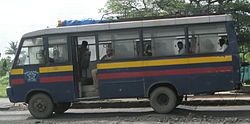
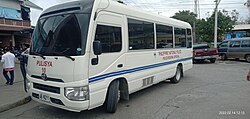
A police bus, also known as a police van is a minibus, full-sized bus or coach used by police forces for a variety of reasons.

Depending on the use, police buses might have markings or a livery indicating its ownership by the police, and also have appropriate equipment fitted. Police buses can be ordinary buses with minor or no modification, have some degree of protection for riot duties, or be fully fitted armoured buses.

Seated buses are used by police forces for transporting large numbers of officers to a needed area, such as for crowd control at sports events and demonstrations, or to facilitate large scale deployments for more serious riot control, such as the UK miners' strike (1984–1985). These may be hired vehicles, or vehicles retained by the police force for the purpose.

Police buses are also used at some large events as static temporary holding and processing areas, where detained people can be processed, and held until onward transport in another vehicle is possible. Police buses may also serve as prisoner transport vehicles where the police force has responsibility for this. One example of this type of bus is the MCI D4000ISTV.

The police may also use buses converted by a bus manufacturer or other specialist company (from a new or retired school bus-style body), to serve more specific purposes. This can be as an incident control room or mobile command post, or even as small mobile police stations for public events. The Toronto Police Service, for instance, has used retired transit buses for their fleet.[1]

Other roles for converted police buses can include being used in public information or awareness campaigns, or as mobile recruitment displays.

[edit]

See also

[edit]

References

[edit]
[edit]
Revisions and contributorsEdit on WikipediaRead on Wikipedia
from Grokipedia
A police bus is a bus-type used enforcement agencies to transport police officers, prisoners, or other personnel in connection with operational functions such as patrols, arrests, or public order . These vehicles, which can range from adapted commercial buses to specialized models, provide high-capacity mobility critical for deploying large numbers of personnel efficiently during mass events, suppression, or detainee handling, often featuring modifications like secure seating, signaling, and reinforced construction for durability in demanding conditions. Police buses are employed globally by various forces, including municipal departments and national gendarmeries, underscoring their role in scaling responses beyond the limitations of individual patrol cars.

Definition and Types

Definition

A police bus is a , typically a , full-sized bus, or coach, adapted or dedicated for use by law enforcement agencies to transport multiple police officers and equipment to operational areas. These vehicles enable rapid deployment of personnel in numbers exceeding what standard patrol cars can accommodate, often carrying 16 or more passengers including the driver. In the United States, such buses qualify for exemptions from requirements when used specifically for transporting police personnel. Police buses are commonly deployed for public order operations, including at sports events, demonstrations, and potential situations, where large-scale officer presence is required. Local procedures, such as those from the Baton Rouge Police Department, regulate their use, requiring authorization from senior command for deployment. They may feature modifications like reinforced structures for enhanced durability during tense scenarios, though standard variants prioritize over armor. In addition to officer transport, police buses can serve secondary roles, such as conveying detainees during mass arrests, as documented in legal proceedings involving responses. This versatility supports 's need for flexible mobility solutions in dynamic environments.

Standard Variants

Standard variants of police buses primarily comprise commercial minibuses, coaches, or transit buses with minimal adaptations for , lacking the reinforced , ballistic plating, or specialized riot-control features found in armored models. These vehicles are typically sourced from standard production lines and modified only with external police , lighting bars, sirens, and basic internal fittings such as secure storage for personal equipment, radios, and non-lethal gear. The design prioritizes high passenger capacity, , and road legality over defensive capabilities, making them suitable for non-confrontational duties like shuttling officers between stations, deploying to planned events, or supporting extended patrols. A notable example is the repurposing of retired commercial coaches by major departments; the New York Police Department operated a 2002 MCI D4500 intercity coach (unit 9829), originally from the Metropolitan Transportation Authority's fleet, for officer transport until its retirement. Similar practices occur elsewhere, where surplus transit vehicles are acquired at reduced cost to provide economical mass transit for personnel without necessitating custom builds. These buses generally seat 30 to 50 officers, depending on the base model, allowing rapid mobilization while adhering to standard commercial vehicle maintenance protocols.

Armored and Specialized Variants

Armored variants of police buses feature ballistic protection levels such as CEN B6 or equivalent NIJ standards, including plating on the body, bullet-resistant glass, and systems to enable operation in hostile environments like riots or ambushes. These modifications, often applied to commercial chassis from manufacturers like or Fuso, allow for secure transport of up to 30-50 officers while withstanding fire and fragmentation. Such enhancements prioritize occupant safety over civilian comfort, with interior configurations emphasizing modular seating for gear storage and rapid deployment. Specialized armored police buses extend beyond basic protection to include riot control adaptations, such as reinforced bumpers for use as mobile barricades or integration with non-lethal dispersal tools. For instance, Mitsubishi Fuso Canter-based armored buses have been deployed by law enforcement agencies for crowd management, providing both personnel transport and tactical support in urban unrest scenarios. In high-threat regions, these variants incorporate underbody blast protection against improvised explosive devices, reflecting adaptations driven by empirical needs in asymmetric conflicts rather than standardized procurement. Manufacturers like International Armored Group offer customizable options, such as the Armadillo series, tailored for police operations in unstable areas, with capacities supporting squad-level responses. These variants differ from standard police buses by emphasizing durability over efficiency, often at the cost of higher fuel consumption and reduced maneuverability due to added weight exceeding 20 tons in fully up-armored configurations. Deployment examples include support for teams in incidents or escort duties in protest zones, where protection levels have proven effective in real-world ballistic testing.

History

Origins and Early Adoption

The transition to mechanized police transport began in the late , with the first known motorized police vehicle—an electric-powered patrol wagon—deployed by the , police department in 1899 for responding to calls and transporting prisoners. This innovation addressed limitations of foot and horse patrols, enabling faster response times and secure detainee conveyance over distances up to 30 miles at speeds of 16 mph before recharging. Prior to motorization, police relied on horse-drawn wagons, such as the "Black Maria" introduced in U.S. cities like in the 1880s, which served as precursors to larger transport formats by accommodating multiple detainees in caged compartments. Early adoption of bus-scale vehicles followed the commercialization of motorized buses around 1905, as police forces sought capacity for mass mobilizations amid , labor strikes, and rising needs. By 1904, motorized wagons had proliferated in larger U.S. cities, evolving into bigger configurations for group transport, though dedicated full-sized police buses emerged primarily in the to handle surges in arrests during Prohibition-era enforcement and industrial unrest. Departments in growing metropolises like integrated modified commercial buses for prisoner shuttles, reflecting practical adaptations to handle dozens of detainees at once rather than relying on smaller vans. In , parallel developments occurred with the in shifting to motorized s by 1920 for and crowd dispersal, incorporating larger omnibus-derived units for officer deployment during public order events. This era's emphasis on efficiency—driven by causal factors like and reliability—prioritized buses over fragmented fleets, establishing them as standard for scalable operations despite initial costs and challenges.

20th Century Developments

The transition to motorized vehicles revolutionized police transportation in the early , with the first motorized patrol wagons appearing in major U.S. cities in to supplant horse-drawn equivalents for prisoner and detainee conveyance. These early models, typically adapted from commercial truck chassis, offered increased capacity for multiple occupants, enhanced speed over urban terrain, and improved security through enclosed designs that minimized escape risks and protected against public interference. By the mid-20th century, as urban populations expanded and civil disturbances escalated—such as during the 1960s U.S. race riots—police agencies adapted larger commercial buses for rapid mobilization of officer contingents to hotspots of unrest. This shift addressed limitations of sedans and vans, enabling the simultaneous transport of dozens of personnel along with equipment like helmets and batons, thereby improving response times to events requiring crowd management or mass arrests. In contexts like labor strikes and sports gatherings, such buses facilitated coordinated deployments, reflecting causal adaptations to the scale of modern policing challenges rather than mere technological novelty. Late-century refinements included reinforced and partitioned interiors in some jurisdictions to dual-purpose buses for detainee shuttles during large-scale operations, though primary emphasis remained on officer transport amid rising incidences of organized protests. These developments prioritized empirical efficiency in over prior ad-hoc reliance on requisitioned civilian vehicles, with utility trucks and vans serving as interim bridges to full bus integration by the era.

Post-2000 Evolutions and Riot Control Applications

Post-2000 developments in police buses for riot control emphasized rapid deployment and urban maneuverability in response to frequent civil disturbances, such as the 2005 French riots that necessitated large-scale mobilization of anti-riot units across multiple cities. These events highlighted the need for efficient transport of equipped personnel, leading to specialized designs beyond standard commercial conversions. In 2017, VDL Bus & Coach delivered the first dedicated crowd and riot control buses to the Dutch National Police, utilizing the Mercedes-Benz Sprinter chassis for compactness and agility in navigating congested areas during unrest. Modern police buses incorporate features like reinforced panels to resist projectiles, compartmentalized interiors for secure officer transport with protective gear, and onboard storage for crowd management tools such as barriers and communication devices. These adaptations support the transportation of 20 to 50 officers per , enabling coordinated responses to contain or disperse crowds effectively. In operational use, such buses function as mobile staging points, allowing squads to disembark swiftly and form defensive lines, as demonstrated in European deployments where quick reinforcement prevented escalation in urban hotspots. Applications in post-2000 riot scenarios have included high-profile responses like the 2023 French unrest, where extensive police convoys, including transport buses, were deployed to over 1,300 arrest sites amid widespread vehicle damage and arson. Similarly, in the UK, updated protected personnel carriers—often bus-like in capacity—have been converted for duties to meet enhanced safety standards, reflecting a broader trend toward vehicles that balance speed, capacity, and resilience against improvised threats like Molotov cocktails observed in prior disturbances. This evolution prioritizes causal effectiveness in restoring order by minimizing response times and maximizing on-scene personnel availability, though effectiveness varies with tactical doctrine and threat intensity.

Design and Technical Features

Chassis and Body Modifications

Police buses are predominantly derived from commercial bus chassis, such as those produced by manufacturers like , , or VDL, which provide a robust foundation capable of supporting extensive modifications for applications. These chassis are often reinforced with additional steel framing or upgraded suspension components to handle increased loads from armored panels, internal barriers, and equipment storage, ensuring structural integrity during high-stress operations like rapid acceleration or collision impacts. For instance, in configurations, the chassis may incorporate heavier-duty axles and braking systems to maintain stability when carrying up to 40 equipped officers. Body modifications focus on transforming the standard passenger layout into a functional or deployment , including the addition of secure cells with bolted partitions and mesh to prevent tampering or escape attempts. Exterior alterations commonly feature reinforced side panels for ballistic resistance, multiple hinged or for swift officer egress—such as extra-wide side doors measuring up to 1.5 meters—to facilitate deployments, and specialized glazing like polycarbonate-laminated windows resistant to shattering. Internal bodywork may include fire-retardant coatings and anti-slip to enhance in dynamic environments. These changes are typically performed by specialized upfitters or original equipment manufacturers, balancing operational needs with compliance to standards.

Security and Protection Elements

Secure compartments and reinforced interiors form the core of protection in police buses designed for detainee , featuring heavy-gauge caging to compartmentalize occupants and prevent internal disturbances or escapes. These modifications often include 9-gauge security partitions that separate prisoners from transport officers, with integrated restraint systems such as belly chains, , and leg irons anchored to fixed points within cells. Ballistic-resistant elements, where specified, encompass windows rated to standards like UL 752 Level 3 or NIJ 0108.01, capable of stopping and rounds, alongside armored door panels and underbody shielding against improvised explosives. Heavy-duty reinforcements, such as upgraded suspension and inserts, enhance mobility under threat, while multiple keyed or electronic locks on entry doors and cell gates ensure controlled access. Surveillance and monitoring systems integrate cameras covering interior and exterior views, often linked to onboard recorders and remote dispatch for real-time oversight, supplemented by panic buttons and for officers. features include roof hatches for evacuation, , and climate controls to maintain habitability during prolonged securement. In riot control variants, such as those used by units like France's CRS, additional exterior protections like anti-projectile mesh or impact-resistant panels guard against thrown objects, though full ballistic armoring remains less common than in dedicated tactical vehicles.

Operational Equipment and Capacity

Police buses in prisoner transport roles typically accommodate 10 to 40 detainees, depending on chassis size, security level, and compartmentalization needs, with heavy-duty models supporting over 40 passengers through reinforced bench seating and partitioned areas. Standard equipment includes tamper-resistant seating with integrated restraint systems, such as seatbelt anchors and anti-pick fasteners, alongside separate compartments for segregating high-risk, juvenile, or grouped inmates to minimize escape risks and internal conflicts. Surveillance is enhanced via onboard cameras with real-time monitoring and secure recording capabilities, while HVAC systems provide climate control and controlled lighting ensures visibility without discomfort during extended hauls. For mobilization, particularly in variants, seating capacities range from 9 to 12 personnel equipped with full protective gear, though larger coach-style buses can exceed 30 occupants by utilizing longitudinal benches and overhead storage for helmets, shields, and batons. Internal features prioritize rapid deployment, including quick-access compartments for non-lethal munitions, communication consoles with radios and PA systems for coordination, and reinforced partitions to separate command areas from troop sections. Security elements like guards over windows and deadbolt-locked cages extend to these models when dual-use for detainee overflow, with capacities adjustable via modular seating to balance personnel transport and equipment stowage. Capacities and equipment vary by jurisdiction and manufacturer; for instance, U.S.-spec buses emphasize ADA-compliant lifts and restraints for legal compliance, while European riot buses integrate ballistic-resistant interiors without compromising mobility for 20+ officers. All configurations mandate front and rear units, fire suppression readiness, and officer-safe seating with minimal reach-across designs to reduce handling risks.

Primary Uses

Prisoner and Detainee Transport

Police buses facilitate the secure and efficient transport of multiple and detainees, enabling to relocate groups from scenes, temporary holding facilities, or courtrooms to jails, prisons, or medical centers without requiring numerous smaller vehicles. These vehicles handle larger capacities—often 24 to 34 passengers in customized models—compared to standard paddy wagons, which typically accommodate 6 to 12 individuals, making buses suitable for high-volume operations such as mass arrests or inter-facility transfers. Design modifications prioritize and safety, including segregated compartments to isolate high-security from low-security detainees, males from females, or adults from juveniles, reducing opportunities for conflict or exchange. Essential features encompass reinforced seating with integrated seatbelt restraints, tamper-resistant door locks, wire mesh or bars over windows to prevent visibility and escape attempts, and forward-facing guard stations equipped with desks, storage, and monitors. Some models incorporate and climate control systems to address ventilation needs during extended journeys, as inadequate airflow has been linked to detainee incidents in prior transports. In the United States, the U.S. Marshals Service employs buses within its Justice Prisoner and Alien Transportation System (JPATS), which coordinates roughly 265,000 prisoner movements annually using a combination of ground vehicles. Local examples include Montgomery County's fleet of 24- and 34-passenger buses for routine inmate shuttles to courts and hospitals, operated by deputies trained in secure convoy protocols. Private firms supplement public resources; for instance, Prisoner Transport Services, an employee-owned company, manages approximately 30,000 inmate transports per year across more than 1,200 agencies, emphasizing purpose-built buses with redundant security redundancies. U.S. Immigration and Customs Enforcement (ICE) mandates certified driver training for bus operations carrying detainees, including pre-transport medical checks and restraint protocols like double-locking with arms secured behind the back. Operational guidelines stress constant supervision to avert escapes or assaults, with prisoners maintained at a physical from each other and under direct oversight. While effective for scalability, these transports have faced scrutiny over injury risks from rough roads or restraint failures, prompting federal standards for vehicle maintenance and emergency response capabilities. Data from agency reports indicate that proper partitioning and monitoring significantly lower incident rates compared to ad-hoc vehicle use.

Officer Mobilization and Deployment

Police buses serve a critical role in the mobilization and deployment of officers by enabling the transport of large groups to operational sites efficiently, surpassing the capacity limitations of standard . This capability is essential for scenarios requiring mass deployment, such as maintaining public order at major events, protests, or emergencies, where rapid assembly of personnel is necessary to establish control or respond to escalating situations. In practice, these vehicles facilitate coordinated movement of specialized units, allowing departments to position dozens of officers simultaneously without reliance on multiple smaller transports, thereby reducing response times and logistical complexity. For example, the Raleigh Police Department maintains a designated police bus explicitly for conveying officers and support personnel to functions, with policy prohibiting its use for prisoner transport to ensure operational separation. Internationally, extensive fleets underscore this function; South Korea's national police operate around 802 buses primarily supporting units' deployment during civil disturbances, highlighting their scalability for high-volume officer movements. Similarly, units like France's utilize adapted buses to deploy mobile intervention teams to hotspots, integrating transport with tactical readiness for crowd management operations.

Riot Control and Crowd Management

Police buses play a critical role in by enabling the rapid transport and deployment of specialized units to sites of , allowing authorities to concentrate force efficiently where disturbances occur. These vehicles accommodate dozens of equipped officers, including those in full anti-riot gear, facilitating surge responses that outpace individual vehicles. For example, in 1977, the maintained a dedicated bus operational 24 hours a day, carrying 40 officers plus a driver and , with onboard storage for riot equipment to ensure immediate readiness. Specialized riot control buses incorporate reinforcements for durability during confrontations, such as protected windows and compartments for less-lethal munitions, enhancing officer safety while maintaining mobility. In February 2017, delivered the first such purpose-built vehicles to Dutch dealerships for police use, optimized for crowd management scenarios including containment and dispersal operations. During the 2020 unrest in following the incident, buses supplied by the proved essential in establishing an effective mass transportation system, addressing logistical bottlenecks that had previously hampered police efforts. Beyond initial deployment, police buses support sustained crowd management by functioning as temporary holding facilities for detainees, freeing field officers from escort duties and preserving operational tempo. Peace Officer Standards and Training guidelines emphasize employing transport vehicles to economize personnel, recommending contingency plans for alternative conveyance if primary assets are compromised. In historical contexts, such as Singapore's anti-riot operations, dedicated buses like the "Ang Chia" models were instrumental in mobilizing response teams amid urban disturbances. This approach underscores the causal link between vehicular capacity and the ability to scale responses proportionally to threat levels, though effectiveness depends on integrated planning to avoid over-reliance on static assets.

Controversies and Debates

The transportation of prisoners in police buses has prompted legal scrutiny under the Eighth Amendment's prohibition on , particularly when detainees are shackled without access to seats or seat belts, leading to injuries from vehicle movement or accidents. Courts have evaluated such practices for evidence of deliberate indifference to inmates' safety, as required under (1994), but have ruled that the mere absence of seat belts in transport vehicles does not inherently violate constitutional standards absent proof of reckless disregard for known risks. For example, in privatized operations, lawsuits have alleged and unsafe conditions on buses, including verbal threats and failure to provide medical attention, though outcomes often hinge on specific facts rather than systemic policy flaws. Incidents involving rough handling or inadequate restraints have resulted in civil rights claims under 42 U.S.C. § , with plaintiffs arguing that officers' failure to secure prisoners properly amounts to excessive force or neglect. The 2015 death of Freddie Gray in , transported in a police wagon without seating (analogous to bus configurations for multiple detainees), highlighted these risks and prompted departmental changes mandating use where feasible, though no officers were ultimately convicted of or in that case. frequently shields officers from liability unless violations of clearly established rights are shown, as affirmed in cases like Pearson v. Callahan (2009), limiting successful Eighth Amendment challenges to extreme negligence. Operational failures in bus availability have also raised due process concerns under the Fifth and Fourteenth Amendments, as delays in transporting detainees to can prolong and undermine Sixth Amendment rights to speedy trials and counsel. In County, a 2024 shortage of inmate transport buses caused approximately 33% of scheduled appearances to be missed at peak, contributing to jail and extended holds for low-level offenders unable to access hearings or release evaluations. County officials responded by acquiring new fleets in late 2024 to mitigate disruptions, but critics argued such systemic breakdowns reflect underfunding rather than isolated errors, potentially actionable in petitions if they demonstrably prejudice defendants' cases. In riot control and mass arrest scenarios, police buses enable rapid deployment and detainee removal, but their use has intersected with First and Fourth Amendment challenges when facilitating bulk arrests without individualized . During the in , mass detentions of over 1,800 protesters—transported via police vehicles including buses—led to a $18 million settlement in 2014 for violations of assembly rights and unlawful seizures, as documented by the New York Union, though courts emphasized that transport logistics alone do not invalidate arrests if initial exists. Broader critiques, including in post-2020 racial justice protests, contend that buses amplify "kettling" tactics—encircling crowds for en masse arrests—which some federal courts have deemed presumptively unconstitutional absent imminent threats, per precedents like NAACP v. City of Philadelphia (2021) on protest policing. However, rulings such as United States v. Drayton (2002) affirm that routine transport post-arrest does not require additional Miranda-like warnings, preserving operational flexibility while subordinating bus-specific claims to overarching arrest legality.

Incidents of Misuse and Public Backlash

During the protests in May 2020, Metro Transit bus drivers in refused to operate vehicles for transporting police officers to protest locations or detainees to facilities, arguing that such use constituted a misuse of public transit infrastructure intended for civilian mobility rather than operations amid civil unrest. The drivers' union endorsed the , which received widespread public support from those who viewed the requests as an inappropriate extension of police authority into essential public services, potentially endangering operators and escalating tensions. This incident underscored broader criticisms that commandeering civilian buses blurred lines between routine transit and riot response logistics, with no formal accommodations for or detainee welfare. Analogous refusals emerged in , where transit workers declined to ferry arrested protesters, citing ethical concerns over participating in mass detentions during demonstrations against police conduct. In , public backlash prompted the to halt the use of Muni buses for conveying officers to sites of anti-police brutality protests, following accusations that the practice prioritized enforcement over equitable access to transit for affected communities. Critics, including labor advocates, contended that these deployments risked transforming neutral public assets into tools of suppression, though officials maintained the necessity for efficient mobilization amid widespread disorder involving property damage and violence. Such episodes fueled debates on the operational boundaries of police transport vehicles, with detractors highlighting potential vulnerabilities like inadequate partitioning or ventilation when public buses were pressed into service without modifications typically found in dedicated police units. While no fatalities were directly linked, the coordinated driver actions amplified calls for stricter protocols on vehicle usage during emergencies, reflecting public wariness of perceived overreach in .

Effectiveness and Necessity Arguments

Proponents argue that police buses enhance effectiveness in by enabling secure handling of multiple detainees simultaneously, reducing escape risks compared to smaller vehicles. A study of New York Police Department operations indicated that 40% of prisoner escapes occurred during transport, underscoring the vulnerabilities of inadequate containment methods and the value of buses equipped with compartmentalized seating and . Similarly, specialized inmate transport buses incorporate features like reinforced partitions and rear guard positions, which allow officers to monitor all occupants efficiently and mitigate in-transit assaults or disruptions. These designs demonstrably improve operational and efficiency, as evidenced by reduced incident rates in agencies adopting such vehicles over standard vans. In officer mobilization for large-scale events, police buses facilitate rapid deployment of substantial personnel contingents, which is critical for containing unrest before escalation. During protests or riots, the capacity to transport dozens of equipped officers to hotspots in a single vehicle outpaces fragmented use of patrol cars, enabling quicker formation of containment lines—a tactic proven to de-escalate volatile crowds when applied promptly. Historical analyses of crowd violence response highlight that coordinated, high-volume officer surges correlate with shorter incident durations and fewer injuries, attributing partial success to efficient logistics like bus-based shuttling. Necessity stems from the scale of modern policing demands, where mass arrests or deployments exceed the limits of alternative transport; for instance, in urban riots involving hundreds of participants, buses prevent logistical bottlenecks that could prolong disorder. Contracted or agency-owned bus services also conserve patrol vehicle wear and allow off-duty officers to focus on core duties, yielding time savings for stretched thin by volume. Critics counter that police buses represent inefficient , with high acquisition and maintenance costs—often exceeding those of vans or contracted shuttles—failing to yield proportional gains in routine operations. Empirical of policing expenditures reveals that specialized vehicles like buses contribute to budgetary strains without always correlating to measurable reductions in transport-related incidents, as smaller, flexible units suffice for most detainee movements. Moreover, over-reliance on buses for crowd management can foster perceptions of , potentially escalating tensions rather than resolving them, though direct causal data remains limited.

Global Perspectives

Usage in Democratic Nations

In democratic nations, police buses primarily serve to transport large groups of officers for rapid deployment during public events, protests, or emergencies, as well as to move detainees securely while complying with constitutional safeguards against arbitrary detention and ensuring humane treatment. These vehicles enable efficient under rule-of-law constraints, where operations must balance public order with individual rights, often subject to judicial oversight and legislative limits on holding times. In the United States, the Justice Prisoner and Alien Transportation System (JPATS), operated by the U.S. Marshals Service, utilizes buses alongside and vans to coordinate approximately 265,000 movements annually, facilitating interstate transfers from local jails to federal facilities with security features like compartmentalized seating to segregate high-risk individuals. Local agencies similarly employ inmate transport buses equipped with reinforced partitions and to minimize escape risks and officer hazards during routine court appearances or jail shuttles. France's (CRS), specialized in , deploy officers via bus convoys to respond to disturbances, as evidenced during urban protests where units arrive equipped for while adhering to standards prohibiting excessive force. In the , police forces charter commercial buses for mass officer mobilization; for example, during the 2021 COP26 summit in , over 100 daily services transported around 12,000 officers, marking one of the largest such operations in the nation's history to secure international gatherings without curtailing . Germany's federal and integrate buses and specialized response vehicles, such as the Survivor R, for public order deployments, enabling swift assembly of personnel at sites of potential unrest while operating under strict proportionality principles enshrined in the , which mandate minimal intrusion on freedoms of assembly. Across these contexts, police buses incorporate modifications like secure locking systems and communication intercoms to enhance safety, reflecting empirical priorities for operational efficacy derived from incident data rather than ideological mandates.

Applications in Authoritarian Regimes

In authoritarian , police buses serve as critical tools for enabling rapid mass detentions and swift clearance of sites, allowing to suppress without immediate constraints from overcrowded detention facilities. These vehicles facilitate the transport of of individuals arrested during anti-government demonstrations, often holding detainees for extended periods en route or at holding areas when jails reach capacity. This application underscores a tactical emphasis on overwhelming opposition through volume arrests rather than , prioritizing regime stability over procedural norms. Russia provides a prominent example, where police buses have been systematically deployed during protests challenging President Vladimir Putin's rule. Following Alexei Navalny's arrest on January 17, 2021, nationwide demonstrations led to over 11,000 detentions in the initial wave, with Moscow authorities using buses to ferry protesters to police stations and temporary holding sites; reports documented detainees confined in vehicles overnight outside facilities like Sakharovo due to space shortages. In September 2022 anti-war rallies against the Ukraine invasion, police in cities like Ekaterinburg loaded approximately 40 protesters onto buses for removal from rally sites. Such operations, repeated in events like the 2014 anti-Putin rallies where over 230 were dragged to waiting buses, enable authorities to disrupt gatherings efficiently while minimizing visible confrontation on streets. In under Alexander Lukashenko's prolonged rule, similar vehicles supported the 2020 election protests, where security forces arbitrarily detained thousands and subjected many to beatings during transport in police vans and buses as part of a broader crackdown involving systematic ill-treatment. This mirrors patterns in other hybrid authoritarian systems, where police buses extend the state's coercive reach by decoupling arrest from immediate incarceration, thereby sustaining suppression campaigns amid large-scale unrest. Empirical accounts from monitors highlight how these mobile units contribute to deterrence, as prolonged uncertainty in transit exacerbates psychological pressure on detainees.

Comparative Analysis

Police buses vary significantly in design, capacity, and application across global contexts, reflecting differences in policing philosophies, threat perceptions, and legal constraints. In European democracies, vehicles often incorporate targeted modifications for , prioritizing officer safety and urban maneuverability. For instance, in 2017, Dutch police acquired Sprinter-based buses from , optimized for agility in crowd management scenarios due to their compact size relative to full-sized buses. Similarly, police forces adopted 5-tonne Ford Transit conversions in 2021, each accommodating up to 10 officers as protected personnel carriers for rapid deployment to disturbances. In contrast, applications in regions with authoritarian influences, such as under Chinese oversight, emphasize high-volume detainee transport during unrest. During 2020 protests against legislation, police routinely herded large groups of arrested demonstrators onto buses for mass relocation, facilitating quick clearance of sites amid widespread clashes. These operations highlight a focus on operational efficiency over individual accommodations, with reports of physical confrontations occurring en route, as documented in 2022 lockdown footage where officers assaulted detainees inside vehicles. Detainee transport standards further underscore these divergences. European protocols, developed by the Council of Europe's Committee for the Prevention of Torture (CPT), mandate features like secure yet humane compartments, ventilation, and supervision to mitigate risks of harm during conveyance, standards honed through decades of inspections across member states. Absent comparable oversight in authoritarian settings, buses serve primarily as logistical tools for suppressing dissent, often accommodating 30 or more individuals with minimal regard for comfort or rights, enabling regimes to handle surges in arrests without proportional infrastructure. Effectiveness debates center on these adaptations: agile, lower-capacity European models support in accountable environments, reducing escalation risks, whereas mass-transport capabilities in expedite control in high-density, regime-threatening events but invite backlash over perceived brutality. Overall, democratic designs balance public order with , while authoritarian uses prioritize swift neutralization of threats, influencing scalability and levels accordingly.

References

Add your contribution
Related Hubs
User Avatar
No comments yet.