


Community hub
Recent from talks
Contribute something
Nothing was collected or created yet.
Armoured bus
View on Wikipedia


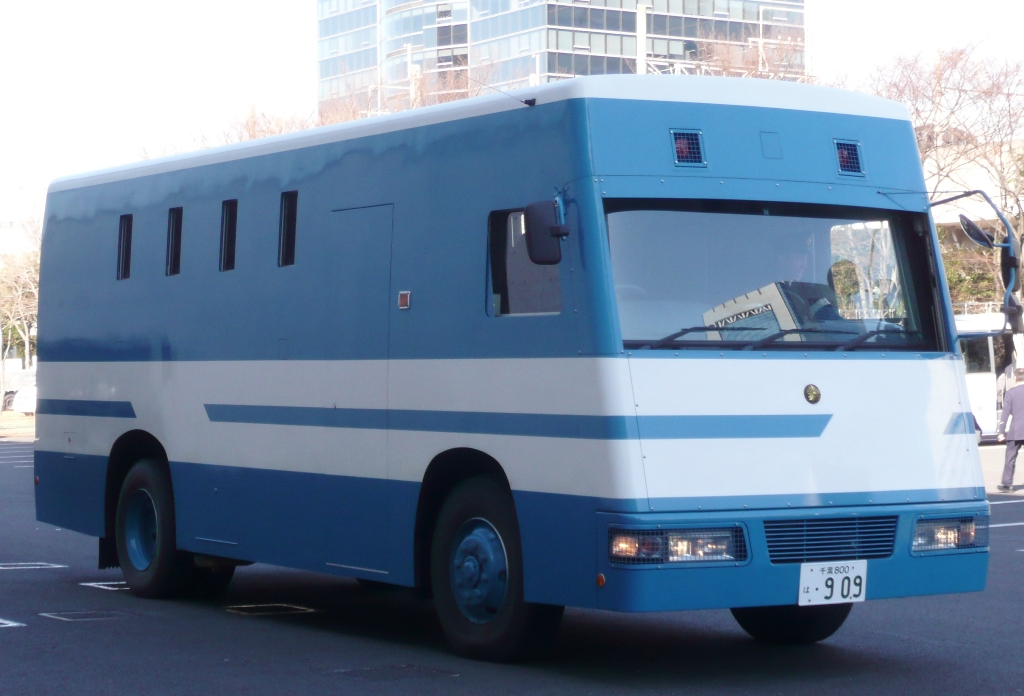
An armoured bus or armored bus is a type of bus which provides increased protection for passengers, usually against small arms and improvised explosive devices. The bus can be a stock commercial bus with retro-fitted vehicle armour as well as bulletproof glass, or a specially built military armoured vehicle. Lighter armoured buses are also used for prisoner transport.
History
[edit]One of the first armored vehicles to be used in combat was the Schneider-Brillié which was built from the chassis of a Schneider P2-4000 bus[1]
During World War I, civilian buses were pressed into service, especially by Great Britain and France, fulfilling several roles: to transport troops, supplies, and livestock, and as ambulances and mobile surgeries.[2] Britain used several hundred Daimler and LGOC B-type buses as troop transports, but they were not armoured. It was found that the windows were frequently broken by troops' equipment, and the glass was eventually removed. Wooden planks were fixed over the apertures, offering protection from the weather but not from hostile fire.[3][4][5]
Armoured buses weigh considerably more than ordinary buses. As a result, they use more fuel, are prone to mechanical breakdowns, have very high maintenance costs and wear out faster.[6]
Use of armoured buses
[edit]Israel's Egged bus company says that all its bus lines in the West Bank use bulletproof buses.[7] Armored buses were considered the safest form of civilian transport on routes to and from the Israeli settlements, although questions have been raised about how effective such buses are. It was estimated the number of fatalities would be lower in the event of attacks on armored vehicles, but this has not always been the case.[8] Some Israeli school buses are armored due to the threat of terrorist attacks.
Manufacturers
[edit]Merkavim Ltd., an Israeli bus manufacturer jointly owned by the Volvo Bus Corporation and Mayer Cars & Trucks Ltd., has been producing armored buses since 1946. Its manufacturing facility in the Caesarea industrial park produces a wide range of buses for the local and international markets.[9]
See also
[edit]References
[edit]- ^ Montes, Gareth Lynn (2018-12-20). "Blindado Schneider-Brillié". Tank Encyclopedia. Retrieved 2023-04-18.
- ^ C. Ellis & D. Bishop, Military Transport of World War I, Blandford Press, 1970. ISBN 0713707011. pp 132, 133, 134, 138.
- ^ G.J. Robbins & J.B. Atkinson, The London B-Type Motor Omnibus, 1970, self-pub. pp 35-46
- ^ BRUCE, J. Graeme & CURTIS, Colin A. The London Motor Bus: Its Origins and Development, London Transport, 1973. ISBN 0853290369 (pp to follow)
- ^ R. Larkin, Destination Western Front: London's Omnibuses Go to War, self-pub 2010. ISBN 0956501400 (pp to follow)
- ^ Interim solution worked out for armored bus shortage
- ^ Interim solution worked out for armored bus shortage
- ^ Questions raised about armored buses
- ^ Merkavim company profile

| Chassis |  | |
|---|---|---|
| Roadway | ||
| Uses | ||
| Power | ||
| Manufacturing | ||

Armoured bus
View on GrokipediaHistory
Origins and Early Development
![Havlagah bus used for self-defense during the 1936-1939 Arab revolt in British Mandate Palestine][float-right] The development of armoured buses originated from the need for protected mass passenger transport amid escalating urban threats and irregular warfare in the early 20th century, building on earlier armoured car designs that emphasized mobility and ballistic resistance. Improvised conversions of commercial vehicles emerged as practical responses to these demands, prioritizing basic shielding over advanced engineering. One of the earliest documented examples occurred during the 1936–1939 Arab revolt in Mandatory Palestine, where Jewish settlements fitted standard buses with wire mesh screens to safeguard passengers from rocks, glass shards, and thrown grenades during ambushes on roads. These "Havlagah" buses, named after the Hebrew term for restraint policy amid violence, facilitated continued civilian mobility despite heightened risks from insurgent attacks.[8] During World War II, similar improvisations proliferated in response to anticipated invasions and urban defense needs. In Britain, the Home Guard converted select buses by adding steel plating and other ad-hoc armour, transforming them into mobile platforms for reconnaissance, command, or troop movement in potential coastal defense scenarios. These adaptations reflected causal pressures from blitzkrieg tactics and the requirement for versatile, road-mobile assets that could carry multiple personnel without relying on scarce tracked vehicles. Such conversions underscored the engineering imperative to balance passenger capacity with rudimentary protection using available commercial chassis and scrap materials.[9] Post-World War II developments remained sporadic, driven by decolonization conflicts where armoured personnel carriers occasionally evolved into bus-like configurations for efficient troop shuttling in asymmetric warfare. In the 1948 Arab-Israeli War, Israeli forces repurposed civilian buses into armoured variants by welding on steel plates, enabling secure convoy operations and urban patrols against irregular threats. These vehicles addressed the logistical challenge of transporting larger groups over contested terrain, where standard trucks proved vulnerable to ambushes. By the 1950s and 1960s, isolated prototypes in colonial theaters, such as Malaya or Algeria, experimented with wheeled bus frames for similar roles, though documentation is limited and focused on immediate tactical necessities rather than standardized production.[10] Pre-1990s civilian applications centered on high-risk environments requiring protected group transit for valuables or personnel, often adapting military-derived designs. Cash-in-transit firms in the United States and Europe began converting bus chassis for secure bulk transport of currency and assets in robbery-prone cities, employing bolted armour and reinforced glazing to deter hold-ups without compromising load capacity. These efforts highlighted first-principles adaptations—prioritizing weight distribution for stability and basic ballistic stops over comprehensive threat negation—paving the way for purpose-built models while avoiding the complexity of tracked alternatives.[11]Modern Military and Security Applications
The development of armoured buses accelerated in the 2000s amid escalating improvised explosive device (IED) threats during operations in Iraq and Afghanistan, where asymmetric warfare necessitated protected personnel transport for convoys and high-risk routes. Vehicles such as the RhinoRunner, introduced around 2004, were designed with V-shaped hulls and reinforced underbodies to deflect blasts, enabling safe shuttling of troops, civilians, and journalists along perilous paths like Route Irish from Baghdad International Airport to the Green Zone.[2] In a November 2004 incident, a suicide bomber detonated between two RhinoRunner buses in a convoy, damaging the vehicles but resulting in no fatalities among occupants, underscoring their blast-mitigating design in real-world IED encounters.[12] By the mid-2010s, armoured buses adapted to hybrid warfare scenarios, exemplified by Ukraine's rapid improvisation of battle buses from civilian chassis during the 2014 Donbas conflict. Ukrainian forces, facing shortages of dedicated armoured personnel carriers, welded steel plating and added defensive features to buses and trucks for troop movement amid artillery and ambush threats, with units like the Azov Battalion employing such vehicles for patrols and advances.[13] [14] These adaptations highlighted the tactical flexibility of armoured buses in resource-constrained environments, where they provided mobile cover against small-arms fire and shrapnel in urban and rural fighting. In parallel, private security contractors expanded armoured bus usage in Iraq and Afghanistan throughout the 2010s for evacuations and logistics in insurgent-heavy zones, often procuring models like the RhinoRunner for client protection on contested highways. Deployments demonstrated efficacy against small-arms fire and under-vehicle blasts, with field survivability data from similar up-armoured transports indicating reduced injury rates from mine-like explosions compared to unmodified vehicles—simple reinforcements alone lowered fatality risks in anti-vehicle mine incidents by enhancing occupant isolation from shockwaves.[2] [15] [16] This integration into contractor operations supported sustained presence in volatile areas, though vulnerabilities to high-yield suicide vehicle-borne IEDs persisted, as evidenced by a 2011 Kabul attack on a NATO armoured shuttle that killed 13 Americans despite the vehicle's protections.[17]Design and Technical Specifications
Armouring Materials and Construction
Armoured buses primarily employ high-hardness ballistic steel plates, with thicknesses ranging from 3 mm to 14 mm depending on the desired protection level, to form the core opaque armor. These plates, often certified to standards equivalent to CEN B6 or VPAM VR7, are capable of defeating 7.62 × 51 mm NATO ball ammunition. Complementary materials include aramid fiber composites such as Kevlar applied as spall liners to capture fragments and reduce secondary injuries from penetration or ricochet. Ballistic glass consists of multi-layered polycarbonate laminates bonded to glass, typically 21 mm to 80 mm thick, designed to absorb impact energy without shattering and producing spall.[18][19][20] Construction begins with a commercial bus chassis, which is reinforced through the addition of steel box sections to the frame rails, pillars, and underbody to distribute the added load and maintain structural integrity. Armor plates are welded or bolted onto the body panels, with deliberate overlaps at seams—often 50-100 mm—to eliminate vulnerabilities at joints where projectiles might exploit gaps. This monocoque-like reinforcement integrates the protective shell with the existing structure, ensuring uniform coverage while accommodating doors and windows with hinged armored panels. The process adheres to ballistic testing protocols, such as those outlined in STANAG 4569 for military variants, verifying resistance to small arms fire and fragmented munitions from low-yield IEDs.[21][22][23] The incorporation of these materials results in a substantial weight increase, often 20-50% over the base vehicle, which compromises fuel efficiency and acceleration but is justified by the imperative of occupant survivability against direct ballistic threats. Empirical testing prioritizes causal factors like material yield strength and deformation limits over mobility optimizations, as excessive weight mitigation could undermine the armor's defeat-resistant properties. Manufacturers balance this by selecting lightweight composites where feasible without sacrificing verified protection thresholds.[24][25][1]Mobility and Defensive Features
Armoured buses feature reinforced suspension systems engineered to support the vehicle's increased mass from protective modifications while preserving maneuverability and stability during high-speed evasion or rough terrain traversal.[26] [27] Run-flat tire systems, often with reinforced sidewalls or insert technologies, enable sustained travel for up to 100 km at reduced speeds following ballistic damage or punctures, allowing operators to relocate from danger zones without immediate immobilization.[28] [29] Powertrains typically include high-torque engines, such as 2.8L turbocharged diesels, paired with upgraded braking components to facilitate rapid acceleration and controlled stops under load, essential for escaping ambushes or navigating obstacles.[30] [31] Active defensive elements encompass gun ports that permit occupants to engage threats externally while remaining shielded, smoke dispensers for deploying obscurants to impair pursuer visibility during retreats, and multiple emergency hatches for expedited passenger evacuation.[32] [33] [34] Reinforced doors with quick-release mechanisms complement integrated CCTV surveillance arrays, providing real-time perimeter monitoring to inform tactical decisions and egress protocols amid dynamic threats.[32]Operational Uses
Military and Conflict Zone Transport
Armoured buses serve a critical role in military operations within conflict zones, facilitating the secure shuttling of troops between bases amid threats from ambushes, small-arms fire, improvised explosive devices (IEDs), and rocket-propelled grenades (RPGs). In Iraq during Operation Iraqi Freedom (2003-2011), vehicles such as the Rhino Runner were deployed by U.S. forces to transport personnel along high-risk routes like Route Irish from Baghdad International Airport to the Green Zone, providing ballistic protection superior to unarmored soft-skinned vehicles that suffered high exposure to IEDs, which caused over 60% of U.S. fatalities in the theater.[35] Similarly, in Afghanistan, the U.S. Army utilized these buses for inter-base movement, where their armored enclosures mitigated risks from asymmetric attacks, though vulnerabilities to large suicide vehicle-borne IEDs were evident in incidents like the 2011 Kabul bombing that killed 13 Americans despite the vehicle's design.[2][17] To address IED-heavy environments, armoured buses have incorporated mine-resistant adaptations, such as V-shaped hulls that deflect blast forces outward and upward, reducing underbody penetration and occupant injury compared to flat-bottomed designs. The Rhino Runner, employed in Afghan operations, exemplifies this with its capacity to withstand RPGs, grenades, and small-arms fire, and it has survived direct hits from substantial explosives, like a 250-pound vehicle-borne IED, leaving passengers uninjured.[36][37] These features align with broader mine-resistant ambush-protected (MRAP) principles, which military analyses credit with enhancing survivability in blast-prone areas by channeling explosive energy away from the passenger compartment.[38] Logistically, armoured buses offer advantages in capacity and efficiency, accommodating 17 to 36 occupants per vehicle—far exceeding smaller armored personnel carriers—thus enabling rapid troop extraction or reinforcement with fewer vehicles, which minimizes convoy exposure and operational footprint in contested zones.[12] In theaters like Iraq and Afghanistan, this scale supported economies in protection by consolidating personnel movement, reducing the need for multiple lightly protected runs that amplified ambush risks, as evidenced by lower relative casualty rates in armored versus unarmored transports per military deployment data.[39] In the Ukraine conflict since 2014, similar imperatives have driven ad hoc use of buses for troop shuttling amid artillery and drone threats, though documented cases often involve unarmored or improvised variants, highlighting ongoing reliance on such platforms despite vulnerabilities.[40]Civilian and Law Enforcement Applications
Armored buses serve civilian applications primarily in high-risk environments for group transport of valuables, personnel, or passengers where standard vehicles face elevated threats of robbery or assault. In cash-in-transit operations, specialized armored buses transport large sums of currency or goods, incorporating reinforced structures to deter and withstand attacks; for instance, models designed for such purposes feature grenade and IED resistance alongside passenger protection.[41] These vehicles have contributed to reducing successful heists in regions with frequent organized crime, though comprehensive statistics specific to buses remain limited compared to vans or trucks.[42] In unstable areas of Latin America and the Middle East, armored buses facilitate secure prisoner transport for law enforcement, minimizing escape risks and attacks on convoys. Manufacturers like International Armored Group have supplied fleets of Guardian prisoner transport vehicles to national police units in South America, enabling safe movement of detainees amid regional instability.[43] Similarly, Merkavim Transportation Technologies produces buses utilized by Israel's Prison Service for transferring prisoners, including high-security operations within contested territories.[44] In the United States, TESCO's heavy-duty prison transport buses accommodate over 40 inmates with expanded steel caging and deadbolt locks, prioritizing officer safety during transfers.[45] Emerging civilian uses include modified armored school shuttles in U.S. high-crime urban areas, responding to post-2020 surges in gun violence affecting public transit and student transport. With incidents like shootings at bus stops contributing to heightened parental concerns—amid broader statistics showing over 1,000 child gun deaths since 2020—some operators opt for discreetly armored buses that balance protection against small-arms fire with non-militaristic appearances to avoid alarming communities.[46][47][48] Law enforcement deploys armored buses for riot control and emergency evacuations, offering shielded mobility for officers or civilians in volatile scenarios. These vehicles enhance personnel safety by withstanding projectiles and enabling rapid extraction, as evidenced in urban unrest responses where standard buses prove vulnerable to hijackings or assaults.[49] However, critics note potential drawbacks, including the perception of intimidation that may escalate tensions in civilian areas, underscoring trade-offs between defensive efficacy and community relations without empirical consensus on net utility in non-combat policing.[46]Manufacturers and Models
Major Global Producers
INKAS Armored Vehicle Manufacturing, headquartered in Toronto, Canada, stands as a prominent producer of armoured buses, leveraging a 200,000 square foot facility equipped for custom builds on various chassis, with an overall production capacity exceeding 40 vehicles per month.[50][51] The company specializes in ballistic protection levels suitable for high-threat environments, including certifications aligned with international standards such as VPAM equivalents for passenger transport.[1] STREIT Group, a privately held entity with operations spanning the UAE and U.S., has established itself as a key global player through over 30 years of experience in armoured vehicle production, emphasizing scalable manufacturing for security-focused transports.[52] Its engineering focuses on integrating armoured solutions onto commercial bus platforms, catering to international clients amid rising security demands.[52] Alpine Armoring, a U.S.-based firm with more than three decades in the field, excels in armoring vans and buses to levels from A4 to A11 (comparable to CEN B7+), prioritizing custom defensive features for civilian and institutional use.[7][53] In regional contexts, Mahindra Emirates Vehicle Armouring in India adapts armoured platforms for insurgency-prone areas, producing specialist vehicles with ballistic and blast resistance tailored to South Asian operational needs.[54] Alpha Armouring, based in Germany, contributes European expertise by developing armoured mini-buses, such as protected Mercedes Sprinter variants, certified to VPAM BRV VR7/BR7 standards for VIP and group transport.[55][56] Post-2010, producers have increasingly adopted hybrid international production models, with facilities in North America, Europe, and the Middle East supporting exports to emerging markets where civil unrest and asymmetric threats have boosted demand for certified armoured buses meeting VPAM BR6/7 equivalents.[57][58]Notable Armoured Bus Models
The RhinoRUNNER, developed by Armour Group in the early 2000s, features a monocoque armored structure designed to withstand improvised explosive devices (IEDs), roadside bombs, small arms fire, and armor-piercing rounds up to NIJ Type IV standards, with protection extending to the floor, roof, sides, and ballistic glass.[2][59] Capable of seating up to 36 passengers plus a driver depending on configuration, it includes 12 gun ports for defensive fire and weighs approximately 13 tons, enabling secure convoy transport along high-threat routes.[60][37] The model gained field-proven status in Iraq, particularly on the Baghdad International Airport road known as Route Irish, where it was deployed by U.S. military contractors and international organizations for personnel evacuation amid frequent ambushes.[61] The Armadillo armored bus, produced by International Armored Group, accommodates up to 30 passengers in a high-capacity layout optimized for employee shuttles in conflict zones, incorporating gun ports, video surveillance, and emergency escape hatches alongside modular armoring for CEN B6/NIJ Level III ballistic and blast resistance against multiple high-powered rifle hits and IED threats.[62][32][63] Its counter-IED underbody design and reinforced chassis enhance survivability in ambush-prone environments, making it suitable for private security firms conducting rotations in unstable regions.[64] Armored variants of the Toyota Coaster minibus, adapted by multiple manufacturers for urban security, maintain a compact footprint for maneuverability in congested areas while achieving ballistic ratings up to CEN 1063 BR6, protecting against 7.62mm armor-piercing ammunition through reinforced ballistic steel (minimum 7.5mm thick) and multi-layered glass.[65][66] These models, often configured for 20-25 passengers, feature run-flat tire systems and OEM-appearing exteriors to blend into civilian traffic, supporting low-profile operations for law enforcement or VIP transport in hostile cities.[67][68]Effectiveness and Criticisms
Demonstrated Protective Capabilities
The Rhino Runner armoured bus, deployed extensively in Iraq, survived a 113 kg suicide vehicle-borne improvised explosive device detonated 2 meters away on March 11, 2006, creating a 1.8 m diameter crater and 0.6 m deep without penetrating the passenger compartment or causing occupant injuries in the incident.[37][12] This field validation underscores blast resistance capabilities exceeding 10 kg TNT equivalents in operational equivalents, with the vehicle's composite armour and V-shaped underbody deflecting shockwaves and fragments.[2] Ballistic testing of armoured buses routinely certifies protection against small arms fire, with models like those from INKAS achieving resistance to 7.62 mm armour-piercing rounds per NIJ Level IV standards, ensuring no penetration through body panels or glass under multiple impacts.[1][2] In controlled VPAM BRV and STANAG 4569 Level 2 evaluations, such vehicles maintain structural integrity against 5.56 mm and 7.62 mm NATO ammunition at 30 m ranges, correlating to near-complete occupant shielding in simulated combat scenarios.[69][25] Operational data from conflict zones, including Iraq's Route Irish convoys, confirm armoured buses' efficacy in sustaining passenger transport under fire, with field reports indicating consistent survival of small arms barrages and grenade fragments without fatalities in protected configurations versus unarmoured alternatives.[2] Security operations in high-risk areas further demonstrate deterrence effects, as visible armouring has led to aborted attacks in documented cases where assailants shifted to softer targets upon encountering reinforced vehicles.[70]Limitations and Debates on Utility
Armoured buses, while effective against small-arms fire and fragmentation, exhibit significant vulnerabilities to potent anti-armour threats like rocket-propelled grenades (RPGs) with shaped-charge warheads or large improvised explosive devices (IEDs). Direct RPG impacts often require specialized countermeasures such as slat or cage armour to disrupt the projectile's fuse before penetration, as standard ballistic plating on buses—typically rated to STANAG Level 1 or 2—fails against tandem-warhead variants commonly used in asymmetric warfare.[71] In underbelly blast scenarios, the elevated passenger compartment and limited V-hull designs common in retrofitted civilian buses amplify risks from IEDs, where ground pressure waves can breach floors or cause catastrophic rollover, as demonstrated in testing of similar lightly armoured personnel carriers.[72] High-intensity operations, such as those in urban insurgencies, have exposed these gaps, with reports of armoured transport vehicles succumbing to coordinated RPG ambushes or buried explosives, prompting tactical shifts away from reliance on such platforms toward more agile or heavily up-armoured alternatives.[73] Cost-benefit analyses of armoured transport highlight debates over their economic viability, particularly when procurement and maintenance costs—ranging from $45,000 for basic retrofits to over $500,000 for advanced models with mine-resistant features—outweigh marginal survivability gains in lower-threat environments.[74] Ex-post evaluations of similar armoured vehicle programs, such as Israel's procurement of tactical platforms, reveal expenditures per life saved in the millions, questioning whether concentrated armoured convoys provide superior protection compared to dispersed, unarmoured transport or route diversification, which reduce target value without equivalent fiscal burden.[75] In low-intensity settings, empirical data suggest over-investment yields diminishing returns, as operational wear accelerates depreciation and logistical demands (e.g., specialized fuel and repairs) erode net utility against cheaper alternatives like reinforced sedans or phased evacuations.[76] Civil liberties advocates criticize armoured buses in domestic policing as emblematic of broader militarization trends, arguing that their deployment in U.S. urban unrest—such as during the 2020 George Floyd protests—escalates tensions and erodes community trust by projecting an adversarial posture akin to combat operations.[77] Surveys indicate majority public opposition, with 54% of Americans viewing police acquisition of military-grade vehicles as excessive, potentially fostering perceptions of occupation over guardianship and correlating with higher civilian injury rates in militarized responses.[78] Proponents counter with threat data from riot scenarios, where armoured units have contained volatile crowds without officer casualties, though empirical reviews note failures like amplified distrust and non-lethal escalations when optics prioritize hardware over de-escalation tactics.[79] This tension underscores causal trade-offs: while real threats like armed riots justify some fortification, unchecked proliferation risks normalizing force multipliers disproportionate to domestic baselines, as evidenced by post-incident analyses linking equipment mindset to procedural overreach.[80]Recent Developments
Technological Advancements
Hybrid-electric propulsion systems have emerged as a key advancement for armoured vehicles, including buses, by combining internal combustion engines with electric motors to improve fuel efficiency, reduce thermal signatures for stealth, and manage the added weight of armour plating, with market reports noting traction in prototypes since 2023.[81] [82] Active protection systems (APS), which use sensors to detect and neutralize incoming threats like rockets or projectiles via countermeasures such as explosive interceptors, have been adapted for heavier armoured platforms post-2020, offering potential integration into bus designs to counter evolving asymmetric threats without excessive weight penalties.[83] [84] Transparent armour innovations, leveraging advanced ceramics like aluminum oxynitride (ALON) or spinel, provide superior ballistic resistance at lower weights compared to traditional glass laminates, enabling clearer visibility and reduced structural strain in armoured bus windows tested for multi-hit capabilities against small arms fire.[85] [86] Modular armouring kits facilitate swift retrofits on commercial chassis, such as those applied to school and transit buses in 2024, incorporating bolt-on ballistic panels and upgraded glazing to achieve NIJ Level IIIA protection while preserving vehicle maneuverability.[46] [87] AI-driven surveillance and detection systems, including dash-mounted cameras with real-time analytics, enhance situational awareness in armoured buses by identifying potential threats like weapons or erratic behavior, with deployments in transit fleets demonstrating reduced response times to incidents.[88] [89] Run-flat and self-sealing tire technologies, refined in recent vehicle upgrades, maintain mobility after punctures from IED fragments or gunfire, as incorporated in armoured transport systems to extend operational range in contested environments.[90]Market Expansion and Adoption Trends
The global market for armoured civilian vehicles, including buses, has exhibited steady expansion, with the segment valued at approximately USD 2.8 billion in 2024 and projected to reach USD 4.6 billion by 2034, reflecting a compound annual growth rate (CAGR) of around 5%.[91] This growth is underpinned by heightened security requirements in regions prone to instability, such as the Middle East and Africa, where the armoured vehicle market is anticipated to advance at a CAGR of 6% from 2024 to 2030, driven by persistent geopolitical tensions and internal conflicts.[92] In the urban United States, demand has similarly risen, with the domestic armoured vehicle market valued at USD 8.09 billion in 2022 and expected to grow at a CAGR of 5.4% through 2030, fueled by increasing needs for secure transport amid elevated crime rates and VIP protection requirements.[93][94] Adoption trends indicate a notable pivot toward civilian applications, particularly in education and high-risk shuttle services, as evidenced by initiatives from manufacturers like Armormax, which have promoted armoured buses and shuttles for student transport to mitigate threats from active shooters and urban violence.[46] This shift correlates with verifiable escalations in school-related security incidents, prompting conversions of standard buses into protected variants without altering their non-threatening appearance.[3] Sales activity has shown spikes in 2023-2025, coinciding with post-conflict escalations in regions like the Middle East, where ongoing hostilities have amplified procurement for civilian and quasi-military transport solutions.[95] Geopolitical events, including the Russia-Ukraine war, have further catalyzed demand for affordable armoured bus conversions, as shortages of dedicated military vehicles have led belligerents to improvise with civilian buses, underscoring the practical utility of such adaptations in asymmetric conflicts and prompting parallel investments in protected transport elsewhere.[96] This trend emphasizes the causal role of resource constraints and frontline necessities in driving market uptake, rather than policy-driven narratives, with broader implications for export markets in unstable areas.[97]References
- https://commons.wikimedia.org/wiki/File:Havlagah_bus_during_1936-1939_Arab_revolt-British_Mandate_of_Palestine.jpg