Hubbry Logo
PosillipoPosillipoMain
Open search
Posillipo
Community hub
Posillipo
logo
8 pages, 0 posts
0 subscribers
Be the first to start a discussion here.
Posillipo
Posillipo
from Wikipedia
Stairway to the sea of the Villa Elisa

Posillipo (Italian: [poˈzillipo]; Neapolitan: Pusilleco [puˈsilləkə]) is an affluent residential quarter of Naples, southern Italy, located along the northern coast of the Gulf of Naples.[1]

From the 1st century BC the Bay of Naples witnessed the rise of villas constructed by elite Romans along the most panoramic points of the coast, who had chosen the area as a favourite vacation spot. The remains of some of these, around the imperial pleasure villa of the Roman emperors, as well as the Tunnel of Sejanus can be seen today in the Parco archeologico del Pausilypon, or Pausilypon Archaeological Park, and elsewhere.[2]

Geography

[edit]
Archaeological Park of Pausilypon on Cape Posillipo

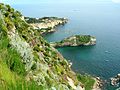
Posillipo is a rocky peninsula about 6 km long surrounded by cliffs with a few small coves with breakwaters at the western end of the Bay of Naples. These small harbours are the nuclei for separate, named communities such as Gaiola Island and Marechiaro.

History

[edit]

Antiquity

[edit]

Posillipo is mentioned in ancient Greek and Roman sources. As part of Magna Graecia, the Ancient Greeks first named it Pausílypon, meaning "respite from worry". The French Homeric scholar Victor Bérard[3] identified Posillipo as the land of Homer's Cyclopes. From the 1st century BC the beautiful coastline of Campania attracted wealthy Romans as a place to build elaborate and grand villas as retreats.

Of ancient Pausilypon the most visible ruins are those of the notorious villa of Vedius Pollio, later to become an imperial villa. The villa was described by the poet Ovid as "like a city".[4] Most notoriously, he kept a pool of lampreys into which slaves who incurred his displeasure would be thrown as food,[5][6][7] a particularly unpleasant means of death, since the lamprey "clamps its mouth on the victim and bores a dentated tongue into the flesh to ingest blood".[8] However, the emperor, Augustus, on visiting Pollio and witnessing the condemnation of a slave, took action against Pollio and saved the slave, an incident widely documented in writings of the era (see Vedius Pollio for more details).

Vedius died in 15 BC and was probably forced to bequeath a large part of his estates, including the villa, to the emperor Augustus. Although Augustus had Vedius' mansion in Rome razed, Pausilypon was rebuilt and extended to become a palace, which remained in imperial possession at least until the time of Hadrian.

Early modern period

[edit]
Villa Donn'Anna
Villa Vedius Pollio

In the 17th century the property of the site of the imperial villa passed to the family Maza who, for several generations, showed an interest in archaeology and Francesco Maria Maza (c. 1680) was the author of inscriptions which he affixed to the so-called 'Piscine of V.Pollio' and to the 'Temple of Fortune' which were in situ as late as 1913. However the Maza collection was dispersed and the loss to archaeological science was irreparable as a catalogue had never been prepared. Several objects of art from Posillipan sites found their way into the hands of Spanish collectors, and are still no doubt among the Roman antiquities in Spain. Many fine pieces were taken to Mergellina and lost among the other ornaments of the villa of the Duke of Medina.[9]

19th century

[edit]

In 1820 the southern portion of the property was purchased by a well-known Neapolitan archaeologist, cavaliere Guglielmo Bechi, and his name was associated with the Villa for more than half a century. He did much excavation, but again without publication of results.

In 1841 more methodical excavations were begun on the adjoining property to the west of the ancient lane that led down the valley from the "Tunnel of Sejanus" to the sea. The principal buildings of that part of the Villa were soon brought to light; the Theatre, an Odeon, and the remains of a Portico overlooking the sea. An oblong building called the temple was also found along with the remains of an aqueduct.

In about 1870 the Marchese del Tufo opened a quarry for pozzolana clearing away the central part of what had been a broad continuous terrace along the south front of the property in Roman times. The buildings that stood on the hillside above the terrace, including the southern part of the baths, fell down the slope into the sea.

Roman Pausilypon

[edit]

The archaeological park is one of the most beautiful places in the city and along the coast of Posillipo.

Among the most important sites are the "cave of Sejanus", the underwater park of Gaiola, the imperial villa of Pausilypon (including the odeon, theatre) and the Palace of the Spirits.

Imperial villa

[edit]
Fragment of fresco, Villa of Vedius Pollio, Ashmolean Museum

The ruins of the Roman villa of Vedius Pollio, also known as the Imperial Villa, include a 2000-seat theatre on the rocky promontory at the end of the Bay of Naples.[10] Some of the villa's rooms can be seen with traces of the wall decorations while its marine structures and fish ponds are now part of the neighbouring submerged Gaiola Park.

The villa was built in the first century BC by Publius Vedius Pollio. On his death in 15 BC, the villa was bequeathed to Augustus, and remained in imperial possession for his successors at least until Hadrian, as witnessed by a stamped water pipe. In various points the presence of water supply pipes (coated with hydraulic mortar) show the opulence of the facilities.

Nereid on sea monster, early 1st c. AD, from the villa of Vedius Pollio, Naples Archaeology Museum

The George Vallet Archaeological museum in Sorrento has a model of the villa.

Tunnel of Sejanus

[edit]

Access for visitors to the ruins of the imperial villa is currently through the Tunnel of Sejanus.

Roman Tunnel of Sejanus western end
Tunnel of Sejanus eastern end

The extraordinary 770 metre-long Grotta di Seiano or "cave of Sejanus" passes beneath the Posillipo hill and connected the imperial villa and other patrician villas nearby with the Phlegraean Fields and the towns and ports of Puteoli (Pozzuoli) and Cumae. It owes its name to Lucius Aelius Seianus (Sejanus), prefect of the emperor Tiberius, who according to tradition commissioned its enlargement in the first century AD; the first tunnel was built 50 years earlier by architect Cocceius Auctus at the behest of Agrippa. The eastern entrance is cut into the rock cliff within the archaeological park while the western entrance was a monumental arch with opus reticulatum lining the cliff sides, and both ends being of about 14 m height.

The height, width and length of the tunnel made it a great engineering achievement and an extravagant one considering it served only a small population. An enormous volume of rock alone had to be removed though some served as building material for the villas. The tunnelling was complicated by the alternation of pozzolanic earth with tufa necessitating the elaborate lining of most of the tunnel with stonework of opus reticulatum and then with vaulting on top of these walls. Work progressed at 5–7 m per day as indicated by the joints between sections. It was not perfectly straight in plan but included small deviations near the centre where the tunnellers from each end met after remarkably small inaccuracies of alignment given the techniques of the time. It had three secondary side tunnels ending in openings overhanging the bay to provide light and ventilation.

Although known about by scholars (for example it is referred to in the Polish writer Adam Mickiewicz's epic Pan Tadeusz published in 1834), it had fallen into disuse over the centuries. it was rediscovered during works for a new road in 1841 and immediately brought to light and made passable by Ferdinand II of the Two Sicilies, becoming a tourist destination. Additional lining and arches were built to repair and reinforce the ancient walls. During World War II, it was used as an air raid shelter for the inhabitants of Bagnoli; the war and landslides during the 1950s took it back to a state of neglect since when it was restored.

Other sights

[edit]
Palace of the Spirits

The remains of other Roman houses can be seen in Marechiaro along the beach, or at Calata Ponticello where there is an Ionic column base and a brick niche. On the cliff towards Gaiola are the remains of the "House of the Spirits" also called "Villarosa" which was the nymphaeum of the villa and also built in the first century BC. Further along the coast to the west is the perimeter of the "School of Virgil" where it was believed that the "prophet" practised magical arts.

The grandeur and luxury of these villas are documented in the George Vallet Archaeological museum.[11]

The Roman aqueduct supplying the coastal villas was a branch of the Serino aqueduct or Aqua Augusta and was discovered in 1882 when the Grotta Nuova di Posillipo was made for a tramway through the hill.[12] Ancient inscriptions found inside the tunnel verify that it fed the villa of Felix Pollio, among others, mainly intended for the nymphaeum and the baths.

Modern developments

[edit]

The area remained largely undeveloped until a road, via Posillipo, was built between 1812 and 1824. That road starts at sea level at the Mergellina harbour and moves up the coast, roughly parallel to the shore. The artistic School of Posillipo was started by Antonie Sminck Pitloo, painting marine shore landscapes from the area.

The submerged parts of the ruins of the imperial villa and the rich and diverse marine and coastal natural environment can be seen via boat excursions.

The area has been heavily overbuilt since the end of World War II, but contains some notable historical buildings and landmarks. Among these is the Villa Rosebery, the Italian President's residence during his stays in Naples. It also contains a Mausoleum to those who died for their country, the Mausoleo Schilizzi.

Sports

[edit]

Posillipo has given its name to Naples' waterpolo team, Circolo Nautico Posillipo. The neighbourhood was seat of the homonymous circuit which hosted the Grand Prix of Naples between 1933 and 1962.

Famous residents

[edit]
[edit]

See also

[edit]

References

[edit]
[edit]
Revisions and contributorsEdit on WikipediaRead on Wikipedia
from Grokipedia
Posillipo is an elegant and prestigious hilly district in the western part of , , overlooking the and known for its scenic beauty, historic Roman ruins, and upscale residential character. The area's name originates from the term Pausilypon (Παυσίλυπον), meaning "place that makes pain cease" or "respite from worry," a reference to the soothing vistas of the bay, including views of Vesuvius, , , and . Historically, Posillipo was urbanized during the Roman era in the 1st century BCE as an residential zone favored by aristocrats and senators, exemplified by the lavish Villa Pausilypon constructed by Publius Vedius Pollio, a Roman equestrian and associate of . This expansive estate, originally spanning about 22 acres, featured an amphitheater seating 2,000, a smaller odeon theater, thermal baths, gardens, fountains, and advanced fish ponds, much of which was later partially submerged or lost, with ongoing excavations revealing artifacts like a 2,000-year-old floor as recently as 2022. Access to the site was facilitated by the Seiano Grotto, a 770-meter-long Roman carved through the rock to link Posillipo with the coastal areas of Bagnoli and Gaiola. In modern times, Posillipo remains a symbol of Neapolitan luxury, with 19th-century villas lining Via Posillipo, green spaces like the Parco Virgiliano offering panoramic terraces, and nearby attractions including the Underwater Park of Gaiola for diving and the Palazzo Donn'Anna palace. The district's promontory forms part of the Campi Flegrei volcanic complex, contributing to its dramatic cliffs and coastal landscape, while providing opportunities for water sports, beaches, and fine dining in a serene contrast to central .

Geography

Location and Boundaries

Posillipo is a quartiere, or quarter, within the 1st Municipality (Municipalità 1) of , which includes the neighborhoods of San Ferdinando, Chiaia, and Posillipo. Posillipo covers approximately 5 km² (as of 2021), making it one of the larger quarters in . The quarter lies along the northern coast of the , forming a prominent that extends westward from the urban center. Its boundaries are defined approximately to the east by the end of the Mergellina waterfront (part of the Chiaia quarter), to the west by the including areas like Bagnoli and Fuorigrotta up to Piazzale Tecchio, and to the north by the slopes of the hill extending toward Agnano. Posillipo has held administrative status as part of greater since the city's 1927 unification, which incorporated surrounding suburbs into its metropolitan framework, and it is zoned primarily as an upscale residential suburb characterized by villas and low-density housing. Within its coastal boundaries, Posillipo includes proximity to key landmarks such as , a small isolated rock formation and former islet connected by a , located just offshore in the . The quarter's elevated terrain also provides expansive views across the gulf toward the island of on clear days.

Topography and Natural Features

Posillipo is a rocky promontory extending westward into the , formed by tufaceous ridges associated with the Phlegraean volcanic complex, specifically composed of Neapolitan Yellow Tuff (NYT) deposits from eruptions around 15,000 years ago, overlain by younger pyroclastic layers. This elongated ridge lies on the southern periphery of the Campi Flegrei caldera, shaped by volcanic and tectonic processes that have influenced its geological structure since approximately 60,000 years ago. The terrain is predominantly hilly, with elevations rising to 100-150 meters above , featuring steep slopes interrupted by terraced landforms and fault scarps reaching up to 150 meters in places. These hills culminate in dramatic sea cliffs of , which drop sharply to the coastline, creating an indented profile with small bays and pocket beaches, including the picturesque cove of Marechiaro. The coastal exhibits ongoing patterns, with wave action and historical human activities like tuff quarrying contributing to cliff retreat since Roman times, compounded by relative sea-level rise from events of about 2 meters between the and AD, likely due to volcano-tectonic activity. A key natural feature is the Gaiola Underwater Park, a spanning over 40 hectares along the Posillipo coast, encompassing volcanic formations, submerged archaeological remains, and diverse coastal ecosystems. The park's waters host rich , including , colorful sponges, sea urchins, , and seagrass meadows like Posidonia oceanica, which serve as nurseries for and carbon sinks. Posillipo experiences a characterized by mild winters with average temperatures around 8-13°C and hot, dry summers, moderated by its seaside location. The area is vulnerable to , a slow ground deformation linked to volcanic activity in the Campi Flegrei, evidenced by historical and recent uplift phases, such as 0.7 meters between 1950 and 1952, which affect coastal stability and sea-level relations. As of November 2025, the area continues to experience bradyseismic unrest, with ongoing ground uplift and seismic swarms, including a M4.4 on March 13, 2025.

History

Ancient Period

The name Posillipo originates from the term Pausilypon, meaning "respite from worry" or "end of pain," which was adopted by Romans in the to describe the area's serene coastal landscape. This reflected the site's appeal as an idyllic retreat, evoking Greek philosophical ideals of tranquility amid the natural beauty of the Bay of . From the 1st century BC, Posillipo developed as an exclusive suburb of Neapolis (modern Naples), where Roman elites constructed opulent villas along its panoramic cliffs and shores to pursue otium—the leisurely lifestyle of intellectual and physical repose away from urban bustle. These estates featured terraced gardens, sea views, and sophisticated engineering to harmonize with the rugged topography, serving as seasonal residences for the wealthy. A prime example was the villa of Publius Vedius Pollio, a prominent equestrian and advisor to Augustus, built around this period and explicitly named Pausilypon to emphasize its restorative purpose. Pollio's property gained notoriety through an anecdote preserved in ancient literature: during a banquet, when a slave broke a crystal cup, Pollio ordered the servant thrown into a pool of lampreys—fierce eel-like fish trained to devour flesh—as punishment, but Augustus intervened, freeing the slave and smashing the pool to rebuke such cruelty. This incident, detailed by Seneca the Younger in De Ira (3.40), underscores the extravagant and sometimes brutal dimensions of elite Roman leisure at Posillipo. In 15 BC, upon Pollio's death, he bequeathed his villa to Augustus, who accepted it despite their strained relations and integrated the estate into imperial holdings. Under and his successors, such as , the property evolved into a key imperial retreat, with enhancements that solidified Posillipo's role in the Roman network of luxurious, state-owned villas until the late empire. This transition marked the area's shift from private elite domains to symbols of imperial patronage and leisure.

Medieval to Early Modern Era

Following the fall of the in the AD, the luxurious villas of Posillipo, including the Pausilypon complex, experienced significant decline due to repeated invasions, such as those by the and , coupled with economic disruptions and natural events like earthquakes and land subsidence. These factors led to the abandonment of the sites, with structures falling into disuse as the region's urban centers contracted and trade networks weakened. By the , critical infrastructure like the aqueduct supplying the area was severed during conflicts, notably by in AD 537, exacerbating the decay. Archaeological evidence, including coins from emperors like Justinian (c. AD 550) and (AD 268–270), indicates sporadic use persisting into , but the once-grand estates transitioned into quarries where locals extracted materials like and marble for reuse in construction. During the medieval period under Norman (11th–12th centuries) and Aragonese (15th century) rule, Posillipo remained a sparsely settled rural periphery of , characterized by limited population and primarily agricultural activities such as and small-scale farming on the terraced hillsides. The area's isolation, compounded by ongoing that submerged coastal sections of the ancient villas, discouraged dense habitation, with substructures repurposed modestly as barns, cellars, or hermitages rather than residential complexes. Ownership was fragmented among local , but no major feudal estates or fortifications emerged, reflecting the broader economic shift toward in southern Italy's hinterlands during this era of political consolidation under Norman and Aragonese governance. In the , interest in Posillipo's antiquities remained limited during the , with sporadic 16th-century explorations by figures like Antonio Paleologo yielding statues such as a Mercury, some of which were exported to Spanish collections under viceregal patronage. By the , the site passed to the Mazza family, particularly Matteo Geronimo Mazza (d. c. 1618), a noble from who acquired a villa there and amassed a collection of inscriptions and sculptures, including acquisitions from earlier excavations like the Spatafora group, documenting over 800 epigraphs across . This collection, displayed in the villa's gardens, attracted modest scholarly attention from antiquarians like Ignazio Maria Como and Francesco Saverio Valletta, whose transcriptions reached Ludovico Antonio Muratori, though much of the material dispersed through sales and viceregal activities, with marbles ending up in European courts or lost. The marked a revival of interest under the Bourbon kings, who, through their patronage of Vesuvian sites like and Pompeii, fostered a broader enthusiasm that extended to Posillipo as a precursor to formal excavations. Charles VII (later ) and his successors emphasized the recovery of classical heritage, influencing noble collectors and scholars to document Posillipo's remains, including the Mazza villa's holdings, which were inventoried and partially preserved. This royal focus on antiquities, evident in court-sponsored studies and maps like Giovanni Battista Carafa di Noja's 1775 topographic survey, highlighted the site's Roman foundations without yet initiating large-scale digs, setting the stage for 19th-century archaeological efforts.

19th and 20th Centuries

In the early , systematic excavations at the Pausilypon villa complex in Posillipo marked a key phase in the site's rediscovery, building on sporadic earlier explorations. In 1841, Monsignor di Pietro, the Apostolic Nuncio, initiated methodical digs west of the Grotta di Seiano under the direction of architect Pietro Bersani, uncovering the theater, odeon, portico, temple, and portions of an aqueduct. By April 1842, the theater had been largely cleared, revealing architectural elements such as six fluted Corinthian columns in the odeon and a white , alongside artifacts including a headless Greek-style found on January 13 of that year. However, these efforts were hampered by destructive activities; in 1870, Marchese del Tufo opened a between Villa Bechi and Scoglio di Virgilio, which damaged terraces and structures near the upper baths until operations ceased that year. Under the Bourbon dynasty, Posillipo transitioned from a sparsely populated coastal area to a more accessible retreat, largely due to projects. The of Via Posillipo, a scenic coastal road linking Mergellina to the hill's western end, began in 1812 under King and was completed by 1824 during Ferdinand I's reign, facilitating elite villas and enhancing the area's appeal as a Bourbon-era destination. Following Italian unification in 1860, when the Kingdom of the Two Sicilies was annexed to the new , Posillipo experienced accelerated integration into ' urban fabric, with expanded road networks and residential development drawing affluent residents seeking views of the . The 20th century brought profound transformations to Posillipo amid global conflict and rapid urbanization. During , endured over 200 Allied air raids from 1940 to 1943, making it Italy's most heavily bombed city and causing widespread destruction, including damage to Posillipo's residential and archaeological areas from bombings targeting nearby ports and infrastructure. Post-war reconstruction from the late 1940s onward led to unchecked overbuilding, as rational planning was often absent, resulting in dense residential expansion along Via Posillipo and adjacent slopes that altered the area's once-open landscape. This period also saw significant population influx, transforming Posillipo from a semi-rural enclave into a bustling suburb. Archaeological investigations continued into the 21st century. In 2022, archaeologists from the University of Naples uncovered a well-preserved 2,000-year-old floor dating to the 1st century BCE in the (dining room) of the Pausilypon villa complex. In 2023, speleologists rediscovered a previously unknown 650-meter subterranean section of the Aqua Augusta aqueduct running beneath the Posillipo hill, providing new insights into Roman water management for the area's elite villas. A notable cultural event in Posillipo was the Grand Prix of , an annual auto race held on a 2.491 km circuit through the neighborhood's streets from 1934 to , attracting international drivers and showcasing the area's winding topography. The event, known as the Coppa Principessa di Piemonte in its early years, highlighted Posillipo's scenic roads but contributed to local traffic and development pressures, ending after the edition won by in a Ferrari 156.

Archaeological Sites

Pausilypon Villa Complex

The Pausilypon Villa Complex was constructed in the second half of the by Publius Vedius Pollio, a Roman equestrian known for his wealth and ties to the imperial circle. Upon Pollio's death in 15 BC, he bequeathed the estate to Emperor , who accepted it and repurposed the site as an imperial retreat. This bequest exemplified Pollio's efforts to curry favor with the emperor, as noted in ancient accounts of his ostentatious displays. The villa's design emphasized , or leisurely retreat, blending architecture with the dramatic Posillipo landscape overlooking the Bay of Naples. Key architectural features included a grand for water displays, an extensive serving as a covered walkway with views of the , and a 2000-seat open-air theater carved into the hillside for dramatic performances. Adjacent to the theater stood a smaller, roofed odeon dedicated to intimate musical recitals and poetry readings, accommodating elite gatherings. The complex integrated a branch of the Aqua Augusta aqueduct, channeling water through underground conduits to supply , fountains, and the , highlighting Roman engineering's adaptation to elite seaside living. Restoration efforts began in the early , with systematic excavations led by scholars like Robert Theodore in 1907–1913, uncovering and stabilizing structures such as the and porticos amid ongoing conservation. Recent excavations have revealed additional features: in December 2022, a 2,000-year-old floor was uncovered in the villa's , and in 2023, a (dining hall) was unearthed, offering new insights into the site's layout and imperial use. Today, the site forms the core of the Parco Archeologico del Pausilypon, opened to the public in 2009 as a protected archaeological and environmental area managed by regional authorities. Visitors access the complex via guided tours, exploring the theater—renowned for its natural acoustic properties that enhance sound projection without amplification, as demonstrated in modern virtual reconstructions—and other preserved elements. A notorious legend associated with Pollio involves a pool stocked with voracious eels (often misidentified as lampreys in later accounts), into which he reportedly fed disobedient slaves as punishment, a practice condemned by ancient writers like Seneca and . The villa's marine extensions, including submerged porticos and breakwaters, remain visible in the adjacent Gaiola Underwater Park, where divers can observe Roman underwater structures amid protected .

Sejanus Tunnel

The Sejanus Tunnel, also known as the Grotta di Seiano or Crypta Neapolitana, is an feat excavated through the tuffaceous hill of Posillipo to connect the mainland near Bagnoli with the Gaiola bay and the promontory's coastal areas. Constructed in the late , around 37 BC, by the architect Lucius Cocceius Auctus under the patronage of during the civil wars, the tunnel facilitated secure land access to elite villas, including the nearby Pausilypon complex owned by Publius Vedius Pollio. Its name derives from Lucius Aelius , the influential prefect under Emperor , who enlarged the passage in the AD to better serve the imperial estate after it passed from Pollio to and subsequently to Sejanus. Engineered for vehicular and pedestrian traffic, the tunnel measures approximately 770 meters in length, with an original height of about 4.5 meters and width sufficient for two carts abreast, carved directly into the soft volcanic rock using manual labor and basic tools typical of Roman subterranean works. To address ventilation in the dimly lit interior, it features two inclined shafts: an eastern one approximately 145 meters long with a gentle 6.2% , and a western one about 100 meters with a steeper 44% incline, allowing natural while minimizing structural weakness in the . The design emphasized functionality over ornamentation, with vertical walls supporting a simple cylindrical vault, reflecting Roman priorities for durable in a geologically active region. Historically, the tunnel served primarily as a vital link for accessing the luxurious Pausilypon villa from and the , enabling elite Romans to travel efficiently to their seaside retreats amid the era's political turmoil. Sections collapsed during the due to seismic events and neglect, rendering parts impassable and contributing to local legends associating the structure with Virgil's mythical engineering. It was rediscovered and restored in 1841 by engineers of the Bourbon dynasty during the construction of a new coastal road, involving reinforcement to reopen the passage for public and military use. Today, the tunnel remains partially accessible as the entry point to the Pausilypon Archaeological Park, with about 340 meters open to visitors while the central section is secured due to instability. Integrated into the route of modern Via Posillipo, it has undergone further restorations, including a major reopening in , but ongoing safety concerns arise from the area's seismic activity in the , where and earthquakes pose risks to the friable structure.

Other Roman Remains

The Palazzo degli Spiriti, a well-preserved Roman maritime villa dating to the , stands as a notable example of residential along the Posillipo coast near Marechiaro. This structure features a and ground-floor elements adapted for coastal living, with some windows partially sealed due to early events that raised relative sea levels between the and AD. Integrated surveys, including marine drone mapping and GIS analysis, have revealed its role in the broader Roman landscape, highlighting human adaptations to environmental changes like volcanic activity in the Campi Flegrei area. Today, it forms part of the Parco Archeologico di Posillipo, offering insights into the luxurious villas that dotted the hillside. A branch of the Aqua Augusta, the extensive Serino aqueduct constructed around 30–20 BC under , traversed the Posillipo hill to supply fresh water to coastal villas and public facilities. Originating from springs at Fons Augusteus near Serino, approximately 80 km inland, this underground conduit passed through the Crypta Napolitana tunnel and distributed water to elite residences, including those of imperial figures and merchants in the Bay of region. The system, unique for serving multiple urban centers like , Puteoli, and , utilized a shallow to maintain flow, with channels typically measuring 0.8 m by 1.5 m in cross-section. Recent explorations by the Cocceius Association have mapped over 647 m of this branch, underscoring its engineering sophistication in supporting the opulent lifestyle of Roman elites. Off the Gaiola area in Posillipo, submerged Roman ruins visible offshore include fish ponds (vivaria) and fragments associated with maritime villas from the , such as extensions of the Villa of Pausilypon. These underwater features, comprising walls and channels for , reflect the Romans' integration of with the for leisure and sustenance. Established as a in 2002 via Interministerial Decree, the Gaiola Underwater Park spans 41.6 hectares from Marechiaro to Trentaremi Bay, safeguarding these remains from environmental threats and illegal activities while promoting research and access. Roman quarry sites on the Posillipo hill, carved into the soft Neapolitan Yellow , provided essential building materials for local villas and infrastructure during antiquity. These extraction areas, evident in tunnel-like cavities and outcrops along the slopes, supplied blocks for opus reticulatum walls and other constructions in the –AD. from such sites was later reused in medieval structures across , exemplifying the continuity of local resources in post-Roman building practices amid the region's volcanic .

Modern Developments

Urban Expansion and Infrastructure

The construction of Via Posillipo, initiated in 1812 under King and completed in 1823, marked the onset of Posillipo's transformation from a sparsely populated, rural into an accessible residential area, facilitating elite settlement along ' western coastline. This coastal road, winding through cliffs and offering panoramic views of the Bay of , spurred initial suburban development by connecting the district to the city center at Mergellina harbor. Following , Posillipo experienced accelerated urban expansion characterized by the proliferation of luxury apartments and high-end residences, often built without stringent planning oversight, which altered the area's once-tranquil landscape. This post-war boom reflected broader Italian trends in condominium-style housing, where multilevel buildings emerged to accommodate growing affluent populations seeking seafront properties. By the mid-20th century, such developments had crested the headland with expansive, though sometimes architecturally contentious, structures. The district's population surged from a rural base to a suburban profile during the 1950s and 1970s, driven by overbuilding that intensified density and strained the hilly terrain's capacity. This rapid converted Posillipo from an elite retreat into a densely settled neighborhood, with residential sprawl encroaching on natural slopes and contributing to ongoing challenges in managing pressures. Infrastructure enhancements have integrated Posillipo with ' maritime network, particularly through the Mergellina port, which serves as a vital entry point for the district's coastal access and supports local maritime activities. Recent expansions at Mergellina, including a 2024 project funded by 100 million euros to extend the breakwater and add berths, aim to modernize facilities while preserving the area's scenic integration. Coastal urbanization in Posillipo has raised significant environmental concerns, balancing development pressures against preservation efforts for the district's cliffs, coves, and underwater heritage. Intensive building has exerted built-environment stress on beaches and marine ecosystems, prompting integrated management strategies to protect sites like the Posillipo Hill from erosion and habitat loss. In 2025, ' designation as Capital of Enterprise Culture under the "Radicati nel futuro" initiative has promoted practices, emphasizing eco-friendly access to Posillipo's coastline to mitigate urbanization impacts and foster preservation.

Notable Contemporary Landmarks

, a 19th-century estate on Capo Posillipo, originated in the early 1800s when Austrian officer Joseph von Thurn acquired the land in 1801 and constructed an initial cottage, which was later expanded and renamed multiple times through various owners, including Luigi of Bourbon in the mid-19th century. The property, spanning 66,056 square meters with a 40-meter elevation difference from , features English-style gardens adorned with , , palm, and exotic succulent plants, offering panoramic sea views along a coastal lined with aromatic . Acquired by the Italian state in 1932 and designated as an official presidential residence in 1957, it serves as a retreat for the President of the Italian Republic during visits to , encompassing structures like the Palazzina Borbonica and a seaside casina. The Mausoleo Schilizzi, constructed between 1883 and the early 1900s along Via Posillipo, stands as a prominent neo-Egyptian style monument overlooking the Bay of from a hillside vantage. Commissioned by wealthy Livornese banker Matteo Schilizzi as a family tomb following the death of his son, it was designed by architect Alfonso Guerra, a of Enrico Alvino, but construction halted unfinished after Schilizzi's death in 1905 and Guerra's shortly thereafter. Later repurposed as a votive for Italy's war dead from and II, the mausoleum's massive dome and symbolic Egyptian motifs, including sphinxes and pylons, contribute to its eerie, pharaonic appearance amid surrounding greenery. Palazzo Donn'Anna, a 17th-century Baroque residence marking the start of the Posillipo coastline at water's edge, was rebuilt in 1642 by architect Cosimo Fanzago as a wedding gift for Anna Carafa, Princess of Stigliano, on the site of earlier structures dating to the 14th century. Intended as a grand seaside palace, it remained incomplete after 1644 due to funding issues and her husband's departure, acquiring a romantic, ruin-like facade further shaped by an 1688 earthquake. The structure's dramatic arches, loggias, and tuff stone elements frame stunning Gulf views, embodying Neapolitan nobility's affinity for coastal opulence. Post-2000 developments in Posillipo have introduced modern luxury accommodations and enhanced viewpoints, complementing the area's historic charm. The BW Signature Collection Hotel Paradiso, a contemporary four-star property overlooking the , exemplifies upscale with amenities like rooftop terraces and sea-view suites, catering to affluent visitors. The Belvedere di Marechiaro, a scenic overlook in the Marechiaro , preserves its romantic allure tied to 1960s celebrity visits while promoting amid the protected coastal zone. These additions underscore Posillipo's evolution into a blend of preserved heritage and exclusive modern retreats.

Society and Demographics

Population and Socioeconomic Profile

Posillipo's stood at 22,081 according to the 2021 Italian census. The quarter covers an area of 4.983 square kilometers, yielding a of 4,431 inhabitants per square kilometer, which is notably low for an due to its hilly and predominance of spacious villas and green spaces. Between 2011 and 2021, the experienced a modest annual decline of 0.34 percent. Demographically, Posillipo exhibits an aging profile, with 24 percent of residents aged 65 and older, 63.2 percent between 15 and 64 years, and just 12.8 percent under 15, suggesting a median age exceeding 45 years. The population is predominantly Italian, with 93.3 percent holding Italian citizenship; foreign residents account for approximately 6.7 percent, including small contingents from other countries (0.9 percent) and non-EU origins (5.8 percent). The area maintains a family-oriented character, reflected in a homeownership rate of 58.86 percent for occupied in the broader Municipalità 1, higher than the citywide average of 50.06 percent. As an affluent upper-class enclave, Posillipo boasts high income levels, with average annual declared income per taxpayer reaching 48,161 euros as of 2023, far surpassing the municipal average of 22,600 euros as of 2022. Unemployment remains low relative to the rest of the city, supported by an employment rate of 52 percent in Municipalità 1—encompassing Posillipo, Chiaia, and San Ferdinando—as of 2024, higher than the regional employment rate of 49.4 percent in as of 2024. Italy's digital nomad visa, launched in April 2024, has contributed to the appeal of affluent areas like Posillipo for remote workers.

Famous Residents

Posillipo has long attracted notable figures drawn to its scenic coastal beauty and affluent ambiance. Italian composer Franco Alfano was born in Posillipo in 1875 to a prosperous family of silver engravers, where the neighborhood's cultural vibrancy may have influenced his early musical development. Alfano later gained international acclaim for completing Giacomo Puccini's unfinished opera in 1926. In 1897, Irish writer resided at Villa Giudice in Posillipo during a tumultuous period following his imprisonment, completing his poignant poem amid the area's tranquil views of the Bay of Naples. This stay provided Wilde a brief respite, allowing him to channel personal hardship into one of his most enduring works. During the 20th century, Posillipo became a haven for international celebrities, particularly those connected to sports and entertainment. Argentine footballer Diego Maradona lived in a villa on Via Scipione Capece in Posillipo from 1984 to 1991 while playing for SSC Napoli, transforming the neighborhood into a symbol of his legendary tenure. Maradona's residency amplified Posillipo's prestige, as his on-field successes—leading Napoli to two Serie A titles and a UEFA Cup—infused the area with a sense of triumph and cultural fervor, making it a pilgrimage site for fans and embedding his image into local identity. His presence elevated Naples' global profile, with Posillipo serving as a private backdrop to his life amid the city's adoration. In more recent decades, Posillipo continues to draw prominent athletes and high-profile individuals seeking its luxurious seclusion. Belgian footballer resided in the historic Palazzo Donn'Anna during the 2010s while with Napoli, embracing the neighborhood's lower coastal section and engaging in community initiatives that endeared him to locals. His long association with the club, including becoming Napoli's all-time leading scorer, reinforced Posillipo's allure as a retreat for sports stars, contributing to the area's vibrant expatriate and celebrity community. Post-2020, the influx of luxury villa sales in Posillipo, including properties once owned by figures like Maradona, has attracted further interest from affluent buyers and celebrities, underscoring the neighborhood's enduring appeal amid its affluent demographic profile.

Culture and Leisure

Cultural Heritage and Events

Posillipo's cultural heritage embodies a seamless blend of its ancient Roman roots as a site of elite leisure and otium with the vibrant folklore of Neapolitan traditions, where seaside myths and local legends continue to shape community identity. The area's Roman legacy, evident in sites like the Pausilypon complex, influences contemporary narratives of relaxation and natural beauty, intertwined with Neapolitan tales such as the legend of the impossible love between Posillipo and the island of Nisida, symbolizing eternal separation across the bay. This fusion is celebrated in annual events like the Sagra del Pesce (Fish Festival) in Marechiaro, a hamlet within Posillipo, which honors maritime folklore through seafood feasts and processions tied to the feast of Santa Maria del Faro, drawing locals to commemorate sea-related myths and bounties. Modern events highlight Posillipo's role as a venue for artistic expression, particularly through summer concerts at the ancient Pausilypon theater, where performances occur against the backdrop of the at sunset, reviving the site's historical acoustics without artificial amplification. Such events, like the former "Nuits d'été à Pausilippe" series held in May and , have featured classical and contemporary music, emphasizing the area's acoustic heritage from Roman times. Broader Neapolitan cultural initiatives incorporate multidisciplinary performances that occasionally utilize Posillipo's villas for art exhibits, tying into the neighborhood's tradition of hosting intimate cultural gatherings. Culinary traditions in Posillipo reflect its coastal position, with seafood dishes like impepata di cozze—mussels steamed with abundant , , , and —served fresh in local trattorias, embodying Neapolitan simplicity and seasonal abundance. This dish, rooted in peasant cuisine, pairs naturally with the panoramic bay views that have long inspired , including poetic evocations in works by Neapolitan authors like Salvatore Di Giacomo, who romanticized Posillipo's landscapes in verses celebrating love and the sea. As a cultural draw, Posillipo attracts day trippers seeking its iconic bay vistas, with the area's protected natural sites like the Gaiola Underwater Park promoting through eco-guided tours that preserve its heritage while enhancing visitor experiences. These initiatives underscore Posillipo's appeal as a serene extension of ' cultural tapestry, fostering appreciation for its enduring blend of history and scenic tranquility.

Sports and Recreational Facilities

Posillipo is renowned for its prominent sports institution, the Circolo Nautico Posillipo, a multisport club founded on July 15, 1925, by a group splitting from the Napoli "Italia" club to promote aquatic disciplines in the area. The club has facilities for , including training areas and regatta support along the Posillipo coast, and an Olympic-sized used for competitive training and recreational use. In water polo, it stands as one of Italy's most successful teams, with multiple national championships, including victories in the Serie A1 league and European competitions like the LEN Champions League. Beyond aquatics, Posillipo hosts facilities for other sports, including a historic circuit that operated from 1933 to 1962 along the area's winding roads, drawing international competitors before its closure. Modern is supported by local clubs such as the Posillipo Tennis Club, which features multiple clay courts and offers lessons for all levels, with a renewed focus on following its 2025 management relaunch. Similarly, the Tennis Club Green Park Posillipo provides outdoor courts amid green surroundings, catering to both competitive play and casual recreation. Golf enthusiasts access nearby courses like the Napoli Golf Club in the broader metropolitan area, though no dedicated course exists directly within Posillipo's bounds. The coastal topography of Posillipo facilitates these water-oriented activities, enhancing accessibility to bays ideal for training. Recreational facilities emphasize outdoor leisure, with Parco Virgiliano serving as a key green space spanning approximately 9 hectares on the Posillipo hill, offering panoramic views, walking paths, and areas for picnics amid . Beaches like Marechiaro provide access to the Gaiola Underwater Park, a 42-hectare established in 2002, where diving and reveal Roman ruins and diverse , including meadows and fish species. Since 2021, Posillipo has seen expanded youth sports programs through clubs like Circolo Nautico Posillipo, focusing on canoa polo and for under-20 and under-14 categories, with events like the promoting skill development. These initiatives align with 2025 health efforts in Napoli, integrating sports activities to promote wellness and prevention.

References

Add your contribution
Related Hubs
User Avatar
No comments yet.