


Community hub
0 subscribers8 pages, 0 posts
Recent from talks
All channels
Be the first to start a discussion here.
Be the first to start a discussion here.
Be the first to start a discussion here.
Be the first to start a discussion here.
Contribute something
Welcome to the community hub built to collect knowledge and have discussions related to Prambanan Temple Compounds.
Nothing was collected or created yet.
Prambanan Temple Compounds
View on Wikipediafrom Wikipedia
Not found
Prambanan Temple Compounds
View on Grokipediafrom Grokipedia
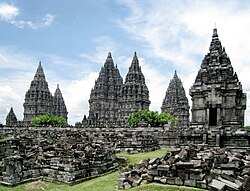
The Prambanan Temple Compounds, located on the border between the Special Region of Yogyakarta and Central Java in Indonesia, form a vast 9th-century Hindu-Buddhist temple complex renowned as the largest Hindu temple site in Indonesia and the second-largest in Southeast Asia after Angkor Wat.[1] Comprising over 500 stone temples across multiple groups, including the central Prambanan Temple (also known as Loro Jonggrang), Sewu Temple, Bubrah Temple, and Lumbung Temple, the site exemplifies classical Javanese architecture with its towering sikhara spires, intricate bas-reliefs depicting the Ramayana epic, and concentric layouts symbolizing the Hindu cosmic order.[1] Designated a UNESCO World Heritage Site in 1991 under criteria (i) for its architectural masterpiece and (iv) for its exemplary representation of Hindu art in Southeast Asia, the compounds highlight the harmonious coexistence of Hinduism and Buddhism during the Sailendra and Sanjaya dynasties.[1]
Historical Background
Constructed primarily between the 8th and 10th centuries CE, the Prambanan Temple Compounds were built under the patronage of the Sanjaya dynasty, with initial development attributed to Rakai Pikatan around 850 CE, as evidenced by the Shivagrha Inscription dated 856 CE.[2] The complex expanded during the reign of King Balitung (r. 898–910 CE), reflecting the kingdom's devotion to Shiva as the supreme deity, while incorporating Buddhist elements in nearby temples like Sewu.[2] Abandoned following earthquakes and volcanic eruptions in the 11th century, the site lay buried until its rediscovery in the 17th century by Dutch colonial explorers, with systematic excavations and restorations commencing in 1918 under Dutch and Indonesian efforts.[1] Further damage from the 2006 Yogyakarta earthquake prompted ongoing international conservation, reinforcing its status as a national cultural property since 1998.[1]Architectural and Artistic Features
The core of the compounds centers on the Prambanan Temple group, featuring three main shrines dedicated to the Trimurti—Shiva (47.6 meters tall), Vishnu, and Brahma—flanked by temples for their divine mounts (Nandi, Garuda, and Hamsa) and hundreds of smaller perwara temples arranged in rows.[1] Each temple rises on a stepped base with narrative relief panels illustrating scenes from the Ramayana epic, showcasing exquisite stone carving techniques influenced by Indian Pallava and Chola styles adapted to local Javanese aesthetics.[1] The layout follows a sacred mandala pattern with four concentric courtyards: an outer perimeter of 224 minor temples, a middle ring of four main temples, and an inner sanctum housing the Trimurti shrines, all constructed from andesite volcanic stone without mortar.[2] Adjacent Buddhist complexes like Sewu, with its 249 stupas and central Candi Sewu, demonstrate syncretic religious architecture, where Hindu and Buddhist motifs blend seamlessly.[1]Cultural and Religious Significance
As a pinnacle of ancient Indonesian civilization, Prambanan symbolizes the peak of Mataram Kingdom's artistic and spiritual achievements, serving as a royal worship site for Shaivite rituals and epic storytelling that influenced Javanese performing arts, such as the annual Ramayana Ballet performed against the temple backdrop.[1] The site's legends, including the myth of Princess Roro Jonggrang who tricked a suitor into building a thousand temples overnight (hence the name Loro Jonggrang, meaning "Slender Virgin"), underscore its enduring role in local folklore and identity.[2] Today, it attracts over two million visitors annually, fostering cultural education, tourism, and interfaith dialogue while facing challenges from natural disasters and urbanization, managed under a 77-hectare preservation zone established by presidential decree in 1992.[2]Overview
Location and Setting
The Prambanan Temple Compounds are situated in central Java, Indonesia, at geographical coordinates 7°45′S 110°30′E, on the border between the Special Region of Yogyakarta and Central Java province. The site lies approximately 17 km northeast of Yogyakarta city, making it easily accessible for visitors from this cultural hub. To the north, Mount Merapi, Indonesia's most active volcano rising to 2,911 meters, stands about 25 km away, offering a striking volcanic backdrop that frames the temple skyline.[1][3][4] The compounds occupy the Prambanan Plain, also known as the Kewu Plain, a fertile expanse shaped by Java's volcanic geology and characterized by expansive agricultural fields of rice paddies and palm groves. The Opak River flows along the western boundary, historically shifting its course but providing a vital water source that defines the valley's lush, undulating terrain. This natural setting, with its rich volcanic soils and proximity to sacred landscape elements like rivers and mountains, was selected to align with Hindu principles of spiritual geography, where such features symbolize cosmic harmony and divine presence, facilitating rituals and meditative practices.[5][6][1] Integrated into the Prambanan Archaeological Park, which spans 39.8 hectares of landscaped grounds, the site supports modern tourism through well-maintained pathways, visitor centers, and shaded areas amid the ruins. Accessibility is enhanced by the main Yogyakarta-Solo highway, allowing easy road travel from Yogyakarta in under an hour, while the nearby Prambanan train station—served by commuter lines from Yogyakarta and Solo—provides a convenient rail option just a 9-minute walk from the entrance.[4][5][7] The region's environmental challenges significantly impact preservation, with the site vulnerable to seismic activity along the nearby Opak fault, as evidenced by the damaging 2006 Yogyakarta earthquake that toppled carvings and structures. Volcanic threats from Mount Merapi, including ashfall and eruptions, further complicate maintenance, while seasonal erosion from monsoon rains and river proximity accelerates stone weathering. Its designation as a UNESCO World Heritage Site in 1991 informs park management strategies to mitigate these risks through reinforced zoning and conservation protocols.[1][8][9]Cultural and Religious Significance
The Prambanan Temple Compounds were inscribed on the UNESCO World Heritage List in 1991 under criteria (i), recognizing it as a masterpiece of human creative genius in Siva art that exemplifies Indonesia's classical culture, and (iv), acknowledging it as an outstanding example of a 10th-century religious complex and architectural ensemble unique among Siva temple sites. As the largest Hindu temple complex in Indonesia, comprising over 240 structures dedicated primarily to Shiva, it ranks as the second largest in Southeast Asia after Angkor Wat, underscoring its exceptional scale and artistic coherence.[1][10] The site represents a pinnacle of Hindu-Buddhist syncretism in ancient Java, embodying the Sanjaya dynasty's revival of Hinduism following the Sailendra dynasty's emphasis on Mahayana Buddhism, as evidenced by its construction as a counterpoint to nearby Buddhist temples like Sewu. Central to Shaivism, Prambanan serves as a grand expression of Trimurti worship, with its core temples honoring Shiva as the paramount deity alongside Vishnu and Brahma, their surrounding shrines for mythical mounts further illustrating this divine triad.[11][1] Prambanan's enduring influence on Javanese culture is evident in its role as the backdrop for Ramayana ballet performances, which adapt the epic narratives carved into the temple's reliefs—a tradition that preserves and popularizes ancient Hindu stories through dance, music, and drama. As a symbol of national identity, it reinforces Indonesia's multicultural heritage, bridging ancient religious traditions with contemporary expressions of artistry and unity.[1] Today, the compounds continue to host Hindu religious ceremonies and rituals, maintaining their spiritual vitality amid growing tourism, which saw over 2.5 million visitors in 2019 before the disruptions of the 2020s and approximately 1.4 million in 2023 as recovery continues. Conservation initiatives, coordinated by Indonesian authorities and UNESCO since the early 20th century, emphasize structural reinforcement against seismic threats and authentic restoration, ensuring the site's preservation as a living testament to cultural legacy.[12][13][1]History
Origins and Construction
The Prambanan Temple Compounds were initiated in the mid-9th century CE under the patronage of Rakai Pikatan, a ruler of the Sanjaya dynasty within the Mataram Kingdom of ancient Java. Construction likely began around 850 CE, serving as a prominent Hindu architectural assertion amid the Buddhist prominence of the rival Sailendra dynasty, exemplified by the nearby Borobudur temple.[11] This royal endeavor underscored the dynasty's devotion to Shaivism, with the complexes designed to honor Shiva as the supreme deity.[14] Primary evidence for the temple's origins stems from the Siwagrha inscription, a Sanskrit charter dated to 856 CE (778 Saka) issued during Rakai Pikatan's reign, which explicitly mentions the establishment of the Shiva temple, originally named Siwa Grha or "House of Shiva."[15] The inscription highlights the patronage's intent to create a sacred site, reflecting the political and religious dynamics of the era where Hindu and Buddhist elements coexisted, as seen in the syncretism with adjacent Buddhist complexes like Sewu.[14] Subsequent rulers, including Rakai Kayuwangi, continued and expanded the project, ensuring its completion over multiple phases.[11] The building process unfolded in stages, starting with the core Shiva temple and its platform, followed by the erection of flanking Vishnu and Brahma shrines to form the Trimurti triad, ultimately encompassing over 240 structures across the main compounds.[1] Builders employed locally sourced andesite stone from nearby rivers for the durable outer structures and volcanic tuff for foundational and inner elements, techniques that demonstrated advanced Javanese masonry without mortar, relying on precise interlocking.[16] [17] This labor-intensive effort mobilized thousands of workers, including skilled stone carvers and haulers, spanning several decades to achieve the compounds' monumental scale.[18][19] Architectural design drew heavily from Indian Gupta and post-Gupta styles, particularly in the tiered sanctuary towers (candi) and concentric layouts symbolizing Mount Meru, but adapted to local Javanese preferences with slender proportions and intricate local motifs.[20] This fusion is evident in the inclusion of perwara temples—smaller guardian shrines surrounding the main structures—to enhance ritual symmetry and cosmic representation.[21]Decline and Abandonment
The Prambanan Temple Compounds reached their peak of religious and cultural use during the 9th and early 10th centuries under the Mataram Kingdom, serving as a central site for Hindu worship. However, this period of prominence ended abruptly around 930 CE following natural disasters, possibly including a Merapi eruption, that devastated the region and prompted King Mpu Sindok to shift the kingdom's capital eastward to Watugaluh in present-day East Java, establishing the Isyana dynasty.[1][22] This political relocation marked the beginning of the temples' disuse, as the center of power and patronage moved away from Central Java, reducing maintenance and ritual activities at the site.[23] Compounding the effects of the earthquake were subsequent volcanic eruptions from nearby Mount Merapi, which buried significant portions of the temple structures under layers of ash, further accelerating their deterioration and contributing to their abandonment by approximately 1000 CE.[1][23] The Mataram Kingdom's economic decline, intertwined with these natural disasters and the loss of royal support, led to the site's neglect amid broader regional instability. Over the following centuries, particularly from the 15th to 18th centuries, looting intensified as local inhabitants and later colonial collectors removed sculptures and stones for trade, construction materials, or private collections, stripping away many ornate elements.[24][25] Natural processes exacerbated the damage, with the tropical climate promoting rapid vegetation overgrowth that enveloped the ruins and erosion that weakened the ancient stonework, leading to partial collapses across the compounds. Despite this, some elements endured: the Sewu Temple Complex retains several partially intact shrines, while the core Prambanan Shiva temple suffered a major collapse—likely from the initial earthquake and subsequent events—but its foundational base and surrounding perwara temples remained somewhat preserved beneath ash and foliage. This state of abandonment persisted until the site's rediscovery in the 19th century, which initiated efforts to halt further decay.[1][26]Rediscovery and Restoration
The Prambanan Temple Compounds were formally documented by Europeans following the visit of British surveyor Colin Mackenzie in 1811, during the short British administration of Java, when he sketched the ruins and reported on their significance. Local Javanese communities had long been aware of the site, but Mackenzie's work marked the beginning of scholarly interest under colonial rule. Subsequent Dutch colonial efforts included systematic surveys, with a notable exploration in 1805 led by engineer H.C. Cornelius, who produced detailed measurements and illustrations of the structures. These early activities laid the groundwork for later conservation, though full-scale interventions were delayed until the 20th century.[27][28] Major excavations and restoration commenced in 1918 under the auspices of the Dutch Archaeological Service, with architects like P.J. Perquin playing a key role in assessing structural stability and initiating disassembly for rebuilding. The process emphasized the anastylosis technique, which involves reassembling monuments using as many original stones as possible, adhering to a guideline that at least 75% of original materials must be available for reconstruction to proceed. Restoration of the core Shiva temple progressed intermittently through the colonial and independence eras, culminating in its completion and inauguration by President Sukarno in 1953; UNESCO provided technical assistance following the site's designation as a World Heritage property in 1991, supporting ongoing work that extended to 1993 for the main complex, where approximately 60% of stones in the Shiva temple are original and the rest incorporate modern reinforcements like concrete.[29][30][1] Restoration of the Sewu Temple complex, part of the broader compounds, began in the 1930s with Dutch-led efforts to clear debris and reassemble key structures, achieving completion of the main temple by 1993 through collaborative international funding and expertise. Challenges persisted, notably the 6.3-magnitude Yogyakarta earthquake on May 27, 2006, which damaged around 20 temples, including collapses of spires and relief panels in the Shiva and surrounding shrines, prompting emergency stabilization and a UNESCO-supported rehabilitation plan.[8] Today, the site is managed by the Balai Konservasi Cagar Budaya Borobudur under Indonesia's Ministry of Education, Culture, Research, and Technology, which oversees conservation through digital risk mapping projects initiated in 2019 to monitor vulnerabilities and anti-erosion measures like stone consolidation and vegetation control to combat weathering. While major temples like Shiva, Brahma, and Vishnu have been largely restored—Vishnu completed in 1991—numerous smaller structures remain incomplete or unrestored due to insufficient original materials, with ongoing efforts prioritizing structural integrity over full reconstruction. As of 2025, restoration efforts have revived 22 temples in the complex, supported by advanced 3D digital documentation projects for enhanced conservation.[31][32][33][34]Architectural Features
Design Principles and Layout
The Prambanan Temple Compounds follow the tri mandala layout, a spatial organization derived from ancient Hindu cosmology that divides the site into three concentric zones representing degrees of sanctity: the utama mandala at the core for divine presences, the madya mandala in the middle for ritual intermediaries, and the outer pawongan or nista mandala for communal access by pilgrims. This hierarchical arrangement structures over 240 temples in precise grid patterns, symbolizing the ordered universe and facilitating ritual progression from profane to sacred realms.[1][6] Structurally, the temples emphasize verticality through tall sikhara spires that evoke Mount Meru, the cosmic axis, crowned by ratna finials resembling jewels or thunderbolts to signify divine illumination. Antefixes along the eaves feature kala-makara motifs—fierce guardian heads—to protect against malevolent forces, while elevated base platforms incorporate dharmadhatu friezes illustrating foundational cosmic principles. These elements collectively project a sense of ascension and protection, aligning the architecture with Hindu philosophical ideals of harmony between earth and heavens.[35][6] The compounds employ andesite volcanic stone blocks meticulously cut and interlocked without mortar, relying on dovetail joints and gravitational stability for cohesion, which contributes to inherent earthquake resistance in a seismically active region. Temples are oriented along cardinal axes, often facing eastward, toward the rising sun in accordance with Hindu tradition. This engineering prioritizes durability and symbolic alignment over ornamentation alone.[36][1] Syncretic influences manifest in the harmonious integration of Hindu and Buddhist architectural motifs across the compounds, reflecting religious coexistence in ancient Java, with perwara ancillary temples—numbering 224 in the main Prambanan group—arranged to complete the cosmic mandala and balance divine energies. These subsidiary structures, smaller in scale, encircle the central shrines to embody the multiplicity of the universe and communal devotion.[1][35]Sculptures and Relief Narratives
The sculptures and relief narratives of the Prambanan Temple Compounds represent a pinnacle of 9th-10th century Central Javanese artistry, blending Hindu iconography with local stylistic adaptations to convey mythological tales and spiritual symbolism.[1] The intricate bas-reliefs, primarily carved on the balustrades and walls of the main temples, depict sequential episodes from the Ramayana epic, an Indonesian variant distinct from the Sanskrit original, illustrating Rama's exile, Sita's abduction by Ravana, and the ensuing battle, across 54 panels (24 on the Shiva Temple and 30 on the Brahma Temple).[37] These narratives, executed in a refined narrative style with detailed figures in dynamic poses, emphasize moral and devotional themes central to Shaivite Hinduism, with each panel transitioning fluidly to form a continuous frieze readable in a clockwise circumambulation.[37] Complementing the Ramayana are reliefs depicting Krishna's story (Krishnayana) from the Bhagavata Purana on the Vishnu Temple, focusing on his boyhood exploits and divine interventions, rendered in 30 panels that highlight themes of preservation and cosmic order.[38] Additional panels across the complex portray Lokapala guardians of the cardinal directions and Tandava dance sequences inspired by the Natyashastra, featuring male dancers executing various karanas (dance poses) from the Natyashastra, with approximately 53 identified, accompanied by instruments, symbolizing Shiva's cosmic rhythm and possibly reflecting Tantric influences.[39] The overall iconography draws from Indian treatises like the Silpasastra, adapting flat, two-dimensional Indian prototypes into more volumetric Javanese forms with exaggerated expressions and fluid drapery, evolving from earlier Borobudur styles toward a greater emphasis on depth and movement.[40] Deity sculptures within the sanctums exemplify this artistic maturity, most notably the 3-meter-high statue of Shiva Mahadeva in the main chamber of the Shiva Temple, depicted with four arms holding a trident, rosary, and fly-whisk, seated on a lotus cushion beneath a nimbus of flames, embodying the supreme deity's meditative poise.[40] Flanking chambers house subsidiary figures like the ascetic Agastya with a water pot and goatee, the elephant-headed Ganesha wielding an axe and broken tusk, and the eight-armed Durga Mahishasuramardini triumphing over the buffalo demon, all carved in andesite stone with attributes denoting their roles in the Trimurti pantheon.[40] In the Brahma and Vishnu Temples, 2.4-meter Brahma with four faces and Vishnu with club, discus, and conch further the triad, while the Sewu complex features four pairs of imposing Dwarapala guardian statues, over 2 meters tall, brandishing maces to ward off malevolent forces.[1] Celestial apsaras, or nymph-like dancers, appear in reliefs as graceful figures with flowing garments, enhancing the ethereal quality of the Tandava panels and symbolizing divine beauty.[40] Symbolic motifs permeate the carvings, with lotus blooms recurring as emblems of purity and enlightenment, often supporting divine figures or framing panels to evoke spiritual awakening.[40] Floral garlands, intertwined vines, and the distinctive "Prambanan motif"—featuring lions flanking wishing trees laden with gems, kinnaras (half-human, half-bird beings), and processions of rams and peacocks—adorn terrace walls and antefixes, representing abundance and cosmic harmony.[40] Kala-makara portals, with demonic heads and mythical aquatic beasts, guard entrances, while astronomical alignments are suggested in the 60 Ramayana scenes mirroring solar cycles and the temple's orientation toward sacred geography.[40] These elements integrate sculptures seamlessly into the temple's ritual pathways, guiding devotees through narrative and symbolic progression.[1] Preservation efforts have addressed extensive weathering and seismic damage, with many reliefs showing erosion from centuries of tropical exposure and volcanic activity, leading to the use of replicas for heavily deteriorated panels to protect originals housed in museums.[1] The 2006 Yogyakarta earthquake severely impacted the site, toppling sections of the Shiva Temple and cracking numerous carvings, including Durga's nose and Brahma's form, which had already suffered from earlier 19th-century excavations that discarded stones into nearby rivers.[8] Restoration since 1918 combines traditional anastylosis with modern techniques, such as concrete reinforcements for drainage, numerous panels, including 21 dance reliefs on the Shiva Temple, have been stabilized or replaced using historical photographs, though ongoing monitoring combats further erosion from humidity and seismic risks. By 2023, 22 additional temples in the complex had been restored, with ongoing efforts continuing as of 2025.[40][33]Core Temple Compounds
Prambanan Temple
The Prambanan Temple, also known as Candi Shiva Mahadeva, serves as the focal point and namesake of the Prambanan Temple Compounds, representing the pinnacle of 9th-century Hindu architecture in Indonesia. This central Hindu temple complex is dedicated to the Trimurti—the divine trinity of Shiva, Vishnu, and Brahma—and features a distinctive triple shrine arrangement at its core. The towering Shiva temple rises to 47 meters in height, flanked by the slightly shorter Vishnu and Brahma temples, each measuring approximately 33 meters tall, symbolizing the hierarchical supremacy of Shiva as the destroyer and paramount deity.[1][11] The complex's layout includes 16 principal temples within the inner courtyard, comprising the three main Trimurti shrines, their accompanying Apit temples acting as symbolic guardians, along with Kelir and Patok temples positioned at the gates and corners for protective purposes. In front of the Shiva temple stands the Nandi pavilion, housing a prominent statue of Nandi, Shiva's sacred bull mount, which underscores the temple's Shaivite emphasis. The inner sanctum of the Shiva temple contains a four-armed statue of Shiva Mahadeva standing on a lotus pedestal, surrounded by subsidiary chambers dedicated to deities like Ganesha and Durga, inviting devotees to approach the divine through ritual circumambulation. Beyond the inner area, the outer enclosures originally encompassed 224 smaller perwara temples arranged in four concentric rows, designed to create a sacred mandala-like progression from periphery to center, though many remain in ruins today.[1][11] Restoration efforts for the Prambanan Temple intensified after its partial reconstruction, with the main Shiva temple fully rebuilt and reconsecrated in 1953 using at least 75% original stones as per Indonesian heritage guidelines, prioritizing authenticity while incorporating modern reinforcements like concrete for stability. This work, initiated in the early 20th century and accelerated post-independence, has allowed visitor access to the upper levels of the Shiva temple, enabling exploration of its intricate interiors. Further conservation followed the 2006 Yogyakarta earthquake, with international efforts reinforcing structures as of 2025. The temple's walls are adorned with bas-relief panels narrating the Ramayana epic, particularly on the Shiva shrine's balustrades, which highlight themes of dharma and divine intervention while reinforcing Shiva's central role in the cosmic order.[1][11]Sewu Temple Complex
The Sewu Temple Complex, located 800 meters north of the main Prambanan temples, represents the largest Buddhist temple group in the Prambanan Temple Compounds and exemplifies 8th-century Javanese Mahayana Buddhist architecture. Constructed during the Sailendra dynasty's rule over the Mataram Kingdom, the complex was initiated around 782 CE under Rakai Panangkaran and completed by 898 CE during the reign of subsequent kings, including Indra, as evidenced by the 792 CE Manjusrigrha inscription discovered in 1960.[1][41] This inscription confirms the site's dedication as the "House of Manjusri," honoring the bodhisattva of transcendent wisdom (prajñā) and underscoring its role as a major center for Mahayana Buddhist practice, potentially incorporating tantric elements in its ritual functions.[41] The layout follows a classic mandala pattern, symbolizing the Buddhist cosmological universe with its concentric zones representing realms of existence, and comprises 249 structures in total. At the core stands the main Manjusrigrha temple, a cruciform edifice with a single garbhagriha (sanctum) accessed via an eastern entrance, surrounded by four prominent apit (directional) temples aligned to the cardinal points. Encircling these are multiple rings of smaller perwara temples—over 100 in the outermost rows—intended for ancillary shrines and offerings, though many remain in ruins. The poetic Javanese name "Sewu," meaning "thousand," evokes the complex's intended grandeur and multiplicity, reflecting Mahayana ideals of expansive enlightenment rather than a literal count.[1][42][41] Distinctive architectural elements include massive Dwarapala guardian statues—carved from single stone blocks approximately 2.3 meters tall—positioned in pairs at each of the four main gates, embodying protective dharmapala figures to ward off malevolent forces. The perimeter features arcaded walls with intricate niches, while the shrines once housed bronze statues comparable to those at Borobudur, including possible depictions of Vajrapani as a fierce protector bodhisattva in the apit temples. These features highlight the complex's emphasis on ritual protection and devotion within a serene, meditative environment.[1][43][44] Following its abandonment by the early 11th century due to natural disasters like earthquakes and eruptions, partial restoration commenced in 1918 under Dutch colonial efforts, with systematic reconstruction starting in the 1920s by the Archaeological Survey of the Dutch East Indies. Ongoing work by Indonesia's Balai Pelestarian Cagar Budaya has focused on stabilizing structures using traditional interlocking andesite blocks alongside modern reinforcements, particularly after the 2006 Yogyakarta earthquake damaged several perwara temples. This preservation underscores Sewu's enduring symbolic role in illustrating religious syncretism, coexisting harmoniously with adjacent Hindu sites.[1][45]Lumbung Temple
The Lumbung Temple is a smaller Buddhist temple complex located immediately north of the Sewu Temple Complex, forming part of the broader Buddhist zone in the Prambanan Temple Compounds. Constructed in the mid-9th century, around 850 AD, during the reign of the Mataram Kingdom, it represents a modest yet integral component of the site's religious landscape. The temple's design reflects the era's Buddhist architectural traditions, emphasizing symmetry and ritual space.[46][1] The structure comprises a single main temple, standing approximately 16 meters tall and measuring about 6 meters by 6 meters at its base, surrounded by 16 smaller perwara temples arranged in four rectangular rows of four. These ancillary temples, each roughly 1 meter high, were likely intended to house additional ritual objects or statues. The name "Lumbung," meaning "rice barn" in Javanese, originates from the complex's elevated, barn-like appearance, reminiscent of traditional Javanese granaries built on stilts to protect rice from floods and pests. The main temple features simple exterior decorations, including niches and altars originally designed to hold over 120 images of deities, with depictions of female figures adorning its walls; however, many statues have been lost or stolen over time. The reliefs are notably plain compared to other Prambanan sites, primarily consisting of subtle floral patterns that enhance the structure's serene aesthetic.[46][47][48] The temple's condition is remarkably well-preserved, owing to its burial under layers of volcanic ash and lava from eruptions of nearby Mount Merapi, which shielded it from weathering and looting for centuries. Restoration efforts began in the early 20th century as part of broader Prambanan conservation, with significant work on Lumbung occurring in the 1940s involving minimal reconstruction to retain original elements; further refinements continued into the 1990s. Functionally, it likely served as a secondary shrine for offerings and ancillary rituals supporting those at the grander Sewu Complex, providing spaces for devotees to place votive items and conduct smaller ceremonies.[1][49]Bubrah Temple
Bubrah Temple, situated southeast of the main Prambanan Temple in the Prambanan Temple Compounds, represents a minimalist open-air structure within the ancient Mataram Kingdom's religious landscape. The name "Candi Bubrah" derives from the Javanese word "bubrah," meaning "ruined," a designation given by locals due to its dilapidated condition when first documented.[50] Constructed in the late 9th century, it exemplifies the coexistence of Hindu and Buddhist elements in the broader temple group, though its specific dedication remains unclear from archaeological evidence.[51] The temple's design features a raised platform forming a staggered square base measuring approximately 19 meters on each side, with slight variations (19 m north, 19.60 m east, 19.30 m south, 19.50 m west). This platform is encircled by nine low stubs of perwara (subsidiary) temples, suggesting an intended layout for a modest ritual complex. Following full reconstruction efforts from 2011 to 2017, the site now includes a restored superstructure standing about 20.5 meters tall, incorporating original materials where possible to maintain authenticity. Notable elements include makara waterspouts along the base for drainage and symbolic purposes, alongside remnants of a Ganesha shrine, indicating Hindu influences despite the site's peripheral Buddhist associations in the compounds.[51] Archaeological excavation of Bubrah Temple contributed to broader Prambanan efforts starting in the mid-20th century, uncovering foundation stones and confirming the platform's original form amid extensive rubble. The 2017 restoration aligns with principles in Prambanan's conservation, balancing reconstruction with historical integrity.[51] Interpretively, Bubrah Temple offers key insights into the variability of ancient Javanese temple construction, serving as evidence of potentially unfinished projects or structures designed solely for temporary rituals, distinct from the more elaborate edifices like Prambanan itself. Its reconstructed state highlights practical and symbolic aspects of 9th-century architecture, where not all sites required full superstructures for spiritual function.[51]Surrounding Temples
Plaosan Temple Complex
The Plaosan Temple Complex, constructed in the early 9th century during the Mataram Kingdom, represents a remarkable example of religious syncretism, primarily Buddhist in character but incorporating Hindu elements. It was commissioned by Rakai Pikatan, a Hindu ruler from the Sanjaya dynasty, in honor of his wife, Queen Pramodhawardhani from the Buddhist Sailendra dynasty, whose influence is evident in the temple's design emphasizing Buddhist stupas and iconography. The complex is divided into two main sections: Plaosan Lor (northern) and Plaosan Kidul (southern), separated by a road and rice fields, with Plaosan Lor featuring twin main temples dedicated to male and female deities, surrounded by 174 ancillary structures including 116 stupas and 58 shrines arranged in a rectangular layout. Plaosan Kidul consists of smaller shrines and additional stupas, forming a cohesive ensemble that highlights the harmonious blend of faiths under the queen's patronage. Unique architectural features underscore the hybrid nature of the site, including standing statues of Buddha figures within the main shrines of Plaosan Lor and intricate reliefs depicting Vishnu alongside Buddhist motifs, symbolizing the integration of Hindu and Buddhist traditions. The temples are adorned with perforated stone elements on stupas allowing glimpses of interior icons, and extensive artificial moats and water channels facilitated ritual purification and symbolic offerings to invoke divine presence. These elements reflect the queen's role in promoting interfaith unity, as seen in the temple's inscriptions and decorative motifs like Kalpataru trees and winged conches that merge fertility symbols from both religions. The layout shares architectural parallels with the nearby Sewu Temple Complex, particularly in its use of perwara shrines and gated enclosures. Restoration efforts intensified in the post-1990s period following archaeological excavations that uncovered scattered artifacts and structural foundations, with only a small number of the ancillary temples restored to preserve its integrity.[52] Ongoing work, supported by national budgets, continues to address earthquake damage and erosion. In October 2025, the Indonesian Culture Minister inaugurated the restoration of an additional perwara temple (Series II No. 19).[53][54] As part of the UNESCO buffer zone for the Prambanan Temple Compounds World Heritage Site, Plaosan benefits from protective measures that regulate surrounding development to safeguard its cultural landscape.[1]Other Nearby Temples
Beyond the core temple compounds of Prambanan, a network of satellite temples extends across the surrounding plain, illustrating the expansive religious landscape of the ancient Mataram Kingdom in 9th-century Java. These sites, totaling over 20 minor temples within a 5 km radius, vary in scale and preservation, contributing to the UNESCO World Heritage designation of the Prambanan Temple Compounds as a testament to Hindu-Buddhist architectural integration.[1] Sambisari Temple, a 9th-century Hindu shrine dedicated to Shiva, exemplifies the region's volcanic history; it was accidentally discovered in 1966 by a local farmer whose tools struck buried andesite blocks, revealing the structure entombed approximately 5 meters beneath layers of volcanic ash from Mount Merapi's eruptions. The temple's main chamber houses a prominent linga and yoni pedestal, flanked by three smaller perwara shrines, with its underground placement preserving intricate carvings of floral motifs and mythical figures that highlight Sanjaya dynasty artistry.[55][56] To the west, the Barong Temple complex, dating to the 9th century, features a damaged yet expansive layout with multiple shrines arranged on three tiered platforms, reflecting a hierarchical ritual space typical of Hindu temple ensembles. Heavily impacted by earthquakes and erosion, its ruins include fragmented pedestals and walls adorned with faded reliefs, underscoring the vulnerability of these structures to natural disasters while preserving evidence of communal worship practices.[57] Kalasan Temple, an 8th-century Buddhist edifice completed in 778 AD as per its Sanskrit inscription, was constructed to honor the bodhisattva Tara and originally housed a large bronze statue of her in a seated position within its central chamber. The site's four inner rooms, designed for substantial sculptures, and its three-tiered roof with ratna pinnacle demonstrate early Sailendra influences, with archaeological finds of bronze fragments emphasizing the use of metal in Javanese Buddhist iconography.[58] Adjacent to Kalasan, Sari Temple serves as a well-preserved 8th-century Buddhist vihara, or monastery, characterized by its two-story design incorporating false windows and doorways that once framed wooden beams, floors, and stairs for monastic living—elements now decayed but evident in the stone framework. Its three internal chambers, connected by passages, served as living quarters for Buddhist monks, illustrating the blend of residential and devotional functions in Sailendra-era architecture.[56] Further exemplifying the site's diversity, Abang Temple stands as a ruined 9th-century structure with a pyramid-shaped base and central well, its fragmented stairs and platforms hinting at ritual bathing rites amid the broader Mataram expansion. These outliers, ranging from intact viharas like Sari to dilapidated shrines like Abang and Barong, collectively map a regional temple network that supported royal patronage and spiritual pluralism.[59] In modern times, these temples are woven into the Prambanan Archaeological Park's trail system, facilitating guided exploration while conservation efforts—overseen by Indonesia's Balai Pelestarian Cagar Budaya since the site's 1991 UNESCO inscription—restrict access to unstable ruins like Barong to prevent further degradation, balancing tourism with preservation.[1]References
- https://en.wikivoyage.org/wiki/Prambanan