


Community hub
Recent from talks
Contribute something
Nothing was collected or created yet.
Proxy server
View on Wikipedia

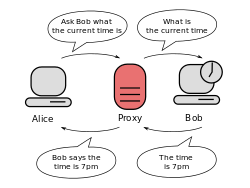
A proxy server is a computer networking term for a server application that acts as an intermediary between a client requesting a resource and the server then providing that resource.[1]
Instead of connecting directly to a server that can fulfill a request for a resource, such as a file or web page, the client directs the request to the proxy server, which evaluates the request and performs the required network transactions. This serves as a method to simplify or control the complexity of the request, or provide additional benefits such as load balancing, privacy, or security. Proxies were devised to add structure and encapsulation to distributed systems.[2] A proxy server thus functions on behalf of the client when requesting service, potentially masking the true origin of the request to the resource server.
Types
[edit]A proxy server may reside on the user's local computer, or at any point between the user's computer and destination servers on the Internet. A proxy server that passes unmodified requests and responses is usually called a gateway or sometimes a tunneling proxy. A forward proxy is an Internet-facing proxy used to retrieve data from a wide range of sources (in most cases, anywhere on the Internet). A reverse proxy is usually an internal-facing proxy used as a front-end to control and protect access to a server on a private network. A reverse proxy commonly also performs tasks such as load-balancing, authentication, decryption, and caching.[3]
Open proxies
[edit]
An open proxy is a forwarding proxy server that is accessible by any Internet user. In 2008, network security expert Gordon Lyon estimated that "hundreds of thousands" of open proxies are operated on the Internet.[4]
- Anonymous proxy: This server reveals its identity as a proxy server but does not disclose the originating IP address of the client. Although this type of server can be discovered easily, it can be beneficial for some users as it hides the originating IP address.
- Transparent proxy: This server not only identifies itself as a proxy server, but with the support of HTTP header fields such as
X-Forwarded-For, the originating IP address can be retrieved as well. The main benefit of using this type of server is its ability to cache a website for faster retrieval.
Reverse proxies
[edit]
A reverse proxy (or surrogate) is a proxy server that appears to clients to be an ordinary server. Reverse proxies send requests to one or more ordinary servers that handle the request. The response from the original server is returned as if it came directly from the proxy server, leaving the client with no knowledge of the original server.[5] Reverse proxies are installed in the vicinity of one or more web servers. All traffic coming from the Internet and with a destination of one of the neighborhood's web servers goes through the proxy server. The use of "reverse" originates in its counterpart "forward proxy" since the reverse proxy sits closer to the web server and serves only a restricted set of websites. There are several reasons for installing reverse proxy servers:
- Encryption/SSL acceleration: when secure websites are created, the Secure Sockets Layer (SSL) encryption is often not done by the web server itself, but by a reverse proxy that is equipped with SSL acceleration hardware. Furthermore, a host can provide a single "SSL proxy" to provide SSL encryption for an arbitrary number of hosts, removing the need for a separate SSL server certificate for each host, with the downside that all hosts behind the SSL proxy have to share a common DNS name or IP address for SSL connections. This problem can partly be overcome by using the SubjectAltName feature of X.509 certificates or the SNI extension of TLS.
- Load balancing: the reverse proxy can distribute the load to several web servers, each serving its own application area. In such a case, the reverse proxy may need to rewrite the URLs in each web page (translation from externally known URLs to the internal locations).
- Serve/cache static content: A reverse proxy can offload the web servers by caching static content like pictures and other static graphical content.
- Compression: the proxy server can optimize and compress the content to speed up the load time.
- Spoon feeding: reduces resource usage caused by slow clients on the web servers by caching the content the web server sent and slowly "spoon feeding" it to the client. This especially benefits dynamically generated pages.
- Security: the proxy server is an additional layer of defense and can protect against some OS and web-server-specific attacks. However, it does not provide any protection from attacks against the web application or service itself, which is generally considered the larger threat.
- Extranet publishing: a reverse proxy server facing the Internet can be used to communicate to a firewall server internal to an organization, providing extranet access to some functions while keeping the servers behind the firewalls. If used in this way, security measures should be considered to protect the rest of your infrastructure in case this server is compromised, as its web application is exposed to attack from the Internet.
Forward proxy vs. reverse proxy
[edit]A forward proxy is a server that routes traffic between clients and another system, which is in most occasions external to the network. This means it can regulate traffic according to preset policies, convert and mask client IP addresses, enforce security protocols and block unknown traffic. A forward proxy enhances security and policy enforcement within an internal network.[6] A reverse proxy, instead of protecting the client, is used to protect the servers. A reverse proxy accepts a request from a client, forwards that request to another one of many other servers, and then returns the results from the server that specifically processed the request to the client. Effectively a reverse proxy acts as a gateway between clients, users and application servers and handles all the traffic routing whilst also protecting the identity of the server that physically processes the request.[7]
Uses
[edit]Monitoring and filtering
[edit]Content-control software
[edit]A content-filtering web proxy server provides administrative control over the content that may be relayed in one or both directions through the proxy. It is commonly used in both commercial and non-commercial organizations (especially schools) to ensure that Internet usage conforms to acceptable use policy.
Content filtering proxy servers will often support user authentication to control web access. It also usually produces logs, either to give detailed information about the URLs accessed by specific users or to monitor bandwidth usage statistics. It may also communicate to daemon-based or ICAP-based antivirus software to provide security against viruses and other malware by scanning incoming content in real-time before it enters the network.
Many workplaces, schools, and colleges restrict web sites and online services that are accessible and available in their buildings. Governments also censor undesirable content. This is done either with a specialized proxy, called a content filter (both commercial and free products are available), or by using a cache-extension protocol such as ICAP, that allows plug-in extensions to an open caching architecture.
Websites commonly used by students to circumvent filters and access blocked content often include a proxy, from which the user can then access the websites that the filter is trying to block.
Requests may be filtered by several methods, such as a URL or DNS blacklists, URL regex filtering, MIME filtering, or content keyword filtering. Blacklists are often provided and maintained by web-filtering companies, often grouped into categories (pornography, gambling, shopping, social networks, etc.).
The proxy then fetches the content, assuming the requested URL is acceptable. At this point, a dynamic filter may be applied on the return path. For example, JPEG files could be blocked based on fleshtone matches, or language filters could dynamically detect unwanted language. If the content is rejected then an HTTP fetch error may be returned to the requester.
Most web filtering companies use an internet-wide crawling robot that assesses the likelihood that content is a certain type. Manual labor is used to correct the resultant database based on complaints or known flaws in the content-matching algorithms.[8]
Some proxies scan outbound content, e.g., for data loss prevention; or scan content for malicious software.
Filtering of encrypted data
[edit]Web filtering proxies are not able to peer inside secure sockets HTTP transactions, assuming the chain-of-trust of SSL/TLS (Transport Layer Security) has not been tampered with. The SSL/TLS chain-of-trust relies on trusted root certificate authorities.
In a workplace setting where the client is managed by the organization, devices may be configured to trust a root certificate whose private key is known to the proxy. In such situations, proxy analysis of the contents of an SSL/TLS transaction becomes possible. The proxy is effectively operating a man-in-the-middle attack, allowed by the client's trust of a root certificate the proxy owns.
Bypassing filters and censorship
[edit]If the destination server filters content based on the origin of the request, the use of a proxy can circumvent this filter. For example, a server using IP-based geolocation to restrict its service to a certain country can be accessed using a proxy located in that country to access the service.[9]: 3
Web proxies are the most common means of bypassing government censorship, although no more than 3% of Internet users use any circumvention tools.[9]: 7
Some proxy service providers allow businesses access to their proxy network for rerouting traffic for business intelligence purposes.[10]
In some cases, users can circumvent proxies that filter using blacklists by using services designed to proxy information from a non-blacklisted location.[11]

Logging and eavesdropping
[edit]Proxies can be installed in order to eavesdrop upon the data-flow between client machines and the web. All content sent or accessed – including passwords submitted and cookies used – can be captured and analyzed by the proxy operator. For this reason, passwords to online services (such as webmail and banking) should always be exchanged over a cryptographically secured connection, such as SSL.
By chaining the proxies which do not reveal data about the original requester, it is possible to obfuscate activities from the eyes of the user's destination. However, more traces will be left on the intermediate hops, which could be used or offered up to trace the user's activities. If the policies and administrators of these other proxies are unknown, the user may fall victim to a false sense of security just because those details are out of sight and mind. In what is more of an inconvenience than a risk, proxy users may find themselves being blocked from certain Web sites, as numerous forums and Web sites block IP addresses from proxies known to have spammed or trolled the site. Proxy bouncing can be used to maintain privacy.
Improving performance
[edit]A caching proxy server accelerates service requests by retrieving the content saved from a previous request made by the same client or even other clients.[12] Caching proxies keep local copies of frequently requested resources, allowing large organizations to significantly reduce their upstream bandwidth usage and costs, while significantly increasing performance. Most ISPs and large businesses have a caching proxy. Caching proxies were the first kind of proxy server. Web proxies are commonly used to cache web pages from a web server.[13] Poorly implemented caching proxies can cause problems, such as an inability to use user authentication.[14]
A proxy that is designed to mitigate specific link related issues or degradation is a Performance Enhancing Proxy (PEPs). These are typically used to improve TCP performance in the presence of high round-trip times or high packet loss (such as wireless or mobile phone networks); or highly asymmetric links featuring very different upload and download rates. PEPs can make more efficient use of the network, for example, by merging TCP ACKs (acknowledgements) or compressing data sent at the application layer.[15]
Translation
[edit]A translation proxy is a proxy server that is used to localize a website experience for different markets. Traffic from the global audience is routed through the translation proxy to the source website. As visitors browse the proxied site, requests go back to the source site where pages are rendered. The original language content in the response is replaced by the translated content as it passes back through the proxy. The translations used in a translation proxy can be either machine translation, human translation, or a combination of machine and human translation. Different translation proxy implementations have different capabilities. Some allow further customization of the source site for the local audiences such as excluding the source content or substituting the source content with the original local content.
Accessing services anonymously
[edit]An anonymous proxy server (sometimes called a web proxy) generally attempts to anonymize web surfing. Anonymizers may be differentiated into several varieties. The destination server (the server that ultimately satisfies the web request) receives requests from the anonymizing proxy server and thus does not receive information about the end user's address. The requests are not anonymous to the anonymizing proxy server, however, and so a degree of trust is present between the proxy server and the user. Many proxy servers are funded through a continued advertising link to the user.
Access control: Some proxy servers implement a logon requirement. In large organizations, authorized users must log on to gain access to the web. The organization can thereby track usage to individuals. Some anonymizing proxy servers may forward data packets with header lines such as HTTP_VIA, HTTP_X_FORWARDED_FOR, or HTTP_FORWARDED, which may reveal the IP address of the client. Other anonymizing proxy servers, known as elite or high-anonymity proxies, make it appear that the proxy server is the client. A website could still suspect a proxy is being used if the client sends packets that include a cookie from a previous visit that did not use the high-anonymity proxy server. Clearing cookies, and possibly the cache, would solve this problem.
QA geotargeted advertising
[edit]Advertisers use proxy servers for validating, checking and quality assurance of geotargeted ads. A geotargeting ad server checks the request source IP address and uses a geo-IP database to determine the geographic source of requests.[16] Using a proxy server that is physically located inside a specific country or a city gives advertisers the ability to test geotargeted ads.
Security
[edit]A proxy can keep the internal network structure of a company secret by using network address translation, which can help the security of the internal network.[17] This makes requests from machines and users on the local network anonymous. Proxies can also be combined with firewalls.
An incorrectly configured proxy can provide access to a network otherwise isolated from the Internet.[4]
Cross-domain resources
[edit]Proxies allow web sites to make web requests to externally hosted resources (e.g. images, music files, etc.) when cross-domain restrictions prohibit the web site from linking directly to the outside domains. Proxies also allow the browser to make web requests to externally hosted content on behalf of a website when cross-domain restrictions (in place to protect websites from the likes of data theft) prohibit the browser from directly accessing the outside domains.
Malicious usages
[edit]Secondary market brokers
[edit]Secondary market brokers use web proxy servers to circumvent restrictions on online purchases of limited products such as limited sneakers[18] or tickets.
Implementations of proxies
[edit]Web proxy servers
[edit]Web proxies forward HTTP requests. The request from the client is the same as a regular HTTP request except the full URL is passed, instead of just the path.[19]
GET https://en.wikipedia.org/wiki/Proxy_server HTTP/1.1
Proxy-Authorization: Basic encoded-credentials
Accept: text/html
This request is sent to the proxy server, the proxy makes the request specified and returns the response.
HTTP/1.1 200 OK
Content-Type: text/html; charset UTF-8
Some web proxies allow the HTTP CONNECT method to set up forwarding of arbitrary data through the connection; a common policy is to only forward port 443 to allow HTTPS traffic.
Examples of web proxy servers include Apache (with mod_proxy or Traffic Server), HAProxy, IIS configured as proxy (e.g., with Application Request Routing), Nginx, Privoxy, Squid, Varnish (reverse proxy only), WinGate, Ziproxy, Tinyproxy, RabbIT and Polipo.
For clients, the problem of complex or multiple proxy-servers is solved by a client-server Proxy auto-config protocol (PAC file).
SOCKS proxy
[edit]SOCKS also forwards arbitrary data after a connection phase, and is similar to HTTP CONNECT in web proxies.
Transparent proxy
[edit]Also known as an intercepting proxy, inline proxy, or forced proxy, a transparent proxy intercepts normal application layer communication without requiring any special client configuration. Clients need not be aware of the existence of the proxy. A transparent proxy is normally located between the client and the Internet, with the proxy performing some of the functions of a gateway or router.[citation needed]
RFC 2616 (Hypertext Transfer Protocol—HTTP/1.1) offers standard definitions:
"A 'transparent proxy' is a proxy that does not modify the request or response beyond what is required for proxy authentication and identification". "A 'non-transparent proxy' is a proxy that modifies the request or response in order to provide some added service to the user agent, such as group annotation services, media type transformation, protocol reduction, or anonymity filtering".
TCP Intercept is a traffic filtering security feature that protects TCP servers from TCP SYN flood attacks, which are a type of denial-of-service attack. TCP Intercept is available for IP traffic only.
In 2009 a security flaw in the way that transparent proxies operate was published by Robert Auger,[20] and the Computer Emergency Response Team issued an advisory listing dozens of affected transparent and intercepting proxy servers.[21]
Purpose
[edit]Intercepting proxies are commonly used in businesses to enforce acceptable use policies and to ease administrative overheads since no client browser configuration is required. This second reason, however is mitigated by features such as Active Directory group policy, or DHCP and automatic proxy detection.
Intercepting proxies are also commonly used by ISPs in some countries to save upstream bandwidth and improve customer response times by caching. This is more common in countries where bandwidth is more limited (e.g. island nations) or must be paid for.
Issues
[edit]The diversion or interception of a TCP connection creates several issues. First, the original destination IP and port must somehow be communicated to the proxy. This is not always possible (e.g., where the gateway and proxy reside on different hosts). There is a class of cross-site attacks that depend on certain behaviors of intercepting proxies that do not check or have access to information about the original (intercepted) destination. This problem may be resolved by using an integrated packet-level and application level appliance or software which is then able to communicate this information between the packet handler and the proxy.
Intercepting also creates problems for HTTP authentication, especially connection-oriented authentication such as NTLM, as the client browser believes it is talking to a server rather than a proxy. This can cause problems where an intercepting proxy requires authentication, and then the user connects to a site that also requires authentication.
Finally, intercepting connections can cause problems for HTTP caches, as some requests and responses become uncacheable by a shared cache.
Implementation methods
[edit]In integrated firewall/proxy servers where the router/firewall is on the same host as the proxy, communicating original destination information can be done by any method, for example Microsoft TMG or WinGate.
Interception can also be performed using Cisco's WCCP (Web Cache Control Protocol). This proprietary protocol resides on the router and is configured from the cache, allowing the cache to determine what ports and traffic is sent to it via transparent redirection from the router. This redirection can occur in one of two ways: GRE tunneling (OSI Layer 3) or MAC rewrites (OSI Layer 2).
Once traffic reaches the proxy machine itself, interception is commonly performed with NAT (Network Address Translation). Such setups are invisible to the client browser, but leave the proxy visible to the web server and other devices on the internet side of the proxy. Recent Linux and some BSD releases provide TPROXY (transparent proxy) which performs IP-level (OSI Layer 3) transparent interception and spoofing of outbound traffic, hiding the proxy IP address from other network devices.
Detection
[edit]Several methods may be used to detect the presence of an intercepting proxy server:
- By comparing the client's external IP address to the address seen by an external web server, or sometimes by examining the HTTP headers received by a server. A number of sites have been created to address this issue, by reporting the user's IP address as seen by the site back to the user on a web page. Google also returns the IP address as seen by the page if the user searches for "IP".
- By comparing the results of online IP checkers when accessed using HTTPS vs. HTTP, as most intercepting proxies do not intercept SSL. If there is suspicion of SSL being intercepted, one can examine the certificate associated with any secure web site, the root certificate should indicate whether it was issued for the purpose of intercepting.
- By comparing the sequence of network hops reported by a tool such as traceroute for a proxied protocol such as HTTP (port 80) with that for a non-proxied protocol such as SMTP (port 25).[22]
- By attempting to make a connection to an IP address at which there is known to be no server. The proxy will accept the connection and then attempt to proxy it on. When the proxy finds no server to accept the connection, it may return an error message or simply close the connection to the client. This difference in behavior is simple to detect. For example, most web browsers will generate a browser created error page in the case where they cannot connect to an HTTP server but will return a different error in the case where the connection is accepted and then closed.[23]
- By serving the end-user specially programmed Adobe Flash SWF applications or Sun Java applets that send HTTP calls back to their server.
CGI proxy
[edit]A CGI web proxy accepts target URLs using a Web form in the user's browser window, processes the request, and returns the results to the user's browser. Consequently, it can be used on a device or network that does not allow "true" proxy settings to be changed. The first recorded CGI proxy, named "rover" at the time but renamed in 1998 to "CGIProxy",[24] was developed by American computer scientist James Marshall in early 1996 for an article in "Unix Review" by Rich Morin.[25]
The majority of CGI proxies are powered by one of CGIProxy (written in the Perl language), Glype (written in the PHP language), or PHProxy (written in the PHP language). As of April 2016, CGIProxy has received about two million downloads, Glype has received almost a million downloads,[26] whilst PHProxy still receives hundreds of downloads per week.[27] Despite waning in popularity[28] due to VPNs and other privacy methods, as of September 2021[update] there are still a few hundred CGI proxies online.[29]
Some CGI proxies were set up for purposes such as making websites more accessible to disabled people, but have since been shut down due to excessive traffic, usually caused by a third party advertising the service as a means to bypass local filtering. Since many of these users do not care about the collateral damage they are causing, it became necessary for organizations to hide their proxies, disclosing the URLs only to those who take the trouble to contact the organization and demonstrate a genuine need.[30]
Suffix proxy
[edit]A suffix proxy allows a user to access web content by appending the name of the proxy server to the URL of the requested content (e.g. "en.wikipedia.org.SuffixProxy.com"). Suffix proxy servers are easier to use than regular proxy servers, but they do not offer high levels of anonymity, and their primary use is for bypassing web filters. However, this is rarely used due to more advanced web filters.
Tor onion proxy software
[edit]
Tor is a system intended to provide online anonymity.[31] Tor client software routes Internet traffic through a worldwide volunteer network of servers for concealing a user's computer location or usage from someone conducting network surveillance or traffic analysis. Using Tor makes tracing Internet activity more difficult,[31] and is intended to protect users' personal freedom and their online privacy.
"Onion routing" refers to the layered nature of the encryption service: The original data are encrypted and re-encrypted multiple times, then sent through successive Tor relays, each one of which decrypts a "layer" of encryption before passing the data on to the next relay and ultimately the destination. This reduces the possibility of the original data being unscrambled or understood in transit.[32]
I2P anonymous proxy
[edit]The I2P anonymous network ('I2P') is a proxy network aiming at online anonymity. It implements garlic routing, which is an enhancement of Tor's onion routing. I2P is fully distributed and works by encrypting all communications in various layers and relaying them through a network of routers run by volunteers in various locations. By keeping the source of the information hidden, I2P offers censorship resistance. The goals of I2P are to protect users' personal freedom, privacy, and ability to conduct confidential business.
Each user of I2P runs an I2P router on their computer (node). The I2P router takes care of finding other peers and building anonymizing tunnels through them. I2P provides proxies for all protocols (HTTP, IRC, SOCKS, ...).
Comparison to network address translators
[edit]The proxy concept refers to a layer-7 application in the OSI reference model. Network address translation (NAT) is similar to a proxy but operates in layer 3.
In the client configuration of layer-3 NAT, configuring the gateway is sufficient. However, for the client configuration of a layer-7 proxy, the destination of the packets that the client generates must always be the proxy server (layer 7), then the proxy server reads each packet and finds out the true destination.
Because NAT operates at layer 3, it is less resource-intensive than the layer-7 proxy, but also less flexible. As we compare these two technologies, we might encounter a terminology known as 'transparent firewall'. Transparent firewall means that the proxy uses the layer-7 proxy advantages without the knowledge of the client. The client presumes that the gateway is a NAT in layer 3, and it does not have any idea about the inside of the packet, but through this method, the layer-3 packets are sent to the layer-7 proxy for investigation.[citation needed]
DNS proxy
[edit]A DNS proxy server takes DNS queries from a (usually local) network and forwards them to an Internet Domain Name Server. It may also cache DNS records.
Proxifiers
[edit]Some client programs "SOCKS-ify" requests,[33] which allows adaptation of any networked software to connect to external networks via certain types of proxy servers (mostly SOCKS).
Residential proxy (RESIP)
[edit]A residential proxy is an intermediary that uses a real IP address provided by an Internet Service Provider (ISP) with physical devices such as mobiles and computers of end-users. Instead of connecting directly to a server, residential proxy users connect to the target through residential IP addresses. The target then identifies them as organic internet users. It does not let any tracking tool identify the reallocation of the user.[34] Any residential proxy can send any number of concurrent requests, and IP addresses are directly related to a specific region.[35] Unlike regular residential proxies, which hide the user's real IP address behind another IP address, rotating residential proxies, also known as backconnect proxies, conceal the user's real IP address behind a pool of proxies. These proxies switch between themselves at every session or at regular intervals.[36]
Despite the providers assertion that the proxy hosts are voluntarily participating, numerous proxies are operated on potentially compromised hosts, including Internet of things devices. Through the process of cross-referencing the hosts, researchers have identified and analyzed logs that have been classified as potentially unwanted program and exposed a range of unauthorized activities conducted by RESIP hosts. These activities encompassed illegal promotion, fast fluxing, phishing, hosting malware, and more.[37]
See also
[edit]- Application firewall
- Captive portal
- Darknet
- Distributed Checksum Clearinghouse
- FreeProxy
- Internet privacy
- InterPlanetary File System
- Proxy pattern
- SMTP proxy
- Virtual private network
- Web accelerator which discusses host-based HTTP acceleration
- Web cache
References
[edit]- ^ Luotonen, Ari; Altis, Kevin (April 1994). "World-Wide Web Proxies" (PDF). Archived (PDF) from the original on 9 October 2016.
- ^ Shapiro, Marc (May 1986). Structure and Encapsulation in Distributed Systems: the Proxy Principle. 6th International Conference on Distributed Computing Systems. Cambridge, MA, USA. pp. 198–204. inria-00444651. Archived from the original on 26 December 2018. Retrieved 26 December 2018.ccç÷
- ^ "Proxy servers and tunneling". MDN Web Docs. Archived from the original on 26 November 2020. Retrieved 6 December 2020.
- ^ a b Lyon, Gordon (2008). Nmap network scanning. US: Insecure. p. 270. ISBN 978-0-9799587-1-7.
- ^ "Forward and Reverse Proxies". httpd mod_proxy. Apache. Archived from the original on 10 February 2011. Retrieved 20 December 2010.
- ^ "Difference between Forward Proxy and Reverse Proxy". GeeksforGeeks. 19 April 2023. Retrieved 24 October 2024.
- ^ Peers, Nick (2020). "Build Your First Reverse Proxy". Maximum PC.
{{cite web}}: Missing or empty|url=(help) - ^ Suchacka, Grażyna; Iwański, Jacek (7 June 2020). "Identifying legitimate Web users and bots with different traffic profiles — an Information Bottleneck approach". Knowledge-Based Systems. 197 105875. doi:10.1016/j.knosys.2020.105875. ISSN 0950-7051. S2CID 216514793.
- ^ a b "2010 Circumvention Tool Usage Report" (PDF). The Berkman Center for Internet & Society at Harvard University. October 2010. Archived (PDF) from the original on 18 January 2012. Retrieved 15 September 2011.
- ^ "How to Check if Website is Down or Working Worldwide". Hostinger. 19 November 2019. Archived from the original on 14 December 2019. Retrieved 14 December 2019.
- ^ "Using a Ninjaproxy to get through a filtered proxy". advanced filtering mechanics. TSNP. Archived from the original on 9 March 2016. Retrieved 17 September 2011.
- ^ "Caching Proxy". www.ibm.com. Retrieved 2 July 2023.
- ^ Thomas, Keir (2006). Beginning Ubuntu Linux: From Novice to Professional. Apress. ISBN 978-1-59059-627-2.
A proxy server helps speed up Internet access by storing frequently accessed pages
- ^ I. Cooper; J. Dilley (June 2001). Known HTTP Proxy/Caching Problems. IETF. doi:10.17487/RFC3143. RFC 3143. Retrieved 17 May 2019.
- ^ "Layering". Performance Enhancing Proxies Intended to Mitigate Link-Related Degradations. IETF. June 2001. p. 4. sec. 2.1. doi:10.17487/RFC3135. RFC 3135. Retrieved 21 February 2014.
- ^ "Hot Tactics For Geo-Targeted Ads on Google & Bing". October 2013. Archived from the original on 14 February 2014. Retrieved 7 February 2014.
- ^ "Firewall and Proxy Server HOWTO". tldp.org. Archived from the original on 23 August 2011. Retrieved 4 September 2011.
The proxy server is, above all, a security device.
- ^ "Sneaker Bot Supreme Proxy". GeoSurf. Archived from the original on 24 September 2017. Retrieved 24 September 2017.
- ^ "absolute-form". HTTP/1.1 Message Syntax and Routing. IETF. June 2014. p. 41. sec. 5.3.2. doi:10.17487/RFC7230. RFC 7230. Retrieved 4 November 2017.
a client MUST send the target URI in absolute-form as the request-target
- ^ "Socket Capable Browser Plugins Result in Transparent Proxy Abuse". The Security Practice. 9 March 2009. Archived from the original on 2 February 2010. Retrieved 14 August 2010.
- ^ "Vulnerability Note VU#435052". US CERT. 23 February 2009. Archived from the original on 10 July 2010. Retrieved 14 August 2010.
- ^ "Subversion Dev: Transparent Proxy detection (was Re: Introduction_". Tracetop.sourceforge.net. Archived from the original on 16 October 2015. Retrieved 16 November 2014.
- ^ Wessels, Duane (2004). Squid The Definitive Guide. O'Reilly. pp. 130. ISBN 978-0-596-00162-9.
- ^ Marshall, James. "CGIProxy". Archived from the original on 16 November 2018. Retrieved 12 November 2018.
- ^ "The Limits of Control". June 1996. Archived from the original on 6 August 2020. Retrieved 12 November 2018.
- ^ "Glype® Proxy Script". glype.com. Archived from the original on 3 January 2013. Retrieved 17 May 2019.
- ^ "PHProxy". SourceForge. Archived from the original on 14 March 2016. Retrieved 7 April 2016.
- ^ "Google Trends". Google Trends.
- ^ "Proxy Stats :: Get Proxi.es". getproxi.es. Archived from the original on 1 September 2021. Retrieved 5 September 2021.
- ^ Estrada-Jiménez, José (March 2017). "Online advertising: Analysis of privacy threats and protection approaches". Computer Communications. 100: 32–51. doi:10.1016/j.comcom.2016.12.016. hdl:2117/99742. ISSN 0140-3664. S2CID 34656772.
- ^ a b Glater, Jonathan (25 January 2006). "Privacy for People Who Don't Show Their Navels". The New York Times. Archived from the original on 29 April 2011. Retrieved 4 August 2011.
- ^ The Tor Project. "Tor: anonymity online". Archived from the original on 9 April 2010. Retrieved 9 January 2011.
- ^ Zwicky, Elizabeth D.; Cooper, Simon; Chapman, D. Brent (2000). Building Internet Firewalls (2nd ed.). O'Reilly. p. 235. ISBN 978-1-56592-871-8.
- ^ "What Is a Proxy Server and How Does It Work?". IPRoyal.com. 17 April 2023. Retrieved 2 July 2023.
- ^ Smith, Vincent (2019). Go Web Scraping Quick Start Guide: Implement the power of Go to scrape and crawl data from the web. Packt Publishing Ltd. ISBN 978-1-78961-294-3. Archived from the original on 17 January 2023. Retrieved 19 November 2020.
- ^ Keenan, James. "What are Residential Proxies?". Smartproxy.com. Archived from the original on 26 December 2021. Retrieved 26 December 2021.
- ^ Mi, Xianghang; Feng, Xuan; Liao, Xiaojing; Liu, Baojun; Wang, XiaoFeng; Qian, Feng; Li, Zhou; Alrwais, Sumayah; Sun, Limin; Liu, Ying (May 2019). Resident Evil: Understanding Residential IP Proxy as a Dark Service. 2019 IEEE Symposium on Security and Privacy (SP). pp. 1185–1201. doi:10.1109/SP.2019.00011. ISBN 978-1-5386-6660-9. S2CID 132479013.
External links
[edit]Proxy server
View on GrokipediaDefinition and Fundamentals
Core Concept and Functionality
A proxy server serves as an intermediary system in computer networks, positioned between client devices seeking resources and the origin servers providing them. Clients configure their applications to route requests through the proxy, which then forwards these requests to the destination server while potentially altering headers, authenticating users, or applying filters. Upon receiving the server's response, the proxy relays it back to the client, often after processing such as caching or content modification. This setup enables the proxy to handle multiple clients simultaneously, optimizing resource access without direct client-server connections.[10][2][11] At its core, the functionality revolves around request interception and mediation, typically operating at the application layer for protocols like HTTP or SOCKS. The proxy evaluates incoming requests for compliance with policies, such as blocking malicious sites or enforcing bandwidth limits, before establishing its own outbound connection to the target. By substituting its own IP address in communications, the proxy conceals the client's identity, facilitating anonymity or bypassing geo-restrictions. Caching further enhances efficiency by storing copies of responses locally, serving repeated requests from memory to minimize latency and upstream traffic.[5][6][12] In technical terms, as outlined in HTTP specifications, a proxy implements both client and server behaviors to bridge incompatible systems or enforce intermediaries. For instance, in HTTP/1.1, proxies handle methods like CONNECT for tunneling non-HTTP traffic, ensuring seamless data flow while maintaining session integrity. This dual role allows proxies to log transactions for auditing, compress payloads for bandwidth savings, or integrate with firewalls for layered security, making them essential for controlled network environments.[13][14][8]Architectural Principles and Data Flow
A proxy server operates on the principle of intermediary mediation in client-server communications, positioning itself between a client device and a target server to handle request forwarding and response relaying. This architecture enables centralized control over network traffic, allowing the proxy to inspect, modify, or filter data packets without direct exposure of client-server endpoints. Fundamentally, proxies adhere to protocol-specific rules, such as those defined for HTTP in standards like RFC 7230, where the proxy parses incoming requests to extract destination details and user agents before establishing outbound connections.[2][10][5] The core data flow in a proxy-mediated transaction begins with the client directing its request—typically via TCP/IP—to the proxy's IP address and port, rather than the ultimate server's. The proxy then initiates a separate connection to the target server, encapsulates and forwards the original request payload, including headers for authentication or caching directives if applicable. Upon receiving the server's response, the proxy processes it according to configured policies, such as applying content compression or logging metadata, before transmitting it back to the client over the initial connection. This sequential interception and relaying ensures that the client's true network address remains concealed from the server, while the server's identity is abstracted from the client.[15][6][16] Architectural modularity allows proxies to layer additional functions atop basic forwarding, such as stateful session tracking for protocols like HTTPS, where the proxy may terminate the client-side TLS connection and re-encrypt outbound traffic to maintain end-to-end security illusions. In terms of causal efficiency, this design reduces direct peer-to-peer overhead by consolidating multiple client requests through a single proxy endpoint, minimizing connection establishment latency in high-volume scenarios. However, it introduces a single point of failure and potential bottlenecks, necessitating scalable implementations with load balancing. Proxies operating at the application layer (Layer 7 of the OSI model) can perform deep packet inspection for granular control, distinguishing them from lower-layer intermediaries like NAT routers.[17][18]Historical Development
Origins in Early Networking (1980s–1990s)
The term "proxy" entered networking terminology in 1986, when researcher Shapiro applied it to designate a local software object serving as a representative for a remote object in distributed systems, facilitating indirect communication to manage resource access and encapsulation.[19][3] This conceptualization aligned with the era's shift toward layered network architectures under TCP/IP protocols, where intermediaries helped bridge heterogeneous systems in environments like ARPANET successors and early university networks.[20] Proxy implementations proliferated in the early 1990s amid the World Wide Web's expansion, initially focusing on caching to alleviate bandwidth constraints on nascent internet infrastructure. Caching proxies stored frequently requested web pages locally, reducing redundant data transfers and latency for multiple clients sharing a connection.[21] A pivotal early deployment occurred at CERN in 1994, where the first dedicated proxy server functioned as a firewall intermediary, routing and filtering all external traffic to protect internal resources while enabling controlled web access for researchers.[22] This setup exemplified proxies' role in enforcing security boundaries between local networks and the broader internet, predating widespread commercial firewalls.[23] Open-source efforts further standardized proxy functionality during this period. The Squid proxy, developed in 1992 under the Harvest project at the University of California, San Diego, and the National Laboratory for Applied Network Research, introduced robust HTTP caching capabilities across Unix-like systems, supporting protocols beyond basic web traffic.[24] By the mid-1990s, application-layer proxy firewalls emerged, inspecting and proxying specific traffic types (e.g., HTTP) to block malicious payloads, marking a transition from simple packet filters of the 1980s to protocol-aware intermediaries.[25] These developments were driven by empirical needs in high-traffic academic and research networks, where direct client-server connections proved inefficient and vulnerable.[26]Expansion and Standardization (2000s–Present)
In the 2000s, proxy servers expanded significantly in corporate environments, where businesses deployed them to monitor employee internet usage, enforce content filtering, and implement security policies for network protection.[21] This period also saw growing recognition of proxies as privacy tools, with anonymous variants enabling users to conceal IP addresses amid rising concerns over online tracking.[27] Concurrently, the Tor Project released its initial software in September 2002, establishing a decentralized network of volunteer-operated proxies that route traffic through multiple layers ("onion routing") to enhance anonymity, initially building on U.S. Navy research from the 1990s.[28] Tor's development into a stable anonymity system by the mid-2000s facilitated its use in evading censorship, particularly in regions with restrictive internet controls like China's Great Firewall.[21] The 2010s marked further technological maturation, including the adoption of SSL-encrypted proxies for secure connections and enhanced reverse proxies for traffic distribution and performance optimization.[26] Residential proxies, leveraging IP addresses from real consumer devices via peer-to-peer networks, emerged around 2014, offering more credible emulation of organic user behavior for applications such as web scraping, ad verification, and market research, though they also enabled cybercrime by complicating detection.[29] These developments coincided with proxies' integration into broader cybersecurity practices, including DDoS mitigation and compliance with data privacy regulations like the EU's GDPR in 2018, which heightened demand for tools balancing access control with encryption.[26] Standardization efforts advanced proxy interoperability and security protocols. RFC 2817, published in May 2000, specified mechanisms for upgrading HTTP/1.1 connections to TLS within proxies, mandating end-to-end tunnels for intermediate operations to preserve security.[30] Later protocols, such as HTTP/2 (RFC 7540, May 2015), introduced multiplexing and header compression with proxy compatibility considerations, enabling efficient handling of concurrent streams. More recently, RFC 9484 (June 2023) defined a protocol for tunneling IP packets through HTTP servers acting as IP-specific proxies, supporting modern encapsulation needs like IPv6 over HTTP for enhanced flexibility in constrained environments.[31] These IETF contributions addressed evolving internet architectures, including cloud-native deployments, while proxies continued expanding into caching, geo-unblocking, and resource optimization roles.[21]Classification by Type
Forward Proxies
A forward proxy server functions as an intermediary between client devices within a private network and external internet resources, forwarding outbound requests from clients to destination servers while relaying responses back to the clients. Clients must be explicitly configured to route traffic through the proxy, which intercepts and potentially modifies requests for purposes such as access control or content inspection. This configuration distinguishes forward proxies from transparent proxies, where interception occurs without client awareness.[32][33] In operation, when a client initiates a request, the forward proxy evaluates it against predefined policies, such as URL filtering or authentication requirements, before transmitting it to the target server using the proxy's own IP address, thereby concealing the client's identity from the destination. Responses from the server are then returned to the proxy, which forwards them to the client after any necessary processing, such as caching frequently requested content to reduce bandwidth usage and improve latency. This mechanism supports load distribution across multiple backend servers for outgoing traffic, preventing bottlenecks during high-demand periods.[34][35][36] Forward proxies enable organizational enforcement of internet usage policies by blocking access to specific sites or protocols, enhancing security through malware scanning of downloads, and providing logging for compliance auditing. They also facilitate anonymity for clients by masking originating IP addresses, though this can be undermined if the proxy itself is identifiable or logs activity. Common implementations include open-source software like Squid, which supports HTTP, HTTPS, and FTP protocols, and configurations of Nginx or Apache adapted for proxying roles. Unlike reverse proxies, which protect backend servers by handling inbound requests, forward proxies prioritize client-side outbound traffic management and are typically deployed at network edges facing the internet.[37][33][38][39]Reverse Proxies
A reverse proxy is a server positioned between client devices and backend web servers, intercepting incoming requests from the internet and forwarding them to the appropriate backend server while returning the responses to the clients as if originating directly from the proxy itself.[18] This architecture conceals the identities and direct locations of the backend servers from external clients, enhancing operational security by limiting exposure of internal infrastructure details.[40] Unlike forward proxies, which operate on behalf of clients to access external resources, reverse proxies serve on behalf of servers to manage inbound traffic efficiently.[35] In terms of data flow, a client initiates an HTTP or HTTPS request directed at the reverse proxy's public IP address; the proxy evaluates the request—potentially based on URL paths, headers, or other criteria—and routes it to one or more backend servers, which process the request and send the response back through the proxy for delivery to the client.[41] This intermediary role enables additional processing layers, such as request modification, authentication enforcement, or traffic compression, before reaching the origin servers.[42] Reverse proxies commonly implement load balancing by distributing requests across multiple backend servers using algorithms like round-robin or least connections, thereby preventing any single server from becoming overwhelmed and improving overall system reliability and response times.[18] Caching represents another core functionality, where the reverse proxy stores frequently requested static content—like images, CSS files, or JavaScript—locally, serving it directly to subsequent clients without querying the backend, which reduces latency and bandwidth usage on the origin servers.[43] For security, reverse proxies facilitate SSL/TLS termination, decrypting incoming encrypted traffic at the proxy edge to offload computational overhead from backend servers, while also enabling inspection for threats such as SQL injection or cross-site scripting via integrated web application firewalls (WAFs).[44] They further bolster protection by rate-limiting requests to mitigate denial-of-service attacks and by providing a single point for access controls, ensuring only authorized traffic proceeds inward.[45] Popular open-source software for deploying reverse proxies includes Nginx, which has supported reverse proxy capabilities since its initial release in 2004 and is widely used for its high performance in handling concurrent connections; HAProxy, optimized for TCP and HTTP-based load balancing since version 1.0 in 2001; and Caddy, a modern server with automatic HTTPS configuration introduced in 2015.[46][47] Commercial solutions like F5 BIG-IP extend these features with advanced analytics and global server load balancing for large-scale deployments.[41] Despite these benefits, reverse proxies introduce a potential single point of failure, necessitating high-availability configurations such as clustering or failover mechanisms to maintain service continuity.[48]Transparent and Intercepting Proxies
A transparent proxy, also known as an inline or forced proxy, intercepts network traffic between clients and servers without requiring client-side configuration or awareness, routing requests transparently via network-level redirection such as policy-based routing or protocols like Web Cache Communication Protocol (WCCP).[49][50] Clients perceive a direct connection to the destination, while the proxy forwards unmodified requests, preserving the original client IP address in headers sent to the server, without adding indicators like "Via" or "X-Forwarded-For" that explicitly signal proxy involvement.[51] This interception occurs at Layer 4 (transport layer) or below, often using techniques like IP spoofing or port redirection to avoid altering application-layer data.[52] Intercepting proxies overlap significantly with transparent proxies but emphasize active intervention, where the proxy terminates the client connection, inspects or modifies content, and reinitiates a new connection to the destination server.[49] Unlike purely passive transparent forwarding, intercepting modes enable deep packet inspection, such as SSL/TLS decryption (via "SSL bumping") to scan encrypted HTTPS traffic for threats or policy enforcement, though this introduces man-in-the-middle risks if certificates are mishandled.[53] The terms are often used interchangeably, with "intercepting" highlighting the mechanism of compelled traffic diversion, as standardized in discussions of proxy deployment modes since at least RFC 1919 (1996), which contrasts "classical" client-configured proxies with transparent interception techniques.[52][49] These proxies are deployed in enterprise networks, ISPs, and firewalls to enforce content filtering without user opt-out, caching responses to reduce bandwidth usage (e.g., Squid proxy servers achieving up to 50% savings in repeated requests), and monitoring for compliance or security.[54][55] For instance, transparent proxies authenticate users on public Wi-Fi by redirecting unauthenticated traffic to login portals, while intercepting variants support DDoS mitigation through TCP SYN proxying, validating handshake completeness before forwarding to protect servers from flood attacks.[56][57] In web filtering, they block malware or restricted sites organization-wide, with implementations like FortiGate or Smoothwall using transparent modes to avoid DNS resolution conflicts that plague explicit proxies.[58][59]| Feature | Transparent Proxy | Intercepting Proxy (Active Mode) |
|---|---|---|
| Client Awareness | None; no configuration needed | None; interception hidden |
| Request Modification | Minimal; forwards as-is | Possible; inspects/modifies (e.g., HTTPS) |
| IP Preservation | Client IP visible to destination | Client IP visible; may add forwarding headers |
| Common Protocols/Tools | WCCP, iptables REDIRECT, policy routing | SSL bumping, Squid TPROXY |
| Primary Risks | Evasion via direct routing bypass | Certificate trust issues, privacy exposure |
Anonymizing Proxies (Open and Anonymous)
Anonymizing proxies function as intermediaries that substitute the client's IP address with the proxy's own in outbound requests, preventing destination servers from identifying the original requester.[63] This mechanism operates by the client establishing a connection to the proxy server, which then relays the request to the target, forwarding responses back through the same path while omitting or altering headers that could expose the client's identity. Anonymous variants specifically withhold indicators of proxy usage, such as the "Via" header in HTTP requests, which transparent proxies include to signal their presence, thereby offering level 2 anonymity where the proxy IP is visible but the intermediary nature is obscured from basic server logs.[64] Open proxies, a subset often employed for anonymization, accept unauthenticated connections from any internet user, making them publicly accessible without requiring credentials or prior configuration.[65] These emerged prominently in the late 1990s as misconfigured or intentionally exposed servers, with scans in 2018 detecting over 6,000 active open proxies globally, though their numbers fluctuate due to shutdowns and new exposures.[65] Unlike closed proxies restricted to specific networks or users, open ones enable broad access but introduce substantial risks, including widespread exploitation for spam distribution, credential stuffing attacks, and data exfiltration, as attackers leverage them to mask origins of illicit traffic.[66] The technical distinction between open and anonymous configurations lies in access control and header manipulation rather than core data flow; an open proxy can be anonymous if it strips identifying client details, but many public listings include semi-anonymous or lower-grade implementations prone to detection via behavioral anomalies like inconsistent latency or shared IP blacklisting.[64] Empirical studies reveal that 47% of examined open proxies inject advertisements into responses, 39% embed scripts for data harvesting, and 12% redirect to phishing sites, compromising user privacy despite the intent for concealment.[66] Security analyses from 2018 further indicate that over 90% of open proxies exhibit vulnerabilities such as unauthenticated remote code execution or logging of plaintext traffic, rendering them unreliable for genuine anonymity and often transforming them into honeypots operated by adversaries to monitor or infect users.[65] While intended for evading surveillance or geographic restrictions, anonymizing proxies of both open and anonymous types fail to provide robust protection against advanced tracing, as destination servers can infer proxy usage through traffic patterns or IP reputation databases, and the proxy operator retains visibility into unencrypted sessions.[67] Longitudinal evaluations confirm that free open proxies suffer high instability, with uptime below 50% in many cases, and frequent IP blocks by services like Google or financial institutions due to abuse histories.[68] Consequently, their deployment correlates with elevated risks of man-in-the-middle attacks, where intermediaries alter content or steal credentials, underscoring that true anonymity demands layered defenses beyond single-hop proxying.[65]Legitimate Applications
Performance Enhancement and Caching
Proxy servers enhance network performance by implementing caching mechanisms that store frequently requested resources locally or intermediately, thereby minimizing redundant data transfers across the network. When a client issues a request, the proxy checks its cache for a valid copy of the resource; if present and fresh according to expiration headers or validation protocols like HTTP conditional GET, it serves the cached version directly, avoiding round-trip latency to the origin server. This process leverages algorithms such as Least Recently Used (LRU) or machine learning-enhanced variants to manage cache eviction and hit rates, optimizing storage for high-demand content like static images, stylesheets, and scripts.[69][70] In forward proxy configurations, caching primarily benefits client-side networks by aggregating requests from multiple users, reducing outbound bandwidth consumption to the internet backbone. For instance, in organizational settings, a forward proxy can cache common web objects, yielding bandwidth savings of 40-70% through decreased repeated fetches of identical content. This is particularly effective in bandwidth-constrained environments, where the proxy's proximity to clients shortens delivery paths and accelerates perceived load times without altering origin server interactions.[71][72] Reverse proxies, positioned before origin servers, further amplify performance by distributing cached responses to inbound traffic, offloading computational and bandwidth demands from backend infrastructure. By serving cached static assets to geographically dispersed users—such as routing a Paris-based request from a local cache rather than a distant server—reverse proxies can drastically cut response times and eliminate server-side bandwidth usage for hits, enabling scalability for high-traffic sites. This caching layer integrates with load balancing to ensure even resource utilization, though effectiveness depends on cache coherence mechanisms to prevent staleness, such as periodic revalidation against origin timestamps.[18][73][74] Overall, these caching strategies yield measurable gains in throughput and efficiency, with studies indicating substantial reductions in network traffic and latency under heterogeneous bandwidth conditions, provided proxies are tuned for disk I/O and memory allocation to maximize hit ratios. However, performance benefits diminish if cache pollution from uncacheable dynamic content occurs or if validation overheads exceed savings in low-hit-rate scenarios.[75][76]Content Filtering, Monitoring, and Access Control
Proxy servers facilitate content filtering by intercepting user requests and inspecting them against predefined rules, such as URL blacklists, keyword matches, or content categories like adult material or social media, before forwarding or blocking them.[77][78] This process allows organizations to prevent access to malicious or unproductive sites, reducing risks from malware or distractions; for instance, forward proxies in corporate environments categorize and filter web traffic to enforce productivity policies.[16][79] Monitoring capabilities stem from proxies' role as traffic gateways, where they log details like visited URLs, timestamps, data volumes, and user identities, enabling administrators to audit usage patterns and detect anomalies without direct endpoint surveillance.[80][9] In enterprise networks, this logging supports compliance with regulations like data protection laws by tracking access to sensitive resources, though it raises privacy concerns if not paired with clear policies.[81][82] Access control is implemented through authentication mechanisms, such as requiring credentials or IP whitelisting, and granular policies like time-of-day restrictions or bandwidth limits per user group, ensuring only authorized personnel reach approved domains.[83][14] Schools and parental setups commonly deploy open-source tools like Squid proxy for these controls, blocking non-educational content during school hours or limiting children's exposure to harmful sites via customizable rulesets.[84][15] In government contexts, proxies enforce national-level filtering for security, such as blocking domains linked to threats, though implementations often extend to broader content restrictions analyzed under policies impacting internet infrastructure.[85][86] Overall, these functions enhance organizational oversight but depend on accurate rule configuration to avoid overblocking legitimate resources or underprotecting against evolving threats.[87][88]Anonymity, Geobypassing, and Censorship Evasion
Proxy servers enable a degree of anonymity by acting as intermediaries that forward client requests to destination servers, substituting the client's IP address with the proxy's own IP in the outgoing traffic, thereby concealing the original source from the target website.[8] Anonymous proxies further enhance this by omitting headers that identify the connection as proxied, such as the "Via" or "X-Forwarded-For" fields, reducing the likelihood of detection compared to transparent proxies.[63] However, this anonymity is partial and technically limited: proxies typically do not encrypt data in transit, exposing traffic to interception by intermediaries like ISPs or the proxy operator itself, unlike VPNs which tunnel and encrypt entire connections.[89] Moreover, the proxy server can log user activities, and if compromised or malicious, it may disclose or misuse client data, undermining privacy claims.[16] In geobypassing, users route traffic through proxies located in targeted geographic regions to circumvent content restrictions based on IP-derived location, such as accessing region-locked streaming services or websites.[90] For instance, a residential proxy with an IP from Italy allows a user elsewhere to appear as if browsing from Italy, potentially unlocking Italy-specific content on platforms enforcing geoblocking.[91] Residential proxies, sourced from real devices, evade detection more effectively than datacenter proxies, which are often blacklisted by services like Netflix or Hulu that actively scan and block known proxy IPs. Rotating residential proxies, which use residential IPs that change frequently (e.g., per request or session), offer enhanced reliability for evasion compared to static proxies by avoiding detection from IP reuse patterns or datacenter-like flags. Selecting such proxies with IPs precisely matching the target country's location further improves spoofing consistency, reducing risks from location mismatch checks. Empirical detection rates vary, but major providers reported blocking millions of proxy attempts daily as of 2023, prompting users to rotate IPs or chain proxies for sustained access.[90] Limitations persist, as unencrypted HTTP proxies leak location via DNS queries or WebRTC, and advanced services employ client-side fingerprinting to identify and restrict anomalous traffic patterns regardless of IP masking.[92] For censorship evasion, proxies facilitate access to blocked domains by relaying requests through uncensored exit points, a tactic employed in restrictive regimes like China's Great Firewall, where users connect to external proxies to reach prohibited sites such as Google or Twitter.[93] Tools like Freegate deploy dynamic proxy networks, automatically updating lists of operational servers to counter blocking, with studies indicating over 90% success rates for short-term circumvention in tested scenarios as of 2015.[94] In Iran, proxy-based techniques have demonstrated evasion of ISP-level blocks on specific relays, achieving connectivity in select networks despite national firewalls injecting false responses or throttling traffic.[95] Ephemeral browser-based proxies, such as those in the Flashproxy system integrated with Tor, further resist enumeration by rapidly cycling short-lived connections, though censors adapt by monitoring traffic volumes and blocking high-usage IPs, rendering static proxies ineffective within hours to days.[96] Overall, while proxies provide accessible entry points for evasion, their lack of obfuscation and reliance on discoverable endpoints enable systematic takedowns, with success hinging on rapid adaptation and low-profile usage rather than inherent robustness.[97]Security Hardening and Resource Protection
Reverse proxies enhance security by positioning themselves between external clients and internal servers, thereby concealing the IP addresses and direct access points of backend resources.[98] This architecture prevents attackers from targeting origin servers directly, as the proxy's IP address is exposed instead, reducing the attack surface exposed to the internet.[44] By intercepting and validating incoming requests, reverse proxies can enforce access controls, filter malicious traffic, and integrate with web application firewalls to mitigate threats such as SQL injection or cross-site scripting.[18] Proxies contribute to resource protection through mechanisms like SSL/TLS termination, where the proxy handles encryption and decryption of traffic, offloading computational demands from resource-constrained backend servers.[18] This allows origin servers to focus on application logic rather than cryptographic operations, preserving their performance under load. Additionally, proxies enable rate limiting to curb denial-of-service attempts by throttling excessive requests from individual sources, thereby safeguarding server availability.[99] In network hardening, proxy servers facilitate centralized logging and auditing of traffic, enabling administrators to detect anomalies and enforce policies that block unauthorized or invalid requests.[100] For distributed systems, proxy networks distribute incoming traffic across multiple backend instances via load balancing, enhancing resilience against volumetric attacks like DDoS by scaling capacity to match threat volumes.[101] Caching frequently requested static content at the proxy layer further protects resources by minimizing backend queries, which conserves bandwidth and reduces latency without compromising data integrity.[102]Security and Privacy Dimensions
Protective Mechanisms and Benefits
Proxy servers enhance network security by acting as intermediaries that inspect, filter, and mediate traffic between clients and external resources, thereby preventing direct exposure of internal systems to potential threats.[103] This mediation allows for deep packet inspection at the application layer, enabling the detection and blocking of malicious payloads that might evade simpler network-layer defenses.[104] A primary protective mechanism is IP address concealment, where the proxy masks the originating IP of clients or servers, reducing the risk of targeted attacks such as DDoS floods or reconnaissance scans directed at vulnerable endpoints.[44] For reverse proxies, this obscures backend server identities from public view, compelling attackers to engage the proxy first, which can be hardened with additional safeguards like rate limiting and anomaly detection.[18] Forward proxies similarly shield client identities, mitigating tracking by adversaries and limiting exposure during outbound connections.[105] Content filtering and malware protection represent another key benefit, as proxies can enforce policies to block access to known malicious domains, scan for embedded threats in downloads, and prevent the exfiltration of sensitive data.[11] By logging and auditing traffic, organizations gain visibility into potential breaches, facilitating rapid response and compliance with regulatory standards such as GDPR or HIPAA through controlled data flows.[106] Reverse proxies further bolster protection via integration with web application firewalls (WAFs), which scrutinize HTTP requests for common exploits like SQL injection or cross-site scripting, thereby reducing the attack surface of hosted applications.[98] This layered approach not only thwarts unauthorized access but also supports load distribution to prevent resource exhaustion from volumetric attacks, ensuring service continuity under stress.[107] Overall, these mechanisms contribute to a defense-in-depth strategy, where proxies complement firewalls and intrusion detection systems to fortify network perimeters against evolving cyber threats.[5] Securing proxy tool usage requires evaluating software options, with open-source implementations preferred for code transparency that enables community auditing of vulnerabilities. Selection criteria should include community feedback, audit history indicating active development and no major security incidents, and usage records confirming absence of known backdoors or unauthorized data collection in proper configurations.[108][109]Inherent Vulnerabilities and Attack Vectors
Proxy servers inherently serve as centralized intermediaries for network traffic, creating a single point of failure that attackers can target to disrupt services or intercept communications. This architectural role amplifies risks, as a breach compromises all routed data, unlike decentralized systems where failures are isolated.[9][8] Compromised proxies can facilitate unauthorized access, data exfiltration, or redirection, particularly if trust is placed solely on the proxy without end-to-end verification mechanisms like TLS encryption.[110] A key attack vector is the man-in-the-middle (MitM) exploit, where attackers position themselves to eavesdrop or alter traffic if the proxy lacks proper encryption or certificate validation. In unencrypted HTTP proxy setups, this allows plaintext interception of credentials, sessions, or payloads, undermining the proxy's protective intent.[9][110] Even encrypted proxies risk exposure if keys are mismanaged or if attackers compromise the proxy itself, as seen in cases where forward proxies are trusted implicitly by clients.[111] Misconfiguration exposes proxies to hijacking, enabling abuse as open relays for spam, DDoS amplification, or anonymous attacks. Open proxies, often resulting from default settings or overlooked access controls, increase attack surfaces by allowing unauthorized chaining, where multiple proxies obscure attacker origins while multiplying bandwidth demands on victims.[8][112][113] Attackers scan for such proxies using tools like ZMap, exploiting them to bypass IP bans or launch volumetric DDoS floods, as documented in campaigns targeting CDN proxies since at least 2018.[112] DNS spoofing and cache poisoning target proxies handling name resolution, injecting false records to redirect traffic to malicious endpoints. This vector succeeds against proxies with vulnerable caching without DNSSEC validation, enabling phishing or malware delivery under the guise of legitimate domains; historical incidents, such as Kaminsky's 2008 disclosure, highlighted proxies' susceptibility when integrated with unhardened resolvers.[110][114] Reverse proxies face specialized threats like FrontJacking, where attackers exploit shared hosting misconfigurations—such as Nginx setups with wildcard certificates—to front legitimate services with malicious content, bypassing backend protections. Demonstrated in 2023, this affects self-managed proxies without strict domain isolation, allowing certificate reuse for phishing domains.[115] Logging vulnerabilities compound risks, as proxies store traffic metadata or payloads for auditing, which, if inadequately secured, leads to data exposure during breaches; without rotation or encryption, logs become repositories for sensitive information like API keys.[9][111] Overall, these vectors stem from proxies' reliance on configuration integrity and operator diligence, with empirical data from vulnerability scanners showing persistent exposures in 20-30% of deployed instances due to outdated software or weak authentication.[116] Mitigation demands layered defenses, including regular patching and anomaly detection, as no proxy design eliminates the intermediary trust bottleneck.[117]Privacy Trade-offs and Limitations
While proxy servers can mask a client's original IP address from destination servers, they often fail to provide comprehensive privacy protections due to inherent architectural limitations. Standard proxy protocols like HTTP or SOCKS do not inherently encrypt the traffic passing through them, leaving data exposed to inspection by the proxy operator, network intermediaries, or even attackers on shared infrastructure.[10][8] This contrasts with end-to-end encryption protocols such as HTTPS, which protect content from the client to the destination but still reveal metadata like visited domains and data volumes to the proxy.[10] A primary trade-off arises from reliance on the proxy provider's integrity, as the server acts as a mandatory intermediary that can log, monitor, or alter unencrypted traffic without user knowledge. Free or public proxies exacerbate this risk, frequently operated by unverified entities that harvest user data for resale, inject advertisements, or distribute malware to offset costs.[118] Studies and user reports indicate that such proxies often employ insufficient security measures, leading to exploits like session hijacking or credential theft.[119][120] Even paid proxies demand scrutiny of logging policies, as operators may comply with legal requests or face breaches that expose stored access records.[9] Additional limitations include vulnerability to leaks that undermine IP obfuscation, such as DNS queries bypassing the proxy or WebRTC-enabled browser features revealing the true IP.[121][122] Misconfigurations, like improper handling of headers or protocol mismatches, can further expose client details, with tools demonstrating that up to certain percentages of proxies fail leak tests under real-world conditions.[123] Proxies also typically route only application-layer traffic for specific ports, leaving system-wide activities—like OS-level DNS or other protocols—unprotected and potentially traceable back to the user.[124] This selective coverage creates a false sense of anonymity, as correlation attacks using timing, traffic patterns, or compromised proxy nodes can deanonymize users, particularly in non-specialized setups lacking multi-hop routing or layered encryption.[125]Illicit and Malicious Uses
Facilitation of Cybercrime and Fraud
Proxy servers enable cybercriminals to obscure their true IP addresses and geographic locations, facilitating activities such as phishing, credential theft, and financial fraud by evading IP-based detection and rate-limiting mechanisms.[126] Residential proxies, which route traffic through legitimate residential IP addresses, are particularly favored for their appearance of authenticity, allowing attackers to bypass anti-fraud systems that flag datacenter or suspicious IPs.[29] These proxies provide access to vast pools of millions of IPs with precise location data, enabling targeted scams while mimicking organic user behavior.[29] In online fraud schemes, proxies support credential stuffing and account takeover attacks by enabling rapid IP rotation to circumvent login attempt thresholds and geographic restrictions. For instance, fraudsters deploy proxy chains—sequences of multiple proxies—to distribute traffic across compromised devices, making malicious actions appear to originate from victims' own systems, as seen in the 911 S5 residential proxy service compromise reported by the FBI in May 2024, where a backdoor allowed criminals to proxy nefarious traffic through infected endpoints.[127] Similarly, services like VIP72 have been exploited to provide proxies for identity theft and payment fraud, enabling perpetrators to test stolen credentials across e-commerce sites without triggering bans.[27] Phishing campaigns increasingly leverage reverse proxies, which intercept and relay traffic between victims and legitimate sites to steal session cookies and bypass multi-factor authentication (MFA). The EvilProxy toolkit, emerging as a phishing-as-a-service offering by September 2022, uses this method to proxy user sessions, facilitating real-time credential harvesting without alerting users to redirects.[128] Notable deployments include attacks on job platform Indeed in October 2023 and cloud service account takeovers in August 2023, where attackers manipulated proxied connections to capture MFA tokens.[129] [130] Click fraud and ad abuse represent another vector, where proxy networks simulate diverse user sessions to generate illegitimate clicks on pay-per-click advertisements or abuse affiliate programs. Attackers employ residential proxies or VPN-proxied connections to mask repeated activity from the same source, sustaining fraud until detection thresholds are exceeded.[131] Proxy browsers, automated tools chaining multiple proxies, further automate this by emulating human browsing patterns across geographies, complicating fraud prevention efforts reliant on IP reputation scoring.[126] Such tactics contribute to broader cybercrime ecosystems, where anonymized proxy access lowers barriers for distributed denial-of-service (DDoS) amplification or spam distribution, though specific proxy-attributable losses remain challenging to isolate amid the FBI's reporting of over 790,000 internet crime complaints in 2021 alone.[132]Evasion of Regulations and Enforcement
Proxy servers enable users to mask their true IP addresses and geographic locations, facilitating the circumvention of regulatory restrictions imposed by governments or financial institutions. By routing traffic through intermediary servers in permitted jurisdictions, actors can simulate compliance with laws such as trade sanctions or investment prohibitions, thereby evading automated enforcement mechanisms like geoblocking or IP-based transaction screening.[133] This technique exploits the reliance of regulatory systems on visible origin data, allowing prohibited entities to access global markets or services that would otherwise deny them based on their actual location.[134] In sanctions enforcement, proxy servers have been instrumental in schemes to bypass U.S. and EU restrictions on Russia following the 2022 invasion of Ukraine. For instance, on April 20, 2022, the U.S. Department of the Treasury's Office of Foreign Assets Control (OFAC) designated a network of facilitators who utilized proxy infrastructure to obscure the involvement of sanctioned Russian entities in malign activities, including technology procurement and influence operations.[134] Residential proxies, which leverage IP addresses from real consumer devices, pose a particular challenge to sanctions compliance because they mimic legitimate user traffic, evading detection by traditional geolocation tools like those from MaxMind.[133] These proxies enable account takeovers (ATO) and fraudulent transactions by making sanctioned actors appear to operate from non-restricted countries, with reports indicating their role in billions of dollars in illicit financial flows.[133] Beyond international sanctions, proxies aid in evading domestic regulations, such as gambling laws in the United States. Proxy betting schemes involve users employing proxy servers to falsify their location and access online sportsbooks in states where they are not legally permitted to wager, undermining geofencing enforced by operators under regulatory mandates.[135] A notable case occurred in 2023 when authorities investigated land-based proxy betting rings that extended to digital methods, highlighting how such tools allow bettors to circumvent state-specific licensing and age verification by routing connections through compliant regions.[135] Enforcement agencies have responded by targeting proxy networks; for example, in May 2024, international operations dismantled the 911 S5 botnet, which infected over 19 million IP addresses to provide proxy services facilitating fraud and regulatory evasion, including access to restricted financial platforms.[136] Regulatory bodies increasingly view proxy-facilitated evasion as a systemic risk, prompting enhanced monitoring and legal actions against proxy providers. In November 2023, law enforcement disrupted the IPStorm botnet, a proxy service exploited for ad fraud and DDoS attacks that also enabled bypassing content and transaction regulations.[137] Similarly, operations in May 2025 targeted 5socks and Anyproxy services, which criminals rented to violate platform policies and financial controls, demonstrating proxies' dual role in both enabling and attracting enforcement scrutiny.[138] Despite these crackdowns, the decentralized nature of proxy networks—often built on compromised IoT devices—complicates complete eradication, as new infrastructures emerge to replace dismantled ones.[139]Ethical Concerns in Proxy Sourcing
Residential proxies, which utilize IP addresses from genuine consumer broadband connections to mimic organic traffic, raise significant ethical concerns in their sourcing practices. Many providers obtain these IPs through non-consensual means, such as infecting devices with malware to form botnets that hijack user bandwidth without permission, thereby violating user privacy and autonomy.[140] This practice exposes unwitting device owners to risks including data interception by proxy operators or downstream users, potential implication in illegal activities conducted via their IPs, and increased vulnerability to further cyberattacks.[141] Ethical lapses in sourcing also extend to embedding hidden software development kits (SDKs) in legitimate apps, which covertly route traffic through users' devices without transparent disclosure, deceiving users who download software for unrelated purposes.[142] Such unethical methods have precipitated legal repercussions, including class-action lawsuits against providers relying on botnet-sourced IPs, as these contravene computer fraud and abuse statutes by accessing systems without authorization.[140] Proxy networks derived from malware-compromised devices often originate in regions with lax enforcement, exploiting economically disadvantaged users whose devices are co-opted for profit, amplifying global inequities in digital resource control. Critics argue that even purportedly "ethical" opt-in models frequently involve opaque terms where participants, incentivized by minimal payments, underestimate the privacy forfeitures, such as logging of their traffic metadata or association with anonymized but traceable abuse.[143] In contrast, transparent sourcing demands explicit, informed consent and robust data protection, yet industry prevalence of questionable practices underscores a causal link between lax oversight and normalized privacy erosion.[144] Providers advocating ethical sourcing emphasize compliance with data protection regulations like GDPR to mitigate these issues, but empirical evidence from security analyses reveals persistent vulnerabilities in proxy pools, where up to significant portions trace to coerced endpoints.[145] This underscores the need for users to scrutinize provider transparency, as unethically sourced proxies not only endanger endpoint owners but also undermine trust in the broader proxy ecosystem by facilitating fraud and evading accountability.Technical Implementations
Protocol-Based Proxies (HTTP, SOCKS, DNS)
HTTP proxies function as intermediaries that handle Hypertext Transfer Protocol (HTTP) traffic, forwarding client requests to destination web servers while potentially modifying or inspecting the HTTP headers and body, including URL rewriting, header manipulation, and response alterations for applications such as ad blocking by filtering or removing ad-related content and geo-unlocking by spoofing location indicators.[146][90][147] Advanced HTTP proxies support scripting through modules, plugins, or JavaScript to dynamically alter requests and responses or execute timed tasks.[148] For HTTPS traffic, these proxies can employ man-in-the-middle (MITM) techniques, relying on a trusted root certificate authority (CA) installed on clients to generate certificates for target hostnames from predefined lists, enabling decryption and inspection; however, this introduces risks such as certificate validation warnings in non-trusting environments and potential security vulnerabilities from exposing decrypted data.[149] Clients configure their browsers or applications to route HTTP requests through the proxy, which then establishes a connection to the target server, relays the request, and returns the response, thereby masking the client's original IP address from the destination.[150] These proxies operate at the application layer and can support methods like GET, POST, and CONNECT for tunneling non-HTTP traffic over HTTP, though they typically require plaintext HTTP unless combined with HTTPS tunneling.[151] Common uses include content caching to reduce bandwidth usage, access control by filtering URLs, and logging for auditing, but they are limited to HTTP/HTTPS traffic and cannot handle arbitrary protocols without additional tunneling.[146] SOCKS proxies, named after the "Socket Secure" protocol, provide a protocol-agnostic tunneling service at the session layer, relaying TCP and, in later versions, UDP packets without parsing the application-layer data.[152] The protocol originated in the early 1990s, with SOCKS4 supporting only TCP connections over IPv4 addresses and basic no-authentication access, making it simpler but less secure and versatile.[153] SOCKS5, standardized in RFC 1928, extends capabilities to include UDP for applications like DNS or streaming, multiple authentication methods (e.g., username/password or GSS-API), domain name resolution at the proxy, and IPv6 support, enabling broader compatibility with modern networks and higher security against unauthorized access. Unlike HTTP proxies, SOCKS does not interpret payload content, allowing it to proxy any TCP/UDP-based traffic such as FTP, email, or torrenting, though it lacks built-in encryption or caching features inherent to protocol-specific proxies.[154] DNS proxies serve as forwarding agents for Domain Name System queries, intercepting client requests to resolve hostnames into IP addresses by querying upstream DNS servers on behalf of the client.[155] They enhance performance through local caching of recent resolutions, reducing latency and upstream server load; for instance, enterprise DNS proxies can store thousands of entries to serve repeated queries instantly.[156] Additional functions include policy enforcement, such as redirecting or blocking queries for malicious domains via predefined rules, and splitting DNS traffic to route internal queries separately from external ones for security isolation.[157] Unlike HTTP or SOCKS proxies, DNS proxies operate solely on UDP port 53 (or TCP for larger responses) and do not handle general data transfer, focusing instead on name resolution to support broader network functions like content filtering or threat prevention without altering application payloads.[158] This specialization makes them lightweight but limits their scope compared to multi-protocol handlers like SOCKS.[159]Software and Hardware Examples
Squid is a prominent open-source caching proxy server, initially developed in 1996 by the National Laboratory for Applied Network Research as a Harvest project offshoot, supporting HTTP, HTTPS, FTP, and other protocols for forwarding requests while optimizing bandwidth through object caching. It operates daemon-style on Unix-like systems and Windows, handling high-traffic scenarios with features like access controls and logging, and remains actively maintained with version 6.10 released in September 2024. Nginx, released publicly on October 4, 2004, serves as both a web server and reverse proxy, excelling in load balancing, HTTP caching, and handling concurrent connections efficiently via an event-driven architecture. Its modular design allows extensions for protocols like SOCKS and supports SSL/TLS termination, making it suitable for forward and reverse proxy deployments in production environments.[160] HAProxy, an open-source TCP and HTTP load balancer and proxy first released in 2000, provides high availability through features like health checks, SSL offloading, and content-based routing, with version 3.0 introduced in June 2025 for enhanced HTTP/3 and QUIC support. It is daemon-based and configurable via text files, commonly deployed for reverse proxying in clustered setups without requiring a full web server stack.[160] mitmproxy is an open-source interactive HTTPS proxy focused on debugging and traffic interception, allowing real-time modification of requests and responses through a console or web interface, with its 11.0 version released in 2024 emphasizing Python scripting for custom addons.[161] Hardware proxy examples include dedicated appliances designed for enterprise web filtering and caching, such as SecPoint's Proxy Appliance, which integrates hardware acceleration for managing user access, blocking malicious content, and enforcing policies on outbound traffic.[162] These devices often combine custom ASICs for throughput with embedded software for protocol handling, contrasting software proxies by offering plug-and-play deployment without OS configuration.[163] Commercial hardware solutions like Proxidize's Proxy Builder servers support mobile proxy networks by accommodating up to 80 USB modems for 4G/5G connectivity, enabling scalable IP rotation for data-intensive applications on dedicated rack-mount chassis.[164] Such appliances prioritize reliability in bandwidth-constrained environments, though they require physical infrastructure maintenance unlike virtualized software alternatives.Specialized Networks (Tor, I2P)
Tor, or The Onion Router, implements onion routing to provide anonymity through a distributed network of volunteer-operated relays that function as multi-hop proxies. Traffic from a client is encrypted in multiple layers and routed via a circuit of typically three relays: an entry node, one or more middle nodes, and an exit node, with each relay decrypting only its layer to forward the data without knowing the full path or origin.[28] This architecture originated from research by the U.S. Naval Research Laboratory in the mid-1990s, with the initial public release of Tor software occurring in 2002, followed by the establishment of the Tor Project as a nonprofit in 2006.[28] The onion proxy component in Tor client software manages connections to the network, encapsulating application traffic and building circuits dynamically to obscure IP addresses and resist traffic analysis.[165] In contrast, the Invisible Internet Project (I2P) employs garlic routing, an extension of onion routing, to enable anonymous peer-to-peer communication within a fully internal network, where traffic does not typically exit to the clearnet. Messages are bundled into "cloves" grouped as "garlic," encrypted end-to-end, and routed through multiple tunnels created by participating nodes, enhancing resistance to timing attacks compared to Tor's fixed circuits.[166] I2P development began in 2002, focusing on hosting services like eepsites internally via cryptographic identifiers rather than DNS, with users acting as routers to distribute load and anonymity.[167] Unlike Tor's emphasis on low-latency access to external internet resources through exit nodes, I2P prioritizes high-availability internal applications such as file sharing and messaging, using outproxies sparingly for clearnet gateways.[168] Both networks specialize traditional proxy mechanisms by decentralizing relay selection and enforcing layered encryption, but Tor's design suits inbound anonymity for clearnet browsing, while I2P's garlic-based tunneling supports bidirectional, persistent anonymous services with stronger isolation from external observation.[168] Tor circuits last about 10 minutes before rotation to mitigate correlation risks, whereas I2P tunnels are shorter-lived and unidirectional for similar reasons.[165] These systems achieve causal anonymity through probabilistic path selection and volunteer diversity, though effectiveness depends on network size—Tor had over 6,000 relays as of 2023— and user practices avoiding identifiable patterns.[28]Comparisons to Related Technologies
Proxy vs. VPN and Encryption Tools
Proxy servers and virtual private networks (VPNs) both serve as intermediaries to route internet traffic and mask the originating IP address, but they differ fundamentally in scope, encryption, and security implications. A proxy typically operates at the application layer, forwarding requests for specific protocols such as HTTP or SOCKS, which allows selective traffic rerouting without affecting the entire network stack.[169] In contrast, a VPN establishes a secure tunnel at the network layer using protocols like OpenVPN or WireGuard, encapsulating and rerouting all device traffic through the VPN server, thereby providing comprehensive IP obfuscation for the whole connection.[89] [170] The most critical distinction lies in encryption: standard proxies do not encrypt data payloads, leaving traffic vulnerable to interception by intermediaries like ISPs or network observers, though they can mask the source IP for the proxied requests.[171] VPNs, however, employ end-to-end encryption (often AES-256) for all transmitted data, protecting against eavesdropping, man-in-the-middle attacks, and surveillance, which makes them superior for privacy in untrusted environments.[172] [173] This encryption overhead in VPNs can reduce speeds by 10-30% depending on the protocol and server load, whereas proxies generally impose minimal latency, making them preferable for high-throughput tasks like web scraping or geo-unblocking without full security needs.[174] [175] Compared to standalone encryption tools such as TLS (Transport Layer Security), proxies emphasize routing and anonymity over data confidentiality. TLS secures specific application-layer connections (e.g., HTTPS) by encrypting payloads between client and server endpoints but does not alter routing paths or hide the client's IP address from the destination or observers.[176] Proxies can integrate TLS for encrypted forwarding—known as HTTPS or SSL proxies—where the proxy handles the TLS handshake and relays encrypted traffic, but this still lacks the full-tunnel protection of VPNs and operates only on designated traffic.[177] [178] Unlike pure encryption tools, which focus solely on payload integrity and confidentiality without intermediary involvement, proxies introduce a potential single point of failure or logging risk at the proxy server itself.[179]| Feature | Proxy Server | VPN | Encryption Tools (e.g., TLS) |
|---|---|---|---|
| IP Address Masking | Yes, for proxied traffic only | Yes, for all device traffic | No |
| Data Encryption | Optional (e.g., via HTTPS proxy) | Yes, full tunnel (e.g., AES-256) | Yes, for specific connections |
| Scope | Application/protocol-specific | Entire network stack | Protocol/session-specific |
| Primary Use Case | Bypassing restrictions, caching | Comprehensive privacy/security | Securing data in transit |
| Performance Impact | Low latency | Higher due to encryption | Minimal, protocol-dependent |
Proxy vs. Network Address Translation (NAT)
Network Address Translation (NAT) and proxy servers both facilitate communication between private networks and the public internet by altering or intermediating IP traffic, but they operate at distinct protocol layers and serve different primary purposes. NAT, standardized in RFC 1631 in 1994 and widely deployed since the late 1990s to address IPv4 address exhaustion, rewrites IP packet headers to map multiple internal private addresses (e.g., from the 192.168.0.0/16 range) to a single public IP, often using port address translation (PAT) to distinguish sessions.[182][183] This process occurs transparently at the network layer (OSI Layer 3), without terminating connections or inspecting application data, enabling outbound traffic from devices behind a router while blocking unsolicited inbound connections by default.[184][185] Proxy servers, by contrast, function at the application layer (OSI Layer 7), acting as dedicated intermediaries that accept client requests, establish new connections to destination servers using the proxy's IP, and relay responses.[182][183] This allows proxies to parse protocols like HTTP or SOCKS, enabling features such as content caching, request modification, URL filtering, and user authentication via credentials, which NAT cannot perform due to its packet-level operation.[184][185] For instance, an HTTP proxy can cache static web resources to reduce bandwidth usage, a capability absent in NAT implementations.[182]| Aspect | Proxy Server | NAT |
|---|---|---|
| OSI Layer | Application (Layer 7); protocol-aware.[186][184] | Network (Layer 3); packet header modification only.[186][184] |
| Transparency | Non-transparent; terminates and re-initiates connections, potentially altering data.[185] | Transparent to endpoints; modifies packets in transit without session termination.[185] |
| Overhead | Higher; requires protocol handling and stateful processing.[182][187] | Lower; simple header rewriting with minimal state tracking.[182][187] |
| Security Features | Advanced: filtering, authentication, content inspection (limited for encrypted traffic).[184][183] | Basic: hides internal IPs but no deep inspection or authentication.[184][183] |
| Use Cases | Anonymity, caching, access control in enterprises (e.g., corporate firewalls).[182][183] | IP conservation in home/small networks; default in consumer routers since ~1998.[182][183] |
Proxy vs. Load Balancers and CDNs
A proxy server functions as an intermediary that forwards client requests to destination servers and relays responses back, potentially inspecting, modifying, or logging traffic at layers 4 through 7 of the OSI model.[188] In contrast, load balancers specialize in distributing incoming traffic across multiple backend servers using algorithms such as round-robin, least connections, or IP hashing to optimize resource utilization and prevent single points of failure.[189] While many load balancers operate as reverse proxies—handling requests on behalf of origin servers—they incorporate advanced features like real-time health checks, session persistence, and failover mechanisms that general proxies lack.[190] For instance, tools like HAProxy or NGINX can serve dual roles, but dedicated load balancers such as F5 BIG-IP emphasize scalability in multi-server environments over broader proxy functions like content modification.[191] Content Delivery Networks (CDNs) extend proxy-like behavior across a geographically distributed infrastructure of edge servers, which cache static assets (e.g., images, scripts) from an origin server to minimize latency and reduce origin load.[192] Unlike standalone proxies, which typically operate from a single location and forward requests without inherent geo-optimization, CDNs employ techniques like DNS-based anycasting or HTTP redirects to route users to the nearest edge node, often achieving sub-50ms response times for global audiences.[193] CDNs internally leverage reverse proxies for caching and compression but prioritize bandwidth savings—evidenced by providers like Cloudflare reporting up to 70% reductions in origin traffic—over the request inspection or anonymity features of general proxies.[192]| Aspect | Proxy Server | Load Balancer | CDN |
|---|---|---|---|
| Primary Focus | Intermediation, filtering, anonymity | Traffic distribution, high availability | Geo-distributed caching, low latency |
| Scope | Single or few endpoints | Multiple backend servers in cluster | Global edge network |
| Key Mechanisms | Request/response modification | Algorithms (e.g., round-robin), health checks | Caching, anycast routing |
| Layer of Operation | Primarily L7 (HTTP/SOCKS) | L4-L7, including TCP/UDP | L7 with DNS integration |
| Typical Deployment | Client-side (forward) or server-side (reverse) | Server-side for web/app scaling | Edge servers for content delivery |