



Community hub
Recent from talks
Contribute something
Nothing was collected or created yet.
Pseudorandom number generator
View on WikipediaA pseudorandom number generator (PRNG), also known as a deterministic random bit generator (DRBG),[1] is an algorithm for generating a sequence of numbers whose properties approximate the properties of sequences of random numbers. The PRNG-generated sequence is not truly random, because it is completely determined by an initial value, called the PRNG's seed (which may include truly random values). Although sequences that are closer to truly random can be generated using hardware random number generators, pseudorandom number generators are important in practice for their speed in number generation and their reproducibility.[2]
PRNGs are central in applications such as simulations (e.g. for the Monte Carlo method), electronic games (e.g. for procedural generation), and cryptography. Cryptographic applications require the output not to be predictable from earlier outputs, and more elaborate algorithms, which do not inherit the linearity of simpler PRNGs, are needed.
Good statistical properties are a central requirement for the output of a PRNG. In general, careful mathematical analysis is required to have any confidence that a PRNG generates numbers that are sufficiently close to random to suit the intended use. John von Neumann cautioned about the misinterpretation of a PRNG as a truly random generator, joking that "Anyone who considers arithmetical methods of producing random digits is, of course, in a state of sin."[3]
Potential issues
[edit]In practice, the output from many common PRNGs exhibit artifacts that cause them to fail statistical pattern-detection tests. These include:
- Shorter-than-expected periods for some seed states (such seed states may be called "weak" in this context);
- Lack of uniformity of distribution for large quantities of generated numbers;
- Correlation of successive values;
- Poor dimensional distribution of the output sequence;
- Distances between where certain values occur are distributed differently from those in a random sequence distribution.
Defects exhibited by flawed PRNGs range from unnoticeable (and unknown) to very obvious. An example was the RANDU random number algorithm used for decades on mainframe computers. It was seriously flawed, but its inadequacy went undetected for a very long time.
In many fields, research work prior to the 21st century that relied on random selection or on Monte Carlo simulations, or in other ways relied on PRNGs, were much less reliable than ideal as a result of using poor-quality PRNGs.[4] Even today, caution is sometimes required, as illustrated by the following warning in the International Encyclopedia of Statistical Science (2010).[5]
The list of widely used generators that should be discarded is much longer [than the list of good generators]. Do not trust blindly the software vendors. Check the default RNG of your favorite software and be ready to replace it if needed. This last recommendation has been made over and over again over the past 40 years. Perhaps amazingly, it remains as relevant today as it was 40 years ago.
As an illustration, consider the widely used programming language Java. Up until 2020, Java still relied on a linear congruential generator (LCG) for its PRNG,[6][7] which is of low quality (see further below). Java support was upgraded with Java 17.
One well-known PRNG to avoid major problems and still run fairly quickly is the Mersenne Twister (discussed below), which was published in 1998. Other higher-quality PRNGs, both in terms of computational and statistical performance, were developed before and after this date; these can be identified in the List of pseudorandom number generators.
Generators based on linear recurrences
[edit]In the second half of the 20th century, the standard class of algorithms used for PRNGs comprised linear congruential generators. The quality of LCGs was known to be inadequate, but better methods were unavailable. Press et al. (2007) described the result thus: "If all scientific papers whose results are in doubt because of [LCGs and related] were to disappear from library shelves, there would be a gap on each shelf about as big as your fist."[8]
A major advance in the construction of pseudorandom generators was the introduction of techniques based on linear recurrences on the two-element field; such generators are related to linear-feedback shift registers.
The 1997 invention of the Mersenne Twister,[9] in particular, avoided many of the problems with earlier generators. The Mersenne Twister has a period of 219 937 − 1 iterations (≈ 4.3×106001), is proven to be equidistributed in (up to) 623 dimensions (for 32-bit values), and at the time of its introduction was running faster than other statistically reasonable generators.
In 2003, George Marsaglia introduced the family of xorshift generators,[10] again based on a linear recurrence. Such generators are extremely fast and, combined with a nonlinear operation, they pass strong statistical tests.[11][12][13]
In 2006, the WELL family of generators was developed.[14] The WELL generators in some ways improves on the quality of the Mersenne Twister, which has a too-large state space and a very slow recovery from state spaces with a large number of zeros.
Counter-based RNGs
[edit]A counter-based random number generation (CBRNG, also known as a counter-based pseudo-random number generator, or CBPRNG) is a kind of PRNG that uses only an integer counter as its internal state:

They are generally used for generating pseudorandom numbers for large parallel computations, such as over GPU or CPU clusters.[15] They have certain advantages:
- The only "state" needed is the counter value and the key. For a given counter and key, the output is always the same. This property makes CBRNGs reproducible.
- Because each random number is computed independently of any previous outputs, they can be generated in parallel. For example, in a massively parallel application, each thread or GPU core can be assigned a range of counter values and compute random numbers without synchronization or shared state.
- Since the generator does not require stepping through every intermediate state, it can "jump" to any point in the sequence in constant time. This is particularly useful in applications like Monte Carlo simulations where independent streams are needed.
Examples include:[15]
- Philox: Uses multiplication-based mixing to combine the counter and key.
- Threefry: Based on a reduced-strength version of the Threefish block cipher.
Cryptographic PRNGs
[edit]A PRNG suitable for cryptographic applications is called a cryptographically-secure PRNG (CSPRNG). A requirement for a CSPRNG is that an adversary not knowing the seed has only negligible advantage in distinguishing the generator's output sequence from a random sequence. In other words, while a PRNG is only required to pass certain statistical tests, a CSPRNG must pass all statistical tests that are restricted to polynomial time in the size of the seed. Though a proof of this property is beyond the current state of the art of computational complexity theory, strong evidence may be provided by reducing to the CSPRNG from a problem that is assumed to be hard, such as integer factorization.[16] In general, years of review may be required before an algorithm can be certified as a CSPRNG.
Some classes of CSPRNGs include the following:
- stream ciphers
- block ciphers running in counter[17] or output feedback mode
- PRNGs that have been designed specifically to be cryptographically secure, such as Microsoft's Cryptographic Application Programming Interface function CryptGenRandom, the Yarrow algorithm (incorporated in Mac OS X and FreeBSD), and Fortuna
- combination PRNGs which attempt to combine several PRNG primitive algorithms with the goal of removing any detectable non-randomness
- special designs based on mathematical hardness assumptions: examples include the Micali–Schnorr generator,[18] Naor-Reingold pseudorandom function and the Blum Blum Shub algorithm, which provide a strong security proof (such algorithms are rather slow compared to traditional constructions, and impractical for many applications)
- generic PRNGs: while it has been shown that a (cryptographically) secure PRNG can be constructed generically from any one-way function,[19] this generic construction is extremely slow in practice, so is mainly of theoretical interest.
It has been shown to be likely that the NSA has inserted an asymmetric backdoor into the NIST-certified pseudorandom number generator Dual_EC_DRBG.[20]
Most PRNG algorithms produce sequences that are uniformly distributed by any of several tests. It is an open question, and one central to the theory and practice of cryptography, whether there is any way to distinguish the output of a high-quality PRNG from a truly random sequence. In this setting, the distinguisher knows that either the known PRNG algorithm was used (but not the state with which it was initialized) or a truly random algorithm was used, and has to distinguish between the two.[21] The security of most cryptographic algorithms and protocols using PRNGs is based on the assumption that it is infeasible to distinguish use of a suitable PRNG from use of a truly random sequence. The simplest examples of this dependency are stream ciphers, which (most often) work by exclusive or-ing the plaintext of a message with the output of a PRNG, producing ciphertext. The design of cryptographically adequate PRNGs is extremely difficult because they must meet additional criteria. The size of its period is an important factor in the cryptographic suitability of a PRNG, but not the only one.
BSI evaluation criteria
[edit]The German Federal Office for Information Security (German: Bundesamt für Sicherheit in der Informationstechnik, BSI) has established four criteria for quality of deterministic random number generators.[22] They are summarized here:
- K1 – There should be a high probability that generated sequences of random numbers are different from each other.
- K2 – A sequence of numbers is indistinguishable from "truly random" numbers according to specified statistical tests. The tests are the monobit test (equal numbers of ones and zeros in the sequence), poker test (a special instance of the chi-squared test), runs test (counts the frequency of runs of various lengths), longruns test (checks whether there exists any run of length 34 or greater in 20 000 bits of the sequence)—both from BSI[22] and NIST,[23] and the autocorrelation test. In essence, these requirements are a test of how well a bit sequence: has zeros and ones equally often; after a sequence of n zeros (or ones), the next bit a one (or zero) with probability one-half; and any selected subsequence contains no information about the next element(s) in the sequence.
- K3 – It should be impossible for an attacker (for all practical purposes) to calculate, or otherwise guess, from any given subsequence, any previous or future values in the sequence, nor any inner state of the generator.
- K4 – It should be impossible, for all practical purposes, for an attacker to calculate, or guess from an inner state of the generator, any previous numbers in the sequence or any previous inner generator states.
For cryptographic applications, only generators meeting the K3 or K4 standards are acceptable.
Mathematical definition
[edit]Given:
- – a probability distribution on (where is the sigma-algebra of all Borel subsets of the real line)
- – a non-empty collection of Borel sets , e.g. . If is not specified, it may be either or , depending on context.
- – a non-empty set (not necessarily a Borel set). Often is a set between 's support and its interior; for instance, if is the uniform distribution on the interval , might be . If is not specified, it is assumed to be some set contained in the support of and containing its interior, depending on context.


![{\displaystyle {\mathfrak {F}}=\left\{\left(-\infty ,t\right]:t\in \mathbb {R} \right\}}](https://wikimedia.org/api/rest_v1/media/math/render/svg/472f4eb229282abad550d6062d9a747d5801269a)
![{\displaystyle \left\{\left(-\infty ,t\right]:t\in \mathbb {R} \right\}}](https://wikimedia.org/api/rest_v1/media/math/render/svg/7b1acf7ae26f3a87cee92ecf09b28aa6dce10946)


![{\displaystyle \left(0,1\right]}](https://wikimedia.org/api/rest_v1/media/math/render/svg/f749eb8f367162222c7b42769a9be3bd11658cd1)
We call a function (where is the set of positive integers) a pseudo-random number generator for given taking values in if and only if:




( denotes the number of elements in the finite set .)


It can be shown that if is a pseudo-random number generator for the uniform distribution on and if is the CDF of some given probability distribution , then is a pseudo-random number generator for , where is the percentile of , i.e. . Intuitively, an arbitrary distribution can be simulated from a simulation of the standard uniform distribution.




Early approaches
[edit]An early computer-based PRNG, suggested by John von Neumann in 1946, is known as the middle-square method. The algorithm is as follows: take any number, square it, remove the middle digits of the resulting number as the "random number", then use that number as the seed for the next iteration. For example, squaring the number "1111" yields "1234321", which can be written as "01234321", an 8-digit number being the square of a 4-digit number. This gives "2343" as the "random" number. Repeating this procedure gives "4896" as the next result, and so on. Von Neumann used 10 digit numbers, but the process was the same.
A problem with the "middle square" method is that all sequences eventually repeat themselves, some very quickly, such as "0000". Von Neumann was aware of this, but he found the approach sufficient for his purposes and was worried that mathematical "fixes" would simply hide errors rather than remove them.
Von Neumann judged hardware random number generators unsuitable, for, if they did not record the output generated, they could not later be tested for errors. If they did record their output, they would exhaust the limited computer memories then available, and so the computer's ability to read and write numbers. If the numbers were written to cards, they would take very much longer to write and read. On the ENIAC computer he was using, the "middle square" method generated numbers at a rate some hundred times faster than reading numbers in from punched cards.
The middle-square method has since been supplanted by more elaborate generators.
A recent innovation is to combine the middle square with a Weyl sequence. This method produces high-quality output through a long period (see middle-square method).
Non-uniform generators
[edit]Numbers selected from a non-uniform probability distribution can be generated using a uniform distribution PRNG and a function that relates the two distributions.
First, one needs the cumulative distribution function of the target distribution :


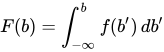
Note that . Using a random number c from a uniform distribution as the probability density to "pass by", we get


so that

is a number randomly selected from distribution . This is based on the inverse transform sampling.
For example, the inverse of cumulative Gaussian distribution with an ideal uniform PRNG with range (0, 1) as input would produce a sequence of (positive only) values with a Gaussian distribution; however


- When using practical number representations, the infinite "tails" of the distribution have to be truncated to finite values.
- Repetitive recalculation of should be reduced by means such as ziggurat algorithm for faster generation.
Similar considerations apply to generating other non-uniform distributions such as Rayleigh and Poisson.
See also
[edit]
References
[edit]- ^ Barker, Elaine; Barker, William; Burr, William; Polk, William; Smid, Miles (July 2012). "Recommendation for Key Management" (PDF). NIST Special Publication 800-57. NIST. doi:10.6028/NIST.SP.800-57p1r3. Retrieved 19 August 2013.
- ^ "Pseudorandom number generators". Khan Academy. Retrieved 2016-01-11.
- ^ Von Neumann, John (1951). "Various techniques used in connection with random digits" (PDF). National Bureau of Standards Applied Mathematics Series. 12: 36–38. Archived from the original (PDF) on 28 November 2022.
- ^ Press et al. (2007), chap.7
- ^ L'Ecuyer, Pierre (2010). "Uniform random number generators". In Lovric, Miodrag (ed.). International Encyclopedia of Statistical Science. Springer. p. 1629. ISBN 978-3-642-04897-5.
- ^ Random (Java Platform SE 8), Java Platform Standard Edition 8 Documentation.
- ^ Random.java at OpenJDK.
- ^ Press et al. (2007) §7.1
- ^ Matsumoto, Makoto; Nishimura, Takuji (1998). "Mersenne twister: a 623-dimensionally equi-distributed uniform pseudo-random number generator" (PDF). ACM Transactions on Modeling and Computer Simulation. 8 (1). ACM: 3–30. doi:10.1145/272991.272995. S2CID 3332028.
- ^ Marsaglia, George (July 2003). "Xorshift RNGs". Journal of Statistical Software. 8 (14). doi:10.18637/jss.v008.i14. S2CID 250501391.
- ^ S.Vigna. "xorshift*/xorshift+ generators and the PRNG shootout".
- ^ Vigna S. (2016), "An experimental exploration of Marsaglia’s xorshift generators", ACM Transactions on Mathematical Software, 42; doi:10.1145/2845077.
- ^ Vigna S. (2017), "Further scramblings of Marsaglia’s xorshift generators", Journal of Computational and Applied Mathematics, 315; doi:10.1016/j.cam.2016.11.006.
- ^ Panneton, François; L'Ecuyer, Pierre; Matsumoto, Makoto (2006). "Improved long-period generators based on linear recurrences modulo 2" (PDF). ACM Transactions on Mathematical Software. 32 (1): 1–16. doi:10.1145/1132973.1132974. S2CID 7368302.
- ^ a b Salmon, John; Moraes, Mark; Dror, Ron; Shaw, David (2011). "Parallel random numbers: as easy as 1, 2, 3". Proceedings of 2011 International Conference for High Performance Computing, Networking, Storage and Analysis, Article No. 16. doi:10.1145/2063384.2063405.
- ^ Song Y. Yan (7 December 2007). Cryptanalytic Attacks on RSA. Springer, 2007. p. 73. ISBN 978-0-387-48741-0.
- ^ Niels Ferguson; Bruce Schneier; Tadayoshi Kohno (2010). "Cryptography Engineering: Design Principles and Practical Applications, Chapter 9.4: The Generator" (PDF).
- ^ Klaus Pommerening (2016). "IV.4 Perfect Random Generators". Cryptology. uni-mainz.de. Retrieved 2017-11-12.
- ^ Pass, Rafael. "Lecture 11: The Goldreich-Levin Theorem" (PDF). COM S 687 Introduction to Cryptography. Retrieved 20 July 2016.
- ^ Matthew Green (18 September 2013). "The Many Flaws of Dual_EC_DRBG".
- ^ Katz, Jonathan; Yehuda, Lindell (2014). Introduction to modern cryptography. CRC press. p. 70.
- ^ a b Schindler, Werner (2 December 1999). "Functionality Classes and Evaluation Methodology for Deterministic Random Number Generators" (PDF). Anwendungshinweise und Interpretationen (AIS). Bundesamt für Sicherheit in der Informationstechnik. pp. 5–11. Retrieved 19 August 2013.
- ^ "Security requirements for cryptographic modules". FIPS. NIST. 1994-01-11. p. 4.11.1 Power-Up Tests. Archived from the original on May 27, 2013. Retrieved 19 August 2013.
Bibliography
[edit]- Barker E., Kelsey J., Recommendation for Random Number Generation Using Deterministic Random Bit Generators, NIST SP800-90A, January 2012
- Brent R.P., "Some long-period random number generators using shifts and xors", ANZIAM Journal, 2007; 48:C188–C202
- Gentle J.E. (2003), Random Number Generation and Monte Carlo Methods, Springer.
- Hörmann W., Leydold J., Derflinger G. (2004, 2011), Automatic Nonuniform Random Variate Generation, Springer-Verlag.
- Knuth D.E. The Art of Computer Programming, Volume 2: Seminumerical Algorithms, Third Edition. Addison-Wesley, 1997. ISBN 0-201-89684-2. Chapter 3. [Extensive coverage of statistical tests for non-randomness.]
- Luby M., Pseudorandomness and Cryptographic Applications, Princeton Univ Press, 1996. ISBN 9780691025469
- von Neumann J., "Various techniques used in connection with random digits," in A.S. Householder, G.E. Forsythe, and H.H. Germond, eds., Monte Carlo Method, National Bureau of Standards Applied Mathematics Series, 12 (Washington, D.C.: U.S. Government Printing Office, 1951): 36–38.
- Peterson, Ivars (1997). The Jungles of Randomness : a mathematical safari. New York: John Wiley & Sons. ISBN 0-471-16449-6.
- Press W.H., Teukolsky S.A., Vetterling W.T., Flannery B.P. (2007), Numerical Recipes (Cambridge University Press).
- Viega J., "Practical Random Number Generation in Software", in Proc. 19th Annual Computer Security Applications Conference, Dec. 2003.
External links
[edit]- TestU01: A free, state-of-the-art (GPL) C++ Random Number Test Suite.
- DieHarder: A free (GPL) C Random Number Test Suite.
- "Generating random numbers" (in embedded systems) by Eric Uner (2004)
- "Analysis of the Linux Random Number Generator" by Zvi Gutterman, Benny Pinkas, and Tzachy Reinman (2006)
- "Better pseudorandom generators" by Parikshit Gopalan, Raghu Meka, Omer Reingold, Luca Trevisan, and Salil Vadhan (Microsoft Research, 2012)
- rand() Considered Harmful on YouTube by Stephan Lavavej (Microsoft, 2013)
- Wsphynx a simple online random number generator. Random numbers are generated by Javascript pseudorandom number generators (PRNGs) algorithms
Pseudorandom number generator
View on GrokipediaDefinition and Fundamentals
Mathematical Definition
A pseudorandom number generator (PRNG) is a deterministic algorithm that produces a sequence of numbers approximating the statistical properties of true random numbers, such as uniformity and independence, through iterative computation from an initial seed value.[1][7] Formally, it is modeled using a finite state space , a state transition function , and an output function . Starting from an initial state (the seed), subsequent states are generated as for , with outputs .[7] The sequence is considered pseudorandom if it satisfies key mathematical properties: each is uniformly distributed over , consecutive outputs exhibit minimal correlation (approaching independence), and the period—the smallest such that for all sufficiently large —maximizes the cycle length, ideally equaling to avoid premature repetition.[7] These properties ensure that finite prefixes of the sequence pass empirical statistical tests, such as convergence of the empirical measure to the uniform distribution, where for any measurable set and probability measure (typically Lebesgue on ), the frequency approaches as grows within the period.[7][8] In cryptographic contexts, additional requirements include computational unpredictability: no efficient algorithm should predict future outputs from past ones better than chance, often formalized via indistinguishability from uniform random sequences under polynomial-time adversaries.[8] However, non-cryptographic PRNGs prioritize efficiency and reproducibility over such security, relying solely on statistical mimicry verifiable through tests like the chi-squared for uniformity or runs tests for independence.[7] The deterministic nature implies reproducibility from the same seed, distinguishing PRNGs from true random generators, with the seed often drawn from entropy sources to enhance apparent randomness.[1]Distinction from True Random Number Generators
Pseudorandom number generators (PRNGs) are deterministic algorithms that produce sequences approximating the statistical properties of random numbers, relying on an initial seed value and a fixed mathematical function to generate outputs that are reproducible given the same inputs.[1] In contrast, true random number generators (TRNGs), also known as non-deterministic random bit generators, derive bits from physical phenomena exhibiting inherent unpredictability, such as thermal noise in electronic circuits, radioactive decay timing, or quantum events like photon arrival times. This fundamental difference arises because PRNG outputs are fully computable and predictable once the internal state and algorithm are known, whereas TRNGs incorporate entropy from chaotic or quantum processes that defy deterministic forecasting.[9] The deterministic nature of PRNGs limits their period—the length before the sequence repeats—to the size of the generator's state space; for example, a 32-bit linear congruential generator has a maximum period of , after which the cycle restarts from the seed.[7] TRNGs, however, lack such periodicity due to their dependence on external, non-repeating physical entropy sources, theoretically producing unbounded unique sequences without algorithmic repetition.[10] While PRNGs excel in computational efficiency, enabling high-speed generation without specialized hardware—often orders of magnitude faster than TRNGs—they fail to provide genuine unpredictability, making them unsuitable for applications requiring absolute randomness, such as one-time pads in cryptography unless seeded or combined with TRNG entropy.[11][12] In practice, PRNGs pass statistical tests for randomness (e.g., uniformity, independence) over short sequences but reveal their deterministic structure under exhaustive analysis or if the seed is compromised, as demonstrated in historical vulnerabilities like the predictability of early Netscape SSL random number generation from timestamp seeds.[13] TRNGs, by sourcing from physical indeterminacy, resist such prediction but introduce challenges like slower generation rates (typically bits per second versus gigabits for PRNGs) and potential biases from environmental factors, necessitating post-processing for uniformity.[14] Hybrid systems, where TRNGs seed PRNGs, leverage the strengths of both to balance speed, reproducibility, and security in fields like Monte Carlo simulations and secure key generation.Periodicity and State Space
The state space of a pseudorandom number generator (PRNG) comprises the finite set of all possible internal states, typically represented by a fixed number of bits or values that fully determine the next output and subsequent state via a deterministic transition function , where is the state space.[15] The size of , denoted , fundamentally limits the generator's behavior, as the total number of distinct states bounds the variety of sequences producible from different initial seeds.[15] For instance, a PRNG with a -bit state space has at most states, ensuring that any sequence generated will repeat after at most steps due to the pigeonhole principle.[16] Periodicity in PRNGs is characterized by the period length, the smallest positive integer such that for some initial state , marking the point at which the sequence cycles.[7] The period cannot exceed , and the state space partitions into cycles under iteration of , with transient states leading into these cycles; optimal designs aim for a single long cycle encompassing nearly all states to maximize unpredictability.[15] Short periods arise from poor parameter choices or mappings that produce small cycles, rendering the generator unsuitable for applications requiring long non-repeating sequences, such as Monte Carlo simulations or cryptography.[7] In practice, achieving the maximum period requires specific conditions on and the modulus or parameters; for example, linear congruential generators (LCGs) attain a full period of modulus when parameters satisfy the Hull-Dobell theorem, including coprime to , divisible by all prime factors of , and if is a power of 2.[17] Similarly, generators like Mersenne Twister exploit large state spaces (e.g., 19937 bits) to yield periods of , far exceeding typical computational needs while maintaining efficient state transitions.[18] Empirical testing via tools like TestU01 verifies period lengths by detecting early repetitions, underscoring that state space exhaustion, not just theoretical maxima, governs effective usability.[19]Historical Development
Early Mechanical and Manual Methods
Prior to the advent of electronic computers, sequences approximating uniform random numbers were generated manually or with rudimentary mechanical aids, primarily to compile tables for statistical sampling and early simulation work. In 1927, statistician L.H.C. Tippett assembled a table of 41,600 random digits by extracting the middle digits from serial numbers in the 1921 British census records, a method proposed by Karl Pearson to leverage ostensibly unpredictable numerical data for randomness.[20] This approach relied on the assumption that census enumerations lacked systematic patterns suitable for biasing statistical tests, though it produced a fixed, deterministic sequence once compiled.[20] In 1938, Ronald A. Fisher and Frank Yates extended this practice by deriving random digits from the decimal expansions of logarithm tables, selecting every nth digit to fill their publication Statistical Tables for Biological, Agricultural and Medical Research.[20] Logarithmic tables, computed via manual or early mechanical arithmetic (such as using slide rules or difference engines), offered expansive digit strings; Fisher and Yates chose this source believing the fractional parts mimicked uniformity, despite inherent mathematical structure in transcendental functions like logarithms potentially introducing subtle correlations undetectable at the time.[20] These manual extractions were labor-intensive, often involving teams verifying digits by hand to minimize transcription errors, and yielded tables of around 10,000 to 20,000 entries, sufficient for agricultural and biological experiments but limited by human effort.[20] Mechanical assistance emerged in the late 1930s with devices like the one employed by Maurice Kendall and Bernard Babington-Smith, who in 1938-1939 generated a table of 100,000 random digits using a spinning cardboard disk divided into 10 sectors labeled 0-9, rotated at approximately 250 revolutions per minute while a flashing light intermittently illuminated a sector to record the digit.[20] Though dependent on physical unpredictability from friction and air currents for true randomness, the device's repeatable setup and fixed digit assignment resembled deterministic machinery, and the resulting sequence was statistically tested for uniformity using chi-squared methods before publication in the Journal of the Royal Statistical Society.[20] Such apparatuses bridged manual tabulation and later computational generators, highlighting the era's reliance on hybrid mechanical-manual processes to scale beyond pure hand computation, yet they suffered from short "periods" (table lengths) and vulnerability to mechanical biases like uneven spin decay.[20] These methods, while not algorithmic in the modern pseudorandom sense, provided deterministic outputs from initial conditions (e.g., starting positions in tables or device calibrations), serving as precursors to software-based PRNGs by enabling reproducible sequences for verification in statistical applications.[20] Their credibility stemmed from empirical testing against known distributions, though contemporary analysis reveals flaws like non-uniformity in log-derived digits due to underlying arithmetic progressions.[20] By the early 1940s, demand from burgeoning Monte Carlo simulations underscored the need for larger, faster generation, paving the way for computational transitions.[20]Mid-20th Century Computational Advances
The advent of programmable electronic computers like the ENIAC in 1945 facilitated the transition from mechanical or manual random number generation to algorithmic computational methods. In 1946, John von Neumann developed the middle-square method as part of Monte Carlo simulations for thermonuclear reactions on the ENIAC.[21][22] This technique took an initial seed number, squared it to produce a fixed-width integer result, and extracted the central digits to form the next value in the sequence, repeating the process iteratively.[23] On the ENIAC, it generated pseudorandom digits at approximately 5,000 per second, roughly 1,800 times faster than reading from punched cards or other input media.[20] Despite its pioneering role, von Neumann identified inherent weaknesses, such as frequent production of zero sequences and rapid entry into short cycles, limiting its practical utility for extended simulations.[24] To address these shortcomings, Derrick Henry Lehmer introduced the linear congruential generator (LCG), also known as the Lehmer generator, around 1948 while programming the ENIAC for number-theoretic computations.[25] The LCG updates the state via the recurrence , where is a multiplier, a modulus (often a large prime), and the output derived from scaling to the unit interval; an additive constant was sometimes included but Lehmer's original form omitted it for multiplicative variants.[22] Lehmer's implementation in 1949 proceedings emphasized parameters yielding full-period cycles under the condition , providing longer sequences and improved uniformity over middle-square outputs.[26] Early tests on ENIAC demonstrated its efficacy for tasks like prime sieving and Monte Carlo integration, establishing LCGs as a staple for 1950s computing despite later-recognized lattice structure artifacts in higher dimensions.[27] These innovations stemmed from wartime and postwar demands for simulating complex probabilistic systems in physics and engineering, where true random sources were impractical for high-volume needs.[28] Von Neumann's and Lehmer's work on the ENIAC not only accelerated generation rates but also highlighted the deterministic nature of pseudorandom sequences, prompting initial empirical spectral tests to assess deviation from uniformity.[20] By the mid-1950s, LCG variants proliferated in mainframe software for statistical analysis and operations research, though parameter selection remained ad hoc until Hull-Dobell theorem formalizations in the 1960s.[29]Late 20th Century to Present Innovations
In 1997, Makoto Matsumoto and Takuji Nishimura introduced the Mersenne Twister (MT19937), a generalized feedback shift register algorithm with a state size of 19937 bits and a full-period length of , achieving equidistribution in up to 623 dimensions. This innovation addressed limitations in earlier linear feedback shift registers by incorporating tempering functions to enhance output uniformity and low autocorrelation, making it highly effective for large-scale Monte Carlo simulations and statistical modeling where long sequences without detectable patterns are required. Its widespread adoption stemmed from superior performance in empirical tests compared to predecessors like linear congruential generators, though it requires significant state storage and is unsuitable for cryptographic use due to predictable state reconstruction from limited outputs.[30] Subsequent developments in the early 2000s prioritized computational speed for general-purpose applications. George Marsaglia proposed xorshift generators in 2003, relying on simple bitwise XOR and shift operations on a linear feedback shift register state to produce sequences with periods up to , achieving generation rates far exceeding those of Mersenne Twister on commodity hardware. These generators excel in low-latency scenarios such as procedural content generation in games but exhibit lattice structure artifacts detectable by advanced spectral tests, prompting refinements like output mixing to mitigate weaknesses.[31] In 2006, François Panneton, Pierre L'Ecuyer, and Matsumoto developed the WELL (Well Equidistributed Long-period Linear) family, an evolution of Mersenne Twister that improves bit-mixing through nonlinear operations, yielding better performance in dimension-based statistical tests while retaining comparable periods. More recent innovations emphasize balanced trade-offs in state size, speed, and statistical quality. In 2014, Melissa O'Neill introduced the PCG (Permuted Congruential Generator) family, which augments linear congruential generators with output permutation functions to scramble results, producing high-quality streams from minimal 64-bit state with periods exceeding .[32] PCG variants pass stringent test suites like TestU01 and PractRand with fewer parameters than competitors, offering advantages in embedded systems and parallel computing due to their simplicity and resistance to initialization biases.[32] These advances reflect ongoing refinement driven by empirical validation against expanded test batteries, including NIST's Statistical Test Suite released in 2001, prioritizing generators that avoid low-dimensional dependencies exploitable in applications like numerical integration.[4]Core Algorithms and Types
Linear Congruential Generators
A linear congruential generator (LCG) produces a sequence of pseudorandom numbers via the recurrence relation , where is the current state, is the multiplier, is the increment, is the modulus, and the initial seed determines the starting point.[33][34] The output is typically the normalized value , yielding numbers in [0, 1).[35] The parameters , , and critically influence the sequence quality; is often chosen as or for efficient computation on binary hardware, with or common to fit in a word size.[34] For full period —the maximum possible, ensuring all residues appear before repetition—the Hull-Dobell theorem requires: coprime to ; for every prime dividing ; and if divides , then .[34][36] Multiplicative congruential generators set , reducing to Lehmer's 1951 form , which achieves full period under modified conditions like .[35] LCGs originated in Derrick Lehmer's 1951 work on algorithmic random number generation for the ENIAC, initially multiplicative before generalization.[35] Examples include the minimal standard LCG with , , (Park-Miller), used in some simulations for its balance of speed and period.[34] GNU libc'srand() employs an LCG with , , .[37]
Despite efficiency—requiring only arithmetic operations and minimal state—LCGs exhibit weaknesses: lower bits are poorly random (e.g., least significant bit alternates predictably), sequences form visible lattice patterns in 2D plots, and predictability allows state recovery from few outputs.[33][32] They fail spectral and lattice tests unless parameters are meticulously chosen, rendering them unsuitable for cryptography but adequate for non-critical simulations when period is full.[32][38]
Linear Feedback Shift Registers and Recurrence-Based Methods
Linear feedback shift registers (LFSRs) generate pseudorandom bit sequences through a linear recurrence relation over the finite field GF(2). An LFSR consists of a shift register of length n, where the input bit to the register is the XOR (modulo-2 sum) of specific taps from the current state, determined by a feedback polynomial.[39] The state evolves deterministically by shifting bits right (or left) and inserting the feedback bit, producing an output stream from the least significant bit or another position.[40] For maximal period sequences, known as m-sequences, the feedback polynomial must be primitive modulo 2, yielding a cycle length of 2n - 1 before repetition, exhausting all non-zero states.[39] These sequences exhibit strong pseudorandom properties, including balance (approximately equal numbers of 0s and 1s, specifically 2n-1 zeros and 2n-1 - 1 ones), equal run lengths for consecutive 0s and 1s across powers of 2 up to n, and low two-level autocorrelation, making them suitable for applications like built-in self-testing and spread-spectrum communications.[39] However, LFSRs fail statistical tests for higher-order randomness and are insecure for cryptography due to their linearity, which allows prediction via the Berlekamp-Massey algorithm after observing 2n bits.[41] Beyond LFSRs, recurrence-based methods encompass higher-order linear recurrences for generating pseudorandom numbers over integers or finite fields, often modulo a prime p or large m. A general form is Xn+k = (∑i=1k ai Xn+i-1) mod m, where coefficients ai are chosen for long periods, typically approaching mk under primitivity conditions analogous to LFSRs.[42] Multiple recursive generators (MRGs), such as those with k=2 or higher, offer periods exceeding 101000 for modest state sizes and pass rigorous tests like dieharder when parameters are selected from primitive polynomials.[42] These methods, including lagged Fibonacci generators (a special case with addition modulo 2w), provide efficient parallelization and are used in Monte Carlo simulations, though they require careful parameter tuning to avoid lattice structure artifacts detectable by spectral tests.[43] Implementations often combine LFSRs with nonlinear transformations or multiple registers to enhance randomness, as pure linear recurrences suffer from short cycles or correlations if non-primitive.[44] Hardware realizations of LFSRs achieve high speeds (e.g., gigabits per second on FPGAs) with minimal gates, roughly n flip-flops and d XORs for degree-d polynomials, outperforming software for bit-level generation.[45] Despite advantages in simplicity and period length, recurrence-based PRNGs are deprecated for security-sensitive uses without entropy seeding, as their deterministic nature permits state reconstruction from outputs.[41]Counter-Based and Block Cipher Generators
Counter-based pseudorandom number generators (CBPRNGs) derive outputs directly from an incrementing counter value, typically via a deterministic function that ensures each output is independent of previous ones. The internal state consists solely of the counter and possibly a fixed key, enabling efficient generation without retaining extensive history. This design produces sequences where the nth output is g(n), with g as a bijection mapping counter values to pseudorandom numbers, facilitating low memory usage and high performance in parallel computing environments.[46][47] Such generators excel in applications requiring reproducible streams, like Monte Carlo simulations, due to their ability to "jump" ahead by large counter increments without sequential computation. Examples include Philox and Threefry, which employ weakened cryptographic primitives for speed while maintaining statistical quality; Philox uses a 64-bit counter-based structure inspired by block ciphers but optimized for non-cryptographic use. These avoid the pitfalls of feedback-dependent methods, such as short cycles from state collisions, by leveraging the full counter space for periodicity up to 2^counter_bits.[48][49] Block cipher-based generators extend this paradigm by applying approved ciphers, such as AES, in modes like counter (CTR) to transform sequential inputs into pseudorandom outputs. In CTR mode, a fixed key encrypts incrementing counter blocks, yielding a keystream indistinguishable from random under the cipher's pseudorandom permutation assumption, provided the key remains secret and counters do not repeat within the key's lifetime. This construction underpins cryptographically secure variants, where security relies on the cipher's resistance to distinguishing attacks.[50] The NIST CTR_DRBG, standardized in SP 800-90A Revision 1 (published January 2015), exemplifies this approach using a block cipher in counter mode, where the counter occupies part of the input block to generate bits on demand. It incorporates reseeding with entropy sources to mitigate predictability from prolonged use without refresh, supporting security strengths up to 256 bits depending on the underlying cipher like AES-256. Validation requires approved ciphers and adherence to instantiation, generation, and reseed procedures to prevent state compromise. While efficient for software implementations, analyses highlight potential vulnerabilities if derivation functions or counters are mishandled, as explored in peer-reviewed security proofs.[51][52][53]Nonlinear and Advanced Deterministic Methods
Nonlinear methods in pseudorandom number generation incorporate nonlinear recurrence relations or feedback functions to mitigate limitations of linear generators, such as visible lattice structures in tuple distributions and susceptibility to prediction via linear algebra techniques. These approaches aim to enhance equidistribution across higher dimensions and prolong effective periods by introducing complexity that defies simple algebraic decomposition. For example, nonlinear transformations disrupt the affine subspaces that plague linear congruential generators, leading to sequences that better approximate statistical independence in empirical tests.[54] Nonlinear congruential generators exemplify this by modifying the standard linear form with terms like multiplicative inverses or higher-degree polynomials. The inversive congruential generator, defined as where is prime and satisfy specific conditions, achieves a maximal period of and resists prediction algorithms that exploit linearity, as demonstrated by computational hardness results for recovering internal states from output sequences. Similarly, a nonlinear variant over Galois fields has been analyzed to produce sequences lacking the tuple correlations of linear counterparts. These generators trade some computational efficiency for improved resistance to lattice-based attacks, with periods scaling to the modulus size under primality constraints.[55][56] Nonlinear feedback shift registers (NLFSRs) extend linear feedback shift registers by using Boolean functions of degree greater than one for the input bit, enabling sequences with periods up to for length under primitivity conditions, though achieving full nonlinearity increases synthesis challenges. NLFSRs generate pseudorandom bits suitable for non-cryptographic simulations and, when combined with linear components, yield efficient generators passing Dieharder tests; for instance, designs with 64- to 128-bit states operate at speeds exceeding 10 GB/s on 64-bit processors while maintaining low linear complexity. Their causal dependence on multiple state bits fosters avalanche effects akin to cryptographic primitives, reducing predictability compared to linear shifts.[57] Chaotic map discretizations represent another advanced deterministic paradigm, deriving sequences from nonlinear dynamical systems with positive Lyapunov exponents, ensuring exponential divergence from initial conditions that mimics randomness. A 2022 construction couples fractal functions from logistic or tent maps to produce 32-bit words passing NIST SP 800-22 tests with p-values above 0.01 for all subsequences, outperforming linear methods in multidimensional uniformity. These methods require careful quantization to preserve chaos without periodicity collapse, often achieving state spaces of or larger via floating-point iterations modulo 1, followed by bit extraction. Hybrid approaches, such as nonlinearly coupling multiple linear generators, further amplify decorrelation; one 2012 design integrates a nonlinear oscillator with lagged linear recursions to yield sequences empirically indistinguishable from uniform in spectral tests.[58][59]Cryptographic Variants
Design Principles for Security
A primary design principle for cryptographic pseudorandom number generators (PRNGs), also known as deterministic random bit generators (DRBGs), is computational indistinguishability: the output sequence must appear uniformly random to any computationally bounded adversary, even one that observes a portion of the outputs and knows the algorithm's structure.[51] This requires basing the generator on one-way cryptographic primitives, such as hash functions, HMAC, or block ciphers approved under standards like FIPS 140, ensuring that inverting the state transition function or predicting future bits from past outputs is infeasible within polynomial time relative to the security strength (typically 128, 192, or 256 bits).[51] Security does not rely on algorithm secrecy but on the entropy of the initial seed and the proven hardness assumptions of the underlying primitives, such as the collision resistance of hashes or the pseudorandomness of cipher outputs.[60] Forward security is essential, meaning that compromise of the internal state at one point does not enable prediction of subsequent outputs generated after reseeding with fresh entropy; this is achieved through mechanisms like state wiping or chaining outputs into new seeds via one-way functions during reseed operations.[51] Backtracking resistance complements this by preventing recovery of prior states or outputs from a compromised future state, typically enforced by designing the update function to erase information about previous states irreversibly.[61] The seed must incorporate at least as much entropy as the desired security level—e.g., 256 bits for high-strength applications—and be sourced from validated entropy providers compliant with NIST SP 800-90B, with periodic reseeding (e.g., after 2^48 bits of output or on demand) to mitigate depletion or compromise risks.[51] State size must exceed the security parameter to prevent exhaustive search, often requiring at least 2n bits for n-bit security to resist state recovery attacks. Additional criteria include resistance to state compromise extension attacks, where an adversary exploits partial state knowledge; this demands that the generator's prediction error probability remains negligible (e.g., less than 2^{-n}) even after observing up to a fraction of the output stream.[62] Rollback resistance ensures that an adversary cannot force reversion to a prior state via malleable inputs or timing attacks, often implemented by monotonic counters or non-malleable entropy mixing.[61] Designs must also withstand side-channel attacks, such as timing or power analysis, by using constant-time operations and masking internal computations, as non-constant-time implementations have led to real-world breaks like the Debian OpenSSL vulnerability in 2008, where reduced entropy space enabled key prediction.[63] Validation against suites like NIST SP 800-22 or STS confirms statistical properties, but cryptographic security hinges on provable reductions to primitive hardness rather than empirical tests alone.[51]Common Cryptographic PRNG Algorithms
Hash_DRBG, HMAC_DRBG, and CTR_DRBG, as defined in NIST Special Publication 800-90A Revision 1 (published January 2012), represent the primary standardized deterministic random bit generators (DRBGs) for cryptographic applications, providing security strengths up to 256 bits when instantiated with approved primitives like SHA-256 or AES-256. These mechanisms require seeding from an entropy source and support reseeding to maintain forward and backward security against state compromise, with instantiation, generation, and update functions designed to resist known attacks under the assumption of underlying cryptographic primitive security. Hash_DRBG operates by hashing an internal state value (V) concatenated with a counter (C) using a hash function approved for the desired security strength, such as SHA-1 (up to 160 bits, though deprecated for new designs) or SHA-256 (up to 256 bits); the state updates via additional hashing steps incorporating additional input if provided. It offers simplicity and efficiency in software without requiring keyed operations but may exhibit lower performance compared to block cipher-based alternatives due to hash computation overhead.[64] HMAC_DRBG builds on the Hash_DRBG framework but uses the HMAC keyed-hash construction for state derivation and update, where the key (K) and chain value (V) are refreshed via HMAC(K, V || input), enhancing resistance to length-extension attacks inherent in Merkle-Damgård hashes. This design supports the same security strengths as Hash_DRBG and is preferred in environments needing keyed integrity, with validation vectors confirming its output unpredictability for up to 2^48 bits generated between reseeds at 256-bit strength.[65] CTR_DRBG employs a block cipher (e.g., AES-128 or AES-256) in counter mode, encrypting an incremented counter derived from the internal state to produce keystream bits, followed by state updates via cipher feedback or block encrypt operations. It achieves high throughput, particularly with hardware acceleration, and is commonly integrated into protocols like TLS 1.3 for nonce and key generation, supporting derivation functions for additional input processing to mitigate predictability risks. Security relies on the cipher's pseudorandom permutation properties, with optional AES encryption of the output block for added protection against certain fault attacks. Fortuna, proposed by Niels Ferguson and Bruce Schneier in their 2003 book Practical Cryptography, divides entropy inputs into pools hashed incrementally (using SHA-256) to schedule reseeding of an AES-256-based generator, aiming for resilience against poor entropy estimation and pool exhaustion.[66] Unlike NIST DRBGs, Fortuna emphasizes continuous entropy accumulation without fixed reseed intervals, reducing risks from delayed entropy collection, though it lacks formal standardization and has seen limited adoption beyond early systems like certain BSD variants.[66] ChaCha20, a 256-bit stream cipher designed by Daniel J. Bernstein in 2008, is repurposed as a PRNG by iterating over a counter nonce in 512-bit blocks, yielding high-speed software generation suitable for resource-constrained devices; its use in Linux kernel's getrandom() (since version 4.8 in 2016) demonstrates practical cryptographic viability without relying on hardware entropy. This approach benefits from ChaCha20's resistance to timing attacks and superior diffusion over Salsa20 predecessors, though it requires careful nonce management to avoid reuse vulnerabilities inherent to stream ciphers.Hardware and Entropy Integration
Hardware random number generators (HRNGs) provide entropy from physical phenomena, such as thermal noise in resistors, avalanche noise in diodes, or quantum fluctuations, to address the inherent determinism of pseudorandom number generators (PRNGs). These sources generate true random bits with high min-entropy, which are essential for seeding or reseeding cryptographic PRNGs to ensure unpredictability against adversaries who might know the algorithm or prior outputs. Without sufficient entropy, even cryptographically designed PRNGs risk predictable sequences, as demonstrated in historical failures like the Debian OpenSSL vulnerability of 2008, where reduced entropy led to key collisions.[67] In deterministic random bit generators (DRBGs) as specified in NIST SP 800-90A Revision 1 (2015), entropy inputs must match the security strength of the mechanism, typically requiring at least 256 bits for 128-bit security levels during instantiation and reseeding. The entropy source undergoes conditioning to remove biases, followed by integration into the DRBG's internal state via approved mechanisms like hash or HMAC functions. For prediction resistance, fresh entropy is periodically injected, with NIST mandating that the source provide non-repeating, high-quality bits validated against SP 800-90B tests for independence and uniformity. Hybrid systems combine HRNG outputs directly with PRNG expansions to balance throughput—HRNGs often output at rates below 1 Gbps—against the faster generation of pseudorandom bits.[51][68] Prominent hardware implementations include Intel's Digital Random Number Generator (DRNG), introduced in Ivy Bridge processors in 2012, which uses on-chip thermal noise amplified and conditioned through a deterministic component compliant with NIST standards. The RDRAND instruction fetches 32-, 64-, or 128-bit blocks from this module, enabling direct CPU integration for seeding system PRNGs like those in Linux's /dev/urandom. Similar capabilities exist in AMD processors via instructions like RNDA, though empirical tests show varying entropy rates, with Intel DRNG achieving up to 3 Gbps post-conditioning. Integration often involves mixing HRNG output with software entropy pools to mitigate single-point failures, as recommended in system-level designs.[69][70] Security analyses highlight risks in hardware reliance, including potential supply-chain compromises or flawed entropy estimation, as seen in critiques of vendor-specific conditioners that may amplify subtle biases if the raw source min-entropy is overestimated. Independent validation, such as FIPS 140-2 certification for modules like Intel DRNG, requires documented entropy sources and post-compromise recovery via reseeding, but experts caution against exclusive dependence on proprietary hardware, advocating diversified sources to counter state-level threats evidenced in leaked documents from 2013 alleging influence on standards. Thus, robust integration demands verifiable entropy bounds and health tests for continuous operation.[67][71]Applications and Use Cases
Non-Security Simulations and Modeling
Pseudorandom number generators (PRNGs) play a central role in non-security simulations and modeling by providing efficient, reproducible sequences that approximate independent uniform random variables, enabling statistical approximations of deterministic or stochastic processes. In Monte Carlo methods, PRNGs facilitate numerical integration, optimization, and probability estimation by generating large samples to model phenomena where analytical solutions are intractable. These applications demand PRNGs with strong statistical properties, such as uniform distribution and low serial correlation, to ensure convergence rates comparable to true randomness, though determinism allows for result verification through reseeding.[72][73] In physics simulations, PRNGs drive Monte Carlo techniques for sampling configurations in systems like molecular dynamics or lattice quantum chromodynamics, where they produce random trial moves or event selections. For example, simulating 128 atoms in a Monte Carlo molecular dynamics run may require over 1,000 PRNG calls per iteration for coordinates and selections, highlighting the need for generators with periods exceeding simulation scales to avoid artificial correlations that bias energy estimates or equilibration times.[15] In high-energy physics, such as particle collision event generation at CERN, PRNGs like RANLUX—employing lagged Fibonacci sequences with Kolmogorov-Arnold mixing—deliver 2^{-k}-mixing quality for k up to 24, ensuring precision in rare event probabilities critical for experimental validation.[74] Medical physics toolkits like GATE, used for radiation therapy and imaging simulations, rely on PRNGs to model photon interactions and detector responses, with studies showing that choices like Mersenne Twister versus WELL affect dosimetric accuracy by up to 1-2% in variance due to lattice artifacts or period limitations.[75] Similarly, in operations research and stochastic modeling, PRNGs seed discrete-event simulations for queueing systems or inventory optimization, where reproducibility aids sensitivity analysis but requires testing against empirical distributions to mitigate underestimation of tail risks.[76] Overall, while true random sources exist, PRNGs dominate due to their speed—often comprising 80% of computation in intensive Monte Carlo runs—balancing quality with scalability across parallel architectures.[73]Gaming and Procedural Generation
In video games, pseudorandom number generators (PRNGs) enable procedural generation by producing deterministic sequences that simulate randomness, allowing algorithms to create expansive content such as terrains, levels, and assets without manual design for each instance. Developers initialize PRNGs with a seed—a fixed value like a user-provided integer or system timestamp—to ensure reproducibility: the same seed always yields identical output, which supports features like shared multiplayer worlds or debug repeatability. This approach contrasts with true randomness by prioritizing computational efficiency and control, as the generated content emerges from mathematical iterations rather than hardware entropy sources.[77] A prominent example is Minecraft, where a 64-bit signed integer seed seeds the PRNG to drive noise functions for generating biomes, caves, and structures across infinite worlds. Released in full version on November 18, 2011, the game computes terrain heightmaps and features on demand using layered Perlin noise variants modulated by the PRNG sequence, enabling vast exploration without storing pre-generated data. This method, rooted in Java's built-in Random class (a linear congruential generator), ensures that players entering the same seed reconstruct identical environments, facilitating community sharing of notable worlds while scaling to arbitrary distances.[78] Roguelike games, such as the original Rogue from 1980, leverage PRNGs for dungeon layouts, item distributions, and enemy behaviors, where each playthrough's procedural variance stems from advancing the generator's state during generation. Algorithms like binary space partitioning or cellular automata use PRNG outputs to place rooms, corridors, and obstacles, balancing novelty with fairness by avoiding truly unpredictable outcomes that could frustrate players. Modern roguelites extend this by combining PRNG-driven elements with hand-crafted templates, as seen in titles generating 2D levels with ASCII or tile-based representations, where the generator's period and uniformity prevent repetitive patterns over repeated runs.[79][80]Cryptographic and Security Protocols
Cryptographically secure pseudorandom number generators (CSPRNGs) form a foundational component in security protocols by producing output sequences that are computationally indistinguishable from true random bits, even against adversaries who observe prior outputs or partially compromise the generator's state.[62] This property ensures resistance to prediction attacks, which is critical for generating ephemeral values without enabling state recovery or forward/backward predictability.[81] Unlike non-cryptographic PRNGs, CSPRNGs incorporate entropy sources and cryptographic primitives to maintain security across reseeding and extended output streams.[82] In key generation, CSPRNGs derive symmetric encryption keys, Diffie-Hellman ephemeral parameters, and components for asymmetric schemes, ensuring keys possess full entropy and uniformity to withstand brute-force and related-key attacks.[83] For instance, protocols like TLS employ CSPRNGs to produce the client random and server random fields—48-byte values exchanged during handshake—to contribute to the pre-master secret and master secret derivation via pseudorandom functions (PRFs).[84] Similarly, SSH uses CSPRNG outputs for Diffie-Hellman group elements and session keys, while IPsec's IKE protocol relies on them for initiator/responder cookies and nonce generation to authenticate exchanges.[81] Nonces and initialization vectors (IVs) generated by CSPRNGs prevent replay attacks and ensure semantic security in cipher modes such as GCM or CBC; nonces must be unique and unpredictable per session to avoid malleability exploits, while IVs randomize plaintext inputs without repetition risks. In TLS, these values underpin authenticated encryption, with CSPRNG-derived nonces protecting against nonce-reuse vulnerabilities that could expose plaintexts.[85] RFC 8937 recommends augmenting CSPRNGs with long-term private keys in protocols like TLS to enhance randomness post-compromise, deriving fresh entropy from key-based PRFs to mitigate persistent threats from seed exhaustion or hardware failures.[86] Beyond core handshakes, CSPRNGs support protocol padding, challenge-response mechanisms, and salt generation in password-based key derivation functions (e.g., PBKDF2), where unpredictable salts thwart rainbow table attacks.[87] In VPN implementations using TLS or IPsec, CSPRNGs ensure secure tunnel establishment by randomizing sequence numbers and anti-replay windows, preserving confidentiality against traffic analysis.[81] These applications underscore CSPRNGs' role in upholding causal security chains, where initial randomness defects propagate to systemic protocol failures.[88]Evaluation Criteria and Testing
Statistical Randomness Tests
Statistical randomness tests assess whether the output of a pseudorandom number generator (PRNG) exhibits empirical properties indistinguishable from independent, uniformly distributed random bits or numbers, such as lack of bias, serial correlation, or periodic patterns. These tests operate by generating long sequences from the PRNG and computing test statistics whose distributions under true randomness are known, yielding p-values that quantify deviation probability. A PRNG is deemed to pass if p-values are consistent with uniformity on [0,1] across multiple trials, typically requiring the proportion of passes to approximate 1-α (e.g., 0.99 for α=0.01). Failure in even a small fraction of tests signals statistical flaws, though passing provides no absolute proof of randomness due to finite sample limitations and test coverage gaps.[4] The NIST Special Publication 800-22 Revision 1a, released in 2010, defines a standardized suite of 15 tests tailored for binary sequences of at least 100 bits per test, scaled to full evaluation on 100 sequences of 1,000,000 bits. Core tests include the monobit test for bit balance (expecting ≈50% zeros/ones), runs test for streak lengths approximating a geometric distribution, and longest run of ones for extreme run detection. More advanced ones, like the approximate entropy test, measure compressibility as a proxy for predictability, while the linear complexity test via Berlekamp-Massey algorithm detects short feedback polynomials indicative of weak linear structure. The suite addresses multiple testing by examining the p-value distribution via chi-squared goodness-of-fit, flagging non-uniformity. It has been applied to validate hardware RNGs and PRNGs in standards like FIPS 140-2, though NIST cautions it evaluates statistical rather than cryptographic security.[89][4] Complementing NIST, the Diehard battery, developed by George Marsaglia and first distributed in 1995, comprises 15-18 interdependent tests probing nonlinear and higher-order dependencies in uniform [0,1) outputs convertible to bits. Notable tests include the birthday spacings test, which sorts n≈10^6 points and checks squared spacings for exponential distribution (sensitive to lattice artifacts in quasi-Monte Carlo methods), and the overlapping permutations test, assessing avoidance of short cycles in 5-bit windows. The monkey tests simulate serial byte overlaps to detect autocorrelation, while the 3D spheres test evaluates packing efficiency in random spheres to uncover clumping. Designed for exhaustive stressing with up to 10-12 GB inputs, Diehard exposed flaws in generators like RANDU, but its Fortran implementation has been superseded by Dieharder (2004 onward), which integrates NIST and adds parametric options. Marsaglia emphasized that no single test suffices; collective failure rates must align with randomness.[90] TestU01, a C library by Pierre L'Ecuyer and Richard Simard released in 2007, provides modular batteries—SmallCrush (15 tests), Crush (96), and BigCrush (160+ for 2^38 bits)—implementing classical (e.g., Knuth's serial, poker) and novel tests like the collision test (for birthday paradox deviations) and spectral test (for lattice discrepancies in linear generators via Fourier analysis). It revealed statistical weaknesses in MATLAB'srand and Java's Random, such as excessive short cycles, by scaling tests to detect dependencies up to lag 10^9. Unlike fixed suites, TestU01 allows custom RNG integration and crush-level escalation for rigor, with p-value aggregation via empirical cumulative distribution functions to mitigate multiplicity. Evaluations in the library's documentation show combined p-values following beta distributions under independence assumptions.[91]
These suites share limitations rooted in their empirical, asymptotic nature: they assume infinite independent trials but use finite sequences, risking Type II errors (missing subtle flaws), and focus on local statistics, potentially overlooking global structures like short periods or algebraic dependencies exploitable adversarially. For instance, a PRNG with known seed can pass all tests yet remain predictable, as tests ignore state information. Inter-test dependence inflates false positives unless adjusted (e.g., via Bonferroni correction), and coverage favors uniformity over application-specific traits like spectral gaps in simulations. Studies confirm some PRNGs (e.g., certain multiply-with-carry variants) fail advanced batteries despite basic passes, underscoring that statistical validation is necessary but insufficient for cryptographic use, where distinguisher-based tests are required. No test suite guarantees unpredictability against computational attacks, as evidenced by historical failures like the Debian OpenSSL vulnerability (2006-2008), where reduced entropy passed stats but enabled key prediction.[92][90]
Security-Specific Assessments
Security-specific assessments for pseudorandom number generators (PRNGs) prioritize cryptographic resilience, evaluating whether outputs remain unpredictable to computationally bounded adversaries who may observe prior bits, know the algorithm, or influence inputs. These differ from statistical randomness tests by focusing on computational hardness rather than empirical frequency distributions, aiming to quantify an attacker's advantage in distinguishing PRNG output from uniform randomness or predicting future values. Security is often formalized through notions like negligible prediction probability, where the probability of guessing the next output exceeds 1/2 by at most a negligible function of the security parameter.[62] Key security models for PRNGs include basic pseudorandomness (indistinguishability from random strings), robustness (resistance to manipulated seeds or entropy), and reseedability (maintaining security after entropy injection). For PRNGs with input, such as those incorporating external entropy, models assess forward security (unpredictability of future outputs post-compromise) and backward security (protection of past outputs from future state revelation). The Systematization of Knowledge (SoK) on these models highlights that provable security typically relies on underlying primitives' hardness, like one-way functions, with concrete bounds derived via hybrid arguments or leftover hash lemmas.[62] Practical assessments involve targeted cryptanalysis, such as attempting state recovery from output prefixes or exploiting reseeding flaws. For instance, analyses of input-mixing PRNGs like Linux's /dev/urandom demonstrate that under entropy starvation, adversaries can achieve non-negligible prediction advantages by reconstructing internal pools from observed outputs, with success probabilities scaling inversely with entropy bits. Such evaluations employ game-based reductions to simulate attacks, measuring bits of security as the log of the inverse attacker advantage.[63] In standardized constructions, security assessments mandate entropy estimation (e.g., min-entropy lower bounds) and prediction resistance tests, where reseeding prevents backtracking even after state exposure. Dual_EC_DRBG, for example, failed such scrutiny due to embedded biases exploitable via undisclosed parameters, underscoring the need for transparent, assumption-based proofs over black-box validation. Overall, no single test guarantees security; assessments combine theoretical modeling with exhaustive attack searches, prioritizing designs with proven indistinguishability under standard cryptographic assumptions.[62][63]Empirical Performance Metrics
Empirical performance metrics for pseudorandom number generators (PRNGs) quantify computational efficiency, primarily through generation speed measured in throughput (e.g., gigabytes per second) or cycles per byte (cpb), alongside state size and scalability. Non-cryptographic PRNGs prioritize high throughput for simulations, often achieving sub-nanosecond latencies per output on modern CPUs, while cryptographic PRNGs (CSPRNGs) incur higher costs for security, typically in the range of 1-10 cpb on x86 processors with hardware acceleration. Benchmarks vary by hardware, such as Intel Core i7 or Xeon with AVX2/AVX512 extensions, and compiler optimizations like GCC.[19][93] For non-cryptographic use, generators like xoshiro256++ deliver sub-nanosecond generation times per 64-bit number on an Intel i7-12700KF at 3.6 GHz, yielding throughputs over 8 GB/s without specialized instructions.[19] In contrast, the Mersenne Twister (MT19937) operates at roughly one-fourth to one-fifth the speed of xoshiro variants due to its larger state (19937 bits) and complex tempering, limiting throughput to under 2 GB/s in similar tests.[94] The PCG family consistently exceeds peers like xorshift and MT in Gb/s throughput across classes, with minimal state (e.g., 128-256 bits) enabling efficient parallelization.[93] Multiply-with-carry (MWC) variants rank among the fastest, leveraging 128-bit operations for near-peak CPU utilization.| PRNG Type | Example Generator | Cycles/Byte or Throughput | Hardware/Notes |
|---|---|---|---|
| Non-Crypto | xoshiro256++ | <1 ns per 64-bit (~>8 GB/s) | Intel i7-12700KF, no SSE req.[19] |
| Non-Crypto | Mersenne Twister | ~4-5x slower than xoshiro | Large state impacts cache.[94] |
| Crypto (AES-CTR) | AES-128-CTR | ~2 cpb | Intel AES-NI, ECB-like mode.[95] |
| Crypto (ChaCha) | ChaCha20 | 4-14 cpb | Software on x86, no hardware accel.[96] |
Limitations, Issues, and Real-World Failures
Inherent Determinism and Predictability Risks
Pseudorandom number generators (PRNGs) operate as deterministic algorithms, producing identical output sequences for any given initial seed and subsequent inputs, a property formalized in standards like NIST SP 800-90A for Deterministic Random Bit Generators (DRBGs). This reproducibility facilitates testing and debugging but introduces inherent predictability risks, as an adversary with knowledge of the seed or algorithm can compute the entire sequence offline.[68] In cryptographic contexts, such determinism amplifies vulnerabilities when outputs are exposed, enabling state reconstruction and future prediction without additional entropy.[83] Predictability manifests through cryptanalytic techniques, including direct attacks that distinguish PRNG outputs from true randomness using statistical biases, input-based attacks exploiting poor seeding, and state compromise extensions where partial observation allows backward or forward inference of the internal state. For linear congruential generators (LCGs), a common PRNG type, as few as three consecutive outputs suffice to recover parameters via solving linear equations, compromising systems like early video game protocols or simulations.[83] Weak seeding, often from low-entropy sources like system time or process IDs, exacerbates this, as attackers can brute-force or guess initials, reducing effective security to negligible levels.[100] Real-world incidents underscore these risks. In Netscape's early SSL implementations (circa 1995), the PRNG seed combined predictable elements like Unix time and process identifiers, permitting attackers to predict session keys after eavesdropping on minimal traffic; Goldberg and Wagner's 1996 analysis showed decryption feasible in under a minute on contemporary hardware using lattice reduction for state recovery.[101] Likewise, a 2006-2008 Debian OpenSSL modification erroneously purged entropy-gathering calls from the PRNG, limiting its state to PID-derived values and yielding only 2^15 distinct SSH host keys across millions of systems; disclosed on May 13, 2008, this flaw enabled widespread key collisions and impersonation, with affected certificates revocable en masse.[102] [103] Mitigation demands cryptographically secure PRNGs (CSPRNGs) with forward/backward secrecy properties, regular high-entropy reseeding, and resistance to state recovery, yet determinism precludes true unpredictability absent external entropy, necessitating hybrid designs with hardware sources for high-stakes use. Failures often stem from implementation errors or underestimating attacker capabilities, as deterministic functions yield no inherent secrecy beyond the seed's strength.[68][83]Statistical Artifacts and Test Failures
Pseudorandom number generators, particularly linear congruential generators (LCGs), often produce outputs that lie on discrete lattice points within the unit hypercube due to their recursive formula , where poor choices of parameters , , and modulus amplify visible correlations and non-uniform distributions.[104] These lattice artifacts manifest as points clustering on parallel hyperplanes, especially in higher dimensions, leading to systematic deviations from true randomness that invalidate assumptions in Monte Carlo integrations or simulations requiring isotropic sampling.[105] For instance, the spectral test quantifies lattice quality by measuring the shortest non-zero vector in the dual lattice, with low values indicating strong artifacts exploitable in error analysis.[106] The RANDU generator, an LCG with multiplier and modulus , exemplifies severe artifacts: successive triples of outputs lie on one of only 15 hyperplanes in three dimensions, creating planar correlations that produce biased results in statistical modeling and render three-dimensional visualizations as flat sheets rather than uniform clouds.[107] Distributed by IBM in the 1960s, RANDU failed basic uniformity tests like chi-squared and exhibited high serial correlations, contributing to erroneous conclusions in early computational physics simulations until its flaws were identified in the 1970s.[108] Similar issues persist in underparameterized LCGs, where the figure of merit for lattice structure—such as Beyer ratios—reveals predictable patterns violating independence.[109] Empirical test failures underscore these artifacts: the 32-bit Unixrand() LCG fails collision and serial correlation tests even in sequential usage, generating dependent sequences that bias variance estimates in stochastic processes.[110] Modern generators like the 32-bit Mersenne Twister pass initial NIST and Diehard suites but fail advanced tests after approximately 256 GB of output due to detectable periodicities in higher-order dependencies.[111] PCG64, despite cryptographic claims, fails the Lilliefors normality test at around samples, highlighting subtle distributional shifts.[112] Such failures in suites like TestU01 or NIST SP 800-22 indicate non-random excursions or poker tests, often traceable to underlying algebraic structure rather than entropy deficits.[113] In practice, these compel hybrid designs or reseeding to mitigate, as pure deterministic recursion inherently limits statistical fidelity over long streams.[114]
Documented Cryptographic Breaches and Attacks
In cryptographic applications, weaknesses in pseudorandom number generators (PRNGs) have enabled attackers to predict outputs, recover private keys, and compromise systems reliant on them for generating keys, nonces, or initialization vectors. Such failures often stem from insufficient entropy, algorithmic flaws, or implementation errors that reduce the effective randomness, allowing statistical or algebraic attacks. Documented cases highlight the consequences of deploying non-cryptographically secure PRNGs or mishandling entropy sources, leading to widespread vulnerabilities.[83] One prominent example is the Dual_EC_DRBG algorithm, standardized by NIST in 2006 as part of SP 800-90 but later withdrawn in 2014 following revelations of a potential backdoor. The generator, based on elliptic curve operations, exhibited biased outputs exploitable if an attacker knows specific secret parameters embedded in the curve points P and Q; documents leaked by Edward Snowden in 2013 indicated NSA influence in its design and procurement of it for use in products like RSA BSAFE libraries, enabling decryption of affected TLS sessions. Analysis showed that with knowledge of a 32-byte trapdoor, an attacker could predict up to 2^90 bits of output per observed block, severely undermining systems using it for key generation.[115][116] The Debian OpenSSL vulnerability (CVE-2008-0166), disclosed on May 13, 2008, arose from a 2006 code change that inadvertently removed the process ID from the PRNG's entropy pool, drastically reducing seed variability and rendering generated numbers predictable across instances. This affected SSH host keys, SSL certificates, and DSA signatures on Debian-based systems from OpenSSL versions 0.9.8c-1 to before 0.9.8g-9, enabling attackers to brute-force approximately 2^15 possible keys instead of 2^160, with over 32,000 unique DSA-1024 public keys identified as vulnerable. The issue persisted in wild exploits for years, including traffic decryption and impersonation.[102][103][117] Implementation flaws in nonce generation for elliptic curve digital signature algorithm (ECDSA) have also proven catastrophic. In Sony's PlayStation 3 firmware, a poor PRNG led to repeated nonce reuse in ECDSA signatures starting around 2010, allowing hackers from the fail0verflow group to recover the console's 256-bit private key via the lattice-based attack described by Howgrave-Graham and Smart in 1997; the key was publicly released on January 5, 2011, enabling unsigned code execution and full system compromise. Similarly, a 2013 flaw in Android's SecureRandom (CVE-2013-7372), affecting versions before 4.2, caused predictable randomness due to improper handling of the /dev/urandom fork in the Java Cryptography Architecture, compromising Bitcoin wallet keys and enabling theft of funds totaling thousands of dollars from affected apps.[118][119][120]| Incident | Date Disclosed | PRNG Issue | Impact |
|---|---|---|---|
| Dual_EC_DRBG | 2013 (Snowden leaks) | Embedded trapdoor parameters | Potential TLS/SSL key prediction in adopting systems[115] |
| Debian OpenSSL (CVE-2008-0166) | May 13, 2008 | Reduced entropy pool | Predictable SSH/SSL keys; ~32,000 vulnerable DSA keys[103] |
| Sony PS3 ECDSA | January 5, 2011 | Nonce reuse from weak PRNG | Private key recovery; console jailbreak[118] |
| Android SecureRandom (CVE-2013-7372) | August 11, 2013 | Fork-induced predictability | Bitcoin wallet thefts via key derivation[120] |