Hubbry Logo
PteranodontidaePteranodontidaeMain
Open search
Pteranodontidae
Community hub
Pteranodontidae
logo
8 pages, 0 posts
0 subscribers
Be the first to start a discussion here.
Pteranodontidae
Pteranodontidae
from Wikipedia

Pteranodontids
Temporal range: Late Cretaceous, Coniacian–Campanian
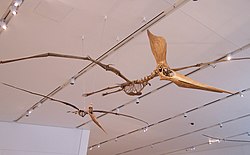
Mounted replicas of female and male Geosternbergia sternbergi skeletons (Royal Ontario Museum).
Scientific classification Edit this classification
Kingdom: Animalia
Phylum: Chordata
Class: Reptilia
Order: Pterosauria
Suborder: Pterodactyloidea
Clade: Pteranodontoidea
Clade: Pteranodontia
Family: Pteranodontidae
Marsh, 1876
Type species
Pteranodon longiceps
Marsh, 1876
Genera

The Pteranodontidae are a family of large pterosaurs from the Late Cretaceous of North America and possibly other continents including Europe and Africa. The family was named in 1876 by Othniel Charles Marsh. Pteranodontids had a distinctive, elongated crest jutting from the rear of the head (most famously seen in Pteranodon itself). The spectacularly-crested Nyctosaurus is sometimes included in this family, though usually placed in its own family, the Nyctosauridae (Nicholson & Lydekker, 1889).

Modern researchers differ in their use of the concept. S. Christopher Bennett and Alexander Kellner have concluded that Nyctosaurus was not a pteranodontid. In 1994 Bennett defined a clade Pteranodontidae, also including species of the Ornithocheiromorpha.[3] However, this definition has not been accepted by other workers. Alexander Kellner, for example, named several additional species for specimens previously classified as Pteranodon, and placed P. sternbergi in a distinct genus, Geosternbergia. Kellner re-defined Pteranodontidae as the most recent common ancestor of Pteranodon longiceps, Geosternbergia sternbergi and Dawndraco kanzai, and all of its descendants. This definition is now contentious, however, as the validity of Dawndraco has been disputed.[4] This clade possibly includes the nyctosaurids. Analyses by David Unwin did indicate a close relationship between Pteranodon and Nyctosaurus, and he used the name Pteranodontia for the clade containing both.

Pteranodontids are primarily known from the Coniacian to Campanian stages of the Cretaceous in North America and Japan.[5] However, potential Maastrichtian remains have been identified from several other locations,[6][7] being actually rather common in the Maastrichtian of the Tethys Sea. Beginning in 2016, Nicholas Longrich, David Martill, and Brian Andres presented evidence of several nyctosaurid and pteranodontid species from the latest Maastrichtian age of north Africa, suggesting that both lineages went through an evolutionary radiation in the Tethys region shortly before the K–Pg extinction event.[8][9] Additionally, later phylogenetic studies imply that they represent a ghost lineage dating much earlier in the Cretaceous.[10] Volgadraco, previously assumed to be an azhdarchid, has also since been relocated to pteranodontidae.[2]

References

[edit]
Revisions and contributorsEdit on WikipediaRead on Wikipedia
from Grokipedia
Pteranodontidae is a family of large, toothless pterosaurs belonging to the suborder , characterized by prominent cranial crests, elongated fourth digits forming expansive wings, and adaptations for soaring flight, primarily known from the Early to the (approximately 120 to 66 million years ago). These flying reptiles, among the largest pterosaurs with wingspans reaching up to 7 meters in some species, dominated the aerial niches of the in during the to stages, with fossils also documented in , , , and , indicating a broader global distribution than previously thought. The family includes notable genera such as , famous for its backward-projecting crest and in crest size. Pteranodontids exhibit postcranial features like a small deltopectoral crest on the and a robust with a prominent ventral , supporting powerful flight muscles suited to marine environments where they likely fed on using their long, pointed beaks. Their fossils, often preserved in marine deposits such as the Niobrara Formation of , reveal a high diversity with over a dozen named , though taxonomic revisions continue due to fragmentary remains and historical misclassifications. The family played a key role in Late Cretaceous pterosaur faunas, coexisting with azhdarchids and nyctosaurids before their abrupt extinction at the Cretaceous-Paleogene boundary, likely due to the global cataclysmic event, with recent discoveries like Tethydraco regalis from Morocco highlighting their persistence until the very end of the Mesozoic.

Description

Physical characteristics

Pteranodontids possessed elongated, lightweight skulls featuring toothless, elongate jaws with sharp edges suited for grasping prey. These skulls were dominated by prominent cranial crests on the posterior portion, formed by extensions of the frontal bones that project upward and backward from the skull. The crests displayed marked sexual dimorphism, with males typically exhibiting larger, more vertically oriented structures for display purposes, while females had smaller, forward-projecting crests. The wings of pteranodontids were supported by an exceptionally elongated fourth finger, forming the primary of the wing membrane, which spanned from the sides of the body to the ankles and included a propatagium anteriorly. Wingspans ranged typically from 3 to 7 meters, with the bones hollow and thin-walled (approximately 1 mm thick) to minimize weight while withstanding tensile and torsional stresses during flight. Postcranially, pteranodontids are characterized by a small deltopectoral crest on the and a robust with a prominent ventral flange, adaptations supporting powerful flight muscles. Pteranodontids exhibited pelvic and hindlimb adaptations that supported , with s relatively robust compared to those of many other pterosaurs, featuring short, sturdy shafts in elements like the . These features enabled quadrupedal stance and movement on land, despite the animals' primary adaptation for aerial life.

Size and variation

Members of the Pteranodontidae exhibited a wide range of body sizes, with estimates for adults varying from approximately 3 to 7 meters. Smaller individuals, often representing females of longiceps, had wingspans around 3.5–4 meters, while larger specimens, including males of the same species and individuals of Geosternbergia, reached 5–7 meters. Body mass approximations for adult pteranodontids, derived from skeletal scaling and volumetric models, ranged from 16 to 50 kilograms, with smaller forms closer to 20 kilograms and larger ones approaching or exceeding 40 kilograms. These estimates account for lightweight skeletal structures and distributions optimized for flight, though values vary based on modeling assumptions. Ontogenetic changes were pronounced in Pteranodontidae, particularly in cranial morphology. Juvenile skulls lacked prominent , which developed and enlarged significantly during maturation as individuals transitioned from subadults to adults, reflecting rapid growth phases. Intraspecific variation, especially in crest morphology, is primarily attributed to . In longiceps, males possessed larger, more upright compared to females, which had smaller, forward-projecting , correlating with overall body differences. Similar patterns of dimorphism in crest and are evident across the family, influencing aerodynamic and display functions.

Classification

Phylogenetic position

Pteranodontidae is a family of pterodactyloid pterosaurs positioned within the clade , more specifically as part of the superfamily Pteranodontoidea, which encompasses several derived ornithocheiroid lineages from the period. In various phylogenetic analyses, Pteranodontidae forms part of Ornithocheiroidea or is closely allied with it, branching off from earlier pterodactyloids such as ctenochasmatids and archaeopterodactyloids during the mid-. This placement reflects a progression toward more specialized cranial and postcranial adaptations in pterosaurs, with Pteranodontoidea emerging as a diverse group alongside dsungaripteroids and azhdarchoids. Key synapomorphies defining Pteranodontidae include a large frontal crest that constitutes the primary component of the cranial crest, a featuring a posterior process that renders the lower anterior margin of the external naris horizontal, and restricted to the tips of the jaws or entirely absent, marking a shift toward edentulous forms optimized for aerial and aquatic lifestyles. Additional shared traits encompass an elongated contributing to a streamlined profile and specialized vertebral modifications supporting enhanced flight capabilities. These features distinguish the family from more basal pterodactyloids and underscore their evolutionary specialization within Pteranodontoidea. Within broader pterosaur phylogeny, Pteranodontidae is most closely related to , often recovered as sister taxa forming the , characterized by extreme cranial crest development and further tooth reduction. This pairing positions them distant from azhdarchids, which branch later within and exhibit distinct long-necked, terrestrial adaptations. Pteranodontidae first appeared in the , with the earliest known records from , and in dating to the stage, followed by peak diversification during the Coniacian to intervals, before declining toward the end of the .

Included genera

Pteranodon is the type genus of Pteranodontidae, known primarily from the Smoky Hill Chalk Member of the in , , with hundreds of specimens documenting and ontogenetic variation. The genus includes the Pteranodon longiceps, characterized by a large, posteriorly directed frontal crest in adults, a slender rostrum, and toothless jaws adapted for piscivory. Geosternbergia, formerly classified as Pteranodon sternbergi, is distinguished by a shorter, more upright crest that is bulbous in profile, a more robust with a sub-vertical premaxillary process, and a broader lower . Known from the deposits, including the Niobrara and formations, it encompasses G. sternbergi and G. maiseyi, reflecting adaptations possibly linked to different ecological niches within the same marine environment. Tethydraco represents the only non-North American pteranodontid, from the phosphates of , with T. regalis featuring a with a short deltopectoral crest and prominent ectepicondyle, alongside an elongated rostrum inferred from associated material. Dated to the late , it suggests a wider geographic distribution for the family toward the end of the . Several other genera have been proposed within Pteranodontidae but remain debated due to fragmentary remains or alternative placements. Muzquizopteryx, a small from the of with a of about 2 m, was initially considered a potential pteranodontid but is more consistently classified as a nyctosaurid based on wing proportions and preservation. Volgadraco, from the of , is known from jaw and vertebral fragments showing toothless margins and robust construction; while some analyses support its inclusion in Pteranodontidae, others suggest azhdarchid affinities due to limited diagnostic material. Nomenclatural issues persist, notably with Dawndraco kanzai, originally described from a partial rostrum and vertebrae from the Smoky Hill Chalk; reassessments have determined it lacks unique autapomorphies and is a junior synonym of , likely representing an extreme example of in that species. Nyctosaurus is excluded here, as phylogenetic analyses consistently place it in the separate family .

History of research

Initial discoveries

The initial discoveries of pteranodontid fossils occurred during Othniel Charles Marsh's expeditions to western between 1870 and 1872, where he collected the first North American specimens from the Smoky Hill Chalk Member of the . These early finds consisted primarily of fragmentary wing elements, such as the distal ends of metacarpals cataloged as Yale Peabody Museum specimens YPM 1160 and YPM 1161, which Marsh initially described as resembling the European Pterodactylus in a preliminary 1871 report. Some of these bones were initially misattributed to birds or even dinosaurs by local collectors before Marsh's systematic work confirmed their pterosaurian nature. In 1876, Marsh formally named the genus Pteranodon based on a partial bearing a prominent vertical crest ( YPM 1177, P. longiceps), emphasizing its edentulous jaws and crest as key features distinguishing it from other pterosaurs; he simultaneously established the family Pteranodontidae to accommodate this group. In the same year, Marsh described additional fragmentary material from the Smoky Hill Chalk as Pteranodon gracilis (later the type of Nyctosaurus gracilis, YPM 1178), recognizing subtle differences in cranial structure but initially classifying it within Pteranodon. These descriptions, published in the American Journal of Science, marked the first recognition of pteranodontids as a distinct North American clade, with the crest serving as a diagnostic trait for the family. By the early 20th century, further expeditions in and yielded more complete partial skeletons of pteranodontids from similar chalk deposits, including additional Nyctosaurus remains and specimens initially assigned to Pteranodon species (later including Geosternbergia sternbergi). Paleontologist George F. Sternberg collected numerous such fossils from the Smoky Hill Member during the 1900s to 1940s, contributing significantly to the growing collection of pteranodontid material at institutions like the Yale Peabody Museum and the Sternberg Museum. These efforts revealed dozens of partial skeletons, primarily comprising wings, vertebrae, and pelves, underscoring the abundance of pteranodontids in the .

Taxonomic revisions

In the late 20th and early 21st centuries, S. Christopher Bennett's extensive monographic studies significantly refined the of Pteranodontidae, including the separation of (formerly ) as a distinct based on cranial and postcranial differences from Pteranodon longiceps, as well as the recognition of marked in characterized by size disparities and crest variations between presumed males and females. In 1994, Bennett further redefined Pteranodontidae to exclude , proposing the new family for the latter based on distinct cranial and skeletal features such as the extreme elongation of the crest and limb proportions, thereby narrowing the family's scope to edentulous pterosaurs with more conservative morphologies. During the , W.A. Kellner expanded the higher-level Pteranodontoidea to encompass a broader array of pterodactyloid genera, including potential pteranodontids like Dawndraco, while debates persisted over the validity of taxa such as regalis, described as a Maastrichtian pteranodontid from but questioned as possibly belonging to an azhdarchid like Phosphatodraco, and Volgadraco bogolubovi, initially classified as an azhdarchid but later reassigned to Pteranodontidae based on mandibular and humeral traits. In the 2020s, cladistic analyses have reaffirmed the of Pteranodontidae within Pteranodontoidea, supported by shared synapomorphies such as edentulous premaxillae and elongated metacarpals, with inferred ghost lineages extending the family's temporal range from the into the to accommodate records like .

Paleobiology

Flight adaptations

Pteranodontids possessed high wings, typically ranging from 10 to 16 across and up to 17 in adults, which facilitated efficient soaring by minimizing induced drag during . These elongated, narrow wings, supported by an extended fourth finger, resembled those of modern albatrosses and enabled over open water bodies. Wing loading in genera like Pteranodon was relatively low, estimated at around 5-12 kg/m² based on mass reconstructions and skeletal scaling, allowing for sustained lift with minimal expenditure compared to contemporary birds of similar . Recent allometric studies indicate that wing increased from ~10 in juveniles to ~17 in adults, enhancing soaring efficiency with growth. Bone microstructure analyses further suggest high lift coefficients, supporting the inference that these structures were optimized for long-duration glides rather than rapid flapping. The in pteranodontids featured robust, fused -coracoid complexes that anchored powerful flight muscles, particularly the depressor muscles responsible for downstrokes. The large provided extensive attachment sites for the pectoralis complex, while the coracoid's acrocoracoid process acted as a for the supracoracoideus muscle, enabling efficient upstroke recovery akin to avian mechanisms. Additionally, extensive pneumaticity in the limb bones, including hollow chambers invading the and manual elements, significantly reduced overall body mass without compromising structural integrity, thereby enhancing flight efficiency. Launch mechanisms in pteranodontids likely involved quadrupedal takeoff, where individuals used all four limbs to generate from elevated surfaces such as cliffs or margins, inferred from disproportionate forelimb strength and trackway evidence in related pterosaurs. This vaulting strategy, involving a crouch-vault-launch sequence, leveraged the robust s to propel the body airborne, bypassing the limitations of bipedal running seen in birds. These adaptations collectively supported endurance flight, with Pteranodon capable of long-distance travel through a combination of initial powered flapping and prolonged thermal or slope soaring, analogous to modern albatrosses.

Diet and ecology

Pteranodontids, particularly the well-known genus Pteranodon, exhibited a primarily piscivorous diet, as evidenced by fossilized stomach contents containing fish vertebrae and scales preserved within thoracic cavities. For instance, specimens such as AMNH 5098 include articulated fish remains in positions consistent with ingestion, supporting the interpretation of fish as a staple prey item alongside occasional cephalopods or soft-bodied marine organisms. Indirect support comes from the toothless, elongated jaws, which would have facilitated grasping small to medium-sized fish. Gastroliths have not been directly associated with pteranodontid remains, but the overall cranial morphology aligns with adaptations for grasping small to medium-sized fish. Foraging behaviors likely involved aerial strategies over open marine waters, such as plunge-diving or surface-seizing, rather than sustained skim-feeding, which biomechanical models indicate would have been inefficient given the fragility of their slender lower jaws. These pterosaurs partitioned ecological niches with smaller congeners like Nyctosaurus, occupying higher trophic levels by targeting mid-sized schooling fish in the upper water column, while smaller species foraged on plankton or near-surface invertebrates. Such strategies minimized competition and optimized energy use in nutrient-rich seaways. Within ecosystems, particularly the , pteranodontids served as dominant aerial predators, exerting significant predation pressure on fish populations and occasionally falling prey to larger marine reptiles like the shark Cretoxyrhina mantelli or mosasaurs such as Tylosaurus. They coexisted with early avian divers like Hesperornis and Ichthyornis, forming a diverse of marine piscivores that collectively shaped dynamics through top-down control on prey abundance. Bone histology reveals rapid growth rates in pteranodontids, characterized by fibro-lamellar bone tissue in limb elements, indicating accelerated somatic development from hatching to skeletal maturity within a few years, comparable to modern seabirds. likely involved oviposition, with inferences of colonial nesting on coastal islands or rookeries drawn from the migratory habits and aggregation patterns observed in related pterosaurs, where eggs were buried in soft substrates for protection. This strategy would have supported high reproductive output in expansive marine habitats, though direct evidence for pteranodontid nests remains elusive.

Distribution and timeline

Geographic range

Pteranodontids are predominantly known from marine deposits in , where the majority of fossils have been recovered from formations associated with the . The most prolific locality is the Smoky Hill Chalk Member of the in western , which has yielded hundreds of specimens, including numerous complete skeletons of . Additional significant sites include the Austin Group in north-central , representing the earliest known occurrence of the family in with isolated wing elements. Extralimital finds outside are rarer and typically consist of isolated elements, indicating a broader but less well-documented distribution. In , pteranodontid remains, including a partial assigned to Tethydraco regalis, have been reported from the deposits of the Ouled Abdoun Basin in . In , possible pteranodontid bones, such as a large cervical and wing phalanges, come from the Rybushka Formation in the Province of , suggesting presence in eastern European marine settings. Fragmentary material from includes potential pteranodontid elements from the of and additional Russian sites, though these assignments remain tentative. Paleobiogeographically, pteranodontids exhibit within the , with the vast majority of well-preserved fossils confined to this epicontinental sea that bisected . Their wider distribution to , , and likely occurred via dispersal across Tethys Sea connections during the , facilitating exchange between northern landmasses. Preservation biases strongly influence the known geographic range, as exceptional Lagerstätten like the Smoky Hill Chalk provided oxygen-poor, fine-grained marine sediments that favored the mineralization of delicate skeletons, while most extralimital sites yield only disarticulated fragments due to less favorable taphonomic conditions.

Temporal occurrence

Pteranodontidae first appeared in the fossil record during the early stage of the , approximately 89–86 million years ago (Ma), with primitive forms documented from the basal Austin Group in . This specimen, a partial pteranodontid wing element, marks the earliest known occurrence of the family. The family achieved its peak diversity during the Santonian to stages, roughly 86–80 Ma, particularly within the where multiple genera including and coexisted, representing an abundant but relatively low-diversity assemblage of pterosaurs adapted to marine environments. This interval saw the proliferation of several species within these genera, with Pteranodon alone encompassing at least 11 named species from the Smoky Hill Chalk Member of the Niobrara. The latest confirmed records of Pteranodontidae extend into the stage, 72–66 Ma, with Tethydraco regalis from the upper phosphates of providing the first definitive evidence of the family in this stage and in . Potential remains, including disputed fragments from the in , suggest possible persistence but remain unassigned to specific taxa within the family. The biochronology of Pteranodontidae correlates with major marine transgressions, such as those forming the , which expanded shallow marine habitats and facilitated the family's diversification and distribution across epicontinental seas.

References

Add your contribution
Related Hubs
User Avatar
No comments yet.