Hubbry Logo
ScaphognathusScaphognathusMain
Open search
Scaphognathus
Community hub
Scaphognathus
logo
8 pages, 0 posts
0 subscribers
Be the first to start a discussion here.
Scaphognathus
Scaphognathus
from Wikipedia

Scaphognathus
Temporal range: Late Jurassic, 155.7–150.8 Ma
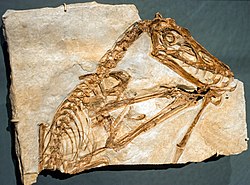
Cast of the holotype specimen
Scientific classification Edit this classification
Kingdom: Animalia
Phylum: Chordata
Class: Reptilia
Order: Pterosauria
Family: Rhamphorhynchidae
Subfamily: Rhamphorhynchinae
Genus: Scaphognathus
Wagner, 1861
Type species
Pterodactylus crassirostris
Goldfuss, 1831
Species
  • Scaphognathus crassirostris (Goldfuss, 1831)
Synonyms

Scaphognathus was a pterosaur that lived around Germany during the Late Jurassic. It had a wingspan of 0.9 m (3 ft).

Discovery and naming

[edit]
1831 illustration of the holotype slabs

The first known Scaphognathus specimen was described in 1831 by August Goldfuss[1] who mistook the tailless specimen for a new Pterodactylus species: P. crassirostris.[2] The specific name means "fat snout" in Latin. This specimen was an incomplete adult with a 0.9 m (3 ft) wingspan recovered from the Solnhofen strata near Eichstätt. In 1858 Johann Wagner referred the species to Rhamphorhynchus. After recognising the fundamentally different snout shape, Wagner, after previous failed attempts by Leopold Fitzinger and Christoph Gottfried Andreas Giebel, who used preoccupied names, in 1861 named a distinct genus: Scaphognathus, derived from Greek skaphe, "boat" or "tub", and gnathos, "jaw", in reference to the blunt shape of the lower jaws.[3]

In the early twentieth century, the "rhamphorhynchoid" nature of S. crassirostris was recognized after the discovery of the second specimen in Mühlheim, whose long tail was preserved. The second Scaphognathus specimen was more complete than its predecessor, but only half the size (twenty inch wingspan) and with partially ossified bones.[2] These characters indicate that the second specimen was a juvenile.[2]

Description

[edit]
Life restoration exhibiting scansorial behavior

The Scaphognathus is known from three specimens, all of which originated in the Kimmeridgian-age[4] Solnhofen Limestone.[2] Physically it was very similar to Rhamphorhynchus, albeit with notable cranial differences.[2]

For one, Scaphognathus had a proportionately shorter skull (4.5 in) with a blunter tip and a larger antorbital fenestra.[2] Its teeth oriented vertically rather than horizontally. The traditional count of them held that eighteen teeth were in the upper jaws and ten in the lower.[2] S. Christopher Bennett, studying a new third specimen, SMNS 59395, in 2004 determined there were only sixteen teeth in the upper jaws, the higher previous number having been caused by incorrectly adding replacement teeth.[5]

Comparisons between the scleral rings of Scaphognathus and modern birds and reptiles suggest that it may have been diurnal. This may also indicate niche partitioning with contemporary pterosaurs inferred to be nocturnal, such as Ctenochasma and Rhamphorhynchus.[6]

Classification

[edit]

The cladogram (family tree) of rhamphorhynchids below is the result of a large phylogenetic analysis published by Andres & Myers in 2013.[7]

Breviquartossa

See also

[edit]

References

[edit]

Literature

[edit]
[edit]
Revisions and contributorsEdit on WikipediaRead on Wikipedia
from Grokipedia
Scaphognathus is a genus of small rhamphorhynchid pterosaur that lived during the Late Jurassic epoch, approximately 150 million years ago, in the lagoonal environment of what is now southern Germany. Known from exceptionally preserved fossils in the Solnhofen Limestone, the type and only recognized species, S. crassirostris, had an estimated wingspan of 0.9 meters (3 feet) and possessed a robust, broad, boat-shaped snout filled with numerous small, pointed teeth adapted for grasping small prey such as fish and insects. The genus was first described in 1831 by German paleontologist based on a nearly complete specimen (now SIPB Goldfuß 1304a and 1304b) that notably preserved impressions of soft tissues, including pycnofibers—a hair-like covering on the neck and body—and aktinofibrils in the wing membranes, marking the earliest reported evidence of such integument in pterosaurs. Subsequent finds, including two additional articulated skeletons (including juveniles), have revealed key anatomical details such as a long, stiffened tail for aerial control, nine , and a dentition pattern of two premaxillary teeth, six maxillary teeth, and five dentary teeth per side of the . Paleobiological analyses indicate Scaphognathus was diurnal, with scleral ring and orbit morphology suggesting adaptation for daytime vision, distinguishing it from nocturnal pterosaurs like Rhamphorhynchus. Its robust build and terrestrial adaptations, including strong claws, support a primarily piscivorous diet supplemented by insectivory or generalist foraging, allowing coexistence with contemporaries like Rhamphorhynchus and Pterodactylus in the Solnhofen ecosystem.

Discovery and naming

Initial discovery

The specimen of Scaphognathus crassirostris, cataloged as SIPB Goldfuß 1304a and 1304b, consists of an incomplete but articulated preserved on a main slab and counterslab, representing an adult individual with a of approximately 0.9 meters. This fossil was acquired by the German paleontologist from quarries in the near , , , in 1831, likely through local quarry workers who were actively extracting the fine-grained lithographic stone used for printing and construction. In 1831, Goldfuß formally described the specimen as a new species of the then-dominant pterosaur genus Pterodactylus, naming it Pterodactylus crassirostris to highlight its distinctive robust, "fat-beaked" rostrum compared to other Solnhofen pterosaurs. This initial classification reflected the limited understanding of pterosaur diversity at the time, as early 19th-century researchers grouped most Solnhofen finds under Pterodactylus based on superficial similarities in wing structure and body plan. The description emphasized the specimen's short, deep and preserved skeletal elements, including parts of the limbs and vertebrae, which Goldfuß illustrated in his publication. The , where the originated, dates to the epoch, specifically the to early stages, approximately 152 million years ago, and represents a calm, lagoonal marine environment with low oxygen levels that facilitated exceptional fossil preservation. This setting was part of a tropical of platforms and islands, ideal for delicate organisms like pterosaurs to be entombed in fine sediment without decay or predation. The discovery contributed to the growing excitement among European naturalists in the 1830s over Solnhofen's pterosaur remains, which were already yielding multiple Pterodactylus specimens and foreshadowing the site's later fame for transitional fossils like Archaeopteryx.

Subsequent specimens and taxonomic revisions

The second specimen of Scaphognathus, the Maxberg specimen (Wellnhofer 1975, no. 110), discovered in 1956 near Solnhofen, , revealed juvenile features including a of approximately 0.5 m and partially ossified bones, confirming the genus's long-tailed rhamphorhynchid morphology previously unrecognized in the . This specimen was stolen from its in 1977 and is now lost. In 1861, Johann Andreas Wagner renamed the species Scaphognathus crassirostris from its original designation as Pterodactylus crassirostris by Goldfuß (1831), deriving the genus name from words skaphos ( or tub) and gnathos () to reflect the broad, boat-like tip of the lower . A third specimen (SMNS 59395), from the , provided further confirmation of the long tail and other rhamphorhynchid characteristics, including a preserved postcranial that supported the genus's distinction from short-tailed pterodactyloids. Taxonomic revisions by S. Christopher Bennett in 2004 addressed earlier uncertainties, correcting the to 16 teeth in the upper jaw and 10 in the lower based on the third specimen, while resolving synonymies with related taxa such as pilosus and affirming S. crassirostris as the sole valid species. To date, only three specimens of Scaphognathus are known, all originating from the Kimmeridgian-Tithonian Solnhofen Formation in , with no additional species recognized beyond the type.

Description

Skull and dentition

The skull of adult Scaphognathus measures approximately 11.5 cm in length, rendering it notably shorter and more blunt-ended compared to the elongate rostrum of Rhamphorhynchus, with a characteristically rounded premaxillary tip that contributes to its broad, robust cranial profile. This configuration is evident in key specimens such as SMNS 59395, where the overall skull shape emphasizes a compact anterior region suited to the genus's basal pterosaurian morphology. A prominent feature is the large antorbital fenestra, which occupies roughly 50% of the total skull length and encompasses the nasoantorbital fenestra—a structure typical of basal pterosaurs that combines nasal and antorbital openings for lightweight cranial construction. The absence of a nasal crest distinguishes Scaphognathus from some contemporaries, though adult specimens may exhibit a small sagittal crest along the midline of the skull roof, potentially for muscle attachment or display. The dentition consists of multicuspate teeth adapted for prey capture, with a revised count of 2 premaxillary and 6 maxillary teeth per side (totaling 16 in the upper jaw) and 10 in the lower jaw, fewer than previously estimated for the holotype. These teeth are oriented vertically, increase progressively in size from anterior to posterior positions, and feature multiple cusps that enhance grip on slippery or mobile prey items. Preserved scleral rings in specimens like SMNS 59395 indicate relatively large eyes, with an outer ring of 13.5 mm and inner of 8.5 mm, structural metrics that align with diurnal visual adaptations when compared to modern archosaurs. This suggests enhanced daytime acuity, consistent with the genus's inferred active lifestyle in coastal environments.

Postcranial skeleton and flight adaptations

The postcranial of Scaphognathus was characterized by lightweight, pneumatized bones typical of pterosaurs, facilitating flight while supporting limited terrestrial mobility. specimens attained a of approximately 0.9 m and a body length of about 0.3 m excluding the tail, with juvenile individuals exhibiting smaller dimensions, including wingspans around 0.5 m. The vertebral column included nine , which were flexible to allow extensive head movement during flight and , and dorsal vertebrae that fused to form a notarium, enhancing thoracic rigidity and stability for wing-powered locomotion. The was long and stiff, measuring 25–30 cm and comprising approximately 30 caudal vertebrae, stiffened by elongated chevrons that likely contributed to aerodynamic balance and in flight. The pectoral featured a robust and , providing strong anchorage for flight muscles, while the elongated fourth metacarpal served as the primary support for the wing . The wing, or , was stretched between the elongated fourth finger and the body, with evidence suggesting the presence of a propatagium (forward membrane from to ) and uropatagium ( ), further optimizing lift and control during aerial maneuvers. Hindlimb adaptations emphasized for efficiency, with an elongated and slender tibia-fibula supporting quadrupedal walking on the ground; the digits bore curved claws suited for perching on branches or rocks. The pelvic girdle was lightweight yet sturdy, accommodating these limbs without compromising flight performance. These features collectively indicate Scaphognathus was capable of sustained flapping flight interspersed with short glides, complemented by agile terrestrial movement.

Classification

Systematic position

Scaphognathus is classified within the kingdom Animalia, phylum Chordata, class Reptilia, order Pterosauria, suborder , family Rhamphorhynchidae, and subfamily Scaphognathinae. The genus is monotypic, comprising solely the S. crassirostris, which was originally described as Pterodactylus crassirostris by Goldfuß in 1831 based on a specimen from the and subsequently renamed Scaphognathus crassirostris by Wagner in 1861 to reflect its distinct morphology. The diagnostic traits of Scaphognathus include a blunt, robust , simple pointed teeth arranged in a deep , and a reinforced by chevron bones, features that clearly separate it from the derived, short-tailed pterodactyloids and align it with basal long-tailed pterosaurs. These characteristics underscore its position as a specialized member of the Rhamphorhynchidae, adapted for a marine environment. Historically, Scaphognathus underwent several taxonomic reassignments following its initial description, reflecting early uncertainties in pterosaur systematics; it was briefly placed in by Wagner in 1858 before receiving its own . Its placement within Rhamphorhynchidae was confirmed through subsequent reviews, including Bennett's 2004 study that established shared synapomorphies with other members of the . Subsequent analyses, particularly Bennett's 2004 study, confirmed the monotypic status of the genus, with all referred specimens attributable to S. crassirostris and no valid synonyms recognized.

Phylogenetic relationships

Scaphognathus occupies a basal position within the Rhamphorhynchidae, a family of long-tailed pterosaurs collectively referred to as rhamphorhynchoids, and is frequently recovered as the sister taxon to muensteri in cladistic analyses. This close relationship is supported by shared morphological features, including an elongated tail stiffened by caudal vertebrae with elongated chevrons and a suited to grasping prey, which together bolster the of the Scaphognathinae. A key phylogenetic study by Andres and Myers (2013) incorporated Scaphognathus into a large matrix comprising 110 taxa scored for 185 characters, resulting in its placement within Scaphognathinae as the immediate sister to Rhamphorhynchus. This analysis emphasizes synapomorphies such as the proportional length of the tail relative to the body and the arrangement of pointed teeth, which distinguish the clade from more basal rhamphorhynchids. Scaphognathus exhibits affinities with other s, positioning it more derived than the outgroup-like basal form Austriadactylus but basal to the more advanced pterodactyloid Ctenochasma, reflecting a gradient of early evolution in Late Jurassic lagoonal settings. The evolutionary implications of Scaphognathus's phylogeny highlight its role in the early diversification of piscivorous rhamphorhynchids, adapted to the marine-influenced lagoons of the Solnhofen region during the . Its position underscores the radiation of small-bodied, fish-eating pterosaurs with specialized dentition for seizing slippery prey in shallow aquatic environments. Debates persist regarding the broader structure of rhamphorhynchoid clades, with some analyses suggesting of Rhamphorhynchidae due to convergent traits among long-tailed forms; however, Scaphognathus consistently clusters within the rhamphorhynchoid grade across studies, including recent analyses as of , reinforcing its foundational status in the family's evolutionary tree.

Paleobiology

Habitat and paleoecology

Scaphognathus is known exclusively from the Formation (also known as the Solnhofen Plattenkalk or Altmühltal Formation) in , , a renowned that formed in a series of isolated, low-oxygen lagoons separated by reefs and mounds at the northern margin of the . These lagoons featured hypersaline conditions with algal mats (microbial biofilms) dominating the sediment surface, contributing to the fine-grained, laminated that preserved intricate details of soft tissues and skeletal elements. The was a shallow, restricted marine basin with episodic influxes of normal marine waters, fostering a stratified where oxygen levels decreased sharply with depth. The formation dates to the stage, approximately 150 million years ago, during a period of warm, tropical marine conditions with periodic salinity fluctuations due to restricted circulation and evaporation. The regional was humid subtropical, characterized by high temperatures and increased moisture from the encroaching Tethys Sea, which supported seasonal blooms that likely drew aerial predators like pterosaurs to the lagoons. This setting extended tropical-subtropical influences across much of the supercontinent , with no evidence of polar ice caps and enhanced global humidity. Taphonomic processes in the Solnhofen lagoons enabled exceptional preservation through anoxic bottom waters that inhibited decay and scavenging, combined with rapid of muds that entombed carcasses before significant . specimens, including those of Scaphognathus, are frequently found nearly complete with wings outstretched, suggesting death during flight followed by immediate sinking into the oxygen-poor depths without postmortem folding or predation. Storms periodically disrupted the calm waters, transporting organisms from adjacent reefs or open sea into the lagoons, further enriching the assemblage. The Solnhofen ecosystem hosted a diverse array of contemporaneous taxa, reflecting a productive coastal marine environment with inputs from terrestrial and habitats. Bony such as Pholidophorus dominated the aquatic community, alongside marine reptiles including ichthyosaurs and crocodylomorphs, while early avialans like represent rare terrestrial incursions. Pterosaur diversity was particularly high, with over ten genera recorded, including , , and Ctenochasma, indicating a rich aerial niche exploited by flying reptiles amid the lagoons' nutrient-rich waters.

Diet, behavior, and sensory adaptations

Scaphognathus is inferred to have been primarily piscivorous, with from a specimen preserving remains in the and region, supporting the capture of small aquatic prey. Its conical, pointed teeth, arranged in a robust , were adapted for grasping slippery , akin to modern gharials, facilitating feeding in shallow coastal waters. Opportunistic insectivory may have supplemented this diet, particularly in environments where were abundant, based on with other rhamphorhynchoids. As an agile flier specialized for coastal habitats, Scaphognathus likely employed its for aerodynamic stability during low-speed maneuvers, such as hovering over to spot and seize prey. On land, it adopted a quadrupedal posture for brief terrestrial excursions, supported by robust limbs and curved claws suited for short bursts of movement or low . Sensory adaptations centered on enhanced vision, with large eyes encircled by scleral rings indicating a photopic () optimized for high acuity in bright conditions, ideal for diurnal of mobile prey. This contrasts with the larger scleral ring apertures in nocturnal contemporaries like some Ctenochasma , suggesting temporal niche separation to reduce . In paleoecological contexts, Scaphognathus's smaller body size relative to enabled niche partitioning, targeting smaller fish and while avoiding overlap with larger piscivores. The relative scarcity of specimens implies low densities, potentially indicating solitary rather than , though direct evidence is lacking. Ontogenetic studies reveal juvenile specimens with less ossified elements and variable vertebral counts, pointing to rapid maturation typical of pterosaurs, achieving adult size within a few years. Sexual dimorphism remains unconfirmed, but the absence of crests in some individuals may reflect differences, warranting further investigation. Recent studies as of 2024, using imaging on cranial material, have revealed additional details of anatomy, supporting inferences of piscivory and sensory capabilities. In 2025, the genus was designated Fossil of the Year by the Palaeontological Society for its exceptional preservation and scientific value.

References

Add your contribution
Related Hubs
User Avatar
No comments yet.