


Community hub
Recent from talks
Contribute something
Nothing was collected or created yet.
Putten
View on Wikipedia
Key Information


.svg)
Putten (Dutch pronunciation: [ˈpʏtə(n)] ⓘ) is a municipality and town in the province of Gelderland, Netherlands. It had a population of 24,365 in 2021. It is located in the coastal area of the old Zuiderzee (Southern Sea). To the east of Putten lies the Veluwe, the biggest national park of the Netherlands. To the north, east and west, Putten is surrounded by farmlands.
Population centres
[edit]- Bijsteren
- Diermen
- Gerven
- Halvinkhuizen
- Hell
- Hoef
- Huinen
- Koudhoorn
- Krachtighuizen
- Putten
- Steenenkamer
- Veenhuizerveld.
History
[edit]Until World War II
[edit]The oldest official paper in which Putten is mentioned dates back to 855. Small settlements, however, were already in existence during the Roman era. After the founding of the present main church in the 10th century, the community became the center of several smaller settlements. Parts of Nijkerk and Voorthuizen also became part of the Putten area, until in 1530 Nijkerk, and later also Voorthuizen, became independent communities.
Until 1356, when a dyke was built, the coastline changed frequently, overflowing agricultural land in the west of Putten. The water was still a threat however, and the dyke broke through several times. The last major flood was in 1916, when large parts of Putten were flooded. After the Afsluitdijk was built in the north of the Netherlands, the Zuiderzee became a lake (1927–1933) and no longer posed a threat.
Agriculture has always been a major source of income in Putten. The manufacturing of paper was also important in the 17th to 19th centuries. From the end of the 19th century tourism emerged, helped by the arrival of the railway in 1863. This made it easier for people from other towns to holiday in the boarding houses that Putten had built. Among those people from elsewhere were also patients who suffered from tuberculosis and similar diseases. They benefited from the sunlight and clean air and recuperated in several sanatoria.
Putten has suffered considerably from military violence. During the 15th, 16th and 17th century Putten was burned down on at least five occasions.


World War II
[edit]One of the biggest Nazi raids held in the Netherlands during World War II took place in Putten. On 1 and 2 October 1944, the majority of the male population was deported from the town and most of them died in concentration camps such as Neuengamme and Birkenau. Following the war, two of the responsible German officers were tried and convicted for this action. The raids were a retaliation for an attack by the local resistance that killed one Wehrmacht officer near Nijkerk. The first and second of October are commemorated every year in Putten. A war memorial at Putten Church and a memorial garden (Vrouwtje van Putten Herdenkingshof) commemorate the event and the loss of life.
| Total number of men deported | 661 |
| Released in Amersfoort | 59 |
| Deported to Neuengamme | 602 |
| Jumped out of the train on the way to Neuengamme | 13 |
| Arrived in Neuengamme | 589 |
| Returned to Putten after liberation | 49 |
| Died in German concentration camps | 540 |
| Killed during the raid | 7 |
| Died shortly after the return | 5 |
| Total number of deaths | 552 |
Economy
[edit]Today agriculture is still important in Putten, but the service sector now predominates. There are considerable numbers of shops, and tourism is important. Tourists are attracted by the varied landscape and the beach at the Ring Lake (Strand Nulde). Every Wednesday there is a produce and food market that is the biggest in the northwest Veluwe area.
Transport
[edit]Putten lies next to the A28 highway that connects Utrecht with the north. The town has a train station on the line between Utrecht and Zwolle. There are also bus connections.
Notable people
[edit]- Hendrik van Boeijen (1889–1947), politician
- Danielle Goldstein (born 1985), American-Israeli show jumper, lives in Putten
- Ummet Ozcan (born 1982), Dutch–Turkish DJ and record producer
- Sander Duits (born 1983), footballer with about 400 club caps who plays for SDC Putten
- Tjarda Struik (born 1986), politician and blindfluencer
Gallery
[edit]-
 Buorren Putten by de tsjerke
 -
 Kasteel Oldenaller
 -
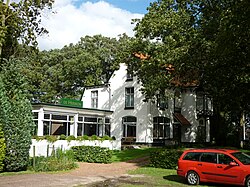 de Herikon, Putten
 -
 Kasteel de Vanenburg


References
[edit]- ^ "Burgemeester H.A. Lambooij" [Mayor H.A. Lambooij] (in Dutch). Gemeente Putten. Retrieved 17 June 2014.
- ^ "Kerncijfers wijken en buurten 2020" [Key figures for neighbourhoods 2020]. StatLine (in Dutch). CBS. 24 July 2020. Retrieved 19 September 2020.
- ^ "Postcodetool for 3881BZ". Actueel Hoogtebestand Nederland (in Dutch). Het Waterschapshuis. Retrieved 17 June 2014.
- ^ "Bevolkingsontwikkeling; regio per maand" [Population growth; regions per month]. CBS Statline (in Dutch). CBS. 1 January 2021. Retrieved 2 January 2022.
External links
[edit]


| International | |
|---|---|
| Geographic | |
| Other | |

Putten
View on GrokipediaPutten is a municipality and town in the province of Gelderland in the eastern Netherlands.[1] It encompasses an area of 85.21 square kilometers and borders the Veluwe, the Netherlands' largest contiguous woodland area, to the east, with polder landscapes to the west near the former Zuiderzee coast.[2][3] As of 2025 estimates, the population stands at 24,953.[2] The municipality is predominantly agricultural, with significant horticultural production, particularly in flower bulbs and vegetables, contributing to the local economy alongside tourism drawn to its natural surroundings and historical sites.[3] Putten maintains a strong community identity rooted in Protestant traditions, reflected in its numerous churches and conservative social fabric.[4] Putten's defining historical event occurred during World War II with the Razzia van Putten, a reprisal raid by German occupation forces on October 1–2, 1944, following an ambush by Dutch resistance fighters on a Wehrmacht vehicle the previous night, which resulted in the deaths of one German officer and injuries to others.[5][6] In retaliation, SS and Wehrmacht units rounded up 659 men aged 18 to 50—nearly the entire male workforce—deporting them to concentration camps such as Neuengamme and Husum-Schwesing, where most perished from harsh labor, disease, and execution; only 49 survived to return postwar.[5][6] The village center was partially razed by fire, leaving a lasting scar on the community, commemorated annually and through memorials, underscoring the raid's status as one of the most severe collective punishments inflicted on a Dutch civilian population during the Nazi occupation.[5][6]
Geography
Location and Topography
Putten is situated in the province of Gelderland in the central Netherlands, with its municipal center at approximately 52°15′39″N 5°36′34″E.[7] The municipality encompasses a total land area of 87.45 km², positioned southeast of the former Zuiderzee coastal region, now part of the IJsselmeer basin.[7] It lies amid expansive farmlands to the north, west, and portions of the east, reflecting the broader polder landscape shaped by historical land reclamation efforts.[3] The topography of Putten is generally low-lying and flat in its western and central areas, with average elevations around 19 meters above sea level, facilitating intensive agricultural use on fertile soils.[8] [9] Elevations range from near sea level in reclaimed lowlands to modest rises eastward, where the municipality borders the Veluwe—a geologically distinct upland region of glacial sands, featuring forests, heathlands, and subtle hills reaching up to approximately 50-100 meters in adjacent areas.[9] This eastern transition marks a shift from open agrarian plains to more varied, wooded terrain typical of the Veluwe's end moraine formations.[3] No significant rivers traverse the core municipality, though proximity to the IJssel River influences regional hydrology.[9]Climate and Environment
Putten has a temperate maritime climate (Köppen classification Cfb), typical of the central Netherlands, with mild temperatures, moderate rainfall, and frequent overcast skies throughout the year. Average annual temperatures range from a low of about 0°C (32°F) in winter to highs of 22°C (72°F) in summer, with extremes rarely falling below -7°C (19°F) or exceeding 28°C (83°F). Annual precipitation averages 878 mm, distributed relatively evenly across months, though July sees the highest at around 90 mm over 14 days, while April is driest at 59 mm.[10][11][12] The local environment features low-lying topography at an average elevation of 13-18 meters above sea level, with modest variations up to 56 meters in nearby areas, reflecting glacial and fluvial deposits from the Pleistocene era. The municipality borders the Veluwe, a expansive forested and heathland region, contributing to diverse habitats including woods, dunes, and wetlands, though much of Putten's land remains dedicated to agriculture such as dairy farming and crop cultivation. Protected areas like Landgoed Schovenhorst estate preserve woodlands and educational nature trails, supporting biodiversity amid intensive land use.[9][13][14][15]Demographics
Population Trends and Statistics
The population of Putten has exhibited steady long-term growth, increasing from 1,450 inhabitants in 1526 to 24,988 as of 2024.[16] This expansion accelerated significantly after the mid-19th century, with the population roughly doubling every few decades during the 20th century due to industrialization, post-war baby booms, and suburban migration patterns common in the Netherlands.[17] From 1940 to 1970, the populace grew from 8,866 to 15,726, reflecting national trends in economic recovery and family formation following World War II.[16]| Year | Population |
|---|---|
| 1526 | 1,450 |
| 1900 | 5,486 |
| 1950 | 10,473 |
| 2000 | 22,700 |
| 2010 | 23,613 |
| 2020 | 24,112 |
| 2024 | 24,988 |
Population Centres and Composition
The municipality of Putten is dominated by its central town of the same name, which accounts for the overwhelming majority of its residents in a compact urban-rural setting. Smaller hamlets, such as Halvinkhuizen and Bijsteren, dot the surrounding countryside but house negligible portions of the population due to their sparse, agricultural character.[18] As of January 1, 2025, the total municipal population stood at 24,953, reflecting a slight decline from prior years amid ongoing trends of aging and balanced family structures.[19] Ethnically, the composition remains largely homogeneous, with native Dutch residents comprising about 90% of the populace; individuals with a migration background represent roughly 10%, including breakdowns of approximately 5.8% with Western origins and 4.1% non-Western, well below national urban averages.[20] Age demographics highlight a family-oriented community: 17% are under 15 years old, 12% aged 15-25, 22% between 25-45, and 22% 65 or older, underscoring moderate population aging driven by low birth rates and longer lifespans.[21] Religiously, Putten exhibits strong Christian adherence, with 72.8% of inhabitants identifying with a church affiliation as of 2022 data, primarily conservative Protestant denominations like the Reformed Churches, aligning with its status in the Netherlands' Bible Belt where church attendance and traditional values persist at elevated levels compared to secular national norms of around 45% affiliation.[22] This composition fosters a cohesive, conservative social fabric, though secularization has incrementally reduced active participation over decades.[23]History
Origins and Development Until 1900
The area encompassing modern Putten shows evidence of human habitation dating back to the Neolithic period, with archaeological finds indicating settlements around 4000–3000 BC, followed by Roman-era presence between 101 and 200 AD and a Merovingian burial field at Krachtighuizen from 550 to 800 AD.[24] Early Christian missionaries arrived around 750 AD, establishing religious influence amid sparse agrarian communities on the Veluwe's sandy ridges.[24] Putten's first documented mention occurs in 855 AD, when the Frisian noble Folckerus donated his estate there to the Benedictine monastery of Werden near Essen, Germany, reflecting early feudal land transfers in the region.[25] The village emerged in the early Middle Ages as a clustered settlement on a cover-sand belt, with an early medieval church serving as a central feature by the 10th century, anchoring community and ecclesiastical life.[26] As part of the Veluwe quarter within the emerging Duchy of Gelderland (elevated from county status in 1339), Putten fell under feudal structures where most farms were held by early nobility, cultivated by serfs in dispersed manors (hoven).[27] Medieval development centered on agrarian estates, with late medieval fortifications including the houses at Arler, Beerencamp, Schoonderbeek, and Vanenburg, built for defense amid regional power struggles in Guelders.[28] Until 1530, Putten shared a single scholtambt (judicial district) with neighboring Nijkerk, after which it gained administrative separation, formalizing local governance under ducal oversight.[29] Estates like Oldenaller originated before 1494 under families such as Van Aller, evolving from defensive sites into symbols of noble control over arable lands ill-suited to intensive farming due to sandy soils.[30] By the 19th century, Putten remained predominantly agricultural, with farms focused on subsistence crops and livestock suited to the Veluwe's marginal terrain, though emerging country estates (buitenplaatsen) marked elite land use for leisure amid gradual enclosure and drainage improvements.[31] Population growth was modest, tied to rural stability rather than industrialization, preserving a patchwork of manorial remnants into the late 1800s before modern shifts.[27]20th Century and Interwar Period
In the early 20th century, Putten's economy continued to revolve around agriculture on the sandy soils of the Veluwe, with dairy farming and poultry production prominent due to the suitability for small-scale mixed operations. The butter factory, established in 1904 along the Stationsstraat as part of a regional cooperative network, represented the municipality's first significant modern industrial facility, centralizing milk processing from local farms into butter for wider distribution.[32][33] A herstellingsoord dedicated to treating lung patients, including those with tuberculosis, opened in 1899 within a structure built in 1883 as a family hotel; it operated until 1928, after which the building was sold to the Christelijk Nationaal Vakverbond for use as a workers' vacation home.[34][35] A major natural disaster struck on the night of 13–14 January 1916, when a storm surge breached dikes at Nekkeveld and the Putterdijk, flooding the entire Arkemheense polder and significant portions of Putten itself as part of the broader Zuiderzeevloed event that affected low-lying areas of the Netherlands.[36][37] This watersnood exacerbated challenges in water management and agriculture, though recovery efforts reinforced local infrastructure resilience without leading to major reclamation projects at the time. Population figures reflected steady rural growth amid national trends: 6,713 residents in 1920 and 7,470 by 1930, driven by natural increase and limited migration in this agrarian setting.[16] To support expanding poultry output, an eierhal (egg hall) was constructed in 1929 on the market square, hosting weekly Wednesday markets where farmers arranged eggs on tiered shelves for inspection and trade by buyers; the prior market hall burned down in 1933, but the new facility underscored Putten's role in regional egg commerce until its demolition in 1977.[38][39] The interwar years (1918–1939) brought economic pressures from global events, including the aftermath of World War I neutrality strains and the 1929 Depression, which hit Dutch agriculture hard through falling prices for dairy and eggs; Putten's farmers adapted via cooperatives, maintaining self-sufficiency in a conservative, Protestant-dominated community.[40] Culturally, the 1930s saw an unusual influx of communist artists to the area, attracted by its unspoiled rural landscapes and as an escape from urban financial woes, briefly introducing leftist influences to the otherwise traditional Veluwe society.[41]World War II: The Putten Raid and Occupation
On the night of 30–31 September 1944, Dutch resistance fighters ambushed a German Wehrmacht staff car near the Oldenallerbrug bridge between Putten and Nijkerk, killing Lieutenant Otto Sommer (who died the following day) and injuring Oberleutnant Eggert, while one resistance member, Frans Slotboom, was also killed.[42] In reprisal, General Friedrich Christiansen, the Wehrmacht commander in the Netherlands, ordered a punitive raid on Putten, executed by Fritz Fullriede on 1 October 1944; German troops surrounded the village early that morning, preventing entry or exit.[42] [43] Residents were assembled at the Kerkplein square, where SS and Wehrmacht personnel separated men from women and children; men, primarily those aged 18–50 but including some older and younger, were detained in the local school and an industrial building (Eierhal) overnight, totaling 659 individuals.[44] [6] During the operation, troops looted homes, set fire to approximately 110 buildings, and executed seven civilians—six men and one woman—by shooting.[42] [43] The detainees were marched to nearby Nijkerk and transported by truck to Kamp Amersfoort transit camp, where 59 were released after interrogation; the remaining 602 were deported by train to Neuengamme concentration camp on 11 October 1944 for forced labor, with some later moved to subcamps like Ladelund or Malchow.[6] [44] [42] Thirteen men escaped by jumping from the train during transit; of those who arrived, 48 survived the camps' conditions of slave labor, starvation, and disease to return home after liberation in April 1945, though five died shortly thereafter, resulting in 552 total victims from the raid.[42] [43] The raid depopulated Putten of its male workforce, leaving women and children to manage amid partial destruction and evacuation orders; this compounded local suffering during the Hunger Winter (October 1944–May 1945), a famine affecting much of the occupied Netherlands due to disrupted supply lines and German blockades, though eastern areas like Gelderland experienced somewhat less severity than the west.[6] Post-raid occupation in Putten involved continued German control until Allied advances forced withdrawal in April 1945, with the absence of men hindering agricultural recovery and community rebuilding.[44] Friedrich Christiansen was convicted of war crimes and imprisoned from 1945 to 1948, while Fullriede faced no prosecution and died in 1969.[42]Post-War Recovery and Modern Era
Following the liberation of Putten by Canadian forces on April 18, 1945, the village faced severe challenges from the Putten Raid's aftermath, including the destruction of over 100 houses by arson and the deportation of 659 men, of whom only 48 survived and returned from concentration camps.[44][45][6] Many widows and families were left destitute, initially sheltering in barns amid the ruins. To address the housing crisis, the Stichting Wederopbouw Putten was established shortly after the war to coordinate national fundraising efforts, with donations from communities across the Netherlands enabling the reconstruction of homes; for instance, a neighborhood association in Heemstede collected funds specifically for building a new house in Putten.[46][47][48] Rebuilding progressed rapidly, with documentary evidence showing active reconstruction by 1947, supported by both local initiatives and broader Dutch post-war recovery programs that prioritized restoring war-damaged rural areas.[48] The returnees, though few, reintegrated into a community marked by collective trauma, contributing to agricultural and social continuity in the Veluwe region. Memorials began emerging soon after, including war monuments at local churches to honor the victims, symbolizing communal resilience and the enduring impact of the occupation.[43] In the modern era, remembrance has become institutionalized through the Stichting Oktober '44, which maintains exhibits and events to preserve the history of the 1940–1945 occupation and the raid's consequences for posterity.[43] Annual commemorations, including ceremonies at sites like the Vrouwtje van Putten memorial, continue to draw attention, fostering historical education while the village has evolved into a stable municipality with a focus on agriculture, services, and heritage tourism tied to its WWII legacy.[49][50]Government and Politics
Local Governance Structure
The governance of Putten adheres to the standard framework for Dutch municipalities as outlined in the Municipalities Act (Gemeentewet). The municipal council (gemeenteraad) serves as the primary legislative body, comprising 19 members elected directly by residents every four years; it determines policy, approves budgets, and oversees the executive.[51] [52] The council is chaired by the mayor and currently consists of representatives from six political groups, reflecting the municipality's emphasis on local decision-making.[53] The executive branch is the college van burgemeester en wethouders, responsible for daily administration, policy implementation, and representing the municipality. It includes the mayor, appointed by royal decree on the recommendation of the Minister of the Interior and Kingdom Relations, and typically three aldermen (wethouders) selected by the council from the elected parties. Henk Lambooij, affiliated with the Reformed Political Party (SGP), has served as mayor since June 15, 2011, with his term extended through at least 2029.[54] [55] The administrative apparatus supports these bodies with approximately 200 employees organized into three departments: Dienstverlening (public services and administration), Samenleving (social affairs and community), and Ruimte (spatial planning and environment).[56]Political Landscape and Conservatism
In the 2022 municipal elections held on March 16, Putten's 19-seat council saw a distribution reflecting strong local and Christian conservative influences, with no single party achieving a majority. Wij Putten, a localist party emphasizing community and rural interests, secured the largest share with 21% of the vote and 4 seats. Other local party Gemeentebelangen followed with 18% and 3 seats, while national Christian parties ChristenUnie (CU), Staatkundig Gereformeerde Partij (SGP), and Christen-Democratisch Appèl (CDA) each obtained 17%, 17%, and 14% respectively, yielding 3 seats apiece; the liberal-conservative Volkspartij voor Vrijheid en Democratie (VVD) rounded out with 13% and 3 seats.[57]| Party | Vote % | Seats |
|---|---|---|
| Wij Putten | 21 | 4 |
| Gemeentebelangen | 18 | 3 |
| ChristenUnie (CU) | 17 | 3 |
| SGP | 17 | 3 |
| CDA | 14 | 3 |
| VVD | 13 | 3 |
Economy
Primary Sectors: Agriculture and Horticulture
Agriculture constitutes a foundational economic sector in Putten, characterized by a mix of arable farming, dairy production, and livestock rearing adapted to the sandy soils of the Veluwe region.[60] Municipal policies emphasize sustainable practices, including nitrogen reduction measures and participation in regional initiatives like Foodvalley's function change policy, which facilitates land repurposing through demolition allowances while prioritizing short supply chains for local food and dairy output.[61] Arable activities focus on crops such as maize, tubers, and grains, reflecting historical patterns of mixed farming on estates and surrounding lands, with modern operations supported by mechanization and subsidies that have driven farm consolidation since the mid-20th century.[62] [63] Livestock farming includes cattle ranching and significant poultry operations, evidenced by multiple commercial layer and broiler breeder facilities in the municipality.[64] [65] These sectors benefit from Putten's rural land use, where approximately 97% of the 8,750-hectare municipal area is terrestrial, much of it allocated to agricultural purposes under ongoing spatial planning for the rural domain.[21] Horticulture plays a supplementary role, incorporating elements like orchards and vegetable cultivation as seen in preserved farm models, though it is less dominant compared to field crops and animal husbandry.[66] Government support via the Agroloket and provincial agrifood programs aids farmers in innovation and compliance, amid broader Dutch agricultural trends where primary production aligns with export-oriented efficiency but faces local pressures like environmental profiling for noise and emissions in the agrarian outer areas.[61] [67] Despite farm numbers declining from historical smallholdings—many now preserved as museums like De Mariahoeve—agriculture retains economic importance, though overshadowed by services in contemporary employment.[63] [60] Detailed municipal-level data on crop yields, livestock counts, and land allocation by type are tracked annually by Statistics Netherlands, highlighting Putten's contributions to Gelderland's agrarian output.[68]Industry, Services, and Employment
In Putten, the secondary sector, encompassing manufacturing and construction, accounted for approximately 25% of employment in 2021, with industry at 15% and construction at 10%.[69] This exceeds the provincial average for construction (7%) but aligns with Gelderland's industrial share (15%). Key industrial activities include food processing tied to the local agrifood chain, logistics, and general manufacturing, supported by a broad base of small and medium-sized enterprises (MKB). A prominent employer is Trouw Nutrition Nederland B.V., a major animal nutrition firm with operations in Putten contributing to global supply chains.[70] The tertiary sector dominates employment, comprising over 70% of jobs in 2021, including retail (15%), hospitality (horeca, 10%), care/education/government (20%), and other services (20%).[69] Retail and hospitality benefit from tourism linked to the Veluwe region's natural attractions and nearby lakes, though e-commerce poses challenges to traditional retail. The care sector has seen strong growth, providing around 1,900 jobs as of 2019 and addressing regional labor shortages with a tension indicator of 8.21 compared to the national 5.80.[71] Overall employment totaled about 10,000 jobs in 2021, reflecting an 8% increase from 2011, with roughly 2,500 companies including 1,700 self-employed (ZZP).[69] The jobs-to-working-age-population ratio stood at 0.57 in 2022, below national (0.69) and provincial (0.66) figures, indicating commuter outflows. Labor market tightness persists in technical, care, and logistics roles, prompting municipal visions for sustainable innovation in industry and quality tourism enhancement in services to maintain employment balance through 2040.[69]| Sector (2021) | Putten (%) | Gelderland (%) | Netherlands (%) |
|---|---|---|---|
| Industry | 15 | 15 | 14 |
| Construction | 10 | 7 | 6 |
| Retail | 15 | 15 | 14 |
| Hospitality | 10 | 8 | 7 |
| Care/Education/Government | 20 | 25 | 25 |
| Other Services | 20 | 23 | 27 |