Hubbry Logo
PyeongPyeongMain
Open search
Pyeong
Community hub
Pyeong
logo
8 pages, 0 posts
0 subscribers
Be the first to start a discussion here.
Pyeong
Pyeong
from Wikipedia
Pyeong
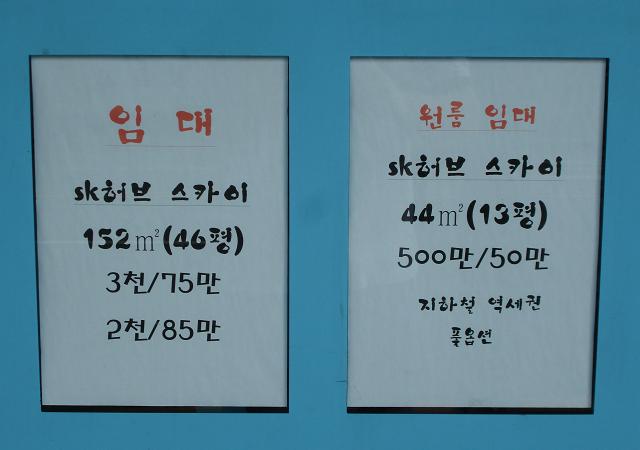
Listing outside a Korean real-estate agency showing floorspace in square meters and pyeong
Chinese name
Traditional Chinese
Transcriptions
Standard Mandarin
Hanyu Pinyinpíng
Wade–Gilesp'ing
Southern Min
Hokkien POJpêⁿ
pîⁿ
phêⁿ
phîⁿ
phiâⁿ
phêng
Tâi-lôpênn
Korean name
Hangul
Hanja
Transcriptions
Revised Romanizationpyeong
McCune–Reischauerp'yŏng
Japanese name
Kanji
Kanaつぼ
Transcriptions
Romanizationtsubo

A pyeong (abbreviation py) is a Korean unit of area and floorspace, equal to a square kan or 36 square Korean feet. The ping and tsubo are its equivalent Taiwanese and Japanese units, similarly based on a square bu (ja:步) or ken, equivalent to 36 square Chinese or Japanese feet.[1][2]

Current use

[edit]

Korea

[edit]

In Korea, the period of Japanese occupation produced a pyeong of 400/121 or 3.3058 m2. It is the standard traditional measure for real estate floorspace, with an average house reckoned as about 25 pyeong, a studio apartment as 8–12 py, and a garret as 1½ py. In South Korea, the unit has been officially banned since 1961 but with little effect prior to the criminalization of its commercial use effective 1 July 2007.[3] Informal use continues, however, including in the form of real estate use of unusual fractions of meters equivalent to unit amounts of pyeong. Real estate listings on major websites such as Daum show measurements in square meters with the pyeong equivalent.

Taiwan

[edit]

In Taiwan, the Taiwanese ping was introduced in the period of Taiwan under Japanese rule, which remains in fairly common use and is about 3.305 m2.

Japan

[edit]

In Japan, the usual measure of real estate floorspace is the tatami and the tsubo is reckoned as two tatami. The tatami varies by region but the modern standard is usually taken to be the Nagoya tatami of about 1.653 m2, producing a tsubo of 3.306 m2. It is sometimes reckoned as comprising 10 .

China

[edit]

In China, the metrication of traditional units would produce a ping of 4 m2, but it is almost unknown, with most real estate floorspace simply reckoned in square meters. The longer length of the Hong Kong foot produces a larger ping of almost 5 m2, but it is similarly uncommon.

See also

[edit]

References

[edit]
Revisions and contributorsEdit on WikipediaRead on Wikipedia
from Grokipedia
The pyeong (평; py) is a traditional Korean unit of area , primarily used to quantify floor space in residential and commercial properties. It equals exactly 400/121 square meters, or approximately 3.3058 square meters (about 35.58 square feet). This unit derives from ancient East Asian measurement systems, where one pyeong corresponds to the area of a traditional room mat or a square with sides of six cheok (a foot-like unit roughly 30.3 cm). Historically, the pyeong originated in Korea's traditional measurement framework, influenced by Chinese systems like the ping (坪), with the modern standard adopted during the Japanese colonial period for land and building assessments. It represented the minimal space for an adult to lie down fully, equating to about 36 square Korean feet, and played a key role in real estate transactions and urban planning before widespread metric adoption. Although officially banned since 1961, despite South Korea's official adoption of the metric system in 1961, with further enforcement in 2007 to criminalize the commercial use of non-metric units like the pyeong in favor of square meters, the term persists in everyday language, property listings, and cultural references. Today, the pyeong remains prevalent in South Korea's market, where apartments are often advertised by size in pyeong (e.g., a standard 84-square-meter (about 25 pyeong) unit is often called a "25-pyeong" home, though this refers to exclusive use area). It is nearly identical to equivalent units in neighboring regions, such as the Japanese tsubo and Taiwanese ping, reflecting shared historical traditions across . This enduring use underscores the pyeong's cultural significance, even as modern construction standards increasingly incorporate metric precision.

Definition and Origins

Definition

The pyeong (평) is a traditional Korean unit of area specifically employed for measuring floorspace in buildings and contexts. It serves as a standard for describing the size of residential and commercial properties, often alongside the official , and remains prevalent in everyday property listings despite the adoption of square meters as the legal unit. The pyeong is defined as the area of a square with sides measuring six cheok, the traditional Korean foot, resulting in 36 square cheok. Each cheok is approximately 30.3 cm in length, yielding a pyeong of about 3.31 square meters. This composition underscores its roots in East Asian architectural modules, where the unit aligns with spatial bays in traditional building design. In contemporary usage, the pyeong facilitates informal descriptions, such as a "25-pyeong" denoting approximately 82.6 square meters of total , helping to convey scale intuitively to local buyers and renters. As a strictly areal measure, the pyeong does not apply to linear dimensions or volumetric capacities, distinguishing it from units like the cheok (length) or other traditional volume measures.

Etymology

The term pyeong derives from the Sino-Korean reading of the hanja character 坪, pronounced pyeong in Korean, which combines the semantic radical 土 (earth or soil) with the phonetic component 平 (flat or level), evoking the concept of a flat expanse of ground. This pictophonetic structure underscores the unit's association with even, level surfaces suitable for measurement, originating in classical Chinese texts where 坪 referred to a leveled plot of land or terrace. The Korean pyeong (평) itself stems from 平, meaning "flat" or "level," aligning with the unit's application to uniform floor spaces in traditional architecture. Linguistic variations of 坪 reflect its shared heritage: in and Mandarin, it is píng or ping (坪), denoting a similar area unit; in Japanese, it is tsubo (坪), equivalent to the space covered by two mats; and in , píng (坪) retains the core sense of level ground. These pronunciations evolved from piᴇŋ, preserving the phonetic link to 平 while adapting to regional phonologies. Historical textual references to the pyeong appear in Joseon-era records (1392–1910), where it denoted a standard floor or mat unit for describing room and land spaces, as seen in administrative documents on property and construction. For instance, fortress and building descriptions from the period, such as those in Gijang county , quantified sites in pyeong to standardize allocations. This usage predates modern but highlights the term's enduring role in denoting balanced, habitable areas.

Historical Development

Origins in Traditional Measurement Systems

The pyeong's roots are embedded in the ancient measurement traditions of and Korea, where linear units like the bu (步, "pace") and kan (間, "interval between pillars") were commonly squared to define areas for land, , and construction. In ancient Chinese systems, the bu served as a fundamental linear measure, equivalent to 6–8 chi (尺, a foot-like unit) during the (c. 1046–256 BCE), later standardized to 5 chi from the (221–206 BCE) through the Qing (1644–1912). These linear units were extended to area calculations, as seen in the mu (畝), a field unit comprising 100 bu squared in the or 240 bu in later dynasties, reflecting practical applications in and . During the Joseon dynasty (1392–1910) in Korea, the pyeong developed as an area unit from precursor linear measures such as the cheok (尺, equivalent to the Chinese chi) and its subdivisions like the chon (寸, inch). The pyeong represented the space of one architectural bay or "kan," conceptualized as a square with sides of six cheok, thus encompassing roughly 36 square cheok; this modular approach facilitated land taxation, property division, and building design in traditional houses and rural plots. The Gyeongguk Daejeon, Joseon's national legal code promulgated in 1485, established the cheok at 30.2 cm, yielding a pyeong of approximately 3.28 m², though practical implementations often deviated based on local customs and tools. This system drew significant influence from (618–907 CE), where analogous squared-linear units informed architectural and spatial planning in temples, palaces, and gardens, emphasizing modular intervals akin to the kan. Tang measurements, including a short chi of 30 cm, were transmitted eastward, shaping East Asian building traditions before Japan's formal adoption of Tang standards in 701 CE. Prior to the , no uniform standardization existed across regions, with variations driven by differences in the defining chi length—approximately 30.25 cm in Korea versus around 33.3 cm in customary Chinese usage—leading to inconsistent pyeong equivalents in cross-border and . These discrepancies underscored the units' reliance on local bodily proportions and artisanal practices rather than fixed metrics.

Introduction and Adoption in East Asia

The pyeong emerged as a formalized unit of area in through Japanese imperial standardization efforts in the early , serving as a key tool for assessment and urban development across colonies. During the Japanese occupation of Korea (1910–1945), particularly through the comprehensive land survey of 1910–1918, the pyeong was imposed as a measurement, supplanting the inconsistent traditional pyong variants that differed by region and locality. This reform aligned Korean land records with Japanese administrative practices, enabling efficient taxation, cadastral mapping, and economic integration within the empire. In parallel, under Japanese rule in (1895–1945), the equivalent unit—known as ping—was adopted for and , standardizing floor areas and lot sizes in colonial developments. Derived directly from the Japanese tsubo, the ping facilitated the layout of modern infrastructure, such as roads and residential zones in cities like , reflecting Japan's broader modernization agenda in the territory. The pyeong ties briefly to earlier East Asian systems through its basis in the square bu or kan, traditional length units shared across the region. Following , Japan retained the tsubo as its domestic counterpart to the pyeong, incorporating it into national building standards by the 1950s amid postwar reconstruction. The 1950 Housing Finance Public Corporation Act, for instance, restricted government-backed loans to homes sized between nine and eighteen tsubo, embedding the unit in policies that shaped urban housing growth. Limited adoption occurred in Chinese territories under Japanese sway, including during the era (1932–1945) and amid the brief occupation (1941–1945), where the unit supported local and needs. However, these implementations were marginal and overtaken by the metric system's enforcement after the of China's founding in 1949. A pivotal development was the Japanese land surveys, which fixed the pyeong at a square ken measuring 1.818 meters per side, promoting uniformity across the empire's expanding domains.

Measurement Standards and Conversions

Relation to Other Traditional Units

The pyeong serves as a key unit in East Asian traditional measurement systems, directly equivalent to the Japanese tsubo, which represents the area of a square ken or bu (with a side length of approximately 1.818 meters), and the Taiwanese ping, defined as a square bu. These units share a common origin in modular construction practices across the region, facilitating standardized room and building sizing without reliance on metric scales. These units (pyeong, tsubo, ping) are historically equivalent, all deriving from a square of six shaku/cheok (≈1.818 m sides) in the shared East Asian modular system, standardized to the metric-linked shaku of 10/33 m. Within Korean traditions, 1 pyeong equals 36 square cheok (尺), the traditional foot (approximately 30.3 cm), reflecting the unit's basis in a 6-by-6 cheok grid for flooring and land division. It is also equivalent to the area of one square kan (間), a modular unit of 6 cheok. This structure underscores the pyeong's role in hierarchical area measurements, such as in housing layouts where multiples define room capacities. Chinese parallels exist in the ping (坪), akin to a square chi (尺) but with variability due to regional standards for the chi's length; in architectural contexts, it aligns with mat arrangements, where 1 tsubo (equivalent to 1 ping or pyeong) covers the space of 2 tatami mats, as seen in standard 6-mat rooms spanning 3 such units. In the , the ping is not an official unit in modern measurements, though traditional definitions similar to other East Asian systems (around 3.3 m² based on the chi of ~30.3 cm) may persist informally. These interconnections highlight the pyeong's adaptability within shared East Asian frameworks for land and building assessment.

Modern Metric Equivalents

The standard Korean pyeong is defined exactly as 400121\frac{400}{121} , equivalent to approximately 3.305785 . This measurement stems from the unit's origin as 36 square shaku (or Korean cheok), where the shaku was standardized under the Japanese-influenced to 1033\frac{10}{33} m (approximately 30.303 cm). The conversion formula is thus 11 pyeong =36×(1033)2= 36 \times \left( \frac{10}{33} \right)^2 , yielding the precise 400121\frac{400}{121} . The Taiwanese ping follows the same foundational definition as the Korean , measuring approximately 3.305 , with slight rounding in practical applications due to the retention of the Japanese-era shaku standard during colonial rule. In , the equivalent tsubo aligns closely with the pyeong at 3.305785 under the official shakudai (metric-linked) system, as used in statistics and surveys. However, a common variation arises from mat sizing, where 1 tsubo equals the area of two standard mats (each approximately 1.653 with dimensions 0.910 m × 1.818 m, or 3 shaku by 6 shaku), resulting in exactly 3.3058 . Regional tatami variations may cause minor deviations, but the official shakudai standard aligns precisely. The Chinese ping exhibits greater variation: traditional values depend on the regional chi length, typically around 3.3–5 in historical contexts, reflecting divergences from the shared East Asian shaku-based . For practical applications in real estate, such as converting land prices from per square meter to per pyeong, the price per pyeong is calculated by multiplying the price per m² by 3.305785.

In

In , the pyeong has been subject to official restrictions under the country's policies, which began with the adoption of the in 1961, though the unit received an exemption at that time due to its entrenched role in land and building measurements. The government later strengthened enforcement through the Act on the Promotion of the Use of the , criminalizing the commercial use of traditional units like the pyeong effective July 1, 2007, to align with international standards and facilitate global trade. This prohibition particularly targets real estate advertisements and transactions, where violations can result in penalties, though exact fine amounts vary by case and are not uniformly specified for pyeong usage alone. Despite these legal measures, the pyeong persists in informal applications, especially within the sector, where it remains a familiar reference for private discussions and listings outside official commercial channels. The government has shown tolerance for such non-commercial, personal usage, recognizing its cultural entrenchment, as evidenced by continued everyday references in rental and sales conversations. For instance, "one-room" studios, popular among young professionals and students, typically range from 8 to 12 pyeong, equivalent to about 26 to 40 square meters of living space. Average urban apartments, often in high-rise complexes, measure 30 to 40 pyeong, or roughly 99 to 132 square meters, reflecting standard family-sized units in cities like . South Korea employs a specific pyeong standard of 3.3058 square meters, derived from definitions established during the Japanese colonial period starting in 1910, when the unit was formalized based on the Japanese tsubo and integrated into Korean land measurement practices. This metric continues to underpin informal real estate norms, even as official documents mandate square meters, highlighting the unit's enduring practical role amid ongoing enforcement challenges.

In Taiwan

In Taiwan, the pyeong is known as "ping" (坪) and serves as an officially recognized traditional unit of area , particularly in and property transactions. One ping is equivalent to approximately 3.305 square meters. This unit originated from the Japanese colonial period (1895–1945), when modern and measurement standards were introduced, and it remains integrated into contemporary practices alongside the . The ping is standard in and documentation, where it is used concurrently with square meters in building permits and official records. For instance, the Ministry of the Interior's transaction database reports unit prices in terms per ping (萬元/坪), reflecting its embedded role in legal and administrative processes. Unlike purely metric systems elsewhere, ping measurements are mandatory for descriptive purposes in property assessments and sales contracts, ensuring accessibility in a market where metric equivalents are also noted but secondary in everyday usage. Typical apartment sizes in range from 20 to 50 ping (approximately 66 to 165 square meters), accommodating standard urban households with 2 to 4 bedrooms. In rural areas, plots are commonly measured and advertised in ping, facilitating straightforward valuation for agricultural or residential development. The unit's prevalence is evident in practices, with the vast majority of listings and transactions referencing ping as the primary descriptor, supported by platforms and industry standards without any legal restrictions on its use.

In Japan

In , the pyeong equivalent is known as the tsubo (坪), a traditional unit of area legally defined during the under the Weights and Measures Act of 1891, which standardized the shaku at 10/33 meters, making one ken (equal to 6 shaku) approximately 1.818 meters and thus one tsubo (the area of one square ken) equal to 3.306 square meters. The tsubo remains widely used in architecture and , particularly for measuring land plots and building spaces, where traditional homes are often described in terms of tsubo to reflect modular layouts, and modern office listings frequently reference it alongside square meters for familiarity in property valuations and rentals. It bears a close relation to the mat, a standard flooring element in Japanese interiors, with one tsubo approximately equivalent to the area of two standard kyōma tatami mats measuring 0.88 meters by 1.76 meters each. The tsubo is fully compatible with the and faces no legal restrictions, having been integrated into Japan's measurement framework through the Measurement Law of 1951, which permits its continued use in specific contexts like construction and real estate alongside SI units.

In China

In mainland , the unit known as "píng" (坪) is rarely used in contemporary contexts, having been largely supplanted by the . The officially adopted the metric system in 1959, standardizing traditional units to align with international measures. Ping was briefly introduced in some regions under Japanese influence during the early 20th-century occupation, such as in , but had limited lasting impact and no standard definition in the Chinese system, where the mu (亩, approximately 666.67 ) serves as the primary traditional area unit. In , traditional units derived from imperial measurements, such as square feet, appear in older property deeds from the colonial era, though their use has declined significantly since the 1997 handover to , with square meters now predominant in legal and documentation. The unit's presence reflects lingering British influences on local measurement practices, but ping is not standard for new transactions. Modern applications of the píng in are minimal, confined primarily to historical , rural land assessments, or cultural sites such as temple floors, where square meters otherwise dominate all official and commercial measurements. Post-1949 policies under the Communist government suppressed traditional units in favor of metric standardization to promote uniformity and modernization.

References

Add your contribution
Related Hubs
User Avatar
No comments yet.