Hubbry Logo
Pyramid G1-dPyramid G1-dMain
Open search
Pyramid G1-d
Community hub
Pyramid G1-d
logo
8 pages, 0 posts
0 subscribers
Be the first to start a discussion here.
Pyramid G1-d
Pyramid G1-d
from Wikipedia

Pyramid G1-d (also known as 'G1d', 'GI-d', 'GId' or 'G Id') is a satellite pyramid within the Khufu pyramid complex on the Giza plateau.

Key Information

The pyramid was discovered in 1992, during work to remove a road, about 25 metres (82 ft) east-southeast of the southeast corner of the Great Pyramid (G1),[1] and about 7 metres (23 ft) west of the subsidiary pyramids G1-b and G1-c.

Superstructure

[edit]

The pyramid's original base length was 21.75 metres (71.4 ft), with a height of 13.8 metres (45 ft). Joseph Dorner established the mean slope to be about 51°45', very similar to that of the Great Pyramid. This equates to a seked of 5 palms and 2 fingers, a ratio of 28 rise to 22 run.[2]

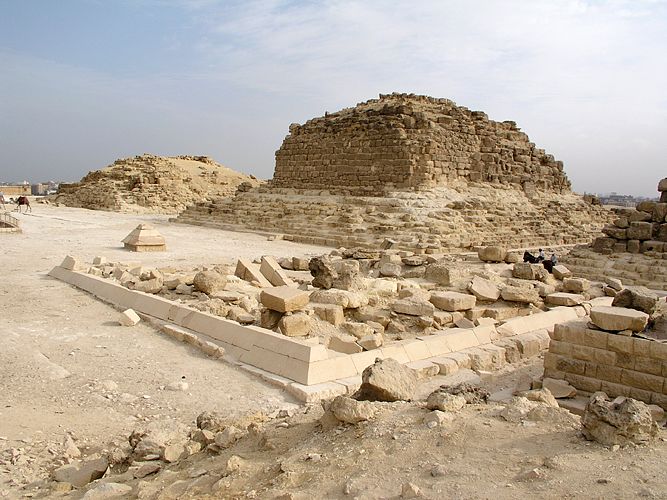
Reconstructed apex of G1-d. The pyramidion and one block of the 3rd course from the top are original.

The pyramid was likely dismantled by the Emir Karakoush of the Ayyubid Sultanate (serving in the 12th century under Saladin), who used the structure's stone for other construction projects.[3]

The blocks that remained in situ surrounded the substructure in a U-shape. The bedrock below the pyramid slopes downward to the east and south, hence a layer of foundation stones was placed to form an even base.

One of the core blocks of the south side was inscribed in red paint on the inside surface. The notation says, "imy rsy s3". This graffito, meaning "on the south (back) side", probably instructed the stone movers where to place the block.[4]

Multiple casing blocks were found out of position, scattered around the pyramid. One of these, slanted on three sides, was one of a pair of blocks that once formed the third course from the top. It is 2.7 metres (8.9 ft) long and 0.56 metres (1.8 ft) thick, and its top side is hollowed, to hold the convex underside of the stone(s) placed above it.[5]

No stones of the second course from the top remained, yet in 1993, the actual pyramidion was discovered accidentally, north of the pyramid, by assistant Alla el-Din Shaat. Its underside is faceted, four triangles forming a shallow downward pyramid. It is the second oldest capstone of a pyramid ever found; the earliest belonged to the Red Pyramid of Sneferu at Dahshur.[1]

The top three courses were reconstructed by Miss Nivien Mohamed Mustafa, four metres north of the pyramid.[6] The foundation and parts of the first course of the pyramid were restored as well, with newly carved limestone blocks.[7]

Substructure

[edit]

The substructure consists of an inclined passage of 25–28° which runs north to south. It starts 3.75 metres (12.3 ft) inwards from the pyramid's base line, indicating that the original entrance lay somewhat above the ground level on the north face.

This corridor, two cubits (1.05 metres (3.4 ft)) wide, runs for a length of 10 cubits (5.25 metres (17.2 ft)), until it terminates 0.55 metres (1.8 ft) above the floor of a chamber extending to the east and west. Together they form a T-shaped structure that matches satellite pyramids subsequent to this one.

A distinct cutting in the chamber floor at its entrance may have held a plugging stone.[8] Alternatively, it may have held an angled stone which continued the ramp down to the chamber floor.[9]

The floor measures about 15 by 6.5 cubits, or 7.92 metres (26.0 ft) long (east to west) by 3.4 metres (11 ft). Traces of mortar hint at a pavement now missing.

The walls of the chamber were not smoothed or polished, and are slightly inclined, narrowing towards the former ceiling. Four small holes in opposing walls at the west end suggest that two beams spanned this end of the chamber. Hawass speculates that they could have been intended for lowering or covering an object.[8]

Purpose

[edit]

The purpose of the pyramid is under debate by scholars. Some possible explanations are that it is for the king's ka, or it represents the king as the ruler of Upper and Lower Egypt, or it is for the viscera of the king, or it is a dummy room for the Sed festival, or it has a solar function. Zahi Hawass, who led the uncovering of the pyramid, believed that the satellite pyramid was used symbolically as a changing room for the Sed festival.[10]

See also

[edit]

References

[edit]
[edit]
Revisions and contributorsEdit on WikipediaRead on Wikipedia
from Grokipedia
Pyramid G1-d, also known as GI-d, is a pyramid forming part of the funerary complex of (reigned c. 2589–2566 BCE) on the in . Located approximately 25.5 meters southeast of the southeast corner of the Great Pyramid (G1), it features a square base measuring 21.75 meters (41.5 cubits) per side and an original height of 13.80 meters, with a slope angle of 51° 51'. Its consists of a core of crude limestone blocks cased in fine Tura limestone, now mostly ruined to about three courses high, while the substructure includes a T-shaped descending passage leading to a chamber with a vaulted ceiling and an offering niche. The pyramid was discovered in 1991 by Egyptologist and the Giza Inspectorate of Antiquities during the removal of a modern road near the site, revealing its location about 7 meters west of the adjacent satellite pyramids G1-b and G1-c. Excavations uncovered a pyramidion (apex stone) nearby in 1993, which was later restored; a nearby core block bears traces of red paint and an inscription ("imy rsy s£", meaning "which is on the south (back) side"). This artifact, one of the oldest known pyramidia, confirms the pyramid's completion with a capstone. No human remains or major artifacts were found within, but traces of red mortar and a small offering table suggest ritual use. Scholars interpret Pyramid G1-d as a symbolic structure integral to Khufu's complex, possibly serving to house the pharaoh's ka (spirit) or as a ritual space linked to renewal ceremonies like the , where the king might have changed attire during jubilees. Its T-shaped substructure parallels those in satellite pyramids of (G2-a) and (G3-a), underscoring the experimental nature of Fourth Dynasty pyramid building. Likely constructed hastily toward the end of Khufu's 23-year reign, it highlights the rapid development of 's monumental landscape during the .

Introduction

Overview

Pyramid G1-d is a satellite pyramid designated as part of the mortuary complex of , constructed during the Fourth Dynasty of around 2600 BC. It serves as one of four subsidiary pyramids (G1-a through G1-d) associated with the Great (G1), located southeast of the main structure on the . The features a square base measuring 21.75 meters on each side, with an original of 13.8 meters and a slope of 51° 51'. The structure shows evidence of partial dismantling in antiquity, with core masonry removed above the substructure. In modern times, the structure has been partially restored using new blocks to preserve the monument and facilitate access.

Location and Context

Pyramid G1-d is situated on the in , approximately 25.5 meters southeast of the southeast corner of the Great Pyramid (G1), the main pyramid of . This positioning places it at the southeastern edge of the main pyramid's enclosure wall, integrating it closely with the overall funerary complex. Additionally, it lies about 7 meters west of the subsidiary pyramids G1-b and G1-c, forming a clustered arrangement in the eastern field of smaller structures associated with the primary monument. As part of the pyramid complex, Pyramid G1-d contributes to the eastern field of subsidiary structures, which includes the three queens' pyramids (G1-a, G1-b, and G1-c) and this additional satellite pyramid. Its proximity to G1-b and G1-c indicates a coordinated layout that may align with broader elements such as boat pits and the causeway, enhancing the ritual and symbolic organization of the site. This arrangement underscores the interconnected design of the complex during the Fourth Dynasty. In the broader context of the , Pyramid G1-d forms one of four subsidiary pyramids linked to the Great Pyramid, enriching the funerary landscape of Egypt by supporting the royal mortuary cult. Associated with the reign of in the Fourth Dynasty, it exemplifies the hierarchical integration of smaller monuments within larger pyramid ensembles.

History and Discovery

Construction and

Pyramid G1-d was constructed during the reign of in the Fourth Dynasty of , circa 2589–2566 BCE, making it contemporaneous with the . The pyramid employed local blocks for its core and initial casing layers, with the internal fill consisting of rough-hewn blocks and debris. Fine Tura was used for the outer casing to provide a smooth, polished finish, though most of this material was later removed. Construction techniques involved quarrying and transporting blocks from nearby sources, with foundation remnants indicating the possible use of ramps or lever systems to position the stones. The structure's estimated volume is approximately 2,175 m³, derived from its original base side length of 21.75 m and height of 13.8 m using the formula for pyramidal volume V=13×base area×heightV = \frac{1}{3} \times \text{base area} \times \text{height}, suggesting a relatively modest workforce of several hundred laborers could have completed it over a period of months. Likely built hastily toward the end of Khufu's reign, it was constructed late in the 23rd year. Much of the pyramid's superstructure, including the casing, was removed in ancient times for use in other constructions.

Excavation and Restoration

The satellite pyramid G1-d was discovered in 1991 by Egyptologist and the Giza Inspectorate of Antiquities during efforts to remove a modern road located approximately 25.5 meters southeast of the Great Pyramid's southeast corner on the . Initial archaeological surveys conducted by Hawass's team revealed the pyramid's limestone foundation and remnants of its lower courses, confirming it as a subsidiary structure within the broader pyramid complex. These findings prompted systematic excavation to document the site's layout, including the burial chamber with an offering niche. A significant development occurred in 1993 when Hawass's assistant, Alaa el-Din Shaat, accidentally discovered the pyramid's (capstone) on the north side of the site while clearing debris. The artifact, carved from fine Tura limestone and measuring 71 cm (709 mm) in height, bears traces of red paint and an inscription; it was analyzed and identified as one of the oldest known pyramidia, following the one from Sneferu's at . This capstone, originally electrum-cased based on comparative relief evidence, provided crucial insights into Fourth Dynasty pyramid completion practices and was promptly documented through detailed measurements and photographic surveys. Restoration efforts began shortly after the discoveries, led by Nevine Mohamed under Hawass's supervision. The top three courses of the pyramid were reconstructed using surviving original blocks supplemented by newly carved ones to restore structural integrity, while the foundation was stabilized to prevent further . The fragmented was reassembled and positioned on a stone base approximately 4 meters from the pyramid's entrance for protective display. As of 2025, the Egyptian Ministry of Tourism and Antiquities continues ongoing monitoring and conservation of the site as part of broader management initiatives. Preservation faces notable challenges from urban encroachment, which has progressively reduced buffer zones around the , and atmospheric pollution from nearby , accelerating limestone deterioration through and particulate deposition. These threats have necessitated integrated site management plans to balance access with long-term safeguarding of structures like G1-d.

Architecture

Superstructure

Pyramid G1-d features a true form with a square base measuring approximately 21.75 meters on each side and an original height of 13.8 meters. The was constructed using local for the core, originally encased in fine white Tura to create a smooth, reflective surface. The faces sloped at approximately 51°50', achieved through horizontal courses that aligned aesthetically with the nearby Great Pyramid (G1). The superstructure has been severely altered over time, with most stonework, including the casing, removed by quarrying activities beginning in the CE to supply building materials for structures in . What remains today is limited to approximately three courses of the core at the foundation level, with no internal corridors or passages exposed on the exterior. In the late , following its discovery and excavation, the pyramid was partially rebuilt using original materials to reconstruct and preserve its profile. The , or capstone, was crafted from fine Tura , measuring about 1.1 meters in height and featuring a polished surface. Recovered in 1993 during excavations, it confirms the pyramid's original completion and is the second-oldest known pyramidion from the Fourth Dynasty.

Substructure

The substructure of Pyramid G1-d features an inclined access corridor entering from the base of the south side, leading to a T-shaped chamber cut into the bedrock. The corridor descends at a of 25–28° and measures 5.25 m in length by 1.05 m in width and height; it was originally blocked by plugging stones, evidencing provisions against unauthorized entry. At the end of this passage lies the chamber, a T-shaped 7.92 m long by 3.4 m wide and 2.5 m high, with roughly hewn walls, a , and an offering niche, but no or burial artifacts discovered. Further examination revealed traces of ramps and debris fills within the substructure vicinity, but no additional side chambers or ventilation shafts were present.

Purpose and Significance

Interpretations

Scholars have proposed several theories regarding the function of Pyramid G1-d, emphasizing its role beyond a simple burial site. One prominent interpretation views it as a ka tomb, intended to house the spirit or ka of , facilitating his journey and rebirth, a concept paralleled in earlier satellite pyramids like that of Snefru at . Another theory, advanced by Egyptologist , posits that the pyramid served as a symbolic changing room for the , a celebrating the pharaoh's renewal of power and divine kingship, where the king would don ritual attire such as the Sed robe during processional ceremonies. Additionally, some interpretations link the structure to solar alignments within the broader complex, symbolizing cycles of solar rebirth and the pharaoh's eternal regeneration, though specific alignments for G1-d remain tied to the overall layout's solstice orientations. The evidence supporting these theories stems from the pyramid's architectural and contextual features. Its T-shaped substructure, consisting of a main room with extending antechambers to the east and west and including a descending passage to a vaulted chamber with an offering niche, deviates from the simpler corbelled vaults typical of queens' pyramids, suggesting a specialized purpose rather than a standard secondary . The structure's proximity to boat pits—one located directly east of G1-d—implies involvement in processional rites, as these pits likely held ceremonial boats for the pharaoh's symbolic journey, aligning with depictions of royal processions. Furthermore, the absence of goods or human remains in the chamber indicates a non-literal use, such as a or symbolic installation, rather than an actual interment site. Debates among Egyptologists center on distinguishing G1-d from the adjacent queens' pyramids (G1-a, G1-b, and G1-c), which are larger, positioned along the eastern face, and associated with royal consorts through inscriptions and . In contrast, G1-d's smaller scale (base approximately 21.75 meters), southeastern location, and unique internal design argue against it serving as a queens' , reinforcing views of it as a or dedicated ritual structure for the himself. These interpretations highlight the pyramid's integration into Khufu's funerary landscape as a multifaceted element of symbolic renewal.

Comparisons with Satellite Pyramids

Pyramid G1-d, with a base measuring approximately 21.75 meters and an original height of 13.8 meters, is notably smaller than the primary pyramid G1-a in the complex, which features a base of 49.5 meters and a height of 30.25 meters. Despite its reduced scale, G1-d shares a similar slope of about 51-52 degrees with the Great G1 itself, reflecting consistent architectural proportions within the eastern layout. In contrast to the queens' pyramids G1-b and G1-c—each with bases around 46-49 meters, heights of 29.6-30 meters, and evidence of sarcophagi indicating functions—G1-d lacks any confirmed interments and features a distinct substructure without a . Beyond the complex, G1-d bears resemblance in overall size to the subsidiary pyramids associated with Sneferu's at , such as the eastern satellite with a base of about 52.8 meters and height of 26 meters, though G1-d's steeper slope of 51-52 degrees contrasts with the shallower 43-degree inclination typical of some structures. A key unique aspect of G1-d is the survival of its , discovered in 1993 and consisting of a restored capstone, unlike the satellite pyramids in the complex (G3-a, G3-b, G3-c), where any original pyramidions have been lost or destroyed, leaving only ruined cores with bases of 30-36 meters and heights around 10 meters. The comparative analysis of G1-d underscores the evolution of satellite pyramid functions during the Fourth Dynasty, transitioning from primarily burial-oriented structures in earlier complexes to more symbolic elements integrated into the royal pyramid's ritual landscape, as seen in the shift from sarcophagus-equipped tombs to non-burial chapels. Its discovery in 1991 by filled critical gaps in the mapping of the eastern field, revealing an overlooked fourth and enhancing understanding of the complex's spatial organization.
Add your contribution
Related Hubs
User Avatar
No comments yet.