Hubbry Logo
Predannack AirfieldPredannack AirfieldMain
Open search
Predannack Airfield
Community hub
Predannack Airfield
logo
8 pages, 0 posts
0 subscribers
Be the first to start a discussion here.
Predannack Airfield
Predannack Airfield
from Wikipedia

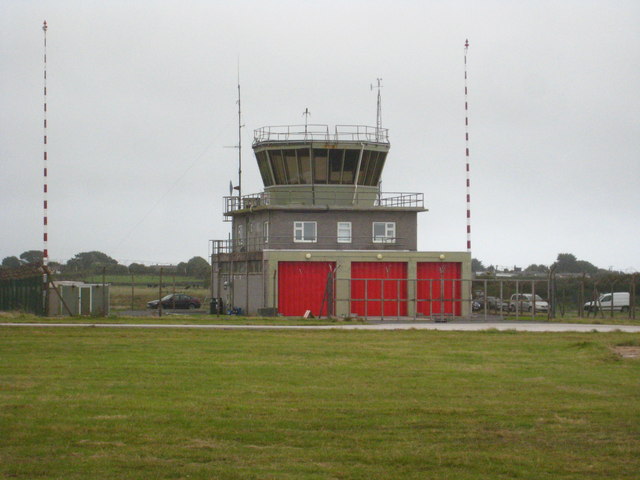
Predannack Airfield (ICAO: EGDO) is an aerodrome near Mullion on The Lizard peninsula of Cornwall in the United Kingdom. The runways are operated by the Royal Navy and today it is a satellite airfield and relief landing ground for nearby RNAS Culdrose.

Key Information

RAF Predannack

[edit]

Second World War

[edit]

Development

[edit]

The capitulation of France in June 1940 gave impetus to the building of numerous airfields across South West England which was now vulnerable to attack by the Luftwaffe. RAF Predannack was opened in May 1941 as a satellite for RAF Portreath. Accommodation was dispersed over a wide area, with officers accommodated in the Mullion Cove and Polurrian Hotels. The number of personnel reached peak strength of 3,600 by 1944.

Operations

[edit]

The first squadron to arrive was 247 (China-British) Squadron with Hawker Hurricanes, specialising in night defence of the South West's towns and ports. The night fighting element was later augmented by 1457 Flight flying Douglas Havoc aircraft with its unsuccessful Turbinlite searchlight tactics. However, the arrival of 600 (City of London) Squadron AAF with Bristol Beaufighters equipped with aircraft interception (AI) radar produced better results. Ground-controlled interception (GCI) in the area was covered by RAF Treleaver radar station.

The Luftwaffe attacked Predannack several times. The first attack on the night of 12 October 1941 followed a Beaufighter on approach and shot up the airfield. Defence soon gave way to offensive operations; fighter sweeps and intruder operations were undertaken over France. The airfield's southerly location made it also suitable for anti-shipping strikes over the Bay of Biscay. Westland Whirlwind and Beaufighter squadrons mounted successful patrols, followed later by a number of de Havilland Mosquito squadrons.

Predannack's location made it suitable for emergency landings, particularly with the growth of the bomber offensive against mainland Europe. Many RAF Bomber Command and US Eighth Air Force aircraft found haven at the base. As a result, the RAF agreed to extend the runways in 1943 for larger aircraft, including Vickers Wellington and Consolidated Liberator aircraft for anti-submarine warfare.[1] This enabled Predannack to be a staging and departure point for aircraft en route to the North African Campaign. Late in 1942 some of the 67th TCG's Douglas C-47 Skytrains and the 81st Fighter Group's Bell P-39 Airacobras refuelled here before flying around the Iberian Peninsula.

In preparation for Operation Overlord, Nos 1 and 165 (Ceylon) Squadrons formed a wing of Supermarine Spitfire IXs at Predannack to prevent Luftwaffe aircraft from attacking Allied shipping. As the invasion convoy around Falmouth assembled, the Spitfires gave constant fighter cover. 179 Squadron equipped with Wellingtons and the Czechoslovak-crewed 311 Squadron equipped with Liberators undertook anti-submarine patrols over the Bay of Biscay and approaches to the English Channel.[2] At its peak about 3,600 crew and support staff were at Predannack.[1]

As the war became less intense in Predannack's area of operations, the station saw fighter squadrons arrive for rest and re-equipment. On VE Day no flying units were present, but two Mosquito squadrons returned. Predannack opened its gates to the public when on 15 September 1945 4,000 visitors arrived for the Battle of Britain air display.

Second World War monument at Predannack main gate, April 2007

A plaque at the entrance, commemorating those who served at RAF Predannack during the Second World War was unveiled on 11 June 2002. It reads: "Like a breath of wind gone in a fleeting second only the memories now remain".[3]

Post-war

[edit]

151 Squadron, with its different types of Mosquitos, continued flying from Predannack until April 1946,[4] and the following month the airfield closed, being reduced to care and maintenance.

After a period of experimental use by Vickers-Armstrongs (Aircraft) Ltd under the supervision of Barnes Wallis from 1951 to September 1957, the base was taken over by the Royal Navy on 15 December 1958.[3] The airfield now operates as a satellite airfield for nearby RNAS Culdrose, to handle intensive helicopter operations and as a relief landing ground. There is also a small arms range on the site and the RN Fire Fighting School moved here in 1971.[3]

Current use

[edit]
Wessex HAS.3 at Predannack Fire School

Predannack Airfield is routinely used for training purposes by helicopters from the Royal Navy. RNAS Culdrose is the Aerodrome Operator and responsible for actively managing and running the satellite airfield.[5]

It is also the practise base of Royal Naval School of Flight Deck Operations, which has a number of dummy aircraft for fire extinguishing practice.

700X Naval Air Squadron continually use the airfield to operate Remotely Piloted Air Systems into the south coast exercise areas.

626 Volunteer Gliding Squadron unit operated by the RAF Air Cadets are also a lodger unit based at Predannack Airfield[1] The airfield is also used by Goonhilly Model Flying Club (with MoD permission) and there has been hobby model flying on the field since the 1950s. The site is currently used by the international disaster relief agency Shelterbox as part of its Academy for Disaster Relief.[1]

Jollytown

[edit]

Two semi-detached cottages, part of the St Just Estate, are in an isolated position on the west side of the airfield and can be reached only by the main airfield gate and the airfield perimeter road. The painter and etcher Bryan Ingham occupied the western cottage from 1958 until his death in 1997.

Scientific interest

[edit]

On the west side of the spectacular Lizard Peninsula, parts of the base away from the operational areas are in a Site of Special Scientific Interest (SSSI) for its combination of botany (including orchids, Cornish heath, magic mushroom), zoology (including butterflies, and snakes notably the venomous common adder) and geology (bastite and serpentinite).[3]

See also

[edit]

References

[edit]
[edit]
Revisions and contributorsEdit on WikipediaRead on Wikipedia
from Grokipedia
Predannack Airfield is a military airfield situated on the Lizard Peninsula in , , originally constructed in 1941 during as a satellite station for RAF within No. 10 Group Fighter Command. It spans approximately 780 acres of heathland and featured fighter pens, a Bellman , and heavy anti-aircraft defenses due to its strategic southerly position for coastal protection and convoy patrols. At its peak, the site supported over 3,600 personnel and hosted squadrons flying aircraft such as Hurricanes and Spitfires for interception duties. Following the war, operations scaled back significantly, with the airfield transitioning from active RAF use to limited training roles. In 1958, it was transferred to the Royal Navy and repurposed as a satellite station for the nearby Royal Naval Air Station (RNAS) Culdrose, serving as a relief landing ground for squadrons and light . By the , its role evolved to include support for remotely piloted air systems (RPAS), with the establishment of training and testing facilities under 700X Naval Air Squadron. In recent years, Predannack has gained prominence in unmanned aviation, hosting trials for drone operations, including historic carrier landings and launches from the airfield, and has been developed into the UK's National Drone Hub, accredited by the (CAA) in August 2025 to advance RPAS integration into and airspace. The site's ongoing utilization balances with environmental considerations on the protected landscape, with public interest in its supported by the adjacent Predannack Airfield Anti-Aircraft Museum, which offers occasional open days.

Historical Background

Site Selection and Construction

In late 1940, following the fall of and the evacuation at , the Royal Air Force selected a site on the Peninsula in for a new airfield, utilizing approximately 780 acres of remote, flat heathland that allowed for swift development far from major population centers. The location's isolation and forward position on the peninsula made it ideal as a satellite to RAF , supporting emergency landings and operations linked to southern routes, such as ferrying aircraft to and . This choice aligned with broader wartime efforts to bolster defenses in southwest against potential threats. Construction commenced in late 1940 under the main contractor Trethowans of Constantine, a local building firm, with assistance from No. 1 RAF Works Service, comprising military engineers. The project was completed rapidly, enabling the airfield to open in May 1941. Initial facilities included three runways arranged in a typical RAF triangular pattern, basic and Bellman hangars for aircraft storage, a control tower, and dispersed accommodation sites. Personnel quarters were rudimentary and incomplete at opening, with officers housed in the requisitioned Polurrian Hotel and communal facilities finished by November 1941. Building efforts faced challenges from the site's rough heathland, harsh coastal that damaged temporary structures, and the airfield's remote setting, which complicated and . Local labor supplemented military teams, but the rapid pace strained resources as squadrons began arriving shortly after activation. By , wartime demands had expanded capacity to support up to 3,600 personnel, though further details on operations appear in later sections.

World War II Operations

Predannack Airfield opened in May 1941 as a satellite station to , primarily serving as a fighter base for No. 10 Group of to bolster defenses in southwest . Its initial role focused on night fighter operations against raids, with early units conducting intruder patrols over occupied to disrupt enemy air activity. By late 1941, the airfield also supported anti-shipping strikes along the and the , targeting German and U-boats in coordination with Coastal Command. Additionally, it functioned as an site for damaged returning from Atlantic convoy escorts, accommodating heavy bombers like B-17s and Liberators that could not reach larger bases. Key squadrons stationed at Predannack included No. 247 Squadron, which arrived in June 1941 equipped with Hawker Hurricanes for interception and intruder missions, marking the airfield's first operational unit. No. 248 Squadron operated Bristol Beaufighters from 1942, specializing in torpedo attacks and anti-shipping patrols, while No. 264 Squadron deployed NF.II s in April 1943 for reconnaissance and interdiction over the . Other notable units included No. 600 Squadron with Beaufighters for reconnaissance and No. 141 Squadron with Beaufighters, contributing to the airfield's multifaceted defensive and offensive capabilities. types emphasized versatility, with Hurricanes for daylight interceptions, Beaufighters for strike roles, and Mosquitos for high-speed night operations, often integrated with Turbinlite-equipped Havocs for searchlight-assisted patrols. The airfield saw its first notable combat engagement in September 1941 when No. 247 Squadron downed a during an intruder sweep, followed by intensified anti-shipping actions in 1942–1943, including the destruction of an He 115 floatplane in March 1942. A significant event occurred on the night of June 20/21, 1943, when No. 264 Squadron's Mosquitos destroyed two Blohm & Voss Bv 138 flying boats and two Bv 222 transports, highlighting the airfield's role in neutralizing maritime reconnaissance. retaliation included a attack on the site on October 12, 1941, causing minor damage but no casualties, while the airfield hosted emergency landings such as 15 B-17 Flying Fortresses on May 1, 1943, after a raid on St. Nazaire. In support of D-Day preparations, Spitfire wings from Nos. 1 and 165 Squadrons provided air cover for invasion convoys in June 1944, underscoring Predannack's strategic importance until the war's end. Personnel numbers grew to a peak of 3,600 by 1944, comprising mostly ground crew and including (WAAF) members who managed logistical challenges amid expanding operations. The airfield integrated closely with nearby bases like for fuel supplies, repairs, and aircraft ferrying, facilitating missions such as the staging of C-47 Dakotas and P-39 Airacobras for in late 1942. Daily patrols reached significant volumes by 1944, with squadrons conducting up to several dozen sorties focused on convoy protection and hunts, though exact figures varied with operational tempo.

Post-War Development

Temporary Closure and Royal Navy Takeover

Following the end of , Predannack Airfield was placed into care and maintenance status on 1 June 1946, under the oversight of RAF Exeter, as the reduced operational demands of peacetime led to its deactivation. At its wartime peak in 1944, the base had supported up to 3,600 personnel, and the closure resulted in significant local job losses in the rural Lizard Peninsula area. From 1946 to 1957, the site saw limited activity, primarily occasional experimental flights conducted by under the supervision of engineer . Starting in 1947, Wallis utilized the airfield for tests of variable geometry models, including the "Wild Goose" and "Swallow" prototypes, with the first powered flight occurring in April 1952 and a total of 31 such flights completed before the project concluded in October 1954. The airfield remained largely abandoned during this period, with non-essential structures falling into disuse to minimize maintenance costs. In response to the expanding needs of Cold War-era naval aviation training, particularly for helicopters at the nearby RNAS Culdrose, the airfield was transferred to the Royal Navy's Fleet Air Arm on 15 December 1958, serving as a satellite station to alleviate congestion at the main base. Initial adaptations included the removal of Wallis's experimental launch track, which had obstructed the runways, and resurfacing of key runway sections to accommodate rotary-wing operations. By 1959, basic helicopter facilities were established, enabling elementary pilot training with aircraft such as the Westland Wessex, which helped restore some employment opportunities in the local community.

Expansion for Training

Following the Royal Navy's takeover of the airfield on December 15, 1958, as a satellite station to RNAS Culdrose, Predannack shifted from frontline combat duties to a primary focus on pilot proficiency and helicopter training amid the rotary-wing aircraft expansion in naval forces. The site was adapted for this purpose through resurfacing of existing runways and the addition of dedicated helicopter pads, allowing safe operations for training squadrons equipped with early models like the . These developments integrated Predannack into joint exercises with Culdrose, providing relief capacity for intensive helicopter flying trials and enhancing overall readiness. The wartime infrastructure provided the foundation for these post-war training roles, with the main runway (05/23) reaching approximately 1,824 meters in length, alongside secondary runways measuring around 1,405 meters (01/19), 1,309 meters (10/28), and 916 meters (13/31). A key milestone in the training infrastructure came in with the establishment of the Royal Navy Fire Fighting School at Predannack, which included the construction of fire training pits using retired airframes for realistic simulations. To support this facility, the 06/24 runway was cleared and resurfaced that year, permitting landings to deliver training assets and expanding the site's capacity for over 500 personnel in specialized courses.

Modern Military Role

Helicopter and Glider Operations

Predannack Airfield serves as a primary training site for helicopter operations, functioning as a satellite station to Royal Naval Air Station (RNAS) Culdrose since its transfer to the in 1958. The airfield supports intensive rotary-wing training, including low-level flying and tactical maneuvers, with helicopters such as the Mk2 routinely deploying from Culdrose for proficiency sorties. Additionally, it hosts elements of 700X Naval Air Squadron, which utilizes the site for experimental and training activities involving unmanned systems integration with manned helicopters like the , as demonstrated in live-fire exercises against target drones. These operations emphasize formation tactics and operational evaluation in a controlled coastal environment conducive to such activities. Routine helicopter activities at Predannack include regular training flights and its role as a relief landing ground for RNAS Culdrose, accommodating emergency diversions and diversions due to weather or maintenance issues. The airfield's runways, originally expanded during to support heavy bomber operations, continue to facilitate these modern rotary-wing needs without major alterations. Annual participation in multinational exercises, such as those involving unmanned systems trials akin to Unmanned Warrior, further integrates Predannack into broader training frameworks. Gliding operations are conducted by 626 (VGS), a unit dedicated to providing air experience flights for Air Cadets, with the squadron based at Predannack since the 1980s. The squadron employs Grob Viking T1 gliders for ab initio training, enabling cadets to learn basic aeronautical principles through winch-launched flights over the Lizard Peninsula. These sessions focus on solo qualifications and instrument familiarization, contributing to the development of future RAF personnel in a low-risk, unpowered environment. Safety and regulatory measures at Predannack are governed by its ICAO code EGDO, with procedures outlined in the UK Military Aeronautical Information Publication (AIP). The airfield integrates with controlled airspace shared via a Combined Military Air Traffic Zone (MATZ) with RNAS Culdrose, ensuring coordinated traffic management for both helicopter and glider movements. Noise abatement protocols are strictly enforced to minimize disturbance to surrounding communities, including restrictions on overflights of nearby villages and altitude guidelines for inbound rotary aircraft to remain below 500 feet QFE during approaches from the south. These measures support sustainable operations while maintaining the airfield's dual military roles.

Firefighting and Unmanned Systems Training

The Royal Naval School of Fire Fighting (RNSFF), established at Predannack Airfield in 1971, provides specialized training for Royal Navy personnel in aircraft crash rescue and firefighting operations. The school utilizes decommissioned aircraft and purpose-built mock-ups to simulate realistic crash scenarios, including live fire exercises conducted on the airfield's runways to replicate post-crash infernos and enhance response capabilities. These sessions focus on rapid intervention techniques, equipment handling, and team coordination under high-stress conditions, ensuring compliance with military aviation rescue standards. In parallel, Predannack has emerged as a key site for (UAV) training and testing, driven by the 's 700X Naval Air Squadron, which operates from the airfield to develop and evaluate remotely piloted air systems (RPAS). A major development occurred in January 2025 with the announcement of the National Drone Hub's construction at the site, aimed at expanding Royal Navy capabilities in unmanned operations, including testing vertical take-off drones such as the Leonardo AW09. This hub integrates UAV training with existing helicopter operations through joint exercises, utilizing over 8,000 square kilometers of segregated for safe, controlled flights. Planned facilities, including drone launch pads and simulation hangars, are slated for completion in 2026 as part of a Live-Virtual-Constructive (LVC) training environment to support advanced RPAS integration. In August 2025, the National Drone Hub received accreditation from the (CAA) as the UK's first dedicated Test & Evaluation site for drones, further solidifying Predannack's position in RPAS development. Post-2023 developments reflect the UK's broader defense strategy emphasizing autonomous systems, with Predannack playing a central role in trials informed by the 2024 Defence Drone Strategy, which prioritizes rapid adoption of uncrewed technologies for operational resilience. The airfield has fostered partnerships with defense contractors like W Autonomous Systems and WholeShip Ltd., facilitating trials such as the 2023 Windracers Ultra UAS operations from the site. A new drone was opened in April 2025 to accommodate these activities, enhancing testing for cargo delivery and surveillance missions. Safety protocols at Predannack include dedicated high-risk zones for both and UAV exercises, with segregated activated via Notices to Airmen to minimize interference with civilian aviation. Environmental impact assessments accompany all expansions, evaluating effects on the surrounding while ensuring compliance with military change proposals. These measures underscore the airfield's commitment to balancing intensive training with ecological and operational safeguards.

Additional Facilities and Uses

Aircraft Storage Area

The aircraft storage area at Predannack Airfield, commonly known as the "plane graveyard," was established in the post-1970s period as the site transitioned to Royal Navy training operations, with retired military aircraft accumulated for natural decay, parts reclamation, and training purposes. The runway was resurfaced in 1971 to facilitate the landing of fixed-wing aircraft specifically for the Royal Navy Fire Fighting School, marking the beginning of this accumulation. Over the decades, the area housed a collection of decommissioned airframes from various eras, serving as a practical resource for maintenance and disposal without active operational use. The stored aircraft formerly included a mix of Cold War-era jets and helicopters, such as Harrier Jump Jets, Sepecat Jaguars, and Lynx helicopters, and Sea Kings, alongside fixed-wing types like the bomber and Jetstream trainers. Sustainable dismantling efforts by contractors have been ongoing since 2020, focusing on recycling composite materials and other components to minimize environmental impact. Most airframes have since been removed to support the development of new facilities, including the National Drone Hub for unmanned systems testing and training. Managed as a secure zone by the , the storage area features prominent warnings against unauthorized entry due to risks associated with , such as structural instability and restricted access protocols. The former wrecks integrated with the airfield's school, where they simulated crash scenarios for realistic . Despite limited public access, the site's historical visibility has positioned it as an informal showcase of and aviation history.

Civilian and Community Activities

The international disaster relief charity ShelterBox has utilized portions of Predannack Airfield for its Academy for Disaster Relief, conducting training simulations for emergency response and deployment of aid shelters, with activities documented from the early through at least 2018. The site's expansive runways and isolated location facilitated realistic disaster scenarios, including setup of tented villages and logistics exercises, though usage was intermittent and no recent operations are confirmed beyond that period. Model aviation enthusiasts have long engaged with the airfield through the Goonhilly Model Flying Club, which has operated there with permission since the 1990s, building on informal hobby flying dating back to the . The club holds weekly flying sessions on peripheral runways, featuring aircraft such as radio-controlled jets and helicopters, promoting a recreational outlet for local aviation hobbyists while adhering to safety protocols around active military zones. Community engagement at Predannack includes periodic open days that allow public access to historical and educational elements of the site, such as the Predannack Anti-Aircraft Battery Museum, with events scheduled throughout 2025 to showcase defenses and interact with preserved artifacts. A notable 2019 event hosted hundreds of students for the Greenpower racing program, where personnel provided engineering guidance and demonstrations to inspire youth interest in STEM fields. The airfield also supports RAF Air Cadet programs through 626 , based there, offering training to local cadets and emphasizing aviation skills and discipline. The site's former aircraft remnants, once forming a prominent "plane graveyard" of retired airframes used for , have attracted informal from afar, contributing to regional interest in Cornwall's heritage despite restricted access. Maintenance operations at the airfield sustain local employment in support roles, bolstering the economy of the Lizard Peninsula area.

Environmental and Scientific Aspects

Site of Special Scientific Interest

Parts of Predannack Airfield fall within the West Lizard (SSSI), which was first notified on 12 January 1951 under the National Parks and Access to the Countryside Act 1949, with subsequent revisions in 1968, 1986, and a full redesignation on 12 January 1995 under Section 28 of the Wildlife and Countryside Act 1981. The SSSI spans 776.28 hectares (1,917.41 acres) of lowland heathland and coastal habitats on the , an area recognized as part of the . The primary rationale for the SSSI designation is the preservation of rare lowland heath communities, including maritime heath dominated by Cornish heath (Erica vagans)—a species endemic to the Lizard Peninsula in Britain—and associated coastal vegetation such as thrift (Armeria maritima) and sea aster (Tripolium pannonicum). These habitats support exceptional botanical diversity, with 13 nationally rare (Red Data Book) plant species, and impose strict restrictions on development to protect from threats like and . Oversight of the SSSI is shared between and the (MoD), as the airfield is operated by the Royal Navy, with additional collaboration from the (which owns portions of the surrounding land) and Cornwall Wildlife Trust for management, including the maintenance of rare seasonal wetlands. conducts periodic monitoring to assess condition, with the majority of SSSI units reported in favourable status as of recent assessments. Military activities at the airfield necessitate careful balancing with conservation safeguards. The site's remote location on the Peninsula, which enabled rapid construction during on 780 acres of rough heathland, now enhances its value through relatively low levels of human disturbance outside operational zones.

Geological and Biological Features

Predannack Airfield is situated within the ophiolite complex, a preserved fragment of ancient dating to the period, characterized by serpentine rocks formed through the hydration and alteration of ultramafic mantle . These rocks, including and varieties, represent one of the few exposed sections of ophiolitic mantle in and provide insights into tectonic processes at mid-ocean ridges. The airfield's construction during involved extensive earthworks on the surrounding heathland, which exposed underlying layers and serpentinized outcrops, enhancing accessibility for geological study in the area. The site's biological diversity is shaped by its serpentine-derived soils, which support specialized heathland habitats hosting rare flora and fauna. Notable plant species include variants of cross-leaved heath () that thrive in the acidic, nutrient-poor conditions, alongside green-winged orchid (), a nationally scarce species found in coastal grasslands on the peninsula. Botanical surveys of the Lizard Peninsula, including areas adjacent to the airfield, have documented over 200 species, highlighting the region's status as a hotspot for rare annuals and orchids influenced by the unique edaphic conditions. includes the marsh fritillary (Euphydryas aurinia), a priority species whose colonies persist in damp grasslands nearby, as well as venomous adders (Vipera berus) common in the heath mosaics and peregrine falcons (Falco peregrinus) nesting on coastal cliffs in the vicinity. Research on the site's geological features focuses on serpentinization processes, where and in the react with to form serpentine minerals, releasing and influencing potential mineralization of and . Studies have identified multiple episodes of this alteration in the Lizard complex, providing models for understanding hydration in oceanic settings and its role in forming vein systems. These investigations underscore the airfield's contribution to broader research, with exposed sections aiding fieldwork on mantle dynamics. Conservation efforts address threats like from military training activities, which are mitigated through revegetation programs involving native species planting and controlled grazing to stabilize serpentine slopes and maintain habitat integrity. The establishment of the National Drone Hub in 2025 at the airfield aligns with broader protections for the area's natural features. Educationally, the site supports occasional guided tours for geologists exploring the exposures, contributing data to UK geological heritage records maintained by bodies like the .

References

Add your contribution
Related Hubs
User Avatar
No comments yet.