


Community hub
Recent from talks
Contribute something
Nothing was collected or created yet.
RTC Transit
View on Wikipedia | |
| Parent | Regional Transportation Commission of Southern Nevada |
|---|---|
| Founded | November 15, 1992 (as Citizens Area Transit) |
| Headquarters | Las Vegas, Nevada |
| Locale | Clark County, Nevada |
| Service area | Southern Nevada: Las Vegas, North Las Vegas, Henderson, Boulder City |
| Service type | Bus, express bus, paratransit |
| Routes | 51 |
| Stops | 3,900+ |
| Stations | 4 |
| Fleet | 408 fixed route 300 paratransit |
| Daily ridership | 172,400 (weekdays, Q2 2025)[1] |
| Annual ridership | 55,665,200 (2024)[2] |
| Fuel type | Diesel, CNG |
| Operator | Transdev (Fixed Route) MV Transportation (Paratransit) |
| Chief executive | M.J. Maynard |
| Website | rtcsnv |
RTC Transit is the name of the public bus system in the Las Vegas metropolitan area of Clark County, Nevada. It is a subsidiary of the Regional Transportation Commission of Southern Nevada. While it services most of Clark County with regularly scheduled routes, most of the service is in the immediate Las Vegas Valley; outlying places such as Mesquite and Laughlin provide transit services to their residents via the Southern Nevada Transit Coalition, which uses several vehicles acquired from RTC Transit. In 2024, the system had a ridership of 55,665,200, or about 172,400 per weekday as of the second quarter of 2025.
History
[edit]Las Vegas Transit
[edit]The privately owned Las Vegas Transit System, Inc. ("LVT") provided bus service on the streets of Las Vegas for more than 40 years. LVT service mainly consisted of loop routes that made many turns throughout the city, sometimes doubling back on its own routes and making several "subloops" within a loop. At one point, LVT was named America's worst transit system.[citation needed]
The Regional Transportation Commission of Southern Nevada (RTCSNV or RTC) was formed in 1965 by state legislation to oversee federally-mandated transportation planning in Clark County. Under pressure by the county and state, and by order of the state court, the company was ordered to cease operations except on Route 6-The Strip and relinquish all its city-owned buses to the Regional Transportation Commission of Clark County as of November 15, 1992. LVT and its successors continued to operate service in competition with Citizens Area Transit until about 2005.
Citizens Area Transit era (1992–2008)
[edit]

Citizens Area Transit ("CAT") was formed by the RTC to provide reliable bus service to the cities of Las Vegas, North Las Vegas, Henderson, Las Vegas Township, Mesquite, and Laughlin. The system began on November 15, 1992 under the direction of Kurt Weinrich, its general manager. Initially the old LVT routes were operated unchanged except for route 6–The Strip, which LVT still retained. The system was totally reconfigured and Strip service begun December 5, 1992. The fleet consisted of mostly old vehicles such as Flxible Grummans, GMC RTSs, TMC RTSs and Gillig Phantoms. They had also purchased 90 new New Flyer D40HFs. The initial route structure was soon seen as deficient and second complete revision was made in June on 1993. Soon after, CAT began to catch on with the city and blossomed. In 1997, the American Public Transportation Association awarded CAT with their highest honor, Best Transit System in America (within its category). However, things began to change in the following years. In 2002, The Amalgamated Transit Union and the bus contractor, ATC, began contract renewal negotiations, but the two sides were unable to reach a compromise on operators' wages and in May of that year, CAT suffered its first strike. Several drivers walked off the job and onto the picket lines, and service had to be suspended on several routes. Coach operators from sister agencies were called in to drive the buses and serve the city before a settlement was reached.
.jpg)
In 2004, CAT received its first shipment of 10 Irisbus Civis bus rapid transit (BRT) vehicles from Irisbus. These buses served on the new Metropolitan Area Express (MAX) route, which serves Nellis Air Force Base via North Las Vegas Boulevard. RTC was a member of the BRT Consortium organized by the Federal Transit Administration (FTA) in 1999. North Las Vegas Boulevard had been restriped in spring 2000, which converted what had been a breakdown lane into a dedicated transit lane; RTC subsequently applied for a federal grant in 2002 under the Bus Rapid Transit Initiative. The Civis featured an optical guidance system (OGS) to automate docking at level-boarding platforms, similar to a light-rail system; however, the OGS proved to be unreliable in service due to the difficulty of maintaining pavement markings. Revenue service on MAX started on June 30, 2004; ridership increased by 25% by the end of 2004, and end-to-end travel times were cut approximately in half, from 50 to 25 minutes.[3]
A year later, CAT received its first shipment of 50 double decker buses from Alexander Dennis. As new vehicles arrived, the RTC started a vehicle replacement program and began to retire its older CAT fleet. In March 2007, CAT received its first shipment of 30 Diesel-Electric Hybrid vehicles from New Flyer. Later that year, an additional 40 double deck vehicles from Alexander Dennis arrived, and the RTC unveiled a new rapid transit system which uses the new Diesel-Hybrid RTV Streetcar from Wright Group. The first line was called the "Gold Line", which serviced the downtown and strip corridors.
RTC Transit era (present)
[edit]In late 2007, the RTC began to rebrand the Citizens Area Transit system as RTC Transit. The New Flyer 900 series coaches were the last to be purchased with the CAT logo, and the first to be purchased with the RTC logo. The CAT bus stop signs around the city were replaced by "Transit Stop" signs using the RTC logo. All rider alerts, bus announcements, bus books, and new NABI Hybrid, NABI Diesel and New Flyer CNG buses no longer use the CAT logo.
The RTC received 50 NABI vehicles and the final shipment of 40 42 ft "Deuce" double-deck buses in summer 2008. The RTC also began to receive 45 New Flyer CNG vehicles in late fall 2008. The rebranding was completed on January 1, 2009 when RTC vehicles started featuring "RTC TRANSIT" along with the normal route destination headers. All remaining CAT buses are in the process of retirement or being refurbished to the new RTC gold/blue livery.
In 2007, nine RTC executives received pay raises which averaged 22%. The raises were based on the findings of a consultant, Peter Ronza, who was once employed by Clark County.[citation needed]
The RTC faced serious legal issues in 2008 after several car accidents involving bus shelters occurred. The public demanded that the RTC improve the safety of its shelters, while the RTC stated that there was only so much they could do. The RTC created a Bus Shelter Advisory Committee, and made studies concerning bus stop safety.[citation needed]

In 2009, the RTC raised bus fares despite public outcry. In 2009 and 2010, proposed bus fares increased from 62% for monthly passes to 100% for full day fare passes. The RTC argued that the fare hikes were due to higher fuel costs, however the largest increase in transit expenditures came from a tripling in capital outlays, rising from $54.5 million in 2007 to $162.9 million in 2009. The price for thirty-day bus passes increased 225% from 1999 to 2010. Ridership was at an all-time high in 2008 due to the very high gas prices, with many people deciding to try transit instead. Ridership numbers declined in 2009 when fuel prices dropped and riders either returned to their own vehicles or began carpooling with co-workers and family.
In January 2010, RTC introduced the ACE branding for its bus rapid transit offerings. The first ACE route was the ACE Gold Line, connecting downtown Las Vegas, the Las Vegas Convention Center, the Strip, and the South Strip Transfer Terminal. In addition, ACExpress was introduced as branding for its express bus service, with an express bus line connecting the Centennial Hills neighborhood northwest of the city with downtown Las Vegas, the Center Strip, and UNLV.[4] In May 2010, RTC rebranded its lines away from the "ACE" name due to a lawsuit from Ace Cab, a local Las Vegas taxi operator; ACE Gold became the Strip and Downtown Express (SDX); ACExpress became Centennial Express (CX), and ACE Green became the Boulder Highway Express (BHX)[5]
The Institute for Transportation and Development Policy (ITDP), under its BRT Standard, has classified the Strip and Downtown Express as a "Basic BRT" corridor.[6] The SDX was suspended due to the COVID-19 pandemic and did not return.[7]
Future
[edit]In 2018, RTC began examining the possibility of installing light rail or enhanced bus rapid transit service along high-ridership routes, particularly the Maryland Parkway corridor.[8][9] Subsequently, the Federal Transit Administration awarded the RTC $150 million to upgrade Route 109 to a BRT with 7.2 miles of bus/bike lanes.[10]
Operations
[edit]The RTC currently operates 51 routes with 17 routes operating 24 hours a day, seven days a week, including The Deuce on The Strip. Most routes run from early morning (04:00) until late night (01:00). On weekends & holidays, some routes either operate less frequently, operate with less hours, or not operate at all. Las Vegas has one of the most comprehensive night bus networks in the United States, owing to the 24-hour nature of the casinos and hospitality industry.
RTC Transit is the largest outsourced transit operation in the United States, having overtaken the title from the now-defunct Metropolitan Transportation Authority's Long Island Bus service in late 2011. As of 2011, the contract is worth approximately $600 million over seven years.[11] The fixed route system had been operated by Veolia Transport and its predecessors, ATC-Vancom and National Express, since inception. Bus operators, mechanics, and most other contractor employees are represented by Amalgamated Transit Union Local 1637. Paratransit and dial-a-ride services are operated by First Transit.
The fixed route contract was scheduled to expire September 25, 2011, and was awarded to First Transit, the apparent low bidder and highest scorer on the comprehensive review, however, Veolia has complained to the RTC board of bidding irregularities in the First Transit bid as well as an unfair emphasis on price in comparison to other technical factors. The RTC board approved the First Transit bid on a 4-3 vote, but after the Nevada Attorney General reprimanded the RTC for approving the contract without a majority of the eight members on the RTC board (as opposed to merely those present), which was determined by a district court judge that all 8 members were not required and the award was legitimate. However, in the fallout of the court decision, the RTC returned for a re-vote in which the board then deadlocked at 4-4 for multiple months. The RTC board decided that it was best to cancel the award and bring forward a new fresh proposal for bid, and gave Veolia a 1-year extension while the board found a means to obtain a majority to make a decision. First Transit subsequently sued the RTC to force them to make a decision.[12]
In November 2011 First Transit and the RTC settled their lawsuit. First Transit continued to operate the paratransit system and Veolia continued to operate the fixed route bus system until the end of 2012. The new fixed route transit contract will be split into two, to allow smaller vendors to bid. The two contract system is similar to that of Foothill Transit in the Los Angeles area, which is the third largest outsourced fixed route public transit system in the United States.[13]
In December 2012, the contractors for both yards submitted their 1st round proposals with Veolia, Keolis (no relation to Veolia), and MV Transportation advancing to round 2 and First Transit failing to advance. In January 2013, the remaining contractors submitted their final proposals to the board, and on February 14, 2013, the RTC voted to award the Sunset Maintenance Facility to Keolis, and the Simmons Maintenance Facility to MV, beating out the original two contractors. Keolis and MV began operations of RTC Transit on July 7, 2013 at 12:00am.
MV operates routes 101, 102, 105, 106, 110, 111, 113, 115, 120, 121, 203, 206, 207, 208, 209, 210, 214, 215, 218, 219, 603, 604, 607, CX, & DVX. These routes are primarily in the northern portion of the service area.[14] MV also operates the 700 series (Silver Star) routes. Keolis operates routes 103, 104, 108, 109, 117, 119, 122, 201, 202, 212, 217, 401, 402, 601, 602, 605, 606, 608, The Deuce on The Strip, BHX, & SX. These routes are primarily in the southern portion of the service area.[15] MV also operates RTC Paratransit operations as of March 2020.
RTC once again consolidated the expiring individual fixed route contracts held by Keolis (Sunset) and MV (Simmons) respectively. The 4-year contract was awarded to First Transit, which was subsequently purchased by Transdev. Transdev took over operations on July 1, 2023.[16]
Service area
[edit]RTC Transit operates a grid-type system within the Las Vegas Valley, which includes the four incorporated cities of Las Vegas, North Las Vegas, Henderson, and Boulder City; in addition, the remaining service area is in unincorporated Clark County. The system's two busiest routes, The Deuce on The Strip and Route 109 Maryland Parkway, provide service to the Las Vegas Strip and Harry Reid International Airport, respectively. Approximately 40% of Clark County residents do not live within close proximity of a bus stop.
RTC Transit also operates special routes for occasions such as sporting events at Allegiant Stadium, T-Mobile Arena, and Las Vegas Ballpark.
The RTC service area has the second longest number of full-time bus-only lanes, second only to MTA New York City Transit.[17] Bus-only lanes operate on portions of Flamingo Road, Sahara Avenue, Boulder Highway, North Las Vegas Boulevard, Grand Central Parkway, and Casino Center Drive.
Funding shortfall
[edit]For its size - the 12th busiest nationwide - RTC's funding mechanism is unusually reliant on local sales tax. As of 2025, its share is three-eights of a percent and has been since 2002, despite major population growth, contributing to the system being unable to meet demand. Many other major transit systems, in contrast, get funding through multiple other sources. In a May 2025 article, RTC CEO M.J. Maynard stated that RTC's transit operations had a funding gap of $136 million, and that without an increase in funds, transit could be significantly cut by 2027 with an impact to 25-30% of service.[18]
Route numbers
[edit]- 100s: Local North/South routes.
- 200s: Local East/West routes.
- 300s: "The Deuce" Strip Corridor routes.
- 400s: Regular Shuttle routes.
- 500s: Express routes.
- 600s: Special Shuttle routes.
- 700s: Silver STAR routes.
- FDRs: Flexible Demand Response routes.
| Route | Name | Termini[a] | via | Notes / Refs. | Length | |
|---|---|---|---|---|---|---|
| 100s: Local (Residential) Routes, North/South | ||||||
| 101 | Rainbow | Lone Mtn & Rancho (N) | Rainbow & Blue Diamond (S) | Rainbow | 16.7 miles (26.9 km) | |
| 102 | Jones | Craig & Rancho (N) | Jones & Robindale (S) | Jones | 16.3 miles (26.2 km) | |
| 103 | Decatur | Grand Teton & Decatur | Decatur & Blue Diamond (S) | Decatur | Route split as 103A/103B; 103A runs east on northern end, 103B runs less frequently west on northern end via Jones, 24-hr service from Deer Springs to Sunset (As route 103) | 20.8 miles (33.5 km) (103A) |
| Decatur & Elkhorn | 22.8 miles (36.7 km) (103B) | |||||
| 104 | Valley View | Tenaya & Mtn View Hospital (N) | SSTT (S) | Torrey Pines, Washington, Valley View, Russell, and Las Vegas Blvd | Some southbound trips continue as 117 or 122 | 16.5 miles (26.6 km) |
| 105 | Martin L. King | N. 5th & Rome (N) | BTC (S) | Tropical, Camino Eldorado, Camino Al Norte, Martin Luther King | 24-hr service | 11.4 miles (18.3 km) |
| 106 | Rancho / Centennial Hills | CHTC (N) | Rancho, Bonanza, and Main | Route split as 106A/106B; 106A runs counter-clockwise at north end, 106B runs clockwise | 17.3 miles (27.8 km) 106A | |
| 17.4 miles (28.0 km) 106B | ||||||
| 108 | Paradise | BTC (N) | Reid Airport (Terminal 1) (S) | Paradise / University Center | 6 miles (9.7 km) | |
| 109 | Maryland Pkwy | SSTT (S) | Maryland Pkwy, Reid Airport (Terminal 1) | 24-hr service | 10.5 miles (16.9 km) | |
| 110 | Eastern | Cheyenne & Civic Ctr (N) | Eastern & Horizon Ridge (S) | Jones | 24-hr service | 17.8 miles (28.6 km) |
| 111 | Green Valley / Pecos | Pecos & Craig (N) | Green Valley Ranch Resort (S) | Pecos | Route split as 111A/111B south of Sunset; A serves Pecos, while B serves Green Valley Parkway | 17.4 miles (28.0 km) 111A |
| 17.7 miles (28.5 km) 111B | ||||||
| 113 | Las Vegas Blvd N | Las Vegas Blvd & Craig (N) | BTC (S) | Las Vegas Blvd N | Alternate trips serve each terminal; 24-hr service south of Craig | 8.5 miles (13.7 km) |
| Sloan & El Campo Grande (N) | 10.8 miles (17.4 km) | |||||
| 115 | Nellis / Stephanie | Craig & N Las Vegas Blvd (N) | Stephanie & Horizon Ridge (S) | Nellis and Stephanie | 24-hr service north of Tropicana | 18 miles (29 km) |
| 117 | Las Vegas Blvd. S. / Silverado Ranch | SSTT (N/W) | Eastern & Serene (S/E) | Las Vegas Blvd (N/S) & Silverado Ranch (E/W) | Many N/W-bound routes continue as 217 (fewer as 104 or 122) | 9 miles (14 km) |
| 119 | Simmons / Koval | Elkhorn & Aliante Pkwy (N) | Reno & Las Vegas Blvd (S) | Simmons, Rancho Tonopah, Sammy Davis Jr, and Koval | 16.1 miles (25.9 km) | |
| 120 | Fort Apache / Rampart | Durango/Rampart & Cheyenne (N) | Durango & Blue Diamond (S) | Rampart and Fort Apache | Most southbound routes continue as 121 | 15.4 miles (24.8 km) |
| 121 | Durango / Buffalo | Buffalo & Cheyenne (N) | Buffalo and Durango | Most southbound routes continue as 120 | 15.1 miles (24.3 km) | |
| 122 | S. Maryland Pkwy / W. Henderson | SSTT (N) | Las Vegas Blvd & Volunteer (S) | Paradise, Maryland Parkway, and St. Rose Parkway | Most weekend/holiday northbound routes continue as 217. Others continue as 104, 109, or 117. | 11.8 miles (19.0 km) |
| Route | Name | Termini[a] | via | Notes / Refs. | Length | |
| 200s: Local (Residential) Routes, East/West | ||||||
| 201 | Tropicana | Tropicana & Fort Apache (W) | Andover (E) | Tropicana | Split as 201A/201B; 201A runs along Tropicana, while 201B has western loop on Russell 24-hr service (201A only) |
15.9 miles (25.6 km) 201A |
| 20 miles (32 km) 201B | ||||||
| 202 | Flamingo | Grand Canyon & Rochelle (W) | Harmon & Boulder Hwy (E) | Flamingo | 24-hr service | 15.3 miles (24.6 km) |
| 203 | Spring Mountain / Desert Inn / Lamb | Town Center & Twain (W/S) | Lamb & Craig (E/N) | Desert Inn, Spring Mountain, and Lamb | 23.8 miles (38.3 km) | |
| 206 | Charleston | Pavilion Ctr & Summerlin Ctr (W) | Charleston & Sloan (E) | Charleston and BTC | Split as Blue and Gold; Blue runs abbreviated route between Rainbow and Nellis while Gold runs whole route, making limited stops between Rainbow and Nellis (currently suspended) 24-hr service |
17.5 miles (28.2 km) |
| 207 | Alta / Stewart | Alta & Rampart (W) | Stewart & Nellis (E) | Alta and Meadows | Most westbound routes continue as 209 | 15.8 miles (25.4 km) |
| 208 | Washington | WTC (W) | Bonanza & Nellis (E) | Washington and BTC | Some eastbound routes continue as 215 | 17 miles (27 km) |
| 209 | Vegas / Owens | Alta & Rampart (W) | Owens & Nellis (E) | Vegas Drive | Most westbound routes continue as 207 | 14.2 miles (22.9 km) |
| 210 | Lake Mead Blvd. | Town Center & Covington (W) | Lake Mead & Radwich (E) | Town Center and Lake Mead Blvd | 24-hr service | 17.4 miles (28.0 km) |
| 212 | Sunset | Fort Apache & Sunset (W) | Lake Mead & Center (E) | Sunset, Warm Springs, and SSTT | 27.5 miles (44.3 km) | |
| 214 | H Street / D Street | BTC | Main, D / H Streets | Loop service split as East (H St) and West (D St) | 12.2 miles (19.6 km) 214E | |
| 10.1 miles (16.3 km) 214W | ||||||
| 215 | Bonanza | BTC (W) | Nellis & Bonanza (E) | Bonanza | 6.2 miles (10.0 km) | |
| 217 | Warm Springs / Lake Mead Pkwy. | Dean Martin / Silverton (W) | Boulder Hwy & Palo Verde (E) | Warm Springs, Lake Mead Pkwy, and SSTT | 18.8 miles (30.3 km) | |
| 218 | Cheyenne | Cheyenne & Hualapai (W) | Cheyenne & Nellis (E) | Cheyenne | 15.4 miles (24.8 km) | |
| 219 | Craig | Lone Mtn & Rancho (W) | Craig & Las Vegas Blvd (E) | Craig | 11.4 miles (18.3 km) | |
| 220 | Ann / Tropical | Skye Canyon Park & Grand Canyon (W) | Centennial & Hollywood (E) | Deer Springs, Ann, and Tropical | 22.3 miles (35.9 km) | |
| 221 | Cactus / Horizon Ridge / Boulder City | Durango & Blue Diamond (W) | Utah & Northridge (E) | Blue Diamond, Cactus, Carnegie, Horizon Ridge, and Boulder City | 40.3 miles (64.9 km) | |
| Route | Name | Termini[a] | via | Notes / Refs. | Length | |
| 300s: "The Deuce" Strip Corridor Routes | ||||||
| Deuce | Deuce on The Strip | Fremont Street Experience (N) | SSTT (S) | Las Vegas Blvd and BTC | 24-hr service | 9.2 miles (14.8 km) |
| DTL | Downtown Loop | BTC | Symphony Park, LV North Premium Outlet, City Hall, Fremont Street Experience, Mob Museum, Arts District, The Strat | Free shuttle, operating primarily in the afternoons
*owned and operated by the City of Las Vegas, not RTCSNV |
8.1 miles (13.0 km) | |
| Route | Name | Termini[a] | via | Notes / Refs. | Length | |
| 400s: Regular Shuttle Routes | ||||||
| 401 | N. Outlets / Symphony Park | BTC | Grand Central and Main | Service to Symphony Park, LV North Premium Outlet, Fremont Street Experience | 3 miles (4.8 km) | |
| Route | Name | Termini[a] | via | Notes / Refs. | Length | |
| 500s: Express routes | ||||||
| BHX | Boulder Highway Express | BTC (N) | CSN Henderson (S) | Fremont Street (Boulder Highway) | Split as BHX-A/BHX-B; BHX-A runs on Water and serves CSN, BHX-B serves NSC 24-hr service north of Horizon (BHX-A only) |
18.4 miles (29.6 km) BHX-A |
| Nevada State College (S) | 20.8 miles (33.5 km) BHX-B | |||||
| CX | Centennial Express | Skye Canyon Park & Grand Canyon (N) | Reid Airport (Terminal 3) (S) | CHTC, Oran K. Gragson Freeway, BTC, Las Vegas Freeway, Flamingo Road, Maryland Parkway | 31.3 miles (50.4 km) | |
| DVX | Downtown & Veterans Medical Center Express | BTC (S) | VA Southern Nevada Healthcare System (N) | Las Vegas Freeway, Losee Road | 12.8 miles (20.6 km) | |
| SX | Sahara Express | Pavilion Ctr & Summerlin Ctr (W) | Nellis & Desert Inn (E) | Sahara Avenue | Split into SX-A/SX-B; SX-B runs on Vegas Valley 24-hr service west of Nellis (signed as SX-B eastbound and SX-A westbound) |
16.6 miles (26.7 km) |
| Vegas Valley & Hollywood (E) | 18.2 miles (29.3 km) | |||||
- Notes
RTC Paratransit
[edit]Even though all buses in the system have wheelchair lifts, RTC operates RTC Paratransit for people who have difficulty in accessing the regular transit system. By-appointment-only paratransit is a door-to-door service. RTC also maintains an open charge account with a local taxicab company to service paratransit ridership when unforeseen delays occur, frequently caused by traffic congestion.
Fares
[edit]Fares effective as of May 1, 2021[20]
Fixed routes
[edit]For all vehicles, children 5 & younger ride for free with fare-paying rider; 3-kid limit applies.[1]
| Fare Type | Residential[a] | Visitor[a] | |||
|---|---|---|---|---|---|
| Regular | Reduced[b] | Regular | Reduced[b] | ||
| Single Ride | $2 | $1 | — | — | |
| Passes:[c] All-Access (residential)[a] Strip & All-Access (visitors)[a] |
2 Hour | $3 | $1.50 | $6[d][e] | $3[d][e] |
| 24 Hour | $5 | $2.50 | $8[d][e] | $4[d][e] | |
| 3-Day[f] | — | — | $20 | $10 | |
| 7-Day[f] | $20 | $10 | — | — | |
| 15-Day[f][g] | $34 | $17 | — | — | |
| 30-Day[f][g] | $65 | $32.50 | — | — | |
| Silver STAR[h] | One-Way | $0.50 | — | — | |
| Transit Guide: | $1 | ||||
| Paratransit Card Holder:[i][j] | FREE[22] | — | — | ||
U-Pass: UNLV, NSC, & CSN Student, Faculty, & Staff
[edit]Purchased through campus bookstore; provides a 50% discount on monthly passes and a 68% discount on semester passes. Valid on all routes.[23][24]
| Fare Type | Regular[k] |
|---|---|
| Monthly Pass: | $32.50 |
| Semester Pass: | $104 |
Paratransit
[edit]Door-to-door service for riders who are unable to use the fixed-route system.[22] Fares effective as of July 1, 2013:
| Fare Type | Regular |
|---|---|
| Single Ride (one-way) | $3 |
| 4 Single Ride Coupon Booklet | $12 |
| 10 Single Ride Coupon Booklet | $30 |
| 22 Single Rides | $40 |
| 46 Single Rides | $80 |
| Personal Care Attendant | FREE |
- Notes
- ^ a b c d The Deuce on The Strip is known as "Premium Service Route" & premium fares only apply to this route. All other routes are known as "Residential Routes" & utilize the general market prices. Visitors to Las Vegas are required to purchase Strip & All-Access passes. Local residents may ride on premium routes with residential fares & all-access passes, but a local ID is required.
- ^ a b To be able to purchase reduced rides and passes, the RTC requires passengers to present an RTC issued Reduced Fare ID card, RTC issued Veterans ID card, RTC issued Mobility Trained ID card, any reduced fare ID card from any US transit agency, a Medicare card, or a current Clark County School District issued school ID. The RTC does not have a program for low-income workers.
- ^ Multi-hour and multi-day passes are available via RTC app.
- ^ a b c d Also available via Ticket Vending Machines (TVM).
- ^ a b c d Also available onboard Deuce vehicles.
- ^ a b c d Multi-day passes cannot be purchased on vehicles.
- ^ a b Also available via Ticket Vending Machines (TVM), at Bonneville Transit Center, RTC Administration Building, or various vendors.
- ^ Provides neighborhood loop routes that connect senior living communities with shopping areas and regular fixed-route service.[21]
- ^ ADA Paratransit & RTC Mobility Trained passengers must swipe their RTC issued ID through the farebox when boarding. Mobility Trained passengers must pay fare after swiping ID card.
- ^ All Paratransit card holders and up to 3 children under 6 with fare-paying rider ride for no charge on all fixed routes.
- ^ UNLV/NSC/CSN UPass Monthly & Semester Passes are accepted on all RTC routes & students must show their UNLV, NSC, or CSN student ID's when boarding.
Equipment
[edit]RTC currently operates mainly New Flyer, Alexander Dennis coaches for fixed routes, and mainly Ford Econoline vans for paratransit.

On October 27, 2005, CAT added a fleet of double decker buses on The Strip Route. The route is now called The Deuce.
Active
[edit]All buses are fully ADA compliant and are 8.5 ft (2.6 m) wide.
| Fleet # (Total ordered) |
Year | Model | Image | Length | Fuel type | Engine/ Transmission |
Depot | Notes |
|---|---|---|---|---|---|---|---|---|
| 15601-15635 (35 buses) |
2015 | New Flyer XN40 | 
|
40 feet (12 m) | CNG |
|
||
| 15701-15720 (20 buses) |
New Flyer XN60 | 
|
60 feet (18 m) | |||||
| 16601-16630 (30 buses) |
2016 | New Flyer XN40 | 
|
40 feet (12 m) | ||||
| 16701-16725 (25 buses) |
New Flyer XN60 | 
|
60 feet (18 m) | |||||
| 17601-17635 (35 buses) |
2017 | New Flyer XN40 | 40 feet (12 m) | |||||
| 17701-17720 (20 buses) |
New Flyer XN60 | 60 feet (18 m) |
| |||||
| 18601-18615 (15 buses) |
2018 | New Flyer XN40 | .jpg)
|
40 feet (12 m) |
| |||
| 18701-18740 (40 buses) |
New Flyer XN60 | 
|
60 feet (18 m) |
| ||||
| 19601-19620 (20 buses) |
2019 | New Flyer XN40 | 40 feet (12 m) | |||||
| 19701-19715 (15 buses) |
New Flyer XN60 | 
|
60 feet (18 m) | Sunset (Keolis) | ||||
| 20601-20620 (20 buses) |
2020 | New Flyer XN40 | 40 feet (12 m) | Simmons (MV) | ||||
| 20801-20840 (40 buses) |
Alexander Dennis Enviro 500 "Go-Anywhere" | 
|
42 feet (13 m) | Diesel |
|
|
| |
| 22601-22602 (2 buses) |
2022 | New Flyer XHE40 | 
|
40 feet (12 m) | Hydrogen Fuel Cell | TBD |
|
[2] |
| 22701-22762 (62 buses) |
New Flyer XN60 | 
|
60 feet
(18 m) |
CNG |
|
|||
| 23601-23604 (4 buses) |
2023-2024 | New Flyer XE40 | 
|
40 feet
(12 m) |
Battery Electric |
|
[4] | |
| 23701-23756 (56 buses) |
New Flyer XN60 | 
|
60 feet (18 m) | CNG |
|
|||
| 24701-24707 (7 buses) |
2024 | New Flyer XHE60 | 
|
CH2 |
|
| ||
| 25601-25620 (20 buses) |
2025 | New Flyer XN40 | 
|
40 feet (12 m) | CNG |
| ||
| 25801-25810 (10 buses) |
Alexander Dennis Enviro500 | 42 feet (13 m) | Diesel |
|
|
|
Retired
[edit]| Fleet # (Total ordered) |
Year | Model | Image | Length | Fuel type | Engine/ Transmission |
Former Depot | Comments |
|---|---|---|---|---|---|---|---|---|
| 101-105 (5 buses) |
1981 | GMC RTS T8J204 | 
|
40 ft | Diesel |
|
|
|
| 101-141 (101-105 2nd) (41 buses) |
2007 | Alexander Dennis Enviro500 |
|
|
| |||
| 150 (1 bus) |
1983 | GMC RTS T8J204 | 
|
|
|
| ||
| 151-152 (2 buses) |
1984 |
|
| |||||
| 153-154 (2 buses) |
1992 | TMC RTS | 
|
|
| |||
| 201-208 (8 buses) |
1981 | Grumman Flxible 870 | 
|
|
| |||
| 200-249 (201-208 2nd) (50 buses) |
2005 | Alexander Dennis Enviro500 | 
|
|
|
| ||
| 250-261 (12 buses) |
1982 | Grumman Flxible 870 | 
|
|
|
| ||
| 301-313 (13 buses) |
1990 | Gillig Phantom | 
|
|
|
| ||
| 300-344 (301-313 2nd) (45 buses) |
2008 | New Flyer C40LFR | 
|
|
|
| ||
| 351-370 (20 buses) |
1997 | ElDorado National Transmark RE |

|
33 ft |
|
| ||
| 380-399 (20 buses) |
1998 | New Flyer D40LF | 
|
40 ft |
| |||
| 401-490 (90 buses) |
1992 | New Flyer D40HF | 
|
|
|
| ||
| 500-503 (4 buses) |
1991 | New Flyer D60HF | 
|
60 ft |
|
| ||
| 504-509 (6 buses) |
2002 | Neoplan AN460L | 
|
|
|
| ||
| 510-517 (8 buses) |
1995 | New Flyer D60HF | 
|
|
|
|||
| 520-525 (6 buses) |
1996 | 
|
|
|||||
| 530-564 (35 buses) |
1997 | NABI 436.08VA | 
|
|
|
| ||
| 565-575 (11 buses) |
1998 | NABI 436.08WA | 
|
|||||
| 601-604 (4 buses) |
1994 | New Flyer D40LF | 
|
40 ft |
|
|||
| 610-631 (22 buses) |
1995 | 
|
||||||
| 640-657 (18 buses) |
1995 | 
|
|
|||||
| 670-676 (7 buses) |
2001 | New Flyer C40LF | 
|
CNG |
|
| ||
| 701-760 (60 buses) |
2001 | NABI 40-LFW (1st Gen) | 
|
Diesel |
|
|
| |
|
800-829 (30 buses) |
2004 | New Flyer D60LF | 
|
60 ft |
|
|
| |
| 900-929 (30 buses) |
2006 | New Flyer DE41LFR | 
|
41 ft | Diesel-electric |
|
|
|
| 949-978 (30 buses) |
2007 | NABI 40-LFW Hybrid (2nd Gen) | 
|
40 ft |
|
| ||
|
979-998 (20 buses) |
2008 | NABI 40-LFW (2nd gen) | 
|
Diesel |
|
| ||
| M01-M10 (10 buses) |
2003 | Irisbus Civis | 
|
60 ft | Diesel-electric |
|
|
|
| 011; 013-061 (50 buses) |
2008–2009 | Wright StreetCar RTV | 
|
62 feet (19 m) | Diesel-electric hybrid |
|
| |
| 830-865 (36 buses) |
2013–2014 | New Flyer XN60 | 
|
60 feet (18 m) | CNG |
|
|
Color schemes
[edit]-
 CAT Gillig Phantom with the first "mountains" livery (1992–2001)
 -
 CAT New Flyer C40LF, 2nd variant of second "stripes" livery (2001–2008)
 -
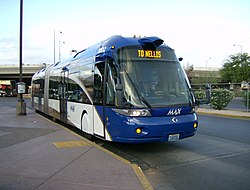 CAT Irisbus Civis, first "bluenose" BRT livery (2004)
 -
 CAT New Flyer D60LF, variant of first "mountains" livery using blue and gold (2005)
 -
 CAT Alexander Dennis Enviro500 in third "goldbug" livery (2005+)
 -
 CAT New Flyer DE41LFR, 1st variant of third "goldbug" livery with dual CAT and RTC branding (2006+)
 -
 RTC New Flyer C40LFR in third "goldbug" livery (2006+)
 -
 RTC Wright StreetCar, second "goldface" BRT livery (2010+)


The first "mountains" livery used was a white base with a mix of broad teal and magenta stripes, black lining around the windows, and the CAT logo in the midsection body, front, and rear. This livery was used from 1992 to 2001.
In 2001, the second "stripes" livery came in three variants, with the second one being the primary livery. The RTC decided to abandon their teal and magenta color scheme and adopted a white, blue, and gold scheme with blue stripes with a cat running on a white base, white around the windows, moving the CAT logo to just above the first window on either side, under the windshield, and on the engine door (with the exception of the Neoplans which had the logo placed above the rear header). Prior to the arrival of the 2001 New Flyer CNGs and Neoplans, the RTC began repainting the fleet with the blue stripe livery. Once they arrived, the RTC approved a variant to the livery and instead of having just blue stripes, it became blue and gold alternating stripes with the logos in the same positions. The RTC then started repainting coaches with this new variant, leaving the already painted coaches with the 1st variant. This livery was used from 2001 to 2005 on the fixed-route fleet. It is the current livery for the RTC paratransit fleet, using the 2nd variant. Since 2008, a 3rd variant has been used by removing the running cat, having the stripes extend around the vehicle, and replacing the CAT logo with the RTC logo.
In 2004, 10 Irisbus Civis coaches arrived for service on the new BRT line, complete with a new MAX Line "bluenose" livery. It consisted of a blue base, with a white line that stretched the length of the coach, and with gold stars on the rear quarterpanels of each side.
In 2005, the RTC again changed the livery, returning to the first "mountains" livery design using the new color scheme, extending the shapes to the bottom of the vehicle. This livery was only used on the 800 series coaches and on coach 654, and it was only used in 2005. A variant of this livery has the CAT logos replaced with RTC fleet logos on the sides of the coach.
Later in 2005, the RTC received its shipment of 50 double deck Alexander Dennis Enviro500 vehicles, painted in a third "goldbug" livery. This one consisted of an all-gold base, with a blue trim around the bottom, and the transit logo between both decks, under the windshield, and under the engine door. Originally limited to the double deckers, the RTC decided to adopt the "goldbug" scheme for new fleet purchases starting in 2006. For non-double deck vehicles, the CAT logo remained above the windows, but the RTC logo was added to the position where the CAT logo was in 1992. To date, only 2 vehicles that were already part of the fleet have been repainted in this livery variant (buses 571 and 725). The New Flyer 900 series vehicles were the last vehicles with this livery. In 2008, the RTC made a variant of the "goldbug" livery which had the CAT logo removed and replaced by a special RTC logo only used on these buses. Coach 702 has been repainted with this livery variant. In 2009, RTC commissioned another variant of the livery by replacing the special RTC logo with an "RTC Transit" logo on the sides and front of the coach. "Regional Transportation Commission of Southern Nevada" was placed near the bottom of the coach. New "No Right Turn On Red" and "This Bus Stops At All Railroad Crossings" stickers were placed on the rear. The numbers were moved to the right of the front and rear of each coach, and "www.rtcsnv.com" is placed on the rear either on the destination sign just under the screen or on one of the engine doors.
In 2010, a new "goldface" BRT livery was implemented with the Wright StreetCars, which consists of a gold base with a blue stripe and a white stripe; the one-piece windshield is outlined in white.
Bus terminals
[edit]

South Strip Transfer Terminal
[edit]The South Strip Transfer Terminal (or "SSTT"), owned by the RTC, is located just south of Harry Reid International Airport on Sunset Rd. and Gilespie St. The SSTT was opened in 2003 after the Vacation Village hotel and casino was closed, which was the southern terminus for many CAT routes. The SSTT has 18 transit bays that are serviced by seven RTC routes, Megabus, which began on December 12, 2012, providing service from the SSTT to Los Angeles via Riverside, and BoltBus to Los Angeles. Both have since ceased operation. In 2008 the park and ride lot was expanded, doubling the amount of spaces available, in response to the overwhelming use of the lot by commuters heading to the airport. The Amtrak Thruway #10 and Greyhound started using the station in 2021, with Greyhound abandoning its long held station at the Plaza Las Vegas.[29]
- SSTT amenities
- 18 transit bays
- payphones
- restrooms
- security offices
- transit vault
- customer service windows
- waiting room
- vending machines
- ticket vending machines
- "Park and Ride" lot
- "Kiss and Ride" passenger drop-off and pick-up area
- WiFi
- SSTT Bays
- 109 / Deuce on The Strip (unloading only)
- 109 / Deuce on The Strip (unloading only)
- 109 / Deuce on The Strip (unloading only)
- 217 EB & WB
- 212 & 217 Overflow
- 212 EB & WB
- Not Used
- Not Used
- Megabus to Riverside and Los Angeles[30]
- Not Used
- Amtrak California to Bakersfield, Santa Barbara, and Los Angeles
- Not Used
- 104 NB
- Deuce on The Strip NB (loading only)
- 117 SB
- 109 Overflow / Silver Rider / Paratransit
- 122 SB
- 109 NB (loading only)
Downtown Transportation Center
[edit]
The Downtown Transportation Center (or "DTC") was the main transit center for the RTC systems in downtown Las Vegas. The DTC had 30 numbered bays, and 4 unnumbered bays that serviced 14 RTC routes, and a private Primm employee shuttle route. The DTC was opened in the late 1980s to serve as the main terminal for the Las Vegas City Trolley, and for the private Las Vegas Transit System, Inc. In 1992, it became the terminal for Citizens Area Transit, once Las Vegas Transit ceased operations. Originally, the DTC only had 23 bays, with two of them unnumbered. In 1999, the city expanded the terminal by building a northern plaza which required closing down Mesquite Ave. in the area. The DTC remained under ownership of the City of Las Vegas until July 31, 2009 when the city discontinued their CityRide transit system and transferred control of the terminal to the RTC. The RTC closed the aging terminal on November 7, 2010, with the grand opening of the Bonneville Transit Center.
- DTC amenities
- 34 transit bays
- restrooms
- security offices
- customer service windows
- waiting room
- ticket vending machines
- 1-hour visitor parking
Bonneville Transit Center
[edit].jpg)
The Bonneville Transit Center (or "BTC") is a transit terminal that was built to replace the aging Downtown Transportation Center as the main downtown terminal for local fixed route service. It opened on November 7, 2010 and is located on the corner of Bonneville Ave. and Casino Center Blvd. It has 16 internal bays, 5 external bays, and an air-conditioned lobby for transit riders. The Bonneville Transit Center is served by Deuce On The Strip, Boulder Highway Express (BHX), Centennial Express (CX) and Downtown & Veterans Medical Center Express (DVX). BoltBus to Los Angeles Union Station is accessible on 1st St. @ Bonneville Ave. On December 2, 2018, a new external bay was added.
- BTC amenities
- 21 transit bays
- restrooms
- security offices
- customer service windows
- waiting room
- ticket vending machines
- bicycle racks and lockers
- cyclist showers
- bike repair shop
- RTC Transit Administration offices
- WiFi
- BTC Bays
- 1 – Not Used
- 2 – 105 NB
- 3 – DVX NB
- 4 – 214 EB/214 WB
- 5 – Not Used
- 6 – 206 WB
- 7 – 109 SB
- 8 – 109 SB
- 9 – 604 NB [Special Events]
- 10 – 215 EB
- 11 – 106 NB [106A/106B]
- 12 – 206 EB
- 13 – BHX SB
- 14 – BHX SB
- 15 – 113 NB
- 16 – 113 NB
- 17A – 208 EB & CX NB
- 17B – 207 EB
- 18 – 108 SB, 207 WB & CX SB
- 19 – 401
- 20 – 208 WB
- Transitway on Casino Center Blvd. (NB) – Deuce on The Strip NB
- Transitway on Casino Center Blvd. (SB) – Deuce on The Strip SB
- On Garces Ave. - Primm Employee Shuttle & Silver State Trailways
Centennial Hills Transit Center Park & Ride
[edit]The Centennial Hills Transit Center is a transit terminal operated by the RTC to serve the northwest valley and its residents. It includes 900 parking spaces, park & ride, indoor waiting facility, next arrival information and restrooms. Construction began in July 2009, and it opened March 28, 2010 in conjunction with the launch of the ACExpress C-Line (renamed to C-Line Express in May 2010 & Centennial Express in November 2010). The facility is located at Grand Montecito Pkwy. & Elkhorn Rd. Routes that currently serve the Centennial Hills Transit Center are: 106A, 106B, and the Centennial Express (CX).
- CHTC amenities
- 4 transit stops
- restrooms
- security offices
- waiting room
- ticket vending machines
- 900 Park & Ride parking spots
- Park & Ride
- WiFi
- CHTC Bays
- Lot 1 – 106B SB, CX SB
- Lot 2 – 607 SB [Special Events]
- Lot 3 – Not Used
- Ace Blvd. @ Grand Montecito Pkwy. - 106A SB
Westcliff Transit Center
[edit]The Westcliff Transit Center is a transit terminal built in the valley's west side community of Summerlin. This terminal is the park & ride for the residents of Summerlin and officially opened on December 12, 2010 in conjunction with the launch of the Westcliff Airport Express (WAX) connecting passengers to McCarran Airport & downtown Las Vegas from the valley's west side.[31] Routes 207, 208 & 209 began service here on November 7, 2010. Route 120 began service here on March 2, 2014. Routes 120, 207, & 209 were removed from here while Route 121 began service here on November 8, 2015. On October 4, 2020 the Westcliff Airport Express was officially discontinued.
- WTC amenities
- 9 transit bays
- restrooms
- waiting room
- ticket vending machines
- Park & Ride
- WiFi
- WTC Bays
- 1 – Not Used
- 2 – Not Used
- 3 – Not Used
- 4 – Not Used
- 5 – Not Used
- 6 – Not Used
- 7 – 208 EB
- 8 – 121 NB
- Durango Dr. @ Westcliff Dr. - 121 SB
UNLV Transit Center
[edit]The UNLV Transit Center is a transit terminal built on the University of Nevada, Las Vegas campus in Central Las Vegas. It is located near Maryland Pkwy. & University Rd. & officially opened on September 4, 2013. Route 602 (special event service during UNLV football games only) & Centennial Express (CX) began service here on September 5, 2013. Route 109 is available along Maryland Pkwy.
- UTC amenities
- 6 transit bays
- ticket vending machines
- UNLV
- In & Out Burger
- UTC Bays
- 1 – 602 WB (UNLV football games only)
- 2 – CX SB
- 3 – Not Used
- 4 – 602 EB (UNLV football games only)
- 5 – CX NB
- 6 – Not Used
Downtown Summerlin Transit Facility
[edit]The Downtown Summerlin Transit Facility serves Downtown Summerlin as well as Las Vegas Ballpark and City National Arena. It is located at Pavilion Center Drive and Summerlin Centre Drive and opened on October 16, 2017. It serves the Sahara Express and route 206.
Proposed terminal
[edit]Henderson Intermodal Transfer Terminal
[edit]RTC planned to build a terminal in Henderson, which was to begin construction in mid-2005. The location was to be near the northeast corner of College Drive and Horizon Drive. According to the RTC, plans included "eight bus berths; covered outdoor waiting; and a small terminal building to include an information/security desk, public restrooms, a driver’s lounge, and mechanical spaces."[32]
Opposition from residents of the nearby Black Mountain Condominiums caused the project to be cancelled following a vote by Henderson City Council on February 15, 2005.[33]
Accidents and incidents
[edit]- 9 March 2004 (continued to 2016)
On the afternoon of 9 March, Lorraine Macdonald was cycling towards the Fashion Show Mall alongside a CAT Bus. The bus driver failed to look in her rear view mirror and side-swiped Lorraine Macdonald twice, which did not kill her but left her disable. March 2007, Miss Macdonald took the bus company to court and won the case, however the bus company appealed and the verdict was reversed in the Nevada Supreme Court and another trial ordered. In March 2010, Miss Macdonald went back to court and won the case again which the bus company has again appealed & won.[citation needed]
- 19 July 2006
On the night of 19 July, Alexander Dennis coach 224 on the "Deuce" service was deadheading north on Interstate 15. A tire failed and the bus went through an opening in the median barrier rail that had been removed for construction access. The coach continued through the median and over a barrier on the southbound side of the Interstate. The coach was spinning clockwise when it was hit by a tractor trailer, which caused the bus to spin the other way and collide again with the trailer before coming to a rest. Due to the size of the cleanup, and the need to investigate the accident, the road was not reopened until approximately 10:00 am the following morning. The driver of tractor trailer was killed in the accident. The passenger in the tractor trailer was unrestrained at the time of the accident, and was severely injured. The driver of the coach was severely injured, and partially disabled.
Following the accident, the coach was retained at the RTC Tompkins yard, covered by a giant tarp to preserve it for inspection during the ongoing investigation and litigation. Upon closure of the RTC Tompkins facility, the bus was taken from the facility and moved to an off-site storage location. In 2011, with the investigation over, the bus was moved to the RTC Simmons facility where the bus was finally dismantled for any usable parts & eventually scrapped.
Initial investigation revealed concerns about problems with the tire were reported a few times by drivers prior to the accident. Maintenance records show that each time a problem was reported it was inspected and evaluated by the mechanics. Additionally, the companies involved in the removal of the barrier were also investigated for contributing to the accident.[citation needed]
- 3 January 2008

On the night of 3 January, a CAT bus collided through two brick walls before finally hitting a house. Around 9:30 pm, CAT bus 915 on route 207 was heading south on Christy Lane and turning left onto Mabel Road, when the bus hit a Ford Mustang car. This sent the bus out of control and into the brick walls and the house. There were three minor injuries on the bus, and unconfirmed injuries in the Mustang. The bus was not taken off the property until the next morning, because officials were concerned that the bus might have made the house structurally unsafe. Support columns were placed in the house and the bus was removed.[citation needed]
- 17 March 2008
On the night of 17 March, CAT bus number 653 struck and killed a pedestrian at the intersection of Washington and Rancho.[citation needed]
- 7 July 2008
On the morning of 7 July, a red truck hit the CAT bus stop on Boulder Highway and Flamingo Road, killing 1 woman and seriously injuring another woman. The driver was arrested and officers said he was under the influence of prescription painkillers.[citation needed]
- 8 July 2008
The day following a deadly crash at a CAT bus stop, another incident occurred with a naked man stealing a bus. At around 07:30 hours, Charles Sell was near Washington Ave. and Lamb Blvd, when Metro police reported that, while naked, he stole beers from a 7-Eleven, and then proceeded to steal CAT paratransit vehicle 1792. He punched the door glass, boarded, and took control while the bus driver jumped off for safety. A few hundred metres away, he jumped off while the bus continued in motion. A Metro officer boarded and stopped the vehicle where the suspect Charles Sell was arrested by Metro that landed him for booking into the Clark County Detention Centre on charges of Grand Larceny Auto and Robbery.[citation needed]
- 13 September 2012
On the morning of 13 September, a man in a 2001 Chevy Monte Carlo, crashed into the bus stop at Spring Mountain and Dectaur, killing four, and injuring 8. The impact tore some of the victims to pieces, and hurled some dozens of yards from the point of impact. According to Las Vegas Metropolitan Police Officer Laura Meltzer, it was difficult to determine their identities, but Metro believe all were waiting for the bus. They were identified Thursday night only as three women, ages 65, 49 and 47, plus a 24-year-old man, all of Metropolitan Las Vegas. The man was arrested on suspicion of DUI and was listed in critical condition.[34]
- 28 January 2013
On the afternoon of 28 January, a woman, driving a 2004 Ford Taurus, crashed into a double decker bus at Charleston and Rainbow, killing herself and injuring 5 people who were on the bus. The people of the bus only suffered minor injuries.[35]
- 9 January 2016
On the evening of 9 January, a 202 bus heading west hit a bus stop sign, near Boulder Highway and Flamingo Road. The bus was pulling in, and hit the bus stop sign off of the shelter, flinging it on the road. Nobody was injured. However, on the same day, around 5 am, a 201B heading east, was pulling up to the curb on Tropicana and Dean Martin Drive. The bus took out the shelter, and doing that, a woman was knocked down and hit by the bus, killing her. (Credit to KTNV 13 for the second story)[citation needed]
References
[edit]- ^ "Transit Ridership Report Second Quarter 2025" (PDF). American Public Transportation Association. August 27, 2025. Retrieved August 29, 2025.
- ^ "Transit Ridership Report Fourth Quarter 2024" (PDF). American Public Transportation Association. February 19, 2025. Retrieved February 25, 2025.
- ^ Booz Allen Hamilton (August 2005). Las Vegas Metropolitan Area Express Bus Rapid Transit (BRT) Demonstration Project (PDF) (Report). Federal Transit Administration. Retrieved 24 February 2020.
- ^ "RTC to launch new ACE rapid transit services in January". Las Vegas Review-Journal. July 16, 2009. Archived from the original on October 7, 2012.
- ^ Green, Steve (August 17, 2010). "Lawsuit prompts RTC to drop 'ACE' name from bus lines". Las Vegas Sun.
- ^ "BRT Rankings". Institute for Transportation and Development Policy. 2020. Archived from the original on February 7, 2015. Retrieved April 26, 2020.
- ^ "RTC to suspend Las Vegas Strip and Downtown Express bus route". Las Vegas Review-Journal. 2020-03-18. Retrieved 2025-05-20.
- ^ "Panel likes light rail line linking key Las Vegas facilities". News3LV. Associated Press. 8 June 2018. Retrieved 5 July 2018.
- ^ Marroquin, Art (25 June 2018). "North Las Vegas leaders envision light-rail line". Las Vegas Review Journal. Retrieved 5 July 2018.
- ^ "Maryland Parkway bus rapid transit project gets a big boost". Las Vegas Review-Journal. 2024-04-01. Retrieved 2024-08-05.
- ^ Adrienne Packer (2011-06-09). "First Transit holds on to bus contract | Las Vegas Review-Journal". Lvrj.com. Retrieved 2013-04-22.
- ^ Adrienne Packer (2011-04-18). "A lot rides on transit contract | Las Vegas Review-Journal". LAS VEGAS REVIEW-JOURNAL – Lvrj.com. Retrieved 2013-04-22.
- ^ Adrienne Packer (2011-11-10). "RTC to re-bid bus contract; First Transit to drop lawsuit | Las Vegas Review-Journal". Lvrj.com. Retrieved 2013-04-22.
- ^ "Archived copy" (PDF). Archived from the original (PDF) on 2014-03-01. Retrieved 2013-04-03.
{{cite web}}: CS1 maint: archived copy as title (link) - ^ "Archived copy" (PDF). Archived from the original (PDF) on 2014-03-01. Retrieved 2013-04-03.
{{cite web}}: CS1 maint: archived copy as title (link) - ^ dima7k (2023-06-29). "Transdev and the RTC of Southern Nevada Launch New Partnership". Transdev United States. Retrieved 2023-10-21.
{{cite web}}: CS1 maint: numeric names: authors list (link) - ^ Mcmullen, Naqiy (2025-08-04). "Twitter".
Crazy that RTC in Vegas & Pace have the 2nd and 3rd most miles of exclusive bus lanes; also really pathetic that Chicago only has 4 miles of 24/7 bus lanes, less than Waukesha!
- ^ Jacqueline Mumford (2025-05-01). "Planes, Buses, and Infamous Orange Cones". nevadabusiness.com. Retrieved 2025-06-17.
- ^ "Ways to Travel – Schedules & Maps". Regional Transportation Commission of Southern Nevada. Retrieved 6 June 2022.
- ^ "Ways to Travel: Fares & Passes". RTC Transit of Southern Nevada. Retrieved 10 February 2020.
- ^ "Services for Senior Citizens". RTC Transit of Southern Nevada. Retrieved 10 February 2020.
- ^ a b "Paratransit and Accessibility". RTC Transit of Southern Nevada. Retrieved 10 February 2020.
- ^ "The RTC is providing discount passes to college students at UNLV, CSN and NSC". RTC Transit of Southern Nevada. September 18, 2019. Retrieved 10 February 2020.
- ^ "Passes For Students". RTC Transit of Southern Nevada. Retrieved 10 February 2020.
- ^ "RTC expands high-capacity transit in Las Vegas Valley with 55 buses from New Flyer". New Flyer | North America’s Bus Leader. 2018-09-04. Retrieved 2021-05-13.
- ^ "Las Vegas Awards New Flyer a contract for up to 305 Xcelsior® buses". New Flyer | North America’s Bus Leader. 2015-03-13. Retrieved 2021-05-13.
- ^ "Las Vegas Exercises Options for an Additional 55 New Flyer Xcelsior® Buses". New Flyer | North America’s Bus Leader. 2016-07-13. Retrieved 2021-05-13.
- ^ Liahusha, Tanya (2021-11-02). "RTC of Southern Nevada awards NFI subsidiary New Flyer a contract for up to 130 low-emission CNG buses". New Flyer | North America’s Bus Leader. Retrieved 2024-03-23.
- ^ "Greyhound bus terminal moving to make way for downtown development". KLAS. 2021-02-23. Retrieved 2023-03-06.
- ^ Lindsay William-Ross (2012-11-28). "$1 Express Bus Service From L.A. To Bay Area and Vegas is Back!". LAist. Archived from the original on 2013-03-29. Retrieved 2013-04-22.
- ^ Hansen, Kyle B. (December 11, 2010). "New express bus route to service airport". Las Vegas Sun. Retrieved 24 February 2020.
- ^ Las Vegas Valley Long Range Transit Survey (PDF) (Report). Regional Transportation Commission. January 2005. Retrieved 6 May 2024.
- ^ "Henderson opposition prompts RTC to give up on terminal". Las Vegas Sun. February 23, 2005.
- ^ Blasky, Mike (2012-09-13). "Four killed as car demolishes bus stop in Las Vegas | Las Vegas Review-Journal". Lvrj.com. Retrieved 2013-04-22.
- ^ Huber, Craig. "Woman killed in wreck with RTC bus ID'd – FOX5 Vegas – KVVU". FOX5 Vegas. Retrieved 2013-04-22.
External links
[edit]
- Regional Transportation Commission of Southern Nevada, owns RTC Transit.
- Keolis Transit America, operates RTC Transit Fixed Route Operations (Sunset).
- MV Transportation, operates RTC Transit Fixed Route Operations (Simmons).
- Veolia Transportation, former operator of RTC Transit Fixed Route Operations.
- Transdev, operates RTC Transit Paratransit Operations.
- First Transit, former operator of RTC Transit Paratransit Operations.
- Southern Nevada Transit Coalition, operator of RTC's routes in Laughlin & Mesquite, as well as the Veterans Medical Transportation Network
- Freeway and Arterial System of Transportation (FAST). Department of RTC responsible for traffic camera system.
| South end |  | ||||||
|---|---|---|---|---|---|---|---|
| West side casinos | |||||||
| East side casinos | |||||||
| Former casinos | |||||||
| Other attractions |
| ||||||
| Transportation | |||||||
| Related | |||||||


RTC Transit
View on GrokipediaRTC Transit is the fixed-route public bus system operated by the Regional Transportation Commission of Southern Nevada (RTCSNV), serving the Las Vegas Valley in Clark County, Nevada, as the region's primary provider of mass transit for residents, commuters, and tourists.[1] The system encompasses local bus routes, express services such as the MAX lines, and the high-frequency Deuce route along the Las Vegas Strip, complemented by paratransit services under the Access program for eligible individuals with disabilities.[2] Launched in 1992 after the RTCSNV assumed operations from the private Las Vegas Transit System, RTC Transit has evolved into a network of 39 routes supported by a fleet of more than 400 vehicles, facilitating connections to employment centers, educational institutions, medical facilities, and major attractions amid the area's rapid population growth.[3][2] Notable for its role in regional transportation planning, the RTCSNV integrates transit with roadway improvements, traffic management, and bicycle infrastructure to address congestion in Southern Nevada's urban expanse.[1] While recognized for security innovations earning the 2021 American Public Transportation Association Gold Award, the system has faced challenges including labor disputes over contracts and efforts to mitigate unruly passenger behavior through enhanced enforcement and legislative measures.[4][5][6]
History
Origins as Las Vegas Transit System
The Las Vegas Transit System (LVTS), a privately owned company, initiated bus operations in Las Vegas, Nevada, in the early 1950s, providing the valley's initial organized public transit service amid post-World War II population growth.[7] As a monopoly franchise holder under city agreement, LVTS focused on essential routes connecting residential areas to the Las Vegas Strip and downtown, relying on fares for revenue while serving a modest ridership base tied to the region's tourism-driven economy.[8] By the late 1970s, LVTS operated a fleet of approximately 26 buses, which proved inadequate for the surging demand fueled by rapid urbanization and visitor influx, as a 1978 consultant report estimated a need for 110 vehicles to meet service standards.[8] The system's limitations became evident in chronic overcrowding and unreliable service, prompting increased public subsidies in the 1980s through the Regional Transportation Commission of Southern Nevada (RTC), which channeled federal funds to support operations without assuming direct control.[8] Persistent financial strains and expansion shortfalls led the Las Vegas City Council to rescind LVTS's franchise in 1990, marking the end of private operation after nearly four decades.[8] Residential routes transitioned to public management under Citizens Area Transit (CAT) in November 1992, with the lucrative Strip service acquired by the RTC shortly thereafter, effectively concluding LVTS's role and paving the way for a regionalized, publicly operated system.[9]Citizens Area Transit Period (1992–2008)
Citizens Area Transit (CAT) was established by the Regional Transportation Commission of Southern Nevada in November 1992 to assume public operation of bus services previously provided by the private Las Vegas Transit System, with operations commencing in December 1992.[10] This transition aimed to deliver reliable fixed-route bus service across the Las Vegas Valley, encompassing Las Vegas, North Las Vegas, Henderson, and surrounding unincorporated areas of Clark County.[11] Initially inheriting approximately 10 routes from its predecessor, CAT focused on enhancing coverage along major arterials to support the region's growing population and tourism-driven economy.[12] During its tenure, CAT expanded its network to address increasing demand, operating services that included extended hours on high-traffic corridors such as the Las Vegas Strip, with some routes running 20 to 24 hours daily.[13] The fleet comprised vehicles inherited from Las Vegas Transit, including GMC RTS models, Grumman 870s, and Gillig Phantoms, supplemented by newer acquisitions to maintain reliability.[10] Fare structures emphasized accessibility, with standard adult fares set at levels comparable to predecessors, while emphasizing integration with regional transportation planning.[7] A key development was the introduction of the Metropolitan Area Express (MAX), a bus rapid transit service launched in 2003 along Las Vegas Boulevard North, featuring limited stops, dedicated vending machines for $1.25 fares, and vehicles capable of carrying up to 120 passengers with optical guidance systems for precision at stations.[14] This initiative represented an early effort to implement higher-capacity transit options amid rising congestion, operating as a 7.5-mile limited-stop line between the Downtown Transportation Center and other northern points.[15] Ridership grew substantially under CAT, starting at 19.4 million annual passenger trips in 1992 and reflecting a 47 percent increase from fiscal year 2002 to 2008, driven by population expansion and tourism.[12] [16] By 2008, the system had evolved to support broader regional needs, leading to a rebranding as RTC Transit to align with the commission's expanded mandate, while maintaining core operations.[17]Transition to RTC Transit (2008–Present)
In 2007, the Regional Transportation Commission of Southern Nevada (RTC) initiated a rebranding of the Citizens Area Transit (CAT) system to RTC Transit, aligning the bus operations more closely with the RTC's broader regional responsibilities for transportation planning, traffic management, and infrastructure.[3] The transition was largely complete by 2008, marking the end of the CAT name that had been used since 1992; the final buses purchased under the CAT branding were certain New Flyer models, after which all new acquisitions bore the RTC Transit livery, often featuring a "goldbug" design variant introduced that year.[3] This shift emphasized integration of transit services within a unified regional framework, amid growing demand from population expansion in the Las Vegas Valley.[3] Post-rebranding, RTC Transit pursued operational expansions to accommodate rising ridership and urban growth, growing from about 10 routes in the late 1990s to 39 fixed routes by the 2010s, with over 3,400 bus stops serving the metropolitan area.[18] The fleet modernized with additions like double-decker buses for higher capacity on high-demand corridors and bus rapid transit (BRT) elements, enhancing speed and reliability on select lines.[3] In 2010, following a trademark infringement lawsuit by an unrelated express service, RTC discontinued the "ACE" branding for premium routes, redirecting focus to established services like the Metropolitan Area Express (MAX).[19] These changes supported annual ridership nearing record levels, with the system carrying 64 million passengers in fiscal year 2023.[3] Further developments since 2008 included service adjustments for efficiency and equity, such as 2021 expansions adding frequency and coverage in underserved residential and retail zones to promote transit-oriented development.[20] The RTC also invested in sustainable technologies, transitioning portions of the fleet from diesel to compressed natural gas and electric options, while maintaining performance metrics like on-time reliability above 80% on core routes.[3] By 2022, marking 30 years of operations (dating to CAT's inception), RTC Transit had solidified its role as the valley's primary public mobility provider, though funding constraints periodically necessitated route optimizations rather than net additions.[21]Post-COVID Recovery and Recent Expansions
Following the onset of the COVID-19 pandemic in March 2020, RTC Transit experienced a sharp decline in ridership, dropping approximately 60% in the early months due to lockdowns, reduced tourism, and shifts in work patterns.[22] By mid-2021, federal funding from the American Rescue Plan Act (ARP) totaling tens of millions enabled the agency to avert service cuts and support recovery efforts, including maintaining operations amid ongoing revenue shortfalls.[22] Ridership began rebounding with the resurgence of Las Vegas tourism and employment, increasing steadily through 2022 and 2023. In 2023, transit ridership rose 21% year-over-year, reflecting improved on-time performance and enhanced safety measures that reduced security incidents by 12%.[23] By June 2024, recovery reached nearly 80% of pre-pandemic levels, aligning with national averages for urban transit systems, driven by population growth and job density in Southern Nevada.[24] Daily boardings hit a reported 154,000 by May 2025, marking record growth amid sustained demand.[25] Recent expansions have focused on route optimizations and infrastructure to accommodate recovery and long-term demand. In August 2021, RTC implemented a valley-wide service expansion, adding connectivity for 23,000 individuals to employment centers and improving access for 380 paratransit users through new routing and frequency adjustments funded partly by ARP allocations exceeding $250 million over five years for maintenance and enhancements.[26] [22] Ongoing initiatives include the installation of 731 slim-line shelters with solar lighting by 2023 to boost rider comfort, and plans for 300 additional bus stop coverings by late 2025 to mitigate extreme heat exposure.[23] Service adjustments continued into 2025, with major changes effective October 12, including routing revisions on six routes (103, 106, 210, 212, 221, and CX) for better residential and retail access, schedule updates on 19 routes to account for traffic and events like Formula 1 races, and new bus stops for enhanced safety and reliability.[27] Paratransit services expanded via a partnership with RideCo, initiated in 2021 and scaled in October 2025 to operate over 400 vehicles and serve more demand-responsive trips.[28] Future-oriented projects, such as bus rapid transit (BRT) on Maryland Parkway with 60-foot articulated buses and stations spaced one-third mile apart, and potential light rail along Charleston Boulevard, aim to further integrate expansions with regional growth.[29] [30]Governance and Funding
Organizational Structure and Oversight
The Regional Transportation Commission of Southern Nevada (RTC), which operates RTC Transit, is governed by a Board of Commissioners composed of elected officials serving ex officio, including members of the Clark County Commission and city council representatives from each incorporated city in Clark County, Nevada.[31] This structure ensures local governmental oversight of regional transportation policies, including transit operations, traffic management, and planning.[32] The board holds regular meetings, such as monthly sessions documented as of February 13, 2025, to review and approve budgets, service expansions, and strategic plans.[33] Executive leadership reports to the board and manages daily operations. The Chief Executive Officer (CEO), M.J. Maynard-Carey as of July 9, 2025, oversees the agency's divisions, including transit services under RTC Transit.[34] Supporting roles include the Deputy Chief Executive Officer, David Swallow, and other deputies like Angela Castro, who handle specific portfolios such as finance and operations.[34] Departmental directors, including those for fixed-route services and paratransit, implement board directives on service delivery and compliance with federal requirements.[35] As the federally designated Metropolitan Planning Organization (MPO) for the Las Vegas urbanized area, the RTC coordinates long-range transportation planning under the Nevada Revised Statutes and federal guidelines, integrating transit oversight with broader infrastructure decisions.[36] The board's composition promotes accountability to local taxpayers but has faced criticism for potential conflicts of interest due to members' ties to development interests, as noted in regional policy discussions.[37] Oversight extends to ensuring compliance with Title VI equity requirements and safety protocols, with recent legislative changes in 2025 enhancing authority to address transit security issues.[38]Revenue Sources and Persistent Shortfalls
RTC Transit's primary operating revenue sources include passenger fares, local taxes, and federal and state grants. In fiscal year 2022, directly generated funds, primarily from fares and ancillary services, accounted for approximately 21.2% of operating expenses, totaling $52.9 million.[39] Local government contributions, derived from Clark County sales taxes and motor vehicle fuel taxes, provided 28.4% or $70.9 million, while federal funds covered 47.3% ($118.1 million) and state funds 3.1% ($7.8 million).[39] The Clark County sales tax, voter-approved in 1989 at 0.25% and later adjusted, along with the motor vehicle fuel tax (MVFT) and its fuel revenue indexing (FRI) program—which adjusts for inflation—form key local pillars, funding both operations and infrastructure.[40] Federal grants, often through the Federal Transit Administration, support capital investments like fleet upgrades, comprising 81.4% of capital expenditures ($18.3 million) in FY2022, with local matches covering the rest.[39] State appropriations, though smaller, include targeted allocations such as $5 million from Nevada's SB 341 in 2023 for transit enhancements amid broader fiscal pressures.[41] Historically, fare revenues from tourist-heavy routes generated surpluses, but declining yields—exacerbated by post-2010 shifts toward lower-income ridership—have reduced their share.[42] Persistent funding shortfalls have plagued operations, driven by revenue volatility and rising costs. Pre-COVID, RTC faced a $6 million annual deficit despite ridership growth, prompting route adjustments.[43] The 2020 pandemic inflated this to $63 million due to ridership drops and fixed costs, mitigated temporarily by $303 million in federal stimulus.[44][45] Looking ahead, the FRI program's expiration at the end of 2026 threatens a $156.3 million annual gap starting in 2028, as unindexed fuel taxes fail to keep pace with inflation and maintenance demands, necessitating potential sales tax extensions or new levies via ballot measures.[46] These structural deficits underscore reliance on elastic local taxes amid stagnant fare recovery and grant uncertainties.[41]Legislative and Policy Influences on Funding
The establishment of the Regional Transportation Commission of Southern Nevada (RTC) in 1983 through state legislation empowered the agency to own and operate a public mass transit system, laying the foundational policy framework for RTC Transit's funding by integrating transit operations with regional planning and revenue allocation mechanisms.[32] This enabling act shifted oversight from prior private and municipal models to a consolidated public entity reliant on a mix of local taxes and fees, though initial funding emphasized property and gaming-related revenues before sales tax dominance emerged.[47] A pivotal legislative influence occurred in 1991 when the Nevada State Legislature, in coordination with the Clark County Board of Commissioners, authorized a 0.25 percent regional sales and use tax dedicated to transit funding, effective July 1, 1991, which became the RTC's largest revenue source at approximately 29.4 percent of its fiscal year 2026 budget.[47][48] This tax, renewed and adjusted over time through local ballot measures and state approvals, addressed chronic underfunding in a tourism-driven economy where transit supports over 50 million annual trips but competes with road infrastructure priorities.[48] Nevada's policy landscape historically disadvantaged public transit, as the state provided no dedicated funding until Senate Bill 341 (2023) appropriated $5 million to the RTC for operational stabilization, marking a departure from its status as one of only four states without such support.[23][41] These funds, with $3.4 million expended by December 2024 on service expansions, paratransit enhancements, and security measures amid projected shortfalls, enabled frequency improvements and on-time performance gains but represented a one-time infusion rather than recurring state commitment.[41] Ongoing policy debates center on fuel tax mechanisms, including Clark County's indexed fuel revenue program—allowing automatic inflation adjustments—which generated $85.7 million in fiscal year 2026 projections but faces expiration at the end of 2026, potentially exacerbating deficits without legislative extension.[48][46] Bills in the 2025 session sought to renew indexing without voter approval, reflecting tensions between fiscal autonomy and public referendum requirements, while broader calls for expanded state transit funding persist amid rising operational costs and ridership recovery.[49][50] Senate Bill 290 (2025) further influenced ancillary funding by empowering transit security personnel, indirectly supporting operational budgets through enhanced safety without direct appropriations.[51]Operations and Service Characteristics
Coverage Area and Network Design
RTC Transit operates fixed-route bus services throughout the Las Vegas Valley in Clark County, Nevada, primarily serving the incorporated cities of Las Vegas, North Las Vegas, Henderson, and Boulder City. The coverage area focuses on densely populated urban and suburban zones, connecting residential neighborhoods, employment centers, the Las Vegas Strip, downtown districts, and outlying communities, with routes extending to key regional destinations like the Harry Reid International Airport and select park-and-ride facilities. As of October 2025, the system map delineates this footprint via color-coded routes spanning these municipalities, excluding expansive rural or unincorporated desert areas beyond the urban core.[52][53] The network design employs a grid-based structure aligned with the Las Vegas area's predominant one-mile street grid, enabling systematic coverage through a combination of local, express, and premium routes totaling more than 39 lines that access approximately 3,795 stops. This layout prioritizes radial corridors from high-demand hubs—such as the Strip and downtown Las Vegas—to peripheral suburbs, with circumferential feeders linking cross-valley travel; express variants like the Deuce (serving the Strip) and MAX (Metropolitan Area Express) Bus Rapid Transit lines enhance efficiency on high-volume arterials by incorporating dedicated lanes, signal priority, and enhanced stations where feasible. Coverage gaps in lower-density zones are supplemented by on-demand microtransit services, but the core fixed-route emphasis remains on maximizing accessibility within a quarter-mile walking distance to stops, promoting equitable service in a sprawling, auto-dependent region.[54][55][45] Performance metrics underscore the design's focus on reliability over expansive reach, with routes engineered for headways of 15-60 minutes during peak hours on major lines, though chronic underfunding has constrained frequency expansions. The system's evolution incorporates data-driven adjustments, such as post-2020 ridership recovery targeting tourist-heavy corridors, while maintaining a hub-and-spoke model to integrate with future infrastructure like potential rail extensions.[56][36]Route System, Scheduling, and Performance Metrics
RTC Transit operates a network of fixed-route bus services across the Las Vegas Valley, encompassing local routes, express services, and premium Metropolitan Area eXpress (MAX) lines designed for higher-capacity corridors. The system includes approximately 39 routes, serving key areas such as the Las Vegas Strip, downtown Las Vegas, Henderson, and North Las Vegas, with connections to major employment centers, residential neighborhoods, and tourist destinations.[57] MAX routes function as bus rapid transit-style services with dedicated lanes, signal priority, and enhanced stations on select alignments like Sahara Avenue and U.S. Route 95, aiming to reduce travel times on congested arterials.[58] Schedules for fixed routes generally span daily operations from 5:15 a.m. to 8:15 p.m., aligning weekday and weekend hours to accommodate shift workers and visitors, with expansions implemented to extend evening service. Frequencies vary by route demand: high-volume corridors like Route 119 (The Deuce, serving the Strip) operate every 15-20 minutes during peak periods, while suburban or low-density routes run every 30-60 minutes; these are approximations subject to traffic conditions. Periodic service adjustments optimize efficiency, as seen in the October 12, 2025, changes that modified schedules on 19 routes, altered alignments on 6 routes, and introduced special schedules for events like Formula 1, responding to traffic growth and rider feedback.[59][60][61] Performance metrics highlight operational efficiency amid urban challenges like congestion. Average on-time performance for fixed routes stood at 77.2% in recent reporting, defined by arrivals within scheduled windows despite heavy traffic on routes like the Strip.[62] Combined ridership across fixed and demand-response services reached 52,203,687 in fiscal year 2024 (ending June 30), up from 49,590,971 in FY 2023, with fixed-route residential services showing a 6.6% increase year-over-year; this reflects partial post-pandemic recovery to about 80% of pre-2020 levels.[62][41] The system serves 3,726 bus stops and ranks as the most efficient bus operator among 3,208 U.S. agencies per 2023 National Transit Database metrics, evaluated on operating cost per passenger mile.[62]| Fiscal Year | Combined Ridership |
|---|---|
| 2021 | 35,005,016 |
| 2022 | 40,953,167 |
| 2023 | 49,590,971 |
| 2024 | 52,203,687 |
Paratransit Services and Accessibility Features
RTC's ADA paratransit service offers shared-ride, door-to-door transportation for individuals with physical, cognitive, or visual impairments who cannot independently board, ride, or disembark from fixed-route buses due to their disability.[63][64] The service adheres to Americans with Disabilities Act (ADA) requirements, operating parallel to fixed routes with origins and destinations within three-quarters of a mile of those routes.[65] Eligibility certification is mandatory and involves submitting an application, potentially followed by an in-person interview and functional assessment to verify inability to use accessible fixed-route services for the specific trip purpose.[66] Temporary eligibility may apply for conditions lasting up to 90 days, while permanent certification has no fixed expiration but requires periodic review.[66] Certified users receive photo ID cards permitting free access to fixed-route and express buses when feasible, promoting maximum use of mainstream services.[63] Trips must be reserved at least one day in advance, up to seven days ahead, via phone or the MyRTCpara mobile app, which also enables tracking, estimated arrival times, and cancellations.[67] The dedicated fleet comprises ADA-compliant cutaway vans and minibuses equipped with wheelchair lifts, ramps, securement systems, and space for mobility devices, ensuring secure transport without accommodating personal care attendants beyond the rider unless pre-arranged.[63] Service hours align with fixed routes, typically 5:00 a.m. to 1:00 a.m., though exact availability varies by demand.[68] A supplementary Ride On-Demand program, launched for select certified users, provides app-based, on-demand rides within designated zones using non-dedicated vehicles to reduce wait times and costs.[69] Non-dedicated options like UZURV and SilverRide partner services fill gaps when dedicated capacity is exceeded, maintaining ADA equivalence.[70] In a 2018 Federal Transit Administration compliance review, RTC was found non-compliant in areas including eligibility assessments overlooking environmental barriers like missing sidewalks, excessive telephone hold times (47.9% of hours below ADA standards), and trip lengths exceeding fixed-route equivalents by over 20 minutes in 43% of sampled cases, prompting mandated corrective actions within 60 days.[71] Broader accessibility enhancements include a 2024-opened mobility training lab with a retrofitted bus simulator to teach disabled riders system navigation, emphasizing independence.[72] Fixed-route accessibility features, such as low-floor buses with kneeling capability and priority seating, complement paratransit by serving users able to transfer with assistance.[63]Fares and Rider Programs
Standard Fare Structure for Fixed Routes
The Regional Transportation Commission of Southern Nevada (RTC) operates fixed-route bus services consisting of local routes, express services such as MAX lines, and the Deuce route along the Las Vegas Strip and downtown area. Standard fares distinguish between local/residential routes and premium routes like the Deuce and MAX, with single-ride cash payments reflecting higher costs for high-demand corridors. As of October 2025, regular single-ride fares are $2 for local routes and $4 for Deuce and MAX routes, payable in exact change onboard or via contactless methods.[73][74] Time-based passes provide unlimited rides across all fixed routes for the specified duration, promoting transfers without additional cost. The 2-hour pass costs $6, the 24-hour pass $8, and the 3-day pass $20, all applicable system-wide regardless of route type. Children under five ride free when accompanied by a fare-paying adult, limited to two per adult.[73][75]| Fare Type | Local Routes (Regular) | Premium Routes (Deuce/MAX, Regular) | Reduced Fare (All Routes) |
|---|---|---|---|
| Single Ride | $2 | $4 | 50% discount |
| 2-Hour Pass | $3 (effective for locals) | $6 | 50% discount |
| 24-Hour Pass | Included in system pass | Included in system pass ($8) | $4 |
| 3-Day Pass | Included in system pass | Included in system pass ($20) | Not specified; eligible via ID |
Discounted Access Programs for Students and Special Groups
The Regional Transportation Commission of Southern Nevada (RTC) offers reduced fares on fixed-route bus services for eligible students and special groups, including youth aged 6-17, K-12 students, college attendees, seniors aged 60 and over, persons with disabilities, veterans, and active-duty military personnel.[76] These discounts apply to single rides and passes, requiring proof of eligibility such as a valid student ID, Medicare card, or RTC-issued reduced fare identification card obtained through application with supporting documentation like a veteran's DD-214 form or disability certification.[77] Reduced single-ride fares are typically $1, half the standard $2 adult fare, while pass options provide further savings for frequent riders.[78] K-12 students qualify for reduced fares and discounted passes upon presenting a school-issued ID, with passes available for purchase at select retailers like Albertsons using the ID for verification.[79] Youth aged 6-17 receive similar youth reduced fares, distinct from adult pricing but aligned with student benefits.[76] For higher education, institutions including the University of Nevada, Las Vegas (UNLV), College of Southern Nevada (CSN), and Nevada State College (NSC) partner with RTC for the College Transit Pass program, offering up to 70% off unlimited rides via 30-day monthly passes or semester-long options tailored to academic calendars.[80] At CSN, for instance, eligible students and faculty can purchase a 30-day pass for $32.50—versus the regular $65—and a semester pass for $104.[81] UNLV additionally provides free or subsidized passes to financially needy students through a semester-based program funded in partnership with RTC, easing access for those without personal vehicles.[82] Special groups such as seniors aged 60 and over access reduced fares with a government-issued ID or Medicare card, supporting mobility for non-driving elderly residents.[76] Persons with disabilities must apply for an RTC reduced fare card, verified through medical or state documentation, enabling half-price rides on fixed routes separate from the complementary paratransit service.[76] Veterans and active-duty military qualify similarly, honoring service with discounted access upon showing proof like a military ID or honorable discharge papers.[76] These programs aim to promote equitable transit use but require in-person or app-based validation to prevent misuse, with fares enforceable by operators.[83]Fleet Composition
Active Vehicles and Technological Upgrades
![RTCLV_2024_XHE60.jpg of hydrogen fuel cell bus][float-right] The Regional Transportation Commission of Southern Nevada (RTCSNV) operates a fixed-route bus fleet exceeding 400 vehicles, primarily consisting of models from New Flyer Industries, an NFI Group subsidiary, with additional units from Alexander Dennis and ARBOC Spirit.[84][85] As of July 2025, the RTC placed an order for 46 additional New Flyer buses, further solidifying its all-NFI core fleet supplemented by specialized vehicles like double-decker buses.[86] These include 40-foot standard buses and 60-foot articulated models, alongside 10 double-decker Enviro500 units introduced starting in 2025 to enhance capacity on high-demand routes such as the Deuce.[87] Propulsion technologies in the active fleet reflect a transition from diesel to alternative fuels, with compressed natural gas (CNG) buses replacing older diesel units in a 2023 procurement of 28 vehicles, including both 40-foot and 60-foot variants.[88] Zero-emission options are expanding, including battery electric buses such as New Flyer XN60 models added in 2022 and four more in 2024, alongside hydrogen fuel cell electric (HFCE) buses.[89] The HFCE fleet began with two units deployed via a $3.8 million U.S. Department of Transportation grant in 2023, followed by seven 60-foot articulated models delivered in fall 2024, aiming for 18 dedicated HFCE buses by 2026 to support the region's first zero-emission transit corridor.[90][91][92] Technological upgrades emphasize sustainability, safety, and efficiency. Hydrogen fueling infrastructure accompanies the HFCE buses, enabling zero-tailpipe emissions and positioning Nevada as a leader in fuel cell transit.[90] Battery electric integrations feature advanced energy management systems for extended range in Las Vegas's high temperatures. Safety enhancements include onboard surveillance and real-time monitoring technologies adopted amid national concerns, while fleet-wide telematics support predictive maintenance and route optimization.[93] Double-decker buses incorporate ergonomic designs and accessibility features compliant with ADA standards, boosting passenger throughput without expanding road infrastructure.[87] ![2020 RTCSNV Alexander Dennis Enviro 500 20803 double-decker bus][center] These upgrades align with federal funding requirements, including FTA guidelines that limit spare ratios but incentivize low-emission procurements, contributing to reduced operational emissions despite challenges like spare vehicle constraints.[84]Retired Fleet and Historical Evolution
The Las Vegas Transit System (LVTS), a private operator, provided bus services in the Las Vegas Valley from the early 1950s until its acquisition by the Regional Transportation Commission (RTC) in 1992.[7] Citizens Area Transit (CAT), the RTC's initial public transit division, launched operations on December 5, 1992, assuming LVTS's routes and inheriting a fleet comprising Flxible Grumman buses, GMC RTS models, and Gillig Phantom buses.[94] [7] These vehicles, characterized by high-floor designs and diesel propulsion, formed the core of early CAT service but were progressively retired as maintenance costs rose and newer models arrived. In 1992, CAT initiated fleet modernization by purchasing 90 New Flyer D40 buses, which began displacing the older inherited stock.[7] By the mid-2000s, high-capacity innovations such as double-decker buses, introduced in 2005 for routes like the Deuce along the Las Vegas Strip, further supported retirement of less efficient units by increasing passenger throughput per vehicle.[95] The 2008 rebranding to RTC Transit aligned with ongoing replacements, phasing out remaining legacy diesel and high-floor buses from the CAT era to prioritize low-floor accessibility and alternative fuels.[3] A shift to compressed natural gas (CNG) vehicles in the 2000s accelerated retirements of diesel models, reducing emissions and operational costs; by 2024, the fleet was 95% CNG-powered.[3] Recent efforts, including the 2023 Green Fleet Procurement project, retired 28 end-of-service-life diesel buses in favor of advanced technologies like hydrogen fuel cells, continuing a pattern of evidence-based fleet turnover driven by reliability, environmental standards, and ridership demands.[88] This evolution reflects causal priorities of extending vehicle useful life—typically 12 years or 500,000 miles—while integrating empirical upgrades for safety and efficiency.[96]Fuel Types, Maintenance Practices, and Efficiency Standards
RTC Transit's fixed-route bus fleet relies predominantly on compressed natural gas (CNG), comprising approximately 95% of vehicles as of 2024, following a transition from diesel-powered operations that reduced reliance on higher-cost and higher-emission fuels.[3] Over 230 fixed-route buses operate on CNG, supported by dedicated fueling stations that also supply renewable natural gas (RNG) through partnerships aimed at further lowering greenhouse gas emissions.[97] Recent procurements include zero-emission technologies, such as two hydrogen fuel cell electric buses (40 feet each) introduced in August 2023, with plans for seven additional 60-foot articulated hydrogen models and up to 18 total by 2026; these vehicles generate electricity via onboard fuel cells combining hydrogen and oxygen, emitting only water vapor.[98][99] Battery electric buses supplement the fleet, with four 40-foot models added in November 2023, offering lower operating costs and higher energy efficiency than diesel equivalents due to regenerative braking and electric drivetrains.[100] Maintenance practices emphasize preventive routines and rapid repairs to maximize fleet availability, conducted at facilities including the Integrated Bus Maintenance Facility and Sunset Maintenance Facility, where crews perform daily inspections, fluid checks, and component overhauls.[101][102] For alternative-fuel vehicles, specialized protocols address CNG system integrity, hydrogen storage safety, and battery thermal management, with facilities undergoing upgrades to support charging infrastructure and fuel cell diagnostics by 2035 in alignment with zero-emission goals.[103] Safety enhancements include high-tech fire suppression systems deployed across maintenance bays to mitigate risks from compressed gases and electrical components.[104] Contracted oversight ensures compliance with manufacturer guidelines for hybrid and electric fleets, minimizing downtime through predictive maintenance tools.[105] Efficiency standards are guided by the agency's Zero Emissions Bus Rollout Plan, which targets a full transition to zero-emission vehicles by 2050 contingent on funding, starting with hydrogen and battery electric introductions to cut fossil fuel dependence and operational expenses.[89][106] CNG adoption yields fuel cost savings, with prices at $2.19 per gasoline gallon equivalent versus $3.08 per gallon for diesel, alongside reduced maintenance needs for cleaner-burning engines.[96] Hydrogen and electric buses exceed traditional efficiency metrics, with federal grants supporting procurement to meet EPA greenhouse gas reduction targets and regional air quality mandates.[107] RNG integration further enhances lifecycle emissions reductions, positioning the fleet to comply with evolving national heavy-duty vehicle standards under the Clean Air Act.[108]| Fuel Type | Approximate Share (2024) | Key Efficiency Benefits | Example Deployments |
|---|---|---|---|
| CNG/RNG | 95% | Lower fuel costs; reduced particulate emissions | >230 fixed-route buses[97] |
| Hydrogen Fuel Cell | Emerging (<5%) | Zero tailpipe emissions; refuel in minutes | 2 buses (2023), 18 planned by 2026[98] |
| Battery Electric | Emerging (<5%) | Regenerative braking; lower lifetime costs | 4 buses (2023)[100] |
| Diesel | Minimal/Phase-out | Legacy use only | Replaced via green procurement[88] |
Infrastructure and Facilities
Operational Hubs and Transfer Terminals
The Regional Transportation Commission of Southern Nevada (RTC) operates multiple transit centers that function as operational hubs and major transfer points for its fixed-route bus services across the Las Vegas Valley. These facilities enable seamless route connections, provide amenities such as ticket vending machines and route maps, and include park-and-ride options to accommodate commuters parking personal vehicles for longer durations, with some allowing up to seven days of free parking to encourage transit ridership.[109] The Bonneville Transit Center, situated at 101 E. Bonneville Avenue on the southwest corner of Casino Center Boulevard in downtown Las Vegas, serves as the primary operational hub for the RTC system. Opened as a LEED Platinum-certified green building—the third such structure in Southern Nevada—it centralizes transfers for numerous local and express routes, including those connecting to the Las Vegas Strip and surrounding areas. The center features sales booths open Monday through Thursday from 7 a.m. to 6 p.m., automated ticket machines, and large system maps at each bay to assist passengers in navigating connections.[109][110] The South Strip Transfer Terminal (SSTT), located at 6675 Gillespie Street near Harry Reid International Airport, acts as a critical southern hub and the RTC's inaugural park-and-ride facility. It supports high-volume transfers for airport-bound routes like the 108, 109, and express services such as the Deuce and SDX, with 18 dedicated bus bays handling inbound and outbound traffic. The terminal includes ticketing areas, seating, and secure parking, making it a key interchange for travelers accessing the Strip and beyond.[111][109] In the northwest valley, the Centennial Hills Transit Center Park & Ride at 7313 Grand Montecito Parkway provides an essential hub for suburban commuters, facilitating transfers to express and local routes serving outlying residential areas. This facility emphasizes park-and-ride functionality to reduce single-occupancy vehicle trips into central Las Vegas, with dedicated spaces for long-term parking aligned with RTC's broader goals of congestion mitigation.[109]Proposed and Under-Development Facilities
The Regional Transportation Commission of Southern Nevada (RTCSNV) is developing neighborhood mobility hubs as part of the All-Access Mobility Plan (AAMP), aimed at enhancing multimodal transportation integration in underserved areas.[112] These hubs are proposed for locations in downtown Las Vegas, East Las Vegas, and the Historic Westside to facilitate seamless connections between bus services, bicycles, pedestrians, and other modes, thereby improving access for residents with limited personal vehicle options.[113] Planned features include dedicated spaces for transit stops, bike parking, pedestrian pathways, and potential amenities like charging stations for electric vehicles or micromobility devices, designed to promote equitable and sustainable mobility without relying on large-scale infrastructure overhauls.[114] As of September 2025, the RTCSNV initiated public surveys to gather community input on optimal hub sites and features, reflecting a data-driven approach to site selection based on transit demand, population density, and equity metrics.[115] The AAMP, which remains in the planning phase through late 2025, prioritizes these hubs to address gaps in the existing Frequent Transit Network by creating localized transfer points that reduce walking distances and wait times for riders.[112] No construction has commenced, with final locations and designs contingent on stakeholder feedback and funding availability from regional capital programs.[113] Beyond mobility hubs, RTCSNV's capital improvement efforts include upgrades to existing maintenance facilities, such as HVAC enhancements at the Integrated Bus Maintenance Facility (IBMF) and Sunset Maintenance Facility (SMF), to support fleet electrification and operational efficiency, though these do not constitute entirely new builds.[116] Proposals for additional depots or large-scale terminals remain unannounced in current plans, with focus instead on incremental infrastructure tied to bus rapid transit corridors like Maryland Parkway, where station enhancements are under construction but classified as route improvements rather than standalone facilities.[117]Safety, Security, and Incidents
Implemented Safety and Security Enhancements
The Regional Transportation Commission of Southern Nevada (RTC) has invested over $33 million in security services and safety upgrades across its transit system since 2015.[118] These efforts include a 25% increase in contracted armed security officers, equipped with high-visibility uniforms to enhance deterrence and rapid identification during incidents.[119] In partnership with Inter-Con Security, RTC has expanded officer presence, achieving a four-minute reduction in incident response times, which contributed to receiving the 2025 American Public Transportation Association Bus Security Award.[120] Technological enhancements feature upgraded surveillance cameras on buses, body-worn cameras for security personnel, and protective driver enclosures with reinforced barriers and GPS emergency trackers.[121] [122] Driver enclosures, initially installed during the COVID-19 pandemic, received extensions adding 12 to 18 inches of plexiglass in August 2020 and continue to be upgraded for ongoing protection against assaults.[123] Rear-door boarding policies, implemented in April 2020, further isolate operators from direct passenger interactions except for those requiring assistance.[124] A key policy advancement is Nevada Senate Bill 290, effective October 1, 2025, which authorizes RTC security officers to remove disruptive passengers from vehicles and facilities without immediate police involvement, targeting behaviors like obstruction or threats to improve reliability and reduce delays.[38] Complementing these measures, RTC expanded its ZeroEyes AI-powered gun detection system—a pilot launched in 2024 at four transit centers—to all eight centers by October 2025, correlating with a 40% reduction in passenger-on-passenger assaults and a 26% drop in operator assaults.[125] [126] Public awareness initiatives include the relaunched "Everyday Safer" campaign in October 2025, featuring signage at bus stops and transit centers alongside digital advertising to promote reporting of issues and reinforce safe conduct expectations.[119] These layered approaches prioritize empirical deterrence through personnel, barriers, surveillance, and rapid intervention, addressing documented risks like assaults without relying on unverified assumptions about rider behavior.Recorded Accidents, Incidents, and Risk Factors
Between 2015 and 2019, Southern Nevada recorded bus-related crashes analyzed by the Regional Transportation Commission (RTC), with improper movements by other vehicles accounting for 55 percent of incidents involving buses, indicating that external driver behavior was the predominant cause rather than bus operator fault.[127] Statewide Nevada data, encompassing RTC operations in the populous Clark County, reported 2,355 bus crashes over the same period, including 196 in 2019 alone, though specific RTC attribution was not isolated beyond regional analysis.[128] These figures highlight buses' involvement in a small fraction (0.5 percent) of total state crashes in 2019, but with elevated injury potential due to vehicle mass and passenger density.[128] Notable fatal accidents include a September 2025 incident where a 7-year-old girl was fatally struck by an RTC bus, prompting a lawsuit against the RTC and contractor Transdev for alleged driver negligence.[129] In April 2025, an electric scooter rider died after colliding with an RTC bus.[130] On April 21, 2025, a motorcyclist failed to stop at a red light and struck an RTC bus, resulting in the rider's death and injuries to the bus driver.[131] An August 4, 2025, crash in Henderson saw another motorcyclist killed when an RTC bus turned left on a flashing yellow signal.[132] Non-crash incidents underscore onboard security risks, with RTC reporting 166 passenger-on-passenger assaults in fiscal year 2023, a decline of 29 from the prior year but still indicative of persistent violence.[133] Shootings include a May 3, 2023, event where a rider was shot on a bus near Eastern Avenue and Bonanza Road, sustaining serious injuries; a November 2023 altercation leading to a shooting and a toddler's accidental injury from a discarded gun; and a June 2024 shootout involving teenagers on a bus, forcing passengers to take cover.[134][135][136] A March 2025 stabbing of a tourist 27 times on a bus further highlighted vulnerabilities.[137] Key risk factors for RTC bus accidents include interactions with non-compliant road users, such as vehicles failing to yield or pedestrians/scooter riders in blind spots, compounded by buses' size, weight, and lack of seatbelts for standing passengers, which amplify injury severity in collisions.[127][128] For incidents, urban density and socioeconomic stressors in Las Vegas contribute to onboard conflicts escalating to violence, with assaults and shootings often stemming from arguments among passengers, as evidenced by police reports of teen-involved disputes.[133][134] Overall traffic patterns in Southern Nevada, with 226 annual fatalities averaging one every 1.5 days from 2019-2023, contextualize RTC risks within broader roadway hazards like speeding and impairment, though bus-specific data shows lower at-fault rates.[138]Performance, Efficiency, and Criticisms
Ridership Trends and Economic Metrics
Ridership for RTC Transit plummeted during the COVID-19 pandemic, falling from approximately 67 million annual trips pre-pandemic to 35,005,016 in fiscal year 2021 amid service reductions and restrictions.[45][62] Recovery began in fiscal year 2022 with 40,953,167 trips, accelerating to 49,590,971 in 2023 and 52,203,687 in 2024, reflecting tourism rebound and service restorations but remaining below pre-pandemic levels at roughly 78% recovery as of mid-2024.[24][62] Daily boardings reached about 143,000 in fiscal year 2024, with reports of further growth to around 154,000 by early 2025 driven by population increases and visitor traffic.[25]| Fiscal Year | Annual Ridership (Unlinked Passenger Trips) |
|---|---|
| 2021 | 35,005,016 [62] |
| 2022 | 40,953,167 [62] |
| 2023 | 49,590,971 [62] |
| 2024 | 52,203,687 [62] |