Hubbry Logo
RedmiRedmiMain
Open search
Redmi
Community hub
Redmi
logo
8 pages, 0 posts
0 subscribers
Be the first to start a discussion here.
Contribute something
Redmi
Redmi
from Wikipedia
Former Redmi logo used until November 2024 in China and until March 2025 on the global market

Key Information

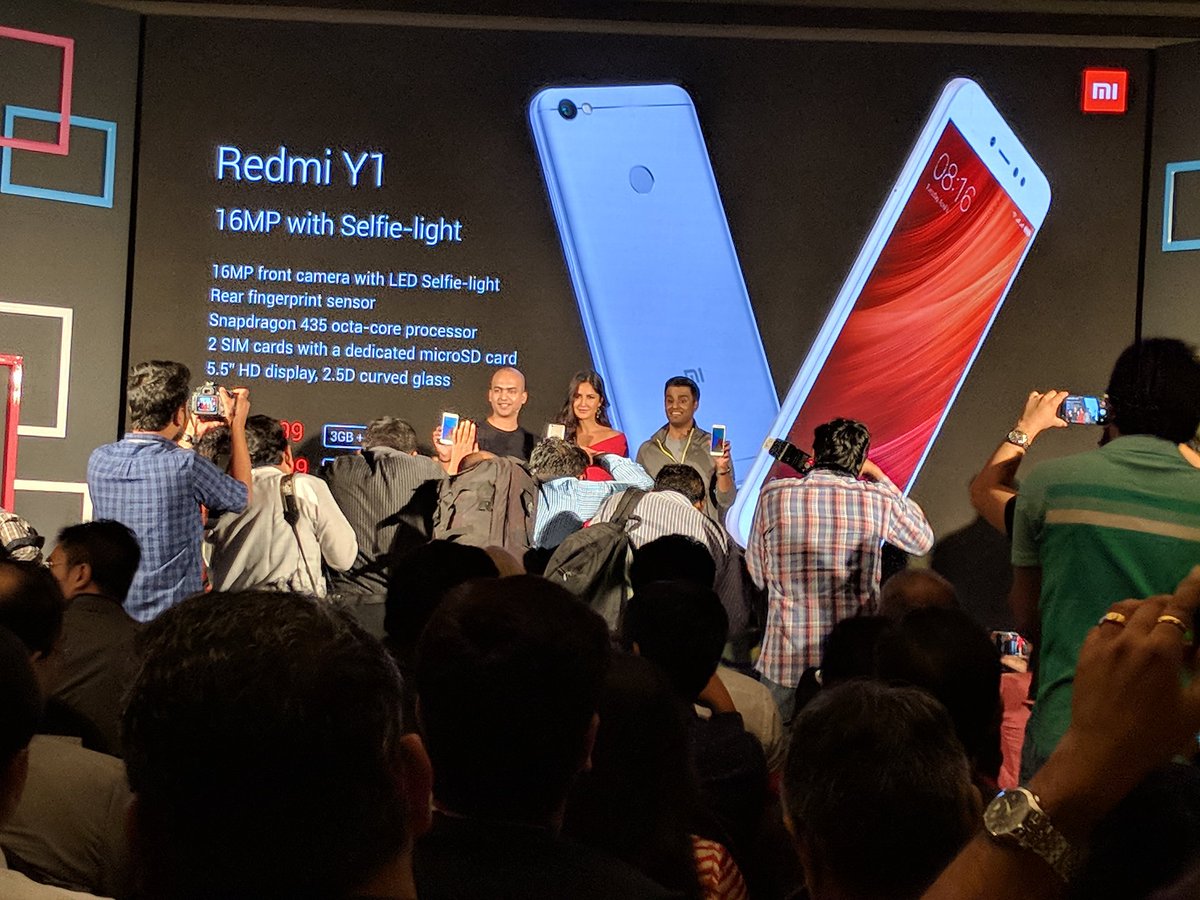
Manu Kumar Jain, VP and MD of Xiaomi India (left), Katrina Kaif (middle) at Redmi Y1 promotional event

Redmi (stylized in all caps as REDMI) is a subsidiary brand owned by the Chinese electronics company Xiaomi. It was first launched in July 2013 as a budget smartphone line,[1] and became a separate sub-brand of Xiaomi in 2019, to takeover entry-level and mid-range devices originally produced by Xiaomi brand, while Xiaomi itself produces upper-range and flagship Xiaomi (formerly Mi) phones.

Redmi phones use Xiaomi's MIUI or Xiaomi HyperOS user interface on top of Android. Models are divided into the entry-level Redmi, the mid-range Redmi Note, and the flagship Redmi K. In 2022, an ultra-basic entry-level lineup, Redmi A was introduced, with some models featuring Android Go and lacking MIUI/HyperOS user interface. The Redmi K is exclusive to China and rebranded as Poco F for select global markets.

The most significant difference from other Xiaomi smartphones is that Redmi uses less expensive components, allowing lower prices while retaining more advanced specifications. In August 2014, The Wall Street Journal reported that in the second quarter of the 2014 fiscal year, Xiaomi had a smartphone market share of 14% in China;[2] Redmi sales were attributed as a contributing factor toward this ranking.[2]

Some devices with identical specification are released in some markets as POCO, in others as Redmi; for example the Poco X7 and Redmi Note 14 Pro 5G. Redmi Note 14 SE officially arrived in India on July 28, 2025.[3]

History

[edit]

2013

[edit]

The first Redmi phone Redmi (Red Rice in Mandarin), released in China in 2013, was first launched on Xiaomi's website, with consumer sales beginning on 12 July 2013. The phone was internationally released under the Redmi brand in early 2014.[4][5]

2014

[edit]

On 13 March 2014, Redmi announced that their phones had been sold out in Singapore alone, eight minutes[6] after being made available to buy on Xiaomi's website. Criticism regarding the release of Redmi phones included the notion that the firm may be exaggerating its sales by releasing them in small batches, causing them to quickly sell out.[7]

On 4 August, The Wall Street Journal reported that in China's smartphone market, Xiaomi overtook Samsung in the second quarter of the 2014 fiscal year with a 14% market share in smartphone shipment rankings, while Samsung had a 12% market share during this time.[8] Yulong and Lenovo both had a 12% market share during this time.[2] Redmi sales were attributed as contributing to Xiaomi's increased shipment rankings in the smartphone market.[2] Conversely, in the first quarter of 2014, Xiaomi held a 10.7% market share.[2]

2015

[edit]

The Redmi Note 3 launched on 24 November 2015; unlike its predecessor, it does not have a user-changeable battery or microSD slot. It uses the MediaTek Helio X10 Octa-core 2.0 GHz Cortex-A53 SOC with the PowerVR G6200 GPU. The Snapdragon variant of the phone, released later the same year, is based on the Snapdragon 650 and has microSD support.

2016

[edit]

In July 2016, the actors Liu Shishi, Wu Xiubo and Liu Haoran became the first ambassadors of the Redmi series in China.[9] Redmi Pro has appeared as Pro lineup in Redmi series.

On 25 August, Xiaomi unveiled the Redmi Note 4, powered by MediaTek's Helio X20 deca-core processor clocked at 2.1 GHz. The device has 2 GB RAM and 16 GB of internal storage. It has a 5.5-inch Full-HD display and a 13 MP rear camera and 5 MP front camera. It runs on Android 6.0 Marshmallow and is powered by a 4,100 mAh battery.

In November, Xiaomi released its new budget phone, Redmi 4. It has a polycarbonate body, dual-SIM support and runs on MIUI 8 based on Android 6.0.1 Marshmallow. The Redmi 4 has a 5-inch 720x1280 pixels display, is powered by a 1.4 GHz octa-core processor, and has 2 GB of RAM.

2017

[edit]

In January 2017, the Xiaomi Redmi Note 4x based on Qualcomm Snapdragon 625 Chipset became the company's first major launch of 2017.[10] It is an upgraded version of the previously released Redmi Note 4 based on the MediaTek Helio X20 chipset. The device is known as Redmi Note 4 in regions where the original Redmi Note 4 was not released.

In December, Xiaomi unveiled the Redmi 5 and 5 Plus. They are the first phones in the Redmi series with an 18:9 screen aspect ratio. The EU release was set to January 2018 and prices were set to 170 for the Redmi 5 and €215 for the Redmi 5 Plus.

2018

[edit]

In February 2018, Xiaomi unveiled the Redmi Note 5 and Note 5 Pro. They are the first phones from Xiaomi to feature facial recognition.

In May, Xiaomi unveiled the Redmi S2, also known as Redmi Y2 for Indian markets.

In June, Xiaomi unveiled the Redmi 6, 6A and 6 Pro. The Redmi 6 Pro is the first phone in the Redmi series with a notch similar to the iPhone X and a 19:9 screen aspect ratio.

In September, Xiaomi unveiled the Redmi Note 6 Pro. It is the first phone in the Redmi series with four cameras (two cameras on the front and two cameras on the back) and constructed using 6000 series aluminium.

2019

[edit]

In January 2019, Xiaomi officially announced Redmi to be a separate sub-brand, distinct from Xiaomi.

On 10 January 2019, Redmi unveiled the Redmi Note 7 and Note 7 Pro, the first phones in the Redmi series with a 48-megapixel rear camera. The Note 7 has a Samsung GM1 image sensor, and the Note 7 Pro has a Sony IMX586 48 MP image sensor. The Note 7 is powered by the Qualcomm Snapdragon 660 Octa-Core Processor clocked at 2.2 GHz, and the Note 7 Pro has an 11 nm Qualcomm Snapdragon 675 Octa-Core Processor clocked at 2.0 GHz. The Note 7 is available with 3 GB RAM with 32 GB storage, 4 GB RAM with 64 GB storage and 6 GB RAM with 64 GB storage. It has a 4,000 mAh battery with Quick Charge 4.0.[11] The Redmi Note 7 series of smartphones is one of the best-selling Redmi phones; over 20 million devices were sold in the 7 months from their introduction.

The Redmi K20 and K20 Pro (also marketed as the Mi 9T) are Redmi's first foray into the flagship market. The phone was launched along with the Redmi 7A in China on 28 May. The K20 Pro is powered by the flagship Snapdragon 855 processor while the K20 is powered by the newly released Snapdragon 730 and Redmi 7A is a less expensive phone with Snapdragon 439. Redmi Note 8 and Note 8 Pro were launched on 29 August, and Redmi 8 and 8A were announced in October 2019.

After emerging as a sub-brand of Xiaomi, Redmi employed the same Smartphone & AIoT dual core strategy as Xiaomi, and branched out to different product categories such as smart TVs, notebook PCs. Xiaomi also forayed into home appliances such as washing machine, and products such as luggage.

2020

[edit]

On 7 January, Redmi unveiled the Redmi K30 5G, it being Redmi's first 5G handset available in the market. The K30 is powered by the flagship Snapdragon 765G, an Octa-Core Processor clocked at 2.4 GHz. The K30 features a LCD display punchhole camera cutout with 120 Hz refresh rate.

In March, the Redmi Note 9 Pro and Redmi Note 9 Pro Max were launched in India. Both handset models is powered by the Snapdragon 720G, an Octa-core Processor clocked at 2.3 GHz. The Redmi Note 9 Pro features a 48 MP quad camera rear setup and 18 W fast charge, while the Redmi Note 9 Pro Max features a 64 MP quad camera rear setup and 33 W fast charge. In the same month, Redmi introduced the Redmi Note 9S to the global market, rebranded from the Indian Redmi Note 9 Pro, both featuring identical design and specifications. Redmi introduced the Indian Redmi Note 9 Pro Max rebranded as the Redmi Note 9 Pro to the global market in May, both featuring identical design and specifications.

24 March saw the launch of the Redmi K30 Pro. The K30 Pro has a Sony IMX686 64 MP sensor. It is powered by the flagship Snapdragon 865, an Octa-Core Processor clocked at 2.84 GHz, and available with 6 GB LPDDR4X RAM with 128 GB UFS 3.0 storage, 8 GB LPDDR5 RAM with 128 GB UFS 3.1 storage or 8 GB LPDDR5 RAM with 256 GB UFS 3.1 storage.

Redmi introduced a massive 98" Redmi TV MAX at a price of RMB 19,999 which undercuts the massive screen LCD TV market.

On 26 May, Redmi unveiled the Redmi 10X Series, featuring the Redmi 10X Pro 5G, Redmi 10X 5G and Redmi 10X 4G. Both the Redmi 10X Pro 5G and Redmi 10X 5G features the MediaTek Dimensity 820, a 7 nm Octa-core Processor clocked at 2.6 GHz. Redmi 10X 4G features the MediaTek Helio G85, clocked at 2.4 GHz. Along with the introduction of the Redmi 10X Series, Redmi also introduced the Redmi TV X-series, offering big-screen TV at excellent value. Redmi also unveiled a range of notebook PCs featuring Ryzen on the same day.

2021

[edit]

In Q2 of 2021, the company overtook Apple as the second-largest smartphone brand globally, and it beat Samsung as the largest phone manufacturer in Europe.[12]

2022

[edit]

The Redmi A1 with stock Android was launched on 6 September 2022.[13]

2023

[edit]

In 2023, Xiaomi launched Redmi's new lineup, the Redmi Note 12 series, globally on 23 March 2023. The series has three variants: Redmi Note 12, Redmi Note 12 Pro and Redmi Note 12 Pro+. It was the first time that a Redmi smartphone featured a 200 MP camera and came with fast 120 W charging (on Redmi Note 12 Pro+[14]). All devices came with MIUI 13 based on Android 12, later receiving an update for MIUI 14 based on Android 13.[15] Xiaomi later also released another variant to the series, the Redmi Note 12 Turbo, on 28 March, which features the Snapdragon 7+ Gen2 processor. In November 2023, it launched the Redmi 13C and Redmi Note 13 series in China.

Backview of Redmi 13 (Ocean Blue)

2024

[edit]

The Redmi Note 13 series was launched globally on 4 January 2024. There were 5 variants available – Redmi Note 13, Note 13 Pro,[16] Note 13 5G, Note 13 Pro 5G, and Redmi Note 13 Pro+. All five devices came out with MIUI 14 based on Android 13,[17] with an available now upgrade to HyperOS, Xiaomi's UI revamp.[18]

In November 2024, the chinese table tennis player Fan Zhendong became the champion ambassador of the REDMI brand in China.[19] REDMI K80 series was released on 27 November, with sales exceeding 660,000 units on the first day, breaking the first sales record of the REDMI K series.[20][21]

Phone firmware

[edit]

Most Android phones, including Redmi and others by Xiaomi, have firmware (operativity which can be updated to modify features, add functionality, correct errors, and update security). Firmware updates can often be carried out automatically ("over the air", OTA), and updated versions can be downloaded and installed. Model-specific alternative firmware from independent developers, claiming advantages over stock firmware, is available for many phones; one example is LineageOS, which supports several Xiaomi phones.[22] The Xiaomi European Community, in particular, provides firmware based on Xiaomi HyperOS for many Xiaomi models, working with Xiaomi, based on heavily modified firmware for the relevant China model, claiming many advantages.[23]

See also

[edit]

References

[edit]
[edit]
Revisions and contributorsEdit on WikipediaRead on Wikipedia
from Grokipedia
Redmi is a sub-brand of Corporation, the Chinese multinational technology company headquartered in , specializing in affordable with a primary focus on budget and mid-range smartphones, as well as integrated (IoT) devices. Originally launched in 2013 as a low-cost smartphone line under , Redmi evolved into an independent sub-brand in January 2019 through Xiaomi's dual-brand strategy, allowing it to operate with distinct branding, product planning, and marketing while remaining fully integrated into Xiaomi's ecosystem. This separation enabled Redmi to target cost-conscious consumers in the mass market by emphasizing high price-performance ratios, innovative features at competitive prices, and accessibility to advanced technologies like . Under the leadership of Lu Weibing, who has served as General Manager of the Redmi brand since 2019 and as President of Group since 2021, the sub-brand prioritizes sales, production, and global expansion, particularly in markets such as , , , and emerging regions. Redmi's product portfolio centers on smartphone series like the Redmi Note and Redmi K lines, which have driven significant milestones for . For instance, the became the best-selling smartphone among Chinese brands globally in 2019, according to market research firm Canalys, while the Redmi K30 5G, launched in December 2019 at RMB 1,999, was the first device under RMB 2,000, featuring a 765G processor and 64-megapixel quad camera. More recent releases include the Redmi Note 13 Series in September 2023, powered by the MediaTek Dimensity 7200-Ultra chipset, and the Redmi K70 Series in November 2023, equipped with the 8 Gen 3 for enhanced performance and AI capabilities. Beyond smartphones, Redmi offers IoT products such as tablets, smart TVs, AI speakers, and wearables, all connected via Xiaomi's HyperOS platform, contributing to a network of 989.1 million IoT devices (excluding smartphones, tablets, and laptops) as of June 2025. The brand has played a key role in Xiaomi's market leadership, helping the company achieve a third-place global ranking with 13.5% and 43.5 million units shipped in the third quarter of 2025, according to IDC. Redmi's focus on quality innovations, such as the Starfish battery algorithm ensuring 90% retention after 1,000 cycles and Dragon Crystal Glass for durability, has resulted in a 99% positive feedback rate on platforms and over 20% improvement in net promoter scores across product generations. Aligned with Xiaomi's "Human × × " smart vision and environmental, social, and governance (ESG) commitments, Redmi continues to expand internationally, leveraging digital supply chains and sustainable practices to deliver value-driven technology to a global audience of 731.2 million monthly active users as of June 2025.

Overview

Establishment

Redmi was established in July 2013 as a sub-brand of , initially launched as a budget-oriented line to expand the parent company's reach into the affordable market segment. The sub-brand was created to offer value-driven devices without compromising Xiaomi's positioning in the premium category, allowing the company to target cost-conscious consumers while maintaining distinct branding for higher-end products. In , the brand debuted under the name "Hongmi," reflecting its focus on accessible, ""-like affordability in hardware and . Xiaomi, founded in April 2010 by entrepreneur and a team of engineers, provided the foundational ecosystem and resources for Redmi's inception, leveraging its established and software expertise to support the new line. , who had previously served as president of Corporation, envisioned Redmi as a way to democratize access through high-quality components at low costs, aligning with Xiaomi's broader mission of innovation for the masses. The initial product emphasis was on entry-level smartphones that prioritized value-for-money specifications, exemplified by the debut device featuring a MT6589T quad-core processor and 1GB of RAM paired with 4GB internal storage. Backed entirely by Xiaomi's operational infrastructure and funding, Redmi adopted an aggressive sales strategy centered on online flash sales to drive high-volume distribution and build rapid in emerging economies. This approach enabled quick sell-outs and fostered early among budget buyers seeking reliable performance without premium pricing.

Brand Positioning

Redmi positions itself as an accessible entry into the market, primarily targeting budget-conscious consumers in emerging markets such as , , and parts of . The brand appeals to specific demographics including students, first-time users, and price-sensitive buyers who prioritize functionality over luxury, offering reliable devices that meet everyday needs without premium frills. This focus differentiates Redmi from Xiaomi's mainline products, which target higher-end users with flagship features. Central to Redmi's is its emphasis on value-driven , starting with devices under $200 to deliver "high specs at low cost." Early models featured competitive elements like large batteries for extended usage and capable cameras that rival mid-range competitors, enabling the brand to capture among cost-aware buyers seeking performance without excessive expenditure. In January 2019, Redmi evolved into an independent sub-brand of , taking responsibility for all entry-level and offerings to streamline operations and accelerate global expansion. This separation freed to concentrate on premium flagships, enhancing overall brand clarity. Redmi's marketing leverages flash sales for urgency, online exclusivity via Mi.com to control distribution, and through MIUI forums to foster hype and user loyalty.

Products

Smartphones

Redmi's smartphone lineup targets diverse market segments through its major series, emphasizing affordability and performance. The entry-level Redmi series, including models like the A, C, and , caters to budget-conscious users with basic yet reliable hardware for everyday tasks such as calling, browsing, and light multimedia consumption. For instance, the Redmi A3 features a Helio G36 processor and a 5000mAh battery, providing extended usage without premium frills. The Redmi Note series occupies the mid-range category, distinguished by large displays and substantial batteries that prioritize endurance and immersive viewing. These devices typically incorporate 6.67-inch or IPS screens with 120Hz refresh rates and batteries exceeding 5000mAh, paired with processors like the Helio G99-Ultra or Snapdragon 7 series for smooth multitasking. Camera systems in this series often include high-resolution sensors, such as the 108MP main camera in the Redmi Note 14, enabling detailed at accessible price points. For users seeking higher performance, the Redmi K series delivers flagship-like capabilities in a more affordable package, focusing on gaming and intensive applications with powerful chipsets. Models like the Redmi K80 utilize the Snapdragon 8 Gen 3 processor, offering octa-core performance up to 3.3GHz, alongside features like 144Hz displays and advanced cooling systems for sustained operation. The Redmi Turbo 3, equipped with the Snapdragon 8s Gen 3 processor, includes a 5000 mAh battery with 90W fast charging support. Across its portfolio, Redmi smartphones commonly employ and processors for balanced efficiency, with higher-end models featuring displays for vibrant colors and fast charging technologies reaching 67W in the Note series for quick recharges. Camera setups have evolved to include up to 200MP sensors by 2024, as seen in the Redmi Note 14 Pro+, capturing high-detail images with AI-assisted enhancements. Redmi's smartphones have driven significant sales growth, with the brand contributing to Xiaomi's shipment of over 190 million units globally in , reflecting strong demand in emerging markets. A pivotal example is the , which featured a 4000mAh battery and Snapdragon 660 processor, selling millions and establishing the Note series as a due to its value-driven design. Innovation in Redmi's hardware has progressed notably, including the introduction of 5G connectivity with the 2020 Redmi K30, powered by the Snapdragon 765G chipset for mid-range 5G access. The brand has explored foldable concepts to push display flexibility, while 2025 models integrate AI features like image expansion and object erasure in camera apps for smarter photo editing. These advancements integrate seamlessly with software like HyperOS for enhanced user experiences.

Other Devices

Redmi has expanded its product lineup beyond smartphones to include a range of affordable consumer electronics, such as power banks, laptops, smart TVs, wireless earbuds, tablets, smartwatches, and AI speakers, all designed to integrate seamlessly with Xiaomi's IoT ecosystem for enhanced connectivity across devices. These offerings maintain the brand's focus on value-driven features, targeting budget-conscious consumers in home entertainment, personal computing, and mobile accessories. The Redmi power bank series debuted in July 2019 with models like the 10,000mAh and 20,000mAh variants, which support 18W fast charging through dual USB-A output ports and include a USB-C input for recharging. These compact devices feature multi-layer safety protections and are compatible with a wide array of gadgets, emphasizing portability and reliability for on-the-go power needs. In the laptop category, the RedmiBook series launched in May 2020, featuring models such as the RedmiBook 13, 14, and 16 equipped with AMD Ryzen 4000-series processors like the Ryzen 5 4500U or Ryzen 7 4700U, alongside configurations offering up to 16GB of RAM and SSD storage. Subsequent iterations incorporated Intel processors, such as the Core i5 or i7 in 2023-2024 models, delivering slim designs suitable for everyday productivity and light multimedia tasks while prioritizing cost-effectiveness. Redmi entered the market in August 2019 with its inaugural 70-inch 4K model, powered by an processor and running overlaid with the PatchWall interface for personalized content recommendations and access to extensive 4K libraries. Later series, including the 2021 Redmi X lineup with 50-inch and 55-inch 4K options under 55 inches, incorporate , 20W speakers with DTS-HD support, and 5.0 for streaming and smart home connectivity. The wireless earbuds lineup began with the Redmi Earbuds S in May 2020, evolving into the Redmi Buds series with advanced noise cancellation; for instance, the Redmi Buds 5 offers up to 46dB active noise cancellation (ANC) via dual microphones and supports 5.3 for stable audio transmission. Models like the Buds 3 Pro include codec support such as AAC for high-quality wireless audio, alongside features like in-ear detection and up to 40 hours of total battery life with the charging case, making them ideal for immersive listening in noisy environments. Redmi also offers tablets through the Redmi Pad series, starting with the Redmi Pad launched in October 2022, featuring an 11-inch 90Hz display, Snapdragon 680 processor, and 8000mAh battery for and . Later models like the Redmi Pad Pro (2024) include 12.1-inch screens with 120Hz refresh rates and up to 67W fast charging. Wearables include the Redmi Watch series, such as the Redmi Watch 4 (2024) with a 1.97-inch display providing a larger screen for improved readability and up to 600 nits brightness for visibility in sunlight, an aluminum alloy frame contributing to a premium build quality, GPS, over 150 sports modes, 5ATM water resistance suitable for swimming, and seamless integration with Xiaomi phones via HyperOS, priced affordably for fitness tracking. AI speakers, like the Redmi AI Speaker introduced in 2023, support voice control and integration with HyperOS for smart . These non-smartphone devices reinforce Redmi's budget-oriented strategy by extending its appeal to personal accessories and home setups, with the broader AIoT segment contributing significantly to Xiaomi's overall revenue growth, reaching approximately RMB 104 billion in 2024 from non-smartphone sources within the combined × AIoT category.

Historical Development

Inception and Early Growth (2013–2018)

Redmi was launched in 2013 as Xiaomi's budget-oriented sub-brand, with the debut of the Hongmi (also known as or ), a device featuring a 4.7-inch IPS display and running on Xiaomi's customized interface. Priced at around 799 RMB (approximately $130), the phone was offered exclusively through online flash sales on Xiaomi's website, where the initial batch of 100,000 units sold out in just 90 seconds, highlighting the intense demand and the brand's innovative model. This launch marked Redmi's entry into the competitive Chinese market, targeting value-conscious consumers with hardware comparable to higher-priced rivals but at a fraction of the cost. In , Redmi expanded internationally for the first time with its debut in in February, where the original Redmi model was priced at S$149 (about $120) and sold out in just 8 minutes during an online flash sale, underscoring the brand's growing appeal beyond . Domestically, , bolstered by Redmi's contributions, achieved a significant milestone by overtaking to become 's top vendor in the second quarter, capturing a 14% through aggressive pricing and rapid product iterations. This period also saw challenges emerge, including constraints that limited stock availability and intensified competition from , which was expanding its own budget offerings and eroding Xiaomi's lead in lower segments. To navigate these issues, Redmi relied on a strategy of weekly flash sales, which helped control inventory costs while building hype and exclusivity around its products. Between 2015 and 2016, Redmi solidified its position with key product releases that emphasized hardware improvements and market expansion. The , unveiled in November 2015, introduced a full metal unibody and an integrated fingerprint sensor, setting it apart in the mid-range category with a 5.5-inch Full HD display and starting price of about $140. Following in August 2016, the featured the Helio X20 deca-core processor for enhanced multitasking, paired with a 4100mAh battery, while the Redmi 4, launched the same month, offered a compact 5-inch form factor with Snapdragon 435 power for everyday use. These models facilitated Redmi's entry into the market, beginning with the locally manufactured Redmi 2 Prime in August 2015 and accelerating with the Note 3's India launch in March 2016, where flash sales quickly established the brand as a budget leader amid rising adoption. Positioned as Xiaomi's affordable lineup, Redmi focused on delivering premium features like durable builds and efficient without premium pricing. From 2017 to 2018, Redmi continued its innovation trajectory with devices that adopted emerging trends, driving substantial sales growth. The and 5 Plus, announced in December 2017, pioneered 18:9 aspect ratio displays in the budget segment—a 5.7-inch HD+ screen on the 5 and a 5.99-inch Full HD+ on the Plus—powered by Snapdragon 450 and 625 chips, respectively, starting at around $120. In early 2018, the introduced AI-enhanced dual cameras for improved low-light photography and portrait modes, featuring a 12MP primary with a 5MP depth , alongside a Snapdragon 636 processor. The Redmi S2, released in May 2018, targeted selfie enthusiasts with a 16MP front camera augmented by AI beautification and soft LED lighting, complemented by a 5.99-inch 18:9 display. These launches propelled Redmi's momentum, contributing to Xiaomi's overall shipments exceeding 40 million units in the first four months of 2018 alone, a 18% increase from the prior year, despite ongoing supply hurdles and Huawei's aggressive push in the value market. The persistent use of flash sales not only mitigated stock shortages but also fostered a loyal , enabling Redmi to capture significant share in and emerging markets like .

Independence and Expansion (2019–2022)

In January 2019, Xiaomi announced that Redmi would operate as an independent sub-brand, allowing it greater autonomy in product development and marketing to accelerate its globalization efforts. This shift was marked by the launch of the Redmi Note 7 series, featuring a 48-megapixel main camera, which became a global bestseller with over 20 million units sold within seven months of its debut. Later that year, the Redmi K20 introduced a pop-up selfie camera mechanism, enhancing its appeal in the mid-range segment and contributing to Redmi's growing international footprint. The year 2020 saw Redmi enter the 5G era with the launch of the K30 in December 2019, positioned as the brand's first smartphone and priced accessibly to broaden adoption. Amid the , which caused supply chain disruptions including the cancellation of the series launch event in , Xiaomi adapted by shifting to online unveilings and maintaining production momentum. These efforts supported Redmi's expansion into new markets, notably , where Xiaomi's smartphone shipments surged 471.4% year-over-year, securing a 9.0% and fourth-place ranking according to Canalys data. By the second quarter of 2021, , bolstered by 's strong performance, overtook Apple to claim the second position in global shipments behind , achieving a 17% per Canalys analysis. The series, highlighted by the Pro model's 108-megapixel quad-camera setup, further drove growth, with the overall Note lineup surpassing 240 million cumulative units sold by October. In 2022, Redmi continued its push into affordable segments with the A1, an entry-level device running stock (Go edition) to appeal to users seeking a clean software experience. The brand expanded its presence in , where Xiaomi's smartphone market share rose year-over-year in the third quarter, and made inroads in through targeted affordable offerings amid rising demand for budget devices. This period solidified Redmi's role in Xiaomi's , with the budget-oriented lineup significantly contributing to overall revenue growth.

Recent Innovations (2023–2025)

In 2023, Redmi expanded its mid-range offerings with the global launch of the Note 12 series on March 23, featuring 120Hz Flow displays for enhanced visual experiences across models like the Note 12 Pro+ and Pro . Later that year, on September 21, the Note 13 series debuted in , introducing a 200MP HP3 main sensor in the Pro+ variant for superior imaging capabilities. Amid these releases, Xiaomi emphasized sustainability across its portfolio, including Redmi devices, by incorporating recycled materials in product packaging and components as part of its broader ESG commitments outlined in the 2023 . The momentum continued into 2024 with the global rollout of the Note 13 series on January 15, bringing the 200MP camera and IP54-rated designs to international markets in five variants. In April, the Redmi Turbo 3 launched in , featuring a 5000 mAh battery with 90W fast charging. In November, the K80 series launched on November 27, powered by high-performance chipsets including the Dimensity 9400 in select models, and achieved strong initial demand with 3.6 million units sold within the first 100 days. By 2025, Redmi targeted emerging markets with the Note 14 SE launch in on July 28, an entry-level device equipped with a 50MP LYT-600 main camera featuring optical . This series integrated AI enhancements via HyperOS, such as real-time translation for multilingual communication in apps like video playback and calls, supporting up to 25 languages. Xiaomi projected overall smartphone shipments of 175-180 million units for the year, with Redmi contributing significantly to this growth through affordable innovations. Key trends in this period included explorations in foldable concepts within Xiaomi's , though primarily under the MIX series rather than K branding, alongside teasers for integration like the SU7 and upcoming YU7 to complement Redmi's connectivity. HyperOS updates further optimized battery life on Redmi devices through adaptive and usage scenarios, allowing up to 20% longer endurance in balanced modes. As of November 2025, export controls on advanced semiconductors continued to pose challenges for , restricting access to certain high-end chips and complicating supply chains for future Redmi flagships amid ongoing restrictions on AI-related technologies to . No major new Redmi launches were reported in Q3 or Q4 2025 as of November 14, 2025.

Software and Technology

Operating System

Redmi devices operate on the Android operating system, with the inaugural model launched in 2013 running Android 4.2.2 Jelly Bean as its base. Subsequent generations have progressively adopted newer Android versions, aligning with hardware advancements; by 2025, flagship and mid-range Redmi smartphones, such as the Redmi Note 14 series, support Android 15, enabling features like enhanced privacy controls and improved performance optimizations. Overlaid on this Android foundation is Xiaomi's custom user interface, initially , which debuted in as a customized ROM before becoming the standard skin for and Redmi hardware. For Redmi's budget-oriented lineup, was adapted with optimizations such as lighter resource usage and simplified themes to accommodate lower-end processors and RAM configurations, ensuring smooth operation on entry-level devices. In 2023, transitioned from to HyperOS across its ecosystem, including Redmi products, to create a unified platform that integrates smartphones, wearables, and IoT devices more seamlessly; HyperOS builds on 's architecture but introduces cross-device connectivity via its HyperConnect framework. HyperOS 2.0, launched in October 2024, added advanced AI features and improved multitasking, while HyperOS 3.0, released in August 2025, enhances ecosystem integration and performance, with rollouts to Redmi devices like the K70 series beginning in October 2025. Key features of the software skin on Redmi devices include gesture-based navigation for intuitive full-screen control, a robust theming engine allowing extensive UI customization without rooting, and the App Vault, a swipe-accessible hub aggregating notifications, widgets, and quick tools to streamline multitasking. is bolstered by regular patches, with mid-range Redmi models receiving up to four years of Android version updates and six years of security fixes to address vulnerabilities. Ecosystem integration enhances usability, with the Mi Home app serving as the central hub for controlling Xiaomi's IoT devices like smart lights and cameras directly from Redmi smartphones. In the Chinese market, where Google services are restricted, the GetApps store functions as an alternative to the Store, providing access to a curated selection of apps, games, and tools optimized for Xiaomi hardware.

Firmware and Updates

Redmi smartphones adhere to Xiaomi's update policy, which varies by model and provides 2-4 years of major Android version upgrades and 4-6 years of security patches for flagship and mid-range models such as the K series and Note series as of 2025. Over-the-air (OTA) updates are distributed directly through the device's Settings application, allowing users to download and install enhancements seamlessly. HyperOS, Xiaomi's proprietary operating system overlay, began rolling out to the Redmi Note 13 series in 2024, featuring enhancements like improved multitasking through floating windows for better app management, with subsequent HyperOS 2 and 3 versions adding AI-driven features and extended support. Beta testing for these updates is facilitated via the official Xiaomi Community platform, where eligible users can enroll to access early versions and provide feedback. Firmware variations exist based on region: the China ROM, intended for the domestic market, omits and includes localized apps, whereas the Global ROM integrates full ecosystem support for international users. Support for older models eventually ends, as seen with the Redmi 4, which reached end-of-life status in 2020 and no longer receives any updates. For users seeking extended or customized support, community-driven options are available, including LineageOS, which offers ongoing firmware builds for devices like the Redmi Note 7 even after official support lapses. Similarly, Xiaomi.eu provides a debloated variant of HyperOS that removes bloatware and delivers updates more rapidly than stock firmware.

Global Operations

Market Presence

Redmi maintains a dominant position in several key emerging markets, particularly in and , where it targets budget-conscious consumers with affordable yet feature-rich . In , its home market, Redmi contributes significantly to Xiaomi's overall 15.2% market share as of 2024, leveraging strong local production and distribution networks to capture over half of the domestic budget segment. In , Redmi leads the budget category, driven by popular models like the Redmi 14C , which ranked among the top-selling devices in Q2 2025 shipments with 13% . The brand has also established a robust presence in , where Xiaomi's Redmi lineup secured a 19% regional in Q2 2025, reclaiming the top position through aggressive pricing and -enabled devices. In , Redmi benefits from Xiaomi's broader strategy in price-sensitive regions, contributing to steady growth in countries like and via platforms. Globally, Redmi's sales performance has been impressive, with Xiaomi's total shipments exceeding 168 million units in , of which the Redmi series played a pivotal role in the budget tier. The brand achieved a peak in 2021, helping rank as the second-largest global vendor behind , with shipments bolstered by the Redmi Note series' popularity. By , maintained the third position worldwide with approximately 13% , and Redmi models accounted for a substantial portion of these volumes in entry-level and mid-range segments. Strategic partnerships, such as exclusive launches with in , have enhanced Redmi's distribution, enabling rapid market penetration during sales events like the 2025 Freedom Sale, where models like the Redmi Note 14 Pro+ saw significant discounts. In the competitive landscape, Redmi primarily contends with and Samsung's A-series in the budget segment, differentiating itself through superior value propositions like high-megapixel cameras and fast charging at lower price points. For instance, in , Redmi employs localized pricing strategies, offering devices like the Redmi 15C for around ₹12,990, undercutting rivals while maintaining competitive specifications. This approach has allowed Redmi to outperform in certain sub-₹20,000 categories, where affordability drives over 40% of shipments in mass-budget segments. Looking ahead to 2025, Redmi is expanding into with the Note 14 series, launching in key markets like , , and to tap into growing demand for durable, budget smartphones. These efforts build on Redmi's dominance, with approximately 80% of sales occurring online through platforms like Amazon and , facilitating efficient global reach without heavy reliance on physical retail. In Europe, Redmi has solidified its entry via Amazon marketplaces, offering models like the Redmi Note 14 4G directly to consumers since the late , with continued availability across EU countries in 2025.

Manufacturing and Supply Chain

Redmi, as a sub-brand of Corporation, relies on a network of contract manufacturers for its production. The primary manufacturing hubs are located in , particularly in the province, where over 70% of Xiaomi's suppliers operate, including key facilities in and . Additional production occurs through partners like and , with handling significant volumes for Redmi devices in factories across and . In , local assembly began in 2018 to meet market demands, utilizing Foxconn's facilities established earlier in partnership with since 2015. This setup supports approximately 70% of production concentrated in , enabling efficient scaling for global distribution. The supply chain for Redmi devices heavily depends on key component suppliers, including and for processors, with MediaTek's shipments to surging over 200% in 2020 amid growing demand. Displays are sourced primarily from and , providing and LCD panels for various models. Following the global chip shortages starting in 2020, exacerbated by the , diversified its sourcing strategies to mitigate risks, including increased reliance on multiple vendors. Sustainability initiatives within the include Xiaomi's 2023 commitment to incorporate recycled materials, targeting at least 10% recycled plastics in products by 2025, as part of broader e-waste goals of 38,000 tons from 2022 to 2026. Labor practices are governed by Xiaomi's , which prohibits child and forced labor, with regular audits conducted across supplier facilities to ensure compliance. Operational challenges have included production delays during the 2020 outbreak, which contributed to global shipment dips of around 20% in the first quarter, though maintained growth through online sales. More recently, in , U.S. controls targeting Huawei's suppliers have indirectly impacted shared components in the , prompting further diversification efforts.

References

Add your contribution
Related Hubs
Contribute something
User Avatar
No comments yet.