Hubbry Logo
Reflection (mathematics)Reflection (mathematics)Main
Open search
Reflection (mathematics)
Community hub
Reflection (mathematics)
logo
8 pages, 0 posts
0 subscribers
Be the first to start a discussion here.
Reflection (mathematics)
from Wikipedia
A reflection through an axis

In mathematics, a reflection (also spelled reflexion)[1] is a mapping from a Euclidean space to itself that is an isometry with a hyperplane as the set of fixed points; this set is called the axis (in dimension 2) or plane (in dimension 3) of reflection. The image of a figure by a reflection is its mirror image in the axis or plane of reflection. For example the mirror image of the small Latin letter p for a reflection with respect to a vertical axis (a vertical reflection) would look like q. Its image by reflection in a horizontal axis (a horizontal reflection) would look like b. A reflection is an involution: when applied twice in succession, every point returns to its original location, and every geometrical object is restored to its original state.

The term reflection is sometimes used for a larger class of mappings from a Euclidean space to itself, namely the non-identity isometries that are involutions. The set of fixed points (the "mirror") of such an isometry is an affine subspace, but is possibly smaller than a hyperplane. For instance a reflection through a point is an involutive isometry with just one fixed point; the image of the letter p under it would look like a d. This operation is also known as a central inversion (Coxeter 1969, §7.2), and exhibits Euclidean space as a symmetric space. In a Euclidean vector space, the reflection in the point situated at the origin is the same as vector negation. Other examples include reflections in a line in three-dimensional space. Typically, however, unqualified use of the term "reflection" means reflection in a hyperplane.

Some mathematicians use "flip" as a synonym for "reflection".[2][3][4]

Construction

[edit]
Point Q is the reflection of point P through the line AB.

In a plane (or, respectively, 3-dimensional) geometry, to find the reflection of a point drop a perpendicular from the point to the line (plane) used for reflection, and extend it the same distance on the other side. To find the reflection of a figure, reflect each point in the figure.

To reflect point P through the line AB using compass and straightedge, proceed as follows (see figure):

  • Step 1 (red): construct a circle with center at P and some fixed radius r to create points A′ and B′ on the line AB, which will be equidistant from P.
  • Step 2 (green): construct circles centered at A′ and B′ having radius r. P and Q will be the points of intersection of these two circles.

Point Q is then the reflection of point P through line AB.

Properties

[edit]

The matrix for a reflection is orthogonal with determinant −1 and eigenvalues −1, 1, 1, ..., 1. The product of two such matrices is a special orthogonal matrix that represents a rotation. Every rotation is the result of reflecting in an even number of reflections in hyperplanes through the origin, and every improper rotation is the result of reflecting in an odd number. Thus reflections generate the orthogonal group, and this result is known as the Cartan–Dieudonné theorem.

Similarly the Euclidean group, which consists of all isometries of Euclidean space, is generated by reflections in affine hyperplanes. In general, a group generated by reflections in affine hyperplanes is known as a reflection group. The finite groups generated in this way are examples of Coxeter groups.

Reflection across a line in the plane

[edit]

Reflection across an arbitrary line through the origin in two dimensions can be described by the following formula

where denotes the vector being reflected, denotes any vector in the line across which the reflection is performed, and denotes the dot product of with . Note the formula above can also be written as

saying that a reflection of across is equal to 2 times the projection of on , minus the vector . Reflections in a line have the eigenvalues of 1, and −1.

Reflection through a hyperplane in n dimensions

[edit]

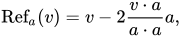
Given a vector in Euclidean space , the formula for the reflection in the hyperplane through the origin, orthogonal to , is given by

where denotes the dot product of with . Note that the second term in the above equation is just twice the vector projection of onto . One can easily check that

  • Refa(v) = −v, if is parallel to , and
  • Refa(v) = v, if is perpendicular to a.

Using the geometric product, the formula is
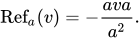
Since these reflections are isometries of Euclidean space fixing the origin they may be represented by orthogonal matrices. The orthogonal matrix corresponding to the above reflection is the matrix
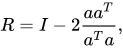
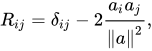
where denotes the identity matrix and is the transpose of a. Its entries are

where δij is the Kronecker delta.

The formula for the reflection in the affine hyperplane not through the origin is

See also

[edit]

Notes

[edit]

References

[edit]
[edit]
Revisions and contributorsEdit on WikipediaRead on Wikipedia
from Grokipedia
In mathematics, a reflection is a type of in that maps every point of a figure to its across a fixed line (in two dimensions) or plane (in three dimensions or higher), thereby preserving distances and straightness of lines while reversing the orientation of the figure. Reflections are fundamental rigid motions, alongside translations and rotations, and they form the building blocks of the of transformations that preserve the structure of space. Unlike rotations and translations, which preserve orientation (the "handedness" of a figure, such as versus counterclockwise), a single reflection flips this property, making it an orientation-reversing transformation; however, composing two reflections yields an orientation-preserving , such as a or . In linear algebra terms, a reflection across a can be represented by a Householder matrix, which is an with -1, explicitly given by H=I2vvTvTvH = I - 2 \frac{v v^T}{v^T v}, where vv is a normal vector to the . Reflections play a central role in symmetry studies, generating finite and infinite reflection groups that classify the symmetries of regular polytopes, crystals, and tilings; in particular, Coxeter groups abstract these structures, with reflections as the generating elements satisfying specific relations defined by a Coxeter diagram. Applications extend to computer graphics for rendering mirror effects, optimization algorithms like the Nelder-Mead method, and physics for modeling specular reflection of light or waves.

Definition and Construction

General Definition

In Euclidean space, a reflection is defined as an isometry that fixes a hyperplane pointwise while mapping each point on one side of the hyperplane to its mirror image on the other side, effectively acting as multiplication by -1 on the orthogonal complement of the hyperplane. This transformation preserves distances and angles in magnitude but reverses their signed sense across the fixed hyperplane. Reflections are involutions, meaning that composing the transformation with itself yields the identity map, as the negation on the squared returns to the positive identity. They are orientation-reversing, characterized by the of their linear part being -1, which distinguishes them from orientation-preserving isometries like rotations and translations. This definition contrasts with point reflection, or central symmetry, which inverts through a single fixed point (acting as -I relative to that point) and fixes only that origin rather than an entire hyperplane. In one dimension, where the hyperplane reduces to a point, reflection over that point is a special case equivalent to central symmetry.

Geometric Construction

In two-dimensional , the reflection of a point PP across a line LL can be constructed by first finding the foot of the from PP to LL, denoted as QQ, and then extending the segment PQPQ by an equal length beyond QQ to locate the reflected point PP'. This method ensures that LL acts as the bisector of the segment PPPP', preserving distances and angles. To perform this construction using a and :
  1. Draw the from PP to LL using standard techniques to erect a , intersecting LL at QQ.
  2. Set the compass width to the length of PQPQ.
  3. With the compass centered at QQ, mark the point PP' on the extension of the perpendicular line, on the opposite side of LL from PP, at the measured distance.
An alternative approach using compass and straightedge involves drawing a circle centered at PP with radius large enough to intersect LL at two points, say AA and BB; then, construct the perpendicular bisector of ABAB, which intersects the circle again at PP'. For reflecting a figure such as a triangle ABCABC across line LL, apply the above steps to each vertex AA, BB, and CC to obtain AA', BB', and CC', then connect these reflected points to form the image triangle ABCA'B'C'. The resulting figure is congruent to the original, with corresponding sides and angles preserved. Points fixed under this reflection lie precisely on the mirror line LL, as their perpendicular distance to LL is zero, so they map to themselves. This construction generalizes to higher dimensions by projecting a point onto the hyperplane (the higher-dimensional analogue of LL) along the normal direction to find the foot QQ, then extending symmetrically beyond QQ by the same distance to reach the reflected point PP'. In practice, this requires coordinate geometry or vector tools for dimensions beyond three, but the principle of orthogonal projection followed by symmetric extension remains the core geometric method.

Properties

Algebraic Properties

In the context of linear algebra, a reflection is an involutory linear operator on a real vector space that fixes a pointwise and acts as negation along the spanned by the normal vector to that . The standard matrix representation of such a reflection in Rn\mathbb{R}^n, known as the Householder reflection matrix, is given by R=I2aaTaTa,R = I - 2 \frac{a a^T}{a^T a}, where II is the n×nn \times n and aRna \in \mathbb{R}^n is a nonzero vector normal to the fixed . This matrix RR is orthogonal, satisfying RTR=IR^T R = I, which follows directly from the symmetry of RR and the properties of the term. The determinant of RR is 1-1, reflecting its orientation-reversing nature as a linear transformation. The eigenvalues of RR consist of 11 with algebraic multiplicity n1n-1 (corresponding to the fixed ) and 1-1 with multiplicity 11 (along the normal direction). Consequently, the trace of RR is n2n - 2. Reflections play a fundamental role in the structure of the O(n)O(n), as established by the Cartan–Dieudonné theorem, which states that every in O(n)O(n) can be expressed as a product of at most nn reflections.

Geometric Properties

A reflection in is an that preserves distances between points and angles between lines, ensuring that the transformed figure remains congruent to the original while mapping points within the fixed to themselves. However, unlike proper isometries, a reflection reverses the orientation of the space, transforming chiral objects—such as a left-handed —into their enantiomorphs, or mirror-image counterparts, which cannot be superimposed on the original by or alone. This orientation-reversing property distinguishes reflections as improper isometries, with a of -1 in their . The fixed set of a reflection consists of the entire across which the reflection occurs, where every point remains unchanged under the transformation. For any point not on this , the reflection maps it to its mirror image on the opposite side, at an equal perpendicular distance from the , thereby maintaining the symmetry of the operation. Outside the , there are no fixed points, as every off-plane point is displaced to its symmetric counterpart. Geometrically, a reflection is an involution, meaning that applying the transformation twice returns every point to its , equivalent to the identity map. This self-inverse property holds without fixed points beyond the , except in degenerate cases where the reduces effectively. Reflections serve as fundamental improper isometries, contrasting with translations, which have no fixed points and preserve orientation while shifting the entire , and rotations, which fix an axis (or origin in 2D) and maintain orientation through around that axis.

Reflections in Euclidean Spaces

In Two Dimensions

In two dimensions, a reflection is an of the that maps every point to its mirror image across a fixed line, preserving distances and orientations except for a reversal in . This transformation fixes every point on the line (the mirror line) and sends points off the line to the opposite side at an equal distance. Reflections in the plane are fundamental to understanding and can be represented using vector projections. The formula for reflecting a vector v\mathbf{v} across a line LL in the direction of a unit vector u\mathbf{u} (parallel to LL) is given by RefL(v)=2(vu)uv.\text{Ref}_L(\mathbf{v}) = 2 (\mathbf{v} \cdot \mathbf{u}) \mathbf{u} - \mathbf{v}. This expression doubles the projection of v\mathbf{v} onto LL and subtracts v\mathbf{v}, effectively flipping the component perpendicular to LL. Equivalently, using a unit normal vector n\mathbf{n} perpendicular to LL, the reflection is RefL(v)=v2(vn)n,\text{Ref}_L(\mathbf{v}) = \mathbf{v} - 2 (\mathbf{v} \cdot \mathbf{n}) \mathbf{n}, which subtracts twice the projection onto the normal direction. Specific examples illustrate these reflections in coordinate systems. Reflection over the x-axis maps a point (x,y)(x, y) to (x,y)(x, -y), negating the y-coordinate while preserving the x-coordinate. Reflection over the line y=xy = x swaps the coordinates, sending (x,y)(x, y) to (y,x)(y, x). Visualizations of reflections often involve mirror images of polygons, where the reflected figure appears as if viewed in a mirror along the line. These transformations play a key role in the symmetry of regular polygons, where the reflection axes align with lines of symmetry passing through vertices or midpoints of sides, generating the reflections in the dihedral group DnD_n of order 2n2n. A special case in two dimensions is reflection over a point, which coincides with a 180° rotation around that point and can be viewed as a limiting form of line reflection, though the primary focus remains on line-based reflections.

In Higher Dimensions

In higher dimensions, reflections generalize to operations across hyperplanes, which are subspaces of codimension 1 in an nn-dimensional Euclidean space, where n3n \geq 3. A hyperplane HH can be defined by a point pp on it and a normal vector n0n \neq 0. The reflection of a vector vv through HH is given by the formula RefH(v)=v2(vp)nnnn,\text{Ref}_H(v) = v - 2 \frac{(v - p) \cdot n}{n \cdot n} n, which subtracts twice the projection of (vp)(v - p) onto the direction of nn. If the hyperplane passes through the origin (i.e., p=0p = 0), the formula simplifies to RefH(v)=v2vnnnn\text{Ref}_H(v) = v - 2 \frac{v \cdot n}{n \cdot n} n. This operation is an isometry that fixes every point on HH and reverses direction along the normal line through pp. In three dimensions, a reflection over a plane provides a concrete example. For the xyxy-plane, defined by z=0z = 0 with normal n=(0,0,1)n = (0, 0, 1) and p=(0,0,0)p = (0, 0, 0), the transformation maps a point (x,y,z)(x, y, z) to (x,y,z)(x, y, -z), preserving coordinates in the plane while negating the perpendicular component. Such plane reflections are fundamental in , where they describe mirror symmetries in crystal lattices, contributing to the 32 point groups that classify crystal structures based on their symmetry elements. The linear operator corresponding to a reflection through a in nn dimensions exhibits a specific eigenstructure: it has eigenvalue 1 with eigenspace of dimension n1n-1 (the itself, where points are fixed) and eigenvalue with eigenspace of dimension 1 (the normal direction, where vectors are reversed). This structure underscores the reflection's role as an involution, satisfying RefH2=I\text{Ref}_H^2 = I, the identity transformation. In abstract finite-dimensional inner product spaces, reflections are defined analogously using the inner product to project onto the of the . Examples in higher dimensions include the symmetries of the 4-dimensional (tesseract), whose full is the hyperoctahedral group B4B_4, generated by reflections across coordinate and diagonal that bisect its edges and faces. These reflections permute the 16 vertices of the tesseract while preserving its geometric structure, illustrating how hyperplane reflections generate the of type BnB_n for nn-dimensional hypercubes.

Composition and Groups

Composition of Reflections

The composition of two reflections over intersecting lines in the plane, or over intersecting hyperplanes in higher-dimensional , is equivalent to a by twice the angle between the reflecting lines or hyperplanes, centered at their point or subspace of . This preserves orientation and can be derived from the algebraic representation of reflections as orthogonal transformations with determinant -1, where the product yields a matrix with determinant 1 corresponding to a proper . For example, in two dimensions, reflecting over two lines results in a 180-degree around their point. When the two reflecting lines or hyperplanes are , their composition produces a by a vector equal to twice the directed between them, to the direction of the parallels. This is orientation-preserving and shifts every point along the line connecting the midpoints of segments to the parallels. In general, the composition of an of reflections results in a direct , which preserves orientation, such as rotations or , while an odd number yields an opposite , which reverses orientation, such as reflections or . The composition of three reflections, whose lines or hyperplanes are neither concurrent nor all parallel, typically generates a in two dimensions—combining a reflection with a parallel to the glide axis.

Reflection Groups

A reflection group is a discrete subgroup of the isometry group of a Euclidean space Rn\mathbb{R}^n generated by a finite set of reflections across hyperplanes. These groups act faithfully on the space and preserve the standard inner product, with each reflection defined as an orthogonal transformation that fixes the hyperplane pointwise and negates the direction perpendicular to it. All real reflection groups are Coxeter groups, meaning they admit a presentation s1,,sksi2=1,(sisj)mij=1\langle s_1, \dots, s_k \mid s_i^2 = 1, (s_i s_j)^{m_{ij}} = 1 \rangle, where the sis_i are the generating reflections and the mij2m_{ij} \geq 2 (or \infty) encode the angles between the corresponding hyperplanes via π/mij\pi / m_{ij}; this presentation is visualized by Coxeter diagrams, which classify the groups up to isomorphism. Finite reflection groups arise in Euclidean spaces and are irreducible if they act irreducibly on Rn\mathbb{R}^n; their yields four infinite families (A_n, B_n, D_n, I_2(m)) and six exceptional types (E_6, E_7, E_8, F_4, G_2, H_3, H_4), excluding non-crystallographic cases like H_3 and H_4 for applications. Most finite reflection groups are , which are the symmetry groups generated by reflections across hyperplanes perpendicular to the roots of a in a ; for example, the SnS_n is the of type A_{n-1}, acting via reflections in the hyperplanes orthogonal to the roots of the standard in Rn\mathbb{R}^n. play a central role in the representation theory of semisimple , where the Φ\Phi of the algebra g\mathfrak{g} generates the WW as the subgroup of the orthogonal group preserving Φ\Phi, with simple reflections corresponding to simple roots. Infinite reflection groups include affine Weyl groups, which extend finite Weyl groups by adding reflections across parallel affine hyperplanes to generate discrete groups acting on with a fundamental domain that tiles the periodically, as in crystallographic tilings; their Coxeter diagrams are affine extensions of finite Dynkin diagrams (e.g., A~n,D~n\tilde{A}_n, \tilde{D}_n). Hyperbolic reflection groups operate in Hn\mathbb{H}^n, generated by reflections across the facets of a convex hyperbolic serving as a fundamental domain of finite , with Coxeter diagrams having indefinite Gram matrices of signature (n-1,1); these groups are discrete and yield infinite-volume quotients unless the is compact. Reflection groups have key applications in geometry and algebra: finite ones classify the symmetry groups of regular polytopes, such as the Platonic solids in 3D (tetrahedron: A_3, cube/octahedron: B_3, icosahedron/dodecahedron: H_3) and higher-dimensional analogs like the 24-cell (F_4), with only finitely many such polytopes existing in each dimension. In , Weyl groups facilitate the classification of semisimple Lie algebras via their root systems and Dynkin diagrams, enabling the study of representations and invariants. A classic example is the DnD_n, the finite reflection group in the plane generated by reflections across nn lines through the origin separated by angles π/n\pi/n, which is the of a regular nn-gon and has Coxeter s,ts2=t2=(st)n=1\langle s, t \mid s^2 = t^2 = (st)^n = 1 \rangle.

References

Add your contribution
Related Hubs
User Avatar
No comments yet.