



Community hub
Recent from talks
Contribute something
Nothing was collected or created yet.
Relative permeability
View on WikipediaIn multiphase flow in porous media, the relative permeability of a phase is a dimensionless measure of the effective permeability of that phase. It is the ratio of the effective permeability of that phase to the absolute permeability. It can be viewed as an adaptation of Darcy's law to multiphase flow.
Formulation
[edit]For two-phase flow in porous media given steady-state conditions, we can write

where is the flux, is the pressure drop, is the viscosity. The subscript indicates that the parameters are for phase .


is here the phase permeability (i.e., the effective permeability of phase ), as observed through the equation above.

Relative permeability, , for phase is then defined from , as


where is the permeability of the porous medium in single-phase flow, i.e., the absolute permeability. Relative permeability must be between zero and one.

In applications, relative permeability is often represented as a function of water saturation; however, owing to capillary hysteresis one often resorts to a function or curve measured under drainage and another measured under imbibition.
Under this approach, the flow of each phase is inhibited by the presence of the other phases. Thus the sum of relative permeabilities over all phases is less than 1. However, apparent relative permeabilities larger than 1 have been obtained since the Darcean approach disregards the viscous coupling effects derived from momentum transfer between the phases (see assumptions below). This coupling could enhance the flow instead of inhibit it. This has been observed in heavy oil petroleum reservoirs when the gas phase flows as bubbles or patches (disconnected). [1]
Modelling assumptions
[edit]The above form for Darcy's law is sometimes also called Darcy's extended law, formulated for horizontal, one-dimensional, immiscible multiphase flow in homogeneous and isotropic porous media. The interactions between the fluids are neglected, so this model assumes that the solid porous media and the other fluids form a new porous matrix through which a phase can flow, implying that the fluid-fluid interfaces remain static in steady-state flow, which is not true, but this approximation has proven useful anyway.
Each of the phase saturations must be larger than the irreducible saturation, and each phase is assumed continuous within the porous medium.
Based on data from special core analysis laboratory (SCAL) experiments,[2] simplified models of relative permeability as a function of saturation (e.g. water saturation) can be constructed. This article will focus on an oil-water system.
Saturation scaling
[edit]The water saturation is the fraction of the pore volume that is filled with water, and similarly for the oil saturation . Thus, saturations are themselves scaled properties or variables. This gives the constraint



The model functions or correlations for relative permeabilities in an oil-water system are therefore usually written as functions of only water saturation, and this makes it natural to select water saturation as the horizontal axis in graphical presentations. Let (also denoted and sometimes ) be the irreducible (or minimal or connate) water saturation, and let be the residual (minimal) oil saturation after water flooding (imbibition). The flowing water saturation window in a water invasion / injection / imbibition process is bounded by a minimum value and a maximum value . In mathematical terms the flowing saturation window is written as





By scaling the water saturation to the flowing saturation window, we get a (new or another) normalized water saturation value

and a normalized oil saturation value

Endpoints
[edit]Let be oil relative permeability, and let be water relative permeability. There are two ways of scaling phase permeability (i.e. effective permeability of the phase). If we scale phase permeability w.r.t. absolute water permeability (i.e. ), we get an endpoint parameter for both oil and water relative permeability. If we scale phase permeability w.r.t. oil permeability with irreducible water saturation present, endpoint is one, and we are left with only the endpoint parameter. In order to satisfy both options in the mathematical model, it is common to use two endpoint symbols in the model for two-phase relative permeability. The endpoints / endpoint parameters of oil and water relative permeabilities are



These symbols have their merits and limits. The symbol emphasize that it represents the top point of . It occurs at irreducible water saturation, and it is the largest value of that can occur for initial water saturation. The competing endpoint symbol occurs in imbibition flow in oil-gas systems. If the permeability basis is oil with irreducible water present, then . The symbol emphasizes that it is occurring at the residual oil saturation. An alternative symbol to is which emphasizes that the reference permeability is oil permeability with irreducible water present.


The oil and water relative permeability models are then written as

The functions and are called normalised relative permeabilities or shape functions for oil and water, respectively. The endpoint parameters and (which is a simplification of ) are physical properties that are obtained either before or together with the optimization of shape parameters present in the shape functions.


There are often many symbols in articles that discuss relative permeability models and modelling. A number of busy core analysts, reservoir engineers and scientists often skip using tedious and time-consuming subscripts, and write e.g. Krow instead of or or krow or oil relative permeability. A variety of symbols are therefore to be expected, and accepted as long as they are explained or defined.

The effects that slip or no-slip boundary conditions in pore flow have on endpoint parameters, are discussed by Berg et alios.[3][4]
Corey-model
[edit]An often used approximation of relative permeability is the Corey correlation [5] [6] [7] which is a power law in saturation. The Corey correlations of the relative permeability for oil and water are then




If the permeability basis is normal oil with irreducible water present, then .
The empirical parameters and are called curve shape parameters or simply shape parameters, and they can be obtained from measured data either by analytical interpretation of measured data, or by optimization using a core flow numerical simulator to match the experiment (often called history matching). is sometimes appropriate. The physical properties and are obtained either before or together with the optimizing of and .


In case of gas-water system or gas-oil system there are Corey correlations similar to the oil-water relative permeabilities correlations shown above.
LET-model
[edit]The Corey-correlation or Corey model has only one degree of freedom for the shape of each relative permeability curve, the shape parameter N. The LET-correlation[8] [9] adds more degrees of freedom in order to accommodate the shape of relative permeability curves in SCAL experiments[2] and in 3D reservoir models that are adjusted to match historic production. These adjustments frequently includes relative permeability curves and endpoints.

The LET-type approximation is described by 3 parameters L, E, T. The correlation for water and oil relative permeability with water injection is thus
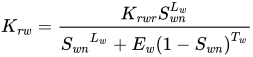
and
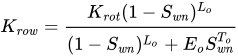
written using the same normalization as for Corey.

Only , , , and have direct physical meaning, while the parameters L, E and T are empirical. The parameter L describes the lower part of the curve, and by similarity and experience the L-values are comparable to the appropriate Corey parameter. The parameter T describes the upper part (or the top part) of the curve in a similar way that the L-parameter describes the lower part of the curve. The parameter E describes the position of the slope (or the elevation) of the curve. A value of one is a neutral value, and the position of the slope is governed by the L- and T-parameters. Increasing the value of the E-parameter pushes the slope towards the high end of the curve. Decreasing the value of the E-parameter pushes the slope towards the lower end of the curve. Experience using the LET correlation indicates the following reasonable ranges for the parameters L, E, and T: L ≥ 0.1, E > 0 and T ≥ 0.1.
In case of gas-water system or gas-oil system there are LET correlations similar to the oil-water relative permeabilities correlations shown above.
Evaluations
[edit]After Morris Muskat et alios established the concept of relative permeability in late 1930'ies, the number of correlations, i.e. models, for relative permeability has steadily increased. This creates a need for evaluation of the most common correlations at the current time. Two of the latest (per 2019) and most thorough evaluations are done by Moghadasi et alios[10] and by Sakhaei et alios.[11] Moghadasi et alios[10] evaluated Corey, Chierici and LET correlations for oil/water relative permeability using a sophisticated method that takes into account the number of uncertain model parameters. They found that LET, with the largest number (three) of uncertain parameters, was clearly the best one for both oil and water relative permeability. Sakhaei et alios[11] evaluated 10 common and widely used relative permeability correlations for gas/oil and gas/condensate systems, and found that LET showed best agreement with experimental values for both gas and oil/condensate relative permeability.
See also
[edit]References
[edit]- ^ Bravo, M.C.; Araujo, M. (2008). "Analysis of the Unconventional Behavior of Oil Relative Permeability during Depletion Tests of Gas-Saturated Heavy Oils". International Journal of Multiphase Flow. 34 (5): 447–460. Bibcode:2008IJMF...34..447B. doi:10.1016/j.ijmultiphaseflow.2007.11.003.
- ^ a b McPhee, C.; Reed, J.; Zubizarreta, I. (2015). Core Analysis: A Best Practice Guide. Elsevier. ISBN 978-0-444-63533-4.
- ^ Berg, S.; Cense, A.W.; Hofman, J.P.; Smits, R.M.M. (2007). "Flow in Porous Media with Slip Boundary Condition". Paper SCA2007-13 Presented at the 2007 International Symposium of the SCA, Calgary, Canada, 10 - 12 September, 2007.
- ^ Berg, S.; Cense, A.W.; Hofman, J.P.; Smits, R.M.M. (2008). "Two-Phase Flow in Porous Media with Slip Boundary Condition". Transport in Porous Media. 74 (3): 275–292. Bibcode:2008TPMed..74..275B. doi:10.1007/s11242-007-9194-4. S2CID 37627662.
- ^ Goda, H.M.; Behrenbruch, P. (2004). Using a Modified Brooks-Corey Model to Study Oil-Water Relative Permeability for Diverse Pore Structures. doi:10.2118/88538-MS. ISBN 978-1-55563-979-2.
{{cite book}}:|journal=ignored (help) - ^ Brooks, R.H.; Corey, A.T. (1964). "Hydraulic properties of porous media". Hydrological Papers. 3.
- ^ Corey, A.T. (Nov 1954). "The Interrelation Between Gas and Oil Relative Permeabilities". Prod. Monthly. 19 (1): 38–41.
- ^ Lomeland, F.; Ebeltoft, E.; Thomas, W.H. (2005). "A New Versatile Relative Permeability Correlation" (PDF). Proceedings of the 2005 International Symposium of the SCA, Abu Dhabi, United Arab Emirates, October 31 - November 2, 2005.
- ^ Lomeland, F. (2018). "Overview of the LET Family of Versatile Correlations for Flow Functions" (PDF). Proceedings of the 2018 International Symposium of the SCA, Trondheim, Norway, 27 - 30 August, 2018.
- ^ a b Moghadasi, L.; Guadagnini, A.; Inzoli, F.; Bartosek, M. (2015). "Interpretation of two-phase relative permeability curves through multiple formulations and model quality criteria". Journal of Petroleum Science and Engineering. 135: 738–749. Bibcode:2015JPSE..135..738M. doi:10.1016/j.petrol.2015.10.027. hdl:11311/968828.
- ^ a b Sakhaei, Z.; Azin, R.; Osfouri, S. (2016). "Assessment of empirical/theoretical relative permeability correlations for gas-oil/condensate systems". Paper Presented at the 1st Persian Gulf Oil, Gas and Petrochemical Biennal Conference Held at the Persian Gulf University in, Bushehr, Iran, 20 April, 2016.
External links
[edit]Relative permeability
View on GrokipediaFundamentals
Definition
Relative permeability, denoted as , is defined as the ratio of the effective permeability of a fluid phase to the absolute permeability of the porous medium, mathematically expressed as where .[4] This dimensionless quantity quantifies the reduction in a phase's ability to flow through the medium due to the presence of other immiscible phases, serving as a key parameter in extending Darcy's law from single-phase to multiphase flow.[4] The concept of relative permeability was introduced by Morris Muskat in the late 1930s, building on earlier work in porous media flow to address multiphase systems.[5] Muskat's seminal book, The Flow of Homogeneous Fluids Through Porous Media (1937), formalized this extension, enabling the modeling of simultaneous flow of multiple fluids.[5] Relative permeability is primarily applied in porous media such as rocks, soils, and filters, where multiple immiscible fluids—like oil and water or gas and liquid—coexist and interact during flow processes.[4]Physical Interpretation
Relative permeability emerges at the pore scale from the competition between immiscible fluid phases for limited pore space within a porous medium, where the presence of one phase obstructs the flow paths of the other, thereby reducing the effective conductivity for each phase relative to single-phase flow. This competition is governed by interfacial tension, which creates menisci that trap portions of the non-preferred phase in smaller pores or dead-end spaces, limiting connectivity and overall flow efficiency. Phase occupancy further influences this process, as the distribution of fluids across pore throats and bodies determines the available pathways; for instance, the non-wetting phase tends to occupy larger pores during drainage, fragmenting the wetting phase's network and hindering its mobility.[6][7] Wettability, the preferential affinity of the solid surface for one fluid phase over another, profoundly affects phase distribution and the resulting flow hindrance in multiphase systems. In water-wet rocks, where the solid prefers water, the wetting phase spreads in thin films along pore walls, maintaining connectivity even at low saturations and allowing it to access a larger fraction of the pore space, which enhances its relative permeability compared to the non-wetting oil phase. Conversely, in oil-wet rocks, the solid's preference for oil leads to the wetting oil occupying central pore bodies and larger throats, displacing water to corners and films, which restricts water's flow paths and reduces its relative permeability while potentially improving oil mobility. This wettability-driven redistribution alters the effective pore network available to each phase, directly impacting the hindrance imposed on flow.[8][9] Hysteresis in relative permeability arises from the path-dependent nature of multiphase displacement processes, where the saturation history—specifically drainage (non-wetting phase invasion) versus imbibition (wetting phase invasion)—leads to different phase configurations and trapping at the same saturation. During drainage, the non-wetting phase advances through larger pores, leaving behind connected wetting-phase films, which results in higher relative permeability for the non-wetting phase compared to imbibition, where capillary forces trap disconnected non-wetting phase ganglia in smaller pores, reducing its mobility and altering the available flow paths for the wetting phase. This trapping mechanism causes the relative permeability curves to diverge between drainage and imbibition paths, reflecting irreversible changes in phase occupancy and connectivity due to the sequence of saturation alterations.[10][11]Mathematical Framework
Formulation
The formulation of relative permeability arises from extending Darcy's law, originally developed for single-phase flow, to describe multiphase fluid transport in porous media.[12] In multiphase flow, the volumetric flux of phase is given by the extended Darcy's law: where is the absolute permeability of the porous medium, is the relative permeability of phase (a dimensionless scalar between 0 and 1), is the dynamic viscosity of phase , and is the pressure gradient in phase . This equation accounts for the reduced conductance of each phase due to the presence of other immiscible phases occupying the pore space.[12] For a two-phase system, such as oil and water in a reservoir, separate flux equations apply to each phase: where subscripts and denote oil and water, respectively, and the relative permeabilities and depend on the saturation of the respective phases (with ). These functions capture how the effective pathway for each phase diminishes as the other phase's saturation increases. The concept extends to general multiphase flow involving immiscible phases, where the relative permeability of phase is expressed as , subject to the constraint . This functional dependence reflects the complex interactions among phases in sharing the porous medium's conductance.Key Assumptions
The formulation of relative permeability extends Darcy's law to multiphase flow in porous media under several core assumptions that enable the independent application of the law to each phase while simplifying pore-scale complexities. A primary assumption is steady-state flow, where fluid saturations and velocities remain constant over time and uniform across the medium, allowing equilibrium conditions for measurement and modeling. The fluids are treated as immiscible, with no significant mass transfer between phases, and the flow is assumed horizontal, neglecting gravitational segregation effects that could otherwise alter saturation distributions. The porous medium is idealized as homogeneous and isotropic, implying uniform pore structure and properties without directional variations in permeability.[13] Each phase is presumed continuous and interconnected within the porous matrix above its irreducible saturation, below which flow ceases due to entrapment. Standard models further neglect interphase momentum transfer, known as viscous coupling, and adsorption of fluid components onto the solid matrix, assuming negligible interaction beyond saturation-dependent hindrance.[4] These assumptions limit applicability in certain scenarios; for instance, in heavy oil reservoirs with high viscosity contrasts, unmodeled viscous coupling can result in apparent relative permeabilities exceeding 1, as observed in depletion tests where momentum transfer enhances phase mobility beyond independent flow predictions.[14] Similarly, capillary-induced hysteresis—arising from path-dependent saturation changes during drainage and imbibition—is often not fully captured, leading to discrepancies in dynamic simulations where wetting history affects permeability curves.[11]Normalization and Parameters
Endpoints
In relative permeability analysis for multiphase flow in porous media, particularly oil-water systems, the endpoints define the boundary conditions of the relative permeability curves at extreme phase saturations, serving as essential parameters for model calibration and simulation. The relative permeability to oil at irreducible water saturation, denoted as , represents the value of the oil relative permeability () when the water saturation () equals the irreducible water saturation (). At this point, water is immobile and occupies the smallest pores without contributing to flow, allowing oil to achieve near-maximum mobility relative to single-phase conditions. Similarly, the relative permeability to water at residual oil saturation, , is the value of the water relative permeability () when the oil saturation () reaches the residual oil saturation (), where oil ganglia become trapped and cease to flow, enabling water to dominate the pore space.[15][16] These critical saturations mark the thresholds of phase mobility: is the minimum water saturation at which water flow effectively stops due to capillary forces binding it in place, while is the minimum oil saturation remaining after imbibition or displacement processes, reflecting trapping mechanisms like snap-off and bypassing. In water-wet systems, common in many sandstone reservoirs, typically ranges from 0.15 to 0.30, and from 0.20 to 0.40, depending on rock wettability, pore geometry, and fluid properties; these values directly impact initial fluid distribution and ultimate recovery potential.[15][17] Endpoints are generally normalized relative to the absolute permeability () of the rock or the effective single-phase permeability under reservoir conditions, ensuring dimensionless consistency in multiphase models. For instance, is often approximately 0.8 to 1.0 in water-wet oil-water systems, indicating that irreducible water reduces oil mobility by only a modest amount, while typically falls in the range of 0.2 to 0.4, as residual oil continues to impede water flow significantly even at high water saturations. These ranges arise from empirical correlations, such as those linking to via for between 0.2 and 0.5, highlighting the influence of initial water saturation on endpoint values.[15][18]Saturation Scaling
Saturation scaling in relative permeability involves normalizing the actual fluid saturations to a standard range, typically between 0 and 1, to facilitate consistent modeling and comparison across diverse rock types. For the water phase in a two-phase oil-water system, the normalized water saturation is defined as where is the actual water saturation, is the irreducible water saturation, and is the residual oil saturation to waterflood.[19] This transformation maps the mobile saturation range—bounded by the irreducible and residual endpoints—onto a unit interval, enabling the relative permeability curves and to be expressed as functions of rather than the absolute .[19] The primary purpose of this normalization is to scale relative permeability curves to a universal form, mitigating the influence of rock-specific residual saturations that vary due to differences in pore structure, wettability, and fluid properties across formations. By doing so, it allows for the direct comparison, averaging, and upscaling of datasets from laboratory experiments or core samples to field-scale simulations, improving the accuracy of reservoir performance predictions. For instance, normalized curves can be grouped by wettability states (e.g., water-wet or oil-wet) and rock types, facilitating uncertainty quantification and the generation of representative inputs for multiphase flow models. In multi-phase systems, such as three-phase oil-water-gas flows, similar normalization principles are extended to account for all mobile phases. The normalized saturation for each phase is adjusted relative to the total mobile saturation window, incorporating gas saturation alongside water and oil, to preserve the functional dependence of relative permeabilities on phase interactions.[20] This approach ensures that saturation paths and hysteresis effects are captured consistently, even as residual saturations for multiple phases (e.g., for residual oil to gas) influence the scaling.[20]Classical Models
Corey Model
The Corey model, developed by A. T. Corey in 1954, represents a foundational parametric approach to describing two-phase relative permeability curves through simple power-law expressions. It defines the relative permeability for the non-wetting phase, such as oil, asand for the wetting phase, such as water, as
where and are the endpoint relative permeabilities at residual saturations, and are empirical exponents that control the curve shapes (typically ranging from 2 to 4), and denotes the normalized wetting-phase saturation.[21] The model's parameters consist of the endpoints (maximum oil relative permeability) and (maximum water relative permeability), with the shape factors and influencing the curvature; in oil-wet systems, reflects the preferential flow of the wetting oil phase.[22][23] This formulation offers significant advantages, including ease of implementation in numerical reservoir simulations due to its minimal parameter requirements, and its effectiveness in fitting empirical two-phase data from diverse sandstone and carbonate reservoirs.[21]