Hubbry Logo
Revelation 22Revelation 22Main
Open search
Revelation 22
Community hub
Revelation 22
logo
8 pages, 0 posts
0 subscribers
Be the first to start a discussion here.
Revelation 22
Revelation 22
from Wikipedia
Revelation 22
Erasmus Text of the New Testament, last page (Revelation 22:8-21), 1516.
BookBook of Revelation
CategoryApocalypse
Christian Bible partNew Testament
Order in the Christian part27

Revelation 22 is the twenty-second and final chapter of the Book of Revelation or the Apocalypse of John, and the final chapter of the New Testament and of the Christian Bible. The book is traditionally attributed to John of Patmos.[1][2][3] This chapter contains the accounts of the throne of God in the New Jerusalem, the conversation between the writer and an angel, and, from verse 10 onwards, the epilogue of the book.[4]

Text

[edit]

The original text was written in Koine Greek. This chapter is divided into 21 verses.

Textual witnesses

[edit]

Some early manuscripts containing the text of this chapter include:[5][a]

Old Testament references

[edit]

New Testament references

[edit]

Contents

[edit]

Verse 1

[edit]
Then he (the angel) showed me the river of the water of life, bright as crystal, flowing from the throne of God and of the Lamb.[8]

The angel is the one who was first encountered in Revelation 1:1.[9]

Verse 6

[edit]
And he said to me, "These words are trustworthy and true. And the Lord, the God of the spirits of the prophets, has sent his angel to show his servants what must soon take place."

"These words" are best taken as a reference to the whole Book of Revelation.[9]

Verse 13

[edit]
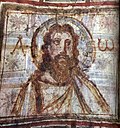
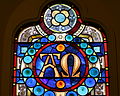
Greek letters alpha and omega
I am the Alpha and the Omega, the Beginning and the End, the First and the Last.[10]
  • Cross reference: Revelation 21:6
  • "The Beginning and the End, the First and the Last" (KJV; NKJV): NU and M[b] read "First and the Last, the Beginning and the End".[11]

Verse 14

[edit]
Blessed are those who wash their robes. They will be permitted to enter through the gates of the city and eat the fruit from the tree of life.[12]

Verse 15

[edit]
Outside the city are the dogs - the sorcerers, the sexually immoral, the murderers, the idol worshipers, and all who love to live a lie.[13]

Verse 16

[edit]
"I, Jesus, have sent My angel to testify to you these things in the churches.
I am the Root and the Offspring of David, the Bright and Morning Star."[14]

See also

[edit]

Notes

[edit]

References

[edit]

Bibliography

[edit]
[edit]
Revisions and contributorsEdit on WikipediaRead on Wikipedia
from Grokipedia

Revelation 22 constitutes the concluding chapter of the , the final book in the of the Christian Bible, where an angelic guide reveals to the prophet John visions of paradisiacal renewal centered on the river and amid the , alongside final prophetic attestations, imperatives, and eschatological promises.
The chapter's initial verses (1–5) portray a pristine, curse-free domain illuminated perpetually by God's glory, with the and the Lamb at its heart, the pure river of life emanating thence, and the yielding perpetual fruit whose leaves remedy all nations' ills, enabling the faithful to behold God's face and reign eternally.
Subsequent sections (6–21) affirm the reliability of these disclosures as faithful and true, enjoin against sealing the prophetic words given the imminence of fulfillment, pronounce blessings on observers of the book's commands while excluding , idolaters, and falsifiers from inheritance, extend a universal call to partake freely of life's , and impose a dire imprecation barring alterations to the text—neither addition nor subtraction—under threat of forfeited blessings and eternal torment.
It culminates in ' self-declaration as the , the Root and Descendant of , and the radiant Morning Star, reiterated with the urgent advent proclamation "I am coming soon," followed by an apostolic for Christ's return and a of grace.

Textual Foundations

Manuscript Evidence

The textual attestation for Revelation 22 derives primarily from uncial codices and later minuscule manuscripts, with over 300 Greek witnesses to the Book of Revelation identified as of 2012. Codex Sinaiticus (ℵ), a mid-4th-century uncial on vellum, preserves the complete text of Revelation 22:1–21, including distinctive readings such as "tree of life" in verse 19. Similarly, Codex Alexandrinus (A), a 5th-century uncial, contains the full chapter without significant omissions, aligning closely with Sinaiticus in its core content. These early codices demonstrate the chapter's inclusion in the complete New Testament canon by the 4th–5th centuries, with minimal structural gaps. Earlier fragmentary evidence for Revelation's circulation, though not extending to chapter 22, is provided by (P47), a late 3rd-century papyrus codex comprising ten leaves that cover :10–17:2. This manuscript, part of the Chester Beatty collection, supports the book's textual transmission in shortly after its composition, bridging to the uncial era. No papyri predating the preserve chapter 22 specifically, reflecting Revelation's relatively scarcer early attestation compared to other books. The Byzantine majority text, dominant in minuscules from the onward, exhibits strong consistency with the Alexandrian witnesses of Sinaiticus and Alexandrinus in Revelation 22, including shared phrasing in verses 18–19 warning against textual alteration. This alignment across textual families—evident in the preservation of the chapter's final and —underscores empirical stability, as copyists maintained the integral structure despite regional variations. Scholarly confirms that such consistency persists even in the chapter's concluding verses, countering claims of major lacunae in ancient exemplars.

Significant Variants

One of the most discussed textual variants in Revelation 22 occurs in verse 19, where the phrase describing the consequence of subtracting from the book's words reads "from the tree of life" (ἀπὸ τοῦ ξύλου τῆς ζωῆς) in the majority of early and reliable manuscripts, including Codex Sinaiticus (א, 4th century), Codex Alexandrinus (A, 5th century), Codex Ephraemi Rescriptus (C, 5th century), and Papyrus 47 (3rd-4th century), as well as the majority of later Greek witnesses. In contrast, the Textus Receptus (TR) and some medieval minuscules render it "from the book of life" (ἀπὸ βίβλου τῆς ζωῆς), a reading introduced by Erasmus in his 1516 Greek New Testament edition through back-translation from the Latin Vulgate when his primary manuscript (Minuscule 1) lacked the final verses. This substitution aligns contextually with the "tree of life" motif earlier in the chapter (verses 2 and 14) but shifts emphasis to eternal judgment via exclusion from salvation's register, though textual critics deem the "tree" reading original due to its superior attestation and avoidance of dittography or harmonization errors. The variant, while doctrinally evocative, does not undermine the passage's warning against tampering, as both preserve the curse's punitive intent. A minor variant appears in verse 21's benediction, "The grace of the Lord Jesus be with all (πάντων)," found in the TR and Byzantine majority text, versus "with the saints (τῶν ἁγίων)" in some early witnesses like and Alexandrinus, or expanded forms like "with you all" in others. This addition of "all" likely arose as a scribal expansion for inclusivity, paralleling Pauline closings (e.g., Philippians 4:23), but the shorter "saints" form predominates in critical editions for its brevity and alignment with the chapter's selective eschatological tone; neither alters the universal offer of grace. Erasmus' handling of verses 16-21 exemplifies a historical source, as he reverse-translated the absent leaf from the into Greek for his 1516 edition, yielding 18 differences from modern critical texts across 132-136 words, including the aforementioned 22:19 reading. Subsequent editions (1519 onward) incorporated Greek manuscripts like Minuscule 141, confirming most readings and refuting fabrication claims, with divergences typical of transmission rather than invention. These variants underscore Revelation 22's robust attestation—over 300 Greek manuscripts total for the —whereby no core or theology is compromised, affirming the chapter's textual stability amid routine scribal fluctuations.

Scriptural Allusions and Parallels

Revelation 22 contains numerous allusions to imagery, particularly from prophetic visions of restoration and Edenic origins, establishing a framework of eschatological reversal. The depiction of a of the water of life proceeding from the in verse 1 directly echoes the life-giving flowing from the temple in 47:1-12, where waters increase in depth and vitality, supporting trees with fruit and leaves for healing. This parallel underscores a causal continuity from prophetic temple typology to ultimate , with the 's source shifting from the to God's , implying fulfilled access to sustaining life without intermediary structures. The flanking the river in verses 1-2, bearing monthly fruit and leaves for the nations' , evokes the primordial tree in Genesis 2:9 and 3:22-24, barred after the fall to prevent perpetual sinful existence, while incorporating Ezekiel 47:12's riverside trees yielding perpetual nourishment. These motifs suggest a literal restoration of pre-fall abundance, reversing the expulsion's consequences through direct access, as the tree's accessibility now aligns with divine sovereignty rather than human guardianship. Verse 3's declaration of no more curse parallels the Genesis 3:17-19 pronouncement of toil and death upon the ground due to disobedience, framing the chapter's visions as a causal to primordial judgment, with unhindered service to God replacing alienated labor. Within the , the self-identification as , First and Last, Beginning and End in verse 13 reiterates divine attributes from Revelation 1:8 and 21:6, reinforcing thematic unity across the apocalypse's portrayal of eternal sovereignty. The invitational call in verse 17 for the thirsty to come and take the water of life freely mirrors Jesus' proclamation in John 7:37, extending Gospel-era offers of spiritual satiation into eschatological fulfillment. The prohibition against adding to or subtracting from the prophecy in verses 18-19 echoes Deuteronomy 4:2's command to preserve words unaltered, applying covenantal to apocalyptic with specified judgments for violation, emphasizing textual as essential to prophetic .

Exegetical Overview

The River and (Verses 1-5)

In Revelation 22:1, John beholds a river of the of , clear as , proceeding from the and of the Lamb, symbolizing the eternal source of divine and purity emanating directly from the divine presence in the new creation. This imagery causally reverses the separation from introduced by in Genesis 3, where access to the was barred to prevent perpetual fallen existence (Genesis 3:22-24), restoring unhindered provision from the Creator. The river's clarity underscores absolute holiness, free from the corruption that tainted earthly waters post-Fall. Verse 2 describes the river flowing through the city's street, with the positioned on either side, producing twelve kinds of fruit each month and leaves for the healing of the nations. This tree restores the Edenic prototype denied after humanity's disobedience (Genesis 2:9; 3:24), now multiplied and perpetually fruitful, indicating physical abundance without seasonal decay in the eternal state. The monthly yield and healing leaves parallel Ezekiel 47:12, where temple-sourced waters revive barren lands and sustain fruit trees year-round, but elevates this to the consummate new earth, where sin's effects—, , and national strife—are eradicated at their root. Revelation 22:3 declares no more curse, positioning the and the Lamb centrally in the city, where His servants serve Him perpetually. The curse of Genesis 3:17-19—ground yielding thorns, toil, and —is causally nullified through Christ's redemptive work, enabling direct service without intermediary barriers or adversarial creation. In verses 4-5, believers see God's face unveiled, bear His name on their foreheads as ownership marks, experience no night due to , and reign forevermore. This unveiled vision fulfills the Mosaic prohibition lifted (Exodus 33:20), restoring pre-Fall intimacy (Genesis 3:8), while eternal reign recaptures humanity's Genesis 1:28 dominion, now incorruptible. A literal interpretation, prioritizing these physical and causal restorations over allegorized fulfillments in the present age, aligns with the text's depiction of a renewed post-judgment, distinct from millennial anticipations.

Prophetic Testimony and Worship (Verses 6-9)

The interpreting authenticates the preceding visions by declaring to John, "These words are faithful and true," thereby certifying the prophecy's divine reliability and correspondence to reality, as conveyed through the agency of "the God of the spirits of the prophets," who dispatched the to unveil to His servants the events that "must soon take place." This affirmation echoes the book's earlier motifs of 's unerring faithfulness, positioning the as a direct extension of prophetic without embellishment or falsehood. The temporal qualifier "soon" signals inexorable divine momentum, rejecting any notion of indefinite postponement and underscoring the prophecy's call to immediate vigilance among its recipients. Interposed in verse 7 is Christ's direct pronouncement, "Behold, I am coming soon," which reinforces the angel's testimony while extending a beatitude to "the one who keeps the words of the prophecy of this book." Here, "keeps" denotes active adherence and preservation of the text's directives, linking blessing to fidelity amid eschatological expectation. This dual attestation—from angel and Christ—establishes the revelation's unimpeachable status, compelling hearers toward obedience without excuse for delay. In verses 8-9, John, profoundly affected upon "hearing and seeing" the disclosures, prostrates himself to the who mediated them, an error promptly corrected: the disclaims , asserting, "I am a fellow servant with you and your brothers the prophets, and with those who keep the words of this book. ." This rebuke equates the 's role with that of human prophets and obedient believers, prohibiting creaturely and redirecting exclusive (proskyneo and latreuo implied in context) to alone, consistent with scriptural . The incident models in prophetic reception, affirming that 's proper response entails reverence for the divine source, not its messengers.

Imminent Judgment and Entry Requirements (Verses 10-15)

In verse 10, the angel instructs John not to seal the prophetic words of the scroll, explicitly stating that "the time is near," in contrast to the command in Daniel 12:4 to seal prophecies until the end times, underscoring the urgency and openness of these disclosures as fulfillment approaches rapidly. This refusal to conceal signals that the events described, including , are not distant but impending, allowing immediate response without deferral. Verse 11 declares, "Let the one who does wrong continue to do wrong; let the vile person continue to be vile; let the one who does right continue to do right; and let the continue to be holy," indicating a fixed at the point of where opportunities for cease and actions solidify eternal outcomes. This reflects causal finality: persistent unrighteousness entrenches exclusion from the , while confirms inclusion, prioritizing enduring behavioral patterns over last-minute shifts. Verse 12 announces, "Behold, I am coming soon, bringing my recompense with me, to repay everyone for what he has done," emphasizing imminent divine judgment based on deeds as the criterion for reward or penalty, aligning with broader scriptural principles of accountability where actions bear direct consequences. Verses 14-15 delineate entry requirements for the New Jerusalem: "Blessed are those who wash their robes, so that they may have the right to the tree of life and that they may enter the city by the gates. Outside are the dogs and sorcerers and the sexually immoral and murderers and idolaters, and everyone who loves and practices falsehood." Washing robes symbolizes purification from sin through the blood of the Lamb, as paralleled in Revelation 7:14, granting legal access to eternal life and the city's blessings for the obedient faithful. Conversely, exclusion applies to practitioners of sorcery (pharmakeia, involving occult manipulation), sexual immorality, murder, idolatry, and falsehood-loving deceivers, with "dogs" serving as a biblical idiom for the morally depraved and unclean—evoking scavenging impurity and often denoting false prophets or shameless sinners in Jewish and early Christian usage—who remain barred due to unrepented vice. This binary enforces ethical boundaries, where causal persistence in sin precludes restoration, affirming fidelity to divine commands as the prerequisite for participation in the renewed order.

Christ's Affirmation and Evangelistic Call (Verses 16-17)

In Revelation 22:16, Jesus personally affirms the prophetic testimony delivered through the angel, stating, "I, Jesus, have sent my angel to testify to you these things for the churches. I am the root and the descendant of David, the bright morning star" (ESV). This self-identification underscores his dual role as divine origin ("root") of the Davidic line—implying preexistence and sovereignty over Israel's royal promises—and human fulfillment ("descendant") as the promised Messiah, directly echoing Isaiah 11:1 and 11:10 where a shoot from Jesse's stump (David's father) restores creation. The title "bright morning star" evokes the herald of dawn and kingship, fulfilling Balaam's oracle of a star rising from Jacob to crush Israel's foes (Numbers 24:17), while signifying Christ's unrivaled light amid eschatological darkness, distinct from any fallen pretender to celestial glory. Verse 17 extends this affirmation into an urgent evangelistic summons: "The Spirit and the say, 'Come.' And let the one who hears say, 'Come.' And let the one who is thirsty come; let the one who desires take the water of life without price" (ESV). Here, the —active throughout in attesting truth (e.g., 22:6)—unites with the Bride, identified as the collective church prepared for (cf. 19:7-8; 21:9), to issue the "Come," a layered imperative that primarily invites the spiritually parched to receive eternal life freely, without merit or payment, paralleling 55:1's call to buy wine and without . Those who hear are enlisted to echo this appeal, propagating the offer universally to any who thirst, emphasizing salvation's accessibility grounded in rather than human effort. This passage establishes the revelation's messianic authenticity through Christ's Davidic credentials, while the collaborative invitation from Spirit, church, and hearers reveals the causal mechanism of : God's self-disclosure prompts responsive , with the free "water of life" (echoing the river of 22:1) as the consummating gift for responders, unencumbered by ritual or works. Scholarly notes the verse's role in framing the book's prophecies as an open, non-coercive imperative, where divine initiative—Christ's and the Spirit's prompting—elicits human appropriation without altering the prophecy's fixed content.

Warning Against Alteration (Verses 18-19)

Verses 18–19 issue a solemn imprecation against any alteration of the prophetic content, stating: "I warn everyone who hears the words of the prophecy of this book: if anyone adds to them, God will add to him the plagues described in this book, and if anyone takes away from the words of the book of this prophecy, God will take away his share in the tree of life and in the holy city, which are described in this book" (ESV). The referent "this book of prophecy" directly pertains to the Book of Revelation, as the warning concludes the visionary sequence initiated in chapter 1, thereby delimiting its scope to the integrity of John's apocalypse rather than the broader scriptural corpus. The penalty for addition—incurring the plagues outlined in Revelation (e.g., seals, trumpets, bowls in chapters 6–16)—mirrors the embedded in the prophecy's eschatological framework, positing a causal correspondence between textual augmentation and experiential judgment. Conversely, subtraction forfeits participation in soteriological rewards: exclusion from the (evoking Genesis 3:22 and :7) and the holy city (:2), with divine agency explicitly removing the offender's portion from the (cf. :5; 20:12–15). This dual sanction enforces verbatim , deterring scribal or excision that could obfuscate the prophecy's predictive precision and moral imperatives. Exegetically, the warning parallels Deuteronomic curses against modifying (Deuteronomy 4:2; 12:32), adapting ancient Near Eastern stipulations to authenticate apocalyptic as covenantal and inviolable. While some traditions extrapolate it to closure, textual and historical priority ( composed circa AD 95, predating New Testament finalization) confine its primary force to preserving this singular text against corruption, though the principle of unaltered transmission informs broader scriptural preservation. Empirical attestation from over 5,800 Greek manuscripts demonstrates 's textual stability, with variants rarely affecting doctrinal core, underscoring the efficacy of such admonitions in transmission.

Concluding Invocation (Verses 20-21)

In verse 20, the speaker identified as the testifier of the book's contents—understood as Christ himself—reaffirms the promise of his swift return with the words "Surely I am coming soon," directly echoing earlier declarations in Revelation 22:7 and 22:12 to underscore the urgency of eschatological fulfillment without implying a fixed chronological timeline. John responds with "Amen. Come, Lord Jesus!," a prayerful invocation akin to the Aramaic maranatha ("Come, O Lord") found in 1 Corinthians 16:22, expressing communal longing for divine intervention and sealing the prophetic testimony with affirmative faith. This exchange personalizes the book's climax, shifting from visionary narrative to direct address and response, emphasizing readiness over speculation. Verse 21 delivers a concise : "The grace of the Lord Jesus be with all. Amen.," paralleling Pauline closings like those in 1 Thessalonians 5:28 and 2 Thessalonians 3:18, but notably broadening the scope to "all" (Greek panton), which conservative interprets as encompassing believers or saints in context, invoking sustaining divine favor amid and expectation. The repeated "Amen" functions as a liturgical seal, affirming the invocation's efficacy and concluding the canon with a doxological note rather than unresolved tension. This final plea encapsulates the epistle's core posture of vigilant anticipation, rooted in Christ's self-attested authority.

Interpretive History

Patristic and Early Readings

Irenaeus of Lyons (c. 130–202 AD), a key second-century apologist, integrated Revelation 22 into his defense of orthodox eschatology against Gnostic spiritualization of , emphasizing the chapter's depiction of a tangible, renewed physical creation where the righteous partake in eternal bodily life. In Against Heresies (Book 5), he described the inheritance of the saints as including features akin to Revelation 22's river of life-giving water and monthly-fruiting tree, portraying these as literal provisions for resurrected bodies in a restored earth free from curse and decay, rather than mere immaterial symbols. This reading underscored causal continuity between creation, , and eschatological fulfillment, rejecting Gnostic dualism that denied matter's redemption. Irenaeus also tied verse 20's "I come quickly" to an imminent parousia, urging vigilance amid anticipated deceptions. Victorinus of Pettau (d. c. 304 AD), author of the earliest surviving Commentary on the Apocalypse (c. 260–270 AD), adopted a premillennial futurist lens, viewing verses 1–5 as post-judgment renewal of paradise on earth after Satan's defeat and the tribunal of the nations. He interpreted the river proceeding from God's throne and the tree of life as sources of perpetual physical vitality and healing for the glorified saints, countering docetic heresies by affirming somatic resurrection and eternal materiality. Though Jerome's later recension (c. 398 AD) softened millennial elements, Victorinus' original preserved literal expectations of Revelation 22's visions as culminating historical events, including Christ's self-identification as Alpha and Omega (v. 13) in sovereign finality. Hippolytus of Rome (c. 170–235 AD), a disciple of , echoed this literalism in works like On Christ and , framing 22's eschatological motifs within a sequence of future tribulation, , and new creation, where the exclusion of the unclean (vv. 14–15) reflects moral preceding bodily entry into the eternal city. His anti-Gnostic polemics reinforced physicality, seeing the chapter's promises as vindication of incarnational realism against ethereal salvations. These patristic interpretations prioritized undiluted futurist readings to safeguard scriptural promises of corporeal eternity, diverging from emerging allegorical trends in later figures like , who spiritualized such imagery amid Hellenistic influences.

Reformation and Protestant Exegesis

![Erasmus' Greek text of Revelation 22:8-21][float-right] During the , Protestant exegetes emphasized in their approach to Revelation 22, treating the chapter's self-witness to its prophetic authority—particularly the against alteration in verses 18–19—as a bulwark against traditions deemed extraneous to apostolic . Reformers applied this warning to contest Roman Catholic doctrines such as the and papal indulgences, arguing that such additions distorted the pure gospel message culminating in Christ's affirmation of the book's testimony (verses 16–17). This inerrantist stance underscored Scripture's sufficiency, positioning Revelation 22 as a capstone affirming the completeness of divine without need for supplemental human authority. Martin Luther, in his 1522 preface to Revelation, acknowledged the book's interpretive challenges while defending its inclusion in the canon for its eschatological encouragement, interpreting the visions of the river of life and eternal light (verses 1–5) as divine comforts amid tribulation, and the curse's removal (verse 3) as liberation from legalistic bondage akin to papal tyranny. By 1530, Luther revised his views to affirm Revelation's utility in revealing Christ's sovereignty over history, with verse 20's invocation serving as a model for believers' prayerful anticipation of judgment on corrupters of the faith. John Calvin, though avoiding a dedicated commentary on Revelation due to its apocalyptic obscurity, integrated the chapter's motifs into his theology of divine sovereignty, portraying the new creation in verses 1–5 as the ultimate outworking of God's electing grace, where the and the Lamb signifies undivided rule free from creaturely mediation. In the (1559, Book 3, Chapter 25), Calvin described the renewal of heaven and earth as erasing sin's effects, aligning with 22's exclusion of the unholy (verses 14–15) and emphasizing perseverance in faith unto eternal inheritance. Eschatological variances emerged: Reformed traditions, per Calvin's symbolic hermeneutic, viewed Revelation 22 amillennially as depicting the church's glorified state post-parousia, sans literal millennium, whereas Anabaptists often leaned premillennial, expecting Christ's return to inaugurate an earthly reign fulfilling the chapter's restorative promises before the final eternal order, as evident in radical groups' apocalyptic expectations around 1530.

Modern Conservative Scholarship

Modern conservative scholars interpret Revelation 22 through the , prioritizing the literal sense of the text informed by its first-century context, grammatical structure, and allusions, while viewing the chapter as a prophetic of the eternal state following Christ's return. This approach rejects higher critical methods that question authorship or predictive elements, instead affirming John's apostolic intent to convey future realities grounded in verifiable prophetic patterns, such as the restoration motifs in 47 and Zechariah 14. Scholars emphasize causal connections between sin's curse (Genesis 3) and its eschatological reversal, with no temple needed due to God's direct presence, as empirical fulfillment of covenant promises. Dispensational commentators like John F. Walvoord, in his analysis, treat the river of life, , and throne in verses 1-5 as literal features of the future , descending as a physical city of immense scale after the millennial kingdom, harmonizing with visions extended to eternity. Walvoord argues these details resist purely symbolic reduction, as the text itemizes measurements and functions (e.g., healing leaves in verse 2) that align with progressive revelation's literal trajectory, evidenced by unfulfilled prophecies demanding material restoration. The warnings in verses 18-19 underscore the text's finality, prohibiting additions that would undermine its prophetic authority, a stance Walvoord ties to the book's self-attestation as faithful witness. Reformed evangelical G. K. Beale, in his 1999 New International Greek Testament Commentary, employs typology to link Revelation 22's imagery—such as the paradisiacal river echoing Eden and Eden's recovery—to , yet insists on ultimate consummation in a renewed creation where God's servants see His face directly (verse 4). Beale integrates intertestamental and backgrounds, arguing the chapter's allusions (e.g., to Psalm 1's ) typify but do not spiritualize away the literal new heavens and earth, countering idealist views by grounding symbols in historical-redemptive history's observable progression. This method upholds textual integrity against variants, viewing minor discrepancies (e.g., in verse 19) as non-essential to the core doctrine of eternal access restricted to the faithful. Contemporary resources like David Guzik's Enduring Word commentary (updated 2010s) affirm 22's reliability despite manuscript variants, portraying the city's interior as a tangible paradise where night ceases and God's light reigns eternally, fulfilling empirical patterns of from to eternity. Guzik stresses verses 6-9's angelic testimony and John's error in worship as historical, cautioning against prophetic tampering, while the invitation in verses 16-17 calls for present response to future realities evidenced by Christ's self-identification as and of . This scholarship collectively prioritizes the chapter's role in bolstering scriptural inerrancy, linking its visions to testable prophetic criteria like Israel's regathering as precursors to full restoration.

Theological and Eschatological Implications

New Creation and Eternal Restoration

Revelation 22 portrays the consummation of the new creation through imagery that reverses the primordial of Genesis 3, where sin introduced separation from , barred access to the , and imposed toil, pain, and mortality upon humanity and creation. The explicit statement in verse 3—"No longer will there be any "—declares the total nullification of these effects, as the and the Lamb occupies the eternal city, enabling direct service and unbroken fellowship among the redeemed. This restoration restores the pre-fall relational harmony, where humanity's priestly role in God's presence is fulfilled without hindrance, grounded in the redemptive that causally upends sin's dominion. The absence of night in verse 5 further underscores this eternal order, as the divine light emanating from God eliminates all shadows of separation or fear, rendering artificial sources obsolete and symbolizing unmediated illumination by the Creator's glory. Causally linked to Christ's victory over death, this perpetual daylight reflects the empirical reversal of Eden's expulsion, where darkness and curse prevailed post-fall; now, the redeemed inherit unending clarity and vitality, with the river and tree of life (verses 1-2) providing sustenance that echoes yet surpasses the original garden's provision. Eternal reigning with God (verse 5) constitutes the ultimate outcome of this redemptive causality, transforming former subjects of the into co-regents in a renewed free from decay. This dominion fulfills humanity's creational mandate from Genesis 1:26-28, now realized without sin's distortion, as the Lamb's sacrifice propitiates divine justice, enabling participatory rule under God's sovereignty. The imagery thus projects a future-oriented of holistic renewal, where empirical patterns of —evident in historical and —are supplanted by indestructible order, affirming the scriptural arc from creation's intent to its eschatological .

Moral Exhortations and Exclusion Criteria

In Revelation 22:14, the text pronounces blessing upon "those who wash their robes," granting them authority to access the and enter the through its gates, symbolizing purification from through in Christ's atoning blood as depicted in :14. This washing represents a transformative cleansing that aligns believers with divine holiness, distinct from self-initiated efforts and rooted in reliance on Christ's sacrifice, which enables ethical obedience as evidence of genuine . The causal connection underscores that such purification—manifesting in sanctified living—directly qualifies individuals for eternal privileges, rejecting notions of automatic inclusion irrespective of moral transformation. Verse 15 contrasts this by excluding from the city "the dogs, those who practice magic arts, the sexually immoral, the murderers, the idolaters, and everyone who loves and practices falsehood," identifying persistent engagement in these vices as disqualifying traits. "Dogs" evokes imagery of moral and ritual impurity, often denoting those defiantly opposed to God's order, while the listed practices highlight unrepentant patterns of sorcery, sexual immorality, homicide, , and deceit that sever communion with the divine. These exclusions emphasize states of willful continuance in , barring entry not through isolated failures but through rejection of and holiness, thereby demanding ethical vigilance as integral to covenant fidelity. This framework counters universalist interpretations by affirming binary outcomes—access for the sanctified versus perpetual exclusion for the unrepentant—prioritizing rigorous over inclusive dilutions that minimize consequences for . Scholarly reinforces that the passage exhorts believers toward obedience-fueled sanctification, where faith initiates but does not obviate the pursuit of purity, as evaluates deeds reflective of heart allegiance. Thus, Revelation 22:14-15 serves as a clarion call to align conduct with redemptive grace, eschewing tolerance of entrenched in favor of transformative holiness essential for eschatological .

Scriptural Authority and Inerrancy

The admonition in Revelation 22:18-19 against adding to or subtracting from "the words of the prophecy of this book" underscores the principle of verbal plenary inspiration, positing that the precise wording of divine revelation is divinely safeguarded and non-negotiable. This warning, issued at the conclusion of the canonical New Testament, implies a prophetic finality that resists post-apostolic accretions, thereby bolstering arguments for a closed canon wherein further revelatory texts would constitute unauthorized alteration. Conservative exegetes contend that while the verse targets the Book of Revelation specifically, its underlying rationale extends to the integrity of the entire scriptural corpus, countering relativist tendencies to supplement or revise biblical content with extrabiblical traditions or modern interpretations. The repeated declaration of Christ's imminent return in verses 7, 12, and 20—"Behold, I am coming soon"—establishes a framework for predictive verifiability, wherein the temporal proximity emphasized invites empirical scrutiny of fulfilled prophecy as a test of authenticity. This imminence, understood in divine chronology rather than strict human timelines, reinforces scriptural self-attestation by tying eschatological claims to observable historical fulfillment, thereby privileging prophecy's falsifiability over indeterminate vagueness. Such language counters skeptical dismissals of biblical timelines by affirming that unfulfilled predictions would undermine the text's credibility, yet partial fulfillments in events like the fall of Jerusalem in AD 70 provide partial corroboration pending ultimate consummation. The concluding in verse 21—"The grace of the be with all"—encapsulates the sufficiency of revealed grace, positioning Scripture as comprehensively adequate for and sanctification without requiring supplemental mediators or rituals. This final pronouncement, echoing apostolic closings like 2 Peter 3:18, affirms the self-contained efficacy of Christ's provision, thereby rejecting ongoing revelatory paradigms that dilute the finality of the apostolic witness. In this meta-textual role, Revelation 22 thus attests to the 's internal coherence as a unified, authoritative deposit, resilient against erosions from or institutional reinterpretations.

Debates and Criticisms

Application of the Tampering Prohibition

The prohibition in Revelation 22:18-19 warns against adding to or subtracting from "the words of the prophecy of this book," with consequences including the addition of plagues described therein for additions and the removal of one's share in the tree of life and the holy city for subtractions. Conservative exegesis, drawing on precedents like Deuteronomy 4:2 and 12:32—which prohibit alterations to the divine commandments given to Israel and apply to the Torah as a cohesive revelation—argues that the scope extends beyond Revelation alone to the integrity of the entire scriptural canon. These Old Testament parallels demonstrate a recurring divine principle against tampering with authoritative revelation, where Deuteronomy's warnings encompass the Mosaic law holistically rather than isolated utterances, logically implying a similar breadth for New Testament prophecy affirming prior Scriptures. In application to the New Testament canon, this extension counters purported additions such as the Catholic (e.g., Tobit, Judith, ), which Protestants classify as non-inspired lacking Hebrew originals and containing doctrinal inconsistencies with protocanonical texts, such as prayers for the dead in 12:44-45 that conflict with 9:27's finality of death and judgment. The principle safeguards against doctrinal corruption by ensuring no extraneous material dilutes core teachings on salvation by grace through faith alone, as articulated in confessions like the (1646), which affirms the 66-book Protestant canon as the without such additions. The specified penalties underscore eternal ramifications: the plagues evoke Revelation's eschatological judgments (e.g., chapters 6-19), while exclusion from the —symbolizing perpetual access to eternal sustenance in the new creation (Revelation 22:2, 14)—and the represent forfeiture of in redeemed , applicable to those who corrupt through textual or interpretive alterations. This conservative interpretation posits that such tampering equates to rejecting God's complete testimony, yielding irreversible spiritual loss rather than mere temporal discipline, consistent with warnings elsewhere like Galatians 1:8-9 against perverting . Empirical observation of historical fidelity, with over 5,800 Greek New Testament showing minimal variants affecting , reinforces the viability of this protective intent across the canon.

Futurist vs. Preterist Frameworks

The interpretation of Revelation 22 posits that its visions, including the descent of the (Rev. 22:1-5), represent literal future events in the eternal state following Christ's and millennial reign. In this view, the river of life, bearing fruit monthly, absence of night, and God's direct presence among humanity describe a physical, renewed where the curse of Genesis 3 is fully reversed, awaiting fulfillment at the consummation of history. Futurists emphasize the chapter's closing declarations—"I am coming soon" (Rev. 22:7, 12, 20)—as urgent promises of Christ's return, not bound to first-century chronology but extending prophetically across time, consistent with the book's overall structure where chapters 4-22 outline end-times sequences like tribulation, , and judgment. In contrast, the preterist framework, particularly partial preterism, interprets Revelation 22 as largely fulfilled in the late first century, associating the New Jerusalem's imagery with the vindication of the church amid Roman or the fall of in . Full preterists extend this to claim complete fulfillment by , viewing the "coming soon" language as referring to Christ's judicial arrival in judgment on apostate or imperial , with the symbolizing the spiritual community of believers rather than a future physical descent. Elements like the open gates and exclusion of the unclean (Rev. 22:14-15) are seen as depicting the church's purity post-temple destruction, rendering subsequent cosmic renewal as inaugurated rather than ultimate. The approach better aligns with causal prophetic realism by treating Revelation 22's detailed, unprecedented transformations—such as universal healing from the (Rev. 22:2) and the and Lamb as sole light source (Rev. 22:3-5)—as predictive of verifiable future divine intervention, unfulfilled empirically in antiquity. Preterist , by confining these to symbolic first-century events like Nero's persecution or Jerusalem's siege (documented in ' Jewish War, circa AD 75), dilutes the text's imminence claims, as no historical records confirm the chapter's global absence of curse, death, or mourning by AD 70. counter preterist charges of failed by invoking 2 Peter 3:8's principle that God's "soon" operates outside human timelines—"with the Lord one day is as a thousand years"—preserving the declarations' motivational force without requiring immediate completion, as evidenced by the epistle's context urging patience amid delayed parousia (2 Pet. 3:3-9). This avoids preterism's need to retroactively spiritualize literal descriptors, which risks undermining the chapter's causal sequence from tribulation to eternal order as a unified prophetic arc.

Responses to Skeptical and Historical-Critical Views

Skeptical and historical-critical approaches to frequently challenge its authenticity by proposing a late composition under Emperor around AD 95, portraying the text as a symbolic reaction to heightened imperial rather than genuine apocalyptic . This view, dominant in much of 20th-century , assumes the book's —such as the beast and seven heads—reflects Domitian's cult rather than predictive elements, thereby reducing supernatural claims to mere political . However, the primary external for this stems from a single, ambiguous report by (c. AD 180), who stated that the vision occurred "toward the end of Domitian's reign," a phrase interpretable as referring to John's rather than the book's writing, and transmitted secondhand without corroboration from earlier witnesses. Internal textual indicators strongly favor an earlier date during Nero's era (AD 54–68), prior to the temple's destruction in AD 70. Revelation 11:1–2 describes measuring a standing temple, an act presupposing its existence and accessibility, which would be anachronistic post-destruction unless contrived symbolically—a strained reading given the book's concrete historical allusions elsewhere. The sequence of in :9–11 aligns with the Julio-Claudian emperors, where five have fallen (Julius to Claudius), "one is" (), and the next () reigns briefly, fitting only pre-AD 68 chronology before the dynasty's collapse. Additionally, the of 666 (:18) corresponds to "Neron Kaisar" in Hebrew (NRWN QSR = 50+200+6+50 + 100+60+200 = 666), evoking 's notorious and post-mortem "return" rumors in Asia Minor, which dissipated by Domitian's time. These elements, unmentioned in a post-70 amid ongoing Roman-Jewish conflicts, suggest composition amid 's AD 64–68 pogroms following the . Textual variants in Revelation 22, such as the alternation between "those who wash their robes" and "those who keep the commandments" in verse 14, or "book of life" versus "tree of life" in verse 19, represent minor transcriptional differences arising from dittography or , present in less than 1% of manuscripts and altering no core doctrines like eternal access or the tampering . Over 99% of variants overall, including those in , are insignificant to meaning, with the abundance of early papyri (e.g., P47 from c. AD 250) attesting stability and undermining claims of late fabrication or mythic evolution. Higher criticism's dismissal of prophetic elements as post-event myth-making often stems from methodological naturalism, presupposing no fulfilled prediction and thus favoring allegorical to evade causal links between text and events like Jerusalem's fall. Empirical prioritization of internal chronology and over late patristic hearsay, coupled with the absence of Domitian-specific markers (e.g., no Flavian-era coinage or titles in the ), bolsters authenticity; scholarly adherence to AD 95 despite these data reflects institutional preferences against preterist fulfillment, as argued in Gentry's of 2,500+ sources concluding a mid-60s origin. This evidential framework affirms Revelation's historical grounding over skeptical .

References

Add your contribution
Related Hubs
User Avatar
No comments yet.